
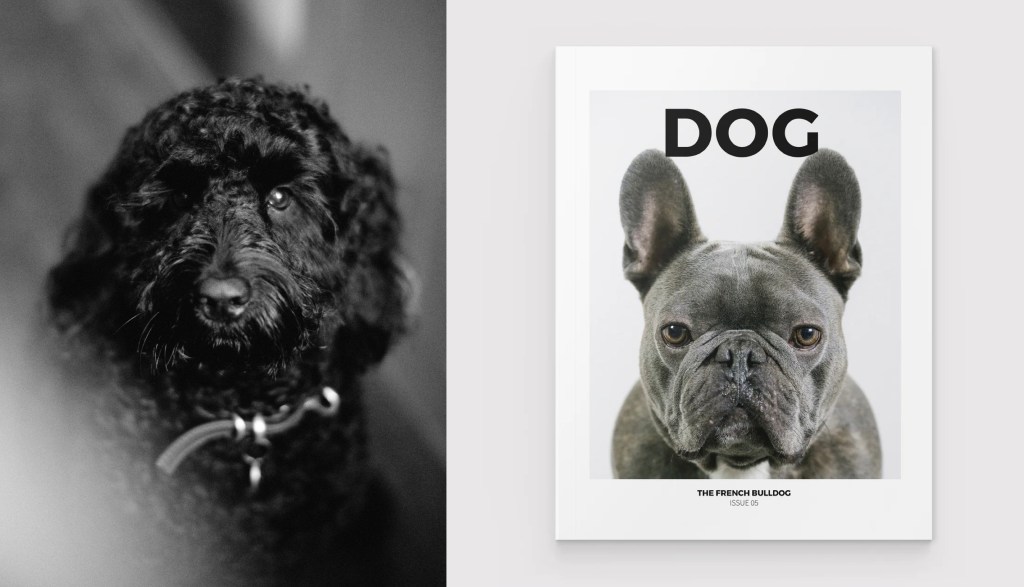
Belvoir have announced a new production of Simon Stephen’s blockbuster theatrical hit, The Curious Incident of the Dog in the Night-Time for their 2024 season, which got me thinking about the time I sat down with Stephens to talk about the play. Back in 2018 I visited Stephens’ home in London (where I was living at the time) to discuss the return season of the National Theatre’s production of Curious Incident for DOG Magazine issue 5.
It was a great chat about the nature of theatre and playwrighting in general. Both he and his wife Polly were charming and warm (as was their gorgeous dog, more on him later). Seeing as the magazine is no longer in print, and the interview was never published online, I’ve received permission from Julian Victoria, editor of DOG, to republish the text and images here.
Simon Stephens’ home office is in a state of disarray. Boxes of books, recently brought out of storage, litter the floor beneath bookshelves waiting to be filled. The shelves are a deep blue, the desk a dark stained wood, with carefully selected lighting waiting to illuminate the words. The inside of the door is painted with a matching bookshelf mural. In time this will become a masculine writer’s cave, but for now it looks like a half-formed thing.
“I know there are some writers who can only work in zen-like conditions, but look at this house. Chaos and mess has an energy to it that I’ve always found really galvanising,” the playwright says with an impish grin. His wife, Polly, nods at the walls and says, “Mark Haddon built all this.”
She’s referring, of course, to the novelist whose book, The Curious Incident of the Dog in the Night-Time, was adapted into a stage play by Stephens in 2012. And that’s what we’re here to discuss. The play has had a trajectory usually reserved for large-scale musicals. An initial run at the National Theatre’s smallest space, the Cottesloe theatre (since rebuilt and renamed The Dorfman) sold out quickly, driven by the public’s love of Haddon’s novel. On deciding to move the show to London’s larger West End theatres, the production team restyled it into the show we know today – a brilliant synthesis of unexpected lighting, projections, physical movement and set design. Since then, Curious Incident has been on a non-stop tour around the UK, Europe, America, China and Australia, and broadcast into cinemas around the world. Six years on, and it’s now returning to London. This kind of run-on success is almost unheard of for a single theatre production.
“We pray to Mark Haddon every day in our family,” says Simon with a laugh, but it’s hard to tell if he’s really joking.
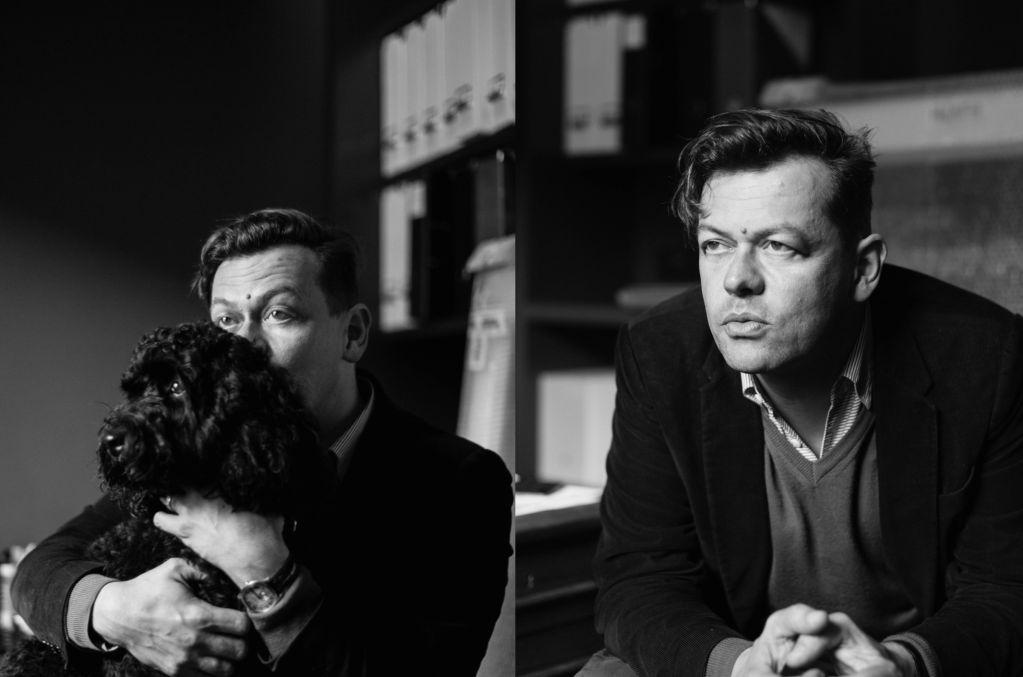
Stephens’ professional career has spanned 20 years and more than 30 plays, many of which are dark and violent pieces. But it is this one play about a boy, a dog and his father that has become a constant presence in his life.
“I think the thing about plays is that if they have a life, that life is innately collaborative. When I watch Curious Incident, I watch it with a great pride. I do have moments when I go, ‘This is good’, but it’s never because of the words, it’s the collaboration. I think the director Marianne Elliott is one of our great theatre artists. The casts, and we’ve had many casts now, have always astonished me with their level of commitment. The lighting design, the video design, the sound design, the music, the movement – all of those elements just combine together. I think that this is one of the most beautiful collaborations I’ve been involved in.
“The biggest test for me was that this is such an English story. Mark rooted the novel so heavily in Swindon and” (here, Stephens raises his voice like a train conductor), “Willesden Green! Willesden Junction! I was nervous that it wouldn’t translate to other countries… I wonder if there are people in Beijing or Melbourne asking themselves ‘Ooh I wonder what exotic Swindon is like?’” and that infectious laugh comes back.
Two things strike you about Simon Stephens. The first is that he laughs freely and easily. It’s a loud laugh, warm and hearty in the best traditions of Northern England (he was born in Stockport, Manchester). The second is that he’s spent a lot of time thinking long and hard about the theatre. When a question grabs him, he pulls himself forward, almost into the classic ‘thinker’ pose, and works the thoughts around his head. He pulls on a tuft of his unruly mane of hair before speaking.
“Someone said this at the workshop this morning [Stephens came from running a workshop at the National Theatre] ‘Most animals learn from experience but we can learn from the tales we tell each other.’ I think that storytellers are a fundamental part of refining the stories we tell ourselves about our world. “There are some things I would never go to the theatre for – you go to journalism for factual interrogation of developments in the news. They can act faster and more rigorously than any playwright ever could. But what a playwright can do is tap into the really deep stories that underpin all those things.”
Can a play change the world, I ask, or does it reflect the world back to us so we can examine it, or is this all just middle-class catharsis?
“The point was made to me that in this country, playwrights tell the stories the TV writers watch and then it percolates into TV drama, which then percolates into soap opera. But in order to crystallise that, you first need to tell more radical stories, and the form that does that best is theatre.
“For example, I’ve read the suggestion that in Britain our recalibration of gay rights in the ‘80s began with the stories we told. I remember my parents were really freaked out by the idea of gay people in the ‘80s, and it took stories to change that. You could say Jonathan Harvey’s Beautiful Thing instigated a cultural revolution that culminated in a Tory Prime Minister introducing gay marriage in the UK, in the space of a generation. It’s simplistic to attribute this entirely to drama, but that’s change! And it is change brought about by reimagining the stories we tell.”
“We live in a culture where anything other than immediacy is frustrating. Maybe the slowness of theatre can be one of its most valuable elements. I started writing Curious Incident in 2009/10 and it wasn’t until 2012 that it was produced. That’s two-and- a-half years of waiting. I think to write a play about the latest developments in the Brexit negotiations would be awful. We need a bit of space. What theatre can give us is metaphor. You can only be really visionary if you allow yourself to breathe. You’ve got to look for the deep layers.”
And looking for deep layers takes time, time which Stephens as a full-time playwright now has.
He explains, “When people think about writing they think about the articulation; the sitting down and writing a scene. But the other bit, the bit where you’re reading widely, you’re listening to music, you’re interviewing experts, you’re making notes and going for walks – that’s really important. There’ll be days I’ll have a lengthy lunch at Blacks [the dog-friendly members club in Soho], then go to see an art exhibition at the RA or the Tate Modern and meet some friends. I usually do the school run. Or I can sit down and write from 9am to 10pm.”

Growing up, Stephens’ cultural diet was primarily one of films (he’s an early fan of Martin Scorsese and David Lynch) and music, with the occasional family trip to see a big touring theatre show around Christmas. “There was an association with theatre being urban because we’d go into Manchester, and they were transgressive because we’d be going out on a school night.”
Now he finds himself transitioning between being the young writer on the scene, to working with the next generation of writers – a call-back to his training as a teacher.
“I feel really inspired by younger playwrights. It’s one of the great joys of our art form in that neither age nor youth are hierarchical. In rock and roll it tends to be youth that’s hierarchical. In other art forms age is more valued. I love that we stand on each other’s shoulders. Some of the most important creative relationships of my life have been with artists who are 20 years younger than me. The things I’ve learnt from Alice Birch or Alistair McDowall are really substantial. The joy of doing the [Royal Court] podcast series is talking to those people at length about their working life and form. I’m as likely to cry from something Alice or Alistair have said to me, as I am from something that Peter Gill or David Hare or Howard Davis might say.”
While the thought of taking over a theatre has little appeal to him (“When I think about the actuality, you’re managing the back of house water supply, making sure the ushers are paid fairly and that the lifts are working. I think I’d find that more draining than inspiring.”) he does enjoy the idea of playing in other mediums.
“I’d quite like to write a bit of telly, and there are a couple of filmmakers I have affection for and enjoy the idea of collaborating with. I’m enjoying making music. I made a bit of music with Underworld – we did a show together called Fatherland. In the next five years, if I make some music or make a film that’ll be great, but my heart will always be in the theatre. It will always be the form I return to.”
While Stephens’ mannerisms are one of a thoroughly engrossing university lecturer, the way he describes his career is more blue-collar in nature.
“One of my obsessions is the spelling of the word ‘playwright’. I talk about the complicated presence of the ‘ght’ in that word all the time, which confused me for years. It doesn’t make any sense until you realise that the verb from which it stems isn’t the verb ‘to write’, like writers do, it is to ‘wright’ like a wheelwright has wrought a wheel, or a shipwright has wrought a ship. So a playwright has wrought a play – we’re shapers, we’re makers. We’re not writers, we’re not people of letters – we make drama, we shape and craft it. It’s more like woodwork. ‘Wrights’ make things out of wood. If plays were made of iron we’d be ‘smiths’ – playsmiths. Like wordsmiths. Words are made of iron, plays are made of wood.”
He continues, “It was at university that I discovered theatre as an art form. Like a lot of people’s introduction to theatre, it was fundamentally libidinous. All of the most attractive girls at York University wanted to be actresses. So in a pathetic, misguided and ultimately entirely fruitless attempt to meet these incredibly exotic girls, I’d go to watch these dreadful student productions. And though the girls never spoke to me and the plays were terrible, I fell in love with the room. Having loved live gigs, and the potential to tell a story like Scorsese, the idea of combining the energy of the two… fundamentally that’s all I’ve tried to do for 30 years since.”
Somehow, between writing plays, working with younger playwrights, recording a podcast series for the Royal Court and being an Artistic Associate at the Lyric Hammersmith, Stephens also has time to be a father to three children, two cats and a Cockapoo with the double-barrelled name, Gilbert & George.
“The original idea was to replace each child with a dog when they left home, and then call the dog the name of the child. But we got him early and named him after the artists Gilbert & George.
“I think I only really discovered the reason we got him after we got him. It’s the extraordinary spiritual energy of having something in the house that just loves us all unequivocally. To be really loved is special. Also, for my younger son, it’s hard to be a boy who can express love and vulnerability and need, but he can do it with a dog. He just holds the dog and can just say that he loves this thing and that’s really useful for a 17-year-old boy to be able to do. Gilbert & George has bonded us; this completely shared love we have for this little dog is just really beautiful.”
Is he ready for the idea that his other, more ‘Curious’ dog, looks set to be part of his life for a lot longer as well?
“Maybe? There’re calls for it to go to South Africa or back to Australia. I love it. I love that it’s been a gateway to the theatre, in the same way that the book was a gateway – for many people it was their first serious novel. If we can capture any of that sense of empowerment the novel gives people over an art form they may not feel they have been empowered to engage with, then I think that’s a real honour. It feels like a genuine privilege.
“The most recent incarnation, before the revival in the West End, has been an edited version we made to tour classrooms and assembly halls. It’s in the round like it was back at the National Theatre. It demonstrates the versatility of Marianne Elliot’s imagination, I think. Watching that was revelatory. The energy and the vitality of kids, kids who weren’t used to going to the theatre, watching that play in their classroom, was just astonishing. It’s a show that continues to inspire me.
“We’re living in a complicated political moment in Australia, the US, the UK, all of Europe and South America… Looking at Curious Incident now, I think there’s something special about an artistic experience that makes people think, ‘Maybe humans are alright.’ When I watch it, that’s what I see: the amazing potential of the human animal to be brave and kind. And that feels politically radical to me in a way that it didn’t in 2012. That maybe humans are quite good, actually.”
 Cultural Binge
Leave a comment