Written by Mike Bartlett. Australian Premiere. The Old Fitz Theatre. 6-22 Dec, 2024.
The modern politics of Brexit and the generational divide are window dressing in Mike Bartlett’s family drama Snowflake. The real draw here is an intelligent, thoughtful script that looks beyond the reactionary, and three absolutely perfect performances.
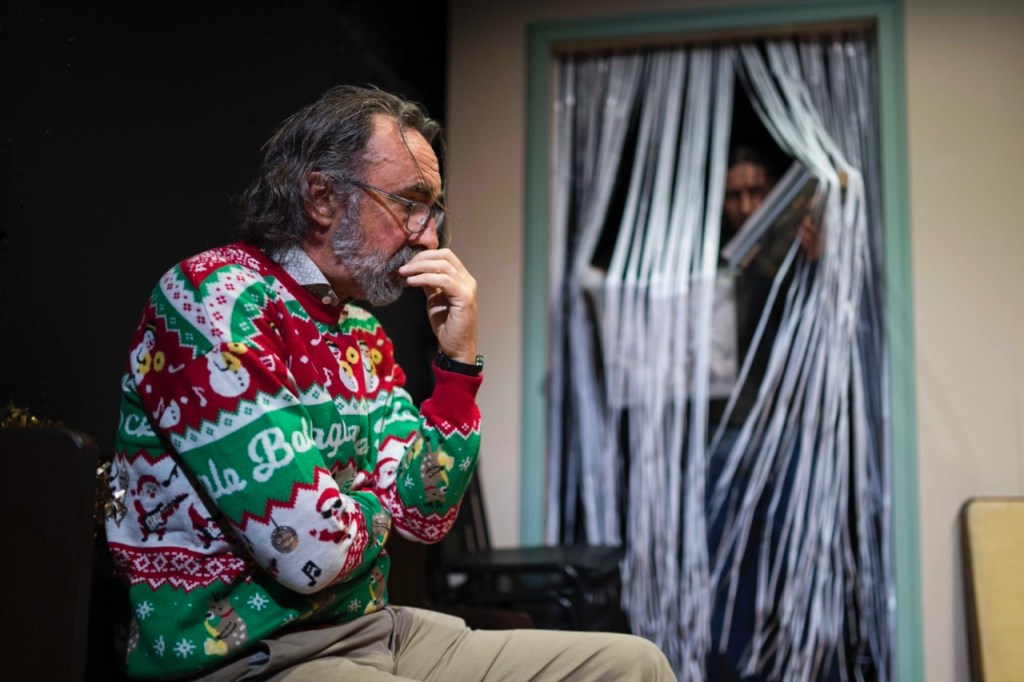
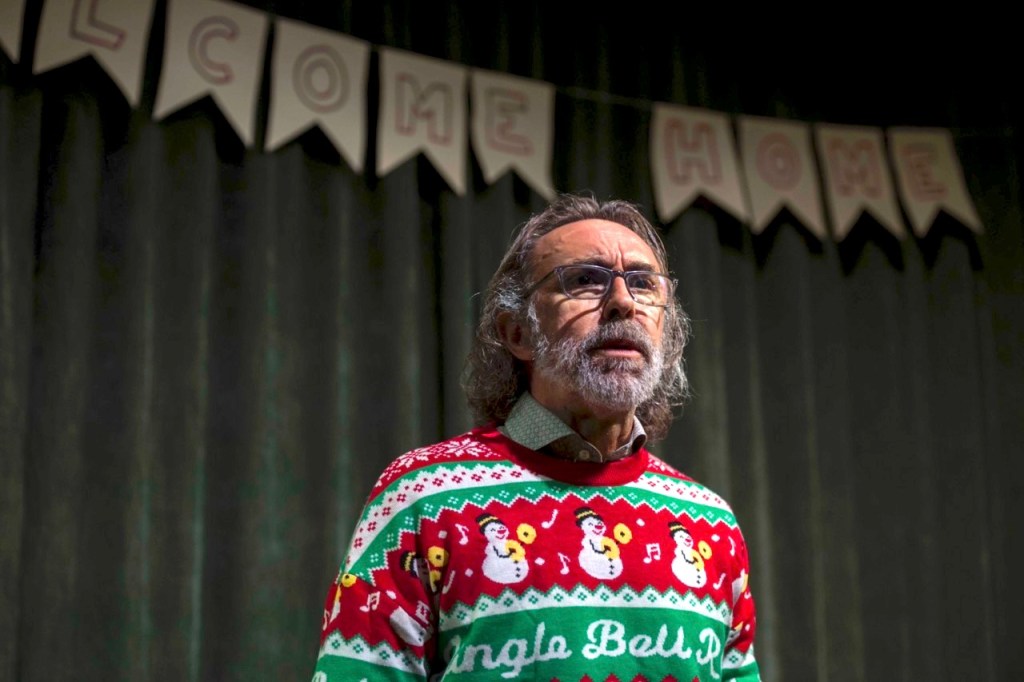
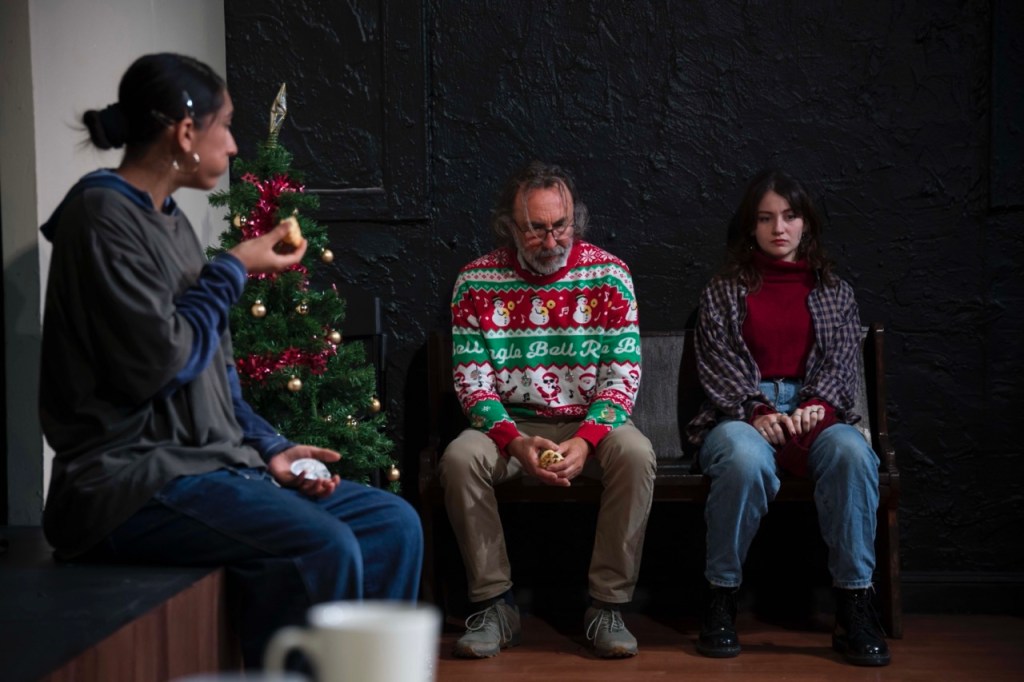
It’s Christmas Eve 2019, and Andy (James Lugton) is nervously setting up a community hall to welcome home his daughter, whom he hasn’t seen in three years. She left home abruptly and cut off all contact, but he’s hoping against hope that she will turn up. When a young woman, Natalie (Lilian Alejandra Valverde), appears needing to get into the hall’s kitchen to borrow plates for her own family Christmas meal, Natalie is instantly intrigued by Andy’s situation and starts to dig for more details. As they talk, Andy starts to realise that his own past actions may not have been as benign as he thought.
When Snowflake was staged in London in 2019 (after its premiere in 2018) some critics felt it was too blunt and too soon to really dissect the complexities of the 2016 Brexit vote to leave the EU. Even after three years, the wounds were still fresh, and the sense of betrayal felt by many younger Britons was still raw. Now, in 2024 and half a world away from the specifics of the event, it’s clear to see that for Bartlett, the real truth doesn’t lie in the vote itself but in the lack of communication between generations. Brexit was the symptom, but not the cause, of the drama.
Where Bartlett succeeds, and what no doubt infuriated people at the time, is in eloquently discussing the world view of both the middle-aged Andy and his daughter Maya (Claudia Elbourne), and showing how they sit in conflict with one another, without really choosing a side. In fact, I guarantee different people will walk away with different ideas of who is right and wrong (and it will probably break along generational lines).
This isn’t a play about arguments or point-scoring; it’s about our own human emotional needs and our blind spots. When Maya is trying to tell Andy how she feels, he constantly interjects to console her. He sees this as the kindness of a loving father; she sees it as an overbearing patriarch who won’t let her speak. Andy doesn’t understand that Maya isn’t looking for answers to questions; she’s looking for support and to be treated as an equal. Meanwhile, Maya is too wrapped up in her own emotions to see things from Andy’s perspective.
Sydney stages are already awash with some great plays to end the year, giving us a smorgasbord of great performances, and this cast easily joins that list. James Lugton is the heart and soul of the show as Andy, delivering a first act that consists of a single monologue with finesse. His confusion and frustration are palpable and relatable, as is his good-natured desire to understand. Andy is no two-dimensional “Boomer” (more of a Gen X’er, actually), but simply a middle-aged father who is trying his best.

In contrast, Lilian Alejandra Valverde’s youthful energy and refusal to politely accept social cues are both aggravating and delightful at the same time. Natalie’s gentle manoeuvring and desire to listen and reflect back are a mix of condescending and caring. Claudia Elbourne’s Maya is full of wounded pain carefully held in check. Her performance is the most withheld and the most layered.
All three are perfect. As are their accents, thank God. We’ve suffered through too many OTT, on-the-nose accents this year, but this trio are so naturalistic you simply forget we’re in a pub basement in King’s Cross. Soham Apte’s set design keeps things hidden before a final reveal, and its bland simplicity evokes the sadness of Andy and Maya’s situation. Jo Bradley’s direction keeps things grounded, focused on the performances, and the show is all the better for it.
Bartlett is one of my favourite playwrights of the past decade (he’s part of a crop of contemporary British writers like Simon Stephens, James Graham, Ella Hickson etc whose work I really connect with), and Snowflake is tonally a sequel to his 2017 hit Albion, which explored British pride and nationalism in the wake of Brexit. Snowflake is less grand in scope, and is in many ways closer to his 2009 breakthrough play, Cock, in dealing with the emotional fallout of one person’s choice.

Everyone will read their own politics into Snowflake, and Bartlett has, either cleverly or cowardly, left those questions open-ended while gleefully poking at both sides. Snowflake isn’t really about picking a winner from the Brexit debate (or Trump, or the climate crisis, or immigration, etc); it’s about finding a way to co-exist with love and respect. It’s about meeting people where they are, not where you want them to be. It’s about learning to shut the fuck up and actually listen to people, instead of being self-centred and self-righteous in our own beliefs.

 Cultural Binge
Leave a comment