
Written by Patricia Cornelius. Malthouse, Melbourne. 13 Feb – 8 Mar, 2025.
Patricia Cornelius’ exploration of the power of whistleblowers and the intrusion of state power in Truth is powerful and portentous but ultimately so one-sided that it risks being dismissed as propaganda. With little new to say about the state of digital surveillance in which we live, it proves to be entertaining and lively. However, you can’t escape the fact that this is a simple hagiography through and through. We’re not here to debate Assange but to venerate him.
Five performers take to the dark, encaged stage to play the hacktivist hero (or traitor) Julian Assange. From his youthful days in Melbourne’s early computer scene to his eventual imprisonment and controversial plea deal, we move through Assange’s life, with extended stops along the way, in a recitative form—five voices speaking as one, finishing each other’s sentences.

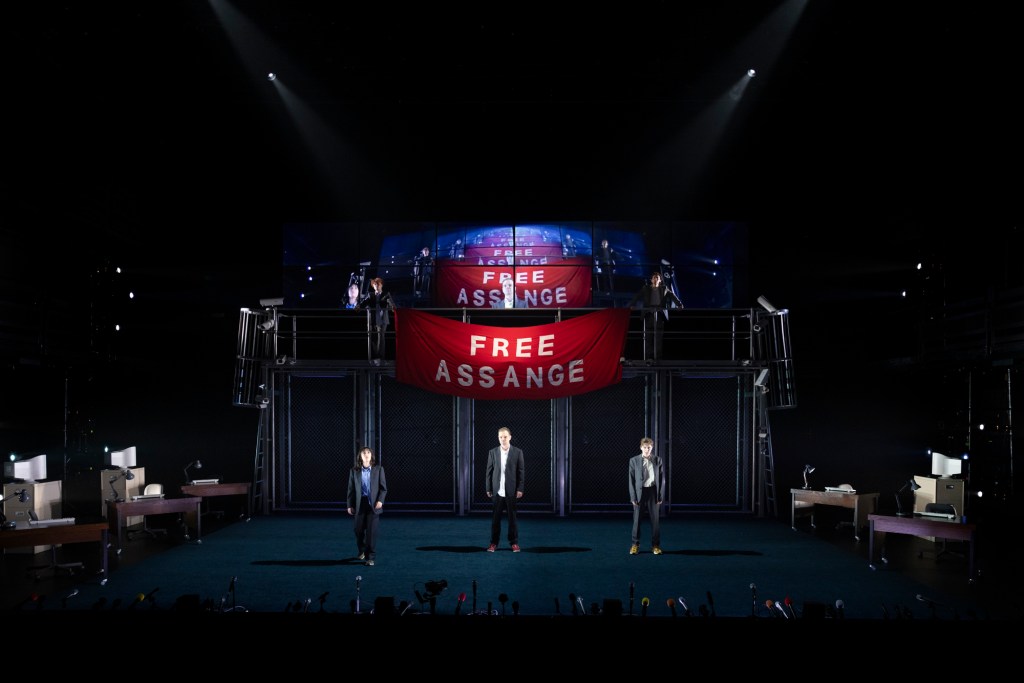
The first thing that strikes you is the ominous set design by Matilda Woodroofe. An imposing metal gantry and wire fencing dominate the rear of the stage, above which hangs a screen displaying bold text. The edges of the stage are littered with microphones and cameras. The only other staging consists of five desks with old-fashioned computer monitors and keyboards. The cast dashes around and through this set with the clandestine fervour of a spy drama or revolutionary guerrilla war.
As a five-strong chorus, Emily Havea, Tomas Kantor, James O’Connell, Eva Rees, and Eva Seymour have very little in common other than the ill-fitting suits they wear. Notably, none have Assange’s recognisable shock of white hair. Their varying heights, ages, and appearances suggest that this version of Assange is the “everyman”—the activist in all of us. As the play progresses, each slips into secondary roles that suit their particular moulds (Edward Snowden, Chelsea Manning, etc.).

And it’s thrilling to watch. Director Susie Dee, a long-time collaborator with Cornelius, animates this wall of text with furious, but never needless, action. Cornelius’ text has a rhythm that the ensemble slips in and out of, giving it a natural flow. Yes, it’s a lecture, but it’s never a dull one.
The events around Wikileaks have been dramatised numerous times in film already, and while Truth anchors itself on Assange’s biography, it is more interested in the broader way the public is kept ignorant and reality is hidden from us all. A replay of violent drone footage, showing the US military killing and injuring civilians, hits hard—a reminder that this isn’t an abstract examination of concepts, but a literal life-and-death issue.

However, it’s in the tension between discussing Assange himself (including the allegations of rape) and the broader examination of deception and informed democracy that things get fuzzy. What is “truth” anyway? Is it facts without context, and who dictates that context? All storytelling is an act of manipulating attention, so can a play speak of “truth” while manipulating the audience to achieve its desired ending?
Sadly, for Assange and for the play, the idealistic notion that revealing information to the public can make the world better has proven to be shockingly false. Truth never grapples with the age of mass disinformation and “flood the zone with shit” politics. Nor does it tackle the erosion of faith in institutions, which has led to the fracturing of modern politics, the rise of conspiracy thinking (from Wikileaks to QAnon isn’t much of a leap), and the structural nihilism that is breaking down society.
With its laser focus on Assange, Truth lets bigger and more contemporary issues pass by without deeper examination, and that is perhaps my biggest frustration with the play. While it is undoubtedly an interesting and engaging piece of theatre, it strangely feels like a timely revival of an old play, rather than a new work for 2025. Assange is a fascinating figure in our history, and his work revealing the hypocrisy of the modern West is rightly to be applauded. However, its legacy is more complicated than Truth lets on.
 Cultural Binge
Leave a comment