
Conversations with Mother ★★½ / Grangeville ★★★★ / Curse of the Starving Class ★★½
Returning to New York for the second time in six months (a quirk of my work schedule more than anything else) meant that many of the shows I’d already seen were still up and running. That gave me a chance to head Off-Broadway more than I usually would, and to see more plays than musicals. The results were definitely hit and miss.
The level of Off-Broadway work felt very familiar to what we have at home, and after a few plays I started to find myself itching for the scale of Broadway shows. I initially had tickets to a fourth Off-Broadway play, which I sold (on the Theatr app – a great little resale app) in favour of seeing a Broadway show that was getting very mixed reviews.
Of the three Off-Broadway plays I saw, there was a real mix of quality and a range of very famous names. It certainly was interesting…

Conversations with Mother ★★½
Written by Matthew Lombardo. Theatre 555
I’ll be honest, the reason I saw this play was timing. Very few shows have Thursday matinees, and it was either this or seeing The Great Gatsby again with new leads. While I definitely enjoyed Gatsby the first time, I thought I should embrace something new instead – plus this starred Tony Award-winner Matt Doyle (he won for playing Jamie in the gender-switched Company) and Caroline Aaron.
It’s the story of a gay man and his relationship with his mother over several decades, taking him from childhood to old age in a series of scenes. While it was certainly sweet and occasionally funny (not as funny as it thought it was), it didn’t really do much to justify its own existence on stage. This felt like the kind of show you’d take your mother – or your grandmother – to. A safe, low-budget play that could be staged at a community theatre, rather than the level of writing you’d expect Off-Broadway; more like Off-off-Broadway. The saving grace was Caroline Aaron’s clear sitcom timing and Matt Doyle’s innate charm.

Grangeville ★★★★
Written by Samuel D. Hunter. Signature Theatre.
Samuel D. Hunter is one of the current crop of acclaimed playwrights, with big hits like The Whale (which became the Oscar-winning film) and A Case for the Existence of God (produced by Outhouse Theatre Co at the Seymour Centre last year). Grangeville, his new play, starred Brian J. Smith (best known for his TV work in Sense8, Stargate: Universe and Treadstone, and his Tony-nominated role in The Glass Menagerie in 2014) and Paul Sparks (also best known for TV – Boardwalk Empire, House of Cards et al) as two estranged brothers trying to reconnect after the death of their mother.
Over the years, the younger brother Arnold (Smith) has moved to Europe with his boyfriend and pursued an art career without ever looking back, while Jerry (Sparks) stayed at home, caring for their mother as she grew ill.
It’s a tight, tough little two-hander that keeps the brothers apart. Though they’re physically on stage together, they communicate through phone calls and video chats for most of the play. It’s an interesting choice, though I’m not sure it does the show many favours. But both performances were excellent, and the script was funny and moving.
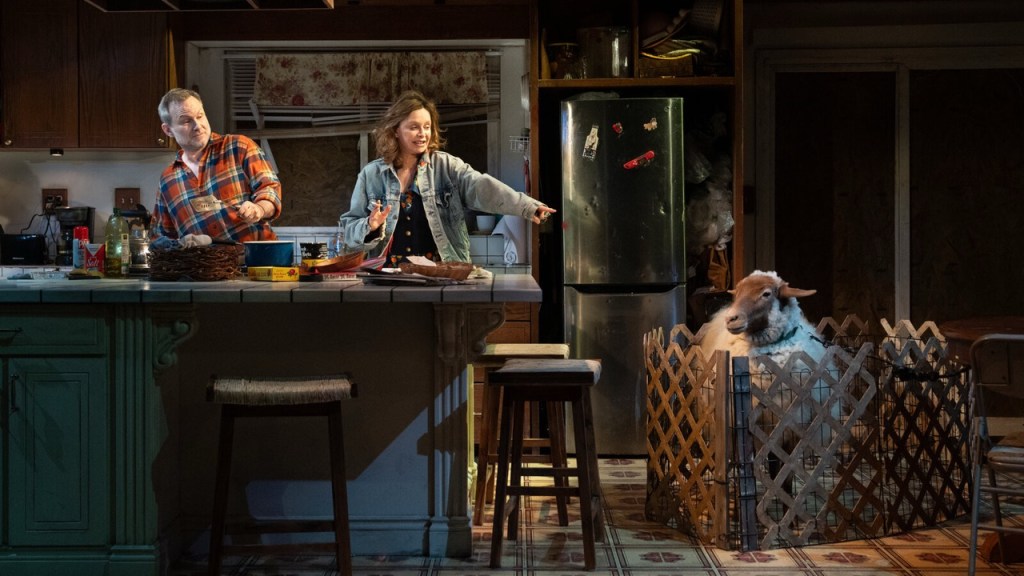
Curse of the Starving Class ★★½
Written by Sam Shepard. The New Group
The decision to see Curse of the Starving Class was threefold: it’s a Sam Shepard play I hadn’t seen before; it starred Christian Slater and Calista Flockhart; and, as a mini-bonus, it also featured Cooper Hoffman – son of the late, great Philip Seymour Hoffman.
Sadly, it wasn’t a very good production. A combination of well-meaning but questionable casting decisions and static staging meant it felt much longer than its 2hr 45min run time. Shepard’s writing remains razor-sharp, and this is one of his most autobiographical works, so there was a lot to take in – but ultimately, it fell flat.
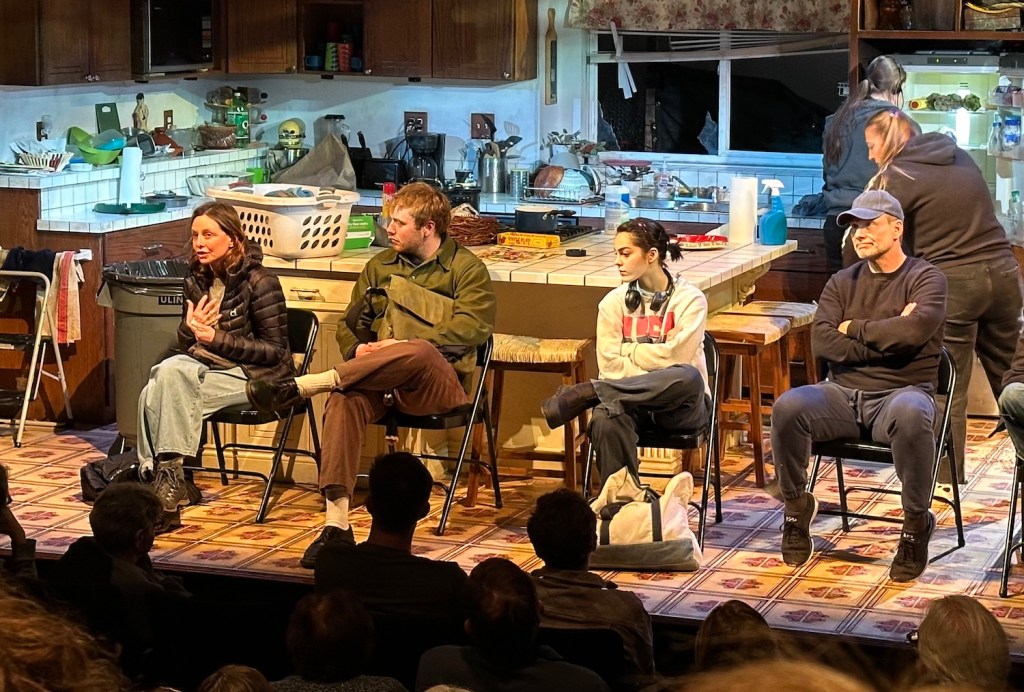
I stuck around after the performance for a cast Q&A, which only reinforced how much personal magnetism both Slater and Flockhart possess. Even though they were clearly exhausted, they still put on a good show for the audience.
 Cultural Binge
Leave a comment