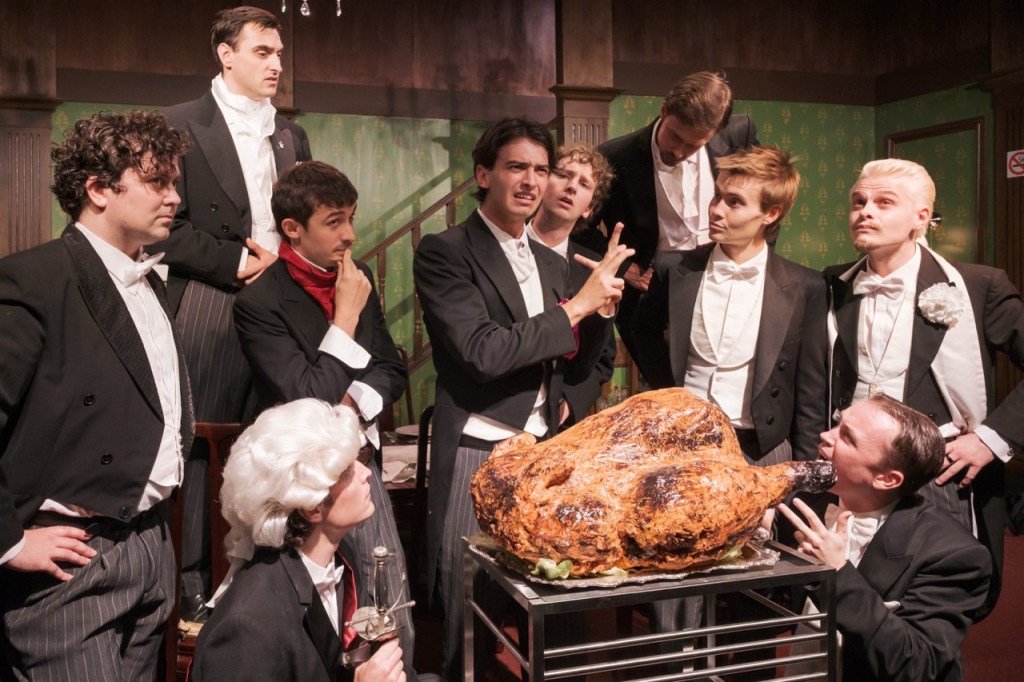
Written by Laura Wade. Australian Premiere. Queen Hades Productions. Old Fitz Theatre. 19 Apr – 17 May, 2025.
Laura Wade’s incendiary class-war drama, Posh, is fifteen years old and only just getting its Australian premiere (what? seriously?). Somehow, it’s gained extra resonance over the years as the divide between the rich and the middle class has grown wider. No longer just a look at the likes of Oxford’s infamous Bullingdon Club and a generation of young Conservatives who would go on to rule Britain, it now carries shades of contemporary right-wing backlash and the paranoia of the embattled uber-rich.
Ten Oxford students gather for the first dinner of the secretive “Riot Club” to be held in some time. When one of their number drunkenly revealed the existence of the club to a non-member—and whose antics became fodder for the press—the age-old institution went to ground. But now, months after the offence, they are finally reconvening, and hopes are high. Can the current Riot Club live up to the debaucherous heights of its alumni?

Guy (Roman Dalo) wants to make a name for himself and become the next President of the Club, but he’s up against his friend, Dimitri (Anthony Yangoyan). Toby (Dylan O’Connor) must make penance for outing the Club. Outgoing president James (Ryan Hodson) is trying to walk the line between fun and responsibility, while others consider the Club part of their family heritage. But as the night wears on and more wine is consumed, the privilege and presumption of these young men—and the spirit of old Lord Ryott (Charles Mayer), in whose name the Club was created—push them too far.
You see, the strata of class never really went away; they just went into hiding.

Wade has painted each member of the Club with a different shade of wealth. The simplistic George (Tristan Black) lives in a Downton-esque fantasy where his family and the farmers who work alongside them are all friends (but he’s always the one who buys the drinks). Gay Hugo (Jack Richardson) is studious and camp, not built for life outside the hallowed halls of aristocracy. Gluttonous Harry (AJ Evans) is a foolish child playing at being a big man. But they all speak a common language of grievance and entitlement.
Sick of opening their stately homes to the National Trust for summer tours and Christmas market stalls (to pay for the leaky roofs), frustrated by the erosion of their unearned wealth, and furious at the presumption that they are expected to behave just like everyone else (i.e. the lower classes), this black-tie manosphere whips itself into a frenzy—led by the frighteningly insightful Alastair Ryle (Christian Byers).

Alastair longs for the unrestrained glory days of wealth, before the beige egalitarianism of New Labour swept in. When the group begins to break out into internal squabbles, he pulls everyone back in line by casting the blame outward—onto the common people—like a budding autocrat riling up the masses. It is only Alastair who sees through the gilded veneer of the Riot Club and recognises its flailing “lost boys” for what they are.
This large ensemble (14 actors squeezed onto the Old Fitz stage) are in good form. The production is held together by Christian Byers as Alastair, who never overplays his hand and slowly rises from the ranks to become the most engaging character in the room—a perfectly mannered performance.

Around him, there is a slight imbalance, with some actors (naming no names) feeling like they’ve stepped out of a sketch-comedy routine (it’s the accents, it’s always the accents), while others remain grounded. But overall, it evens out, thanks to Margaret Thanos’ direction. The stage is crowded, but characters are never lost (though sitting in the front row might be an act of bravery, considering the chaos happening right in front of you). Soham Apte’s set makes the confined space feel larger—who knew you could fit a staircase-to-nowhere into the Old Fitz?
The real star for me is Laura Wade’s writing. While it is admittedly a bit of an “eat-the-rich” polemic, it still holds up after 15 years. First staged in 2010, in the wake of the 2008 financial crisis (seriously, Australia—no one calls it the “GFC”, it’s not a fucking fast-food outlet), and later turned into a film (The Riot Club, 2014), it even predated the scandals of Boris Johnson. As Alastair says in the play: “‘Can’t have one rule for them and another rule for you’—why not? Seriously, why the fuck not? We’re the fucking Riot Club. And we’ve hardly started, mate!” That line pretty much sums up the 2020/21 “Partygate” scandal.

Do the rich really, secretly, hate and fear the rest of us? Looking at the machinations of the 1%—building bunkers to survive climate change and refusing to limit their own consumption—it seems plausible. While the 90s and 00s brought a democratisation of many spheres of life, it’s clear that businesses are now reorienting themselves to cater to the wealthy (fashion brands cutting off cheaper diffusion lines, airlines investing more and more in first and business class, etc.).
The beauty of Wade’s script lies in how she saw this bitterness rising even as David Cameron was pushing the image of a “new, compassionate” Conservatism, and Boris Johnson hid his public disdain behind the facade of “the bumbling toff.” She captures the mindset of a generation of young, rich men looking at previous generations and feeling screwed over by the system—which doesn’t sound a million miles away from the current plight of Gen Z men, feeling abandoned and lashing out.

And that’s where I was pleasantly surprised by how well Posh has stood the test of time. For me, it’s less a story of class and more a portrait of young men whose futures are less grand than those of their forebears—how they isolate themselves from society into their own bubbles and stew, with disastrous consequences.
Posh at the Old Fitz is great writing brought to life on stage. It may be a bit cramped in there, but it’s worth it—and I wouldn’t be averse to seeing it play in a larger space sometime.

 Cultural Binge
Leave a comment