Written by Samuel Beckett. Sydney Theatre Company. 5 May – 15 Jun, 2025.
Usually, when a critic says a show is “static”, it’s a criticism—but not in the case of Samuel Beckett’s surreal Happy Days. Here, being “static” is the whole point.
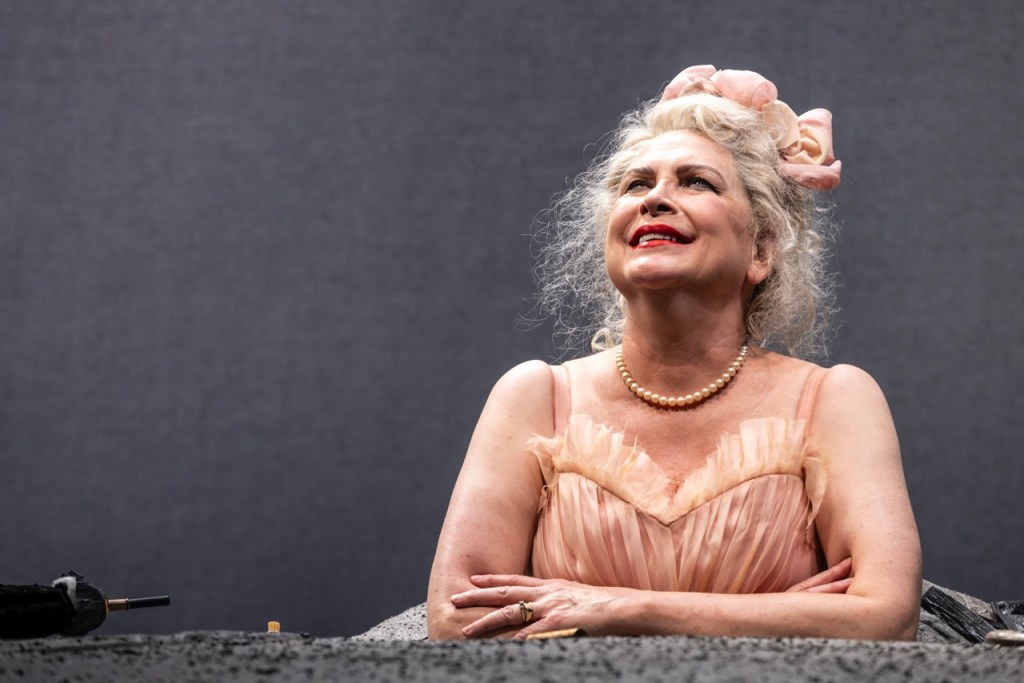
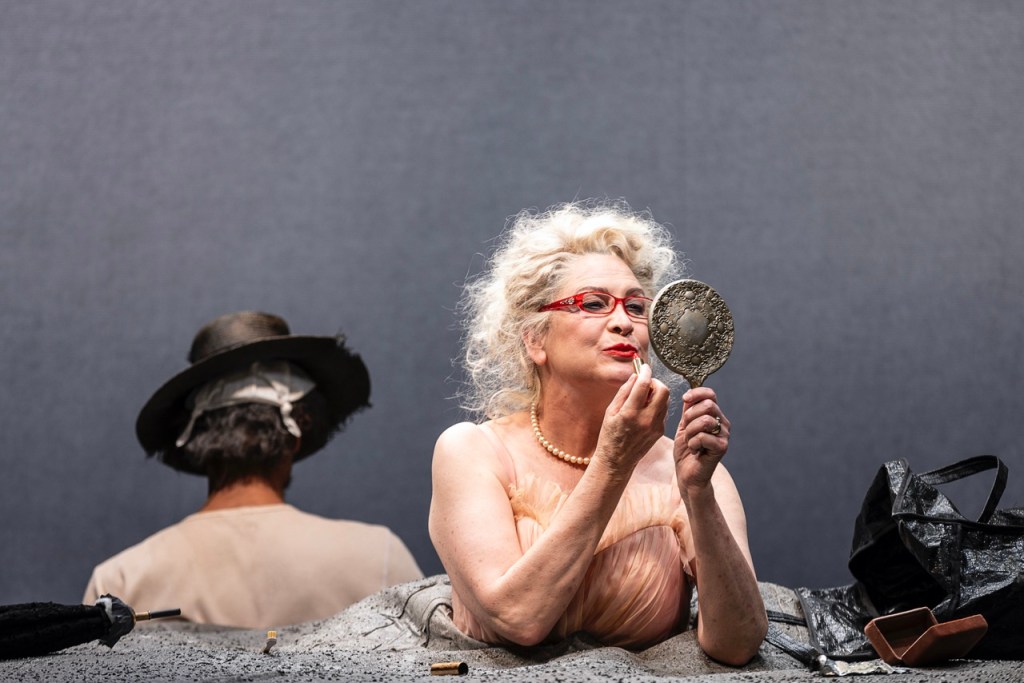
Winnie (Pamela Rabe) wakes up and is ready to tackle the day. In a stream of consciousness, she talks us through her orderly daily routine: brushing her teeth, combing her hair, and timing exactly when to sing her song. She is accompanied by her capacious black bag and a positive attitude. When confronted with the gradual decay of her possessions, or even the decline in her eyesight, she simply sighs and carries on—what else can she do? Her only human companion is her husband, Willie (Markus Hamilton), who potters around occasionally, muttering the odd word or two, like any old married couple. The only difference is… Winnie is encased in solid rock up to her waist.
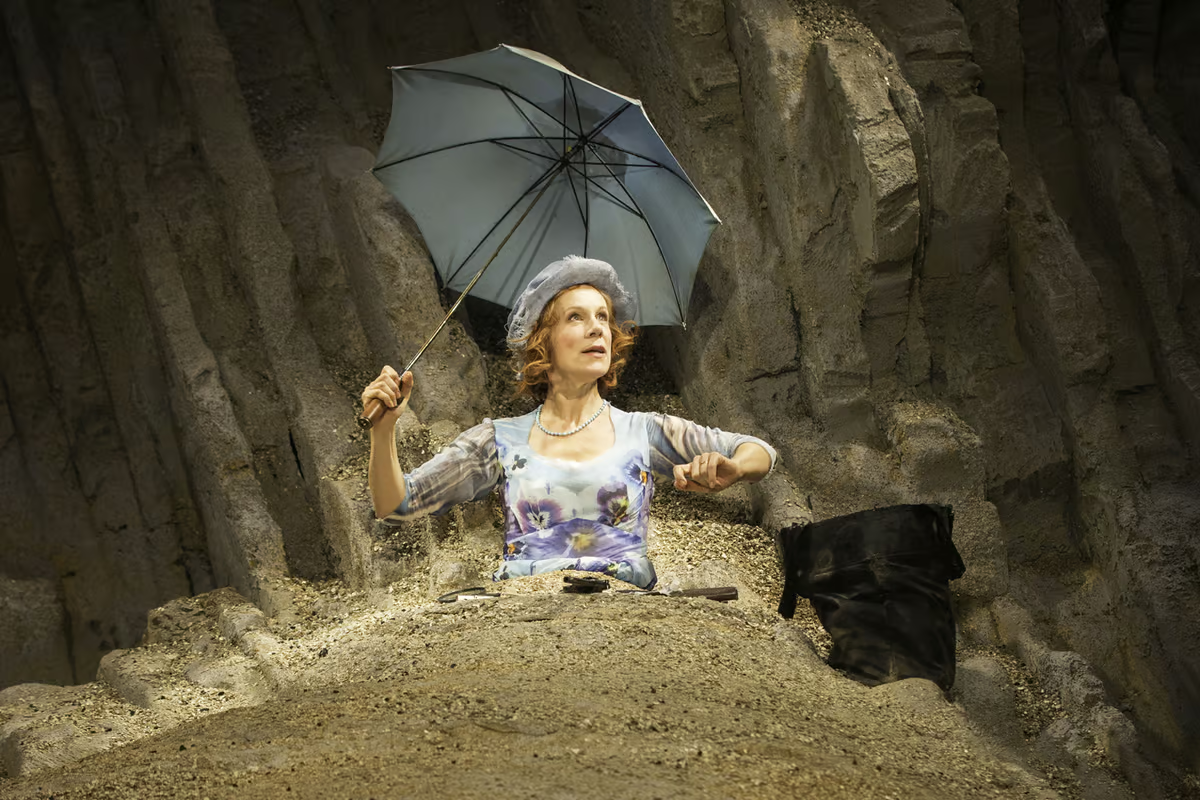
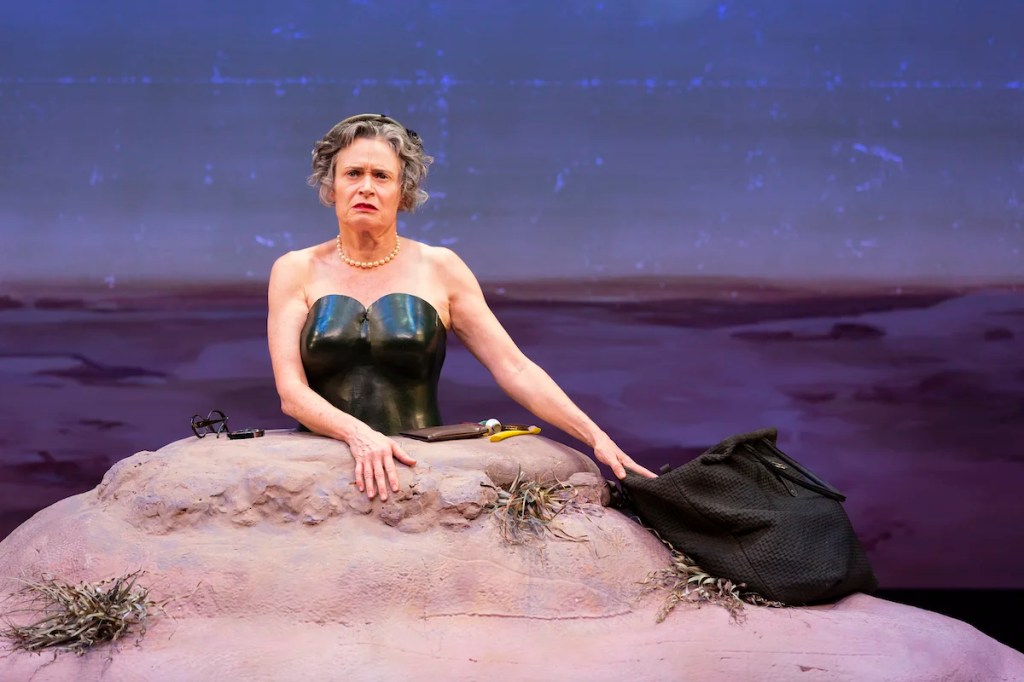
Beckett’s Winnie is a powerhouse of cheerful denial. It takes a performer of intense charisma to hold the audience’s attention for a solid 100 minutes with little more than her voice and facial expressions. But that doesn’t seem to limit the ways in which Winnie can be interpreted and performed. I’ve seen three main stage productions of Happy Days (Juliet Stevenson at London’s Young Vic, Judith Lucy at Melbourne Theatre Company, and now Pamela Rabe), and each has found nuances and elements to make entirely its own.
Pamela Rabe (who co-directs this production alongside Nick Schlieper, who also designed the show) commands this post-climate-apocalyptic mound of slag with sharp shifts in expression. Her Winnie is a combination of self-soothing routines and a bubbling stream of doubt and rage that slowly filters through to her public persona. She is always on edge, but always putting forward a good face and positive spin.
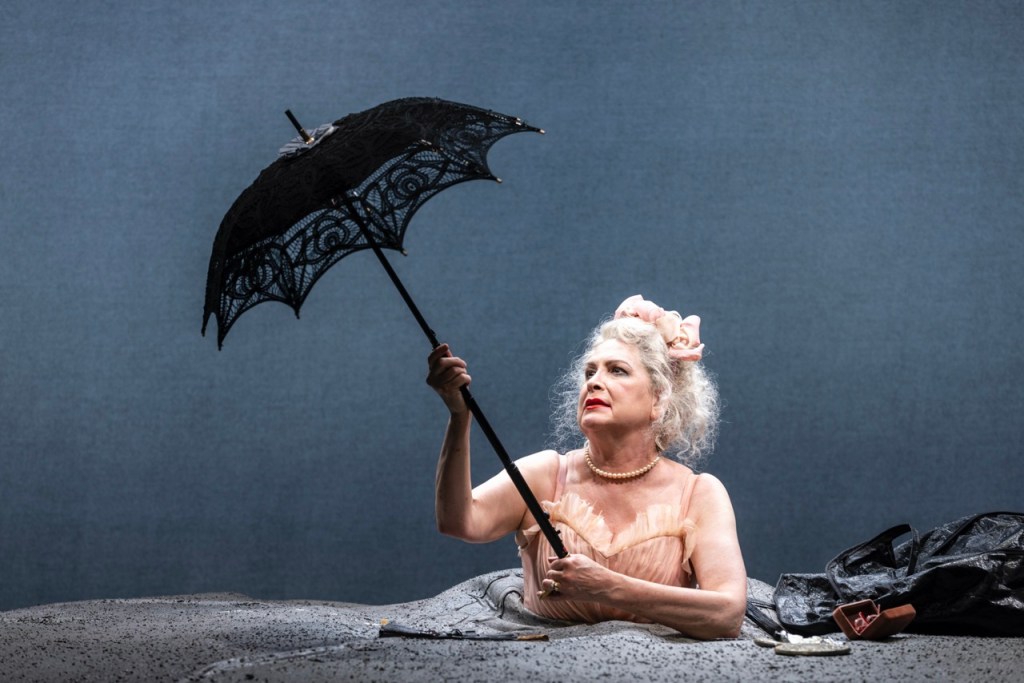
And what do we make of Winnie’s denial in 2025, more than 60 years after the play was written? When I saw the 2023 MTC production, I felt the weight of the climate emergency bearing down, with Winnie—baking in the sun, surrounded by man-made detritus—refusing to act as the arid world swallowed her. That image still lingered in my mind. But this time, I felt more connected to Winnie’s sense of self and how it is bound up with her memories, which are fading along with everything else. Rabe’s Winnie feels anchored (literally) by her past experiences and the routines that have accrued their own meaning. She is primarily trapped in a psychological loop that is slowly killing her.
Yet there is an element of grace here. Faced with an impossible situation, Winnie does not rail against the world. Instead, she finds ways to stay in the moment and discovers small joys to sustain her. Hers is a stoic mindset in a drastic situation.
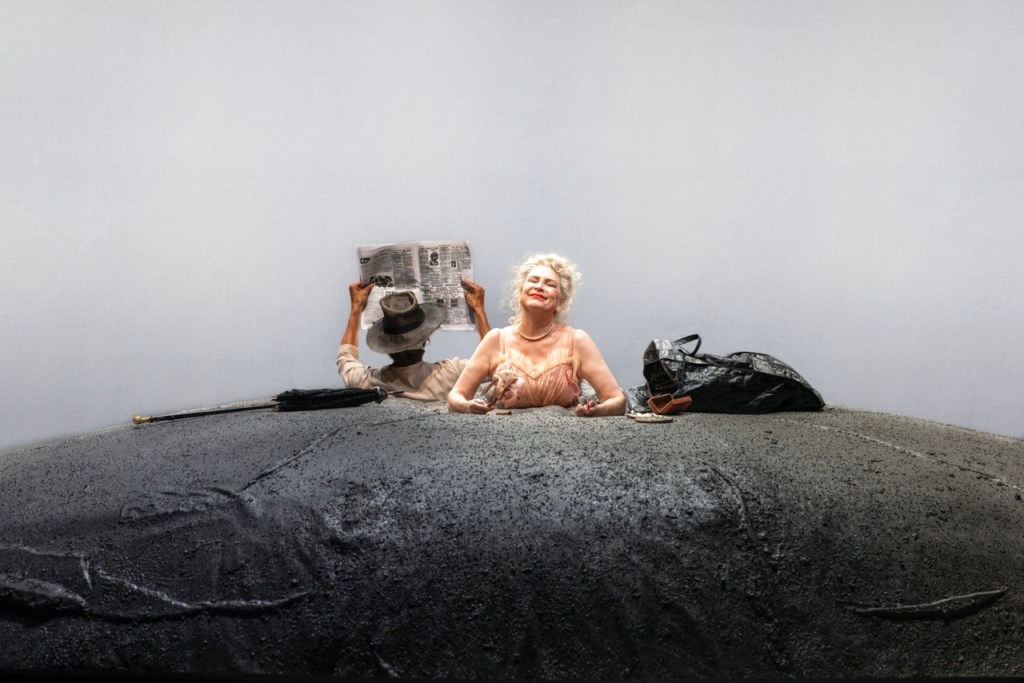
Schlieper’s design is stark. The stage is framed by a letterbox window, through which we see Winnie. Behind her, a single uninterrupted expanse of white. Her rock is a solid mound of bleak, tar-like, congealed lava. It has an organic quality that lends a hint of horror to its mass. The only colours come from Winnie’s faded possessions & clothing (costumes by Mel Page) and the occasional lighting cue. It’s a bold choice for such a sparse and static play, placing all attention on the central performer to bring life to the stage with only her upper body.
I’ve always had a soft spot for Happy Days, which I much prefer to Beckett’s more revered masterpiece, Waiting for Godot. There is no escaping the show’s surrealist nature, your tolerance for which will dictate how much you get from it, but with a performer like Rabe at its core, this production holds strong and its humanity reigns. Central to the character of Winnie is her constant movement, but ultimate inaction. It’s a purely human thing to do. Her bizarre behaviour holds a mirror to our own foolishness. Happy Days is a reminder to address the elephants in the room—before it’s too late.
 Cultural Binge
Leave a comment