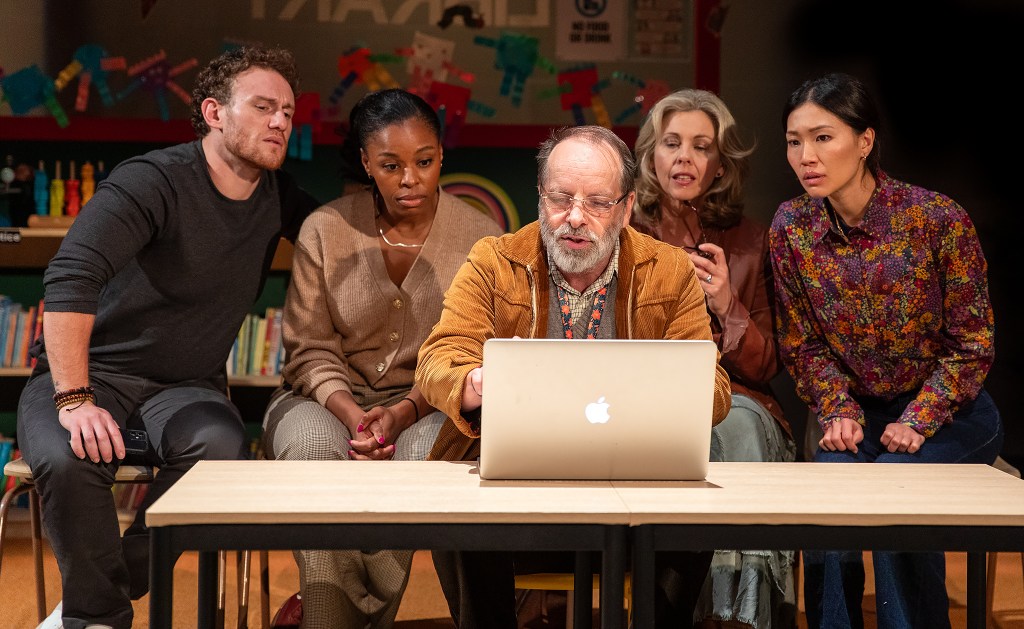
Written by Jonathan Spector. Presented by Seymour Centre and Outhouse Theatre Co. 29 May – 21 Jun, 2025.
Eureka Day is, on the surface, a funny look at the political Left’s delicate balancing act between broad inclusion and reconciling contradictory beliefs. Set in 2018 at a progressive private primary school where kids learn both spelling and social justice, this group of compassionate parents and educators finds themselves stuck in a moral quandary that feels all too familiar. But I must confess, I took away a deeper, simpler truth – parents of school kids are just the ****ing worst.
The parents on the “Eureka Day” school Executive Committee have gathered to welcome a new member, Carina (Branden Christine), and to debate making their admissions form even more inclusive. The committee is chaired by the accommodating Don (Jamie Oxenbould) and includes founding parent Suzanne (Katrina Retallick), stay-at-home dad Eli (Christian Charisiou), and May (Deborah An). Their discussion is a MAGA-head’s nightmare of liberal jargon and identity politics. But the usually open and accepting community takes a darker turn when a mumps outbreak hits the school. The Committee is soon flooded with angry parents on both sides of the vaccination debate, exposing deeper divisions that threaten the school’s future.
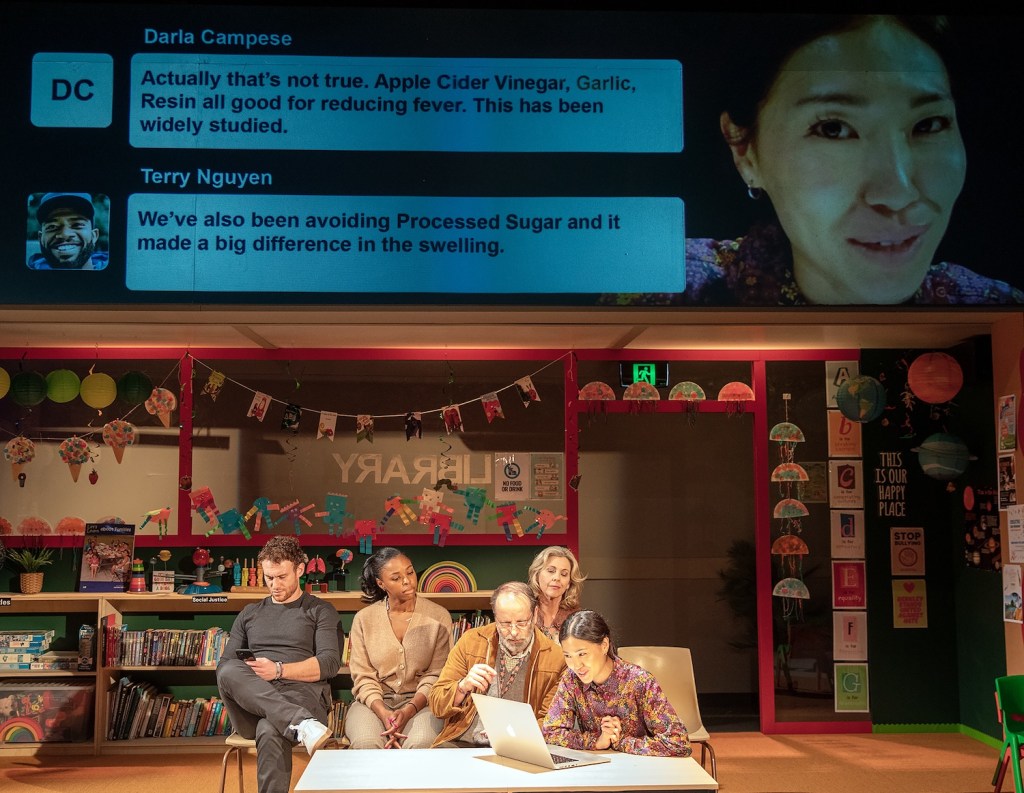
The highlight of Eureka Day is an online forum where the Committee tries to listen to parents’ feedback after temporarily closing the school to quarantine. As Don speaks on video, the parents’ chat is projected above him. What starts as typical tech issues (one parent can’t figure out the live stream, etc.) quickly devolves into a sadly familiar online “flame war” (do we still call them that?) between parents. But theatrically, what seems like chaos reveals itself as a carefully timed ballet of dialogue and projection. The audience splits between the live discussion on stage and the scrolling text above, and the two streams of information dovetail into wonderful comedic moments—like when the live cast is upstaged by a thumbs-up emoji.
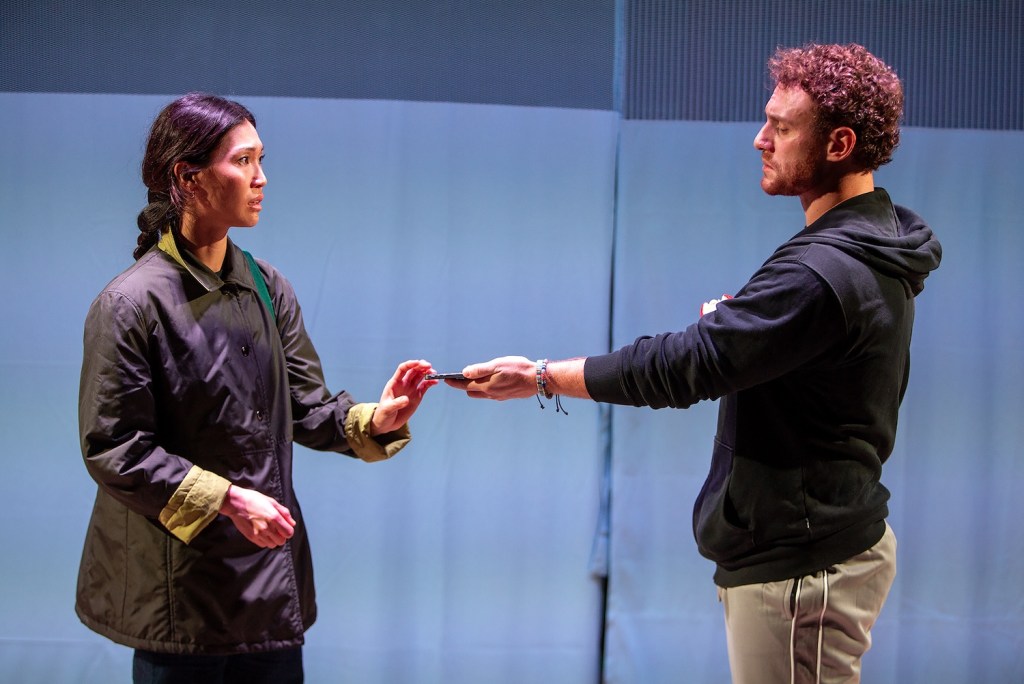
Among the Committee members, opinions on vaccines – and more broadly on liberal ideals clashing with emotional realities – vary widely. How can you foster consensus while including such divergent viewpoints? Suzanne refuses to introduce a vaccination mandate, advocating for families who feel attacked for distrusting medicine. May is cautious and hasn’t vaccinated her own daughter. Eli staggered his son’s vaccinations but believes having them was the responsible thing to do. Carina is shocked parents aren’t following the best science to protect their kids. It’s a spectrum from evidence-based reasoning and faith in institutions to woo-woo denialism and “alternative facts” (remember those?). At the centre, poor befuddled Don tries to create a safe space for all viewpoints to be heard and respected—but it’s a losing battle.
Set and first staged in 2018, the play offers a prescient pre-Covid look at how anti-scientific views and online disinformation have taken root in society. The fact it so clearly predicted what happened a few years later is disturbing. But this saves it from being just a “Covid play”; it’s about something more fundamental.
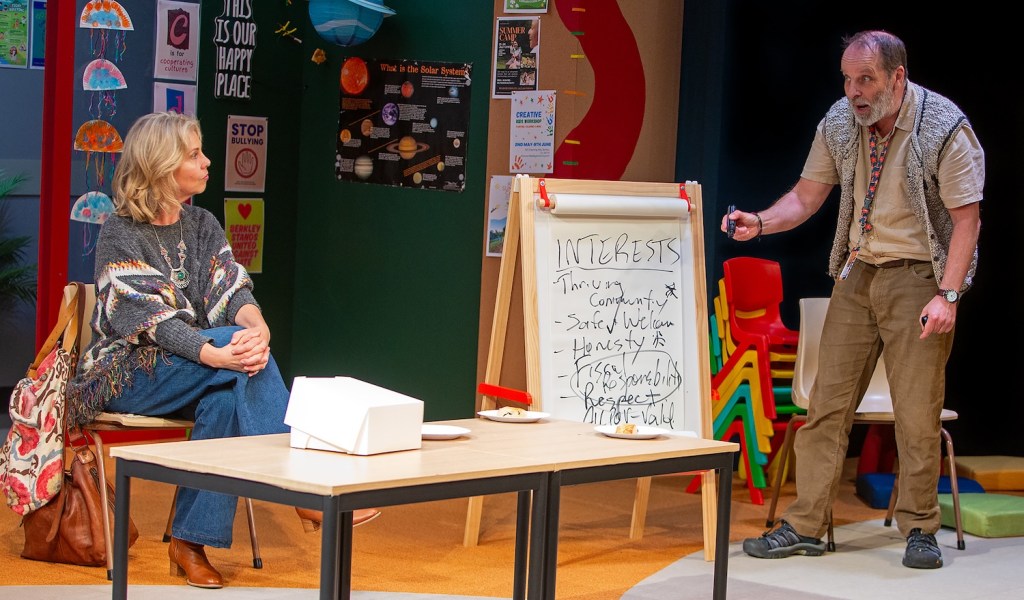
Playwright Jonathan Spector wraps this moral and intellectual debate in the comedy and drama that play out at every school drop-off. The intense politicking and subtle jibes behind smiling teeth grow sharper as the emotional stakes rise. We’re invited to laugh at the well-meaning, stereotypical liberal parents we all recognise (debating the ethics of disposable plates while eating rustic artisan muffins). At times, the “spoonful of sugar” threatens to overpower the “medicine,” and you may laugh more than you think—but you’ll never stop being entertained.
The cast are terrific, with careful and subtle comic timing. Katrina Retallick makes it easy to laugh at the earnest and emotional Suzanne without undermining her core. Branden Christine’s Carina throws stunning side-eye as she fights for rational thought. But for me, Deborah An’s May holds the key to the play—caught in the middle, burdened with information and aware of the medical sciences’ history of hubris, she is simply lost trying to do the right thing.
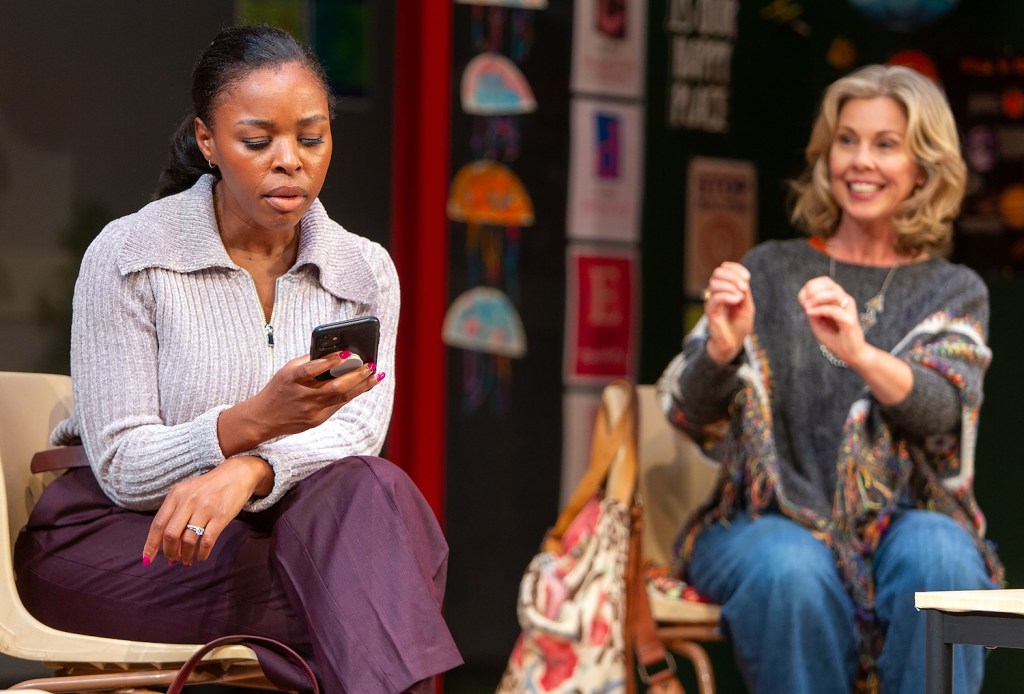
Director Craig Baldwin’s light touch keeps things organic and genuine, allowing moments of farce to unfold naturally. Through both the fun and emotionally fraught scenes, the play remains grounded in a human truth: these are regular people, with good intentions, struggling to handle an intense and confusing situation—leading to big laughs and tears.
To the play’s credit, it doesn’t sit on the sidelines, leaving the final judgement to the audience. It makes its case clearly and compassionately, without the cynical bite of something like Bruce Norris’ Clybourne Park. But perhaps its biggest message isn’t about conspiracy theories, parental rights, or medical science at all. Eureka Day delivers a cold, hard fact: even in fiery, emotional ethical debates… money talks the loudest.

 Cultural Binge
Leave a comment