
Written by Vivian Nguyen. Purple Tape Productions. Belvoir 25a. 29 Jul – 17 Aug, 2025.
Some shows deliberately defy simple, clear interpretation and artfully invite the audience to discover meaning on their own terms (Martin Crimp’s Fewer Emergencies is an excellent recent example). Some, like werkaholics, do none of those things.
Jillian (Shirong Wu) is a struggling actor who can’t catch a break. She mostly works as a photographer/videographer for her best friend Lilian (Georgia Yenna Oom), a beauty/lifestyle influencer who has taken social media by storm. But Lilian’s followers don’t know her real life is nowhere near as glamorous as she pretends. When Jillian starts dating a new girl, Sage (Ruby Duncan), she’s unaware that Sage secretly runs the influencer-busting Instagram account Unmoi, which is determined to take Lilian down.

Werkaholics sets out to critique #manifestation culture and the influencers who peddle half-truths while racking in cash from their followers. At least, that’s what it says it’s trying to do, the story quickly goes off the rails with confusing dialogue and bizarre plot developments.
For a moment, during a climactic argument in which the word “armidillo” was repeatedly used, I wondered if I had misjudged the tone of the play and this was in fact a piece of absurdist theatre. Maybe the incoherence was the whole point? Perhaps it was, in fact, some kind of meta-commentary on internet culture, or I was caught in the middle of an AI hallucination masquerading as a play? No — ChatGPT would at least produce a scene with some banal logic.
The programme notes try to hand-wave the chaos by calling it a “hyperpop aesthetic” — but this has neither the fun vibes nor the layered sensory experience of hyperpop. Werkaholics is simply a jumble of convoluted speeches, nonsensical plotting and painfully thin characterisations.
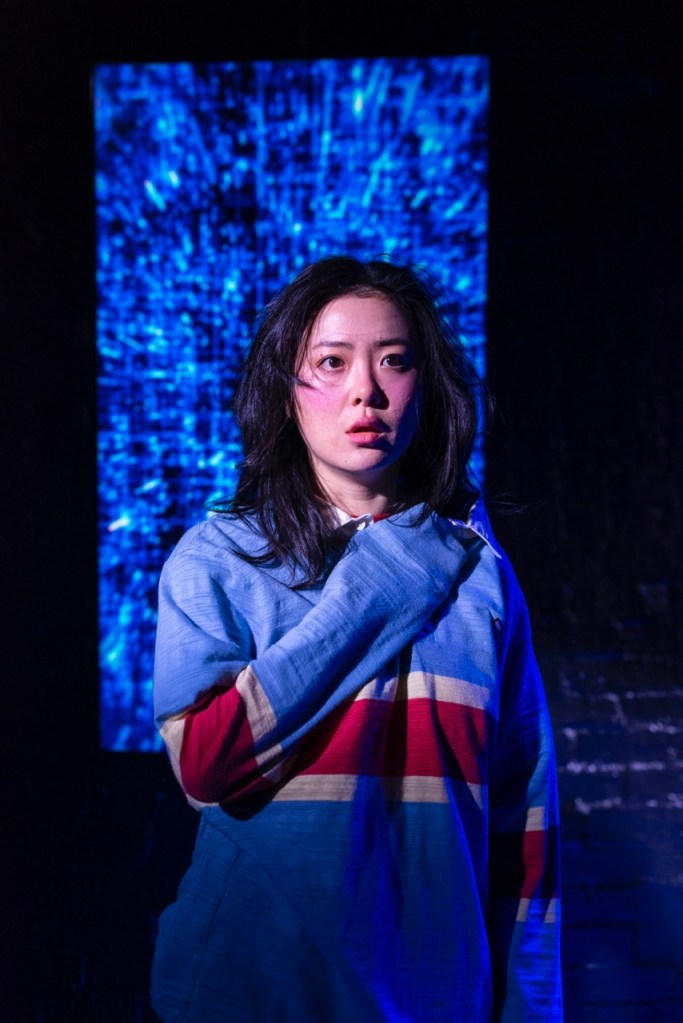
On a positive note, the cast manage to produce some enjoyable work, despite every character sounding like a chatbot trained exclusively on YA melodramas and TikTok comment threads. The excellent Shirong Wu has fun playing both the distraught Jillian and Sage’s mother (in an outrageous wig). Georgia Yenna Oom juggles Lilian’s ambition and nervous energy well. The play’s highlight is a completely incomprehensible but very enthusiastic cyber-sex scene brought to life with some extremely energetic movements — Ruby Duncan does things to that TV screen that frankly stole the show.
But their good work and personal charm can only carry us so far, especially when the material feels instantly out-dated and tired. Video calls that sound like Skype. References to Perez Hilton. Sage wears sunglasses indoors as if she’s a “hacker” from The Matrix. People slowly wave their arms around like they’ve just watched Minority Report. Even the basic premise of “influencers are frauds” is played out already.

Does werkaholics tackle the modern influencer economy with originality or insight? No. Does it show an understanding of how the influencer world functions? Also no. All of this would be forgivable if werkaholics offered interesting outsider commentary or demonstrated some kind of novel point-of-view. But as it creaks towards its truly baffling conclusion (the final scene exudes real “oh-fuck-how-do-I-end-this” desperation), it’s clear the level of thought here is only one pixel deep.
Werkaholics needs a lot more “werk.” The “fake it ’til you make it” mantra may be acceptable for wannabe influencers, but not for theatremakers asking audiences to pay for a seat.


 Cultural Binge
Leave a comment