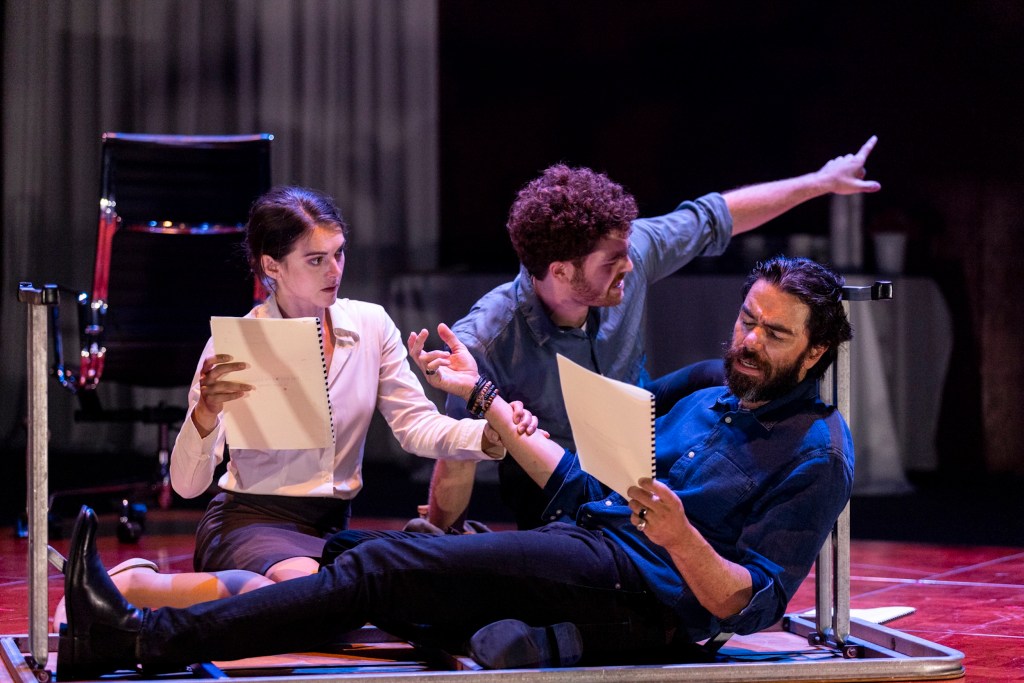
Written by Sam Holcroft. Belvoir. 21 Feb – 22 Mar 26.
Now this is a play with meat on its bones. Sam Holcroft’s A Mirror is a slippery beast, constantly wrong-footing the audience in a way that keeps your mind questioning just about everything.
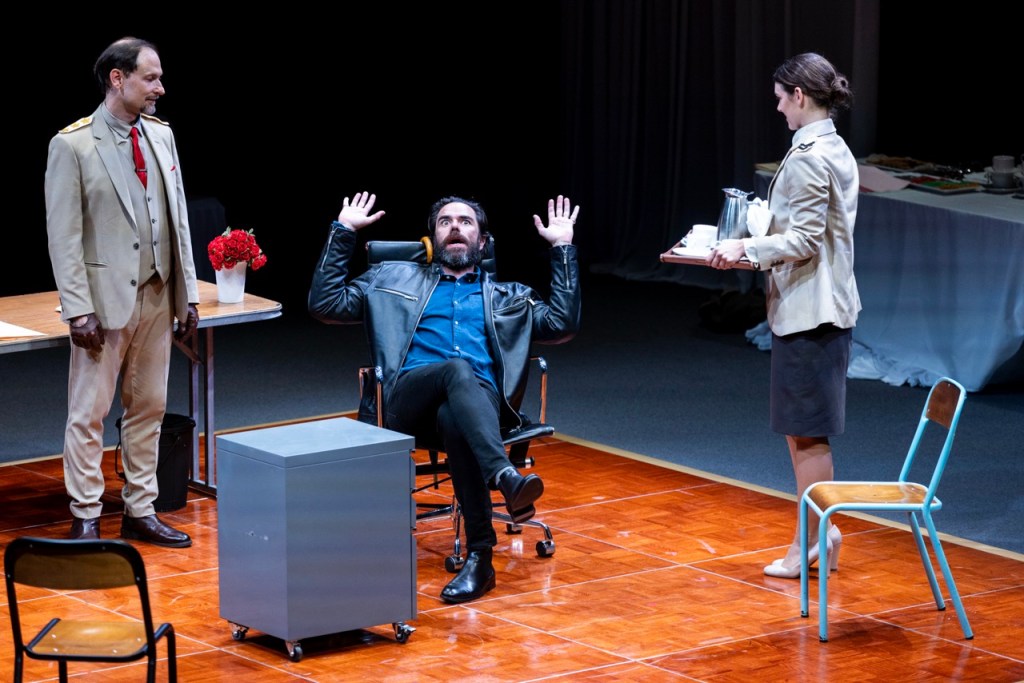
You wind your way up the staircase covered in art that has been covered up by the Ministry of Culture to arrive at a wedding ceremony with a groom and best man waiting nervously, or so it seems. Within minutes of the ceremony beginning the ruse is dropped and the real reason for gathering is revealed. You’re going to see a banned play that the totalitarian regime doesn’t want you to see. In this play-within-a-play, a young playwright, Adem (Faisal Hamza) has been pulled into the frightening office of Mr Čelik of the Ministry of Culture (Yalin Ozucelik) to answer for a work he submitted for approval. But Adem is confused. His work isn’t subversive — it’s a word-for-word transcript of things real people have said. How can the truth be a crime?
Čelik, surprised by Adem’s naivety but impressed with the technical skill of his writing, decides to take him under his wing, much to the surprise of his ex-military assistant Mei (Rose Riley). Čelik introduces Adem to a renowned state-sanctioned playwright, Bax (Eden Falk), and they try to teach Adem how to really craft a play — one that will impress the censors and the regime.
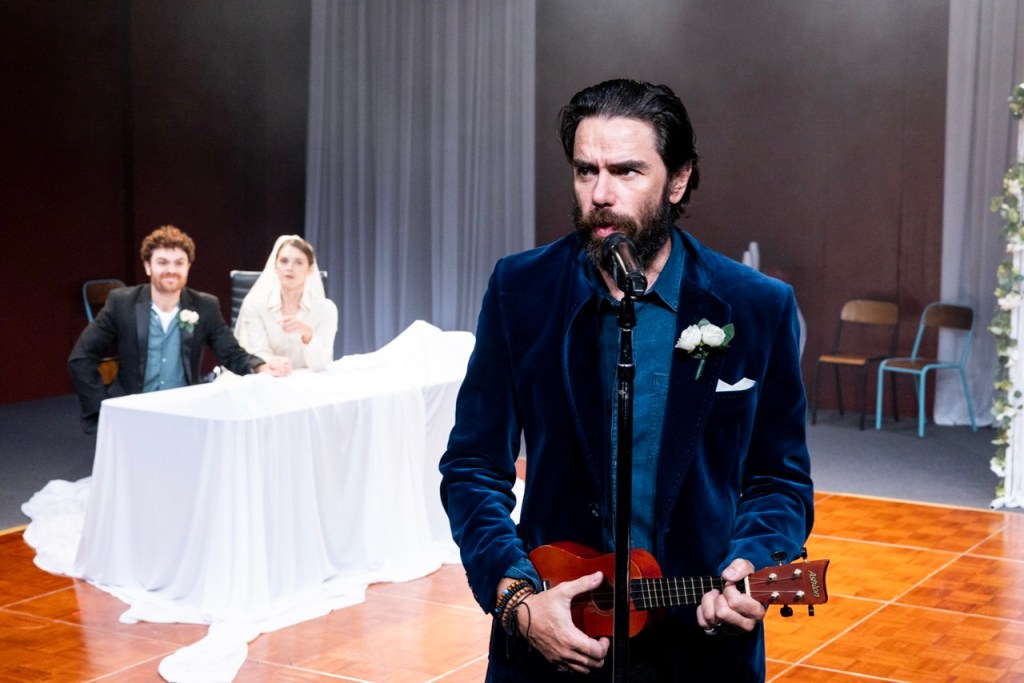
All of what I’ve described takes place in the first act of A Mirror, and to give you more plot would be to compromise your eventual enjoyment when you see it. Needless to say, the twists, interruptions and revelations keep coming, and they will keep you probing your understanding of the play as it goes on. This is mentally active theatre — a puzzle box that keeps changing size and weight as you shake it.
Holcroft’s writing has a clarity of intent and a sharpness that cuts. Even though we don’t live in a police state like the characters, there was a wry chuckle when “social cohesion” is used as a justification for censorship. Holcroft takes the oft-repeated platitude “Art is the lie that reveals the truth” and pushes back — in a world of non-stop misinformation, maybe art needs to be truth itself.
To drive this point home, she has crafted a script that plays with theatrical form as it slowly peels back the layers. At one point, as the quartet of characters stage a reading, we are wrapped in a-play-within-a-play-within-a-fake-wedding-within-a-play. There are small clues scattered through the work that hint at its resolution, but they are never too overt. Like the best mysteries, when the moment comes for the big final reveal, the truth was always in plain sight — but is still a surprise.
The message is layered, depending on which angle you want to approach it from. This is either a satire of cultural gatekeeping which “encourages” artists to make palatable work “that will sell.” Or it’s a bracingly political deconstruction of authoritarian politics, offering us a way through the fog of lies. This is the sort of writing I live for.
It’s never confusing, thanks to the fantastic work of the cast — all playing roles-within-roles, the true extent of which is only revealed at the very end. Faisal Hamza continues to impress, bringing the overtly literal Adem to life and finding real comedy in his genuine honesty.
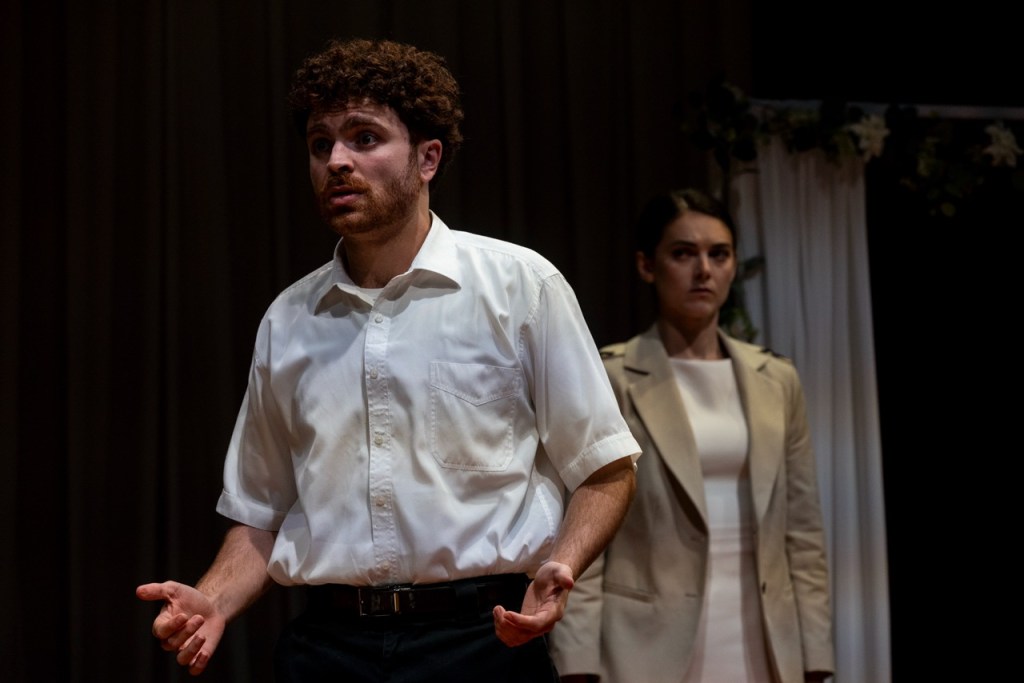
Rose Riley is constantly transformative as she slips between the awkwardness of being a soldier forced into the world of the arts, and a quick-witted activist. And Eden Falk swings from confident to tortured as a once-revolutionary playwright who has allowed himself to be dulled into submission.
The standout is Yalin Ozucelik’s friendly yet menacing Mr Čelik — a tightrope-walking performance that fills you with unease in small degrees. A high-level bureaucrat in the regime, he is the not-so-subtle force of censorship while also being filled with a genuine love of the arts. Is he a well-meaning collaborator trying to find small ways to improve people’s lives under oppression, or just the kind of self-deluding functionary that keeps any abusive regime running?
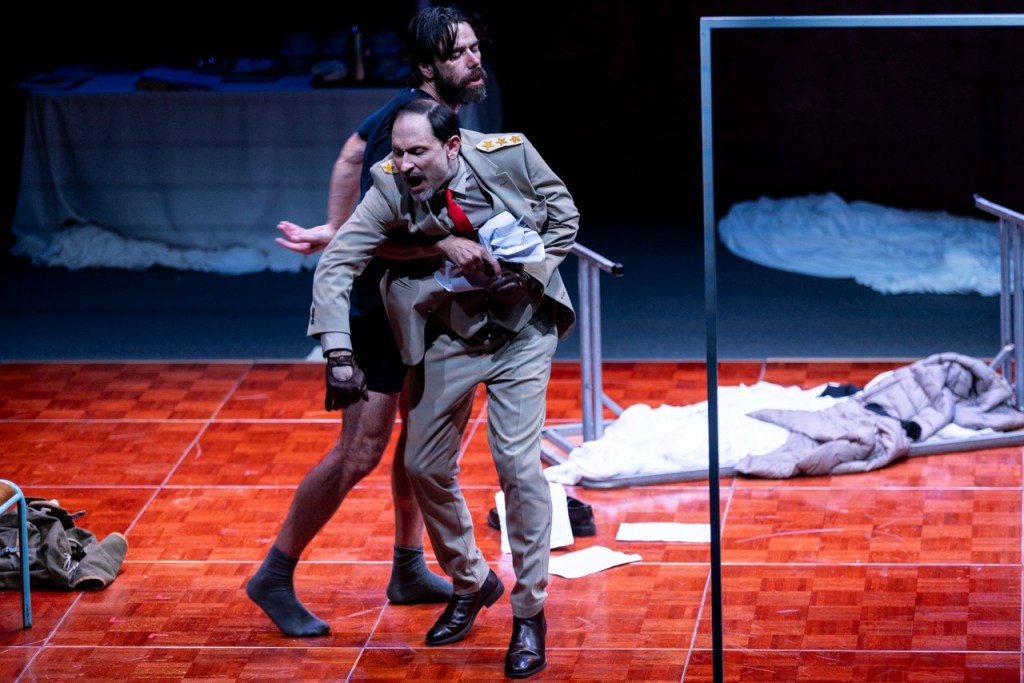
Clear-eyed direction from Margaret Thanos — who, along with designer Angelina Daniel, transforms the Belvoir corner stage into a semi-panopticon — means we feel like we’re both witnessing and enclosing the characters in a prison. Phoebe Pilcher’s lighting and Daniel Herten’s sound design guide us through the Inception-like layers of reality.
A Mirror is a classic piece of theatre-about-theatre-making mixed with some Dario Fo-style political agitation. This cerebral work will leave some audience members a bit cold, but it is well and truly right in my wheelhouse. I even started to read my own meta commentary into the play skewering the toothless, commercial production of Art happening down the road at the Roslyn Packer — but that’s probably just me.
 Cultural Binge
Leave a comment