-
Welcome to Cultural Binge

The rating system is simple:
★★★★★ – Terrific, world-standard. Don’t miss.
★★★★ – Great, definitely worth seeing.
★★★ – Good. Perfectly entertaining. Recommended. Individual mileage may vary.
★★ – Fine. Flawed and not really recommended, but you may find something to appreciate in it.
★ – Bad (& possibly offensive).
See more reviews over at The Queer Review.
Instagram: @culturalbinge
Substack: culturalbinge.substack.com
Email: chad at culturalbinge.com
-
Blaque Showgirls (Griffin) ★★★

Written by Nakkiah Lui. Griffin Theatre Company. 4 Sep – 21 Oct, 2023.
Blaque Showgirls is both a daft comedy and a commentary on the status of indigenous Australian lives. Terrible and terrific at the same time, it has the energy of a Christmas panto fueled with bags of cocaine – to be honest, I loved and hated it in equal measure.
Fair-skinned Sarah Jane Jones (Stephanie Somerville) knows she is a proud Aboriginal woman, despite what everyone around her says. Her only clues about her mother come from a single photograph of her smiling in front of the billboard for ‘Blaque Showgirls’, a burlesque show whose selling point is its all-black cast. Sarah is convinced her mother was a showgirl and she intends to follow in her footsteps. Her nips may be too pink, and her hair too fair, but she won’t let narrow-minded racism hold her back…

Photo: Brett Boardman Very loosely inspired by the cinematic, trashy classic Showgirls, Blaque Showgirls is a story of ambition, delusion and the way Australian society treats Aboriginal culture and people. Its style is broad, crass and loud, but its message goes much deeper. Everything I loved about the show comes from playwright Nakkiah Lui’s script. It’s both pun-erific and sharp as a knife in places. It’s a smart script pretending to be dumb.
The performances and direction however don’t manage to hit the high/low balance of the text. One-note and shouty, the show rarely goes much further than its campy surface. This is all glitter and tits. Which isn’t to say it’s not wonderfully fun, just that the fun is completely two-dimensional and wears thin after the deliberately stupid dialogue has been hurled at you at full volume for 85 minutes

Photo: Brett Boardman The highlights of the show come from those rare moments when the comedy is balanced with meatier content. When Molly (Angeline Penrith) drops the accent and delivers a monologue to the audience, it hits home. Not every attempt at seriousness works as well. Things turn didactic at the end as the thin pretence is dropped. It felt unnecessary and heavy handed for a play filled with such a lightness of being.
Blaque Showgirls is a good time out, filled with laughs and some important messages. While the execution didn’t work for me, it has for many, and I can’t deny the show is entertaining.
-
Venus & Adonis (Seymour Centre) ★★★1/2
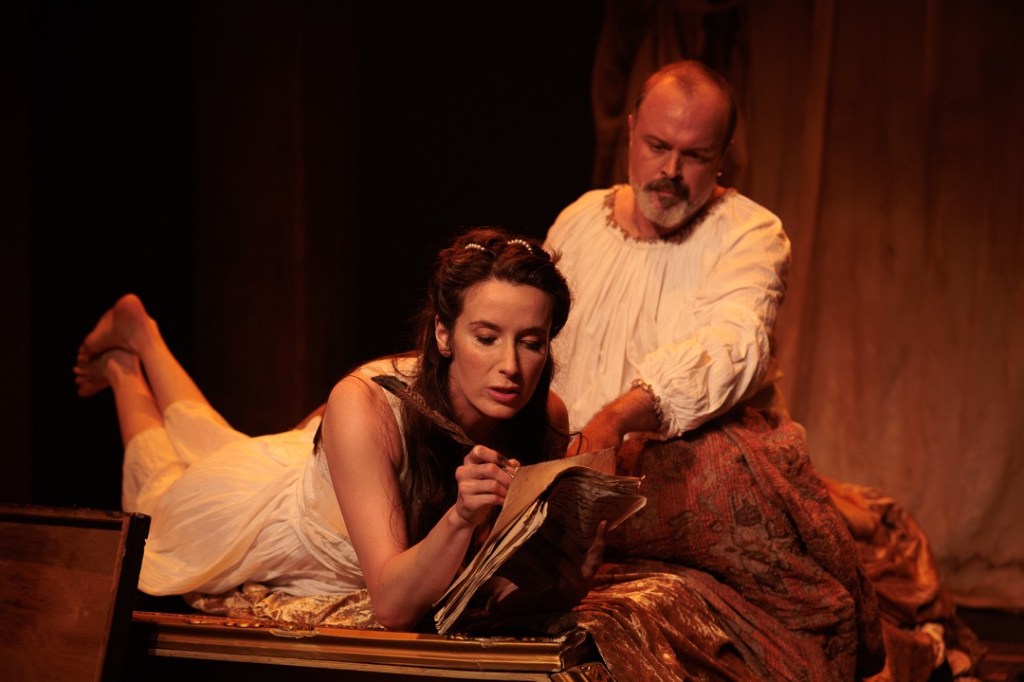
Written by Damien Ryan. World Premiere. Sport By Jove & Seymour Centre. 29 Sep – 21 Oct, 2023.
Damien Ryan’s Venus & Adonis feels like a companion piece to Jessica Swale’s Nell Gwynn. Both reframe Shakespeare with a female protagonist, lashings of humour and cutting commentary on the battle of the sexes. The more you know your Bard, the more fun you’re going to have. But beneath the bawdy jokes and wry observations, more serious plot threads rumble.
Aemilia Lanyer (Adele Querol) is getting tired of seeing reflections of herself in the plays of her lover, William Shakespeare (Anthony Gooley). She’s a writer of her own, though no one will publish a woman. But Shakespeare has an idea, he wants to stage his epic poem, ‘Venus & Adonis’, at court – and seeing as it is not a public performance, he wants to cast Aemilia in the role of Venus. A woman playing a woman, almost unheard of! And for Adonis, he wants to cast one of his players, the young pretty Nathaniel (Jerome Meyer), who is used to playing the female roles… It’s all scandal-baiting fun till Shakespeare receives word from home about his son, Hamnet.
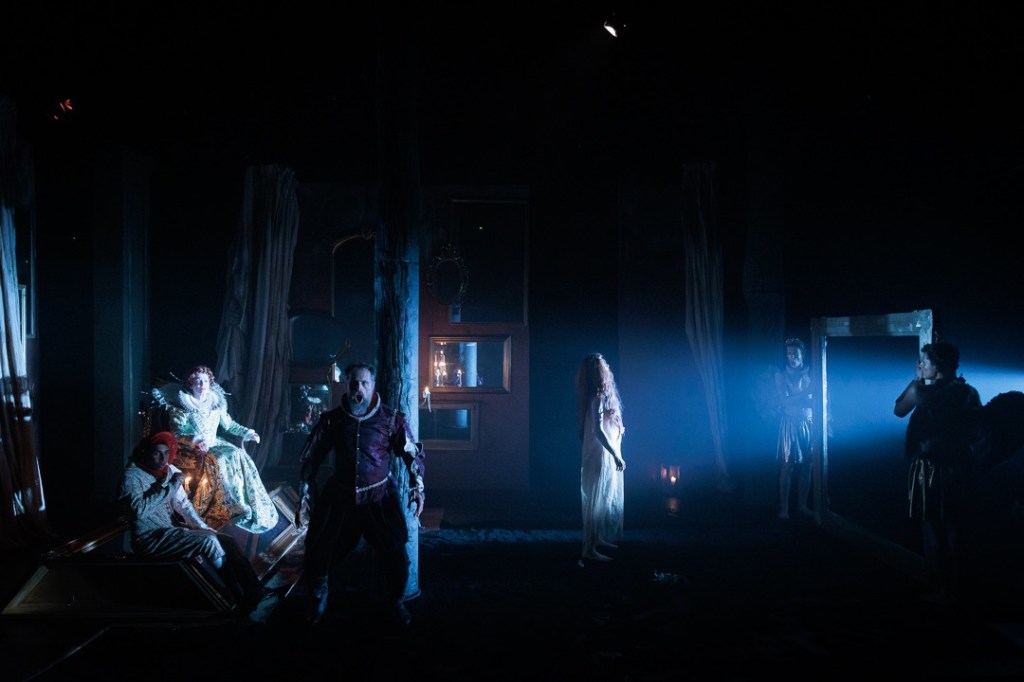
Dinitha Senevirathne, Belinda Giblin, Christopher Tomkinson, Adele Querol, Oliver Ryan, Max Ryan. Photo: Kate Williams. It’s clear Damien Ryan has done his homework, as the play is almost too eager to show you the depth of knowledge. The core of the story centres around dissecting Shakespeare’s sonnets for the truths behind the poetry, like his love for a man, his affairs with women and his feelings of guilt around his family. It’s refreshing to have a Shakespeare story that isn’t dancing between the raindrops of his more famous plays. Here we have a man who is tainted by guilt and grief, unable to express himself in prose, only poetry.
The tale of Aemilia Lanyer is new to me and intriguing, but is underserved in a play that is ostensibly her own. After opening the tale, and delivering a scathing monologue (Querol is outstanding in the role), she is all but side-lined as the sheer dramatic gravity of Shakespeare pulls focus. The emotional journey of the play is his, his loves, his deceit, his loss all drive the narrative despite the effort to put the spotlight on Lanyer.
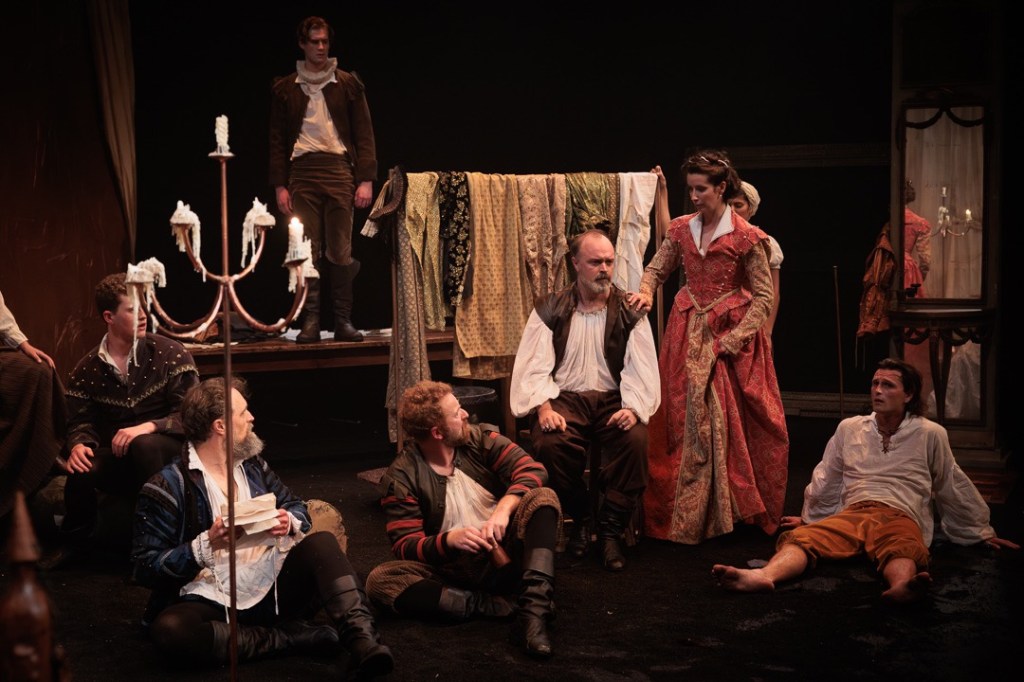
Max Ryan, Christopher Tomkinson, Oliver Ryan, Kevin Macisaac, Anthony Gooley, Adele Querol, Jerome Meyer. Photo: Kate Williams In fact it feels like there are two plays here, both competing for stage time. In one, Lanyer is the heroine, a brilliant but ignored writer who would never receive her due in a world where women were ignored. And in another, Shakespeare’s repressed emotions bubble forth in his sonnets, a complex mix of emotions about his lovers and his family, brought into sharp focus by the death of his son. Existing in the same world, they never quite gel into a single, clear story.
The real highlights of the night are the performances. Almost everyone on stage is note-perfect. The comedy is sharp and organic, the rage justified and the love deeply-felt. This cast can handle verbose monologues, dirty jokes and physical comedy deftly – they’re a real joy to watch. And the meta-humour about contemporary theatre life provides some of the best comedy of the night.
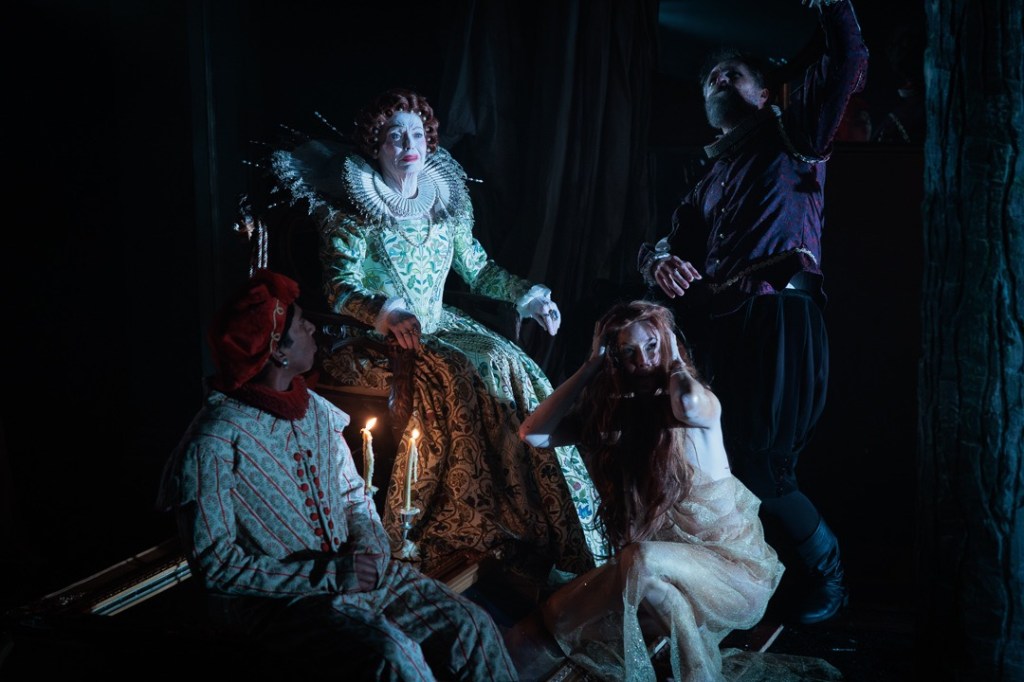
Dinitha Serevirathne, Belinda Giblin, Adele Querol, Chistropher Tomkinson. Photo: Kate Williams. Ryan’s script is full of gorgeous language as well, just maybe too much of it. At three hours, the play starts to punish with its long scenes and desire to be deep and poetic. It’s clear he’s a talented director too (Ryan pulls triple duty as writer/director and set designer), as the comedic scenes are tightly choreographed and, as I mentioned, the performances wholly human and honest. The set design is rich, but the use of projections is at times hard to digest.
Venus & Adonis is packed with great elements but feels overwrought and overwritten. Almost everything here is a little too, too much. We don’t need the nudity. We don’t need the fire. We don’t need the rain. We don’t really need Anne Hathaway to be honest. And we definitely don’t need to break the fourth wall for a cheap gag. They just distract from the terrific story and dynamic performances. What we need is faith in the material, and at its heart, the material is very strong indeed.
-
Lady Day at Emerson’s Bar & Grill (Belvoir) ★★★★1/2

Written by Lanie Robertson. Belvoir St. Theatre 14 Sep – 15 Oct, 2023.
Zahra Newman steps into the role that won Audra McDonald her 6th Tony Award and an Emmy nomination. These are big shoes to fill, and she is more than up to the task.
We open at Emerson’s Bar & Grill in Philadelphia in 1959. Billie Holiday (Newman) is scheduled to appear in what will be one of her final performances. This isn’t a performer at the peak of her popularity, but a woman fighting with her ghosts, her legacy and the world around her. Weaving Holiday’s songs with stories from her past, the show paints a picture of a complex woman crumbling under the weight of her life.
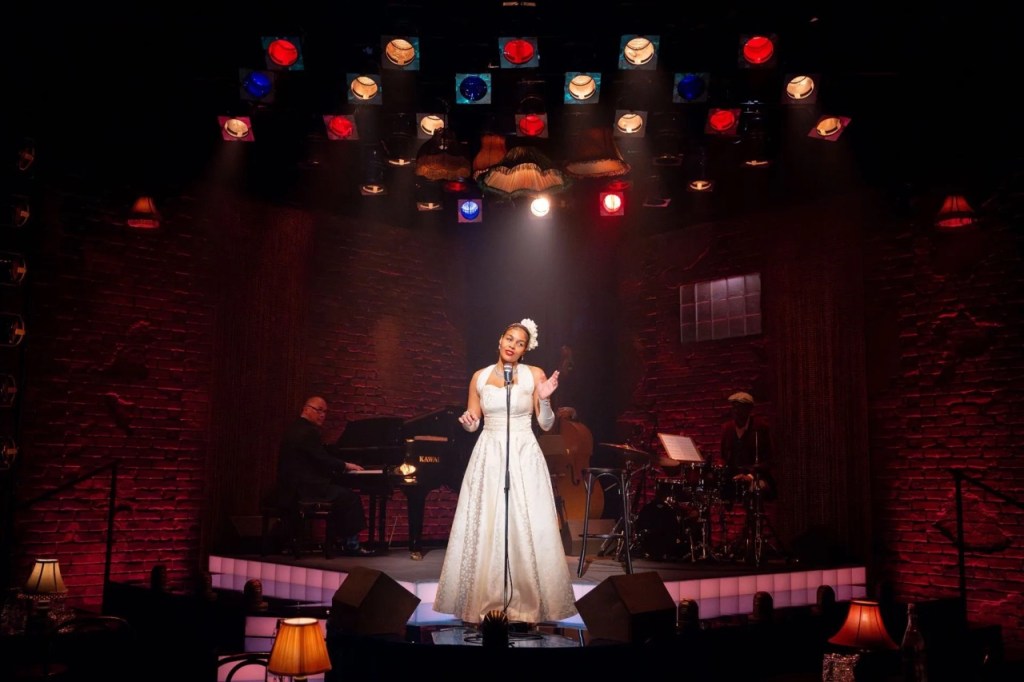
Photo: Matt Byrne. Pro tip: Get the cabaret seating if you can. Don’t worry, this isn’t an ‘interactive’ show, but it is all about nuance and the closer you are, the more you’ll be immersed in the tale.
I was lucky enough to see McDonald perform the role in London, and she was dynamite. Newman is an equal match. There is a rage behind the voice (which Newman mimics well) and it seeps out over the course of the evening. This is Holiday at a time when she was struggling to keep the facade up. A life littered with rape, racism, prison and drugs, she is in danger of falling apart at any minute.
Photo: Matt Byrne. This is how you do a “jukebox musical”. There is no awkward weaving of songs into a forced narrative. Here the tunes are bookmarks to moments, crystallising the emotions into poetry. But this is more of a play, with songs, than a traditional musical. The theatrical conceit of a live gig makes each stumble more immediate, you know things aren’t going to fade to black when something bad happens.
Ailsa Paterson’s tiered stage elevates and reflects Holiday back to us, letting Newman rise above on a pedestal and step down into the crowd. Govin Reuben’s lighting makes things look luscious and subtly focuses us on the right moments. The band (Kym Powers, Victor Rounds and Calvin Welch) bring the heat.

Photo: Matt Byrne. But this is Newman’s showcase and she doesn’t waste a moment. She is a master of playing stoic women on the verge of breaking and here she gets to crumble and decay before our eyes. It’s a lesson in pace and determination. If her recent roles in A Raisin in the Sun and Fences form the start of a trilogy of African-American women standing strong, Lady Day is the third act finale – and it is a bitter one.
Beautifully concise (90 minute shows are a godsend), and both deeply emotional and entertaining, Lady Day at Emerson’s Bar & Grill is a jewel of a show, and a fitting crown for Zahra Newman, one of our best stage performers.
-
The Visitors (Sydney Theatre Co.) ★★★★

Written by Jane Harrison. Sydney Theatre Co. Sydney Opera House. 11 Sep – 14 Oct, 2023 Riverside Theatres from 19 – 21 Oct, 2023 and Illawarra Performing Arts Centre from 25 – 28 Oct, 2023
Jane Harrison’s The Visitors isn’t about The Voice debate, but the timing is perhaps serendipitous. As Australia prepares to hold a referendum about enshrining an indigenous “voice to parliament” (i.e. an indigenous-led advisory body that will speak to the government) into Australia’s constitution, The Visitors makes us think about pre-colonial Australia and the impact the Western invasion had on native peoples. And it does so with a light touch and a laugh.
Six clan leaders, and one younger proxy, gather to observe the boats approaching their land and discuss how best to deal with the situation. Should they present a show of force to scare them away, or treat them like visitors and offer hospitality? Like all meetings, it has a protocol to be followed, that not everyone appreciates. It’s slow going, slower than they’d like, as they look at it from multiple angles. They don’t know how important this day will be, or how the seeds of destruction have already been planted among them.

Photo: Daniel Boud. Muruwari playwright Jane Harrison has written a play that’s laden with foreboding, laced with humour (at times it’s the other way around). Treating the gathering like a corporate meeting, reframes these elders as people we all know. Some nice, slightly anachronistic jokes are well presented, getting laughs from the audience. Putting them in modern, office attire breaks down the barriers between the predominantly white audience and the First Nations actors on stage.
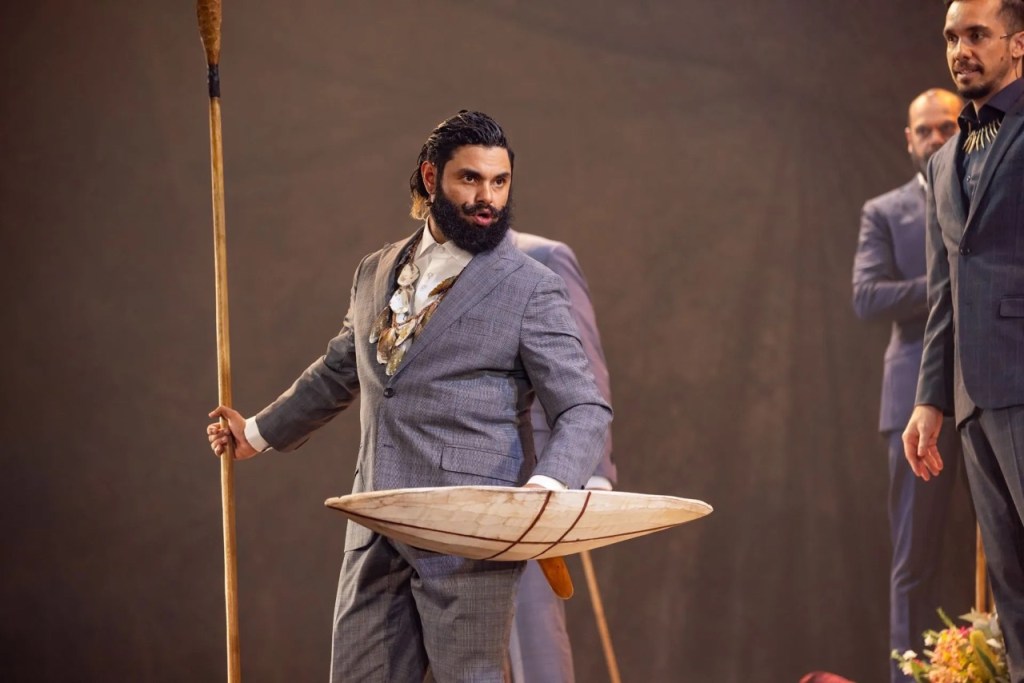
Photo: Daniel Boud. Just as we look at the news and hear a multiplicity of indigenous opinions discussing the referendum, here we get the same – different clans with different views on who these people are, what they want and how best to handle them? Oh the irony if they’ve managed to “turn back the boats” then and there!
Even with all the character-based humour, Harrison never lets us forget what’s coming. As the elders pass on news about how the white people keep coughing and sneezing, our knowledge of how the colonists introduced smallpox to the unprotected indigenous communities raises alarm bells. Even if the boats never landed, people would soon die. The set, covered in discarded shells, seems to hint at the disaster to come.

Photo: Daniel Boud. Told without any breaks (the play is one, 75-minute scene in real time) director Wesley Enoch keeps things fluid and moving. This cast feels like a well-oiled machine, moving through the text with a keen sense of pace, comedy and drama. Pertame & Tiwi actor Joseph Wunujaka Althouse; Wiradjuri & Ngunnawal actor Luke Carroll; Yunkunytjatjara, Warrigmal & South Sea Islander actor Elaine Crombie; Noongar & Budmiya actor Kyle Morrison, Wiradjuri & Gamilaraay actor Beau Dean Riley Smith; Biripi actor Guy Simon, and Gumbaynggirr & Wiradjuri actor Dalara Williams, all have an authenticity to them that rises above their modern dress and mannerisms. As the final moments strip the artifice away, they stand tall.

Photo: Daniel Boud. I hope people won’t be so burnt out by the political rancour surrounding The Voice that they avoid The Visitors (I attended the first performance after Opening Night and it was about 90% full). It stands alone as a great piece of Australian drama and it was timed as part of the Opera House’s anniversary, not the political moment it finds itself in. The play reframes a moment in our history to present it back to us fresh. There is no judgement in its voice. Instead it presents us with a chance to appreciate what came before, to help inform our actions moving forward.
-
The 25th Annual Putnam County Spelling Bee (Hayes Theatre) ★★★★★

Book by Rachel Sheinkin. Music & lyrics by William Finn. Conceived by Rebecca Feldman. Hayes Theatre. 8 Sep – 8 Oct, 2023.
Perfect. No Notes.
Oh okay, I’ll break it down. The last time I saw Spelling Bee was back in 2011. I remember really enjoying it but I never gave it another thought. The songs weren’t anything I’d listen to out of the context of the show so it went to the back of my brain. All I remember is laughing. A lot.
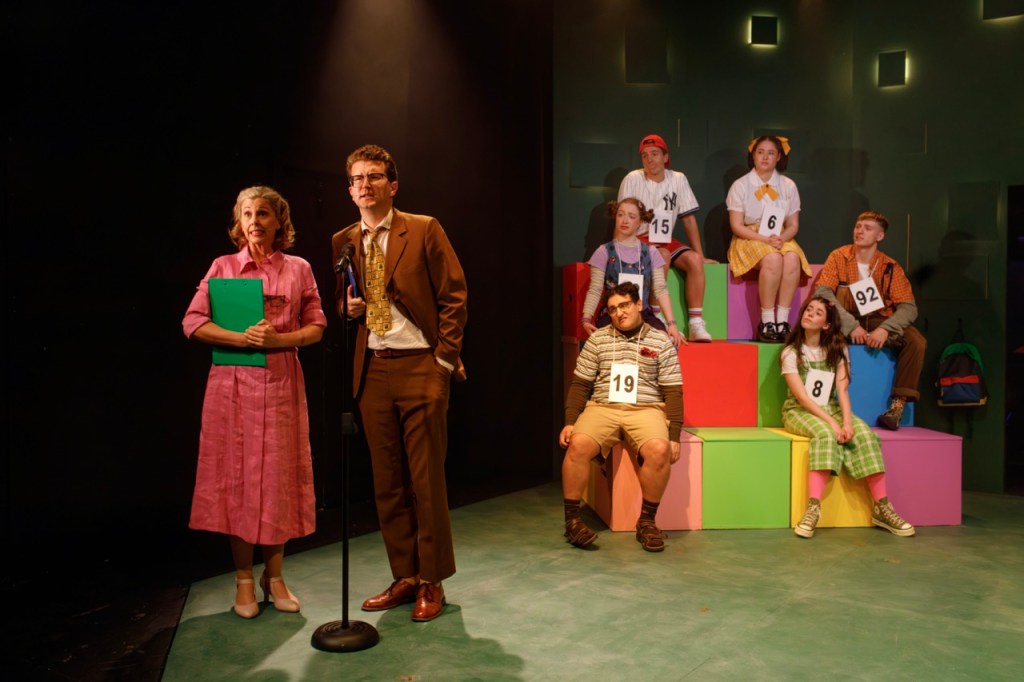
Katrina Retallick, James Haxby, Daniel Raso, Adeline Hunter, Matthew Predny, Jessica Kok, Rebecca Ordiz & Axel Duffy in The 25th Annual Putnam County Spelling Bee. Photo supplied by Hayes Theatre. For those unfamiliar with the show, welcome to the Spelling Bee – a school competition where the brightest kids compete to see who can spell the most complex words. Our collection of contestants includes Chip (Matthew Predny) the returning champion, William Barfée (Daniel Rasso) an obnoxious boy with an unusual “magic foot” that helps him spell, Logainne “Schwartzy” Schwartzandgrubenierre (Adeline Hunter), a politically aware teen with two pushy dads, Marcy Park (Jessica Kok) a recent transfer student who is a total alpha, Leaf Coneybear (Axel Duffy) a home-schooled kid who goes into a trance when he spells, and the sweet Olive Ostrovsky (Rebecca Ordiz) who is patiently waiting for her absent father to take his seat. For these kids the Spelling Bee is high stakes.
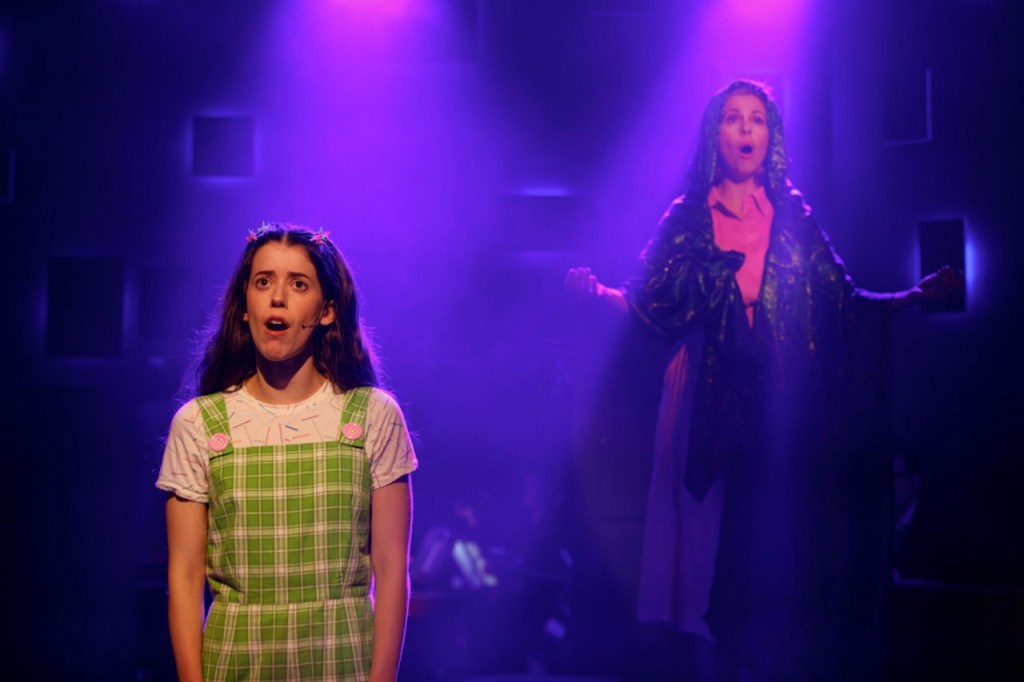
Rebecca Ordiz & Katrina Retallick in The 25th Annual Putnam County Spelling Bee. Photo supplied by Hayes Theatre. The big conceit here is that adults are playing the children, with all their unguarded quirks, and this cast is comedy gold. They make each child endearing, you can’t help but feel protective of them even though you know only one can win. The adults are almost all, well, awful. The parents are either pushy or neglectful. Vice Principal Douglas Panch (a gloriously deadpan James Haxby) feels like he’d rather be anywhere else than here. Only Rona Lisa Peretti (Katrina Retallick), a former winner of the Bee, and Mitch Mahoney (Nathaniel Laga’aia), a convict doing community service as a comfort counsellor, seem to actually care.
It’s tough to pick a stand out among the cast, but Axel Duffy’s gentle, savant-like Leaf was a real joy to watch. Especially after seeing Duffy switch to playing Schwartzy’s unlikable father and back again. But the whole cast are wonderful, each character is lovingly created and fully realised.
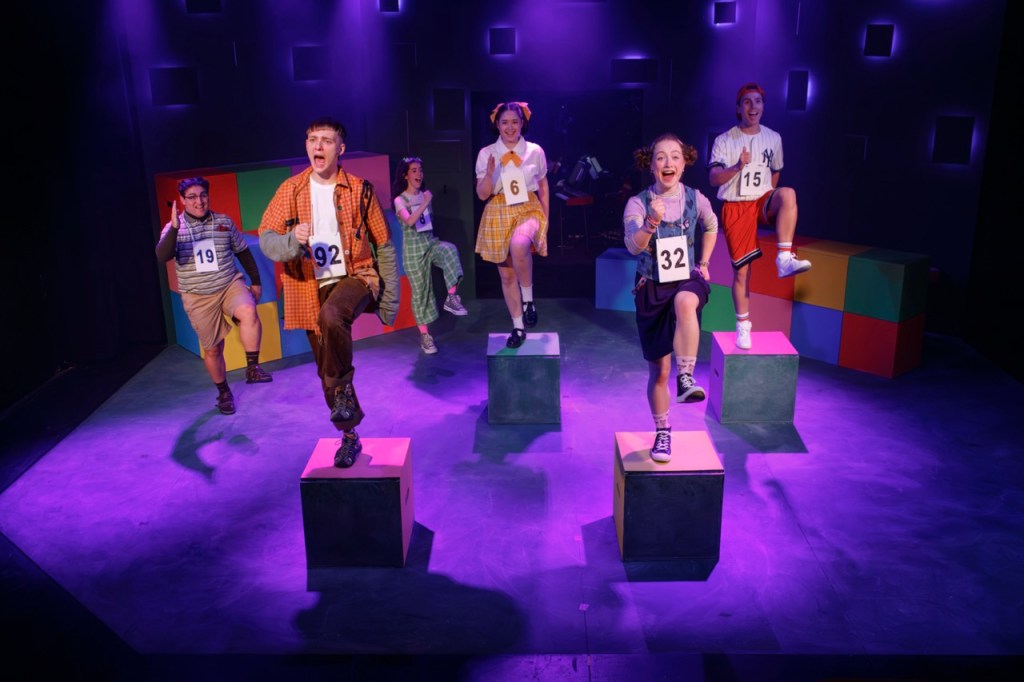
Daniel Raso, Axel Duffy, Rebecca Ordiz, Jessica Kok, Adeline Hunter & Matthew Predny in The 25th Annual Putnam County Spelling Bee. Photo supplied by Hayes Theatre. The script has been subtly updated with some contemporary gags but the story is essentially the same. Full of joy and heartbreak, the commentary on childhood and the pressure parents place on their kids hasn’t lost its punch. Director Dash Kruck and choreographer Vi Lam keep the show constantly moving (thanks to a smartly multifunctional set by Monique Langford).
This is another absolute crowd-pleaser at the Hayes (following on from Murder For Two). Grab a ticket before they’re all gone.
-
Summer of Harold (Ensemble Theatre) ★★★1/2

Written by Hilary Bell. World Premiere. Ensemble Theatre. 8 Sep – 14 Oct, 2023.
Hilary Bell’s triptych of short plays focuses on the way memory interacts with our present-day lives. From heart-warming stories of youth, to tales of past snubs and regrets. Summer of Harold, Enfant Terrible and Lookout are beautiful vignettes of life, showcasing two excellent actors and Bell’s power of storytelling.

Hannah Waterman in Summer of Harold. Photo: Jaimi Joy. The most successful is the opening piece, Summer of Harold. Bell explains in the programme/playtext that it began as a short play, Window, Cricket Bat (co-commissioned from Griffin Theatre and the Australian Design Centre for Sydney Festival 2022) before being expanded. Inspired by true events, it’s a monologue by an Australian woman named Janet (Hannah Waterman), who backpacked to London in 1984 and worked as housekeeper to intimidating playwright Harold Pinter [insert pause. Two dots, not three]. It’s a charming tale of Aussie gumption, culture clash and the importance of savouring small moments. Waterman is hilarious as Janet, reminiscing of her youthful adventures and weaving a lovingly high-stakes/low-stakes tale of a single luncheon.

Berynn Schwerdt in Enfant Terrible. Photo: Jaimi Joy. The most broadly comedic story is the second, Enfant Terrible, in which Gareth (Berynn Schwerdt) breathlessly explains his night and everything that built up to one moment of intense spite. A ceramicist, who can not stand the success of a ‘friend’ he considers his inferior, Gareth is a ball of resentment wrapped in denial. Schwerdt is bursting at the seams as he bounces around the set delivering Gareth’s manic story. It’s funny because we’ve all known this type of graceless, bitter artist (or let’s be honest, at some point, we’ve all been this insecure, judgemental mess ourselves), a mix of ego under strain and self-delusion that comes to an explosive finale.

Berynn Schwerdt & Hannah Waterman in Lookout. Photo: Jaimi Joy. Closing out the evening is Lookout, the most rawly emotional of the three. Jonathan (Schwerdt) hikes to a lookout and is surprised to find Rae (Waterman) there as well. Bell’s writing keeps you guessing as to their dynamic. Are they a couple of friends? Ex-lovers? Relatives? There is a comfortable familiarity tinged with sadness as Jonathan talks about selling up and starting a new life with a new woman. As the two confront their past, filled with warmth and pain, they reach a moment of unexpected catharsis.
The three stories are held together by the detailed design work of Jeremy Allen, whose towering shelves of mementos and nicknacks hint at dozens of untold, personal experiences. The set is littered with humour and takes you on a journey all its own. Matt Cox’s lighting is sharp and atmospheric, almost a character in itself. Director Francesca Savige gives each piece its own energy, powered by the two talented performers.

Hannah Waterman & Berynn Schwerdt in Lookout. Photo: Jaimi Joy. Rooted firmly in their humanity, Bell avoids trying to make these tales anything more they are – brief character studies. They may not be speaking to the world at large, but focus their attention on the personal and intimate. This makes them heartfelt and entertaining but those seeking more urgent theatre will need to look elsewhere.
Short tales are a skill all their own, and while it’s rare we get to see short plays staged (I’m still waiting on someone to programme Tom Stoppard’s The Real Inspector Hound for me to see) there is a real joy and relief to watching a whole story be told concisely. The worry going into an evening of short plays is that they’ll be disjointed or unsatisfying, and Summer of Harold definitely isn’t that – you’re just getting three emotional rollercoasters for the price of one!
-
Beauty & the Beast (Capitol Theatre) ★★★
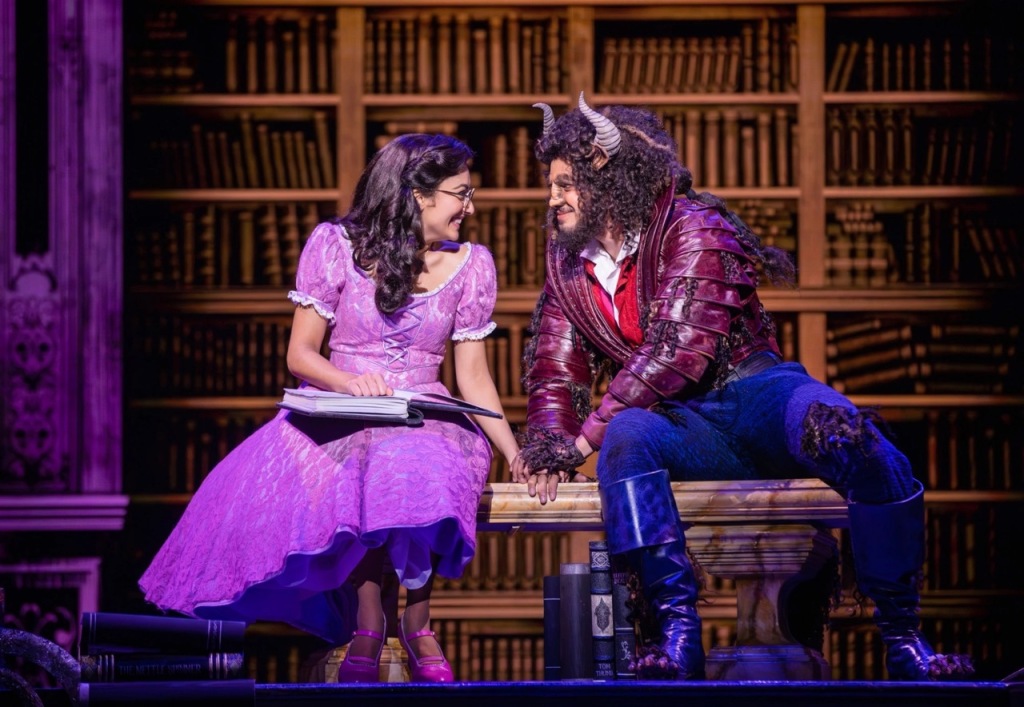
Book by Linda Woolverton. Music by Alan Menken. Lyrics by Howard Ashman and Tim Rice. Capitol Theatre, Sydney. Jun 14 – Dec 24, 2023.
Beauty & the Beast alternates between, well, being beautiful and being beastly. At times it’s full of wonder and at times it just plods its way through the story. But one thing was clear when I caught the Sunday evening performance – the children in the room were utterly invested in everything happening on the stage. It was magical.
Disney adaptations tend to be… fine. And they don’t strive for much more than that. A few flashy moments to make the kids go ‘wow’ and a standard walk-through of the story with a few new songs thrown in (which rarely linger in your ears the second they’re done). They seem designed to be easily replicated on tour, on a cruise ship, around the world (The Lion King is the great exception of course, and possibly Mary Poppins). So I never find myself racing out to see them, as much as I know that I will find stuff to enjoy in them. Beauty & the Beast was no different.

I just couldn’t understand why ‘Be Our Guest’ was a bog-standard production number. Yes there were lots of flashing lights and dancers but the premise of representing a dinner party was thrown out after about 30 seconds. The rest of the choreography could have been lifted straight out of another show. And after all the reliance on a projection for backgrounds, why not replicate the original CG ballroom from the film? Plus, did Lumière (Rohan Browne) need to light his candles every 2 minutes? We get it, they’re real.
These odd choices were offset by some fantastic transformations (although I could have done without the lights flashing right in my eyes – a cheap trick). For the life of me I can’t figure out how they brought the tea-cup Chip to life. How did they hide the performer’s body? I was distracted trying to see through the stage magic. The best sound effect of the night was the screams of shock and joy coming from all the kids around me. It was louder than a Harry Styles concert. The best line of dialogue came, not from the stage, but from a small boy who wasn’t happy with the way Belle (Shubshri Kandiah – as wonderful as always) had snubbed the Beast (we had understudy Luke Ward on as The Beast, and he was terrific) who was trying to be nice… “He has feelings too!” he yelled out to rapturous applause from the audience. Thankfully it was the only interactive moment of the night.
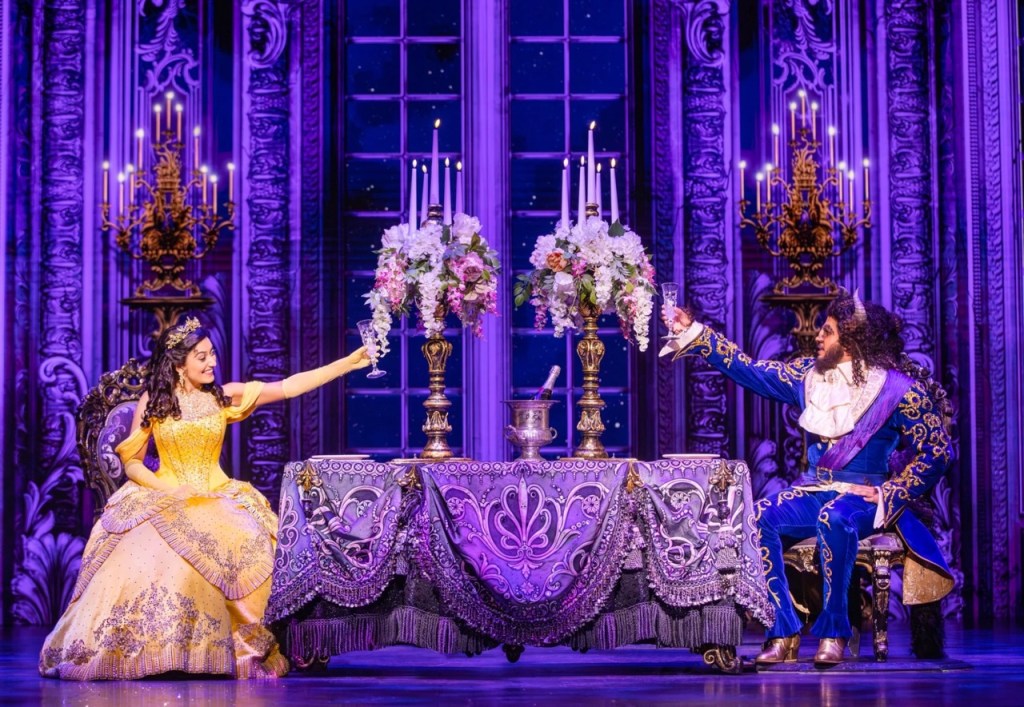
Apart from these highlights, and the excellent casting (Gareth Jacobs as Cogsworth, Jayde Westaby as Mrs Potts, Jackson Head as Gaston and Nick Cox as Le Fou were also stand outs), the show itself is pretty dull. Adult minds have to skip over the appalling sexual politics involved, and gloss over the shallow love story. The less said about the book the better frankly. There was no attempt to do anything other than a basic translation from screen to stage aimed at the smallest children.
But you can’t fight the amazing tunes by Howard Ashman and Alan Menkin. Those originals are timeless classics and do more storytelling than all the flashing lights, animated backgrounds and terrible dialogue that surround them. No matter how cynical I was, they won me over every time. The newer tunes with lyrics by Tim Rice barely made an impact.

The hierarchy of Disney Beauty & the Beasts is still The Original Animation > The Live Action film > The Stage Musical. Maybe the stage version and the live action film can switch depending on the casts but the original animation reigns supreme. There’s fun to be had here, but it’s a patchy affair. If you’re going to go, get as close as you can to the stage… and see if you can figure out how they do Chip! I really want to know!
-
Interview: Playwright Simon Stephens on ‘The Curious Incident of the Dog in the Night-Time’ (2018)

Belvoir have announced a new production of Simon Stephen’s blockbuster theatrical hit, The Curious Incident of the Dog in the Night-Time for their 2024 season, which got me thinking about the time I sat down with Stephens to talk about the play. Back in 2018 I visited Stephens’ home in London (where I was living at the time) to discuss the return season of the National Theatre’s production of Curious Incident for DOG Magazine issue 5.
It was a great chat about the nature of theatre and playwrighting in general. Both he and his wife Polly were charming and warm (as was their gorgeous dog, more on him later). Seeing as the magazine is no longer in print, and the interview was never published online, I’ve received permission from Julian Victoria, editor of DOG, to republish the text and images here.
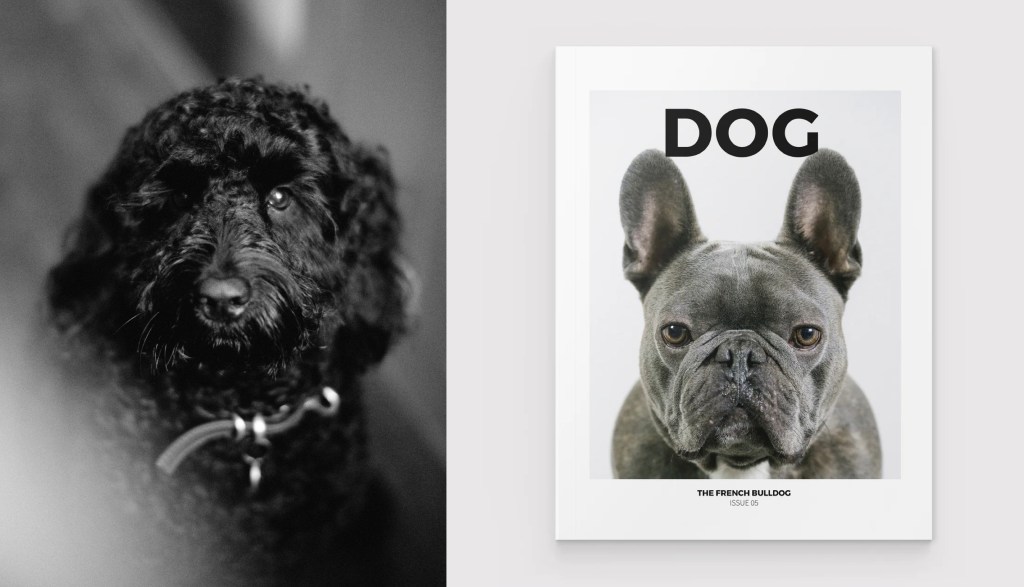
Gilbert & George, and DOG Magazine Issue 05. Photo: Julian Victoria. Simon Stephens’ home office is in a state of disarray. Boxes of books, recently brought out of storage, litter the floor beneath bookshelves waiting to be filled. The shelves are a deep blue, the desk a dark stained wood, with carefully selected lighting waiting to illuminate the words. The inside of the door is painted with a matching bookshelf mural. In time this will become a masculine writer’s cave, but for now it looks like a half-formed thing.
“I know there are some writers who can only work in zen-like conditions, but look at this house. Chaos and mess has an energy to it that I’ve always found really galvanising,” the playwright says with an impish grin. His wife, Polly, nods at the walls and says, “Mark Haddon built all this.”
She’s referring, of course, to the novelist whose book, The Curious Incident of the Dog in the Night-Time, was adapted into a stage play by Stephens in 2012. And that’s what we’re here to discuss. The play has had a trajectory usually reserved for large-scale musicals. An initial run at the National Theatre’s smallest space, the Cottesloe theatre (since rebuilt and renamed The Dorfman) sold out quickly, driven by the public’s love of Haddon’s novel. On deciding to move the show to London’s larger West End theatres, the production team restyled it into the show we know today – a brilliant synthesis of unexpected lighting, projections, physical movement and set design. Since then, Curious Incident has been on a non-stop tour around the UK, Europe, America, China and Australia, and broadcast into cinemas around the world. Six years on, and it’s now returning to London. This kind of run-on success is almost unheard of for a single theatre production.
“We pray to Mark Haddon every day in our family,” says Simon with a laugh, but it’s hard to tell if he’s really joking.
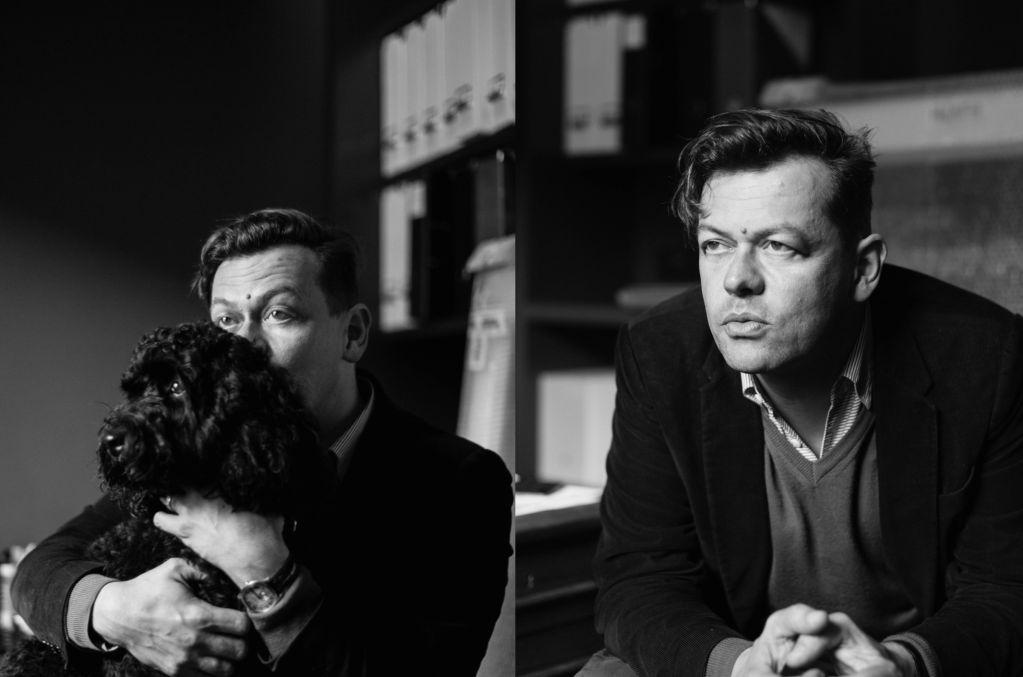
Simon Stephens. Photo: Julian Victoria. Stephens’ professional career has spanned 20 years and more than 30 plays, many of which are dark and violent pieces. But it is this one play about a boy, a dog and his father that has become a constant presence in his life.
“I think the thing about plays is that if they have a life, that life is innately collaborative. When I watch Curious Incident, I watch it with a great pride. I do have moments when I go, ‘This is good’, but it’s never because of the words, it’s the collaboration. I think the director Marianne Elliott is one of our great theatre artists. The casts, and we’ve had many casts now, have always astonished me with their level of commitment. The lighting design, the video design, the sound design, the music, the movement – all of those elements just combine together. I think that this is one of the most beautiful collaborations I’ve been involved in.
“The biggest test for me was that this is such an English story. Mark rooted the novel so heavily in Swindon and” (here, Stephens raises his voice like a train conductor), “Willesden Green! Willesden Junction! I was nervous that it wouldn’t translate to other countries… I wonder if there are people in Beijing or Melbourne asking themselves ‘Ooh I wonder what exotic Swindon is like?’” and that infectious laugh comes back.
Two things strike you about Simon Stephens. The first is that he laughs freely and easily. It’s a loud laugh, warm and hearty in the best traditions of Northern England (he was born in Stockport, Manchester). The second is that he’s spent a lot of time thinking long and hard about the theatre. When a question grabs him, he pulls himself forward, almost into the classic ‘thinker’ pose, and works the thoughts around his head. He pulls on a tuft of his unruly mane of hair before speaking.
“Someone said this at the workshop this morning [Stephens came from running a workshop at the National Theatre] ‘Most animals learn from experience but we can learn from the tales we tell each other.’ I think that storytellers are a fundamental part of refining the stories we tell ourselves about our world. “There are some things I would never go to the theatre for – you go to journalism for factual interrogation of developments in the news. They can act faster and more rigorously than any playwright ever could. But what a playwright can do is tap into the really deep stories that underpin all those things.”
Hear Belvoir Artistic Director Eamon Flack discuss The Curious Incident of the Dog in the Night-Time during their Season launch video. Can a play change the world, I ask, or does it reflect the world back to us so we can examine it, or is this all just middle-class catharsis?
“The point was made to me that in this country, playwrights tell the stories the TV writers watch and then it percolates into TV drama, which then percolates into soap opera. But in order to crystallise that, you first need to tell more radical stories, and the form that does that best is theatre.
“For example, I’ve read the suggestion that in Britain our recalibration of gay rights in the ‘80s began with the stories we told. I remember my parents were really freaked out by the idea of gay people in the ‘80s, and it took stories to change that. You could say Jonathan Harvey’s Beautiful Thing instigated a cultural revolution that culminated in a Tory Prime Minister introducing gay marriage in the UK, in the space of a generation. It’s simplistic to attribute this entirely to drama, but that’s change! And it is change brought about by reimagining the stories we tell.”
“We live in a culture where anything other than immediacy is frustrating. Maybe the slowness of theatre can be one of its most valuable elements. I started writing Curious Incident in 2009/10 and it wasn’t until 2012 that it was produced. That’s two-and- a-half years of waiting. I think to write a play about the latest developments in the Brexit negotiations would be awful. We need a bit of space. What theatre can give us is metaphor. You can only be really visionary if you allow yourself to breathe. You’ve got to look for the deep layers.”
And looking for deep layers takes time, time which Stephens as a full-time playwright now has.
He explains, “When people think about writing they think about the articulation; the sitting down and writing a scene. But the other bit, the bit where you’re reading widely, you’re listening to music, you’re interviewing experts, you’re making notes and going for walks – that’s really important. There’ll be days I’ll have a lengthy lunch at Blacks [the dog-friendly members club in Soho], then go to see an art exhibition at the RA or the Tate Modern and meet some friends. I usually do the school run. Or I can sit down and write from 9am to 10pm.”

The Curious Incident of the Dog in the Night-Time. Photo courtesy of Belvoir. Growing up, Stephens’ cultural diet was primarily one of films (he’s an early fan of Martin Scorsese and David Lynch) and music, with the occasional family trip to see a big touring theatre show around Christmas. “There was an association with theatre being urban because we’d go into Manchester, and they were transgressive because we’d be going out on a school night.”
Now he finds himself transitioning between being the young writer on the scene, to working with the next generation of writers – a call-back to his training as a teacher.
“I feel really inspired by younger playwrights. It’s one of the great joys of our art form in that neither age nor youth are hierarchical. In rock and roll it tends to be youth that’s hierarchical. In other art forms age is more valued. I love that we stand on each other’s shoulders. Some of the most important creative relationships of my life have been with artists who are 20 years younger than me. The things I’ve learnt from Alice Birch or Alistair McDowall are really substantial. The joy of doing the [Royal Court] podcast series is talking to those people at length about their working life and form. I’m as likely to cry from something Alice or Alistair have said to me, as I am from something that Peter Gill or David Hare or Howard Davis might say.”
While the thought of taking over a theatre has little appeal to him (“When I think about the actuality, you’re managing the back of house water supply, making sure the ushers are paid fairly and that the lifts are working. I think I’d find that more draining than inspiring.”) he does enjoy the idea of playing in other mediums.
“I’d quite like to write a bit of telly, and there are a couple of filmmakers I have affection for and enjoy the idea of collaborating with. I’m enjoying making music. I made a bit of music with Underworld – we did a show together called Fatherland. In the next five years, if I make some music or make a film that’ll be great, but my heart will always be in the theatre. It will always be the form I return to.”
While Stephens’ mannerisms are one of a thoroughly engrossing university lecturer, the way he describes his career is more blue-collar in nature.
“One of my obsessions is the spelling of the word ‘playwright’. I talk about the complicated presence of the ‘ght’ in that word all the time, which confused me for years. It doesn’t make any sense until you realise that the verb from which it stems isn’t the verb ‘to write’, like writers do, it is to ‘wright’ like a wheelwright has wrought a wheel, or a shipwright has wrought a ship. So a playwright has wrought a play – we’re shapers, we’re makers. We’re not writers, we’re not people of letters – we make drama, we shape and craft it. It’s more like woodwork. ‘Wrights’ make things out of wood. If plays were made of iron we’d be ‘smiths’ – playsmiths. Like wordsmiths. Words are made of iron, plays are made of wood.”
He continues, “It was at university that I discovered theatre as an art form. Like a lot of people’s introduction to theatre, it was fundamentally libidinous. All of the most attractive girls at York University wanted to be actresses. So in a pathetic, misguided and ultimately entirely fruitless attempt to meet these incredibly exotic girls, I’d go to watch these dreadful student productions. And though the girls never spoke to me and the plays were terrible, I fell in love with the room. Having loved live gigs, and the potential to tell a story like Scorsese, the idea of combining the energy of the two… fundamentally that’s all I’ve tried to do for 30 years since.”
Somehow, between writing plays, working with younger playwrights, recording a podcast series for the Royal Court and being an Artistic Associate at the Lyric Hammersmith, Stephens also has time to be a father to three children, two cats and a Cockapoo with the double-barrelled name, Gilbert & George.
“The original idea was to replace each child with a dog when they left home, and then call the dog the name of the child. But we got him early and named him after the artists Gilbert & George.
“I think I only really discovered the reason we got him after we got him. It’s the extraordinary spiritual energy of having something in the house that just loves us all unequivocally. To be really loved is special. Also, for my younger son, it’s hard to be a boy who can express love and vulnerability and need, but he can do it with a dog. He just holds the dog and can just say that he loves this thing and that’s really useful for a 17-year-old boy to be able to do. Gilbert & George has bonded us; this completely shared love we have for this little dog is just really beautiful.”
Is he ready for the idea that his other, more ‘Curious’ dog, looks set to be part of his life for a lot longer as well?
“Maybe? There’re calls for it to go to South Africa or back to Australia. I love it. I love that it’s been a gateway to the theatre, in the same way that the book was a gateway – for many people it was their first serious novel. If we can capture any of that sense of empowerment the novel gives people over an art form they may not feel they have been empowered to engage with, then I think that’s a real honour. It feels like a genuine privilege.
“The most recent incarnation, before the revival in the West End, has been an edited version we made to tour classrooms and assembly halls. It’s in the round like it was back at the National Theatre. It demonstrates the versatility of Marianne Elliot’s imagination, I think. Watching that was revelatory. The energy and the vitality of kids, kids who weren’t used to going to the theatre, watching that play in their classroom, was just astonishing. It’s a show that continues to inspire me.
“We’re living in a complicated political moment in Australia, the US, the UK, all of Europe and South America… Looking at Curious Incident now, I think there’s something special about an artistic experience that makes people think, ‘Maybe humans are alright.’ When I watch it, that’s what I see: the amazing potential of the human animal to be brave and kind. And that feels politically radical to me in a way that it didn’t in 2012. That maybe humans are quite good, actually.”
-
Wicked (Sydney Lyric) ★★★★★
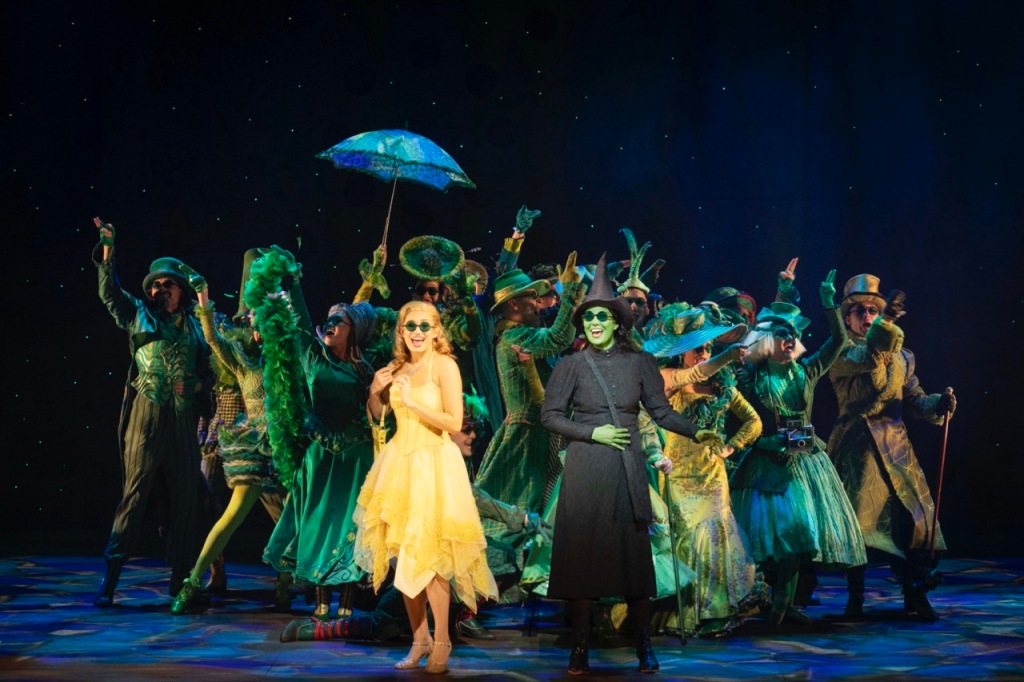
Music and lyrics by Stephen Schwartz. Book by Winnie Holzman. Based on the book by Gregory Maguire. Sydney Lyric. 25 Aug – 31 Dec 2023.
Whoever thought the tale of an unlikely friendship between a green domestic terrorist and a blonde collaborator, who fall in love with the same Shiz-tagram thirst-trap would be one of the biggest musical theatre hits of all time? But then, we also all rushed out and watched a plot-less show about cats, so maybe we’re not the best judges of taste. Yes, now that the kids of Hogwarts have left the country, it’s time for the students of Dear Old Shiz to rise once more – Wicked is back baby, to take over the other Emerald City of Oz (that’s Sydney by the way)!
Are you ready for another dose of that same ol’ black magic? I mean this is literally the same production as when it debuted 20 years ago. Nothing has changed. Well, I’m sure small things have changed, but the smash-hit songs and the empowering story of female friendship are all still there. Two witches, both alike in dignity in fair Oz where we lay our scene etc.

Courtney Monsma and Sheridan Adams. Photo: Jeff Busby. My cynical, critical hat was firmly on my head as the show started but once we got past the intro, it all started to click. It became clear that the producers hadn’t just cast the biggest, blandest voices they could… These people can really act. Somehow, miraculously, Wicked felt fresh again, like I was watching it for the first time with an original cast.
Long running shows can be hard to appreciate. They exist in the shadows of all their previous casts and the expectations of the audience who know the original recordings by heart. It’s the nature of these productions that, over time, the performers generally get less experienced (i.e. cheaper), or overloaded with D-list celebrities, and they find themselves sleepwalking through the template set years ago. Thankfully this staging avoids all those pitfalls.

Sheridan Adams and Courtney Monsma. Photo: Jeff Busby. Courtney Monsma’s Glinda was not only funny (it’s all in the off-the-cuff mannerisms that she nailed every time), but also full of.. I can’t believe I’m saying this… genuine pathos. You totally got her blend of entitled enthusiasm and social awakening. I’ve seen Glinda’s who looked like they were having a stroke with every forced squeal and dramatic mood swing, but Monsma gives a completely honest performance that felt natural at every turn. She may be the best Glinda I’ve ever seen.

Sheridan Adams. Photo: Jeff Busby. Similarly, Sheridan Adams hits the literal highs as Elphaba. It’s always been a frustratingly underwritten central role (she never really changes and is forced to be the “straight man” to Glinda’s quirkiness). Her rendition of “The Wizard and I” is the starting gun that sets the whole night off – the cheers from the audience were electric. By the time we hit “Defying Gravity” you could feel the room sit up in anticipation and we were not disappointed.

Liam Head, Courtney Monsma and Robyn Nevin. Photo: Jeff Busby. Robyn Nevin gives Madame Morrible some actual dramatic weight. She’s terrifying with a twinkle in her eye. I did wonder if she would be doing a big musical to cash the check and take it easy, but no, Nevin delivers the ridiculous dialogue like she’s doing Ibsen. Todd McKenney also gives us a Wizard who is nicely restrained. Coming alive centre stage when needed but never stealing the limelight from the leading ladies. Liam Head is full of charm and swagger as the callow Fiyero, briming with safely PG-rated sensuality. Adams and Head actually manage to inject some sexual tension as they writhe in the fully-clothed “As Long As You’re Mine”, although all that ‘singing loudly straight into your partner’s mouth’ can’t be healthy, neither can all that dry humping… surely those costumes start to chafe?
I’ll take my black, pointy hat off to local director Lisa Leguillou for keeping this production vibrant. It may seem like a small thing, but it was clear the actors were “discovering” their moments rather than anticipating them. They weren’t just copying the original direction of Joe Mantello, they were doing the hard work to really give it a life of its own.

Courtney Monsma, Liam Head and Ensemble. Photo: Jeff Busby. Whenever talk of the upcoming film adaptation comes up, I’ve rolled my eyes at the thought of the producers splitting the narrative in two separate movies. But watching the show for the first time in a decade, I can see how compressed the story is. Elphaba and Glinda’s friendship turns on a dime more than once and really only works because the audience is constantly distracted by another catchy showtune. Maybe, given extra space, their characters can develop a bit more organically.
This is Wicked. I’m pretty sure you already know if you’re interested or not. If you’re allergic to big musicals then steer clear, but if you like big Broadway belters as I do then definitely go see it. If you’ve never seen Wicked before, you’ll get to discover why it’s so beloved, and if you’re making a return visit, it’s a great reminder of how good it was in the first place.
This review is based on the final preview / “media night”, not the official opening night.
-
The Dismissal (Seymour Centre) ★★★★

Book by Blake Erickson and Jay James-Moody, Music and Lyrics by Laura Murphy, Conceived by Jay James-Moody. World Premiere. Seymour Centre. 31 Aug – 21 Oct 2023.
Squabbalogic’s time-travelling new musical, The Dismissal, is an assault on your senses (and memories) as it retells the story of Prime Minister Gough Whitlam’s demise. It’s an insane part of Australia’s history, and The Dismissal matches that with suitably manic storytelling enthusiasm.
1975 was an historic year for Australia. Two events would change the course of the nation’s history. Firstly, the Governor General Sir John Kerr (Octavia Barron Martin) would step out from his traditionally ceremonial position and use his reserve powers to remove Whitlam (Justin Smith) from office. Secondly, I was born. Okay, I’ll admit the second one was perhaps less important in the grand scheme of things but was pretty significant to me.

Georgie Bolton. Photo: David Hooley The dismissal of the Labor government was the culmination of audacious political moves and an unprecedented use/abuse of power. Had Whitlam tried to move too fast with his progressive agenda? Had Malcolm Fraser (Andrew Cutcliffe), the leader of the opposition and next Prime Minister, manipulated events to force Whitlam out? Was Kerr a puppet or the puppet-master? These three men would shape the nation, ending a spree of lower-case-L liberal policies and forcing a debate on the place of the monarchy in Australia. Spoiler alert: Australians still hate change and the monarch of Britain, King Charles III, is still our Head of State.
Seen through the eyes of Norman Gunston, Garry McDonald’s satirical small-time TV reporter from the 1970s (played by Matthew Whittet), the events unfold in a not totally linear order. The fact a fictional reporter was actually present for one of the biggest political stories in our history says a lot about Australia’s attitude to news and politics. I’m genuinely curious to see how younger audiences react to Gunston, whose cultural footprint has dimmed over the decades. Are they even really aware of who he is anymore?
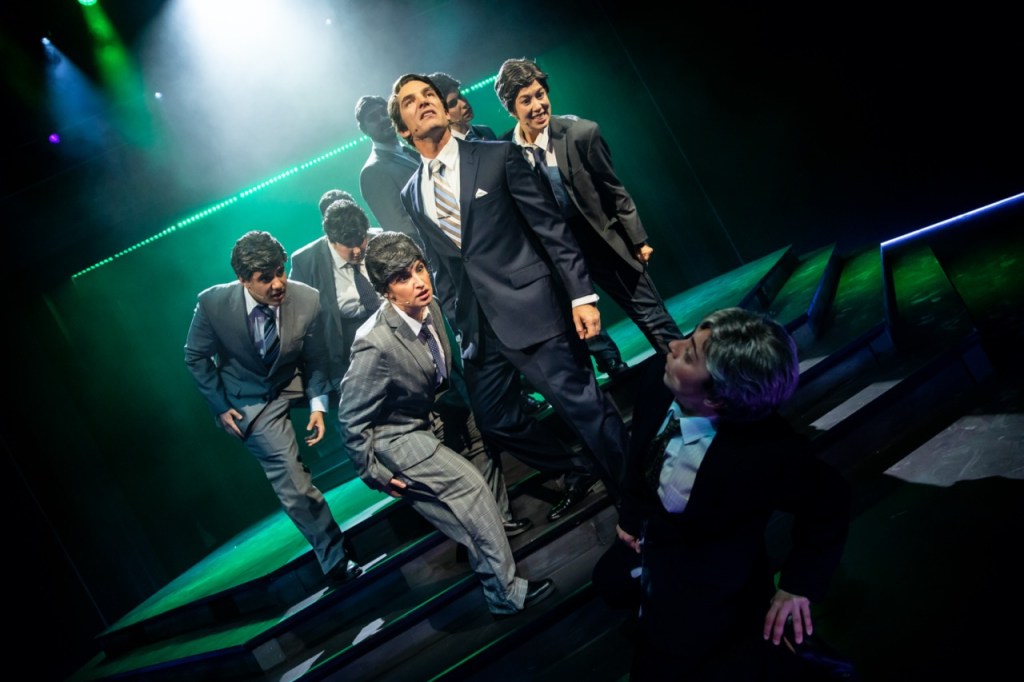
Quinton Rofail Rich, Georgie Bolton, Brittanie Shipway, Joe Kosky, Andrew Cutcliffe, Stacey Thomsett, Monique Salle & Kaori Maeda-Judge. Photo: David Hooley You can’t accuse book writers Blake Erickson and Jay James-Moody of playing it safe. This is the kind of inventive, explosive new musical that we’re sorely lacking on stage. If anything, I’d fault the show for trying too much, pushing so hard that some moments feel overcooked, but I’d take a hundred scruffy-but-bold shows over the snoozefest of endless revivals Sydney is currently stuck in.
James-Moody has assembled a near perfect cast that both channel the look of their real-world versions without compromising on the performance chops. Justin Smith, the unsung hero of Belvoir’s Into The Woods, swaggers as the triumphant-the-embattled Whitlam. Cutcliffe’s Fraser is seductive and sharp (a step up from the actual version). But it’s Octavia Barron Martin as Kerr who really steals the limelight. Her dimwitted, insecure version of the real man is this show’s version of Ryan Gosling’s Ken from Barbie. Sincere but lacking, Kerr is shown as being manipulated by others and his own fragile ego into pushing the boundaries of his personal power. Of all the players, Kerr has the strongest arc and characterisation.
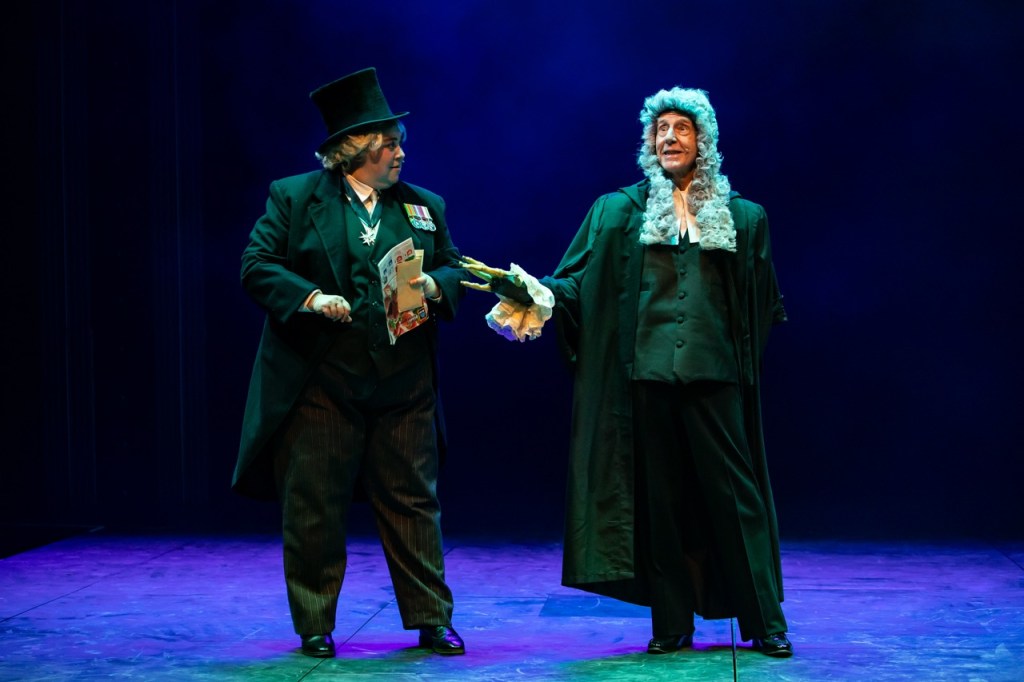
Octavia Barron-Martin & Peter Carroll. Photo: David Hooley. Around these three, the ensemble are having the time of their lives (and performing a bewildering number of costume and wig changes). Peter Carroll is chewing the minimal scenery as the demonic Justice Garfield Barwick. Joe Kosky steals scenes with his deep, cerebral Dr Jim Cairns who is often misconstrued. And Monique Sallé should be earning triple pay for her barnstorming turns as Opposition Leader Billy Snedden, International Trade Emissary Tirath Khemlani and, best of all, Queen Elizabeth II – that one is worth the price of admission alone (think Diana: The Musical but actually deliberately funny).
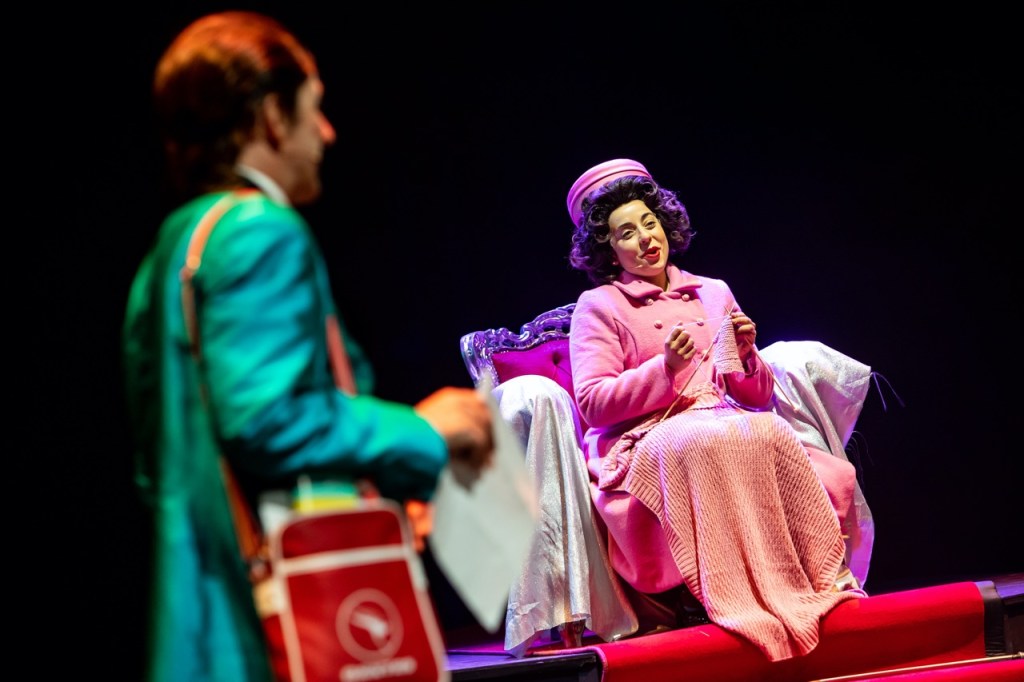
Matthew Whittet & Monique Salle. Photo: David Hooley However there is a lack of focus to the show that starts to frustrate as the evening progresses. Whitlam and Fraser never feel truly defined, not in the way Kerr is. Minor storylines, like the sexist treatment of Junie Morosi (Shannen Alyce Quan) which has no real impact on the story, feel inserted just because Quan is so good it felt like a waste not to give her a solo number. The final epilogue feels needlessly tacked on to bring events to the modern day. While there are some hilariously catchy tunes (“Private School Boys” and “I’m Not Listening” are real standouts), others come across as filler (Whitlam’s anthem “Maintain Your Rage” doesn’t really land).
The Dismissal combines the satire and fun of The Wharf Review with big musical theatre energy for a very Australian show. This is the kind of show I crave to see more of. Australian stories told with zeal and imagination. While it may occasionally lose its way, it is guaranteed to never bore you.
-
Subscribe
Subscribed
Have a WordPress.com account? Log in now.

