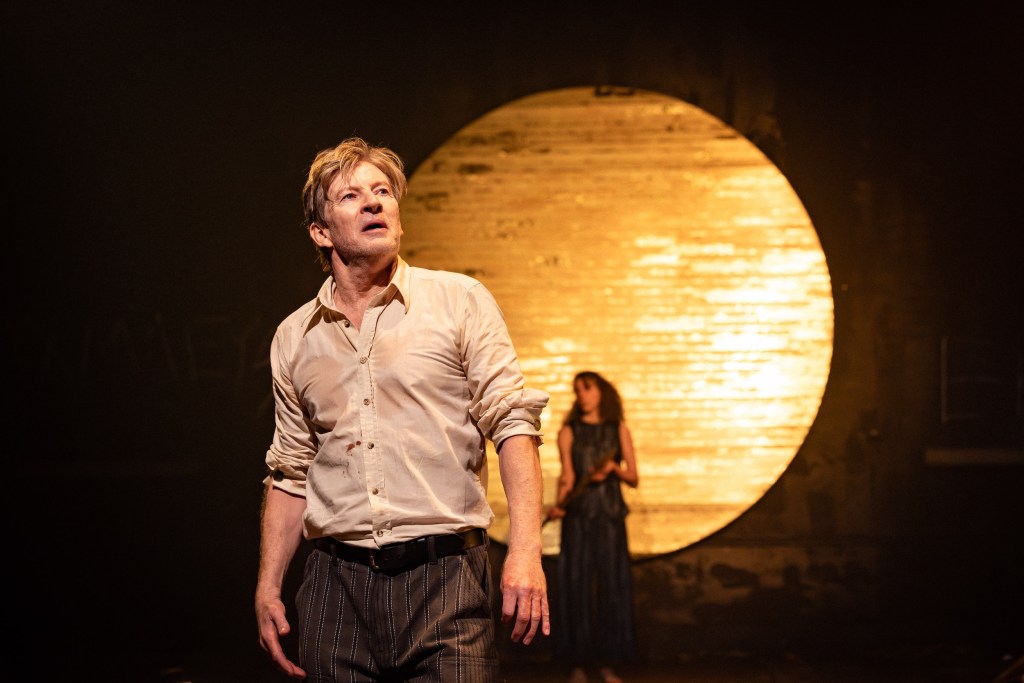
Written by Lisa Peterson and Denis O’Hare. Adapted from Homer’s Iliad. Translated by Robert Fagles. Sydney Theatre Co. Wharf 1 Theatre. 18 Apr – 21 Jun 2026.
My first thought, looking at the bare walls of the Wharf 1 Theatre was, “Jeez, STC has spared all expense on this one!” I was of course proven wrong in very short order as An Iliad bloomed into an ingenious piece of lo-fi story telling. Small on sets but big on visuals.
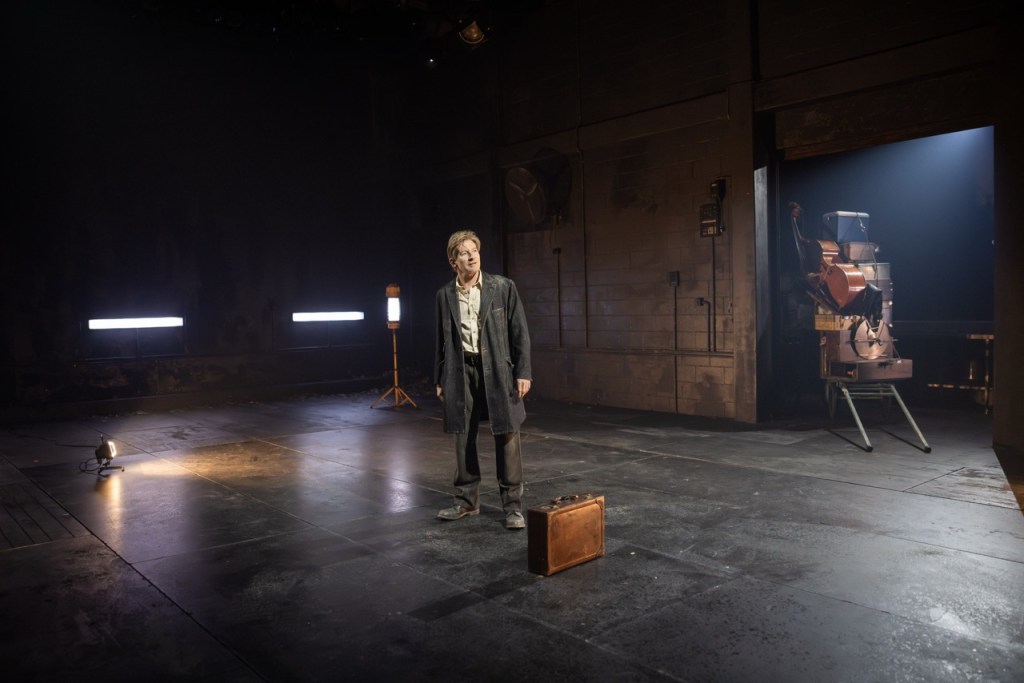
How do you tell the story of the Trojan war with only one man and a musician? You rely on old fashioned oral storytelling with some well chosen props, the odd lights and some atmospheric sound.
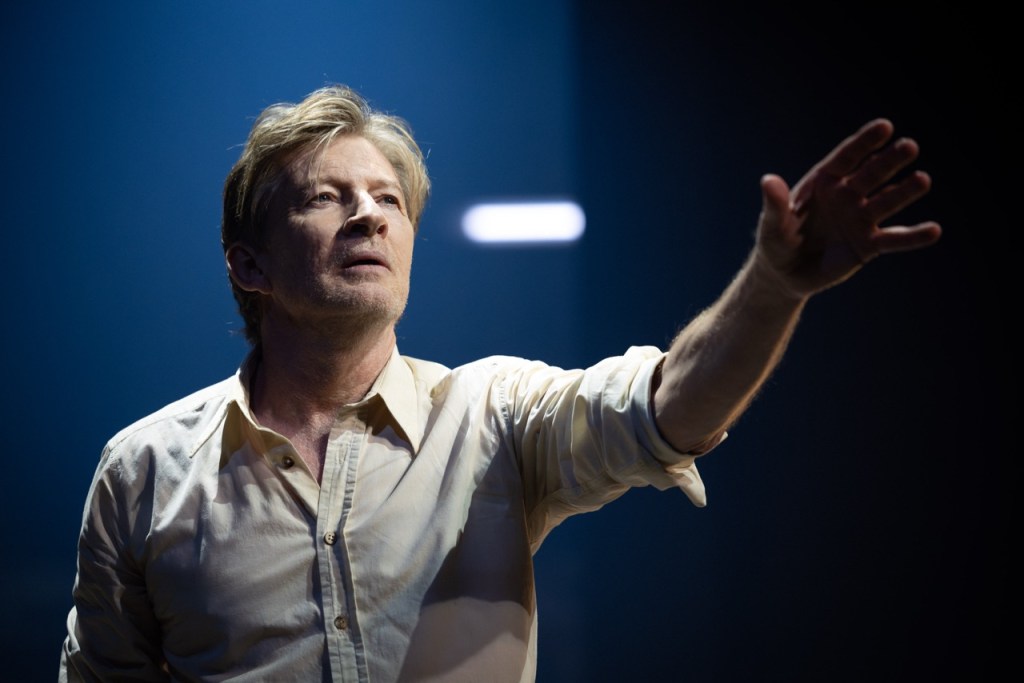
The Poet (David Wenham) has been singing his song for… well it feels like a millennia. The same story echoing through time. He’s getting tired of the telling, but this is what he does. With the help of The Musician (Helen Svoboda), he tells the tale of human war – and that tale hasn’t ended yet. Wheeling a cart of tricks onto the bare stage, he uses the tools of his trade to transport us back to ancient Greece, and the battle lines of the Trojan War where Achilles and his beloved Patroclus are torn asunder by fate and human greed.
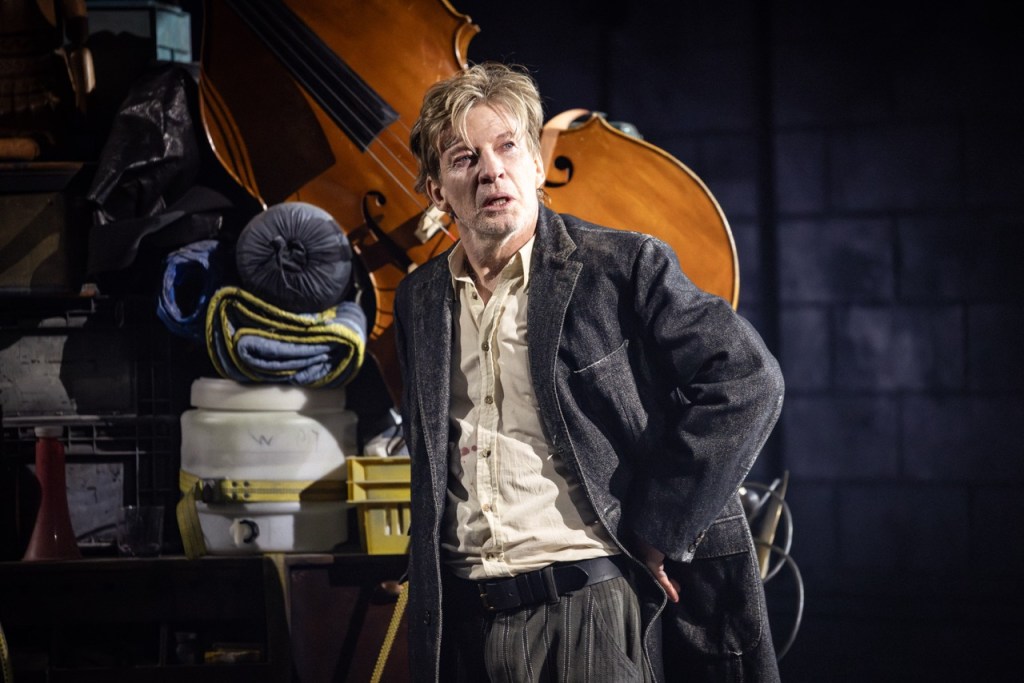
An Iliad requires a storyteller with magnetism to make it work, and Wenham’s powerful, sonorous voice and malleable manner make him a terrific fit for this tale. He brings a world-weariness to The Poet, a deep sadness at the state of humanity, that seeps out of him as he tells his story. Lines like “Achilles, who is addicted to rage – as so many of us are, really, when it comes right down to it…” slip into your brain with their casual assuredness. Wenham never overplays the emotions, making it more powerful.
He is joined by Helen Svoboda as The Musician, who aids him in his tale with the use of a cello, vocals and percussion. Svoboda’s performance is much more than just musical accompaniment. She becomes part of the show’s visual and aural fabric, bashing the strings, letting out wails of anguish and acting as a puppeteer. Her presence gives you a broader sense of the story being told, of the impact on the civilians inside Troy and those waiting at home for the armies to return, of Helen, whose beauty began the feud, and of the gods watching the action below them.
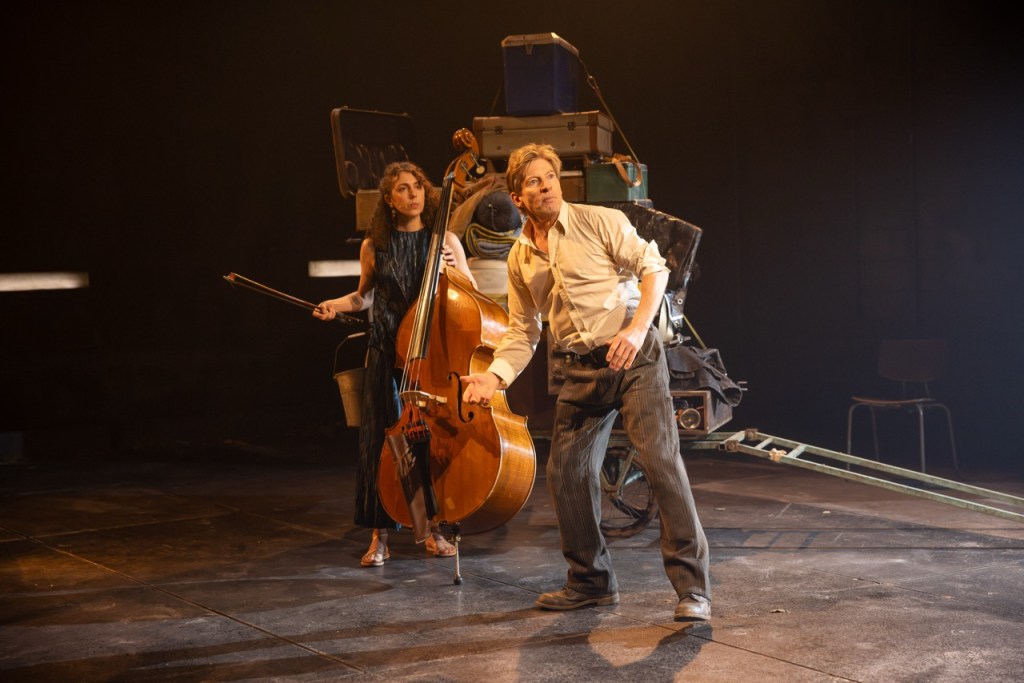
Under Damien Ryan’s direction there is a simplicity that speaks volumes. The stage is that of an abandoned warehouse. A well placed light, a simple misdirection, a rising musical cue, do all the work of a full scale set (kudos to Brady Watkins’ immersive sound design – aided on opening night by a thunderstorm outside). Ryan’s work isn’t on the stage, but in your imagination. When he does give us a visual – like a towering silhouette, a helmet engulfed in flames, or the rise of a golden orb – they make an impact.
In this sea of sparse design, the focus falls entirely on the storytelling and the language. With a text that has been localised for Australian audiences, the play is filled with sly laughs to keep it light – Wenham is a practised master of a wry look or casual aside. But it’s often the simplest things that cut deepest. The most impactful part of the night comes as Wenham simply recites a chronological list of wars from Troy to today. The sad lesson is self-evident. We never change. We never learn.
With a virtuosic performance at its centre, and marvellous inventive stagecraft, the cracks in the script start to show. Playwrights Peterson & O’Hare have narrowed the focus of the story from Homer’s original sprawling epic poem and that requires a bit of didactic set-up. Despite everyone’s best efforts it does occasionally slip into a recitation of event after event and it’s hard to drum up real emotional investment in Achilles’, Patroclus’ or Hector’s woes. I found myself intellectually stimulated by the text, but my emotions were left unstirred.
You may have experienced other Iliads in the past, like Brad Pitt’s lamentable film Troy, or you may be gearing up to see Christopher Nolan’s upcoming blockbuster cinematic version of Homer’s ‘sequel’, The Odyssey – no matter what has piqued your interest in An Iliad, it is easily worth the price of admission to see David Wenham flex his theatrical muscles once more.


Leave a comment