-
Welcome to Cultural Binge

The rating system is simple:
★★★★★ – Terrific, world-standard. Don’t miss.
★★★★ – Great, definitely worth seeing.
★★★ – Good. Perfectly entertaining. Recommended. Individual mileage may vary.
★★ – Fine. Flawed and not really recommended, but you may find something to appreciate in it.
★ – Bad (& possibly offensive).
See more reviews over at The Queer Review.
Instagram: @culturalbinge
Substack: culturalbinge.substack.com
Email: chad at culturalbinge.com
-
Till The Stars Come Down (KXT) ★★★★
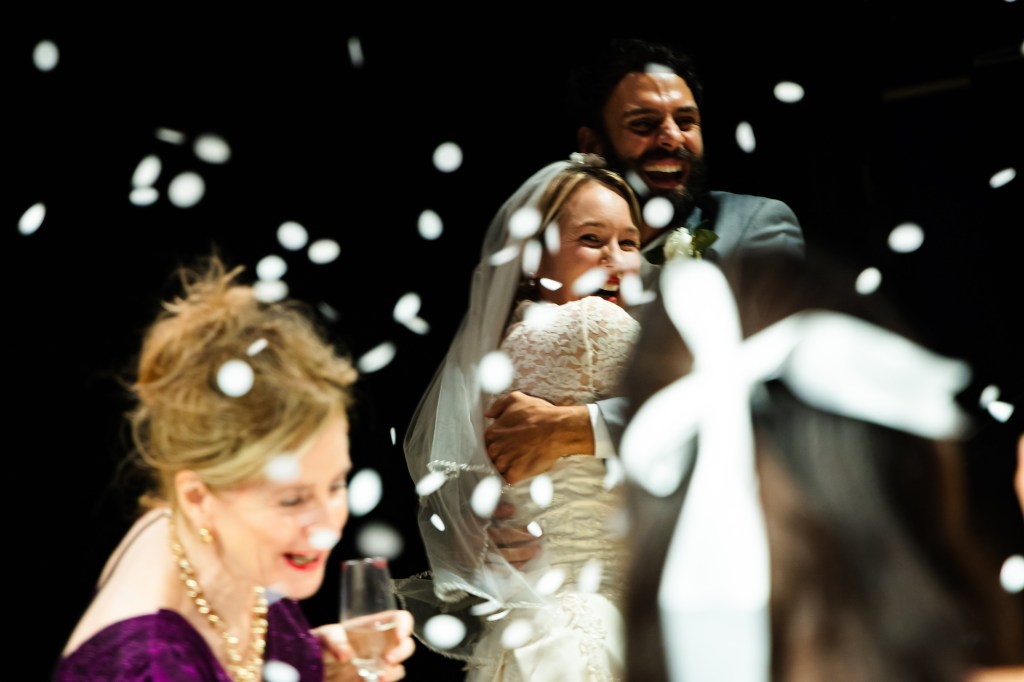
Written by Beth Steel. Secret House in association with Bakehouse Theatre. KXT on Broadway. 17 Mar – 11 Apr 2026.
I had a sinking feeling at the start of Till The Stars Come Down at KXT. As the UK specificity of the play started to unfold (and one accent clanged a bit) I worried this was going to be one of those acclaimed UK plays that doesn’t quite resonate here in Sydney. What do complaints about Polish immigration have to do with Sydney in 2026?
My initial misgivings were completely unfounded. Beth Steel’s West End hit may be rooted in the English Midlands and filled with UK-centric details, but its heart is universal. And most importantly — it’s hilariously funny.
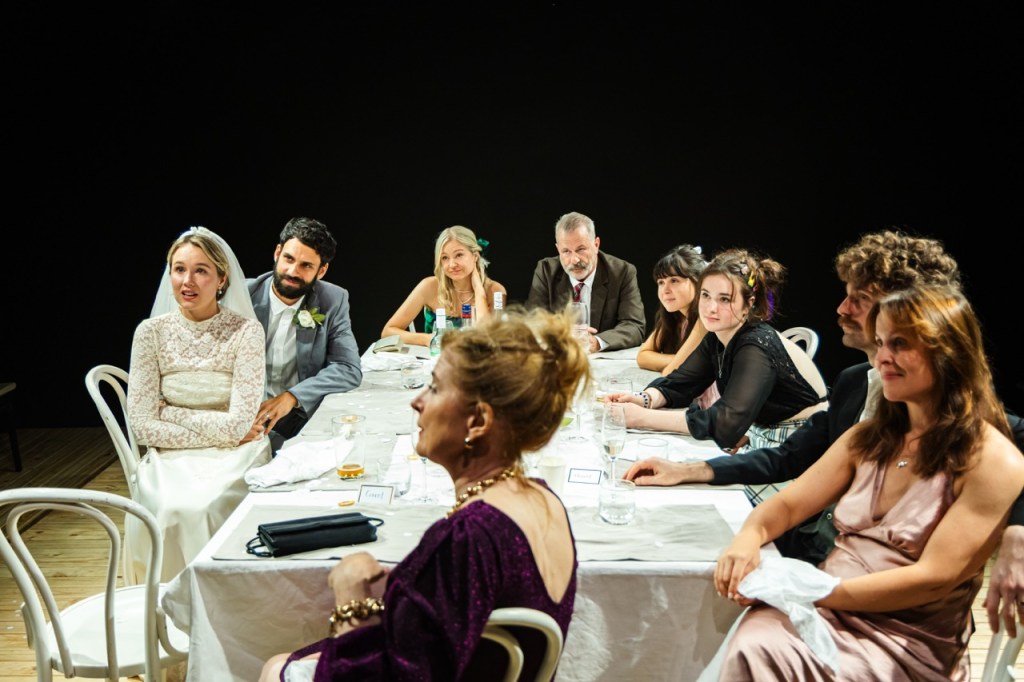
Ensemble of Till The Stars Come Down. Photo: Braiden Toko. Sylvia (Imogen Sage), the youngest of three sisters in a working-class family, is getting married to Polish immigrant Marek (Zoran Jevtic) today and the audience is all invited. Her eldest sister Hazel (Ainslie McGlynn) is frantically trying to keep the extended family on time, including her two daughters, taking on the tasks their late mother would have done. Meanwhile, frequently-married-now-divorced sister Maggie (Jane Angharad) has returned home for the big event having moved away six months ago. The three sisters’ banter flies thick and fast. But it’s clear something isn’t right. Maggie is vague about her reasons for moving away, and Hazel keeps making xenophobic comment about immigrants. Sylvia has the feeling something bad is going to happen — but she has no idea what it might be.
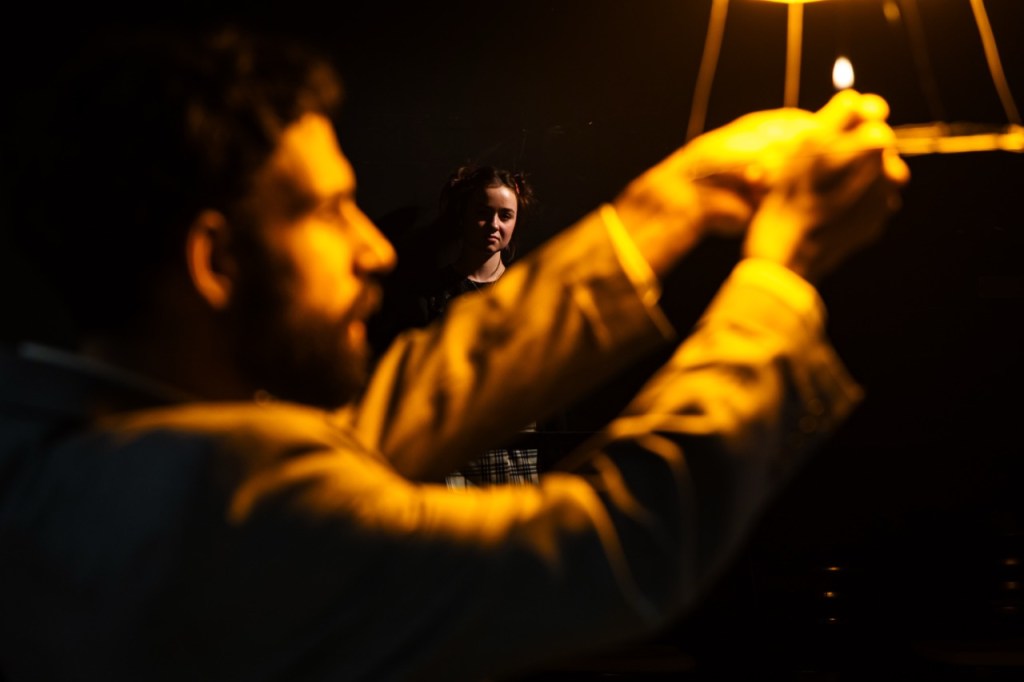
Zoran Jevtic & Amy Goedecke. Photo: Braiden Toko. Told in more-or-less real time, Till The Stars Come Down charts the events of one tumultuous wedding, and Steel has populated it with vivid characters that all happily wrestle for your attention. It’s a non-stop barrage of jokes, clues and familiar family dynamics. The three sisters bounce off each other like kids on a trampoline, finding their own rhythms to all stay mid-air. This effervescent patter makes the time fly as it layers in exposition without you noticing.
Among the large cast, it’s the women who truly shine — from younger performers playing Hazel’s daughters Leanne (Amy Goedecke) and Sarah (Kira McLennan), to the absolute scene-stealing Aunty Carol (Jo Briant — in brilliant drunken form).
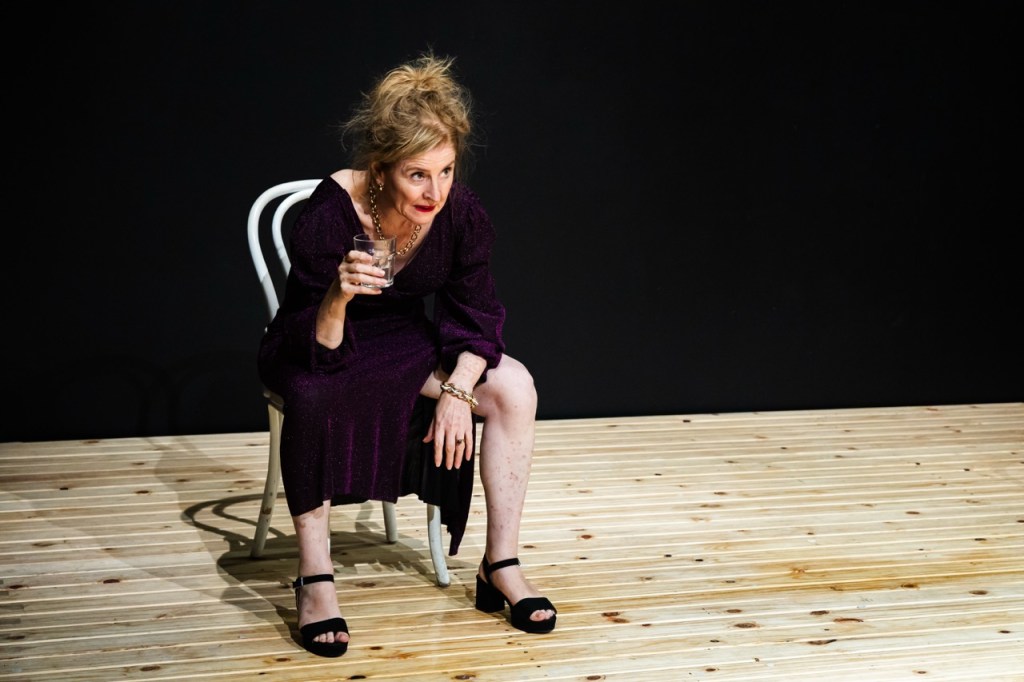
Jo Briant. Photo: Braiden Toko. Director Anthony Skuse keeps the apparent screeching chaos under control, letting the excellent script and strong performers play. Scene transitions may be awkwardly long, but Skuse fills them with activity (helped by a support ensemble of Nick McGrory, Marley Dunn and Cyan Fernando — all in character). Layla Phillips’ sound design is lively and impactful, as is Topaz Marlay-Cole’s lighting. James Smithers’ set is practically minimal but has a clarity of purpose.
But the absolute star of the night is Beth Steel’s naturalistic, idiosyncratic script. It grounds the twisted familial drama in realism, and when things turn ugly, it hits all the harder. The tears feel as earned as the laughs.
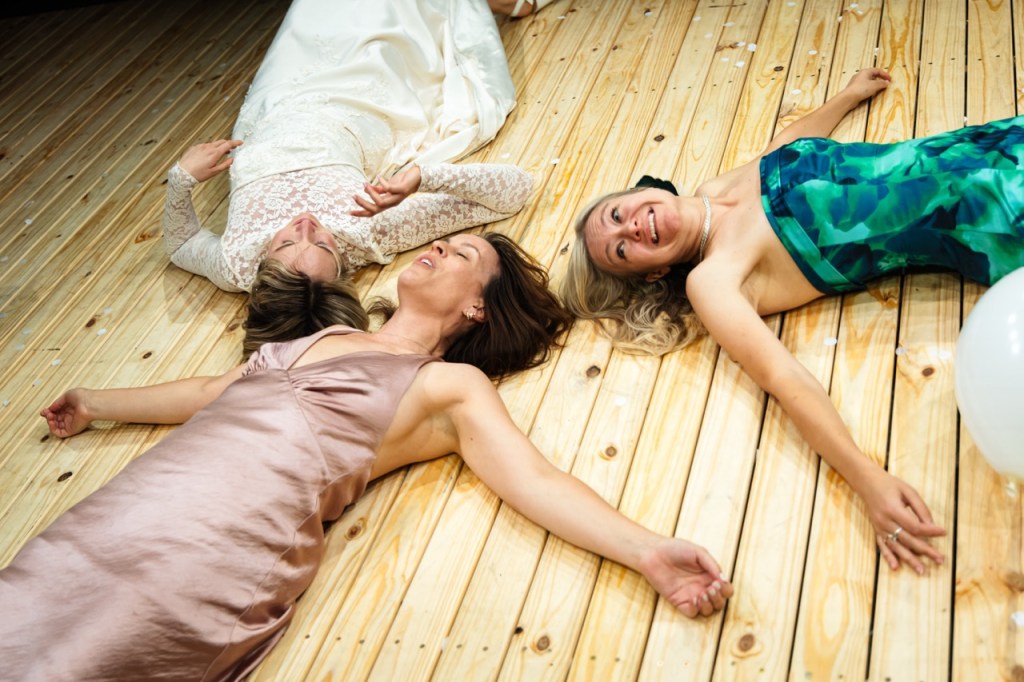
Imogen Sage, Ainslie McGlynn & Jane Angharad. Photo: Braiden Toko. At London’s National Theatre (and on the West End), Till The Stars Come Down would play like a “State of the Nation” piece — a slice of UK life echoing national themes of economic pain, loneliness, rising xenophobia and a lack of hope. Today, in Sydney, it’s freed of much of that portentous weight and is simply a knotty family drama filled with clear truths that resonate here.
This is simply good theatre. It’s not trying to break any rules or be too clever — it’s here to take the audience on a journey, and it does it beautifully.
-
Femoid (Old Fitz Late) ★★★
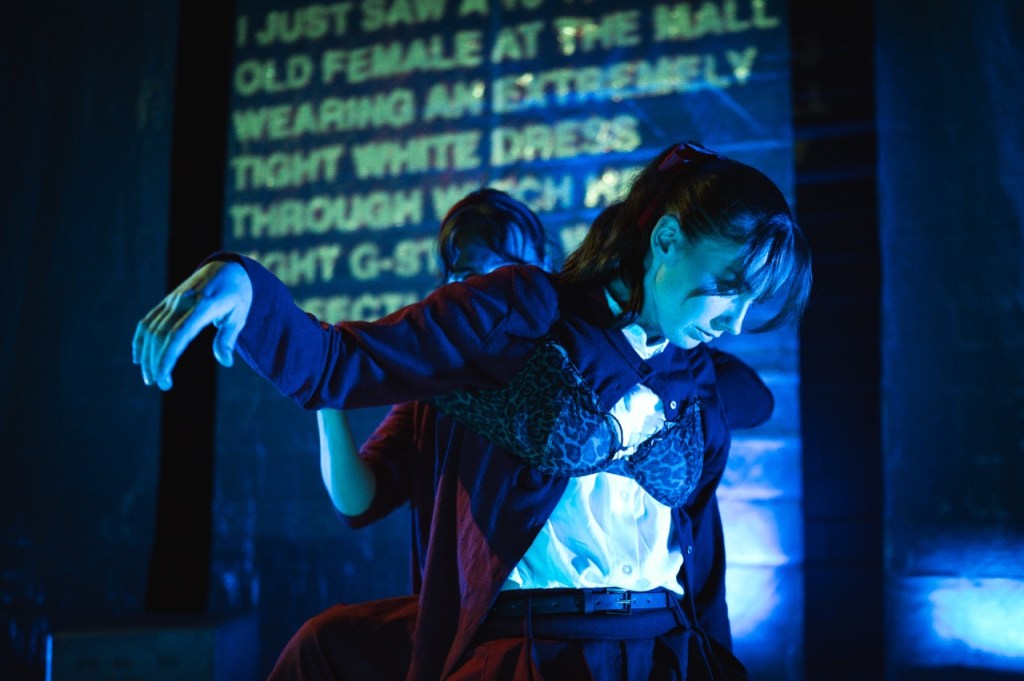
Written by Iris Warren. Presented by Vixen Theatre Company. The Old Fitz Theatre. 31 Mar – 10 Apr, 2026.
Femoid wants to incite your rage about the “manosphere” but instead it elicits a feeling of inevitable sadness.
Rory, Olive, and Piper are thick as thieves, buzzing with excitement and nervousness about the future — sex in particular. From brash and braggadocious to nervous reticence, these Catholic schoolgirls are taking their first steps toward adulthood. When they decide to attend a party to celebrate the end of Year 12, they let themselves loose — but after one drunken night their lives will changed forever.
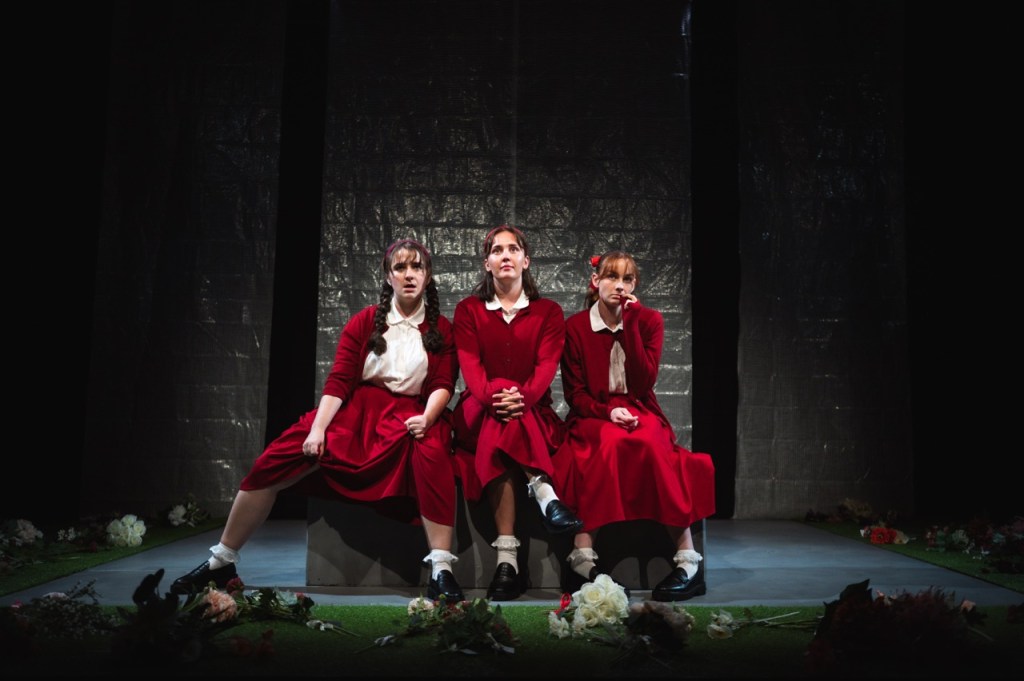
Iris Warren, Natasha Pearson & Roisin Wallace-Nash. Photo: SMW Photography (previous production). There is a natural, organic rhythm to all three actresses on stage in Femoid. Iris Warren, Roisin Wallace-Nash and Natasha Pearson make for convincing teenagers, naive to the world around them — Warren pulling double duty as playwright. There is an irrepressible energy to them as a trio that makes their impending split to go to university feel genuinely disruptive.
Elegant design work by Wallace-Nash — flowers strewn across grass, with plastic sheeting hovering above onto which the rancid discussions of an incel chatroom are projected (vision designed by Jacques Cooney Adlard) — gives the two worlds a nice juxtaposition without being overbearing. Under the direction of Izabella Day, the production has a confident visual identity.
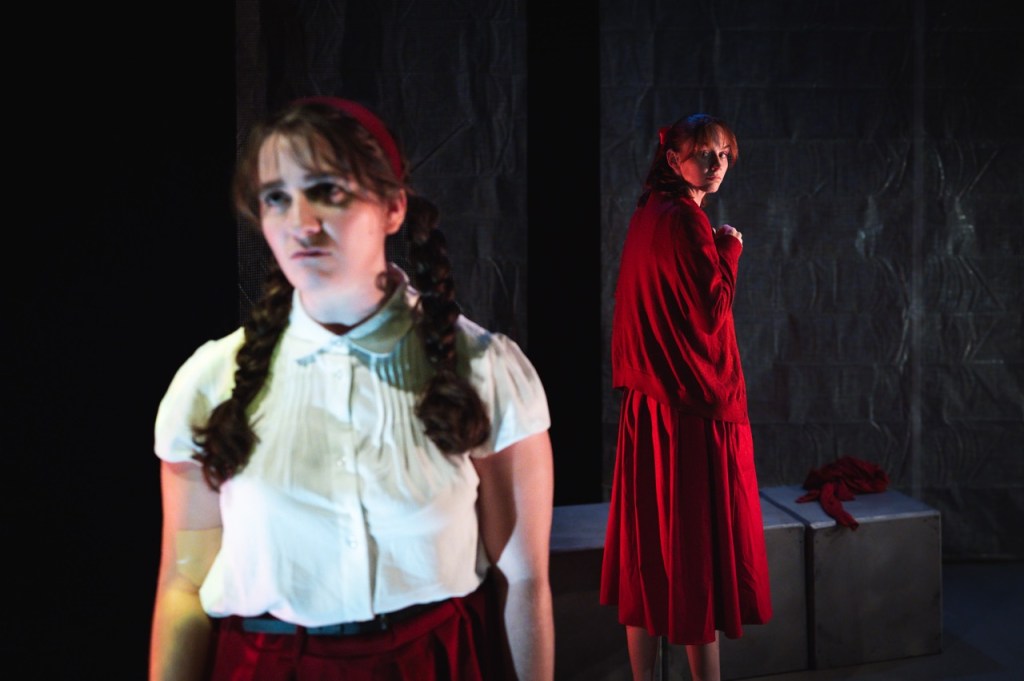
Iris Warren & Natasha Pearson. Photo: SMW Photography (previous production). Maybe this was just me, or the late hour (Femoid is part of the Old Fitz’s late night programming) but one thing that wasn’t clear was the passage of time. The play exists in roughly two time frames — all three girls in high school, and two of them reminiscing as adults. These time jumps needed more clarity, but even within the high school period, time got a bit confusing. The girls go from a basic sex education class to leaving Year 12 very quickly. They seemed to be portrayed much younger than they were — a clear device to preserve their innocence for the tragedy ahead, which took a lot of the sting out of the finale by being a touch too obvious.
But my main feeling at the end of the play was… and? The seductive dangers of the online manosphere are well documented at this point, and I’d hazard a guess that the people this story most needs to reach aren’t sitting in the stalls. Simply pointing at something that’s awful and saying “that’s awful” lacks dramatic punch. As a self-professed piece of critical feminist theatre, I was waiting for Femoid to make me think about this in a new way, to subvert the issue and reveal a truth behind the blinkered view of traditional patriarchal theatre — not just try to manipulate me into feeling anger I already felt toward this toxic subculture.
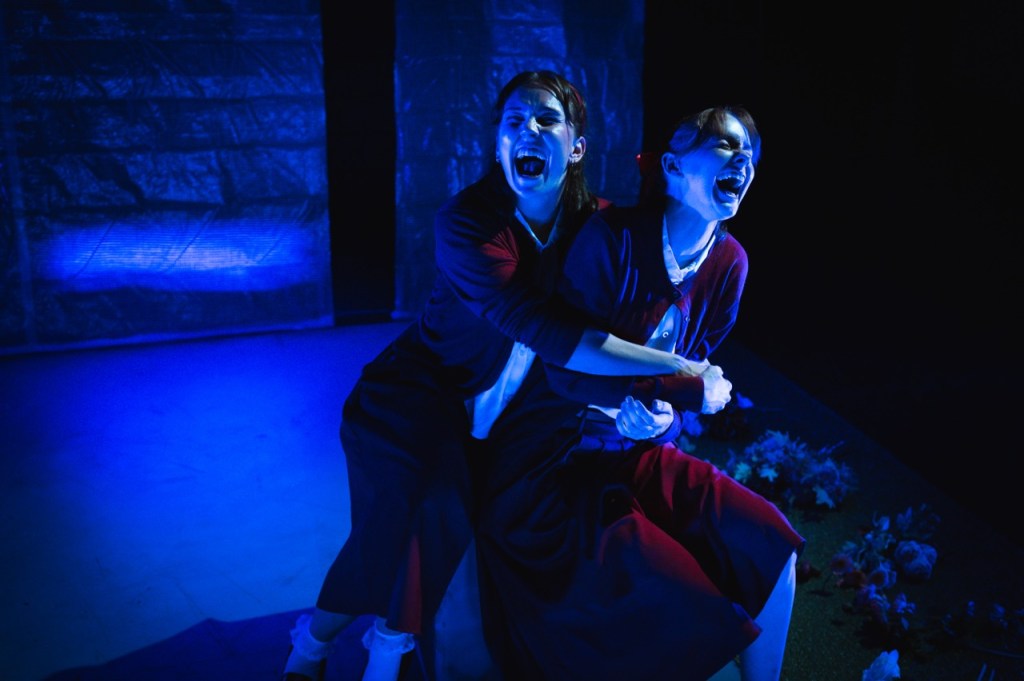
Natasha Pearson & Roisin Wallace-Nash. Photo: SMW Photography (previous production). At just 55 minutes this is feels like an interesting Act One to a more complete work, a setup in search of a real investigation into the lives of teenagers and the gradually mainstreaming philosophy of the manosphere. Femoid tells us Who, Where, When and What, but doesn’t tackle the Why and How. It doesn’t clear the bar of “In-yer-face” horror, nor does it give us a fresh insight – the emotions and thoughts both feel stuck in first gear.
With genuinely funny dialogue, engaging characters, fine acting and presentation, Femoid shows us a horrific slice of modern life. Ultimately, though it falls short in its lack of genuine inquiry — it’s a shallow tantrum, not a fiery challenge — and this topic urgently needs to be explored, dissected and understood to be counteracted, not just mirrored back at us on stage.
-
A Transgender Woman on the Internet, Crying (Old Fitz) ★★★½
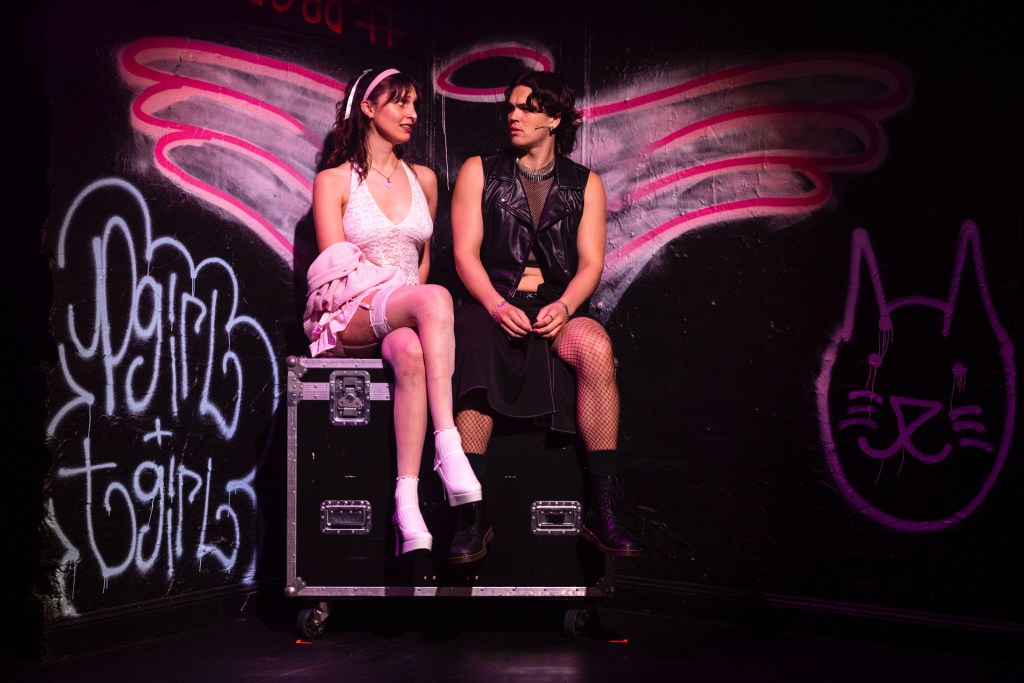
Written by Cassie Hamilton. Presented by Green Door. Old Fitz Theatre. 26 Mar – 11 Apr, 2026.
This is A LOT – in a hectic, whirlwind, fun way. Taking on the aesthetic assault of hyperpop with a deep dive into transgender storytelling, A Transgender Woman on the Internet, Crying gets into the complex details with a sense of glee and abandon. If you’re feeling starved for new stories on stage – this one’s for you.
Transgender social media darling Avis (Cassie Hamilton) is chronicling her transition journey online and using her (primarily cis) fanbase to help her decide all her next moves. And now that she’s had her bottom surgery, she’s looking for love (ideally with a cis man, but she’s not saying that bit out loud). Meanwhile upcoming transfemme hyperpop DJ Mouth Feel (Rosie Rai) has no time for the doll-like Avis and what she sees as her comphet, bio-essentialist, cis-friendly worldview. Infuriated by her popularity, she wants to dig up Avis’ dirt and take her down. So she enlists her keyboard warrior friend Corrin (Blake Appelqvist) to befriend Avis and find out her secrets. But as Corrin 10-Things-I-Hate-About-You’s Avis, they find themselves maybe, actually, IRL – falling in love.
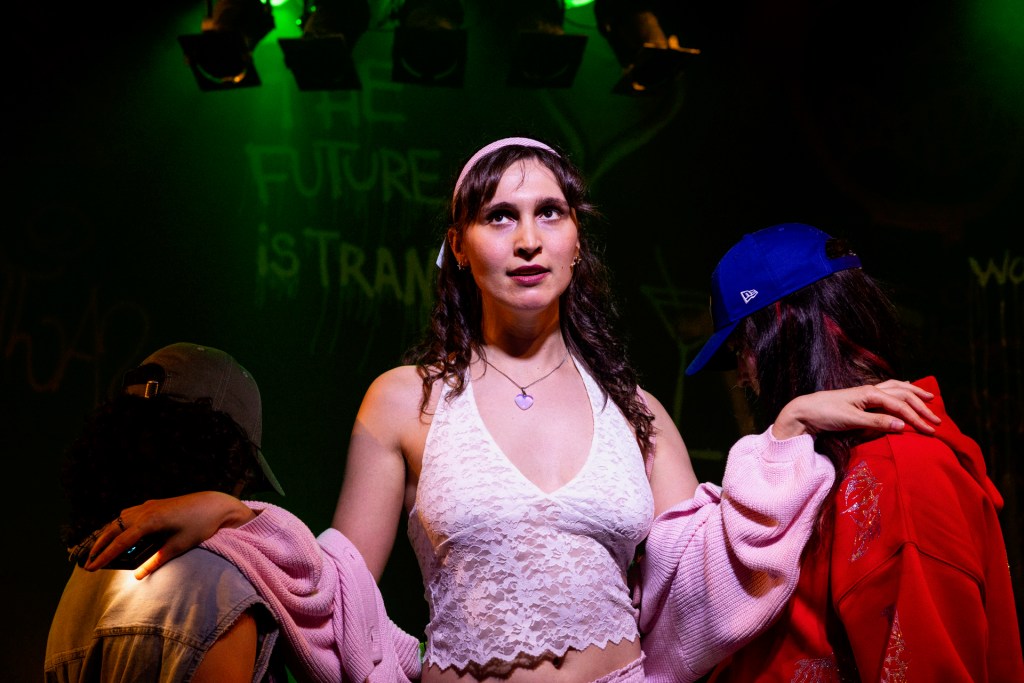
Cassie Hamilton. Photo: Brett Boardman. It’s a plot we’ve seen before. The protagonist tricks someone into thinking they’re in love on a dare but — plot-twist — actually falls for them, and things turn sour when the truth is revealed. Familiar as it is, it gives the musical a clear dramatic structure, which matters, because the specificity of these characters can get hard to follow. An easy-to-digest plot gives the audience a north star.
After debuting at the 2024 Adelaide Cabaret Festival and giving audiences a taste at Hayes Theatre’s Festival of New Work in 2025, this first full staging feels like an exciting next step — and hopefully not the last.
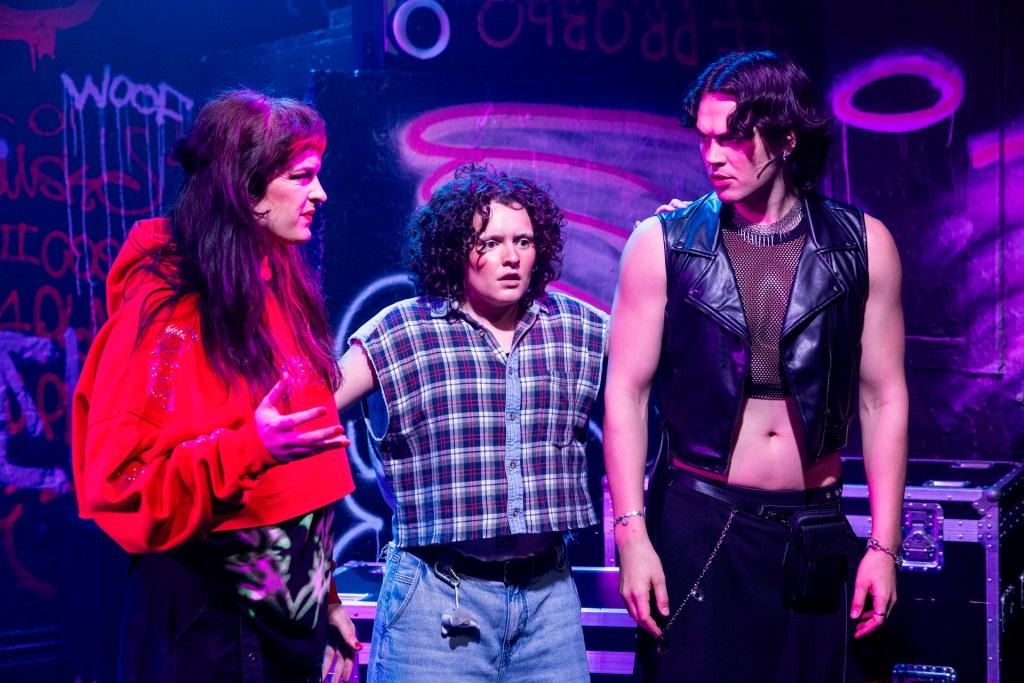
Rosie Rai, Teo Vergara & Blake Appelqvist. Photo: Brett Boardman. Bringing hyperpop into musical theatre is, on one hand, a perfect fit — they both love big emotions and a catchy hook, and there’s an unbridled sense of emotional release in both that sits well together. But hyperpop presents real challenges: its sheer artificiality can cut against genuine emotion when it’s most needed, its wall-of-sound production de-emphasises the lyrics that theatre depends on, and its relentless intensity leaves little room for the dynamic variation a full evening requires. As the genre has matured and been absorbed into the wider world of commercial pop (“Brat summer” anyone?), it has become more amenable to narrative storytelling — and Hamilton’s score finds a smart middle ground, hitting hyperpop’s signature moves while blending in more familiar musical theatre forms when the drama needs clarity and breath.
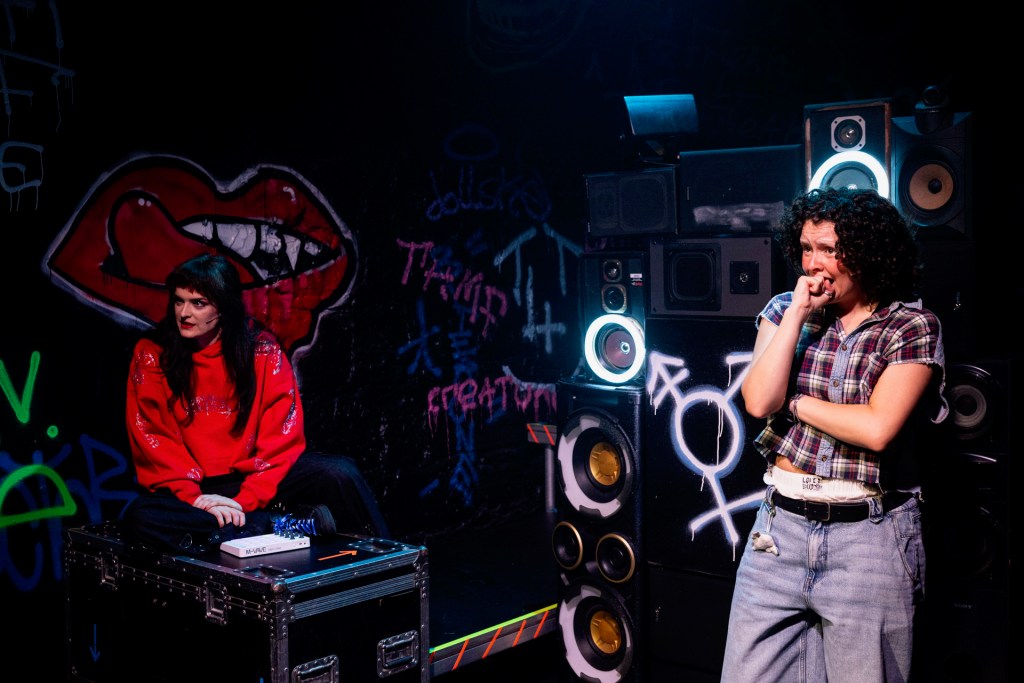
Rosie Rai & Teo Vergara. Photo: Brett Boardman. The real exciting thing about ATWOTIC, though, is its evolution of trans stories on stage. This may be the first time I’ve seen a broader sense of the multiplicity of the trans community represented theatrically, and it opens up refreshing narrative avenues. Where recent plays have been content to pat themselves on the back telling audiences things they already know, ATWOTIC offers a glimpse into lives less familiar. It could benefit from laying out its internal community politics with more finesse for the uninitiated — a clearer directorial and dramaturgical hand would do wonders — but the ambition and fresher point-of-view are exciting.
If you’re worried about being bogged down in unfamilliar politics, never fear. The debate about who is “the right kind of trans” could translate to almost any arena. Who is “the right kind of immigrant” or “the right kind of progressive” or “the right kind of Christian/Muslim/Jew”? Humanity loves to argue about who is the most righteous, regardless of the arena.
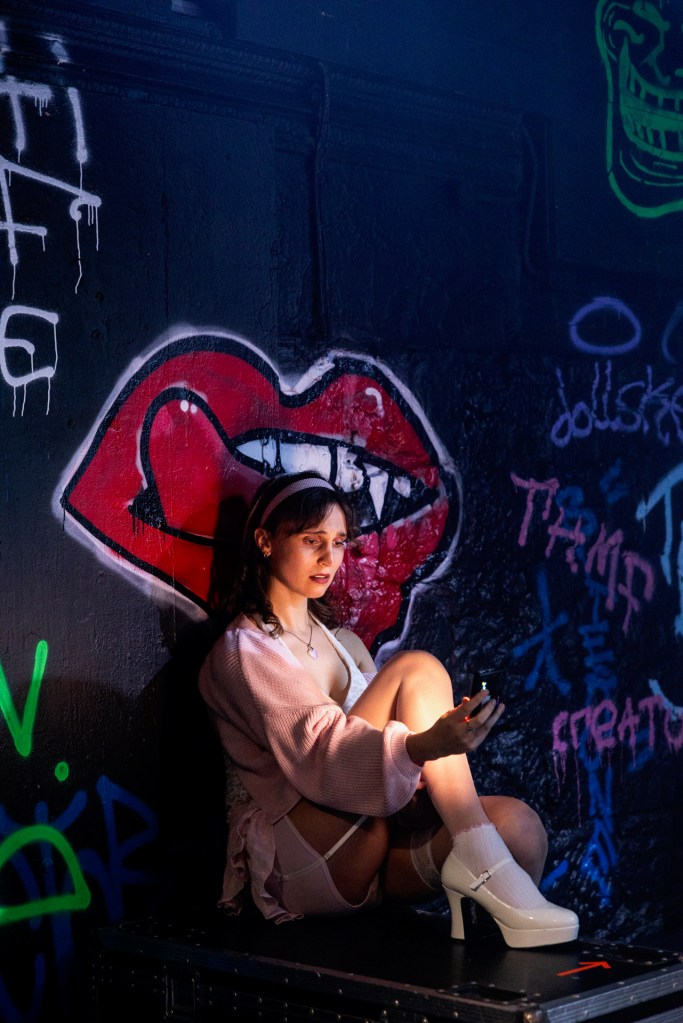
Cassie Hamilton. Photo: Brett Boardman. Another strong part of the storytelling is its critique of performative social media. For many in the LGBTQIA+ space, online communities can be an affirming safe haven — but there is also a deeply toxic side, and ATWOTIC highlights the irreplaceable need for actual human connection. Followers are no substitute for real friends who can hold you when you need it most. The exaggerated hyper-connectivity of the internet is a cold and shallow mirror compared to the kaleidoscopic, rewarding chaos of real relationships.
For all its sometimes confusing jargon and occasionally incomprehensible lyrics, I found myself smiling all the way through. Don’t worry about the musical style or the trans politics — I guarantee they won’t be what you’re thinking about as you leave the theatre. You’ll walk away with a simple sense of joy at seeing complicated people find community and a space to be themselves.
-
Niusia (Qtopia) ★★★★
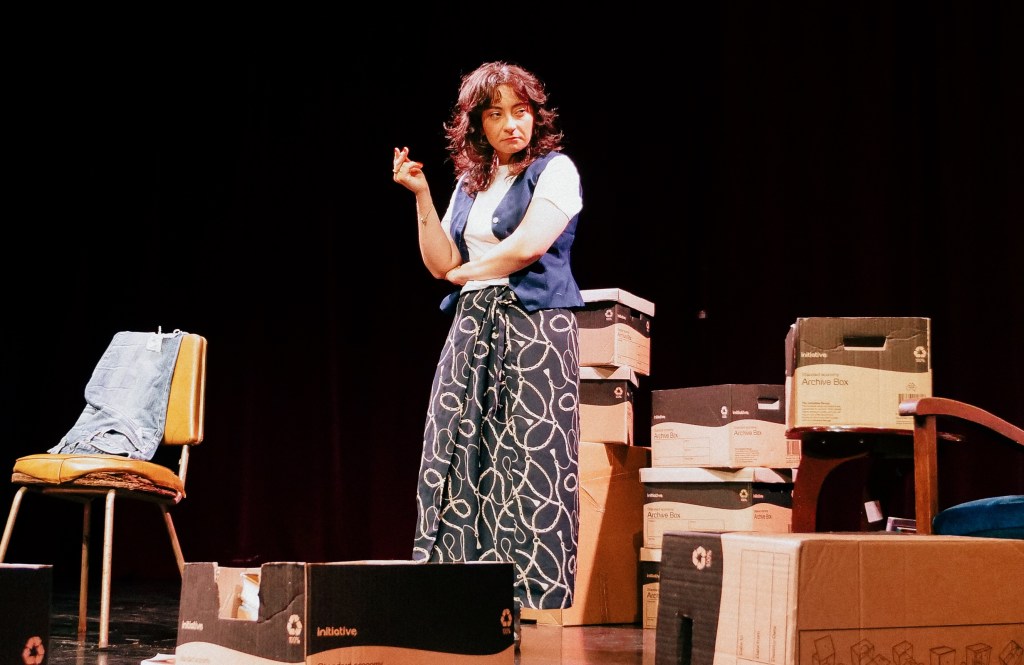
Written by Beth Paterson. Qtopia. 1-12 Apr 2026.
Niusia has snuck into Sydney with little fanfare — which is odd, given it arrives laden with awards from Melbourne, Adelaide and a prestigious Scotsman Fringe First from the Edinburgh Festival Fringe. This unique tale of a young, non-religious Jewish woman trying to reconcile the stories of her grandmother is refreshingly brash and funny.
Beth’s grandmother, Niusia, was a Holocaust survivor who lived through unimaginable suffering. She was also an angry old bitch. Beth has decided to piece together a full picture of her grandmother by researching the parts of the family history no one wants to revisit. Through recorded interviews with her mother Suzie — Niusia’s daughter — she dives deep into the past, and reconnects with her own history along the way.
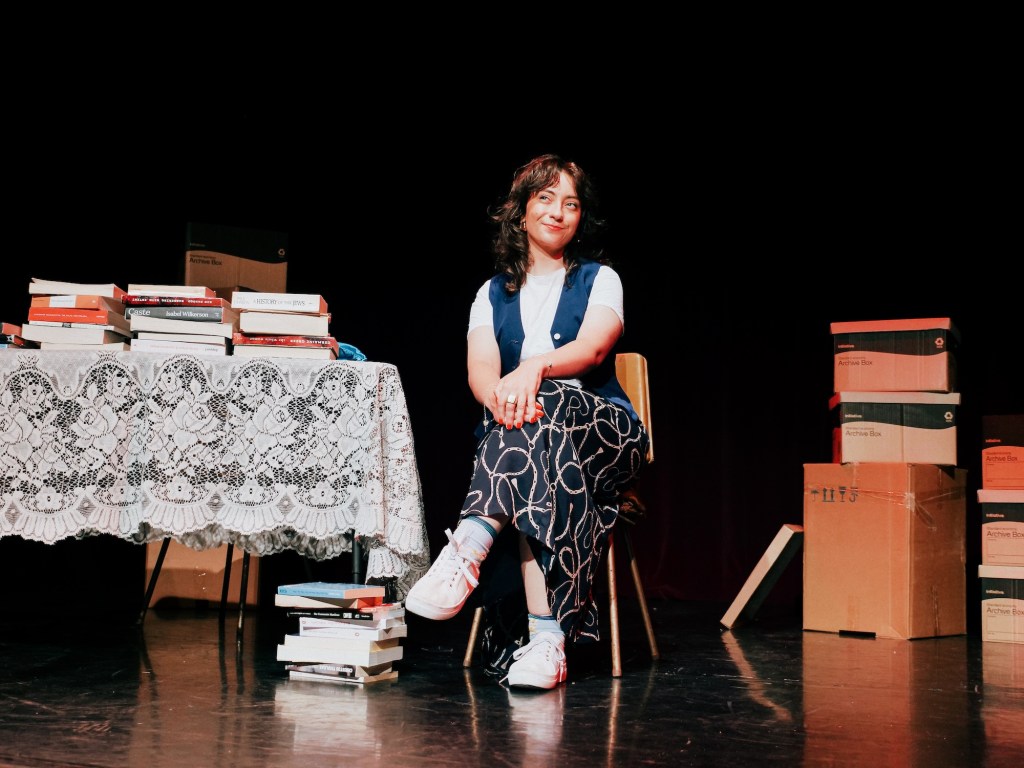
Beth Paterson. Photo: Mayah Salter (previous production) There is a childlike, blunt hilarity to Paterson’s delivery that punctures any air of piety around discussions of the Holocaust — and it is wonderfully refreshing. It’s shocking and relaxing all at once: this is a space where sacred cows may get tipped over. But it’s done with an undeniable authenticity. Her memories of her grandmother are the same as most people’s — the old relative you were obliged to visit. And in Niusia’s case, she was an angry old woman constantly testing her daughter’s loyalty and affection.
As Paterson builds a picture of Niusia for the audience, we get to know a complicated, strong woman — trained as a nurse, with a tenacity that would save her life in Auschwitz. Niusia’s disillusionment with humanity comes, in part, from her time forced to witness the heinous work of Dr Josef Mengele, as he conducted experiments on Jewish prisoners. She saw the most inhuman side of existence and survived with deep scars.
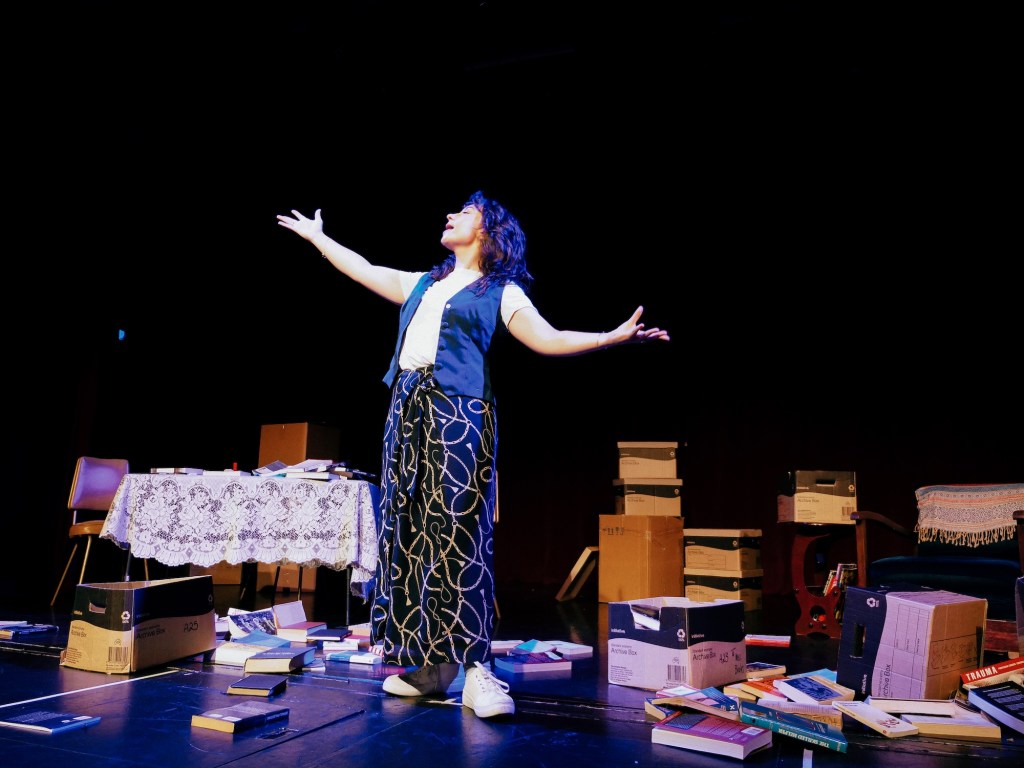
Beth Paterson. Photo: Mayah Salter (previous production) Director Kat Yates helps Paterson bring these stories to life through clever, effective staging — boxes of books strewn across the stage are deployed to a variety of ends. The one-woman show makes extensive use of audio interviews with Suzie, filling the gaps in Beth’s own recollections.
The result is a collage of memories that creates a rich, complex image of a life. Within it is the arc of an immigrant family — from first-generation pioneers to third-generation natives — part of the broad multicultural mix that is modern Australia. This is not just a story of the Jewish diaspora and the horrific effects of antisemitism; it is broader and more universal than that.
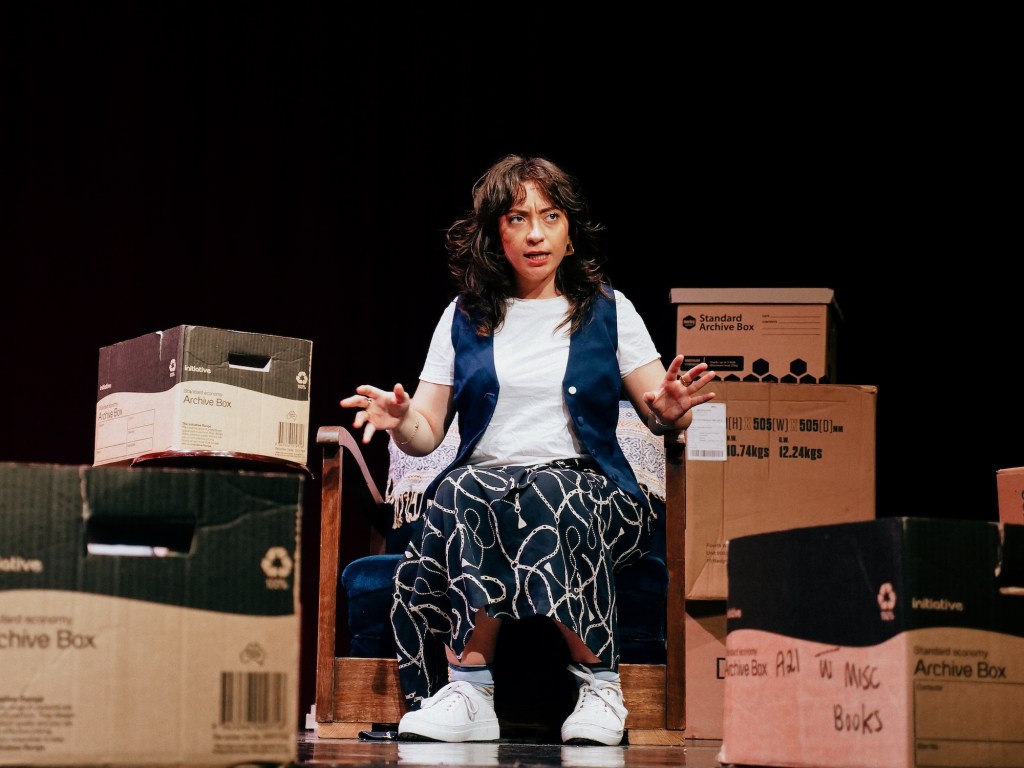
Beth Paterson. Photo: Mayah Salter (previous production) Niusia pushes back against the insistence of modern life to flatten people into easily digestible, two-dimensional caricatures for social media. It reminds us that there is so much more to every story than the headlines screaming at us. Niusia was a bitch, and she was a hero, and she was a loving mother, and a controlling manipulator. These things don’t contradict — they’re the reality of being human.
-
The Prom (Teatro) ★★★½
Music by Matthew Sklar. Lyrics by Chad Beguelin. Book by Bob Martin & Chad Beguelin. Australian Premiere. Teatro in association with On Your Feet Australia. Teatro at the Italian Forum. 24 Mar – 19 Apr, 2026.
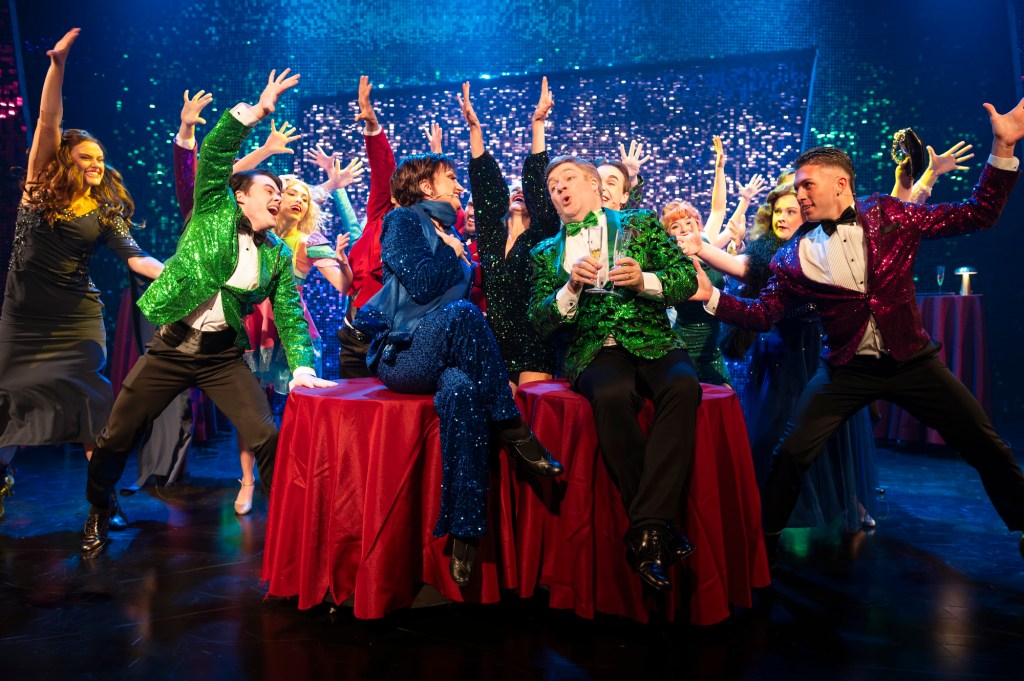
I don’t know how many branches of Spotlight they had to ram-raid to make the sequin-clad set of The Prom at Teatro, but it was worth it. This new theatre is putting its most sparkly foot forward with a killer cast and irrepressible charm.
When newly out high-school lesbian Emma (Sophie Montague) is denied the right to attend prom with her girlfriend by the homophobic PTA, a group of narcissistic Broadway performers swoop into her small Indiana town to preach love and acceptance to the locals — and rehabilitate their own rancid reputations.
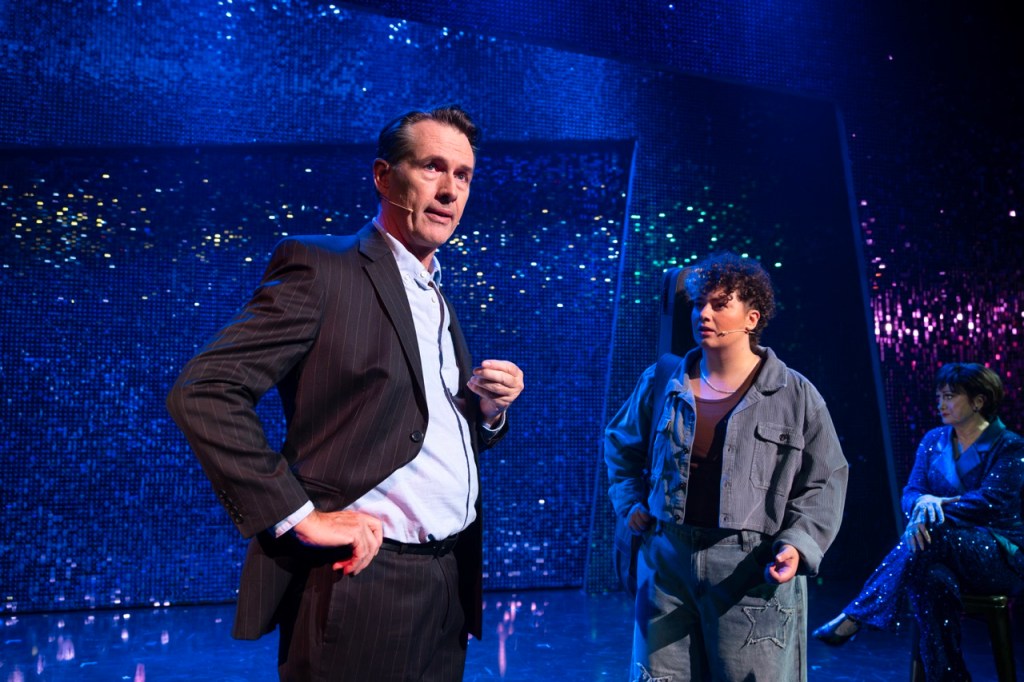
Scott Irwin & Sophie Montague. Photo: Robert Miniter. You’d think the plot twists in The Prom were too ridiculous — and too cruel — to be anything but fiction, but the story is adapted from real events. In 2010, high-schooler Constance McMillen was first banned from attending her own prom, then watched the school board cancel it entirely when she objected. When a court order forced them to proceed, local parents secretly threw a second prom and didn’t invite her.
Homophobes really are awful humans.
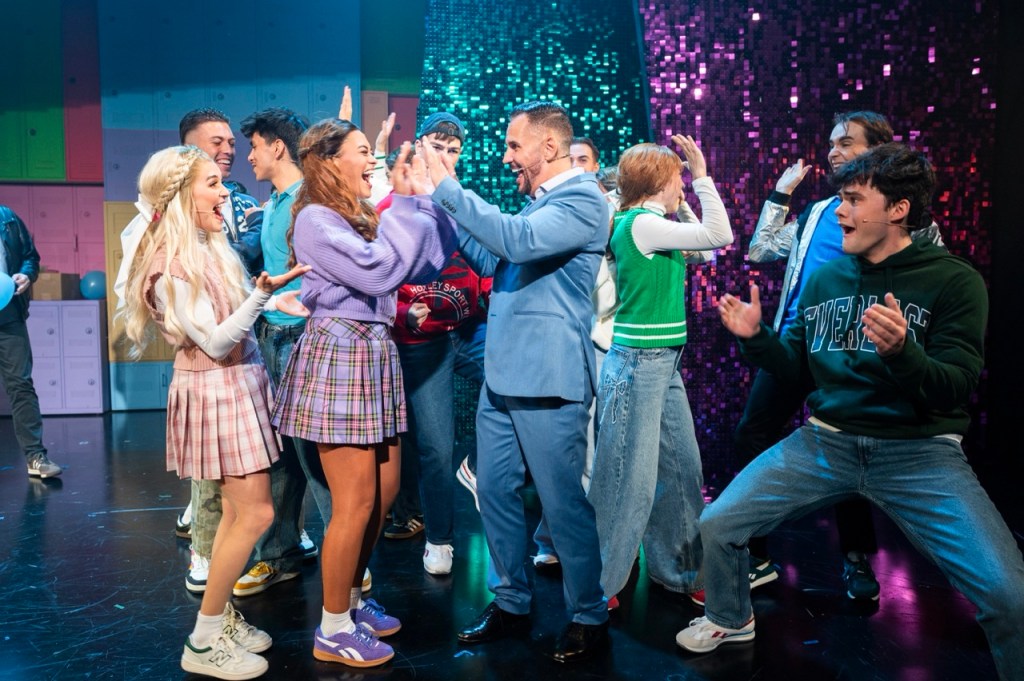
Abbey McPherson, Nina Hurley, Thern Reynolds & ensemble. Photo: Robert Miniter. The Prom tweaks the story around the edges, throws in some high-energy pop tunes, and piles on the over-earnest messaging, laced with a healthy dose of Broadway self-mockery. Think modern-day Hairspray or queer Bring It On — bitchy students, stern parents, and sundry stereotypes played broad and bright.
The book is full of deep-cut Broadway references that won’t always land in Leichhardt, but will delight the MT fans. It’s camp pantomime as morality tale, and it leaves absolutely no room for subtlety. It’s the kind of thing I’d normally cringe at (I’m no fan of the Netflix film adaptation for exactly that reason) but here I found myself falling for its unrelenting technicoloured assault on my faculties.
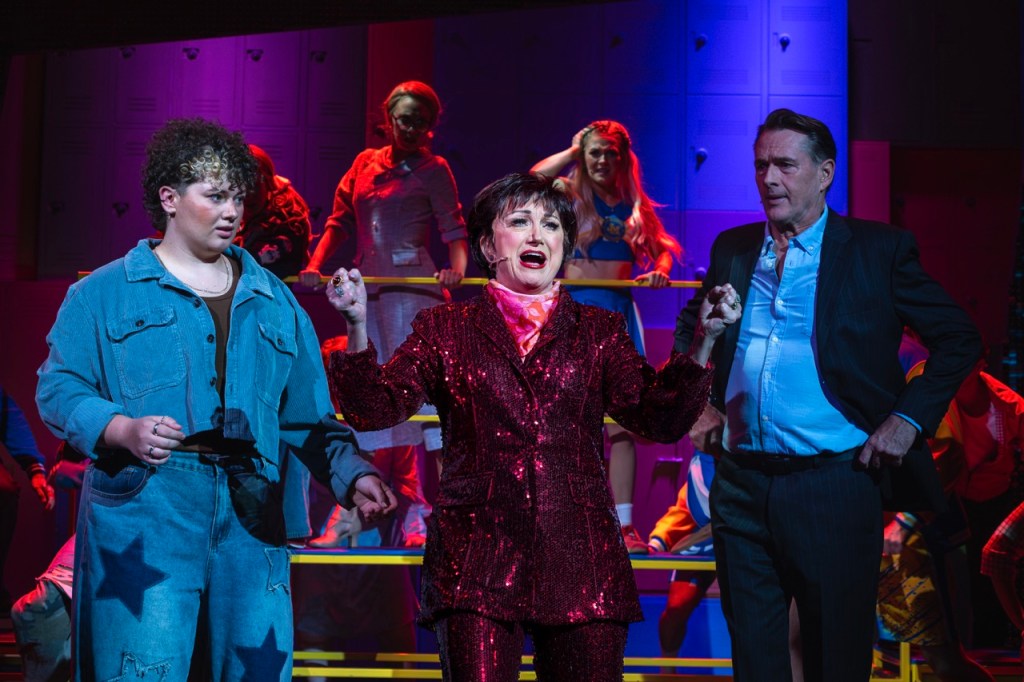
Sophie Montague, Caroline O’Connor & Scott Irwin. Photo: Robert Miniter. Headlining the show is the pitch-perfect Caroline O’Connor as self-absorbed Broadway diva Dee Dee Allen. O’Connor’s physical comedy is dialled up to all-time highs and it’s an absolute delight to watch up close in this intimate space.
She’s joined by Brendan Monger as Barry Glickman, Allen’s middle-aged gay co-star, Bella McSporran who elevates the role of the forever chorus-girl Angie, and Thern Reynolds as the pompous ex-Juilliard alumni Trent Oliver. At the centre of it all is Sophie Montague as the shy Emma, whose stunning voice stands out even among this strong cast. The leads are surrounded by a talented, enthusiastic young ensemble who attack Nathan M. Wright’s excellent choreography with real gusto.
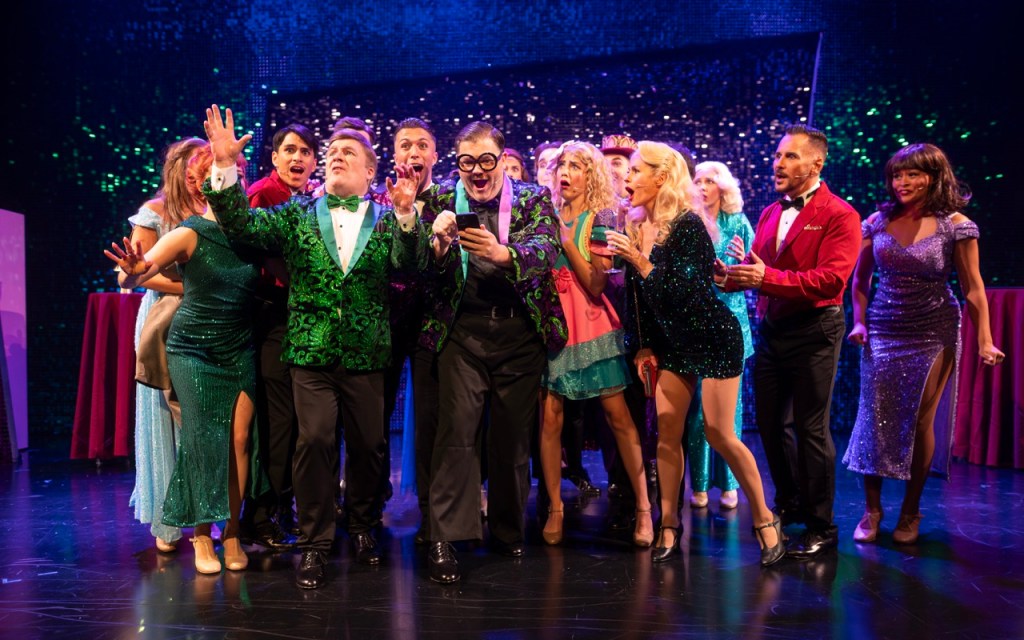
Brendan Monger, Brad Green, Renae Berry, Thern Reynolds & ensemble. Photo: Robert Miniter. Designer Nick Fry pulls off some clever tricks to transform Teatro’s awkwardly shaped stage into a multifunctional space. The sequins — and there are so many sequins, cascading across both Cornelia Cassimatis’s costumes and seemingly every available surface — add up to something like a gay teenage fever dream. Shiny things + show tunes = fun in my book. Some early sound issues had me worried, but things settled as the night progressed and the band were pumping out the tunes.
By the final curtain I was cackling at O’Connor’s gags, marvelling as each costume somehow became more bedazzled than the last, and shedding a quiet tear at the happy ending. The Prom is exactly as silly and as spangly as it sounds — and if you give it half a chance, this high-powered, joyous ensemble will put a big ol’ grin on your face.
-
The Phantom of the Opera (Handa Opera) ★★★★
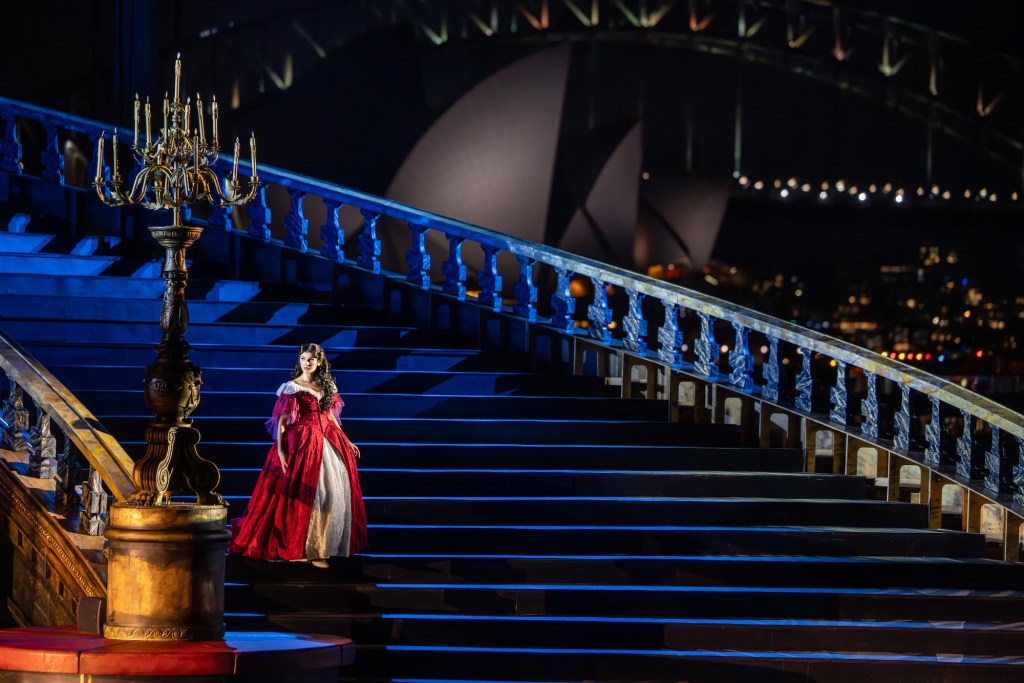
Music by Andrew Lloyd Webber. Lyrics by Charles Hart, with additional lyrics by Richard Stilgoe. Libretto by Andrew Lloyd Webber & Richard Stilgoe. Based on the novel by Gaston Leroux. Opera Australia. Handa Opera on Sydney Harbour. 27 Mar – 3 May, 2026.
The Phantom of the Opera is back on Sydney Harbour. After a triumphant, if rainy, debut in 2022, the Handa Opera production has been restaged with a new lead cast. And when it comes to the synthesis of opera and musicals – you don’t get better than this.
Aspiring soprano Christine (Amy Manford) is stuck in the chorus with her best friend Meg (Jayme Jo Massoud), but strange things are happening. Christine barely leaves the opera house anymore and has found a new singing tutor who is so determined to see her succeed, he is ready to murder anyone who stands in her way. But when her literally entitled childhood sweetheart Raoul, Vicomte De Chagny (Jarrod Draper), who is both super-hot and super-rich, appears offering to take her away from the bitchy world of the opera, she is ready to chuck it all in. Her masked, incel of a teacher, the Phantom (Jake Lyle), may be talented, but is getting a lead role really worth the price of putting up with a creep?
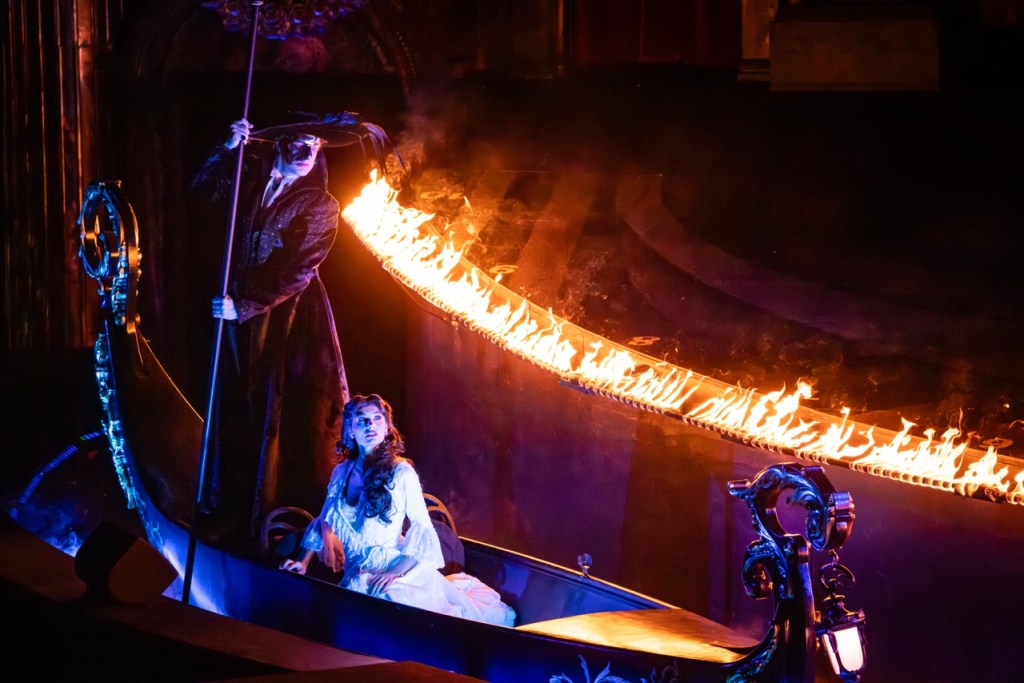
Jake Lyle & Amy Manford. Photo: Daniel Boud. The plot hasn’t aged especially well, and it takes a generous dose of wilful disbelief to get past the clunky transitions — but you don’t come to this event-sized show for subtlety. You come for grandeur and 9pm fireworks.
With a cast of nearly 50, this is a scale of production you rarely see, with a score extravagant enough to fill the harbour. When the ensemble and orchestra peak in “Masquerade” at the top of Act Two, fireworks timed to the beats with the Harbour Bridge and city lights behind them, it’s simply transcendent — a Sydney-only spectacle you can’t replicate.
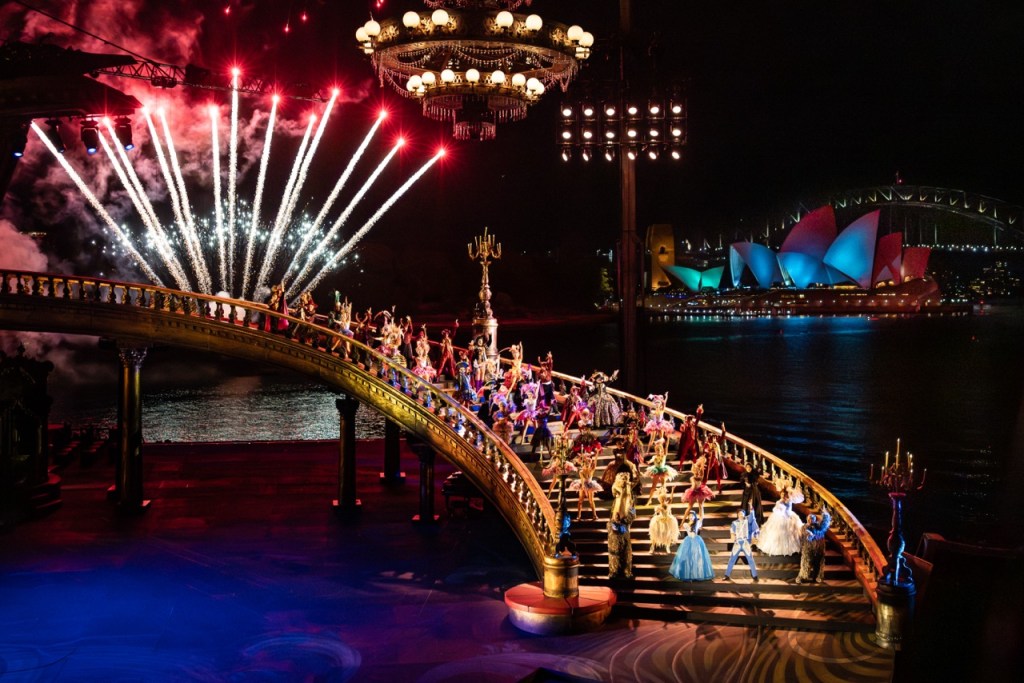
The cast of Handa Opera on Sydney Harbour’s 2026 production of The Phantom of the Opera. Photo: Daniel Boud. In this open-air environment you trade nuance for spectacle. Emotions are telegraphed to the… well, I was going to say “the cheap seats,” but in this case it’s “the fractionally less expensive seats.” The Phantom comes across as a petulant teenager more often than not — the psycho-sexual daddy-vibes of traditional productions replaced by a toxically possessive love triangle and a lot of hurling himself to the ground screaming “Christiiiiiinnne!”
Other trade-offs are unavoidable. The slow-moving sets create pacing lags, the tricky acoustics render the counter-melodies in “Prima Donna” completely incomprehensible, and the chandelier looks less like a life-threatening accident than someone installing faulty Philips Hue bulbs. But as you stare at Gabriela Tylesova’s stunning gothic set, framed by the modern architectural lines & lights of the city, all those theatrical sins are easily forgiven.
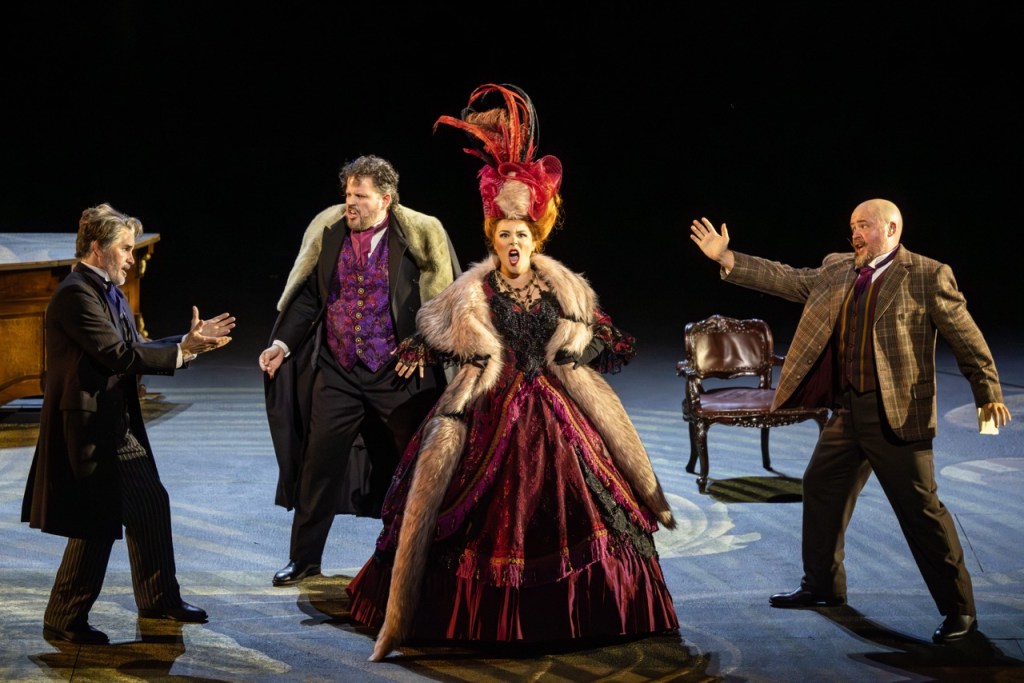
Martin Crewes, Daniel Belle, Giuseppina Grech & Brent Hill. Photo: Daniel Boud. Amy Manford is in fine voice and has perfected a flamboyant cape flip. Jarrod Draper cuts a genuinely heroic figure as Raoul. Jake Lyle brings a callow energy to the Phantom that I initially questioned as too youthful, but by Act Two he’d fully won me over. And as always, the best role in Phantom is Carlotta — Giuseppina Grech is having an absolute blast, though I wish her “frog” croak hadn’t been so obviously goosed by sound effects.
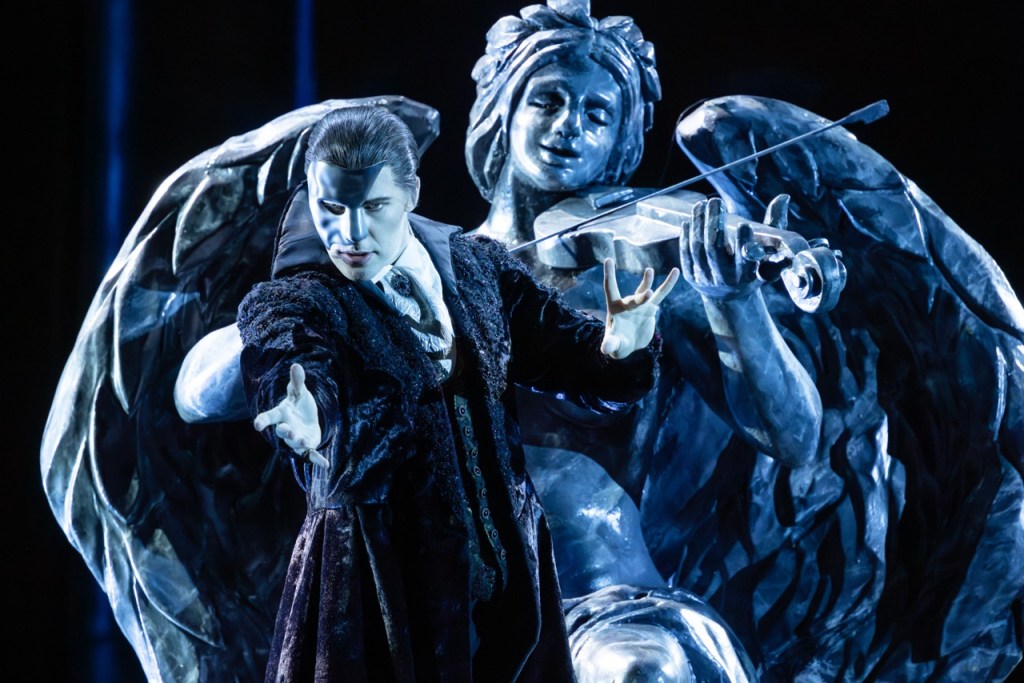
Jake Lyle. Photo: Daniel Boud. Of all the Handa Opera productions — and West Side Story and Guys & Dolls were both a blast — The Phantom of the Opera is the one that truly nails the format, because it was always built for exactly this kind of glorious excess. Give it a harbour, a bridge, and a pyrotechnics budget, and suddenly the melodrama feels completely natural. Even the dramatic opening-night winds, which made the chandelier feel genuinely perilous for once, only added to the spectacle.
Which is all to say: yes, it’s a bit silly. Emotionally indulgent, overblown, and gloriously ridiculous. Dress up, grab a glass of bubbly and settle in – this is exactly as magnificent as pop-opera should be.
-
Bette & Joan (Ensemble) ★★★
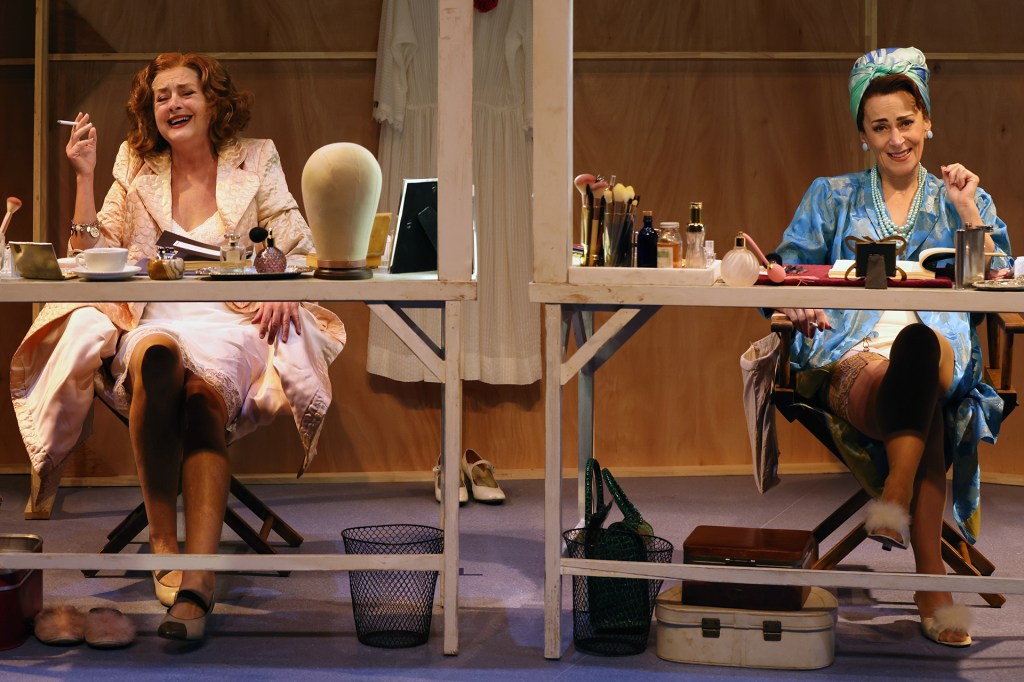
Written by Anton Burge. Australian Premiere. Ensemble Theatre. 20 Mar – 25 Apr, 2026.
As cinematic rivalries go, the feud between Bette Davis and Joan Crawford is the stuff of Hollywood legend: two icons of the screen, used and ultimately abandoned by the same industry that made them. So why is a play about these two dynamic powerhouses so static?
Set during the filming of cult classic What Ever Happened to Baby Jane? (their only on screen appearance together), Bette & Joan is primarily a string of duelling monologues taking us into the minds of two stars fighting to stay relevant. The play’s isolating structure and peculiar lack of dramatic momentum mean too much of the first act feels like an animated Wikipedia entry or public reading of their memoirs.
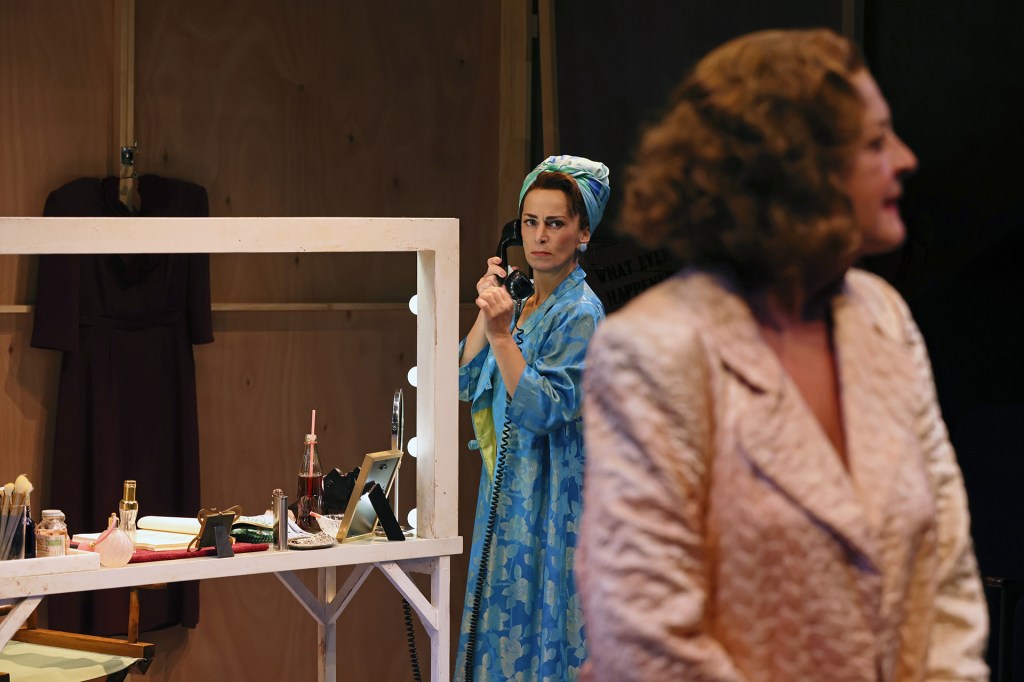
Lucia Mastrantone & Jeanette Cronin. Photo: Prudence Upton. There are moments of camp, but the tension between the pull to be a bitchy comedy and the real human drama is never really resolved. The pranks the women play on each other to gain the upper hand are diverting, but they don’t generate genuine tension. Playwright Anton Burge attempts to let us into their psyches to glimpse the real women beneath the mythology: ageing actresses grappling with an industry that had discarded them, forced together out of sheer desperation.
Things pick up considerably in the second act, where an extended drunken scene between the two finally allows the relationship to breathe — but even then it doesn’t quite ignite. Those waiting for fireworks might have to settle for hearing them go off across the harbour at the open-air Phantom of the Opera.
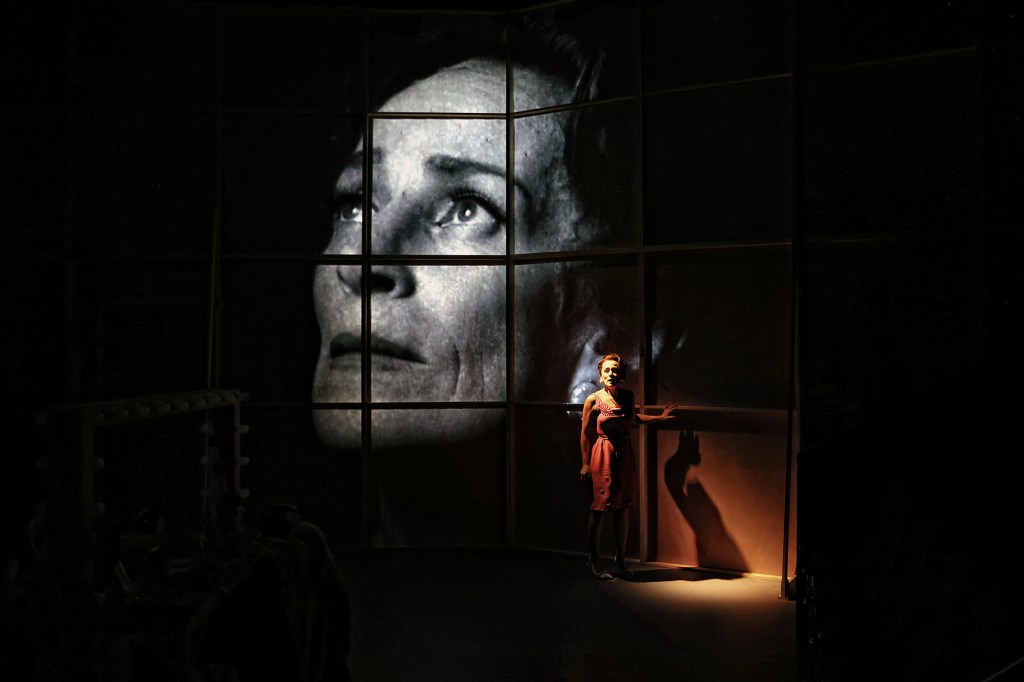
Lucia Mastrantone. Photo: Prudence Upton. Director Liesel Badorrek works hard to animate the biographical monologues, reframing some as pre-recorded interviews projected onto the set — at times having the performers react to their own projected selves. It is a visually inventive device, and Cameron Smith’s video design gives the production a flair that the text alone doesn’t always provide. But it can’t quite overcome the inertia of Act One.
Thankfully, there are two formidable actresses on stage to bring the material to life. Lucia Mastrantone brings real silver-screen majesty to Joan Crawford — a woman determined to be seen, at all times, as a star. As Crawford herself put it: “I never go outside unless I look like Joan Crawford the movie star. If you want to see the girl next door, go next door.” Mastrantone understands that Crawford’s famous fragility was the fuel — the engine that drove her relentlessly upward.
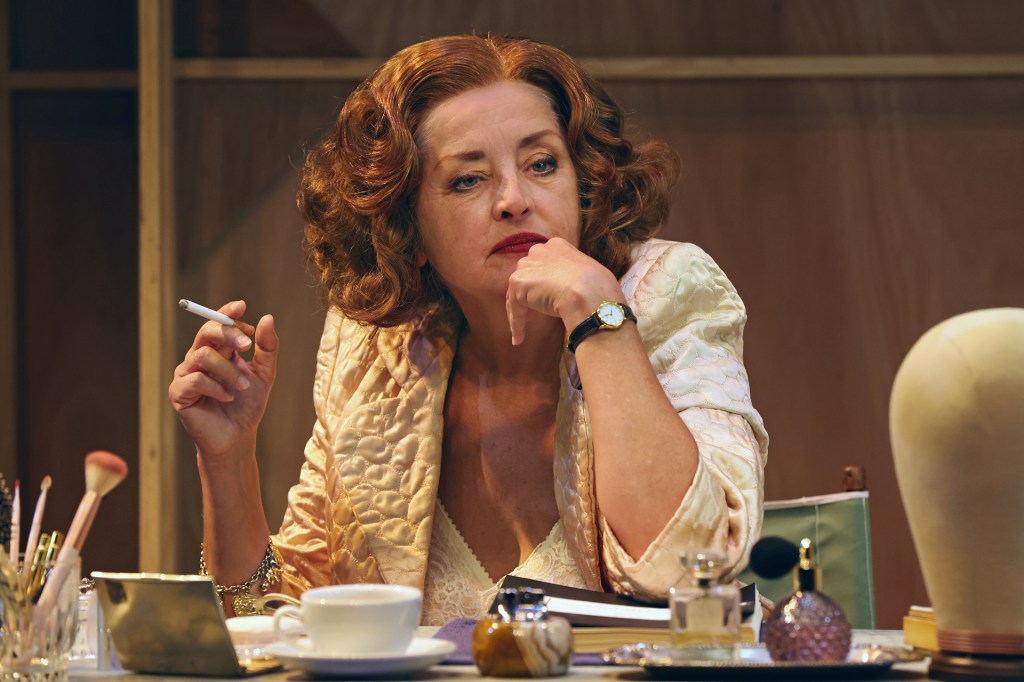
Jeanette Cronin. Photo: Prudence Upton. Against her, Jeanette Cronin brings a wry, combative energy to Bette Davis — a working actress with no patience for glamour, savage wit on full display, and every intention of being taken seriously, and paid accordingly. She is the “real actress” to Crawford’s “movie star”.
The casting of these two together is wonderful: both women understand instinctively how their characters use very different instruments to achieve the same ends. When they share the scene, the production crackles. Left alone with the monologues — as they are for most of the evening — the alchemy is lacking as they are occasionally reduced to solo impersonations.
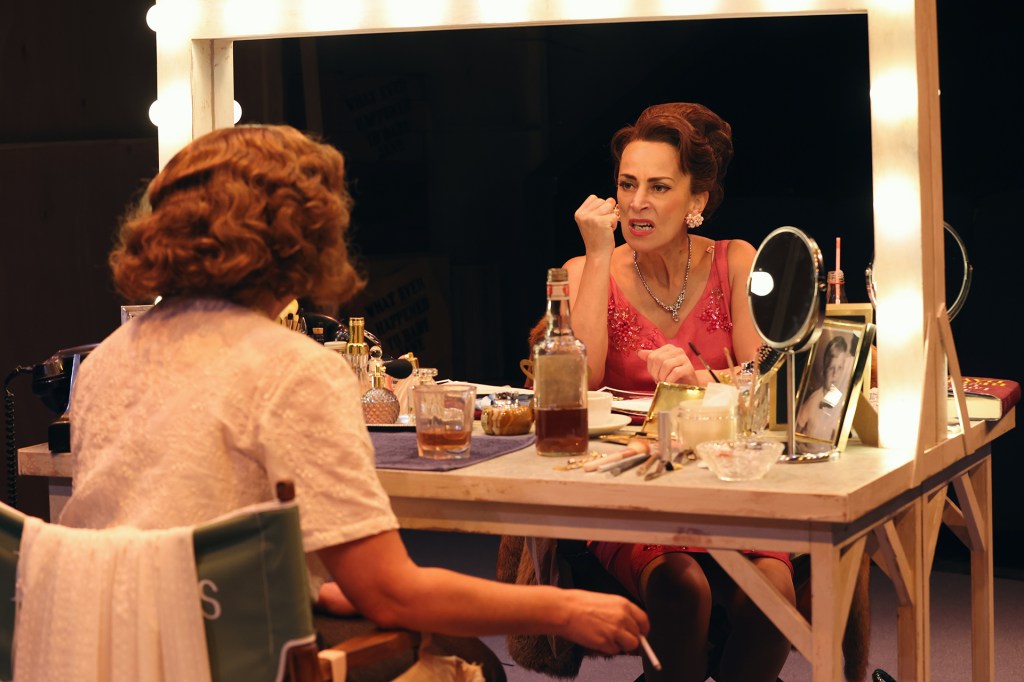
Jeanette Cronin & Lucia Mastrantone. Photo: Prudence Upton. Burge’s shrewdest insight is that these two women were far more alike than either would ever have admitted. In a different world, they might have been allies; instead, the industry of the day pitted them against each other for tabloid headlines. Badorrek’s direction and Grace Deacon’s set design make the mirror dynamic visually explicit.
Those who relish the details of Hollywood’s golden age will love the specificity, and with two great performers anchoring the play, there is a lot to enjoy, but Bette & Joan never quite cohered into fully satisfying drama for me.
-
My Brilliant Career (STC) ★★★★★
Book by Sheridan Harbridge and Dean Bryant. Music by Mathew Frank and Lyrics by Dean Bryant. Based on the novel by Miles Franklin. Melbourne Theatre Company & Sydney Theatre Company. Roslyn Packer Theatre. 21 Mar – 3 May, 2026.
Why is it titled My Brilliant Career? Because My Brilliant-Ecstatic-Defiant-Poetic-Ambitious-Uplifting-Hilarious-Heartwarming-Beautiful Career doesn’t quite roll off the tongue. But it is all those things, and more.
My Brilliant Career arrives in Sydney fully formed, off the back of two successful Melbourne runs and more critical stars than you can poke a telescope at. But not every adored Melbourne show makes its mark here. Sometimes it’s something transcendent, like Red Stitch’s Who’s Afraid of Virginia Woolf? And sometimes it’s… well… Bloom! So I walked in filled with anticipation — but not entirely with confidence.
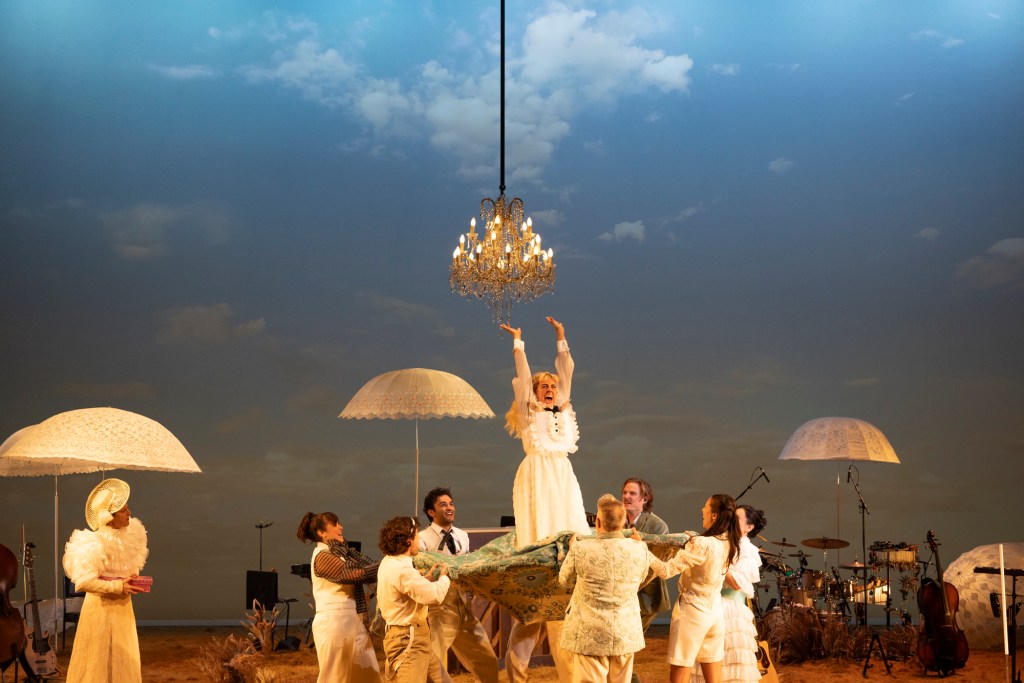
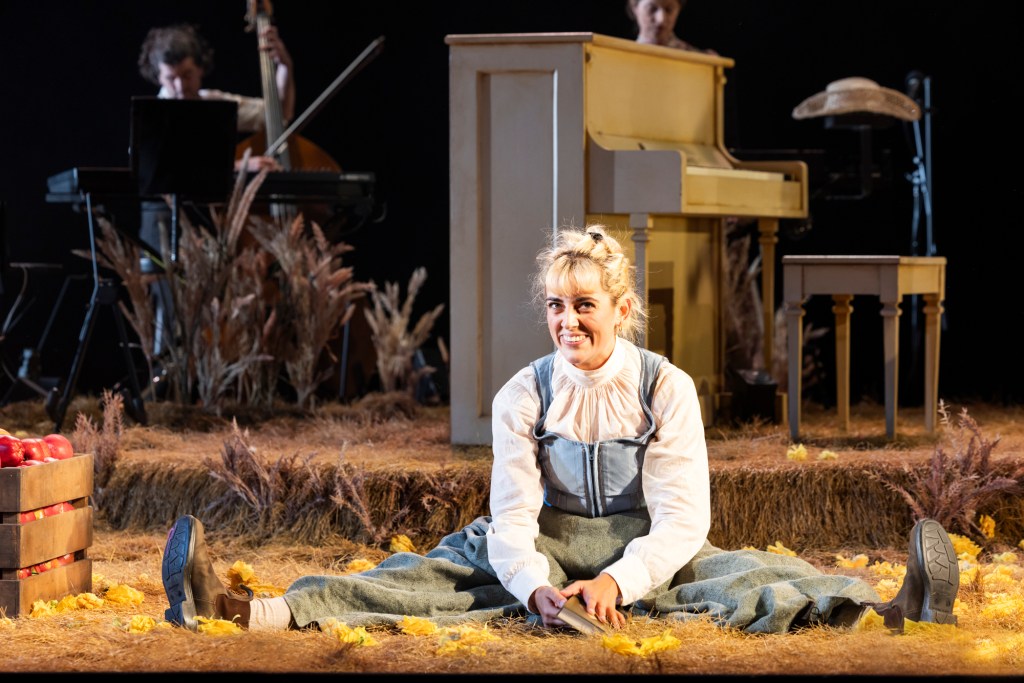
Cast of My Brilliant Career. Photo: Pia Johnson. Miles Franklin’s story of a country girl pushing against everything the world throws at her holds an almost mythic place in Australian pop culture — from the turn-of-the-century novel that became a touchstone for generations of young women, to the iconic 1979 Gillian Armstrong film that launched Judy Davis to international acclaim. Transforming it into a contemporary musical is no small undertaking. But this troika of creatives — Bryant, Frank and Harbridge — take their lead from their own lead character: they rush in with a gleeful lack of reverence that busts the story wide open.
Musically, the show is eclectic to a fault, criss-crossing genres without falling into pastiche. What elevates it above mere genre-play is the canny way the creative team — along with director Anne-Louise Sarks — use music not just to move the plot or reveal a character’s thoughts, but to actively manipulate the audience’s perceptions. It’s that sophistication which makes this one of the best new Australian musicals in years.
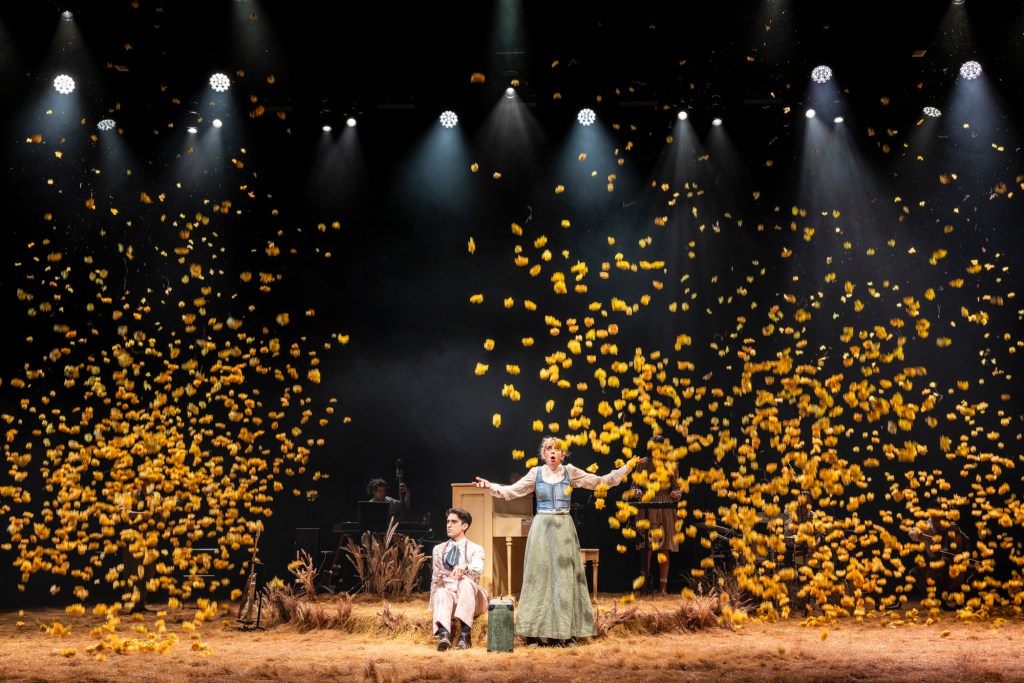
Cameron Bajraktarevic-Hayward & Kala Gare. Photo: Pia Johnson. The design is impeccable. Marg Horwell’s sets and costumes are elegant in their simplicity — never empty, never unconsidered. Amy Campbell’s choreography brings an organic physicality to the piece, along with some genuinely funny comedic beats (a particular shout-out to Cameron Bajraktarevic-Hayward’s remarkable leg work). Anne-Louise Sarks’ direction is alive with the kind of micro-moments that only emerge from a genuinely free rehearsal process. No element is missing.
As Sybylla makes clear from the outset, this is “a yarn” — a story told directly to the audience, with the cast of actor/musicians filling the stage with movement and music, slipping between characters and instruments with complete ease. Kala Gare inhabits Sybylla’s skin so seamlessly she disappears — rambunctious and arrogant on the surface, achingly yearning underneath. Her performance is acrobatic: physically, emotionally, and vocally.
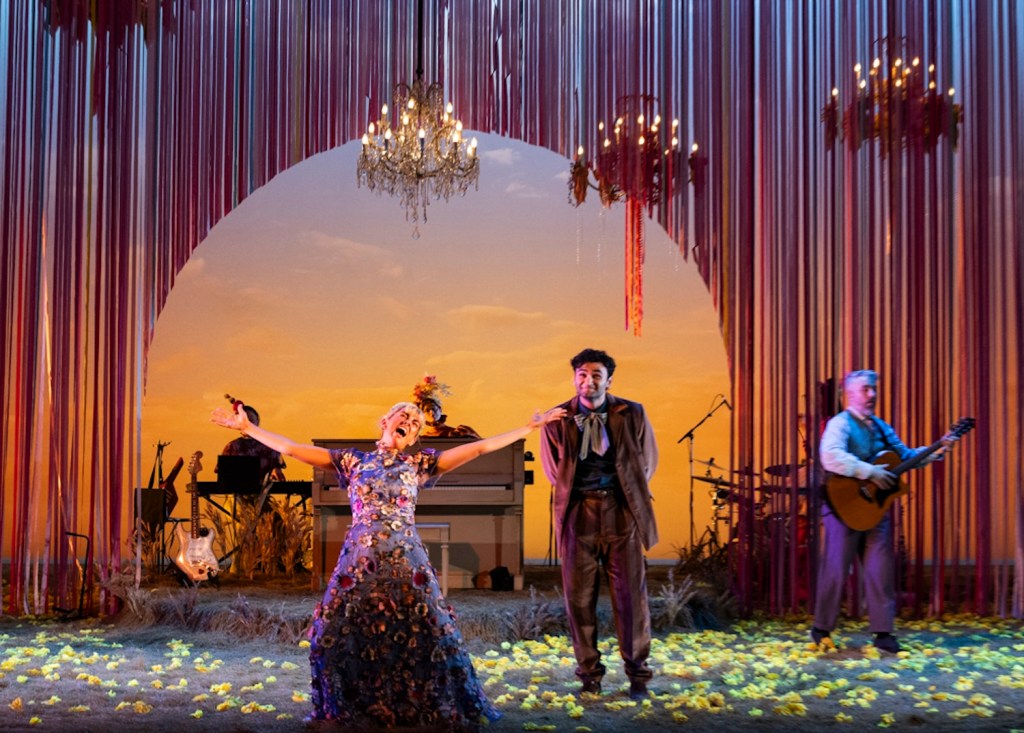
Kala Gare, Raj Labade & Drew Livingston. Photo: Pia Johnson. But what gives it genuine weight is the way the show allows Sybylla to grow. As she experiences more of life and slowly matures, My Brilliant Career takes on weightier territory — arriving finally at the question that drives every young artist: why do I write? What is the point of art? The answer she arrives at is almost spiritual in its execution.
Raj Labade gets to flex like a theatrical Swiss Army knife — swoon-worthy leading man, comedic foil, vocal and instrumental star. (He is also, not incidentally, extremely gifted with a bullwhip.) He embodies the audiences attraction and bewilderment to Sybylla’s iconoclastic ways with a gentle charm.
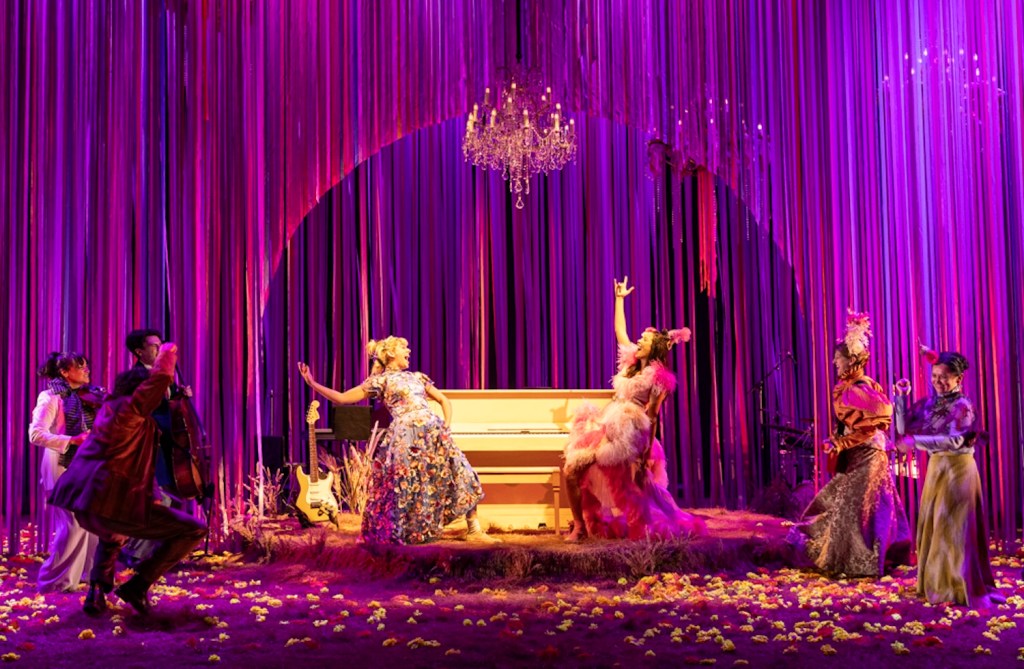
Kala Gare, Melanie Bird & Ensemble. Photo: Pia Johnson. But the performance I find myself most wanting to single out is Melanie Bird’s. Across the evening she inhabits a whole host of different characters, from Sybylla’s younger sister Gertrude, a gloriously bratty M’Swat child, the cosmopolitan Blanche, and more — while also understudying Sybylla and playing a range of instruments. It is a performance of ebullient range, delivered with complete ease.
My Brilliant Career has something too many Australian musicals — and plays and films and television shows — lack: an artistic ambition that refuses to stop at “good enough.” Rather than retreating to easy quirk-comedy or knowing pastiche, it dares to be great on every level. And it succeeds. Accessible and smart, bold and inviting — and at its heart, a questing exploration of the birth of a young artist, told by artists who know exactly how that feels.
-
Four Quartets (The Old Fitz) ★★★½
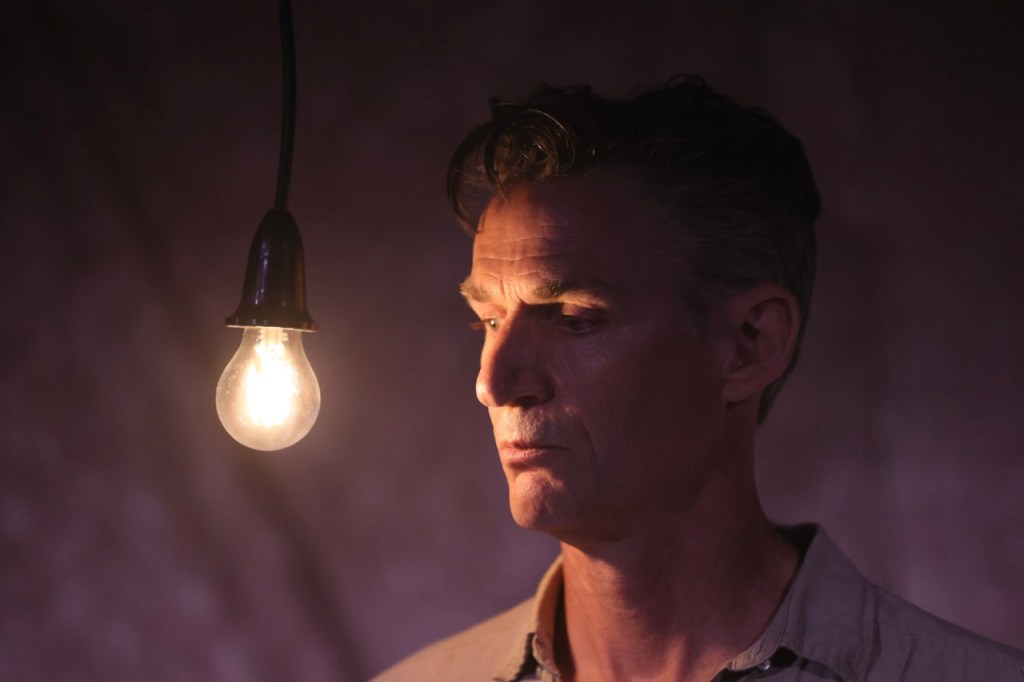
Written by T.S. Eliot. Presented by The Wounded Surgeon. Old Fitz Theatre. 16-20 March 2026.
T.S. Eliot’s epic meditation on time, humanity and divinity gets put on its feet for a late-night show at The Old Fitz — where the intimate darkness of the space, and the late hour, turns out to be a natural fit. And to be clear: this is nothing like Cats.
Eliot’s Four Quartets is made up of four poems — Burnt Norton, East Coker, The Dry Salvages, and Little Gidding — written as the world irrevocably changed around their author in the late thirties and early forties. These are works of spiritual seeking and anguish: Eliot wrestling with mortality, God, and the search for meaning, starting before World War Two begins and deepening as the conflict tore across Europe. Deeply rooted in his Anglicanism but reaching into Buddhist philosophy, he arrives at a vision of the divine that can only be approached by abandoning the very striving we instinctively bring to difficult things — the need to grasp, comprehend, and resolve.
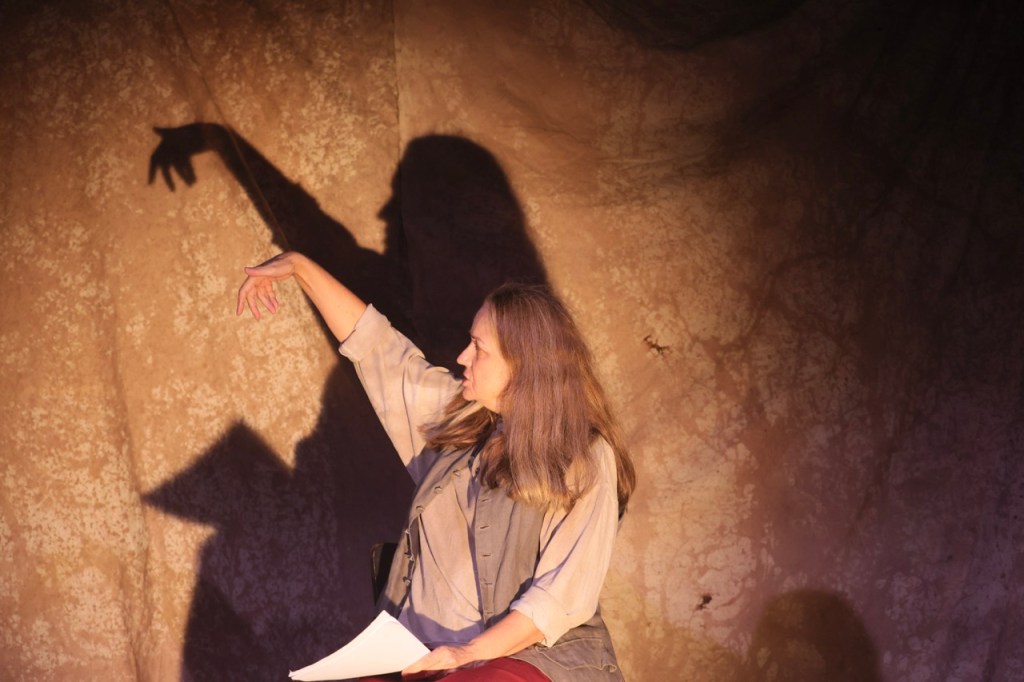
Sandie Eldridge. Photo: Matt Bartlett. Eliot is also a master of form. Each poem is loosely structured like a classical music quartet (hence the title) with a lyricism and metre that carries you through some pretty dense liturgical imagery and complex philosophical terrain. Each is anchored to a specific place, from the Cotswolds to the Massachusetts coastline, and each references one of the four classical elements. There are layers here to luxuriate in, these are rich works that reward further study.
Which makes the production’s central challenge a fascinating one. Each poem is presented as a monologue by a single performer in turn — Sandie Eldridge, Grace Stamnas, Charles Mayer and Kaivu Suvarna navigating these non-linear passages as both dramatic works and spoken-word poetry. Getting the cadence right, finding the understanding underneath the language is no small ask. While they all speak with Eliot’s clear voice, each performer brings a slightly different colour to the material, giving the evening a clear sense of progression.
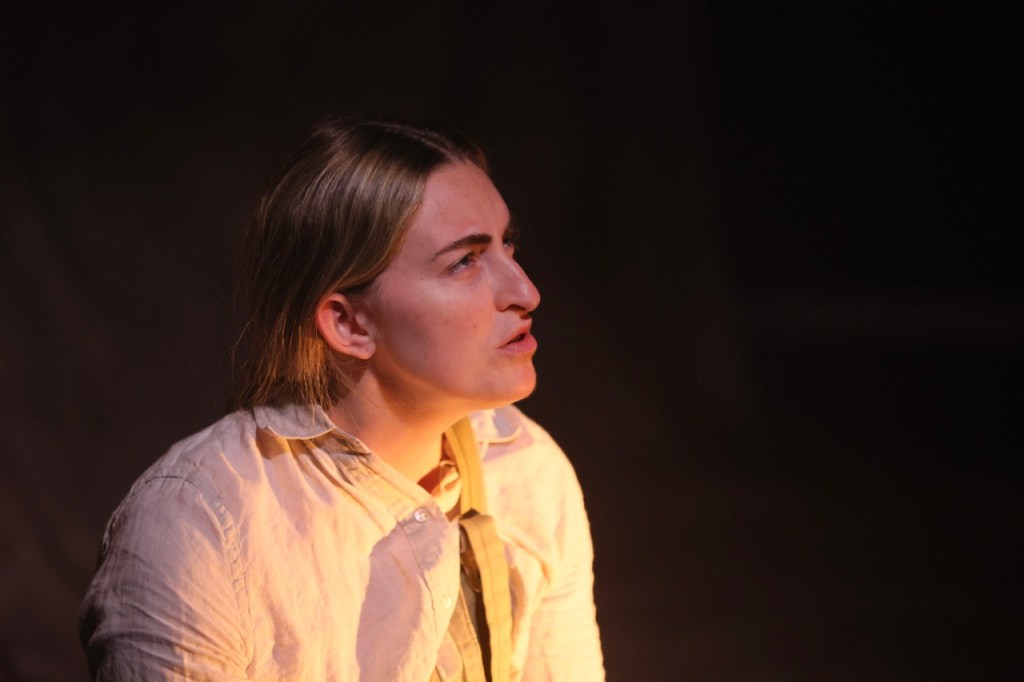
Grace Stamnas. Photo: Matt Bartlett. Under Patrick Klavins’ direction, with Topaz Marlay-Cole’s lighting, Jamie Hornsby’s sound design, and Bella Saltearn’s earthen set and costumes, there’s an almost rural, organic earnestness to the staging. A few props and simple blocking keep things alive without pulling focus from the heady material. It grounds us so that the elements of avant-garde can’t overpower the emotion.
What the theatrical format does best is enact Eliot’s own instruction. These are poems you go along with rather than dissect — you let the language carry you, resist the urge to pin every image down. Just as Eliot preaches the abandonment of attachment as the path to the divine, the only way to truly receive this work is to loosen your grip on comprehension. The late-night setting helps with that. You arrive already disposed toward mood over meaning. At a tight sixty minutes, the production has the good sense to trust the material and get out of the way.
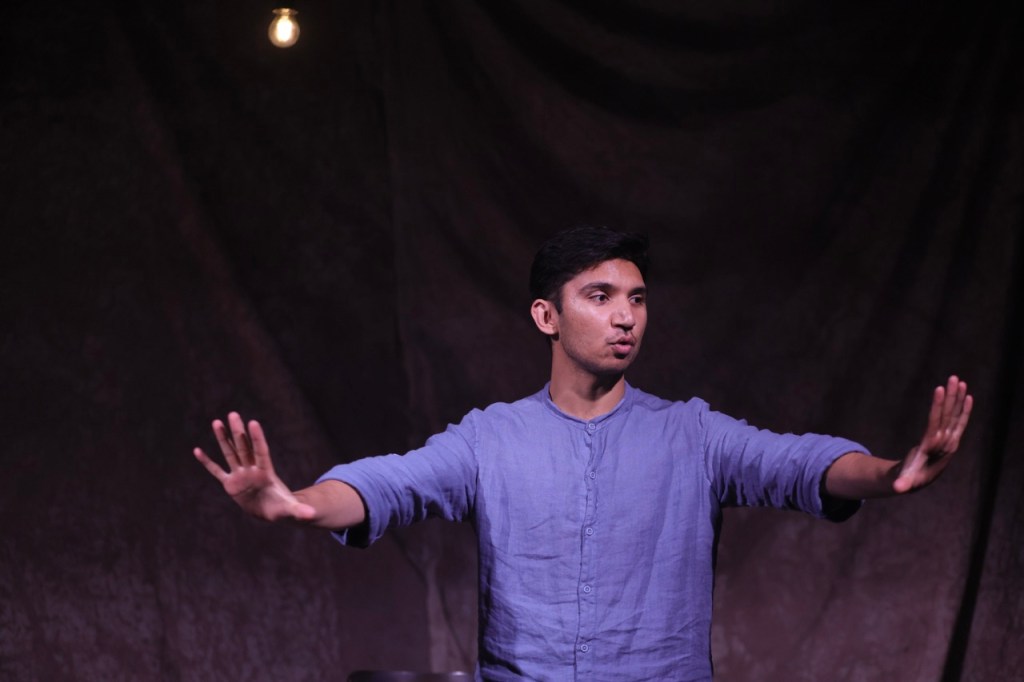
Kaivu Suvarna. Photo: Matt Bartlett. It’s confronting to sit with this work right now, when the world seems permanently on the brink and the lessons of the great wars feel all but forgotten. As events around us grow in scale from the transformative power of AI to repeated shocks of war, Eliot’s meditations speak to our sense of existential insecurity – which for Eliot came from surrendering to the divine. Would that we could face the horror of humanity’s capacity for evil with even a fraction of Eliot’s rigour, honesty, and poetry.
Four Quartets won’t be for everyone — and it’s worth being straight about that. If you’re not already disposed toward poetry, or you need drama to come with plot and conflict, there’s a real chance this will be a slow, bewildering night. Eliot doesn’t meet you halfway. But if language moves you, if you’re drawn to the big unanswerable questions, if you’re willing to sit in the dark and let something wash over you without demanding it explain itself — this can be genuinely magical. The kind of evening that follows you home. Go late, go open, and leave your need for answers at the door.
-
Monster (KXT) ★★★½
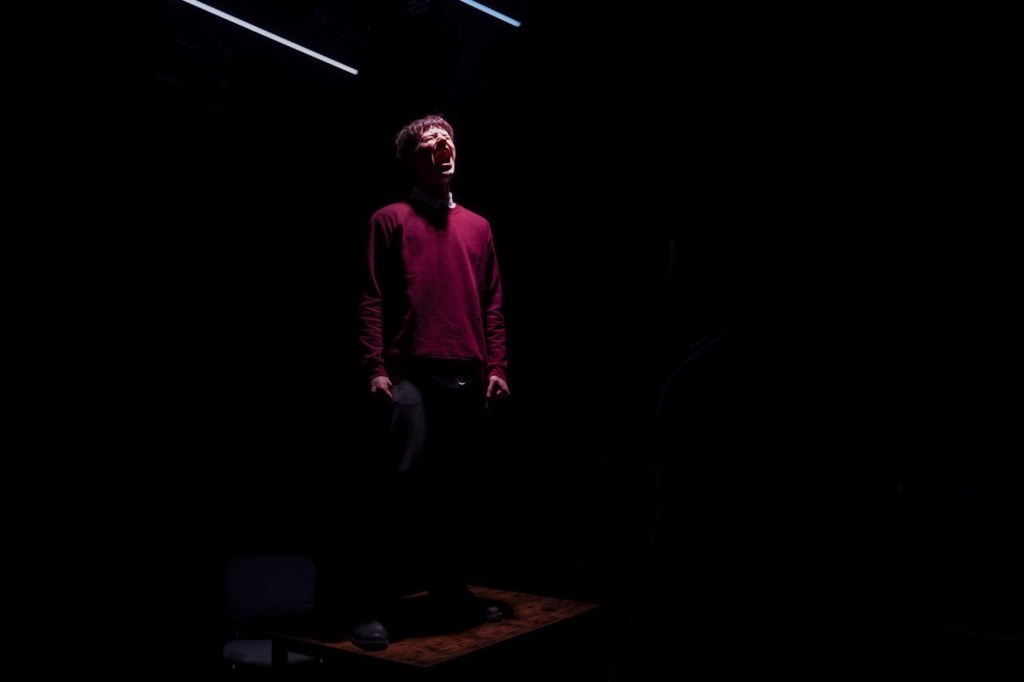
Written by Duncan Macmillan. Tiny Dog Productions in association with Bakehouse Theatre Co. KXT on Broadway. 6-21 Mar 2026.
What turns boys into dangerous young men? What makes a monster? Playwright Duncan Macmillan doesn’t provide answers so much as prod you to draw your own conclusions in this dark, spacious early work — receiving its Sydney debut at KXT on Broadway. If you were fascinated by the Netflix series Adolescence, this makes for a compelling companion piece.
Darryl (Campbell Parsons) is a disruptive 14-year-old, removed from his regular classes to be tutored by Tom (Tony J Black), an inexperienced teacher. Tom is disturbed by Darryl’s obsession with violence and his lack of empathy. Meanwhile, at home, his fiancée Jodi (Romney Hamilton) is pregnant with their first child. As Tom grows more involved in Darryl’s life — desperate to find a way to help him — his own world begins slipping into dangerous territory.
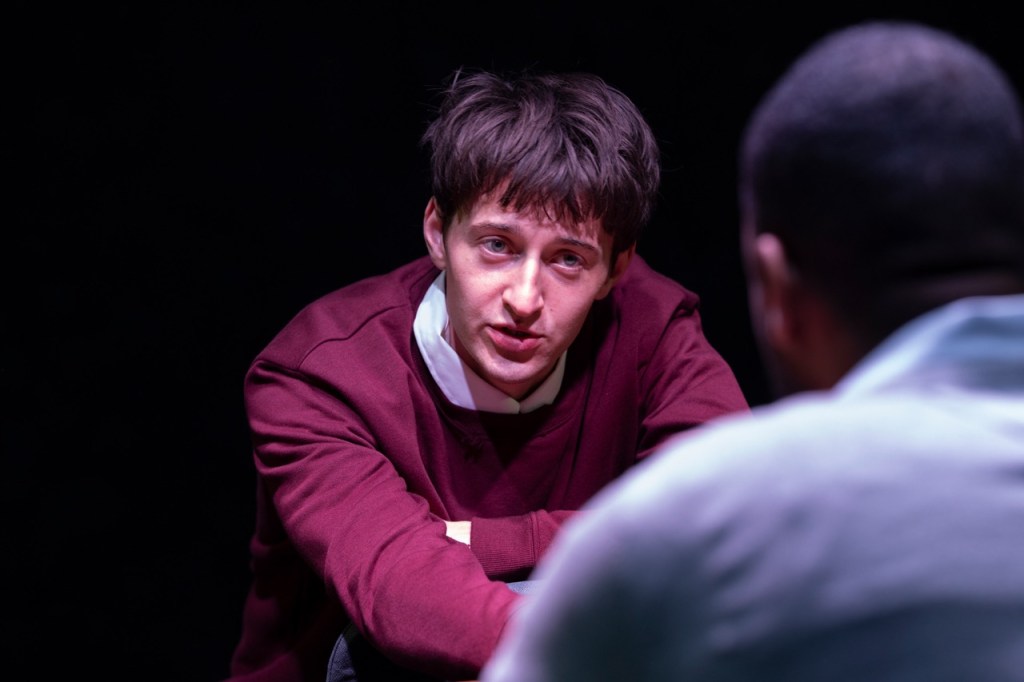
Campbell Parsons & Tony J Black. Photo: Abraham De Souza. Campbell Parsons, who was impressive in Babyteeth last year, is utterly magnetic here as Darryl. In Parsons’ hands, Darryl feels genuinely unpredictable and charged with unnerving energy. There is an almost overwhelming drive to him that steamrolls over people, situations and social graces. Truth, lies and youthful storytelling become indistinguishable in the things he says. Without any institutional power of his own, he nonetheless exerts control over those around him. Even offstage, his presence is felt.
A further performance highlight is Linda Nicholls-Gidley as Darryl’s grandmother Rita. His only family, Rita is both fierce defender and fearful subject, and Nicholls-Gidley balances that embattled protectiveness with a weary defensiveness beautifully. It fantastic to have her on stage again, rather than just in the rehearsal room coaching dialects (which are all excellent in this show by-the-way).
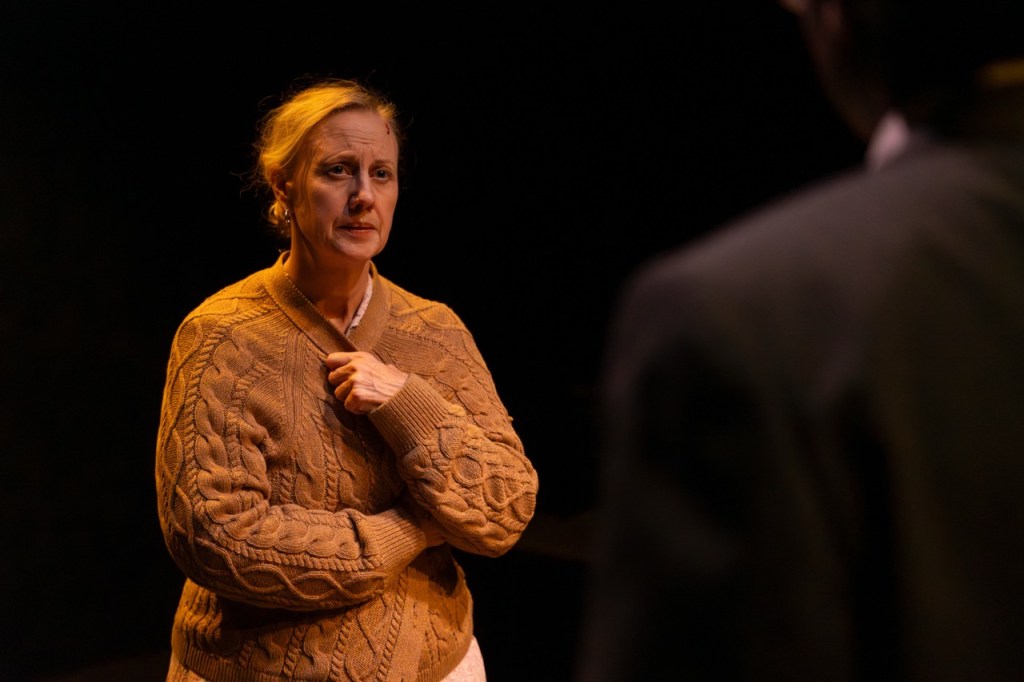
Linda Nicholls-Gidley. Photo: Abraham De Souza. Romney Hamilton gets to run the emotional gamut as Tom’s fiancée Jodi. Her performance hints at past pain — and for all the emotional fireworks, there is real nuance beneath. A joy to watch.
Tony J Black, a last-minute casting in the demanding lead role of Tom, faces a steeper climb than most and puts in solid work given the limited preparation time (he was technically on-book for opening night, but only relied on it in small moments). His performance — and the show as a whole — will no doubt deepen once he has fully found his stride.
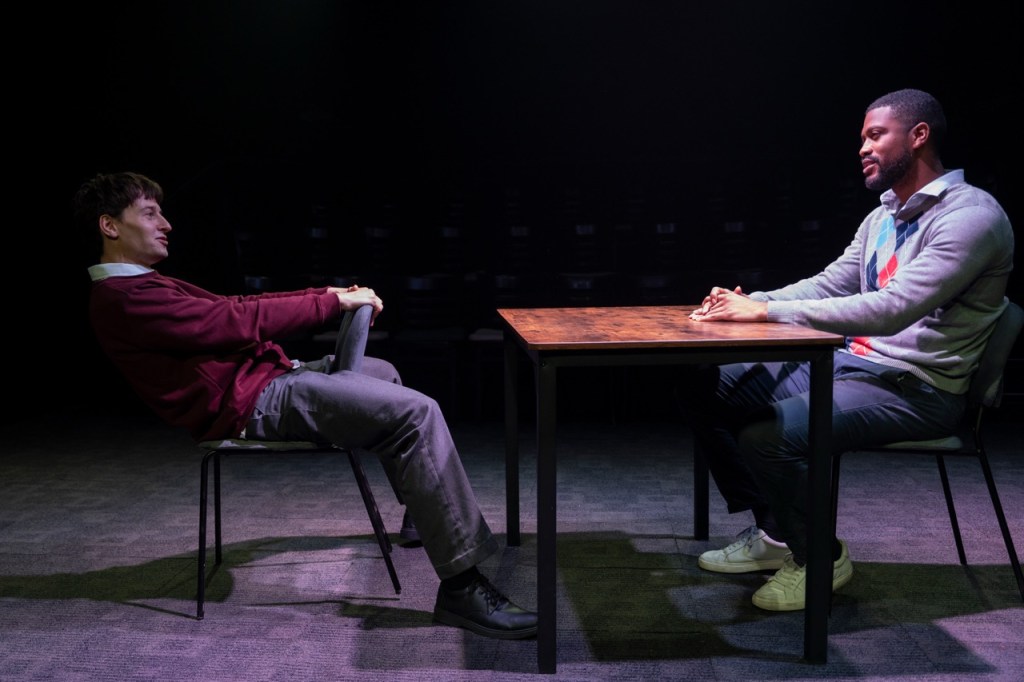
Campbell Parsons & Tony J Black. Photo: Abraham De Souza. Director Kim Hardwick presents this with as little embellishment as possible. A sleek, sparse set by Victor Kalka provides a moody backdrop — essentially a table and two chairs. Charlotte Leamon’s sound design is deployed only in key moments, leaving the soundscape bare for long stretches. By not deploying the usual bag of directorial tricks to give emotional guidance, Hardwick puts the emphasis on the text and the performances to do the heavy lifting — and thankfully, this cast is more than equal to that task.
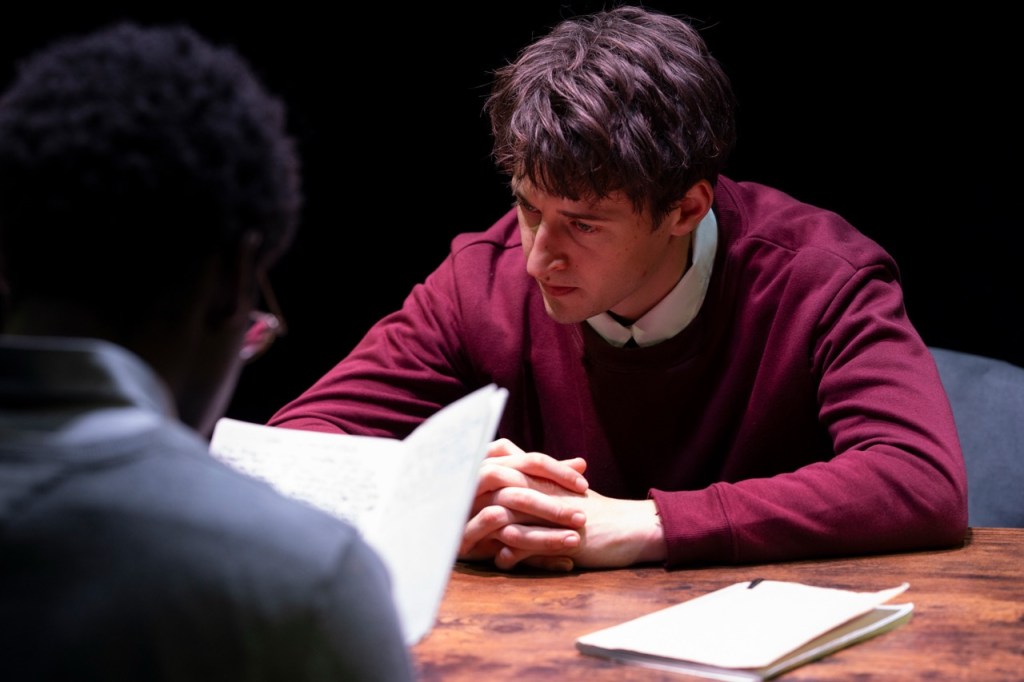
Campbell Parsons & Tony J Black. Photo: Abraham De Souza. Macmillan’s script flirts with danger, and his grasp of Darryl’s unrelenting nature is thrilling. Darryl is an emotional terrorist, refusing to negotiate with those around him, turning every conversation into an unbending interrogation and every interaction into a potentially violent one. He is a brilliant character who makes the play what it is.
Monster is a heavy affair, and this production’s contemplative pacing and monastic staging leave little room to escape. Macmillan’s writing is sharp and unsettling, circling its themes with precision — a reminder of why this early work has earned its place on stage. Its triumph lies in the casting — an ensemble who bring real vibrancy to that open, demanding space.
-
Subscribe
Subscribed
Already have a WordPress.com account? Log in now.
 Cultural Binge