-
Welcome to Cultural Binge

The rating system is simple:
★★★★★ – Terrific, world-standard. Don’t miss.
★★★★ – Great, definitely worth seeing.
★★★ – Good. Perfectly entertaining. Recommended. Individual mileage may vary.
★★ – Fine. Flawed and not really recommended, but you may find something to appreciate in it.
★ – Bad (& possibly offensive).
See more reviews over at The Queer Review.
Instagram: @culturalbinge
Substack: culturalbinge.substack.com
Email: chad at culturalbinge.com
-
Zombie! The Musical (Hayes) ★★★★★

Book, musical and lyrics by Laura Murphy. World Premiere. Hayes Theatre Company. 8 Mar – 6 Apr, 2024.
Don’t call them “zombies”, they’re “ghouls”… or maybe the better word is “trolls”. Laura Murphy’s destined-to-achieve-cult-status musical Zombie! The Musical proves she’s one of our best working talents, writing the music, lyrics and book – and all three are better than any other Australian musical I’ve seen in the last five years. This show has my heart, and it can eat it too if it likes.
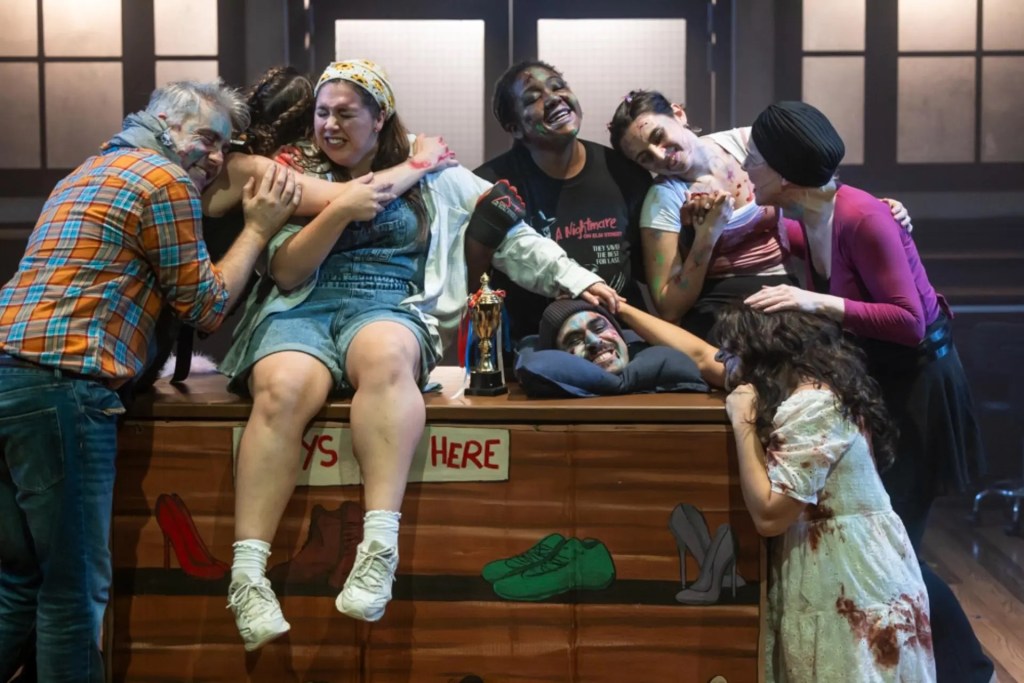
A community theatre group is rehearsing what can only be described as a depressingly sexist old musical when their lead actor Dave (a bizarrely multifaceted performance by Ryan Gonzalez) gets bitten by a strange five-year-old. As the leading lady Felicity (Chelsea Dawson), and director George (Drew Livingston) fight over who should replace him, the news reports flood in. Sydney is under threat from a zombie-apocalypse and everyone should stay in doors. Trapped in a theatre, with a brains-hungry zombie-Ryan on the loose. Ingenue Felicity, Dave’s girlfriend Hope (Chelsea Dawson), ageing star Carol (Tamsin Carroll), ensemble members Sam (Natalie Abbott) and Mila (Monique Sallé), director George and stage manager Trace (Nancy Denis) have to put their high kicks and stage-fighting skills to the test to survive… and maybe… save the world through the power of musical theatre.
Zombie! The Musical is laugh-out-loud daft, with a whip-smart book and lyrics hiding beneath its B-movie exterior. What starts off with a stage director dehumanising his cast and boxing them into generic and retrograde roles, develops into a surprisingly (if blatant) allegory for how we treat each other online – demonising those we disagree with while they do the same to us. Impaled zombies stand in for a polarised nation.

To add that spoonful of sugar to the “big message”, Murphy has loaded Zombie with non-stop musical theatre jokes that will keep even a casual fan of musicals rolling in the aisles. From visual gags (like Felicity fending off a zombie barricade-style with a French flag) to verbal expletives like “Oh my Godspell”, the Easter Eggs are all there to find. The score plays with pastiche of recognisable hits as well bursting out in brand new bangers. MT and horror tropes are turned on their head with clever wordplay and the B-movie vibes get elevated by some particularly gruesome props. Although can we all please retire the phrase “flip the script” from pop-musical lyrics? It’s done.
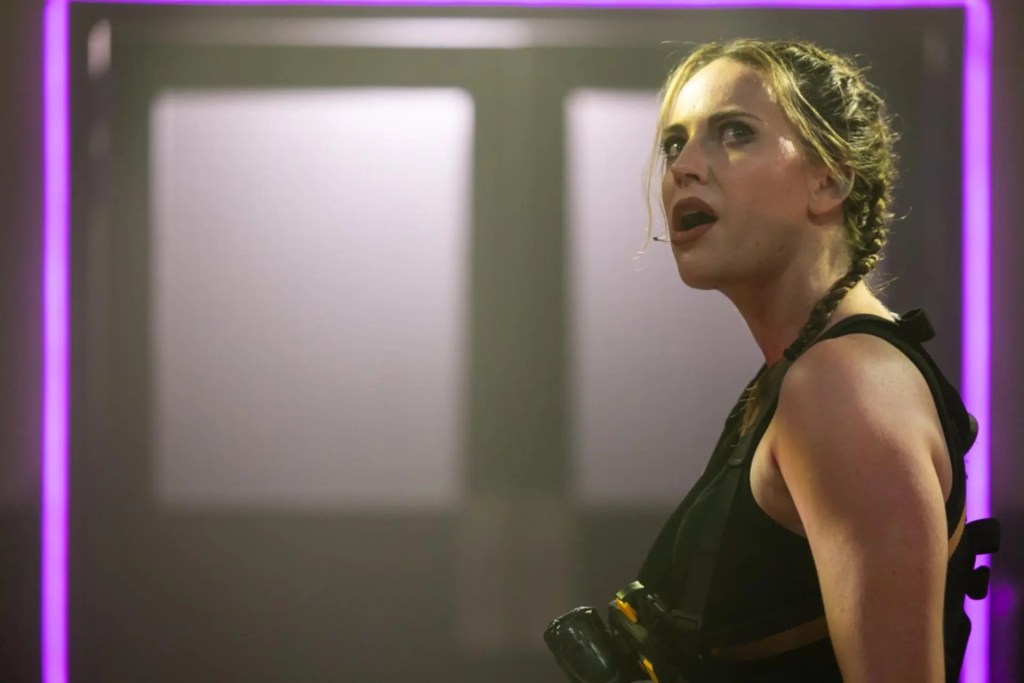
I’m a big fan of Monique Sallé, and it says a lot that in this show she does slightly fade into the background. Not because she’s not giving it her all, but because the ensemble are all operating on the same talentedly demented level. There are really no weak links here. Gonzales is both charming and monstrous as a zombie, Carroll is droll and divine, while Dawson goes from ambitious young actress to zombie-hunting machine with conviction.

Director (the actual real director, not the character) Darren Yap keeps the show moving and spinning. It takes some clever staging to make the horror & comedy work, and both are delivered with panache. Choreographer Chiara Assetta gets to play with a cast who can move well (Ryan Gonzales’ zombie-hip-hop is a real treat). And Verity Hampson’s lighting, along with David Grigg’s sound, nails the tone.
But this is Laura Murphy’s triumph. After delivering solid commissions like The Lovers and The Dismissal, it feels like Zombie! The Musical is coming straight from her creative heart. Quirky and deranged, it’s bound to be a hit around the world, especially in smaller theatres, and who knows, with an injection of cash it could take over the big stages too. So, chookas to the Apocalypse!
-
Holding The Man (Belvoir) ★★★★
Written by Tommy Murphy. Belvoir St Theatre. 9 Mar – 14 Apr, 2024.
It’s hard to overstate the importance of Tim Conigrave’s memoir Holding The Man in the Australian gay zeitgeist. When it was released in 1995, it became a surrogate for the stories of thousands of gay men who grew up in the Aussie suburbs and battled ignorance to find liberation and love, before a generation of men were cut down by the Aids epidemic. Belvoir’s revival of the theatre adaptation by Tommy Murphy channels the feel of Australia’s 70s, 80s and 90s to tell the tale once more.

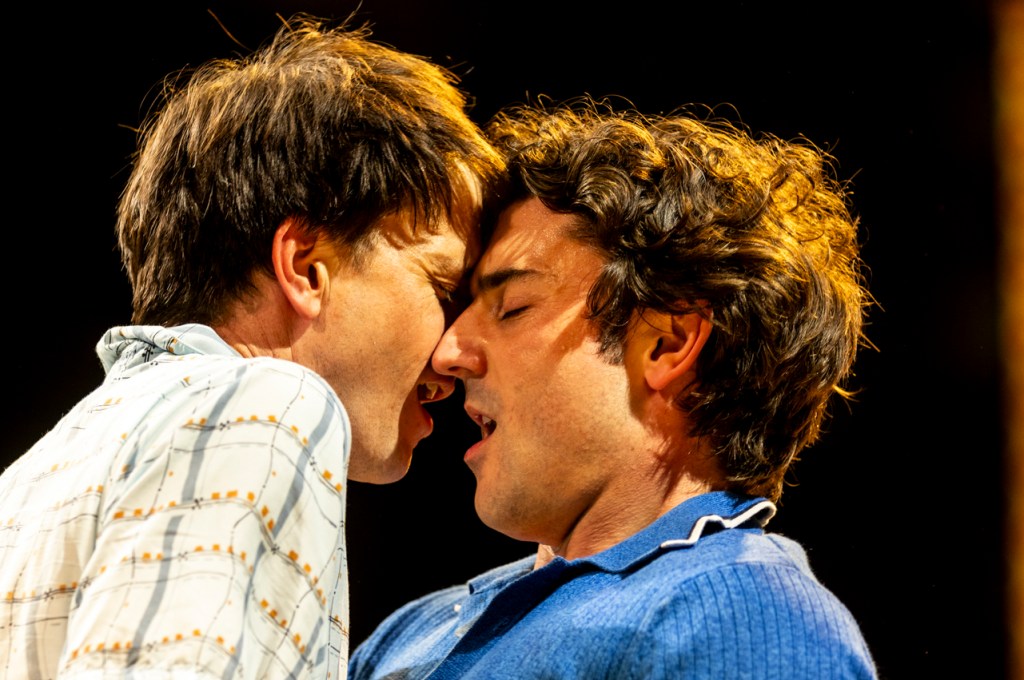
Danny Ball & Tom Conroy. Photo: Brett Boardman. In highschool, young Tim (Tom Conroy) can’t stop thinking about John Caleo (Danny Ball), the handsome Italian-Australian sport-star in his school. When he finally summons the courage to talk to him the two start an uneasy friendship till one night, playing a party game, they kiss and sparks fly. What follows is a classic love story of parental disapproval, young lovers growing together and apart, and overcoming adversity as a pair. Until Act Two when they face the reality of HIV.
Things have changed a lot for gay men since the 70s, 80s and 90s, and now that Holding The Man is firmly a period piece it has become a different beast than it was originally. It’s still a heartfelt tribute to John Caleo. His innocence and devotion are untainted by the events happening around and to him. But in the 2020s, Holding The Man is less “Australia’s Big Aids Play” and more of a character study of Conigrave, a flawed gay man trying to figure out what being gay means without any role models. Conigrave paints a saintly portrait of his lover while denigrating himself constantly.
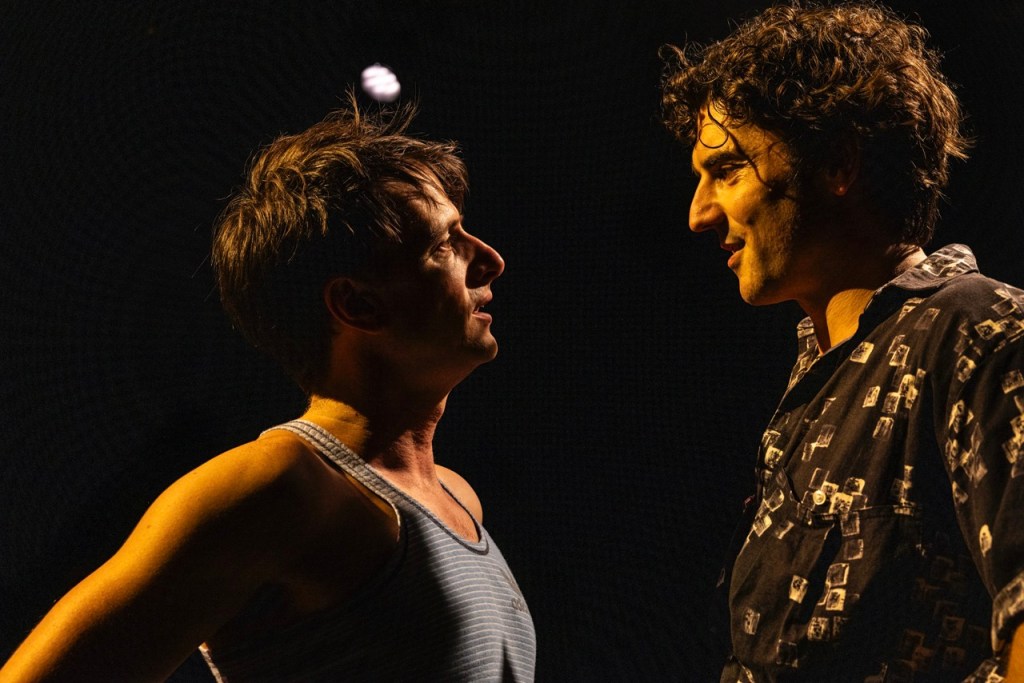
Tom Conroy & Danny Ball. Photo: Brett Boardman. As the age-old gay dilemma of monogamy vs open-relationships rears its head, Caleo has no desire for anyone other than his partner, while Conigrave is keen to explore all aspects of his sexuality. It’s here that Tim becomes an often unlikable narrator, his blunt honesty and lack of regard for others feels like a rough confessional from a writer dealing with his own sense of guilt. It makes for a fascinating character. But moving the spotlight firmly onto Conigrave has the negative effect of sidelining the warm and sweet Caleo, who is off-stage for large chunks of the story. His absence is keenly felt.

Tom Conroy & Russell Dykstra. Photo: Brett Boardman. I’ll be honest, the delay in posting this review has been because when I saw it on opening night I was… disappointed. There was a large shadow looming over this production of Holding The Man. It wasn’t HIV or Aids. It was The Master & Margarita, Belvoir’s barnstorming hit from the end of 2023, also directed by Eamon Flack. It had built a sense of expectation in me that wasn’t satisfied by what I saw. But as I wrote the review I realised I’d fallen into the trap of judging the production for what I wanted it to be, rather than judging it for what it actually was. Holding The Man is dear to me. I can’t remember how many copies of the original book I’ve given away over the years, or how many times I re-read it. My heart wanted this play reach the ecstatic heights of The Master & Margarita.
So I went back to see it again.

Shannen Alyce Quan, Russell Dykstra, Guy Simon, Tom Conroy & Danny Ball. Photo: Brett Boardman. Grabbing a ticket at the last minute, I watched from the onstage seating. Suddenly, the show came alive for me. Without the burden of my expectations, plus a much more intimate view, all of the emotions I didn’t feel the first time came flooding in. My experience of the show was very, very different.
Conroy’s Conigrave is… okay to be honest he’s a bit of a dick, but an engaging one. In comparison Ball’s childlike Caleo is instantly adorable. Their relationship makes sense, the “good boy” Caleo attracted to the wild Conigrave. When you realise how young they both were when they died, it hits hard. Far too young to be taken by Aids, their whole lives were ahead of them.

Russell Dykstra, Rebecca Massey, Guy Simon & Tom Conroy. Photo: Brett Boardman. Even after the second viewing, some of my initial criticism’s still remain, John’s final scene includes a needlessly distracting piece of staging (I’m trying not to spoil some of the bigger moments). Spreading out the “circle jerk” scene means the audience is whipping their head around like a game of tennis.

Guy Simon. Photo: Brett Boardman. But the elements I liked became even better. Guy Simon is the shows MVP, for the pitch perfect tone of his multiple roles, especially Juliet’s mother (I want her costume and her hair), and Peter, John and Tim’s friend. Up close I could see the smaller bit of tenderness between John and Tim that I’d missed the first time, without which their relationship felt cold. The magic of their early love hits the mark.
The return of Holding The Man to Belvoir is a chance to look back on how far we’ve come and think about whether we’ve come far enough. Book a ticket, as close to the stage as you can, and soak it all in.

-
The Great Divide (Ensemble) ★★★1/2

Written by David Williamson. World Premiere. Ensemble Theatre. 8 Mar – 27 Apr, 2024.
Retirement obviously does not sit well with playwright David Williamson, or maybe Australia is just in need of its great chronicler to help illuminate the way and he’s heeded the call to duty… whatever the reason, he’s back and he’s tackling Australia’s obsession with property and the widening wealth gap in The Great Divide.
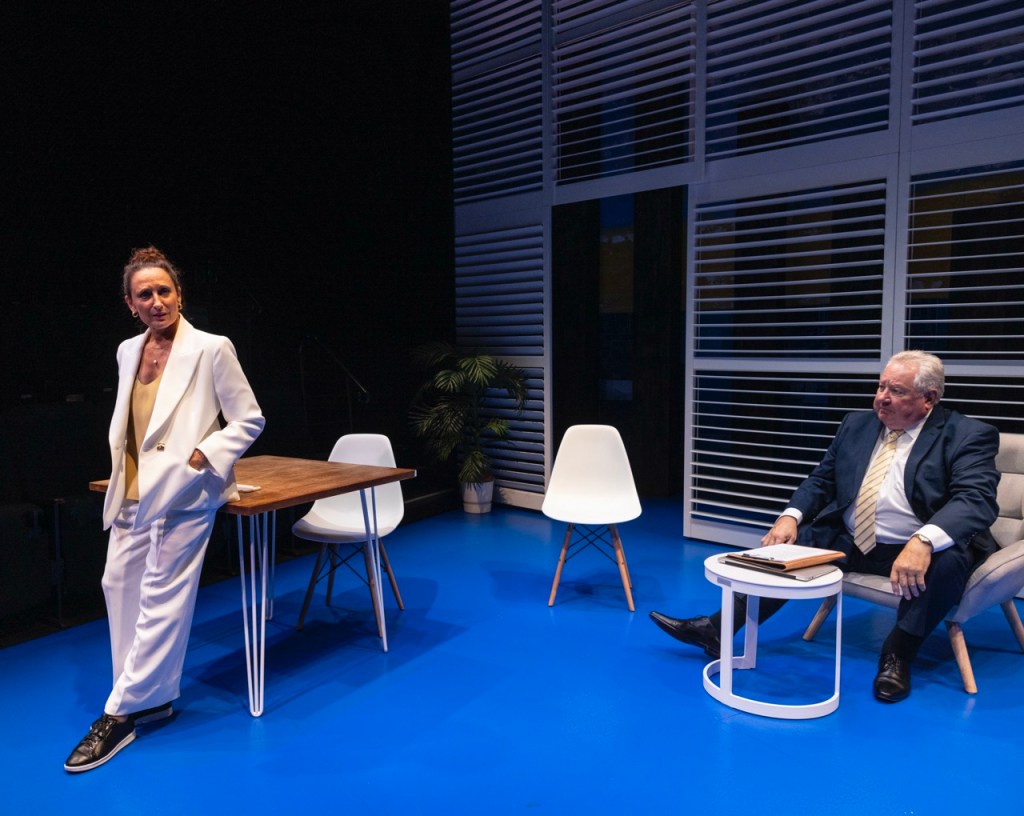
Georgie Parker and John Wood. Photo: Brett Boardman. Australia’s richest woman, Gina Rine… oops sorry, I mean Alex Whittle (Georgie Parker) has picked the sleepy coastal town of Wallis Heads to become the new Byron Bay and is using all her influence to push opposition aside. But single mum Penny Poulter (Emma Diaz) is fighting back, trying to ensure people like her, those on minimum wage in the midst of a rental crisis, aren’t forced out of town by rising rents. When rough progress hits compassionate conservation – which will win?
Georgie Parker is having a ball playing the powerful, manipulative and downright nasty Alex. Pacing across the set with a permanent sneer on her face, she spits out insults and rude truths with glee – she’s incredibly likeable while we loathe her at the same time. Kate Raison’s poise as Alex’s long-suffering personal assistant is a complete contrast, and the duo work so well together I wanted more scenes of them chewing each other out.

Kate Raison. Photo: Brett Boardman. Williamson’s strength here is to make it clear that Alex’s plans are not without merit. An influx of development and jobs would be welcome in a town full of empty shop fronts. The youth of the area, as represented by Penny Poulter’s teenage daughter Rachel (Caitlan Burley), are keen for the change. Is Penny being unreasonable by trying to hold back progress? Do we dislike Alex’s plans because we dislike her?

Caitlin Burley & Emma Diaz. Photo: Brett Boardman. In the age of shamelessness that we live in now, Williamson taps into the difference of generational mindset to add some fun wrinkles to the tale. The scene of Penny explaining a shameful secret to her daughter is filled with laughter and takes the story in a fresh direction. Unfortunately that spark of originality isn’t present in all aspects of the script, which does seem to walk its way through the plot. The ending is neat, but feels forced compared to everything that has come before without really offering too much in the way of insight into the issues.

Emma Diaz and Kate Raison. Photo: Brett Boardman. Mark Kilmurry’s production is, on the whole, surprisingly flat. The coastal 80s inspired set is static, bar the cast moving the odd chair around. The lighting bakes the stage like the set of a soap opera and some inter-scene black outs had the audience momentarily confused about whether the act had ended or not.
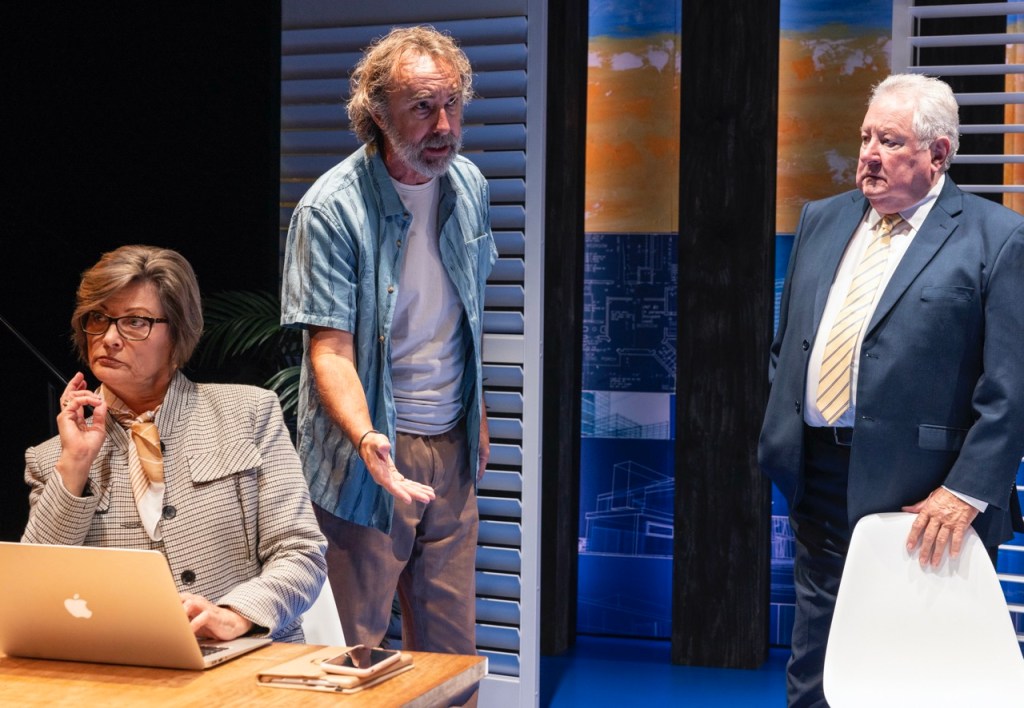
Kate Rasion, James Lugton and John Wood. Photo: Brett Boardman. It’s really the energy of the cast that brings The Great Divide to life. John Wood may not have much to do as the town’s Mayor, but he happily makes a meal of it in every scene. James Lugton’s local newspaper editor is a great counterpoint – all tired idealism in the face of economic collapse. Caitlan Burley literally bounds onto the stage with teenage exuberance. You can feel Kate Raison’s eyes rolling behind Alex’s back without even looking at her face.
But this is Georgie Parker’s night and she delivers in spades. I’d have loved her to dial it up even more – a full-on Miranda Priestly for the Australian stage! With each devious turn of Alex’s mind, Parker gets to have her cake and eat it too, and so do we.
-
37 (Melbourne Theatre Company) ★★★
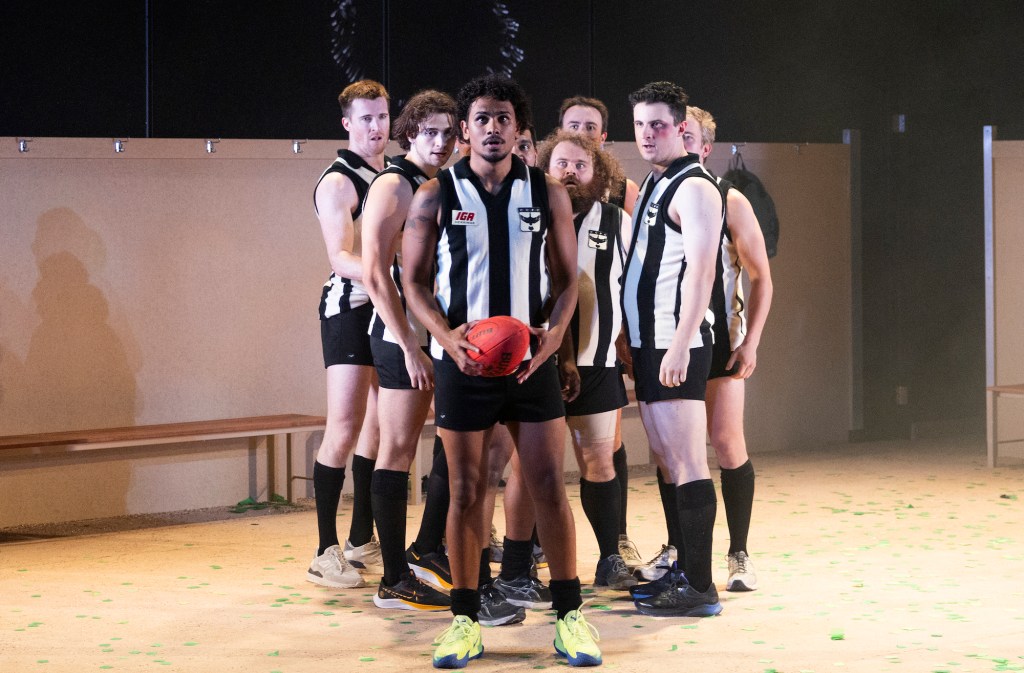
Written by Nathan Maynard. Melbourne Theatre Company. 2 Mar – 5 Apr, 2024.
Nathan Maynard opens up the culture wars in Australian sport with a head-on look at racism with his play 37. It’s short on nuance but big on short shorts – much like the game of AFL itself.
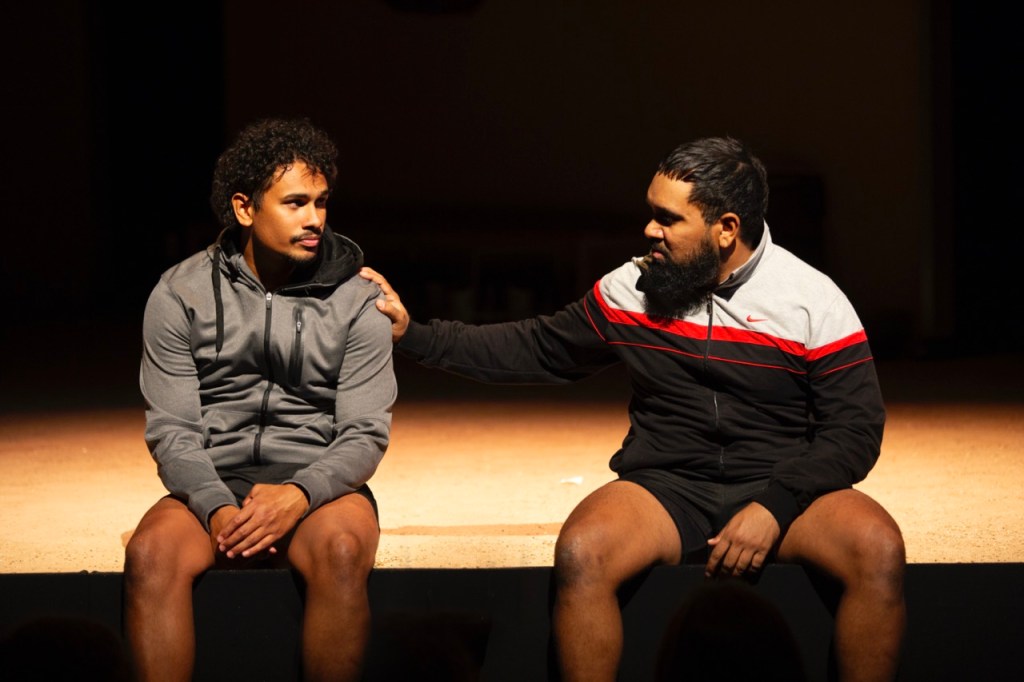
Ngali Shaw and Tibian Wyles. Photo: Pia Johnson Let me be upfront – I don’t know / kinda hate sport. To misquote Val from A Chorus Line, “I never heard about the
Red ShoesAFL, I never saw theRed ShoesAFL, I didn’t give a crap about theRed ShoesAFL”. I was slightly apprehensive about going in, but this is theatre, and having recently seen the NTLive broadcast of the brilliant Dear England (about soccer), I figured this production would also be sure to cater to people like me. And it did. 37 isn’t about AFL, it’s just a microcosm for Australia’s attitudes on race.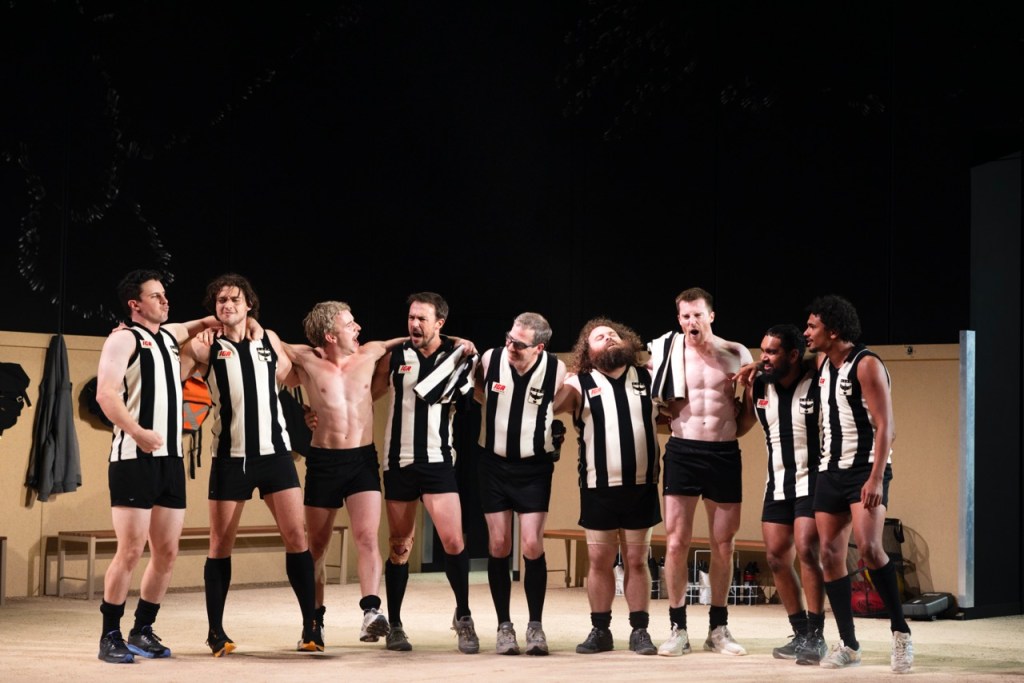
The cast of Melbourne Theatre Company’s 37. Photo: Pia Johnson. Centred around a local football club that is underperforming, two new, indigenous players are brought in, the star-players Jayma (Ngali Shaw) and Sonny (Tibin Wyles). Jayma struggles to bond with anyone on the mostly white team other than the captain Joe (Ben O’Toole), while Sonny’s bright, easy-going personality helps him fit in. Together they grin their way through micro-aggressions and ignorant questions before one player, Woodsy (Eddie Orton) makes clear what he thinks of his Blak teammates.
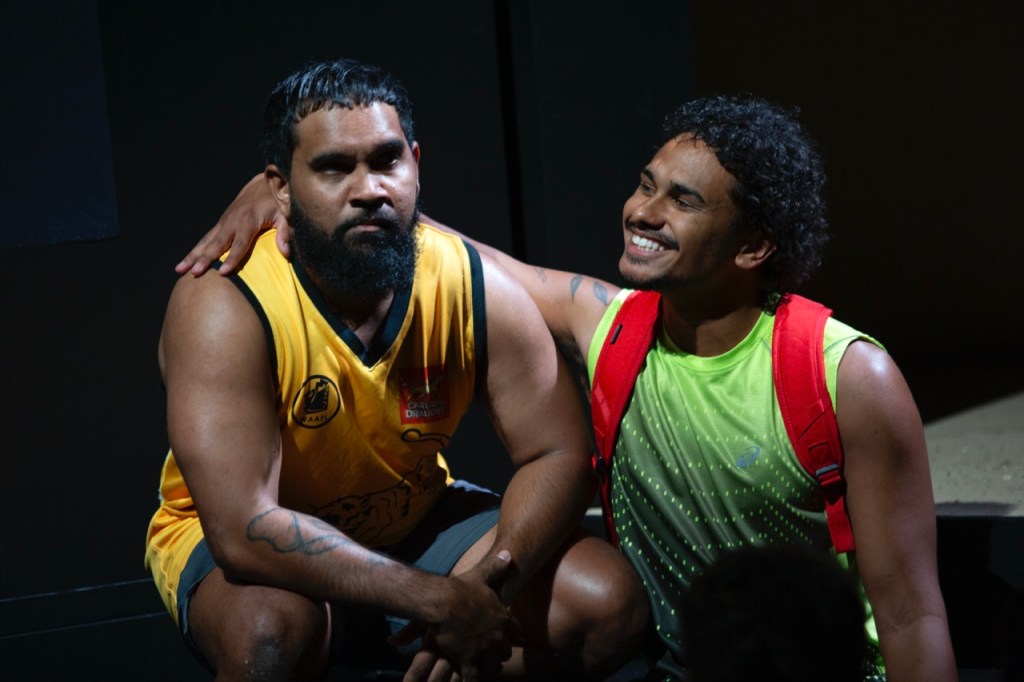
Tibian Wyles and Ngali Shaw. Photo: Pia Johnson. The title is taken from the number on Aboriginal superstar football player Adam Goodes’ AFL jersey whose career ended in a haze of political and cultural mudslinging that put Australia to shame. It would be nice to say Australia has improved since then but, *looks at news websites*, nope – same old screamin’ bullshit goes on today! It was hard to watch 37 without thinking of the current “outrage” over Sam Kerr’s recent outburst. One recurring line from the script is the seemingly innocent question of “Is that racist?”
Maynard uses the 10 actors to portray a kaleidoscope of opinions. From the young player Ant (Costa D’Angelo) whose own non-white background is brushed off to the genuinely ignorant Gorby (Mitchell Brotz) and the allyship of Apples (Samuel Buckley). With all these potential viewpoints in the mix, it’s surprising that the discussion of racism in Australia feels so basic and undemanding. There is an odd lack of nuance, examination or understanding in the script – the polar opposite to Maynard’s At What Cost? Some interesting threads are raised (Sonny’s decision to simply ignore the racism and get on with things, or the behind-the-scenes politics of the club) but they never really take hold.

The cast of Melbourne Theatre Company’s 37. Photo: Pia Johnson. The script is kept alive by some breathtaking choreographed moments that emulate the sport, giving the play a lyrical vision the text somewhat lacks. Outside of these moments though scenes felt rather static, buoyed by a charismatic cast.
37 tackles its big topics directly and in doing so fell flat for me. The good people were good and the bad people were bad and there wasn’t any attempt to bridge the gap, or do what theatre does best, which is illuminate a knotty issue with a fresh point-of-view.
-
Yentl (Malthouse) ★★★★★

Written by Gary Abrahams, Elise Esther Hearst and Galit Klas. After the short story by Isaac Bashevis Singer. Malthouse Theatre, Melbourne. 29 Feb – 17 Mar, 2024.
You may think you know the story of Yentl from the 1975 Broadway play and Barbra Streisand’s iconic 1983 musical film but this production (returning for a second season after its 2022 debut) fills the tale of the young woman who dresses as man in order to receive an education with mysticism, theology and sex.
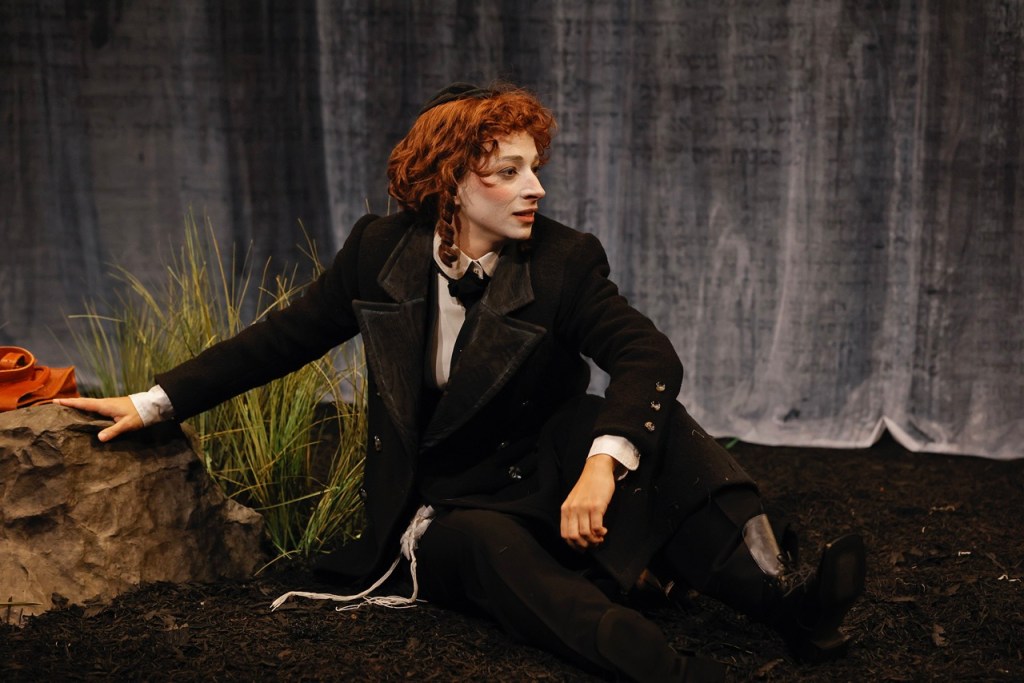
Amy Hack. Photo: Jeff Busby. How can an all-knowing, infallible god make mistakes? How can humanity have free will, when an all-powerful god has predestined the future? Can you really be a heretic if you enlighten the scriptures?
Yentl poses a lot of big questions about faith, but ultimately comes down to the emotional wrangling of a young woman struggling with her unfair place in society, and her own sexuality.
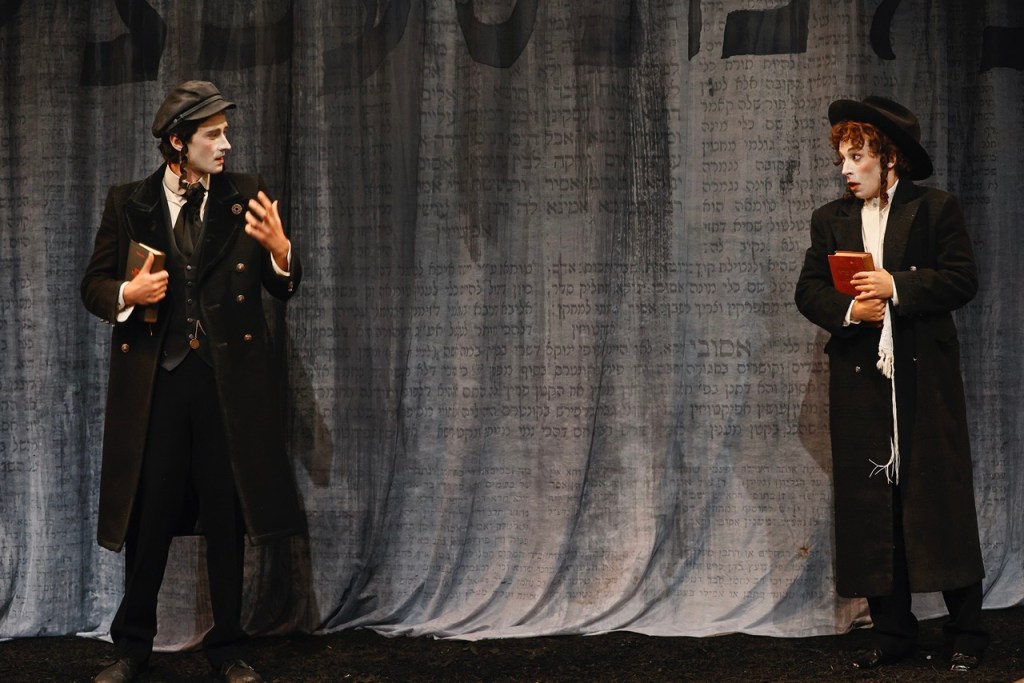
Nicholas Jaquinot & Amy Hack. Photo: Jeff Busby. After the death of her father, and teacher, Yentl (Amy Hack) takes his clothing and disguises herself as Anshl, a young scholar, to attend school. There she meets the handsome, tortured rebel Avigdor (Nicholas Jaquinot) who becomes her best friend. But the pretence of boyhood gets more complicated than she planned when Avigdor’s former fiance Hodes (Genevieve Kingsford) falls for the soft-skinned, sweet, young student Yentl has invented.
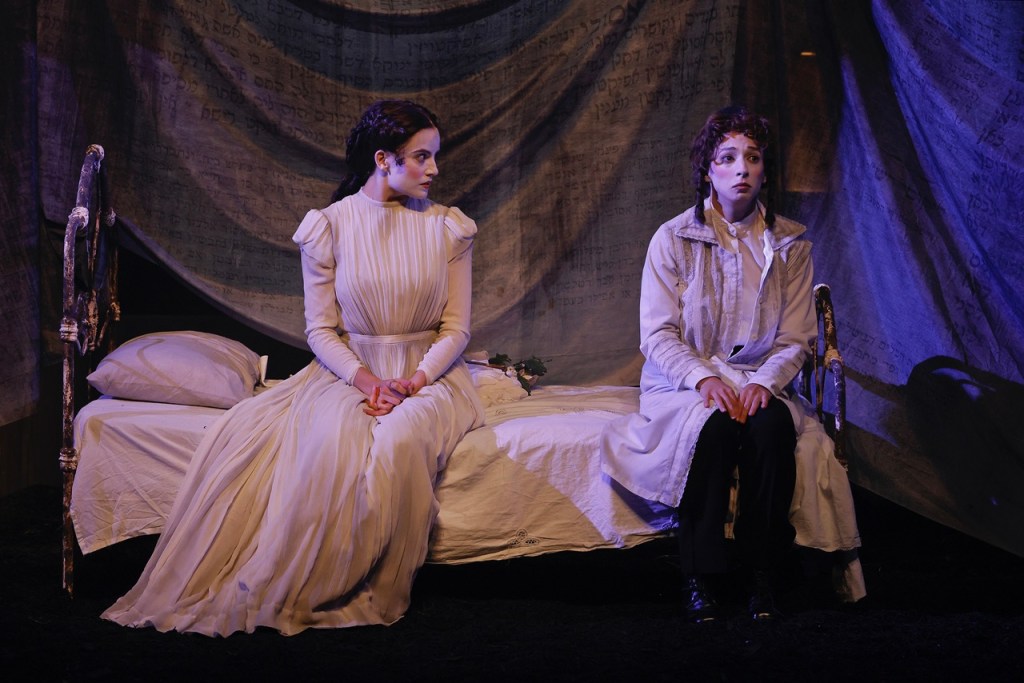
Genevieve Kingsford & Amy Hack. Photo Jeff Busby. The real genius of this production is the invention of the yeytser ho’re (Evelyn Krape), “The Evil Inclination”. Part-narrator, part-meddling-sprite, she is constantly subverting the tale and pushing Yentl further along. Krape gives her role a malevolent glee, enjoying the emotional turmoil Yentl creates among the village. She is Yentl’s desire and drive made manifest as an agent of chaos.
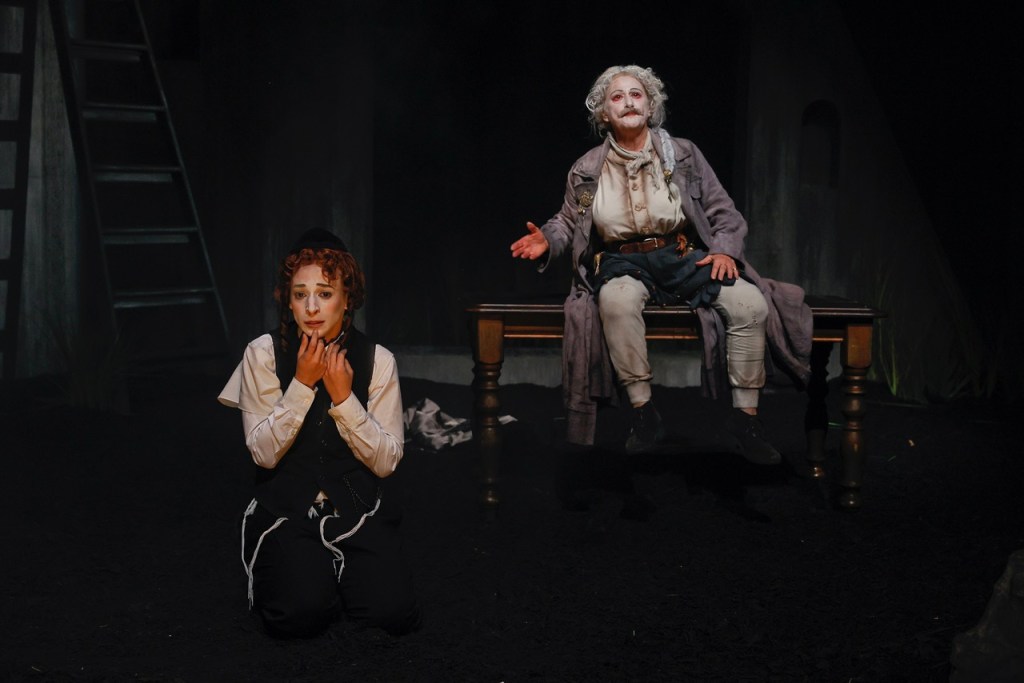
Amy Hack & Evelyn Krape. Photo: Jeff Busby. Writer/director Gary Abrahams has created a darkness in the space that feels as oppressive as the cultural restraints placed on Yentl’s life. Set and costumes by Dann Barber feel decrepit and heavy as Russell Goldsmith’s sound fills the room with an ethereal energy. This is a ghost story in a way. But it’s the script by Abrahams, Elise Esther Hearst, and Galit Klas that makes this show what it is. Deeply grounded in Jewish lore and faith it manages to circumnavigate doctrine and myth with clarity. For a story that hits existential heights, it never loses its footing. This text has a lust for theology and an intricate, scholarly drive to explore gender and sexuality.
This is first rate theatre with literally nothing to critique. Worth a trip to Melbourne to see it all on its own, we can only beg the theatre gods, or the yeytser ho’re, for a Sydney transfer.
-
The Hate Race (Malthouse) ★★★★
Written by Maxine Beneba Clarke. Malthouse Theatre, Melbourne. 23 Feb – 17 Mar, 2024
Zehra Newman hits it out the park with this funny, charming look at growing up Black in suburban Australia. Short, sharp and sparklingly funny, my only question, where is the ending? It feels like there’s more story to tell.
Inspired by Maxine Beneba Clark’s memoir, The Hate Race takes us into the childhood of Maxine, the middle child of Black British parents of Jamaican and Ghanaian descent who lives through the both subtle and overt racism of the 80s and 90s. All the marketing material would lead you to think this is a manifesto for change in Australia… but to be honest, it’s not that. It is surprisingly gentle as it immerses you in Maxine’s world.
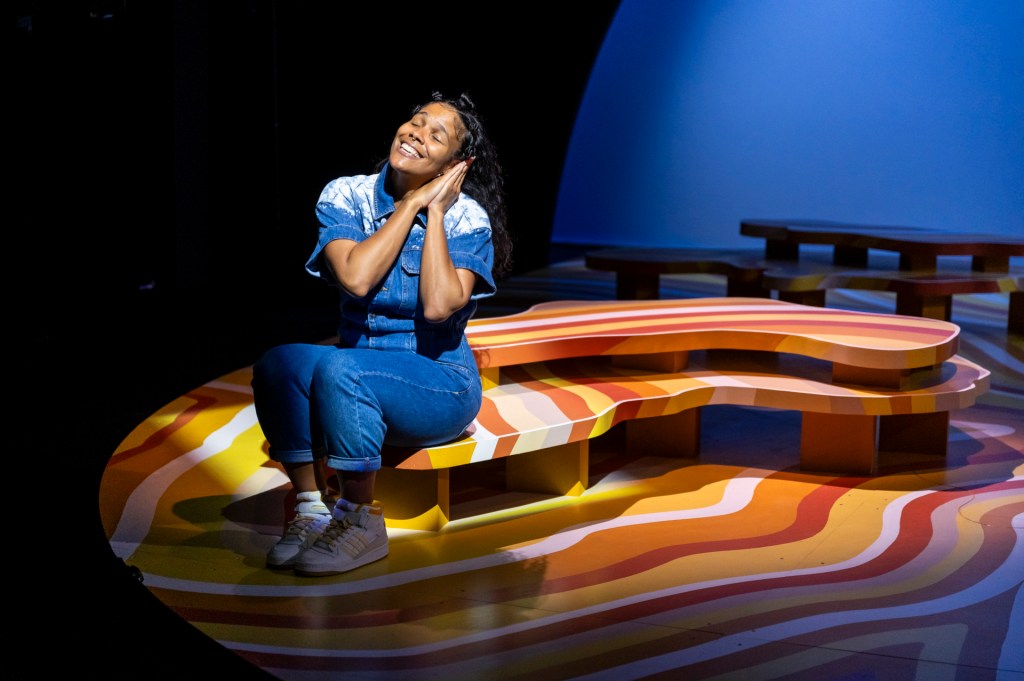
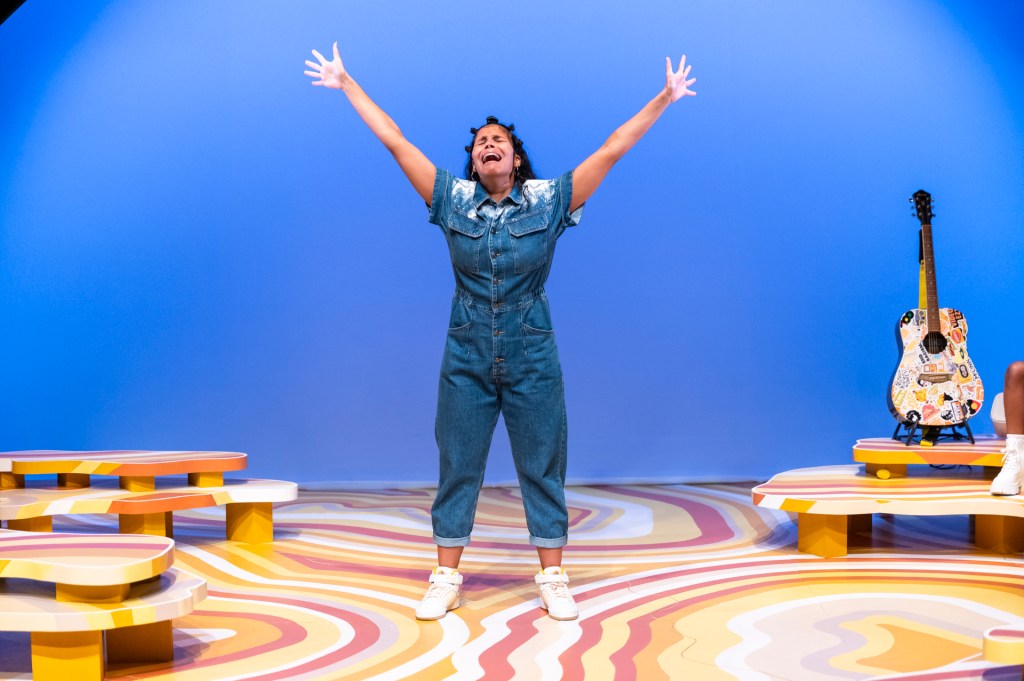
Photo: Tiffany Garvie Zahra Newman is the star of the show as Maxine (and just about every other character) but this isn’t a one-woman show. She is assisted onstage by Kuda Mapeza who lends her voice, musicianship and presence at key moments. But none of this works without Newman’s skill as a performer. The precision in her performance is truly stunning to behold as she leaps between characters and tones with the lightness of a stone skipping over calm waters.
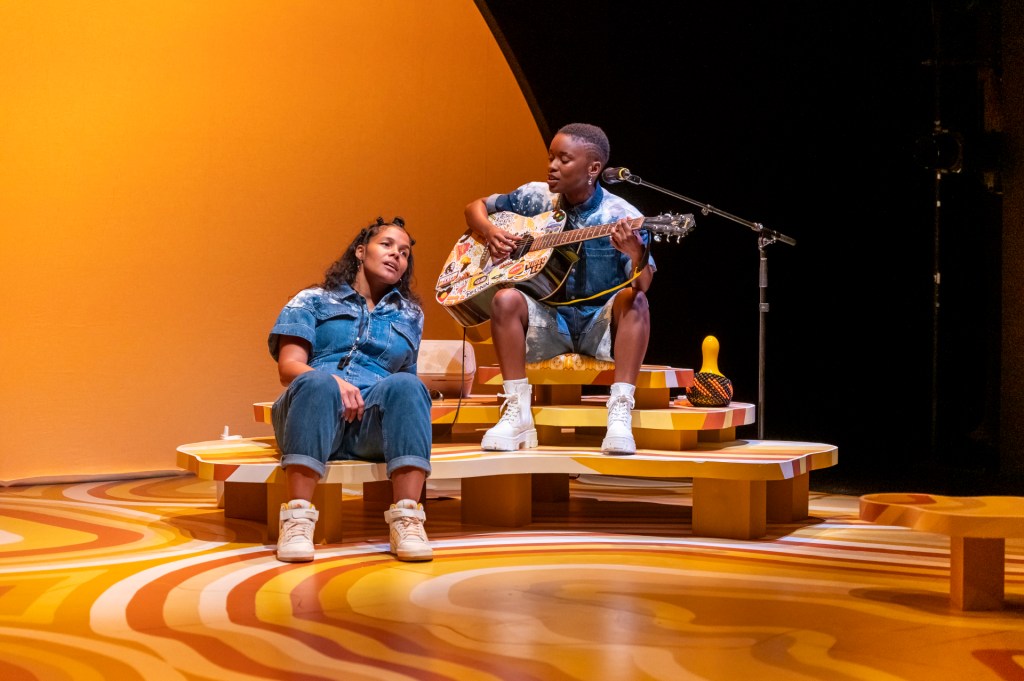
Photo: Tiffany Garvie Newman is lifted up by some of the best use of sound design and music I’ve heard in some time, both by Dan West. Using recognisable pop music, blending between sound effects and live music by Mapeza. The play has a seamlessness to it that never feels stale. Similarly the set (Zoë Rouse) and lighting (Rachel Lee) are a kaleidoscope of colours that come to life to illustrate each scene. The production aspects are all flawless.
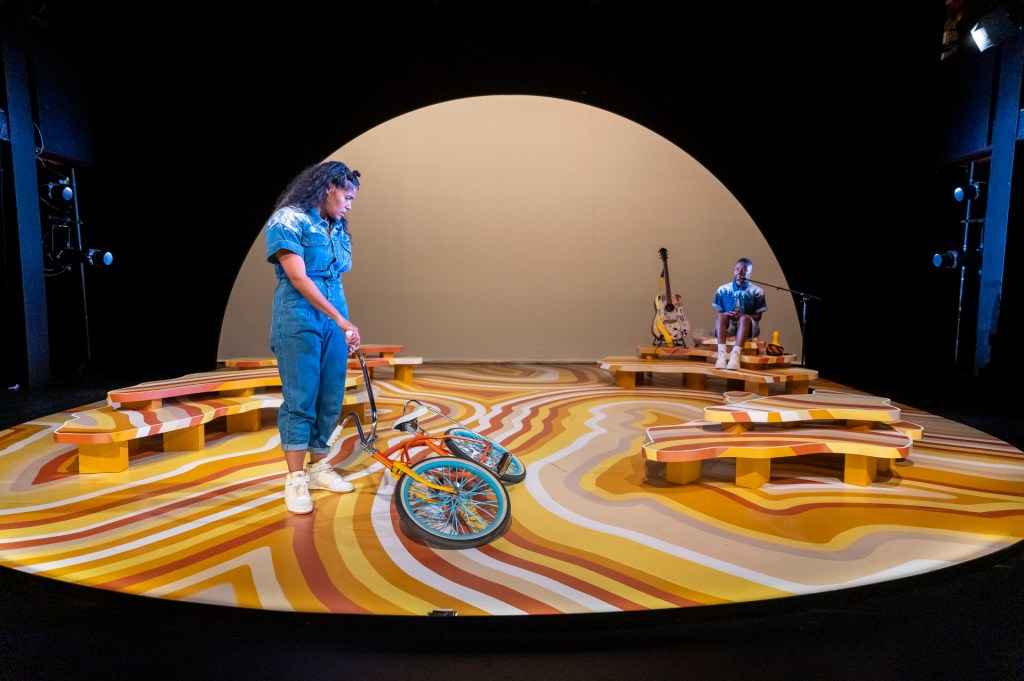
Photo: Tiffany Garvie As a tale of racism The Hate Race makes it point without screaming and shouting (I mean, Maxine does scream and shout at points but it’s more to do with a Cabbage Patch Doll than outpourings of repressed rage). As someone of Caribbean descent myself (you’d never know to look at me but my genetic history is quite the blend) I could recognise the voices and cadence of the islands in Maxine’s grandmother that brought a smile to my face. But apart from the timeless truth of the lesson, racism is bad, this is more an individual character study than a “state of the nation” piece.
The ending, as it is, is open ended. In fact, it’s barely an ending at all, the play finds a nice, uplifting place to leave the audience, waves and says goodbye. As an arc it is somewhat lacking, without being emotionally unfulfilling at all. The opening scene, with adult Maxine hearing a voice shouting at her on the street, is never revisited. We never see how adult Maxine is different from the youthful Maxine we spend the bulk of the show’s 70 minutes with.
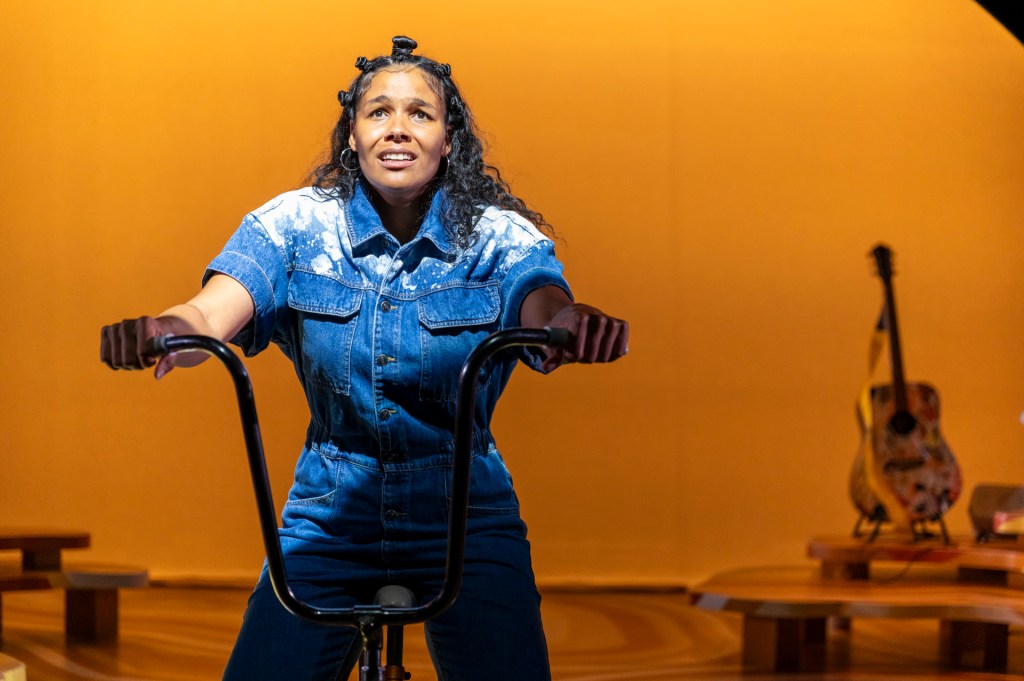
Photo: Tiffany Garvie What surprised me most however was the audience. I probably shouldn’t have been shocked to see the usual white, middle class people filling the seats but I for one would have hoped to see the show bring more of the Blak community into the theatre. Of course, predominantly older, white patrons are the lifeblood of our theatres and if you poke fun at them, you do so at your own peril (*throws A Fool in Love a hard stare*), but more work is needed to reach out into the community to convince people that the theatre isn’t just a “rich white person” thing.
And maybe that’s my only real critique of The Hate Race, it feels designed for white people. It takes our hand and lets us have a glimpse at what it’s like to be Black in Australia but softens all the stings with humour and music and love. That’s not a bad thing, we need to speak against racism in whichever way gets people to listen. In an age of shouting, The Hate Race speaks warmly and calmly, and that may be more effective in the end.
-
Groundhog Day: The Musical (Princess Theatre) ★★★★★
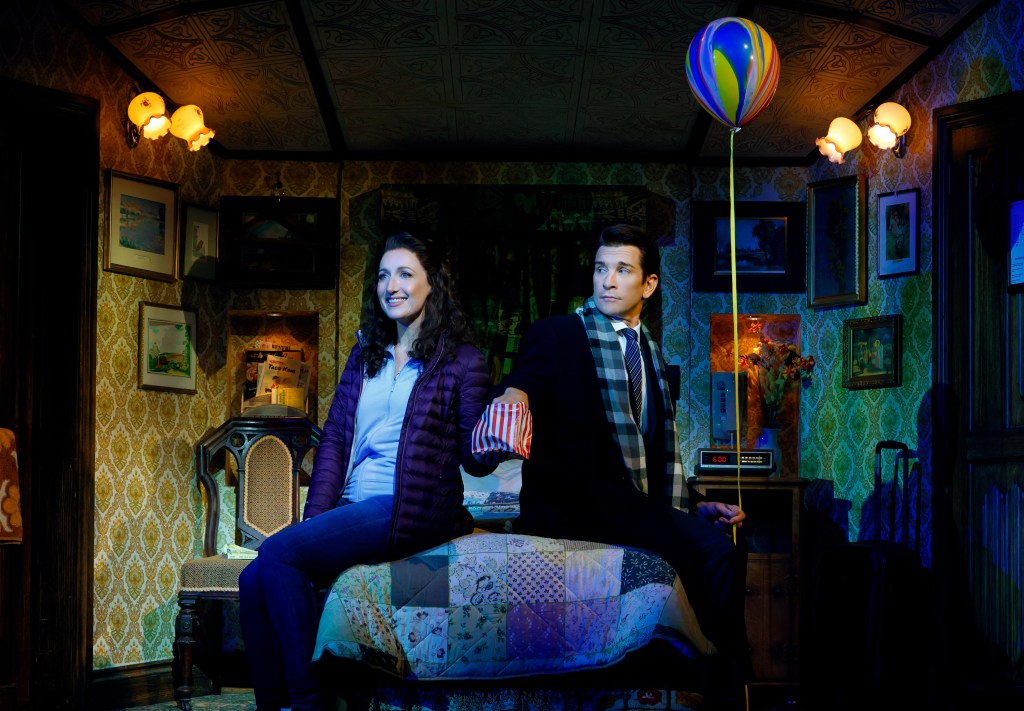
Book by Danny Rubin. Music and Lyrics by Tim Minchin. Princess Theatre, Melbourne. Till April 20, 2024.
Watching Groundhog Day has become something of a musical theatre experiment for me. I can’t think of another show that has run on three continents, with multiple different casts, but kept the same leading actor, in this case Andy Karl. Having that constant as its centre means there is a control element from which you can judge everything around them. And I feel safe in saying this Australian production of Groundhog Day is the best the show has ever been, and that’s because of one brilliant performer… Elise McCann.
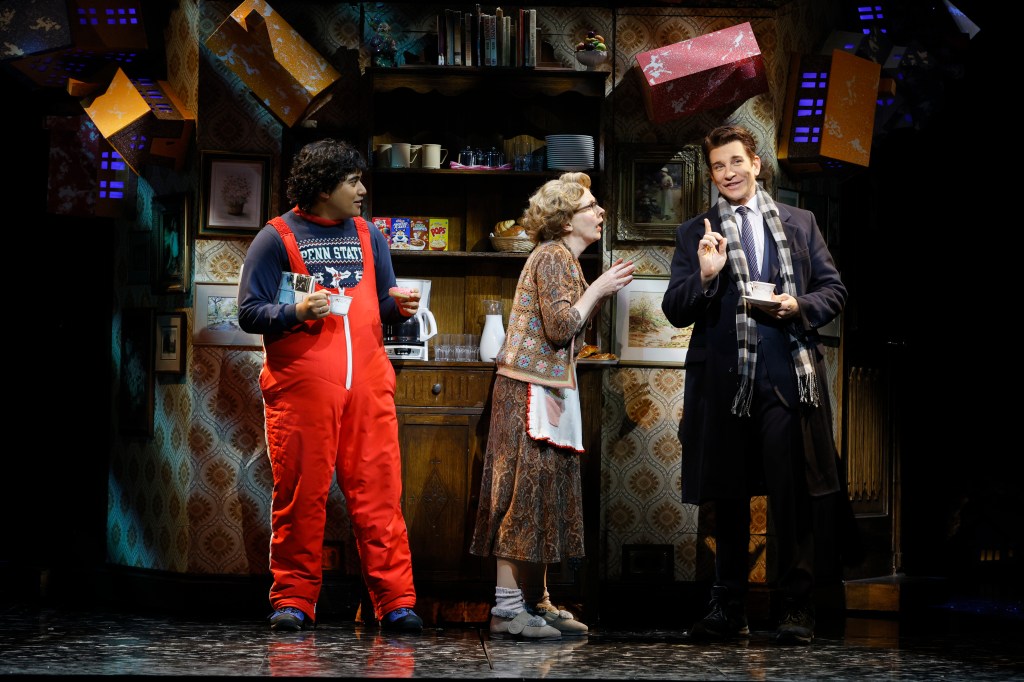
The Australian company of Groundhog Day The Musical. Photo by Jeff Busby Based on the 1993 romantic-comedy starring Bill Murray and Andie MacDowell, in which an arrogant TV weatherman, Phil Connors (Karl) is sent on assignment with a lowly Associate Producer, Rita (McCann) to cover Groundhog Day, a local tradition in Punxsutawney, Pennsylvania. According to legend, if a groundhog comes out of his burrow and sees its own shadow, they’ll be stuck with six weeks more of winter. But Phil gets stuck in a 24hr time loop, forced to relive this particular Groundhog Day again and again.
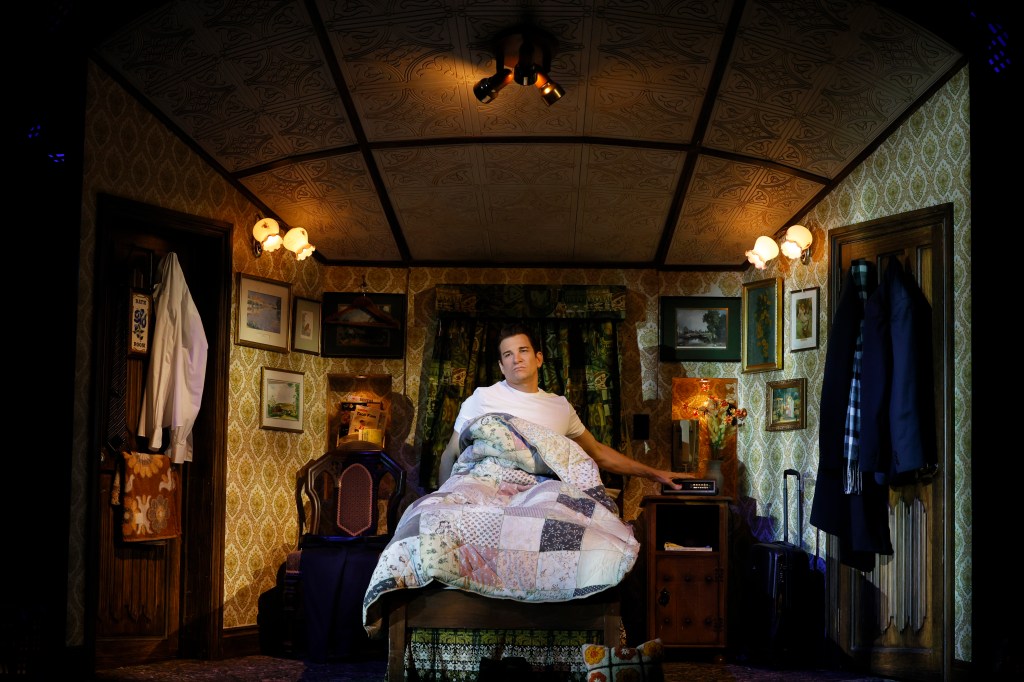
Andy Karl in the Australian production of Groundhog Day The Musical. Photo by Jeff Busby Original screenwriter Danny Rubin has translated his film to the stage with music & lyrics by Tim Minchin and direction by Matthew Warchus (the creative duo behind the mega-hit Matilda), and the result is 100% stage-craft. Phil’s repetitive time loops are carefully crafted to keep you engaged and onstage trickery used to keep him popping up in bed brings gasps of wonder from the crowd (having seen the show four times now I had a great time watching the mechanics).
The score is pure Minchin. Witty and emotional, probably filthier than some families in the audience would like, and happy to take the odd diversion. The Act Two opening number for instance, ‘Playing Nancy’, gives the stage over to a minor character with no real narrative function. It’s a metatextual thought bubble for both character and actress in a show already heavy on existential exploration (and my favourite song in the show). Local insurance salesman Ned Ryerson’s advertising jingle returns as a heartbreaking ballad turning your laughter to tears as Minchin does best.
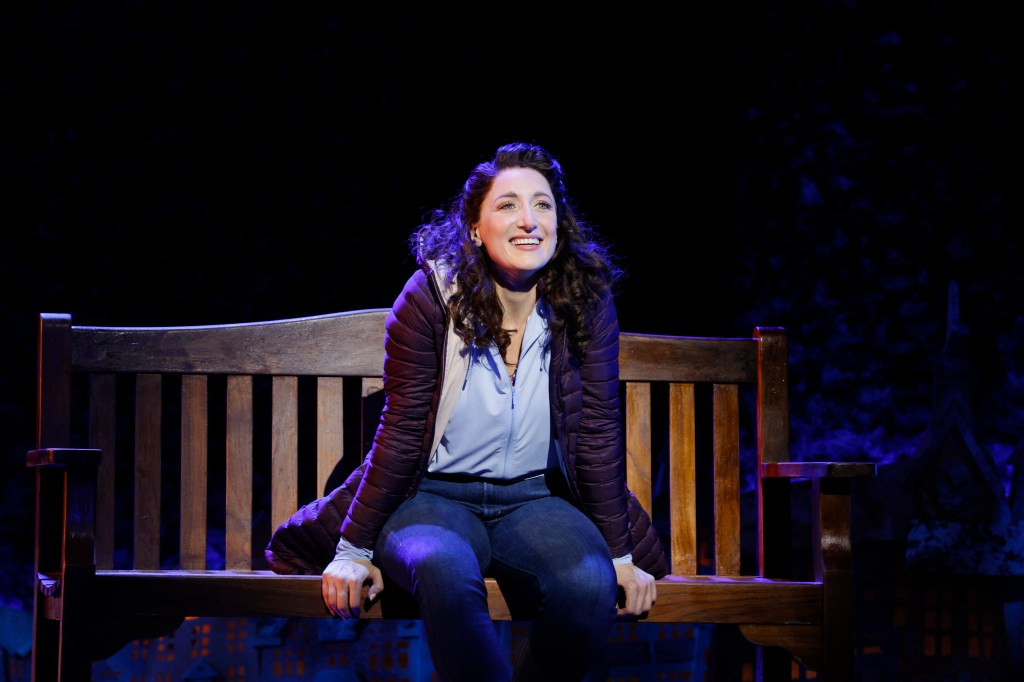
Elise McCann in the Australian production of Groundhog Day The Musical. Photo by Jeff Busby Having now seen Karl perform opposite four different leading ladies (who I hate to say, have always been the weak point in the show), it was thrilling to watch McCann take on the role of Rita with such honesty. For the first time, Rita felt human and well-rounded, not just a foil for Phil. There was a genuine connection between the characters that I always felt was lacking in both London runs and on Broadway.
It’s no surprise that Andy Karl plays Phil Connors to perfection. As the only actor to play the role (other than understudies) his Phil is a well-oiled machine and seems to be more rambunctious now than ever before. The show takes Phil on a wide character arc of hedonism, altruism, sacrifice and growth and Karl seems to be playing it as fresh as he did on the first day in 2017 when he originated the role. That said, I would LOVE to see an understudy run to watch another performer take it on for a night.
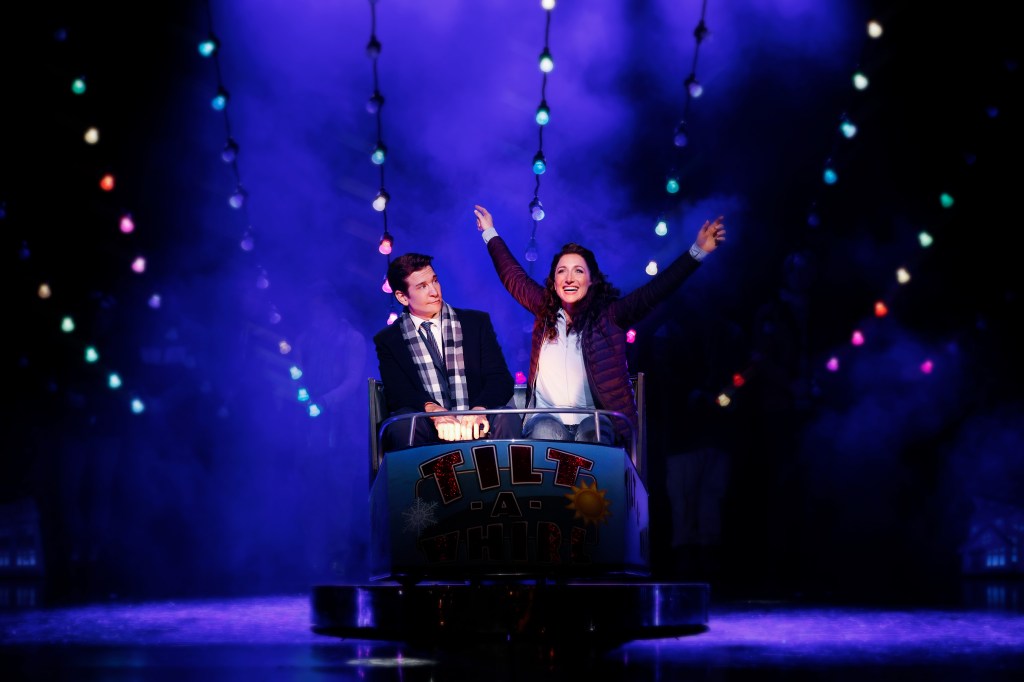
Andy Karl and Elise McCann in the Australian production of Groundhog Day The Musical. Photo by Jeff Busby. My brain did go on a tangent trying to understand why a joke from the original production about eating too much fried chicken was changed to be about eating camembert cheese (did the Americans feel very attacked by the original joke? Is the new one elitist, or even racist?) I also picked up on easter eggs I’d missed before (there’s a nice reference to Minchin’s Christmas classic ‘White Wine in the Sun’ on one of the screens).
In short, this is the most fun, and most refined Groundhog Day has ever been. This show is easily in my Top Ten Favourite Musicals of the 21st Century (so far) and I personally think it’s superior to Matilda. If I was stuck in a loop watching this show, I think I’d be pretty fine with it.
-
& Juliet (Lyric Sydney) ★★★★★

Music by Max Martin. Arrangements by Bill Sherman. Book by David West Read. Lyric Sydney. Feb – June, 2024.
I’ve been thinking about jukebox musicals a lot of late. I’ve gone on the record saying how much I hate them, with very few exceptions (& Juliet is one of those exceptions, but I’ll get into that in a little bit). Whether it’s a musical biography (like Tina, or Jersey Boys, or MJ) or an original story woven around an artists catalogue (like Mamma Mia, or Jagged Little Pill, or The Girl from the North Country) or a film-turned-musical-with-a-soundtrack (like Cruel Intentions or Moulin Rouge!) there are more bad examples than good ones.
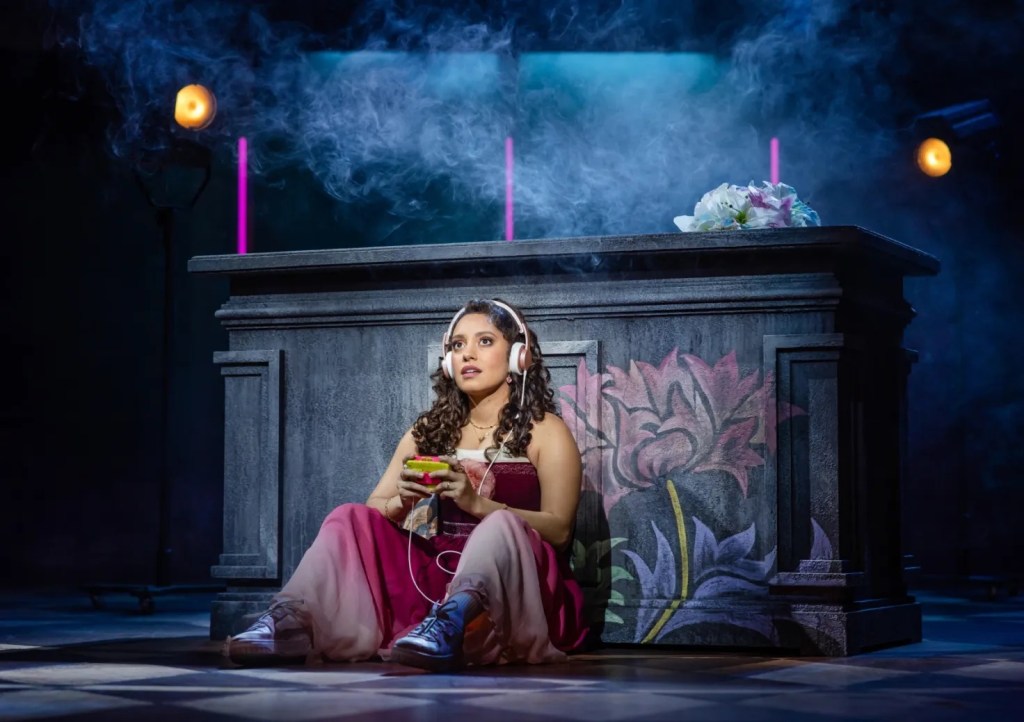
Some of this is my own utter snobbery. Jukebox musicals are like cover bands, they’re for the people in an RSL, not “the theatre”. As good as the performances are, and they almost always are excellent, the book is usually utter garbage, and the songs awkwardly retrofitted into moments that never quite work.
Which is why two of the more recent versions of the jukebox musical have really turned me around. & Juliet and Moulin Rouge! take very different routes in the evolution of the genre (oh god, are jukeboxes a genre on their own now?!) and both succeed for very different reasons. Moulin Rouge! gives itself over to the insanity of the “covers concert” vibes and remixes and speeds through songs faster than an ADHD kid on TikTok. While & Juliet takes the usual weak-point of a jukebox, the book, and elevates it into something worth watching all on its own without the tunes.

I’ve already reviewed & Juliet. Twice. So I won’t go over the basic details again, other than to say that this local cast are still fresh as ever (even after a lengthy run in Melbourne, Singapore and Perth before arriving in Sydney). Like Romeo, the show still has “a tight body, and a lot of feelings”. If anything it’s gotten more fun than it was in Melbourne.
As iconic as the songs in the show are, it’s the playful way they’re used that makes & Juliet rise above the competition. Lyrics remain unchanged for the most part, but the meaning is totally different. And the book, by David West Read, serves up sit-com style gags at a furious pace. Most comedic plays aren’t this hilarious, or this audacious, all without compromising the music. You still get the big voices you’re expecting, and big laughs as well.
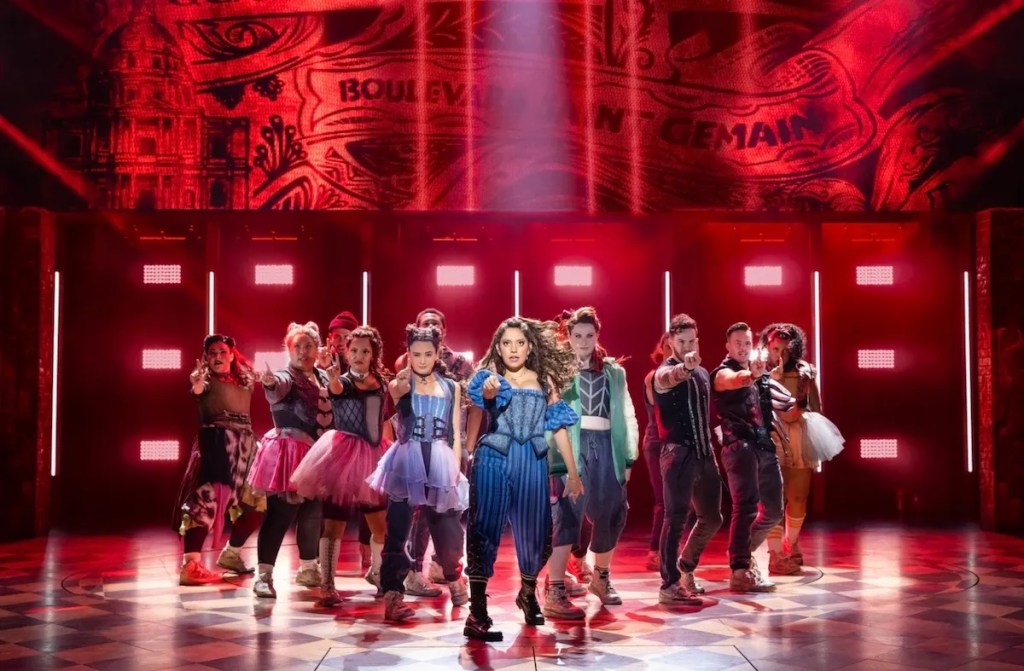
For a show as rammed full of big pop hits and jokes as & Juliet is, it would be easy to gloss over the messages it delivers along the way. You could forgive the story for giving us the usual feminist mantras and some ‘box ticking’ queer affirmation, but there are nuances in dialogue that prove the show has not only the unexpected smarts and wit but also more genuine heart than you get from the corporate mega-musical.
& Juliet is pure joy in musical form and even after three viewings I can’t wait for more.
-
Hannah Gadsby – Woof! (Roslyn Packer) ★★★1/2

Written by Hannah Gadsby. Roslyn Packer Theatre. 7-17 Mar, 2024.
Hannah Gadsby is having a mental health moment on stage, or so they would have us believe. For a comedian whose shows are usually designed to take the unassuming audience from one joke to a startling subversion of a bigger subject, it’s almost hard to believe they have abandoned six months of work to present a show that’s seemingly more off-the-cuff.
Then again this new show, Woof!, does feel surprisingly rough and raw… You won’t expect the twists and turns, but you’ll definitely laugh as Gadsby changes before your eyes.
On a road trip with their partner, Gadsby suffered a panic attack in a rural town. What their partner found charming, Gadsby saw as terrifying. It was confusing for them to say the least.
“We’re a Bible believing church”, said a sign in the town. Gadsby doesn’t unpack the statement so much as riff off it with a sense of ever-growing anxiety. Much like the modern world it’s the things unsaid, the coded meanings and messages, that hold menace.
There’s a lot of grief in Woof! Grief, converted into observation from Gadsby’s unique point-of-view. Grief, mixed with fame, showing how much has changed in the comedian’s world. From having laser eye-surgery (gone are the recognisable glasses), to staying in posh hotels (with beds that are too comfortable), and starting to take testosterone (leading to a deepening of their voice) – the freedom success brings also breeds more anxiety.
As much as Gadsby’s world is in flux, it feels like Woof! is too. Yes, the well planned comedy call-backs are there but a lengthy Q&A session sees the comedian bounce off the audience with glee. The element of improvisation shakes up the usually finely crafted narrative we’ve come to expect making way for something fresher, and different from a comic who is used to taking the audience to unexpected places.
-
The Lehman Trilogy (Theatre Royal) ★★★★★
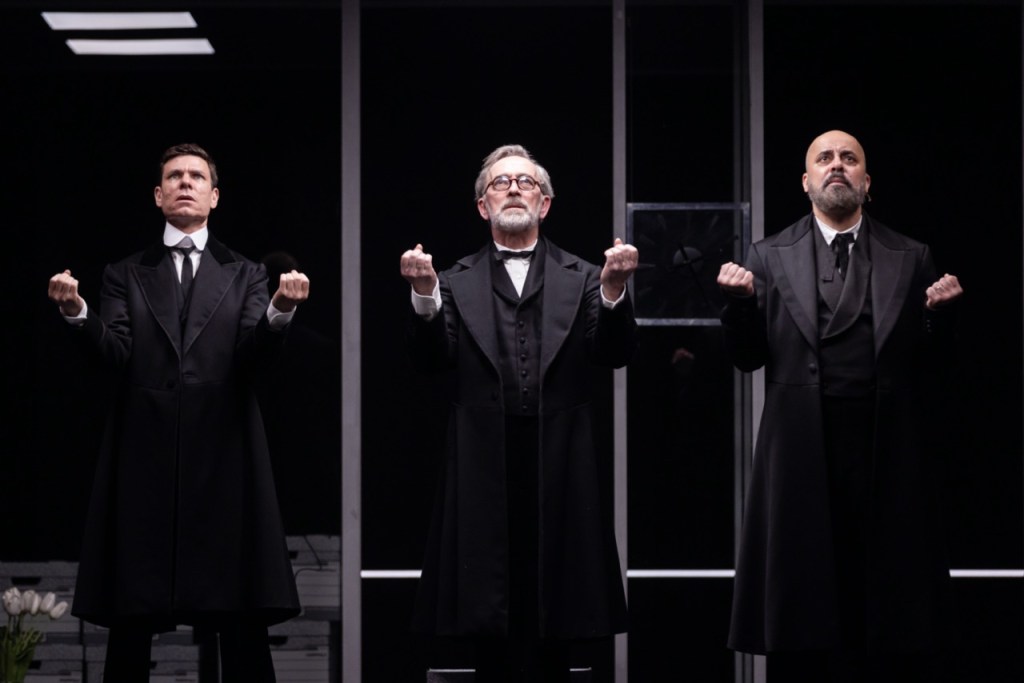
Written by Stefano Massini. Adapted by Ben Power. Theatre Royal Sydney. 21 Feb – 24 Mar, 2024.
It’s the kind of alchemy the theatre does best, taking this collection of seemingly unappealing things: a play about a bank, over three hours long, a relatively unknown cast of three, set in a glass box, costing $$$ in a cost of living crisis – and turning it into unmissable, thrilling entertainment. The UK’s National Theatre production of The Lehman Trilogy has arrived in Sydney, six years after its debut, still as sharp as ever.

Aaron Krohn, Adrian Schiller & Howard W. Overshown. Photo: Daniel Boud. You are instantly inclined to like the three Lehman brothers. Charming, hard working immigrants who turn setbacks into triumphs. They start with nothing, not even their names, in a general store in Alabama. They will trade with anyone, regardless of skin colour, buying from slave owning plantations and selling for a modest profit. They do not approach the world with judgement, they live in the moment and move where and when they need to, to stay afloat and try to prosper. Step by step we watch their lives and their business change, grow, move to New York, and reshape the way the world thinks about money.
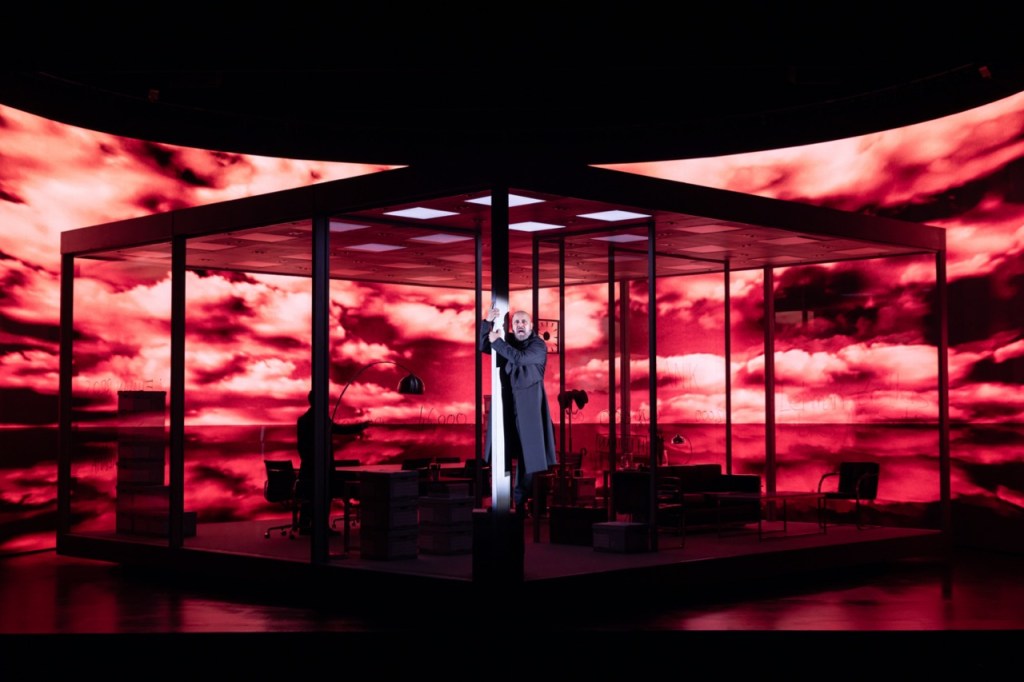
Howard W. Overshown, Photo: Daniel Boud. But it’s not the subject that draws audiences in, it’s the production, the theatricality of it all. Massini (via Power) has written an epic poem of power and money, but it is Sam Mendes’ directorial vision that makes this a hit. Three actors run a marathon playing the three Lehman brothers, plus their wives, children, business partners etc, often changing roles with the simplest alteration of stance or the wave of a hand. They animate what is essentially a massive monologue of text with subtle voice work and the constant movement of the set (more on that later). This cast, Aaron Krohn, Howard W Overshown and Adrian Schiller are serving us a bacchanalian feast of performances, where even the smallest roll is a sharply defined character that leaps off the stage. It is pure imagination combined with skill, marvellous to behold.
Es Devlin is possibly my favourite set designer in the world. Her sense of scale and clarity appeal to me immensely and this is pure Devlin. A glass box, rotating on stage, in front of giant projections. It focuses the eyes while telling a story itself – this is the architectural version of “the emperor’s new clothes”, there is nothing there. Much like the financial markets, theatre is built on belief, not literal truth.
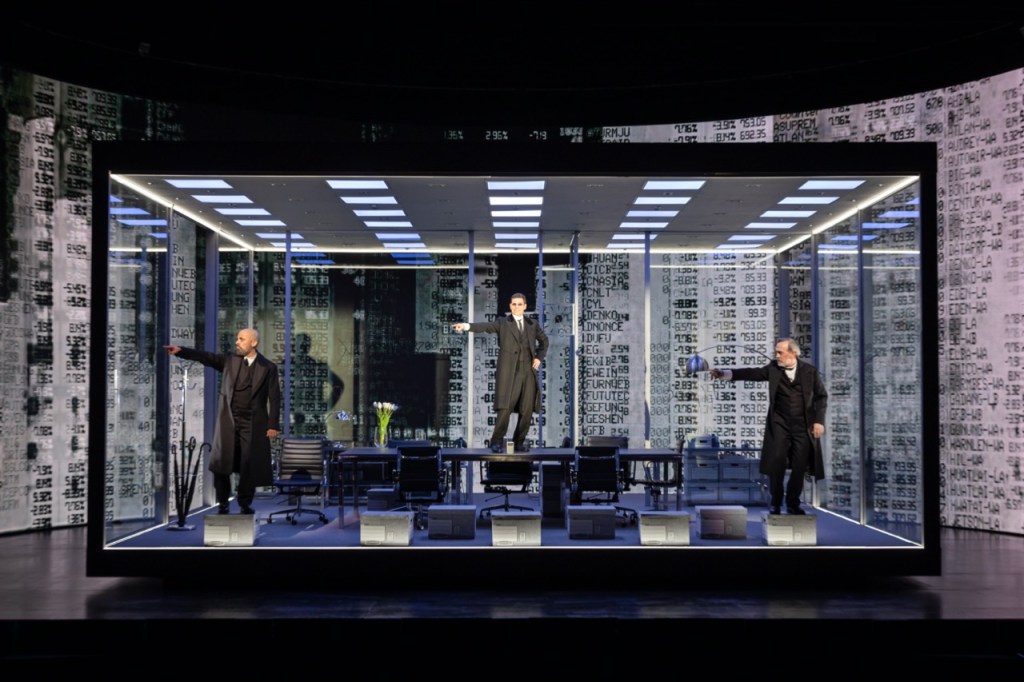
Howard W. Overshown, Aaron Krohn & Adrian Schiller. Photo: Daniel Boud. The action is accompanied by a live piano score (played by Cat Beveridge) that works more or less like a film score would. Almost always present, it highlights emotional tone, smooths transitions and keeps scenes fresh. A crisp three act structure (each act is just under an hour) means you are never sitting down too long. In fact, it feels very much like watching three episodes of television, with time to get up, go to the loo and grab a cuppa between episodes.

Adrian Schiller, Howard W. Overshown & Aaron Krohn. Photo: Daniel Boud. When the play was first staged in its native Italy in 2013, just five years after the bank’s collapse in 2008, the world was still recovering from the shockwaves to the financial system. When this production was first seen in 2015 in England, the motherland of financial chicanery, it struck a nerve. Stefano Massini’s drama, adapted by Ben Power, seemed to shine a light on the shadowy world of investment banking that appeared all powerful… until it wasn’t. The play is a rebuke of rampant capitalism, but a gentle, stylish and entertaining one. No bankers were harmed in the making of this play.
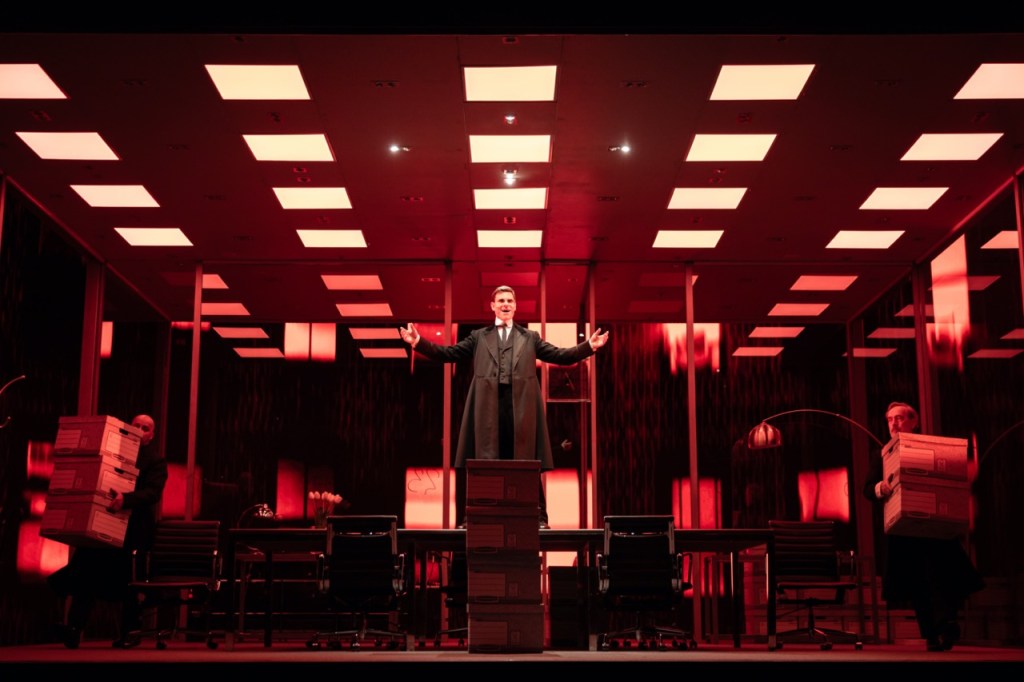
Aaron Krohn. Photo: Daniel Boud. If you want to quibble you can take issue with the presentation of the women in the brother’s lives, and the way the play glosses over events from 1969 (the death of the final Lehman offspring in the company) to the collapse in 2008. But the story is one of how struggle and hard work turned into greed, and how that greed dehumanised us, divorcing money from its utility to become an end unto itself. After the last Lehman was gone, the machine they built kept running in the hands of men who never knew anything different – a self-perpetuating system of avarice.
The scope of this particular production of The Lehman Trilogy is breathtaking. It’s clear to see why it has won almost every conceivable award. The star of this show is nothing less than theatre itself.

Sam Mendes’ design precepts for The Lehman Trilogy. Souce: An Altas of Es Devlin.
-
Subscribe
Subscribed
Have a WordPress.com account? Log in now.

