-
Welcome to Cultural Binge

The rating system is simple:
★★★★★ – Terrific, world-standard. Don’t miss.
★★★★ – Great, definitely worth seeing.
★★★ – Good. Perfectly entertaining. Recommended. Individual mileage may vary.
★★ – Fine. Flawed and not really recommended, but you may find something to appreciate in it.
★ – Bad (& possibly offensive).
See more reviews over at The Queer Review.
Instagram: @culturalbinge
Substack: culturalbinge.substack.com
Email: chad at culturalbinge.com
-
London Week Two

Two new musicals, two existing musicals and two play revivals, mixing off and on West End productions – it was a nice mix this week, including a pleasant surprise and a clanker of a show. Here are some mini-reviews in chronological order

The Curious Case of Benjamin Button: The Musical. Photo Juan Coolio. The Curious Case of Benjamin Button: The Musical (Southwark Playhouse) ★★★★
Book & Lyrics by Jethro Compton. Music & Lyrics by Darren Clark. Southwark Playhouse: Elephant. 22 May – 1 Jul, 2023.
This musical has been in development for a while and I know friends who’ve seen smaller, rough versions of the show in years previous. This incarnation feels like it’s primed for a main stage now. It reminded me strongly of Once: The Musical, thanks to the celtic/folk score and feel-good/feel-bad energy. Jamie Parker is great as Benjamin Button, his earthy, easy charm helps to sell the conceit of the piece. My only complaint might be that the music does get a bit too familiar at times, but overall, this is a very exciting new piece.
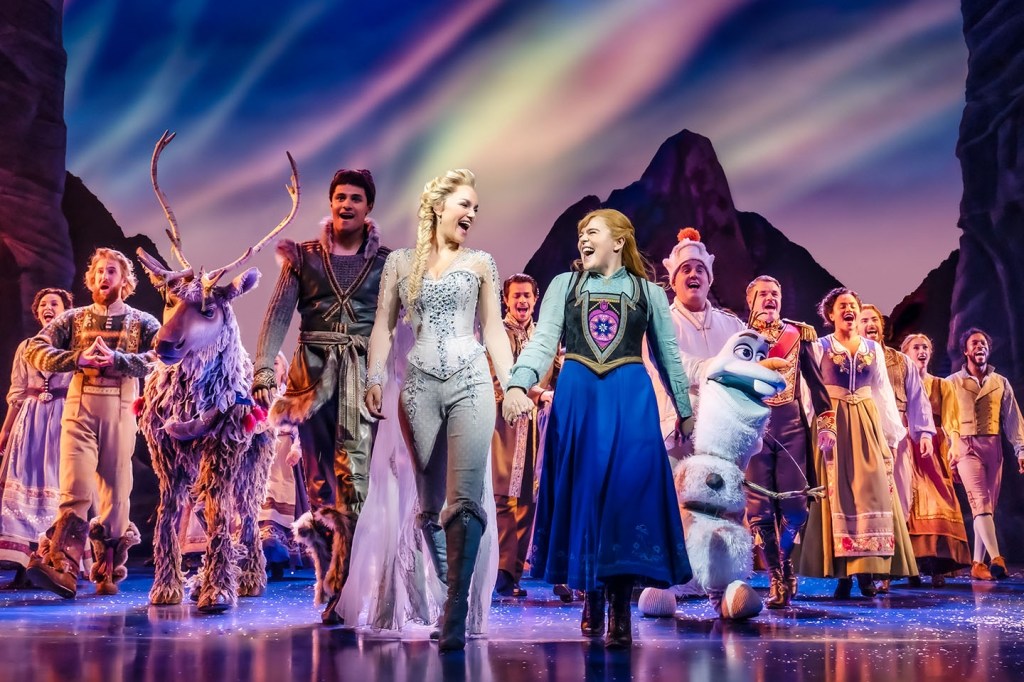
Frozen: The Musical. Frozen: The Musical (Theatre Royal Drury Lane) ★★★
Music & Lyrics by Kristen Anderson-Lopez and Robert Lopez. Book by Jennifer Lee. Theatre Royal Drury Lane. Currently booking through Jan 2024.
I had very little interest in this one to be honest, as much as I like the film. I’d heard nothing but mediocre reviews since it opened and hadn’t summoned up the energy to see it in Sydney. But on a particularly hot summer day, the allure of air-con, and a £25 rush ticket got me inside… and I was pretty entertained. This is corporate theatre at its most cynical but the polish and gloss got me most of the way there. Great central performances by Samantha Barks as Elsa and Emily Lane as Anna (and Oliver Ormson as Hans) won me over.
The special effects ranged from excellent to rather pathetic, which is disappointing after so many recent shows have shown us how much magic can be seen on stage. Overall the show is the most fine, average thing possible and I mean that as being it’s completely watchable without being exceptional in the slightest.

The Third Man: A Musical Thriller. Photo: Manuel Harlan The Third Man: A Musical Thriller (Menier Chocolate Factory) Preview Performance
Book & Lyrics by Don Black and Christopher Hampton. Music by George Fenton. Menier Chocolate Factory. 10 Jun – 9 Sep, 2023
This one had me excited from the minute I heard about it. A new musical, based on Graham Greene’s book (and the Orson Wells film), with book and lyrics by Don Black and Christopher Hampton, directed by Trevor Nunn with a cast of 18 in a small, well-respected venue – this was clearly the “out of town trial” for a show aimed at the West End. So I grabbed a ticket to the previews (so yes, the show is still in flux, take everything I say with a grain of salt).
It’s a shame it’s so dull. The score is unremarkable with some really obvious lyrical choices, I could guess the end of most of the lines in the songs. The show itself seemed to forget it was a musical for long stretches of time (and was better off for it – it works much better as a play). Even the swelling music couldn’t really sell the convenient “I just met someone and am now madly in love” moments. All of that said, the cast are fantastic, especially the three leads of Edward Baker-Duly (Calloway), Simon Bailey (Crabbit) and Natalie Dunne (Anna).

The Shape of Things. Photo: Mark Douet. The Shape of Things (Park Theatre) ★★★★
Written by Neil LaBute. Park Theatre. 24 May – 1 Jul, 2023.
I have a real soft spot for this play. When I was first discovering theatre for myself in the late 90s / early 00s I saw the Sydney Theatre Company production and was blown away by Neil Labute’s moral ambiguity and sharp language. It’s one of the first times I saw a play explore a contemporary issue and make me really think. This new production is equally as pointed and the play has a new resonance in 2023 than it did back in 2001-03. Issues of male body image and “human-optimisation” culture are more prevalent now as Adam (Bridgerton‘s Luke Newton) goes from nerd to hipster in a dark reversal of Pygmalion. Evelyn (Amber Anderson) is even more ambiguous than she was originally – channelling a post-Me-Too rage blended with a nihilistic worldview that feels sadly contemporary. This is still a biting satire and worth every penny.
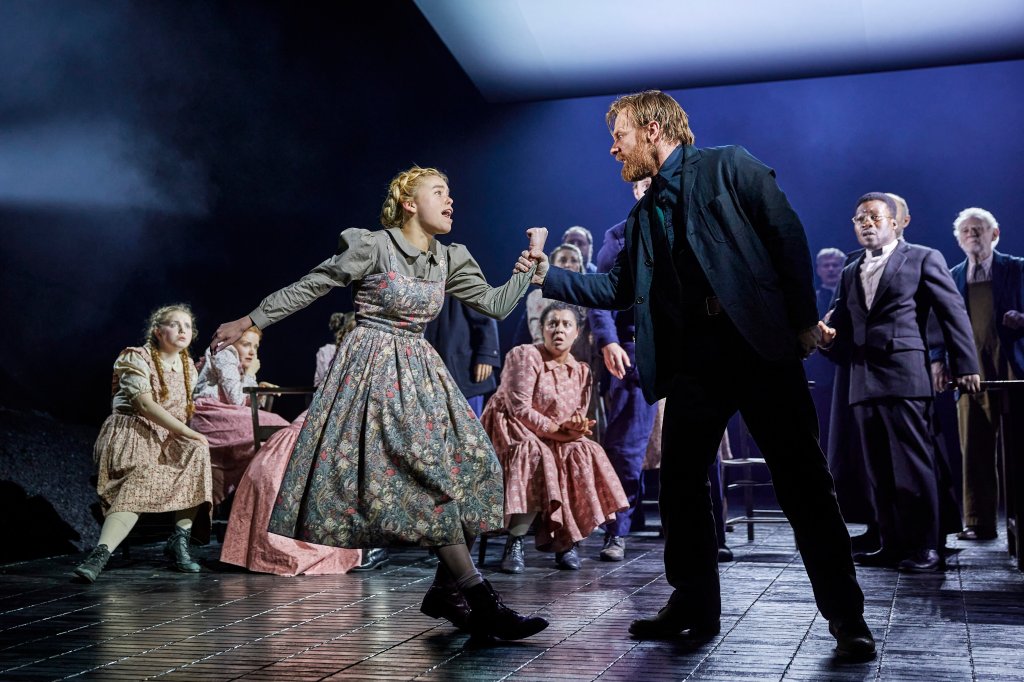
The Crucible. Photo: Brinkhoff Moegenburg. The Crucible (Gielgud Theatre) ★★★★★
Written by Arthur Miller. Gielgud Theatre. Booking till 2 Sep, 2023.
The National Theatre’s 2022 production of Arthur Miller’s The Crucible received rave reviews and has now transferred to the West End. Again, thank god for £25 rush tickets. For me the selling point was Es Devlin’s design (she’s possibly my favourite stage designer), and its mixture of simple spaces and dramatic scale give this a ghostly air. You are greeted by a nonstop curtain of water, starting the show with an impression of awe and a sense of overwhelming power.
Maybe it’s the world climate we live in, but The Crucible feels frighteningly modern. As the force of reality-defying mobs swell (be it Covid, or Trump, or religion, or science) this tale of superstition and seemingly unstoppable powers made me squirm. If you ever want a reminder how stupid and evil humans can be, just take a seat and let Miller’s brilliant characters show you. Everyone here has fallen for a lie and refuses to turn around, choosing instead to double-down on their blindness rather than admit they’re wrong. This is the kind of pride and hubris that kills people (just look at every Covid-denying, anti-vax person you know and you’ll see the same stubborn lack of humility).
Milly Alcott (best known for the Game of Thrones spin off, House of the Dragon in her stage debut) is brilliant as Abigail Williams – she has an undeniable stage presence that she channels into Abigail’s manipulations. Matthew Marsh’s Judge Danforth is scarier than anything you’ll see in 2:22: A Ghost Story (which, to be clear, I really enjoyed too).
This is as brilliant as everyone has said.

How to Succeed in Business Without Really Trying. Photo: Pamela Raith. How to Succeed In Business Without Really Trying (Southwark Playhouse) ★★★
Music & Lyrics by Frank Loesser. Book by Abe Burrows, Jack Weinstock & Willie Gilbert, Based on the novel by Shepherd Mead. Southwark Playhouse: Borough. 12 May – 17 Jun, 2023.
Gender flipping this musical/comedy of mid-century corporate incompetence is a cute idea that just doesn’t really pay off in this revival of How to Succeed… In fact, in softening the edges of the sexual politics it removes some of the sting from the text. That said though, the tunes are great and are sung to perfection. The real standouts are the two characters played more or less ‘straight’, the sexy Hedy Larue (Annie Aitken) and the sweet secretary Rosemary Pilkington (Allie Daniel). Everything else about this quite cartoonish production feels like it’s trying too hard to be funny.
-
London Week One
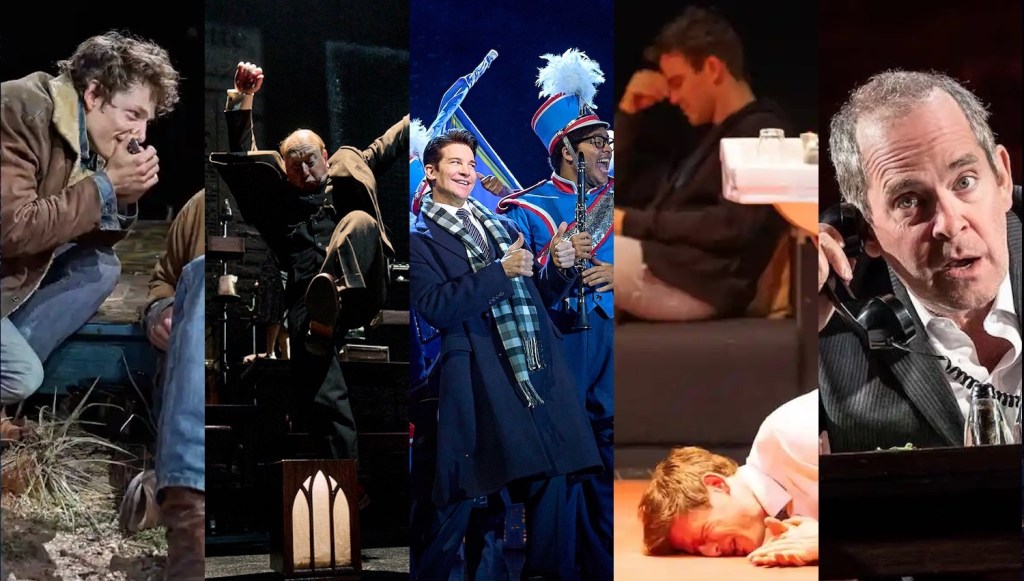
I hit the ground running in London, thanks to a bunch of theatre-loving friends who were keen to catch shows or take me to shows they loved. Here are some mini-reviews in chronological order…

Groundhog Day. Photo: Manuel Harlan. Groundhog Day (Old Vic) ★★★★★
Book by Danny Rubin. Music & lyrics by Tim Minchin. The Old Vic. 20 May – 19 Aug 2023.
I saw this twice back in 2017 when it first opened so I knew I would love it. Andy Karl returns to the role he originated, and is the only person to play Phil Connors, the arrogant weatherman stuck in a time loop. The production has been slightly scaled back (I wouldn’t have noticed if it hadn’t been pointed out to me) but the magic remains. The scale of the theatrical trickery is still impressive in an unshowy way. The music is top notch with tunes I’ve been listening to on repeat for the last six years.
I heard Tim Minchin say on a podcast that Australian producers were chomping at the bit to bring the show to Australia, so hopefully we can all see it again, and again, and again, and again… for ourselves.

Brokeback Mountain. Photo: Manuel Harlan. Brokeback Mountain (Soho Place) ★★★★
Written by Ashley Robinson based on Annie Proulx’s short story. Soho Place. Till 12 Aug, 2023.
To be honest, my main motivation to see Brokeback Mountain was to have a look at Soho Place, the first new-build West End theatre in 50 years. The area around the theatre was shut down for over a decade as London built its Crossrail/Elizabeth Line underground line. In doing so London lost some iconic venues (RIP the Astoria). Unlike most traditional proscenium arch theatres in the West End, Soho Place is set up in the round. It feels intimate despite seating slightly more than 600 people. It’s very shiny, very new… and a little bit soulless for now.
The show itself is beautiful, but nothing really remarkable. A terrific cast, lead by Mike Faist (Dear Evan Hansen, West Side Story) and Lucas Hedges (Lady Bird, Boy Erased), deliver all the heart you expect from the story. My only complaint is that at a swift 90 min running time, it doesn’t really have the scope to show the impact of Ennis & Jack over the decades, but the love story remains intact and as strong as ever. The play is accompanied with music by Dan Gillespie Sells (The Feeling, Everyone’s Talking About Jamie). The tunes act as an emotional shorthand that help sell the feelings these two taciturn men feel without turning it into a musical. If you know and love the film or the short story of Brokeback Mountain, then the stage show will continue that. If you didn’t, I don’t think it’ll convince you otherwise.

A Little Life. Photo: Jan Versweyveld. A Little Life (Harold Pinter Theatre) ★★★1/2
Based on the novel by Hanya Yanagihara. Adapted by Koen Tachelet, Ivo Van Hove & Hanya Yanagihara. Harold Pinter Theatre (moving to the Savoy Theatre). 25 Mar – 5 Aug, 2023.
Disclaimer: I hate this book. I read the first third and threw it away. It was misery porn that grotesquely revels in the pain it inflicts on Jude. In many ways I went to see the English translation of the play (£25 ticket thanks to the lottery) to see what the fuss was about and so I could legitimately rant about it – it was a hate-watch.
So colour my surprise when… I liked it!
I still don’t love it! This isn’t a Damascene moment. I think it’s pornographic love of pain and abuse is deeply unpalatable but these elements work differently on the stage than on the page. And I think my seat helped. Being front row on the side with a restricted view meant I was up close and intimate, but also shielded from some of the worse elements (eg my eyeline was stage height so I couldn’t see blood pooling on the stage and I could see the fake skin on James Norton’s arm that he would cut etc)
At 3hr 40min this is a slog of a show, but Ivo Van Hove’s direction is fiercely theatrical (as in, it’s designed for the stage, not any other medium). Some intriguing design choices, like a heavy box suspended over the stage, are somewhat bizarre in context, but the performances are impressively dynamic. Both James Norton and Luke Thompson really impressed me (Omari Douglas and Zack Wyatt are underserved). Elliot Cowan gives a towering performance as an amalgam of all of Jude’s abusers – loathsome roles, brilliantly portrayed. I’d say he deserves awards but I’d hate to elevate these characters.
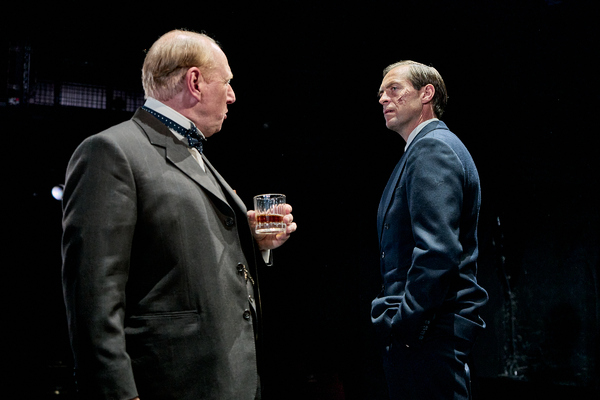
When Winston Went to War with the Wireless. Photo: Manuel Harlan. When Winston Went to War with the Wireless (Donmar) ★★★
Written by Jack Thorne. Donmar Warehouse. 2 Jun – 29 Jul, 2023.
Writer Jack Thorne is prolific. Across stage and screen his name is everywhere. From plays like Harry Potter and the Cursed Child, Let the Right One In, TV shows like Skins, Shameless and His Dark Materials, and Netflix’s Enola Holmes films, he is kind of everywhere. His new play, When Winston Went to War with the Wireless, is a love letter to the BBC.
Set during the 1926 General Strikes in the United Kingdom it tells of the media war between the only two news sources not on strike, a government run newspaper The British Gazette (edited by then Chancellor Winston Churchill) and the British Broadcasting Corporation (run by closeted gay man John Reith).
I just wanted a bit more from this one. It had all the right things in the right places but I was unmoved by it all. Interestingly there is an element of live radio-play on stage, with live foley sound effects being produced from the back of the stage, which is a great idea never fully realised. The ever excellent Haydn Gwynne stole the show for me. Playing multiple smaller roles she’s just a stage gem.
It’s a great set up for the characters and there is some interesting drama, but in the end I just wondered what point Thorne was trying to make. Admittedly, seeing it the same day as I saw A Little Life meant I was rather tired, so maybe it’s just me.

Patriots. Photo: Marc Brenner. Patriots (Noël Coward Theatre) ★★★1/2
Written by Peter Morgan. Noël Coward Theatre. 26 May – 19 Aug, 2023.
Well I’ve never been in a theatre with so many Russians in the audience before! Peter Morgan (The Crown) has written a play about the ascendancy of Putin, seen through the eyes of a corrupt, but very entertaining, real-life oligarch Boris Berezovsky (played by Tom Hollander).
Starting in 1991, we see Berezovsky ruling as one of Russia’s uber-wealthy elite, doing deals, bribing and threatening his way to everything he wants. When he is approached by the young deputy mayor of St Petersburg named Vladimir Putin (Will Keen), he is only too happy to help to gain influence in the Kremlin. But Putin’s accumulation of power isn’t always in Berezovsky’s favour.
Tom Hollander is wonderful and this role feels like it was tailored to his style. Fast dialogue, zinging sarcasm and a lot of energy make Berezovsky a fun character to spend time with. Will Keen brings his determined self-belief (seen recently in His Dark Materials) to the stage, and Will Thallon (Albion, The Inheritance) shakes off his “soft-boy” image as Roman Abramovich.
Of course, the audience knows what’s coming when his associate, Alexander Litvinenko goes out to have some tea (also well chronicled in Lucy Prebble’s A Very Expensive Poison) and Putin’s rise is inevitable. But what does this play say about the future, the Ukraine War? I’m not sure.
-
Consent (Seymour Centre) ★★★1/2
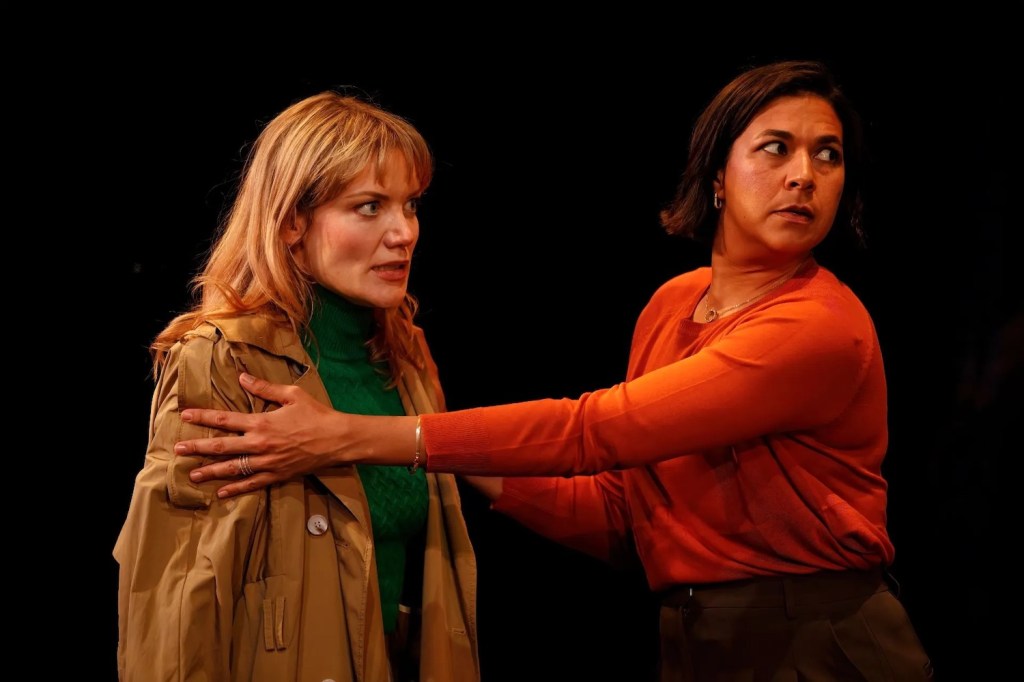
Written by Nina Raine. Outhouse Theatre Co. Seymour Centre. 1 – 24 June, 2023.
The ever excellent Outhouse Theatre brings Nina Raine’s 2017 UK hit play Consent to the Seymour Centre. A big drama that blends the professional and the personal for a group of British lawyers who prosecute and defend sexual assault cases. These sharp minds come to discover the gap between the legal debates in the courtroom, and the messy, emotional world of victims and the accused to be almost insurmountable.

Anna Samson & Nic English. Photo: Phil Erbacher. Kitty (Anna Samson) and her defense lawyer husband Ed (Nic English) are new parents, moving into a new home. Their biggest fights are about where the sofa should go and whether the new light fittings are appropriate. Their friends Jake (Jeremy Waters) and Rachel (Jennifer Rani), also lawyers, are there to celebrate with them, along with Zara (Anna Skellern), an aspiring actress they hope to set up with Tim (Sam O’Sullivan), also a lawyer. Their banter about work is glib with a brutish familial tone. It soon becomes clear that not everything is going well with these couples. Jake and Rachel split after Jake is caught having an affair. Tim and Ed’s friendship is more about professional one-up-manship hiding a long held distrust. All the while Kitty is trying to navigate the incisive minds and tongues of these lawyers to find some honest emotional truths.

Anna Samson, Jennifer Rani, Anna Skellern & Jeremy Waters. Photo: Phil Erbacher. A cracking great cast makes this assemblage of rich, entitled lawyers almost, almost likeable in their slick suits and beautiful dresses. There’s an element of Succession-lite in watching them start to tear strips off one another while Raine’s script sparkles with some stunning lines of dialogue. One of their opening salutes to Kitty & Ed’s newborn is to “toast to Kitty’s vagina”. For such a talky play about big topics, director Craig Baldwin keeps things light on its feet, with constantly moving furniture and some evocative one-way mirrored walls.
Many will feel challenged by the way rape is discussed, with a deliberately off-hand, light approach. For these characters rape is a concept to be argued about, not a lived reality, and Raine’s use of marital rape is perhaps too slight for the weight of the topic. But personally, I liked the brashness of the approach. As much as the reality of rape is embodied in the character of Gayle (Jessica Bell), its never really the subject matter of the story. This isn’t actually a play about rape, or the law. Prima Facie it is not.

Nic English & Jeremy Waters. Photo: Phil Erbacher. Consent does the kind of theatrical sleight of hand I don’t really enjoy. It starts with big themes and heavy issues which the writer can’t bring any kind of dramatic resolution to, and so the narrative goes from the universal to the personal to bring things to a close. Here we talk about lot of sexual abuse and the legal system, but the real story is about one couple struggling with the aftershocks of infidelity (with some side swipes at how the upper-middle-class ignore the issues affecting those below them).
In flipping the narrative, it cheats the audience of a resolution to the terrific set up of the first act, and leaves some serious matters unresolved. To its credit though, there is an abundance of grey-areas in each and every character. You loathe and love them in equal degrees. Filled with great dialogue and scenes the performers can sink their teeth into, it brings out the best in the cast.

Sam O’Sullivan, Anna Samson, Nic English, Anna Skellern & Jeremy Waters. Photo: Phil Erbacher. I was lucky enough to see the original production of Consent in the UK and even then the play left me cold. This new production has more life and comedy than the acclaimed original, and I genuinely believe it to be an all-round better take on the material – the performances, especially Samson and English, are excellent. But the play itself never really hits the bullseye.
Note: This review was based on a preview performance of Consent.
-
Jacky (Melbourne Theatre Company) ★★★★

Written by Declan Furber Gillick. Melbourne Theatre Company. Fairfax Studio, Art Centre Melbourne. 22 May – 24 Jun, 2023
Full review up on The Queer Review.
-
Do Not Go Gentle (Sydney Theatre Company) ★★★★1/2

Written by Patricia Cornelius. Sydney Theatre Company. Roslyn Packer Theatre. 23 May – 17 Jun, 2023.
Do Not Go Gentle sees five explorers push through ice and snow to be the first to reach the South Pole. Do Not Go Gentle sees five people in the winter of their lives face dementia in various ways. Do Not Go Gentle is a stunning piece of theatre.
Taking its name and theme from the famous Dylan Thomas poem, evoking a beauty & majesty to ageing while reframing Robert Falcon Scott’s failed Terra Nova Expedition to the South Pole, Do Not Go Gentle is an ironically gentle look at the havoc dementia wreaks on lives and loved ones. Filled with compassion and warm humour that laughs with, but never at, its characters. Rejecting sentimentality or mawkishness, writer Patricia Cornelius creates a moving and poetic play that never turns away from the issues it’s steeped in.

Photo: Prudence Upton Director Paige Rattray and team of Charles Davis (design), Paul Jackson (lighting designer) and James Brown (composer and sound designer) bring the desolate, epic expanse of the Arctic to the Roslyn Packer Theatre. This may be my favourite set in a very long time. Some stunning comic touches, such as sleeping bags that descend from the ceiling, are just the icing on the cake. The entire design takes the seemingly simple and elevates it with skill and humour.

Photo: Prudence Upton An exceptional cast, lead by Phillip Quast, play this group of explorers/patients each dealing with their lives while navigating around the gaps in their minds. Brigid Zengeni’s Bowers can’t remember her family, but recalls her career interviewing criminals and politicians. Vanessa Downing’s Wilson at first seems to be freed from burden by her lack of memory. Peter Carroll, as Evans, is a left-wing activist who refuses to go quietly. While John Gaden’s Oates is being pursued by a creature in the darkness that he can’t make peace with. One of the most beautiful performances comes from 78 year old opera singer Marilyn Richardson, who plays Maria, a Serbian immigrant who has lost her country, her family and now, slowly, her mind.
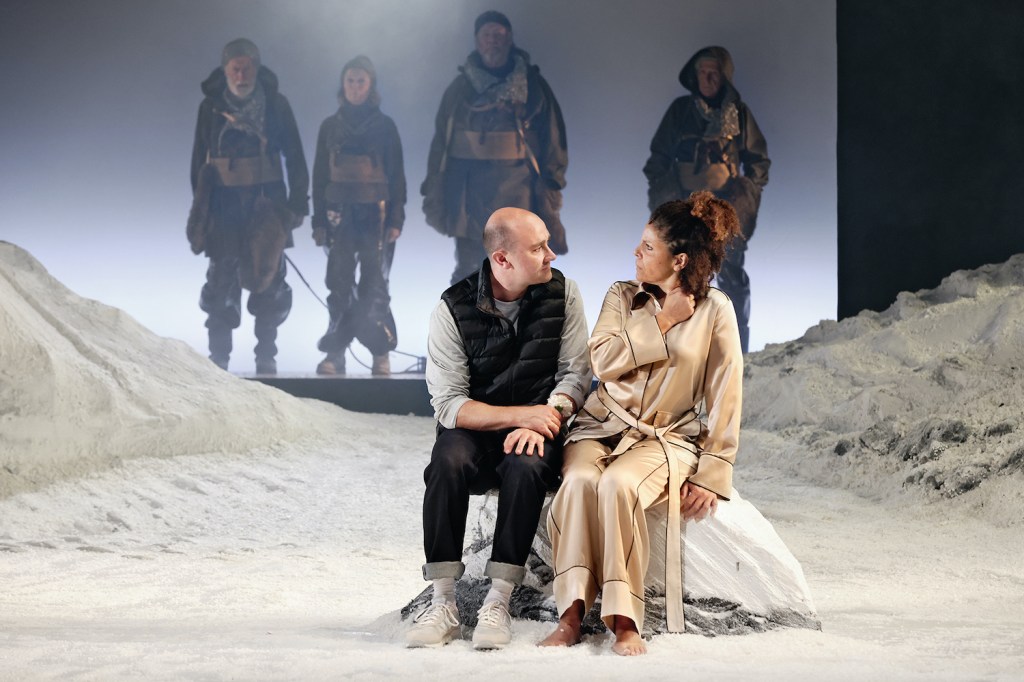
Photo: Prudence Upton In a wonderful piece of writing, all the supplementary roles are played by Josh McConville (Triple X) who inhabits the husbands, sons and memories of the patients – laying each part with the fears and pains of those whose connections are ripped away by the cruel march of dementia.
It’s a remarkable feat that the play never feels depressing or overly burdened. The audience is left with a sense of humour and beauty that fills every scene. Even the stabs of hard reality never puncture the aura of poetry that surrounds these people in their darkest hours.

Photo: Prudence Upton The restraint in not over-using the Thomas poem is admirable, and adds weight to its eventual recitation. These characters are raging against the dying of the light. They refuse to fade, even as the curtain falls.
-
Happy Days (Melbourne Theatre Company) ★★★★1/2

Written by Samuel Beckett. Melbourne Theatre Company. 1 May – 10 June, 2023.
There seems to be a natural melding of elements in Melbourne Theatre Company’s production of Samuel Beckett’s 1961 classic, Happy Days. As if somewhere between Judith Lucy’s life as a comedian and Beckett’s existential outlook the show has landed in a sweet-spot of despair, determination, and humour.
Winnie (Lucy) is stuck in body, but not in spirit. She may be buried up to her waist in immovable rock, but she isn’t letting that get her down, oh no. Her static day is full of moments and rituals, rules she’s established to help pass the time. Her trusty black bag full of items helps her stay groomed and presentable. Her husband, Willie (Hayden Spencer), makes for tolerable company. Winnie will grab hold of any brightness to declare that today will be a “happy day”.

Judith Lucy. Photo: Pia Johnson Oh course, this is Samuel Beckett so nothing here is to be taken literally. Winnie’s drive for positivity in the face of destitution is both admirable and disturbing. Behind the smile is a malignant, creeping fear – it’s the kind of emotional double-speak a comedian like Lucy excels at. After all, who can stare into the abyss and still laugh quite like a stand up comic? Lucy peels back the thin veneer between comedy and tragedy to create a Winnie of remarkable depth and nuance. Every line is precise, each wince is an earthquake. Instead of resting on Lucy’s stock-in-trade dry wit, director Petra Kalive draws out a seam of self-doubt and the vulnerability of age.
One thing that shone through here is the very modern commentary on climate change. Winnie’s choice to politely ignore the changing face of the arid world around her is damning. In pretending that nothing has changed, and life can go on as normal, Winnie seals her own fate. The incessant klaxon, a bell to signal waking and sleeping hours from an unseen controller, is a warning of doom that goes unheeded.
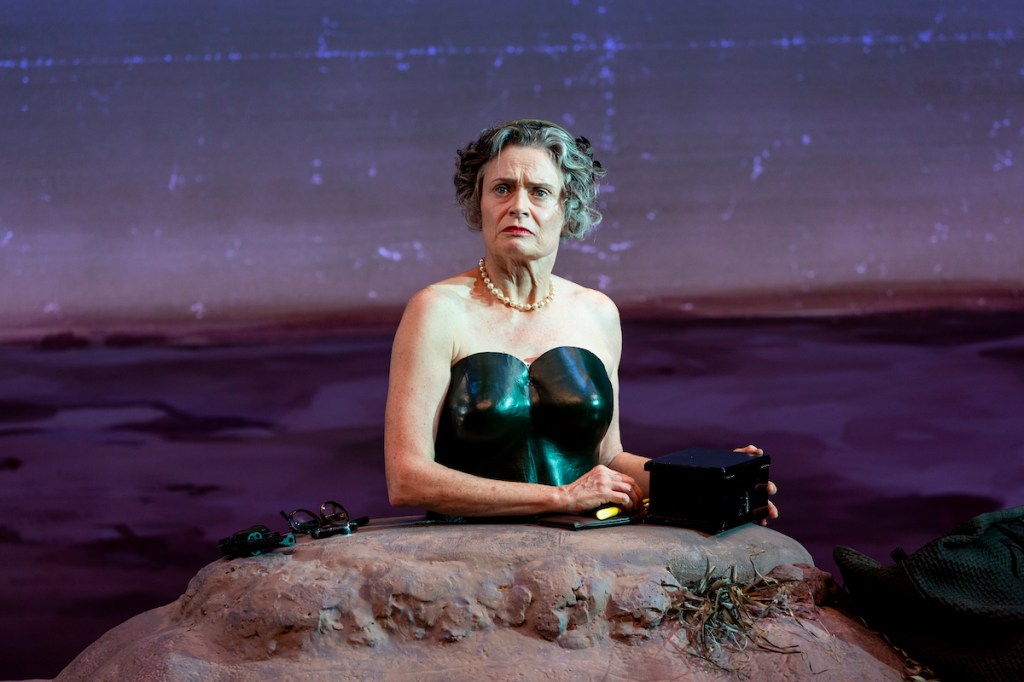
Judith Lucy. Photo: Pia Johnson Eugyeene Teh’s set is well executed and almost fiercely three-dimensional, but perhaps too literal. It’s brought to life through the subtle work of J David Franzke’s sound and Paul Kim’s lighting, which are unobtrusive but keep this stationary work from feeling stagnant. I was also a little confused by the costuming choices. Lucy’s Winnie wears a leather bodice that is both visually flat and overly sexual for the character. A matching hat, and black bag continue the flat look that seems out of keeping with Winnie’s personality. But these quibbles are more personal preference than failures.
This production has drawn nothing but high praise and it’s easy to see why. It is a shame this wasn’t a co-production that would tour other cities. Judith Lucy proves she has the dramatic and theatrical chops to shine in what is essentially an epic, existential monologue. Beckett can, in lesser hands, be a slog to get through, but this production hits the right notes. Winnie, it’s time to sing your song!
-
Girl Band (Riverside Theatres, Parramatta) ★★★★
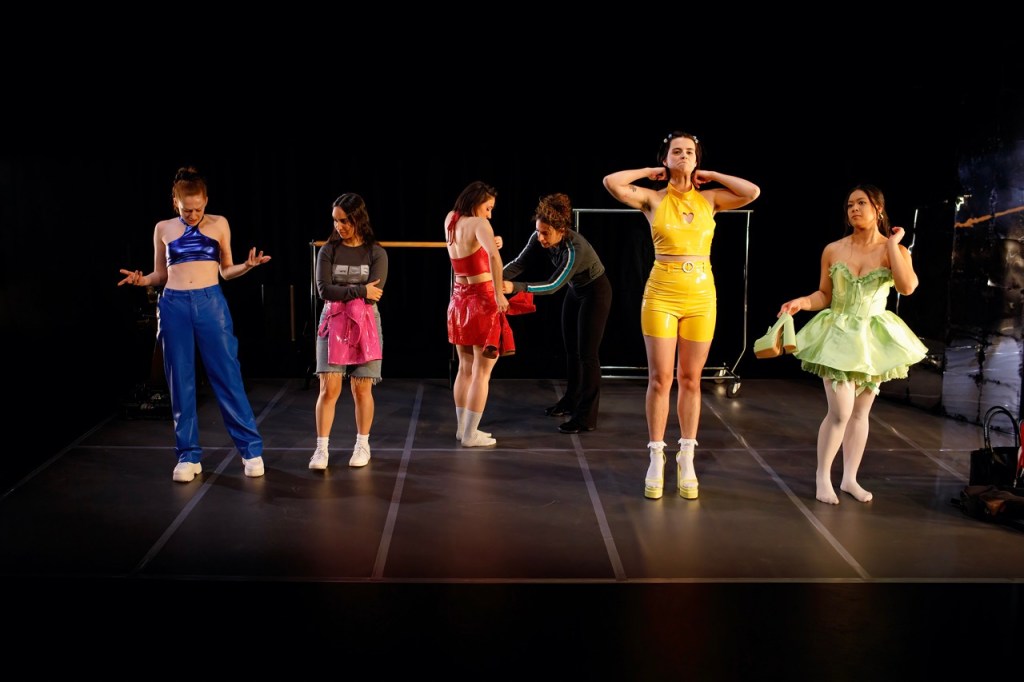
Written by Katy Warner. Riverside Theatres, Parramatta. 18 – 27 May, 2023.
Playwright Katy Warner is taking aim at performative “girl power”, literally, in her new play Girl Band, going behind the scenes of the birth of a 90s pop group. For all the bubble-gum music and outfits, this tale gets realistically dark.
Music industry svengalis Craig and Darren are the money and power behind upcoming girl group, The Sensation Girls, the brainchild of choreographer Becky (The Italians’ Amy Hack). In rehearsals, four of the quintet are stunned to learn that lead singer Didi has left the group, flying to London to launch a solo career. Founding member, MJ (LJ Wilson) wants to step up lead vocals (and the centre of the choreography), but the girls are shocked when Didi has been instantly replaced by Kiki (How to Defend Yourself’s Madeline Marie Dona) – a charming ex-stripper. But their in-group rivalries are nothing compared to the toxic patriarchy of the music business. For all their lyrics of female solidarity, the reality of making it in the industry is a murkier, dirtier warzone to navigate.
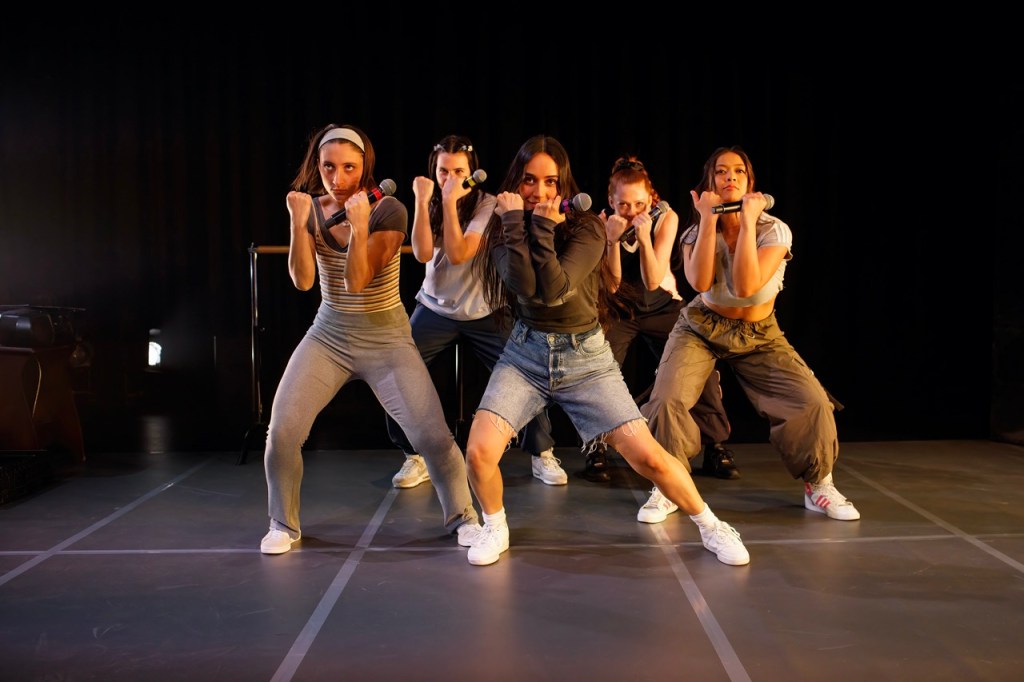
Jade Fuda, LJ Wilson, Madeline Marie Dona, Meg Clarke, Chaya Ocampo. Photo: Phil Erbacher Disclaimer: I worked in music television for almost two decades from the late 90s, so this era of girl groups and 90s pop is something I know well. I got to see first hand how these groups came and went, and how they behaved behind-the-scenes when the cameras were turned off. Some were fantastic young professionals, some great vocalists, others sparkling personalities with passable voices, and some were frankly rancid. From callously pushy parents, soulless corporate taskmasters… it can be a nasty business behind the colour and lights. That’s why I found so much to love in this play.
Some of the observations of the dynamics of these teen-friendly groups are so lovingly rendered it’s clear Warner knows her pop. When lesbian Sammy (Past The Shallows‘ Meg Clarke) is told to tone it down, she bites back at the clear Sporty Spice/lesbian-coded personae she is forced to portray only to be told in no uncertain terms her sexuality is there to excite straight men, not empower queer women. The threat of being “replaced” mimics the changing rosters of groups like Destiny’s Child and Sugababes. When MJ, the “smiley” one of the group, rages at being overlooked yet again, she’s bluntly told she doesn’t have star power, and should be grateful to be dancing in the back.

Chaya Ocampo. Photo: Phil Erbacher. Warner has created six characters of terrific depth that weave their way through the familiar tropes of teen pop stardom. From being forced to publicly date the member of a rival boyband, having interview questions answered by their manipulative management team and rewriting their life stories to better fit a narrative. It’s hard to pick a stand out character or performance, it’s clear that each one has been well crafted. Every storyline is clear, and nuanced and rarely reaches for melodrama – the script lets telling moments fly past and trusts the audience will catch them.
It’s in this slow build of passing comments it becomes clear that these young women are being manipulated and expected to tolerate abuse. They see it being part of the job and are devastatingly worn down by it – each reacting differently. MJ has toughened herself to stoically get through it all. Stacey (Jade Fua) makes polite excuses. Jade (a stunning performance from Chaya Ocampo) tries to block it out. Becky tries to protect the girls while also enabling their abusers. It takes newcomer Kiki to blatantly point out that this is not right – but are they willing to throw their careers away?
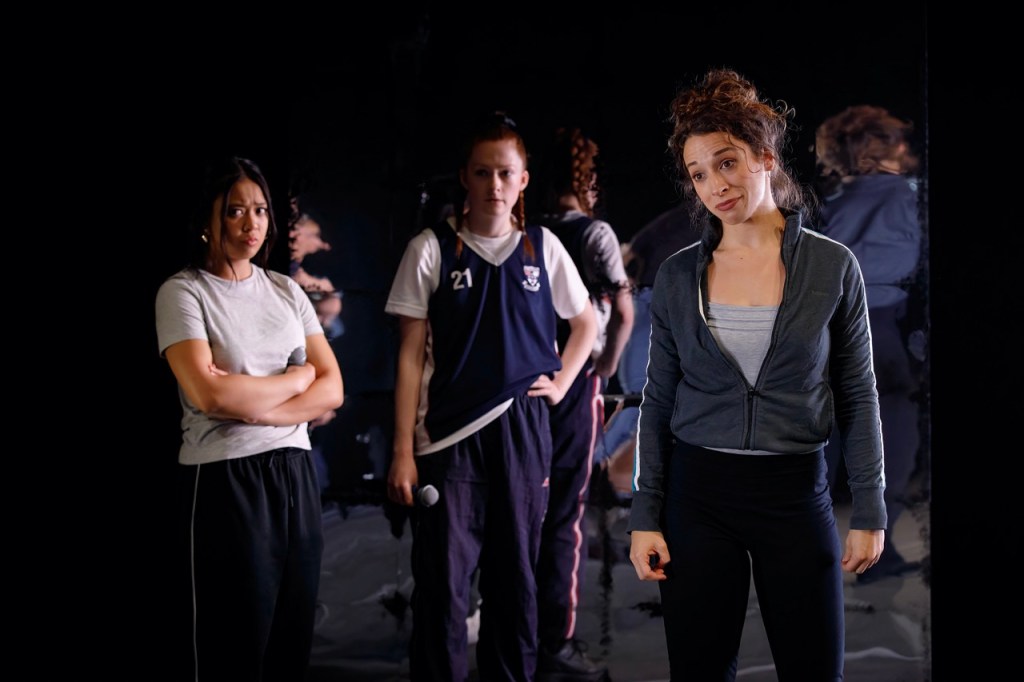
Chaya Ocampo, Meg Clarke, Amy Hack. Photo: Phil Erbacher The loving pastiche that fills the script is sadly dampened by the tunes (these aren’t Cathy Dennis-penned bangers, or Xenomania chart toppers by any stretch of the imagination). If we’re to believe there might be an upside for these women to tolerate their situation, then there has been evidence they could conceivably hit number one. The deliberately poor tunes make their songwriting overlords look amateurish and the group members come off stupid for believing any of it might pay off. Thankfully the songs are little more scene setting, this isn’t a musical, it’s a drama.
Girl Band is a rock solid drama with great performances all round. This play is just at the start of its journey, and it’ll be exciting to see where it ends up.
-
Suddenly Last Summer (Ensemble Theatre) ★★★★

Written by Tennessee Williams. Ensemble Theatre. 18 May – 10 Jun, 2023.
Tennessee Williams’ hypnotic play, Suddenly Last Summer heats up the autumnal nights at Ensemble Theatre with a stunning new production from director Shaun Rennie and a stellar lead performance by Andrea Demetriades. Compact, precise and haunting; to quote a very different show, “I’ve got chills. They’re multiplying”.
This is 1936 New Orleans. The elderly Mrs. Violet Venable (Belinda Giblin in mesmerising form) tries to coerce a doctor into performing a lobotomy on her niece Catherine (Demetriades) whom she has had placed into an asylum. The doctor (a terrific last-minute turn by Remy Hii) tries to get to the bottom of this tangled, emotionally incestuous family, and in doing so unleashes a shocking secret.
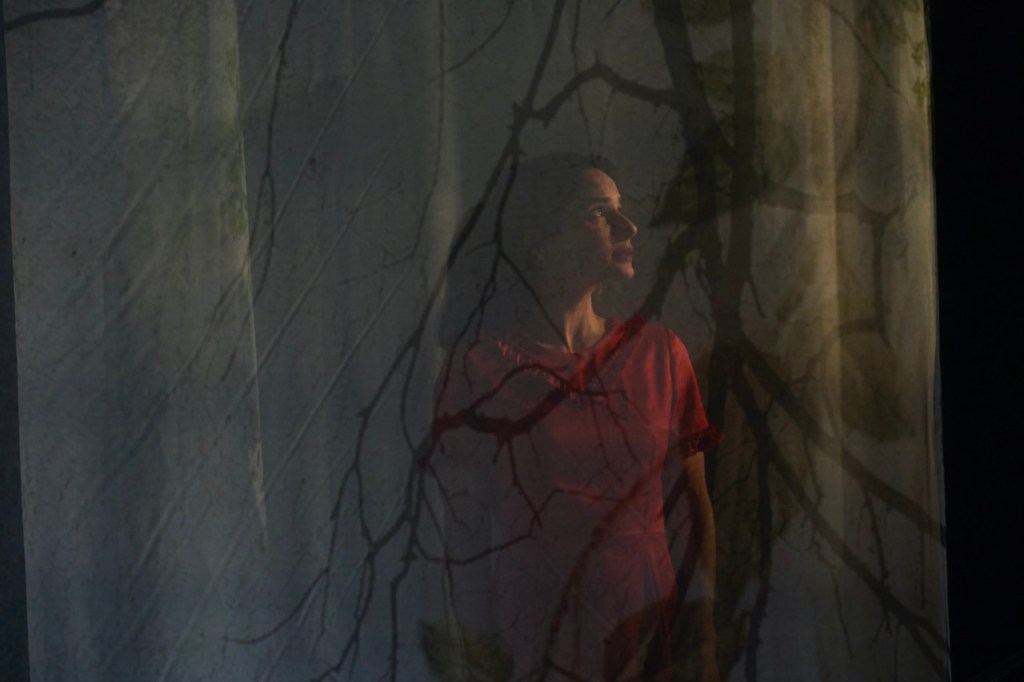
Andrea Demetriades. Photo: Jaimi Joy. This is Williams at his most “southern-gothic”. The claustrophobic setting, a jungle-like garden (beautifully realised by Simone Romaniuk’s ephemeral design – diaphanous, foliage printed drapes, and exotic greenery in glass terrariums) is ripe with secrets and questions. A psychologically perverse relationship between a mother and Sebastian, her queer son. A beautiful young woman struggling to cope with a horrific memory. Relatives vying for inherited wealth. This is an entitled southern family who know no boundaries, slamming up against a reality they don’t want to admit.
The entire play is based around stories and perceptions – the truth is less relevant than the overriding narrative as Violet tries to strike down Catherine for contradicting her version of Sebastian, whose death has driven this family to the brink. Their wealth could only protect them so far.
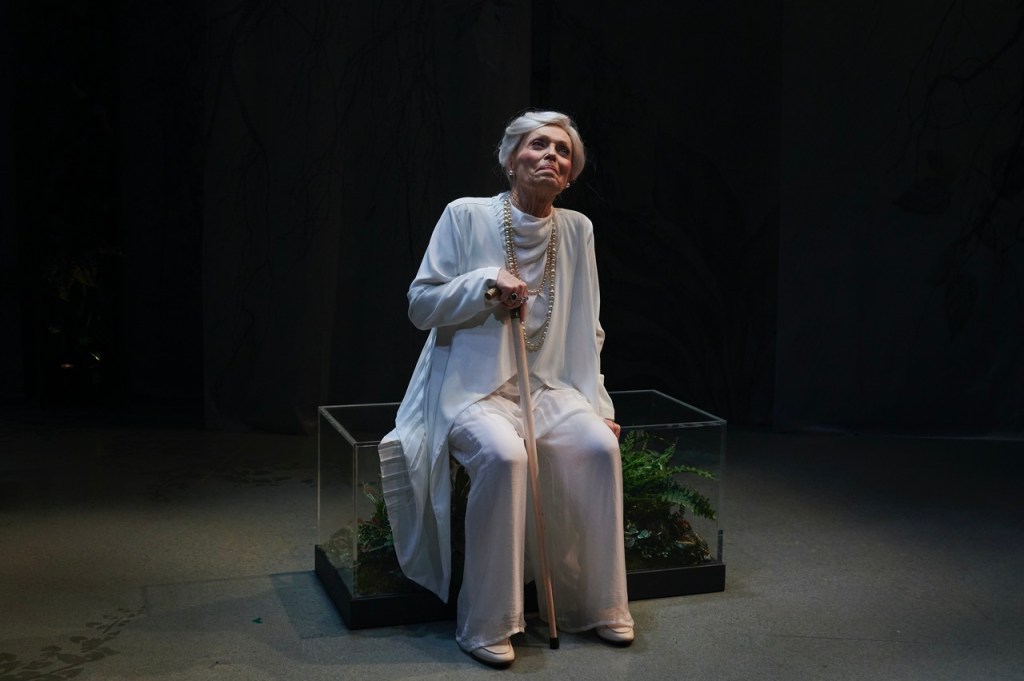
Belinda Giblin. Photo: Jaimi Joy. The ghost of Sebastian haunts every moment. He is understood only through the eyes of those who knew him but is ever-present in Romaniuk’s use of almost mini coffin-like terrariums on the set (a rich extravagance tightly bound by society). At first he draws our sympathy as an eccentric gay man struggling in a homophobic world, but as his ugly, vain, predatory nature is revealed, a darkness takes over.
It would be easy to create a chamber piece of camp excess with this coterie of characters but Rennie and cast excel by keeping a tight rein on proceedings. Demetriadies walks us right up to the line of “girl-gone-craaaazzzy” but holds it together with fierce will. Her finale monologue soars without tipping over into drag. Her eyes are steely as they relive her most awful moments.
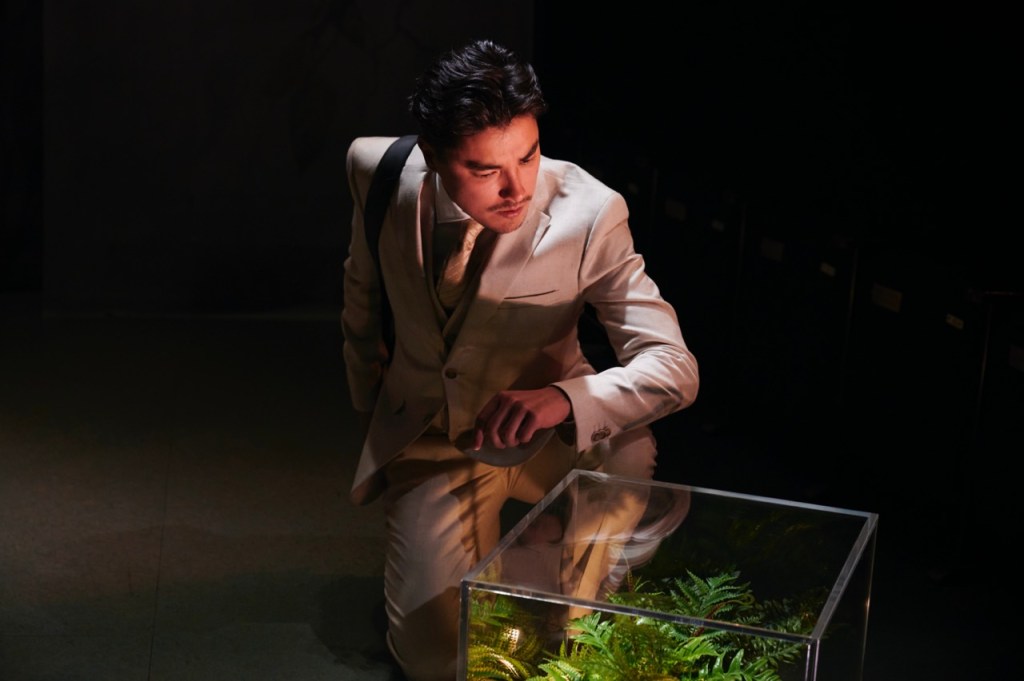
Remy Hii. Photo: Jaimi Joy. And an extra round of applause please for Remy Hii, who stepped into the role of Doctor “Sugah” with only four days rehearsal. You can forgive him a quick glance at a well concealed script, his performance was as emotionally conflicted and steely as required. Every inch a charming Southern Gentleman thrown into a dense and morally murky scenario.
Suddenly Last Summer is a complex, taunt play given intoxicating life in this staging. Everything here is working in harmony, from the design, direction, script and cast. A great, fresh vision for this classic piece.
-
Clyde’s (Ensemble Theatre) ★★★1/2

Written by Lynn Nottage. Australian Premiere. Ensemble Theatre. 5 May – 10 June, 2023.
Lynn Nottage, the two-time Pulitzer Prize winner, comes to the stage with a lot of expectations. Her new comedy, Clyde’s, hits Australia with a reputation of being the most staged play in America last year. There’s clearly something good here.

Aaron Tsindos, Nancy Denis, Ebony Vagulans, Charles Allen & Gabriel Alvarado. Photo: Prudence Upton In a truck-stop in Pennsylvania, four ex-felons work the kitchen making sandwiches for drivers on the go, under the watchful eye of aggressive matriarch Clyde (Nancy Denis). The zen-like sandwich master Montrellous (Charles Allen) is experimenting with flavours and finessing his approach to life. Rafael (Gabriel Alvarado) mans the grill while Letitia (Ebony Vagulans) preps and assembles the orders. When a new employee, Jason (Aaron Tsindos), arrives with white supremacist tattoos, the Black and Latinx staff bristle. Together, the four of them strive to find meaning in their work while Clyde berates and assaults them. Can the pursuit of the perfect sandwich save their souls?

Ebony Vagulans & Gabriel Alvarado. Photo: Prudence Upton There is a mad-cap, workplace sit-com energy to Clyde’s. The eponymous boss is like a nasty Krammer crashing through Seinfeld’s door, causing chaos and belittling her team. Montrellous’ patience seems to be almost absolute, while Letitia and Rafael flirt and Jason reveals himself to be more than he seems. Nottage’s dialogue is snappy, and by juxtaposing the gritty reality of the kitchen to the descriptions of their dream sandwiches (“Maine lobster on a potato roll with truffle mayo, caramelised fennel and a touch of dill” etc) it sells the aspirational dreams of these ex-cons looking for a better life.
Darren Yap’s production is fast and frenetic (and desperately unhygienic for a kitchen space). Some careful touches of fire and smoke, and the constant moving and slamming down of condiments, adds a layer of physical comedy to the evening. You are guaranteed not to be bored. But beneath all the sound and fury, I feel like something was lacking.
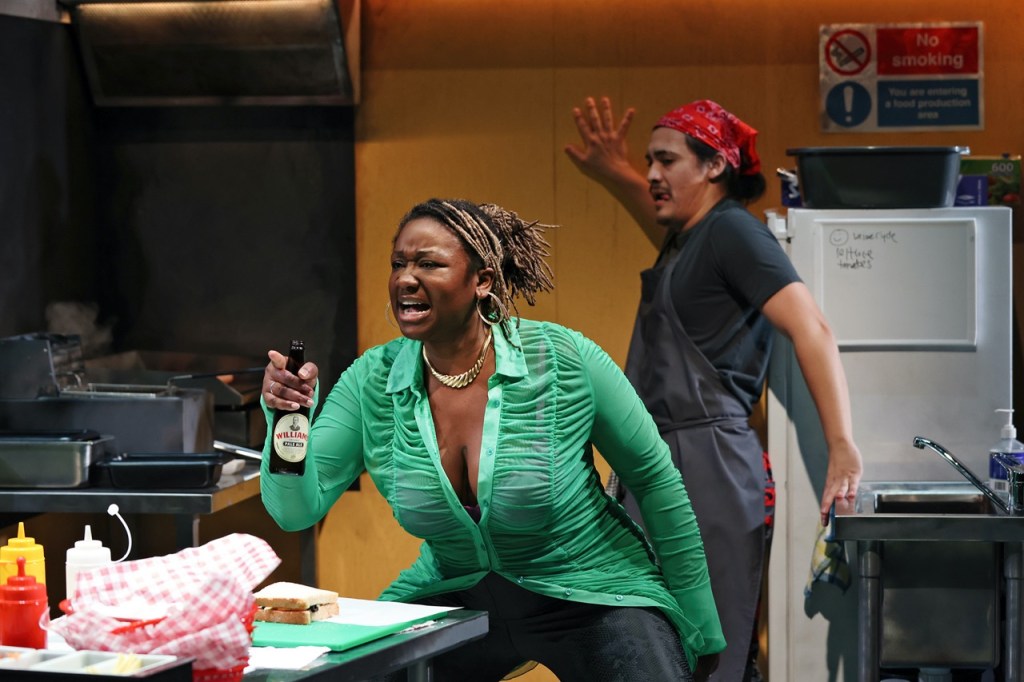
Nancy Denis & Gabriel Alvarado. Photo: Prudence Upton. Both Nottage’s characters, and Yap’s direction are broad and don’t leave much room for the performers to give their roles the nuance they need to elevate them. Clyde herself becomes a series of one-note barks; funny at first, less so after 90 minutes. The secret of Montrellous’ own incarceration is disappointingly vapid. The actual food-prep on stage is so haphazard it cuts against the text. The only character to get real development is the newcomer Jason and you can predict it all from the moment he walks on stage. For a story of ex-cons, this play has assembled a range of soft-ball criminals whose redemption is within easy reach, guaranteed not to divide the audience too much.
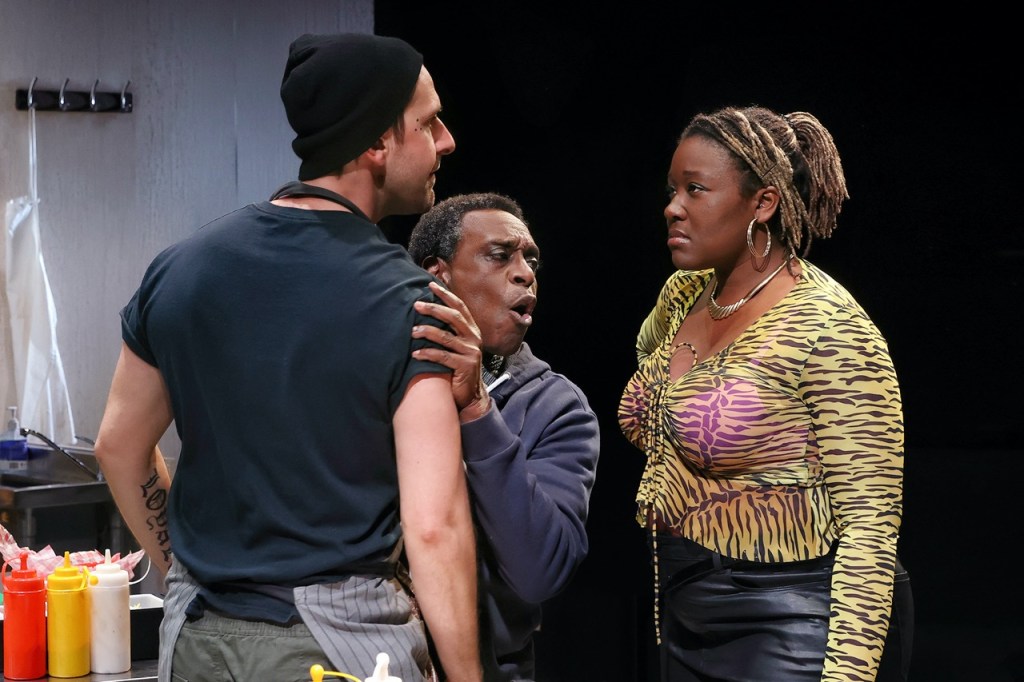
Aaron Tsindos, Charles Allen & Nancy Denis. Photo: Prudence Upton. I’ll be frank, whatever Lynn Nottage’s secret sauce is, it does little for me – but that doesn’t mean it won’t work for you. I was similarly unmoved by her Pulitzer Prize winning drama, Sweat. Clyde’s is amusing but cloying and unsubtle with the gloss of deeper meaning but no real depth. Others have loved it, maybe you will too!
-
At What Cost? (Belvoir) ★★★★★

Written by Nathan Maynard. Belvoir St Theatre. 4 – 21 May, 2023.
While many people spent the night watching the Coronation of King Charles III, Australia’s new Head of State, a smaller group were sitting in the Belvoir St Theatre watching a play rooted in the intergenerational damage of British colonialism.
At What Cost? Nathan Maynard’s seering play about an Aboriginal community in Tasmania fighting over cultural & ethnic authenticity, returns to Belvoir before a national tour. I missed it when it debuted in 2022, but the cast has reassembled and it’s easy to see why it’s getting another run – this play is rich and exciting.
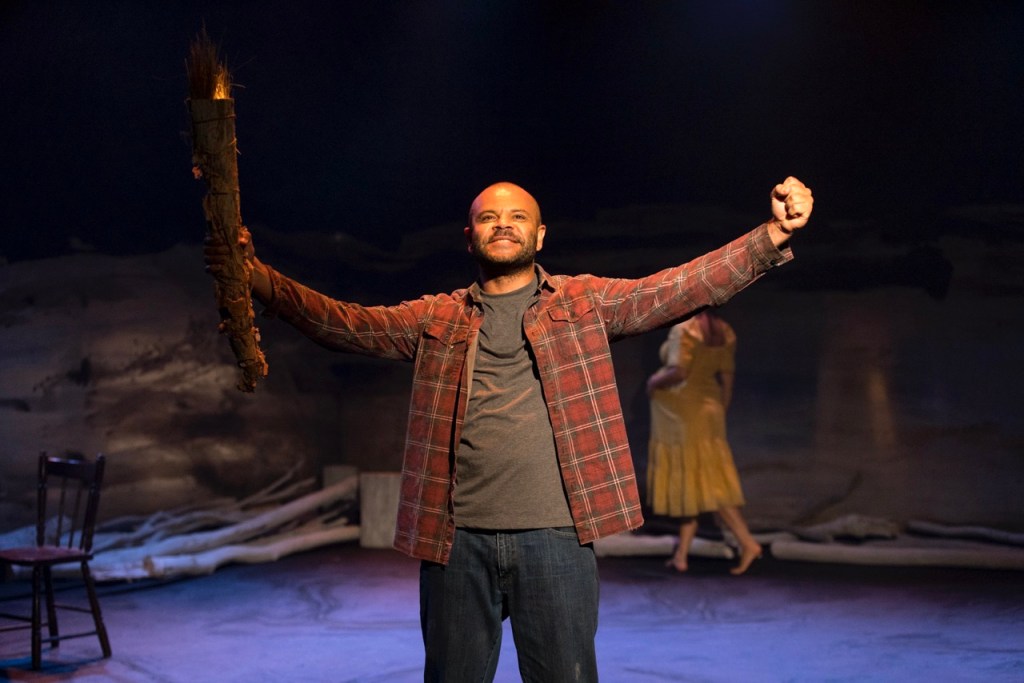
Luke Carroll. Photo: Brett Boardman. Boyd (an unmissable performance by Luke Carroll), is a leader in the palawa community preparing for a British museum to return the stolen remains of William “King Billy” Lanne, an Indigenous Tasmanian man. Preparing a cremation pyre on palawa land, not open to the general public, he and his partner Nala (Sandy Greenwood) notice a new tent has been set up on the outskirts. Boyd fears it is part of a political group of “box tickers”, people with no provable claim to Aboriginality but who take on the identity for themselves. When Boyd, and his younger cousin Daniel (Ari Maza Long) explore, they find Gracie (Alex Malone), a red headed woman who says she’s there to research her thesis.

Ari Maza Long & Luke Carroll. Photo: Brett Boardman. Everything here is a double-edged sword. Boyd’s rage and hardline stance to protect his people is as destructive as it is righteous. Gracie’s own crushing desire to belong, to be special, might be born of white guilt but does it make her illegitimate? The script uses Nala and Daniel to draw out the nuances of the debate. Nala is more accepting because she’s lived through years of people trying to hide their Aboriginality, the links aren’t always clear anymore. Daniel is part of a younger generation with his eyes on the present, not the past.
Maynard’s script is so tight and jam-packed with big issues it fuels debate long after you’ve left the theatre. I spent a lot of time translating all this questioning of Aboriginal identity over to that of gender, sexuality and disability. How is the issue of self identification for trans people different from that of self identification for Indigenous people? Can heterosexual people claim queerness? Race, like disability, isn’t about the obvious physical markers. These aren’t like-for-like comparisons to race and ethnicity of course, but At What Cost? got my brain ticking in a way that not many plays do – it is a conversation starter.

Alex Malone & Sandy Greenwood. Photo: Brett Boardman. Around these performances is Jacob Nash and Keerthi Subramanyam’s simple but gripping set. A collection of white branches border the stage and slowly become the funeral pyre, rising high into the sparkling night sky. Evocative music (Brendon Boney) and sound design (David Bergman) ratchet up the tension. Director Isaac Drandic skillfully paces the story out and when the revelations drop, the audience literally gasps.
If you’re wanting a quibble, I’d say I would have loved one more scene at the end to decompress the final moment – but I also love the economy of the storytelling. All plays are fifteen minutes too long as a rule and the sharp ending sends you out into the foyer in need of a drink and a moment to process.

Luke Carroll. Photo: Brett Boardman. At What Cost? is thrilling theatre. It entertains and provokes in equal measure. We’re lucky it’s come back so soon, and that it is about to tour. Uniquely Australia and expertly done – this one should be seen around the world.
-
Subscribe
Subscribed
Have a WordPress.com account? Log in now.

