-
Welcome to Cultural Binge

The rating system is simple:
★★★★★ – Terrific, world-standard. Don’t miss.
★★★★ – Great, definitely worth seeing.
★★★ – Good. Perfectly entertaining. Recommended. Individual mileage may vary.
★★ – Fine. Flawed and not really recommended, but you may find something to appreciate in it.
★ – Bad (& possibly offensive).
See more reviews over at The Queer Review.
Instagram: @culturalbinge
Substack: culturalbinge.substack.com
Email: chad at culturalbinge.com
-
My Brilliant Career (STC) ★★★★★
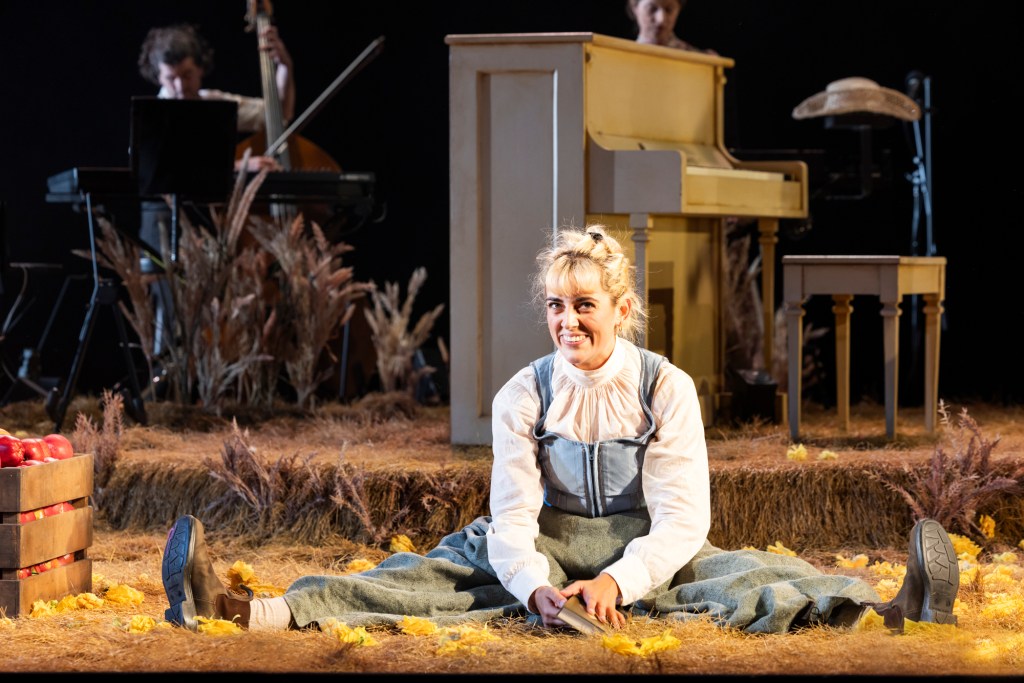
Book by Sheridan Harbridge and Dean Bryant. Music by Mathew Frank and Lyrics by Dean Bryant. Based on the novel by Miles Franklin. Melbourne Theatre Company & Sydney Theatre Company. Roslyn Packer Theatre. 21 Mar – 3 May, 2026.
Why is it titled My Brilliant Career? Because My Brilliant-Ecstatic-Defiant-Poetic-Ambitious-Uplifting-Hilarious-Heartwarming-Beautiful Career doesn’t quite roll off the tongue. But it is all those things, and more.
My Brilliant Career arrives in Sydney fully formed, off the back of two successful Melbourne runs and more critical stars than you can poke a telescope at. But not every adored Melbourne show makes its mark here. Sometimes it’s something transcendent, like Red Stitch’s Who’s Afraid of Virginia Woolf? And sometimes it’s… well… Bloom! So I walked in filled with anticipation — but not entirely with confidence.
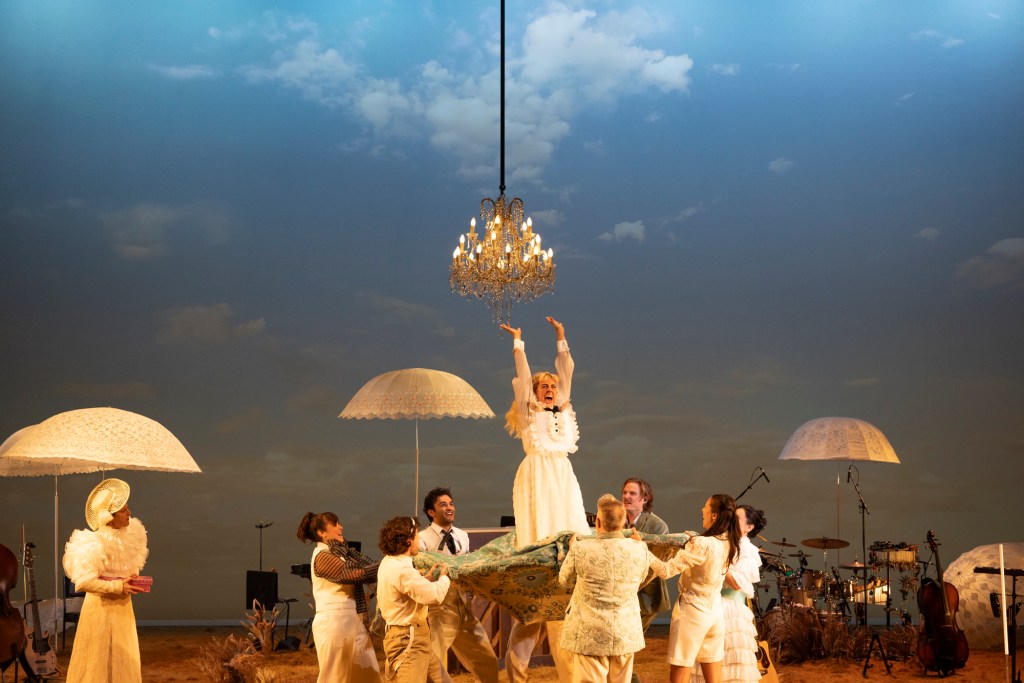
Cast of My Brilliant Career. Photo: Pia Johnson. Miles Franklin’s story of a country girl pushing against everything the world throws at her holds an almost mythic place in Australian pop culture — from the turn-of-the-century novel that became a touchstone for generations of young women, to the iconic 1979 Gillian Armstrong film that launched Judy Davis to international acclaim. Transforming it into a contemporary musical is no small undertaking. But this troika of creatives — Bryant, Frank and Harbridge — take their lead from their own lead character: they rush in with a gleeful lack of reverence that busts the story wide open.
Musically, the show is eclectic to a fault, criss-crossing genres without falling into pastiche. What elevates it above mere genre-play is the canny way the creative team — along with director Anne-Louise Sarks — use music not just to move the plot or reveal a character’s thoughts, but to actively manipulate the audience’s perceptions. It’s that sophistication which makes this one of the best new Australian musicals in years.
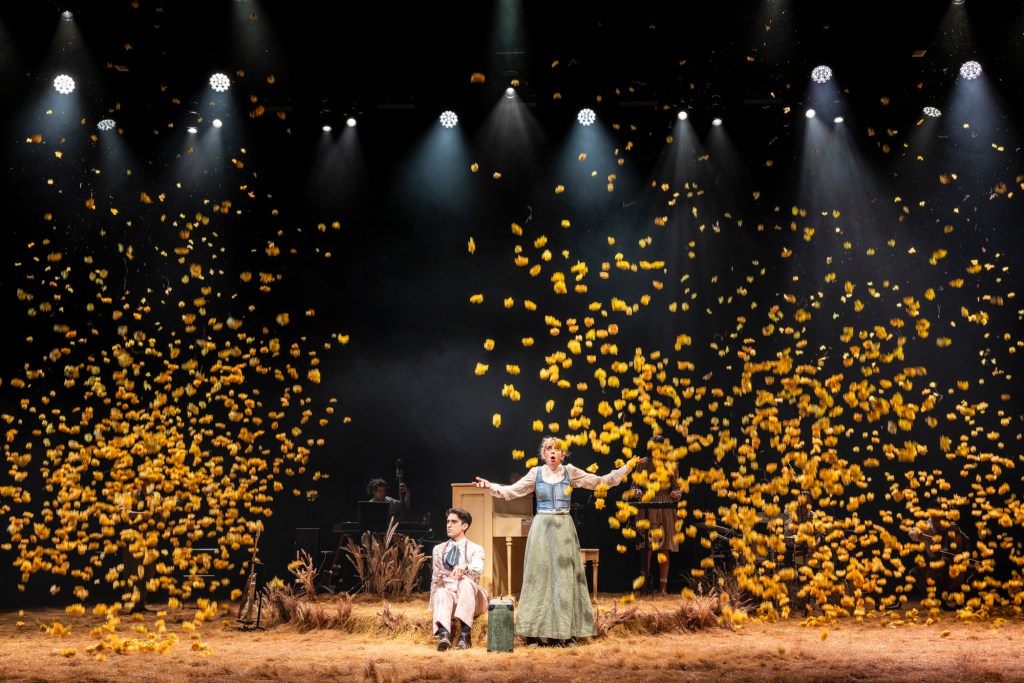
Cameron Bajraktarevic-Hayward & Kala Gare. Photo: Pia Johnson. The design is impeccable. Marg Horwell’s sets and costumes are elegant in their simplicity — never empty, never unconsidered. Amy Campbell’s choreography brings an organic physicality to the piece, along with some genuinely funny comedic beats (a particular shout-out to Cameron Bajraktarevic-Hayward’s remarkable leg work). Anne-Louise Sarks’ direction is alive with the kind of micro-moments that only emerge from a genuinely free rehearsal process. No element is missing.
As Sybylla makes clear from the outset, this is “a yarn” — a story told directly to the audience, with the cast of actor/musicians filling the stage with movement and music, slipping between characters and instruments with complete ease. Kala Gare inhabits Sybylla’s skin so seamlessly she disappears — rambunctious and arrogant on the surface, achingly yearning underneath. Her performance is acrobatic: physically, emotionally, and vocally.
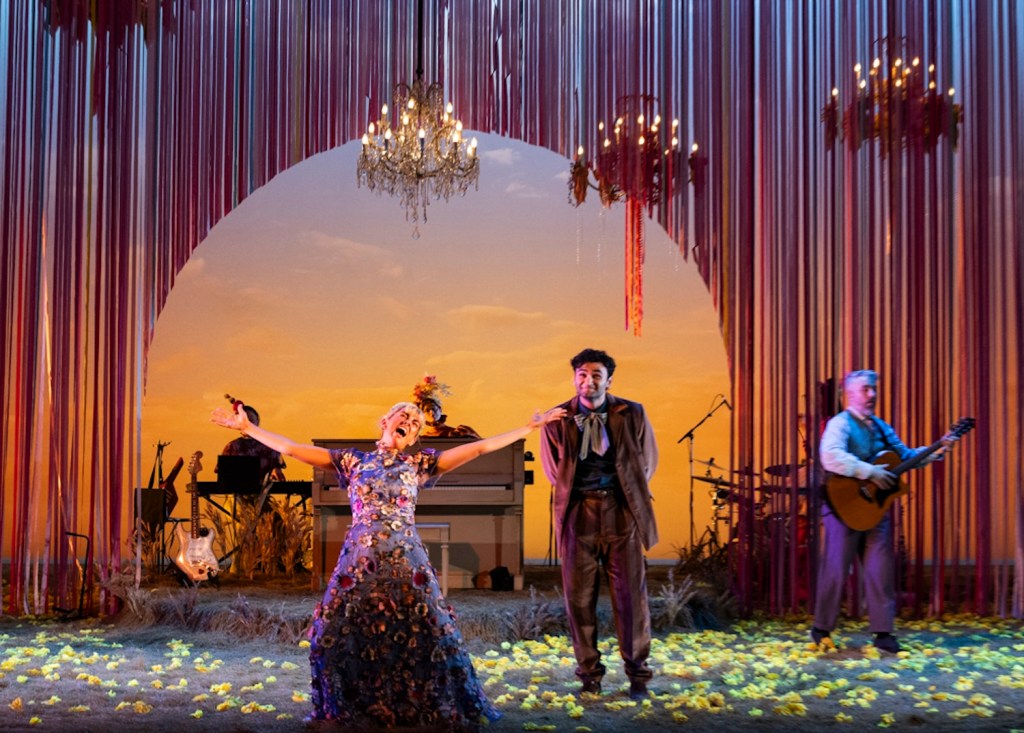
Kala Gare, Raj Labade & Drew Livingston. Photo: Pia Johnson. But what gives it genuine weight is the way the show allows Sybylla to grow. As she experiences more of life and slowly matures, My Brilliant Career takes on weightier territory — arriving finally at the question that drives every young artist: why do I write? What is the point of art? The answer she arrives at is almost spiritual in its execution.
Raj Labade gets to flex like a theatrical Swiss Army knife — swoon-worthy leading man, comedic foil, vocal and instrumental star. (He is also, not incidentally, extremely gifted with a bullwhip.) He embodies the audiences attraction and bewilderment to Sybylla’s iconoclastic ways with a gentle charm.
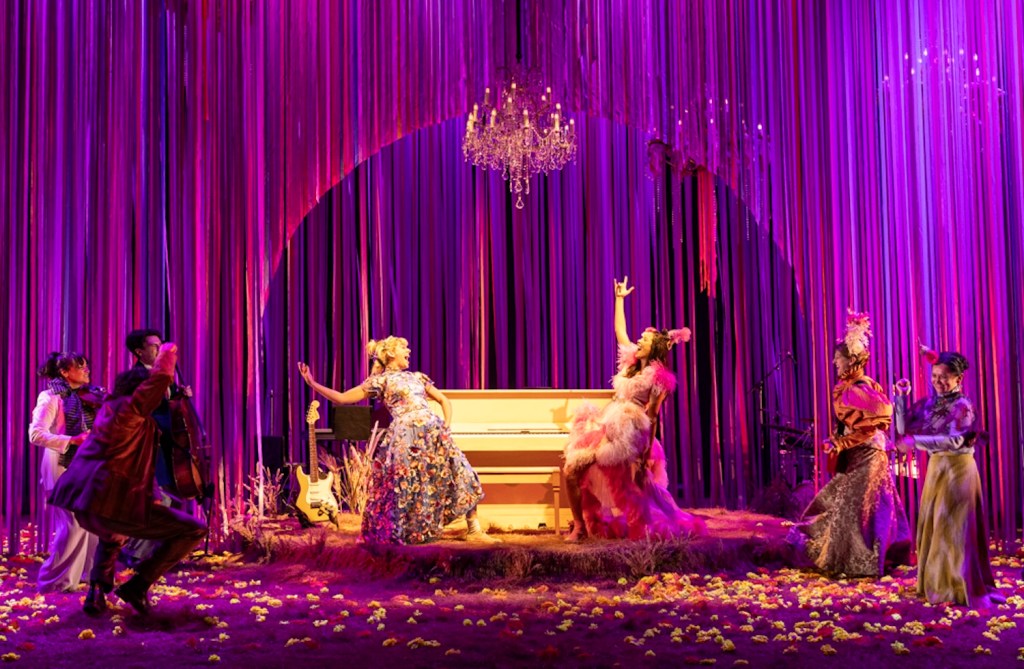
Kala Gare, Melanie Bird & Ensemble. Photo: Pia Johnson. But the performance I find myself most wanting to single out is Melanie Bird’s. Across the evening she inhabits a whole host of different characters, from Sybylla’s younger sister Gertrude, a gloriously bratty M’Swat child, the cosmopolitan Blanche, and more — while also understudying Sybylla and playing a range of instruments. It is a performance of ebullient range, delivered with complete ease.
My Brilliant Career has something too many Australian musicals — and plays and films and television shows — lack: an artistic ambition that refuses to stop at “good enough.” Rather than retreating to easy quirk-comedy or knowing pastiche, it dares to be great on every level. And it succeeds. Accessible and smart, bold and inviting — and at its heart, a questing exploration of the birth of a young artist, told by artists who know exactly how that feels.
-
Four Quartets (The Old Fitz) ★★★½
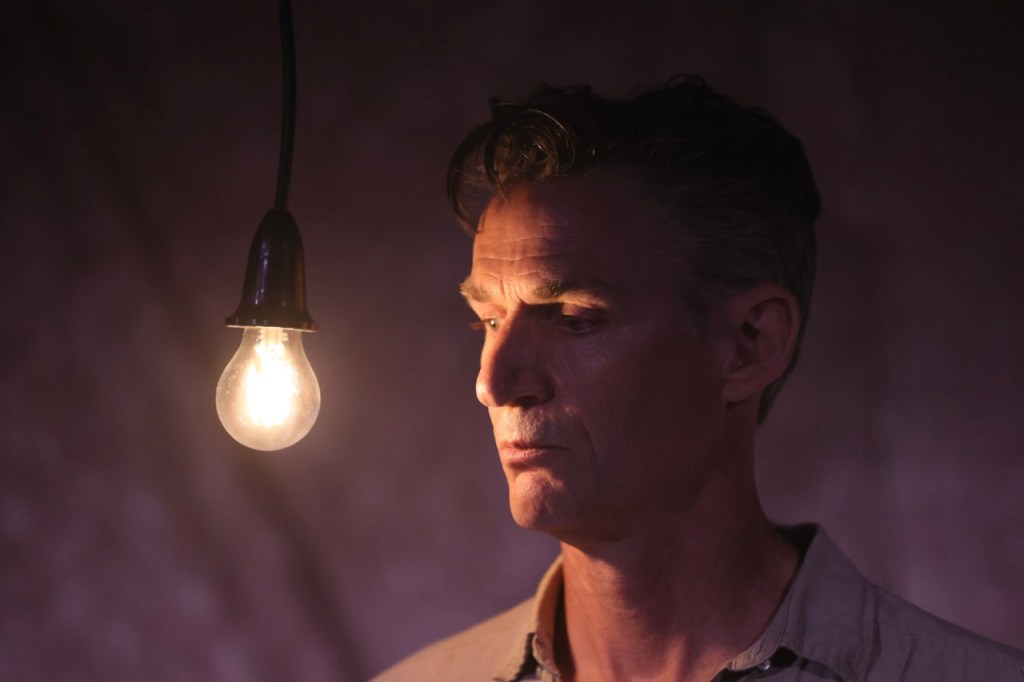
Written by T.S. Eliot. Presented by The Wounded Surgeon. Old Fitz Theatre. 16-20 March 2026.
T.S. Eliot’s epic meditation on time, humanity and divinity gets put on its feet for a late-night show at The Old Fitz — where the intimate darkness of the space, and the late hour, turns out to be a natural fit. And to be clear: this is nothing like Cats.
Eliot’s Four Quartets is made up of four poems — Burnt Norton, East Coker, The Dry Salvages, and Little Gidding — written as the world irrevocably changed around their author in the late thirties and early forties. These are works of spiritual seeking and anguish: Eliot wrestling with mortality, God, and the search for meaning, starting before World War Two begins and deepening as the conflict tore across Europe. Deeply rooted in his Anglicanism but reaching into Buddhist philosophy, he arrives at a vision of the divine that can only be approached by abandoning the very striving we instinctively bring to difficult things — the need to grasp, comprehend, and resolve.
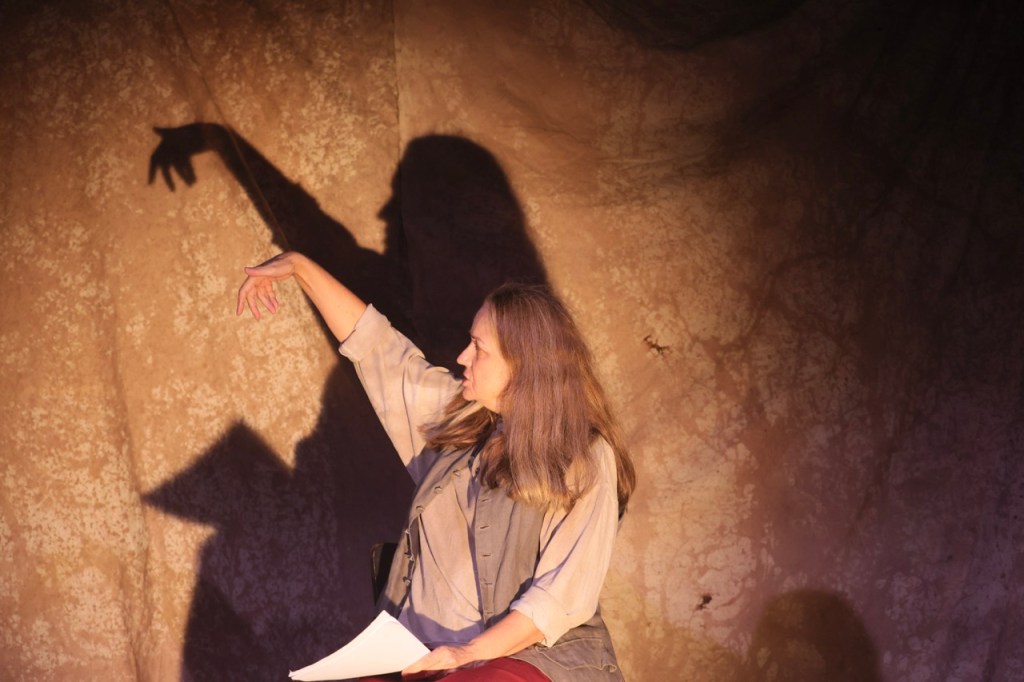
Sandie Eldridge. Photo: Matt Bartlett. Eliot is also a master of form. Each poem is loosely structured like a classical music quartet (hence the title) with a lyricism and metre that carries you through some pretty dense liturgical imagery and complex philosophical terrain. Each is anchored to a specific place, from the Cotswolds to the Massachusetts coastline, and each references one of the four classical elements. There are layers here to luxuriate in, these are rich works that reward further study.
Which makes the production’s central challenge a fascinating one. Each poem is presented as a monologue by a single performer in turn — Sandie Eldridge, Grace Stamnas, Charles Mayer and Kaivu Suvarna navigating these non-linear passages as both dramatic works and spoken-word poetry. Getting the cadence right, finding the understanding underneath the language is no small ask. While they all speak with Eliot’s clear voice, each performer brings a slightly different colour to the material, giving the evening a clear sense of progression.
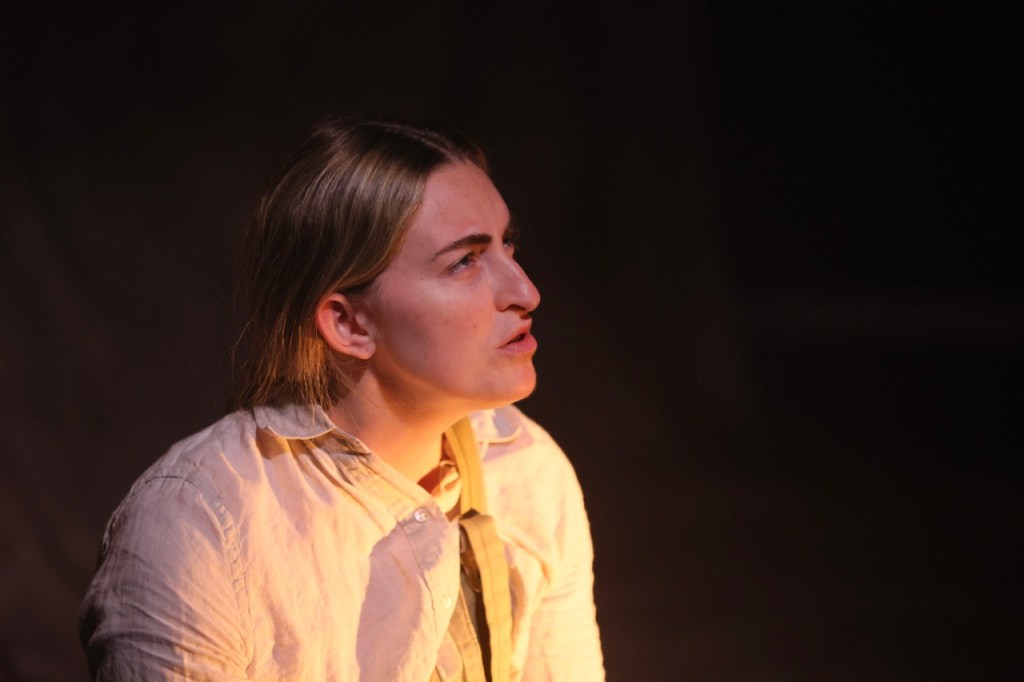
Grace Stamnas. Photo: Matt Bartlett. Under Patrick Klavins’ direction, with Topaz Marlay-Cole’s lighting, Jamie Hornsby’s sound design, and Bella Saltearn’s earthen set and costumes, there’s an almost rural, organic earnestness to the staging. A few props and simple blocking keep things alive without pulling focus from the heady material. It grounds us so that the elements of avant-garde can’t overpower the emotion.
What the theatrical format does best is enact Eliot’s own instruction. These are poems you go along with rather than dissect — you let the language carry you, resist the urge to pin every image down. Just as Eliot preaches the abandonment of attachment as the path to the divine, the only way to truly receive this work is to loosen your grip on comprehension. The late-night setting helps with that. You arrive already disposed toward mood over meaning. At a tight sixty minutes, the production has the good sense to trust the material and get out of the way.
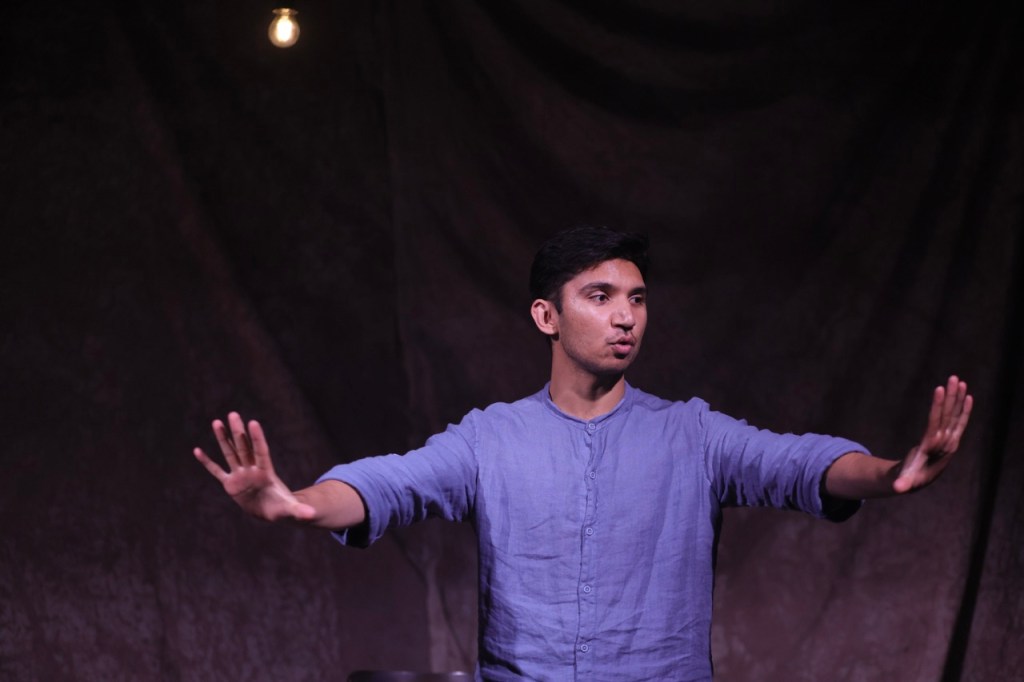
Kaivu Suvarna. Photo: Matt Bartlett. It’s confronting to sit with this work right now, when the world seems permanently on the brink and the lessons of the great wars feel all but forgotten. As events around us grow in scale from the transformative power of AI to repeated shocks of war, Eliot’s meditations speak to our sense of existential insecurity – which for Eliot came from surrendering to the divine. Would that we could face the horror of humanity’s capacity for evil with even a fraction of Eliot’s rigour, honesty, and poetry.
Four Quartets won’t be for everyone — and it’s worth being straight about that. If you’re not already disposed toward poetry, or you need drama to come with plot and conflict, there’s a real chance this will be a slow, bewildering night. Eliot doesn’t meet you halfway. But if language moves you, if you’re drawn to the big unanswerable questions, if you’re willing to sit in the dark and let something wash over you without demanding it explain itself — this can be genuinely magical. The kind of evening that follows you home. Go late, go open, and leave your need for answers at the door.
-
Monster (KXT) ★★★½
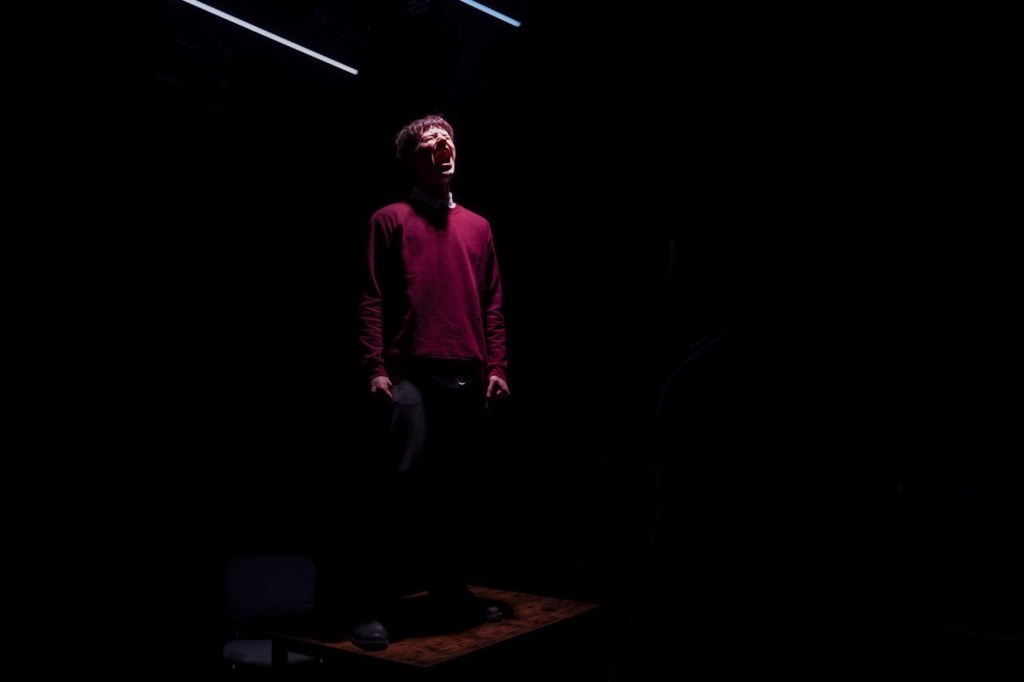
Written by Duncan Macmillan. Tiny Dog Productions in association with Bakehouse Theatre Co. KXT on Broadway. 6-21 Mar 2026.
What turns boys into dangerous young men? What makes a monster? Playwright Duncan Macmillan doesn’t provide answers so much as prod you to draw your own conclusions in this dark, spacious early work — receiving its Sydney debut at KXT on Broadway. If you were fascinated by the Netflix series Adolescence, this makes for a compelling companion piece.
Darryl (Campbell Parsons) is a disruptive 14-year-old, removed from his regular classes to be tutored by Tom (Tony J Black), an inexperienced teacher. Tom is disturbed by Darryl’s obsession with violence and his lack of empathy. Meanwhile, at home, his fiancée Jodi (Romney Hamilton) is pregnant with their first child. As Tom grows more involved in Darryl’s life — desperate to find a way to help him — his own world begins slipping into dangerous territory.
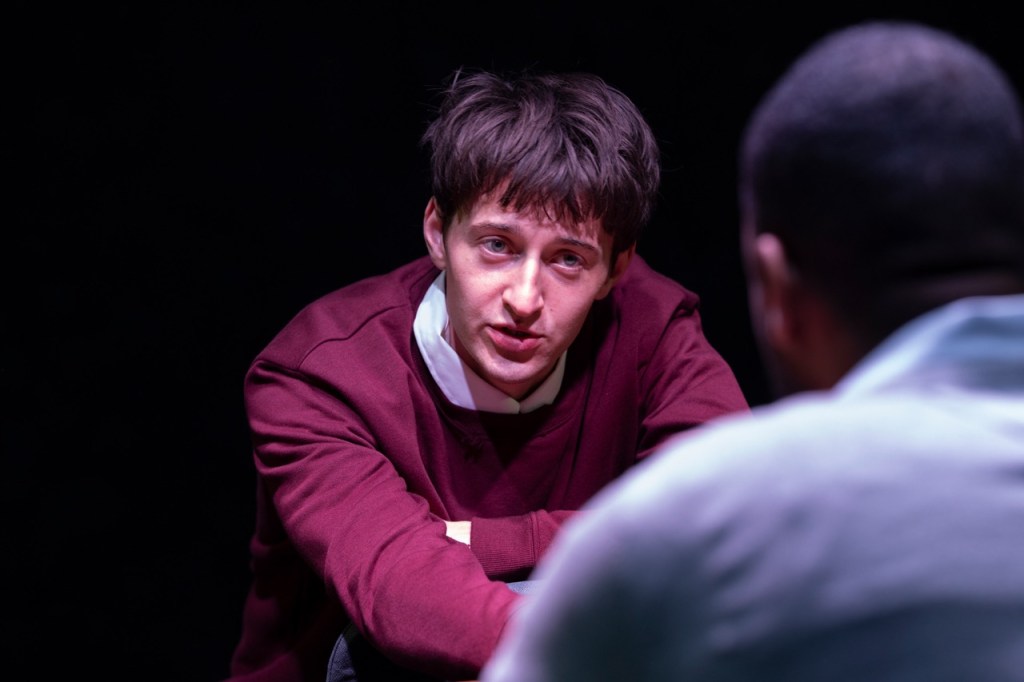
Campbell Parsons & Tony J Black. Photo: Abraham De Souza. Campbell Parsons, who was impressive in Babyteeth last year, is utterly magnetic here as Darryl. In Parsons’ hands, Darryl feels genuinely unpredictable and charged with unnerving energy. There is an almost overwhelming drive to him that steamrolls over people, situations and social graces. Truth, lies and youthful storytelling become indistinguishable in the things he says. Without any institutional power of his own, he nonetheless exerts control over those around him. Even offstage, his presence is felt.
A further performance highlight is Linda Nicholls-Gidley as Darryl’s grandmother Rita. His only family, Rita is both fierce defender and fearful subject, and Nicholls-Gidley balances that embattled protectiveness with a weary defensiveness beautifully. It fantastic to have her on stage again, rather than just in the rehearsal room coaching dialects (which are all excellent in this show by-the-way).
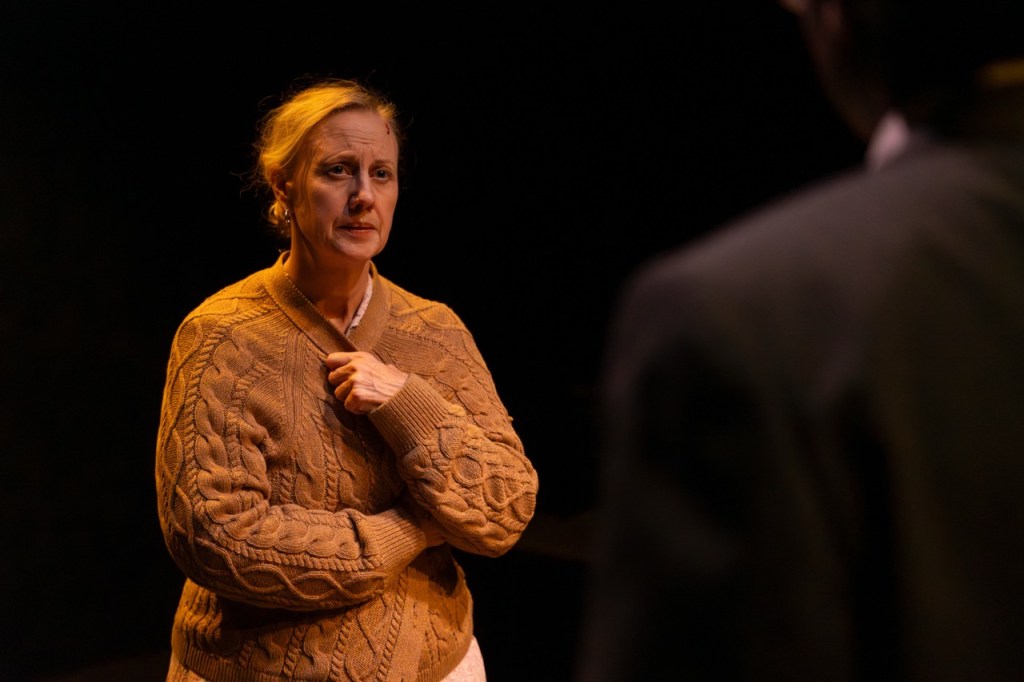
Linda Nicholls-Gidley. Photo: Abraham De Souza. Romney Hamilton gets to run the emotional gamut as Tom’s fiancée Jodi. Her performance hints at past pain — and for all the emotional fireworks, there is real nuance beneath. A joy to watch.
Tony J Black, a last-minute casting in the demanding lead role of Tom, faces a steeper climb than most and puts in solid work given the limited preparation time (he was technically on-book for opening night, but only relied on it in small moments). His performance — and the show as a whole — will no doubt deepen once he has fully found his stride.
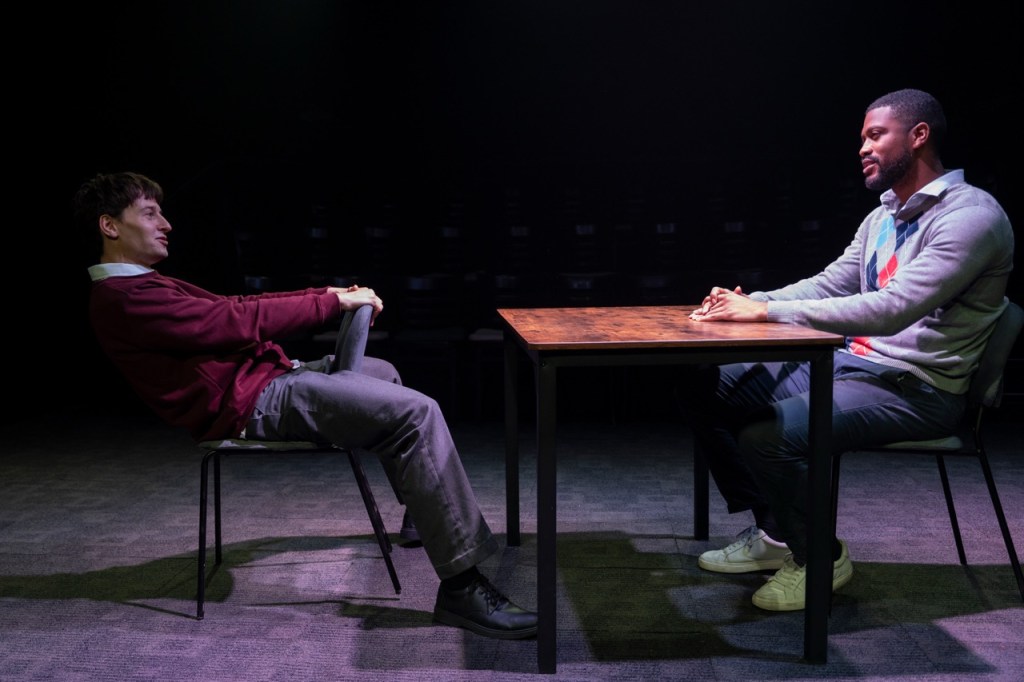
Campbell Parsons & Tony J Black. Photo: Abraham De Souza. Director Kim Hardwick presents this with as little embellishment as possible. A sleek, sparse set by Victor Kalka provides a moody backdrop — essentially a table and two chairs. Charlotte Leamon’s sound design is deployed only in key moments, leaving the soundscape bare for long stretches. By not deploying the usual bag of directorial tricks to give emotional guidance, Hardwick puts the emphasis on the text and the performances to do the heavy lifting — and thankfully, this cast is more than equal to that task.
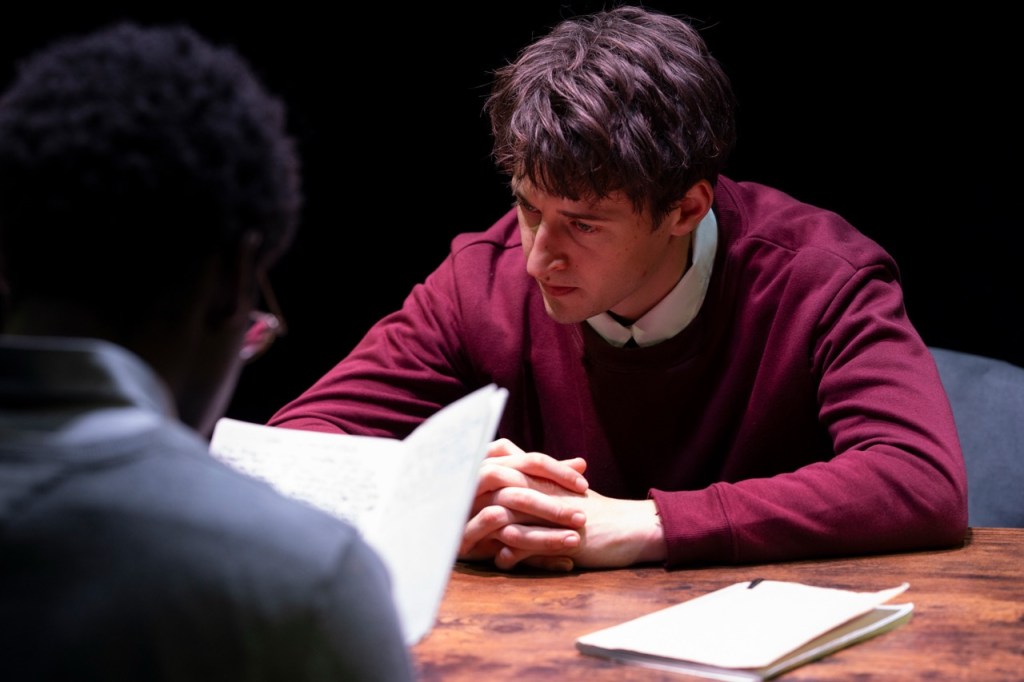
Campbell Parsons & Tony J Black. Photo: Abraham De Souza. Macmillan’s script flirts with danger, and his grasp of Darryl’s unrelenting nature is thrilling. Darryl is an emotional terrorist, refusing to negotiate with those around him, turning every conversation into an unbending interrogation and every interaction into a potentially violent one. He is a brilliant character who makes the play what it is.
Monster is a heavy affair, and this production’s contemplative pacing and monastic staging leave little room to escape. Macmillan’s writing is sharp and unsettling, circling its themes with precision — a reminder of why this early work has earned its place on stage. Its triumph lies in the casting — an ensemble who bring real vibrancy to that open, demanding space.
-
Fair Play (Old Fitz) ★★★★
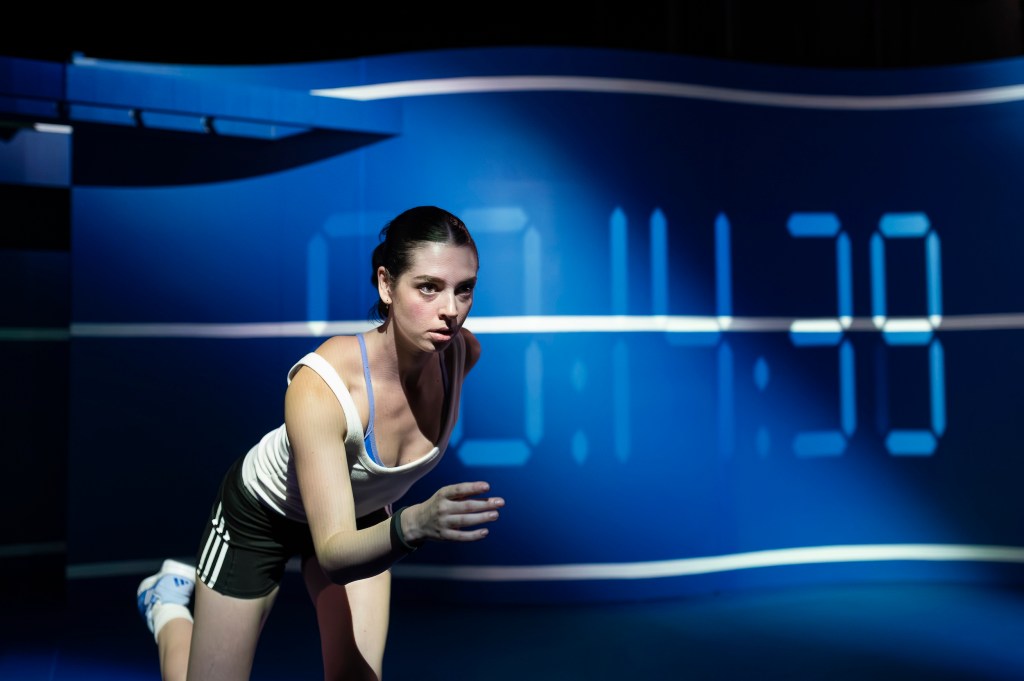
Written by Ella Road. Australian Premiere. Lost Thoughts presents. Old Fitz Theatre. 6-21 Mar 2026.
A crisp, clear two-hander that goes down like a bright, dry riesling on a hot summer’s day, sporting drama Fair Play is definitely worth checking out. Beautiful design, great performances, a script that gets into some knotty themes – yes, this is great stuff.
Ann (Rachel Crossan) & Sophie (Elodie Westhoff) are two teenage competitive runners from very different worlds. Sophie is posh, white, and ferociously driven — the kind of athlete who treats every training run like a final. Nigerian-born West Londoner Ann is a newer arrival to the sport, quietly talented, juggling the demands of school, church, a boyfriend, and a family who don’t quite understand why she runs. As they put in the hard yards, pushing to hit personal bests and qualify for Nationals, then the Euros, then maybe the Olympics, they build a solid friendship based on mutual respect. But when a rule cuts one of their careers off short — it becomes a question of whether friendship trumps personal ambition.
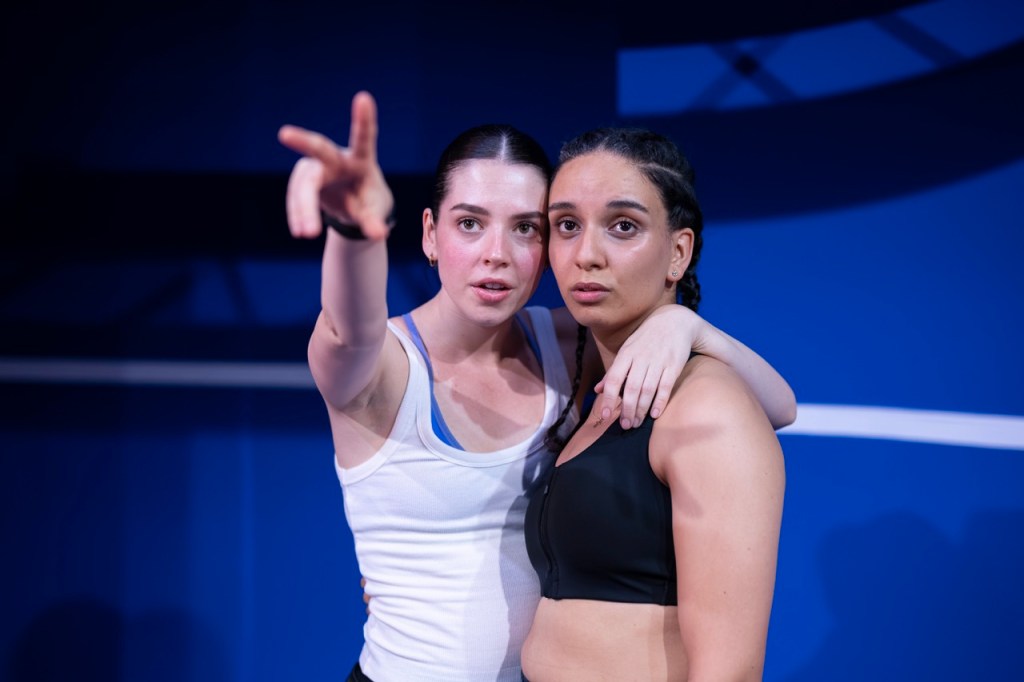
Elodie Westhoff & Rachel Crossan. Photo: Robert Miniter. Under Emma Whitehead’s sure-footed direction, Fair Play builds a solid foundation of friendship between these two hyper-competitive women. As the script gives us glimpses into the mutual safe-space that is athletics for these two women, we develop a relationship with them as they build one together as well.
It’s in this friendship that Crossan and Westhoff get to show their stuff. As the power dynamics between Ann & Sophie shift, so does the focus on their friendship — and these actresses play all the careful shades of their relationship with realistic subtlety. There’s respect, and jealousy, and love, and frustration – all woven together. Combine that with a genuinely athletic performance (there’s obviously a lot of running to be done) and they both deliver on the script’s promise.
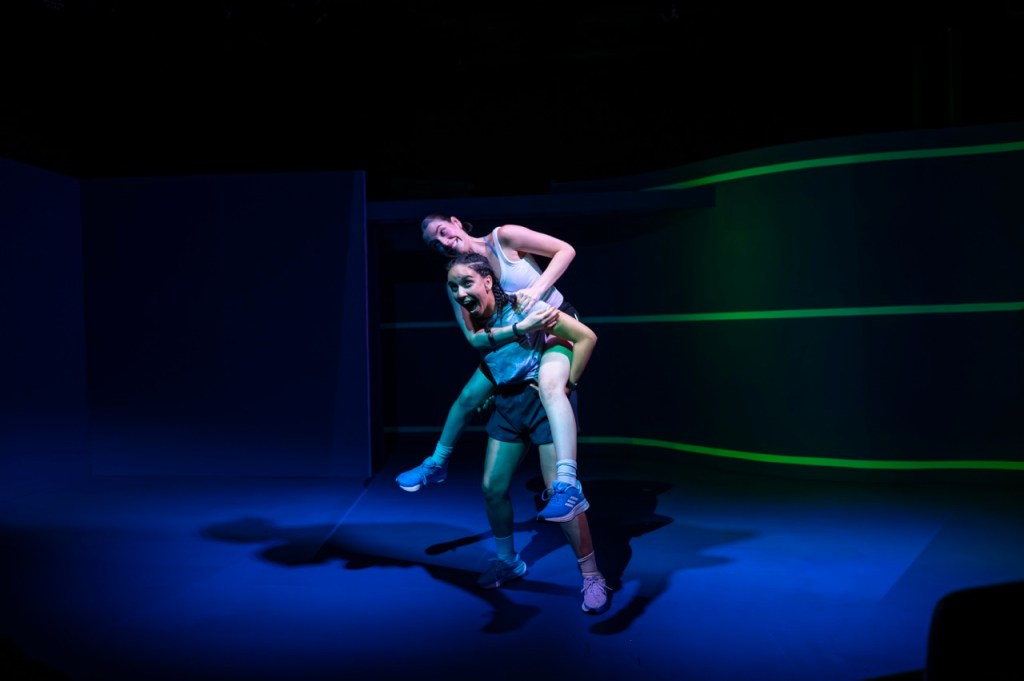
Elodie Westhoff & Rachel Crossan. Photo: Robert Miniter. And this is a visually striking show. Kate Beere’s production design brings the race track to the Old Fitz in an architectural set of vibrant blue that feels like we’re living inside a cool pair of sneakers. It serves as an electric backdrop to video design by Aron Murray and lights by EJ Zielinski. Also effective is the sound design by Mitchell Brown & Osibi Akerejola. It’s easily one of the best looking shows I’ve seen at the Old Fitz.
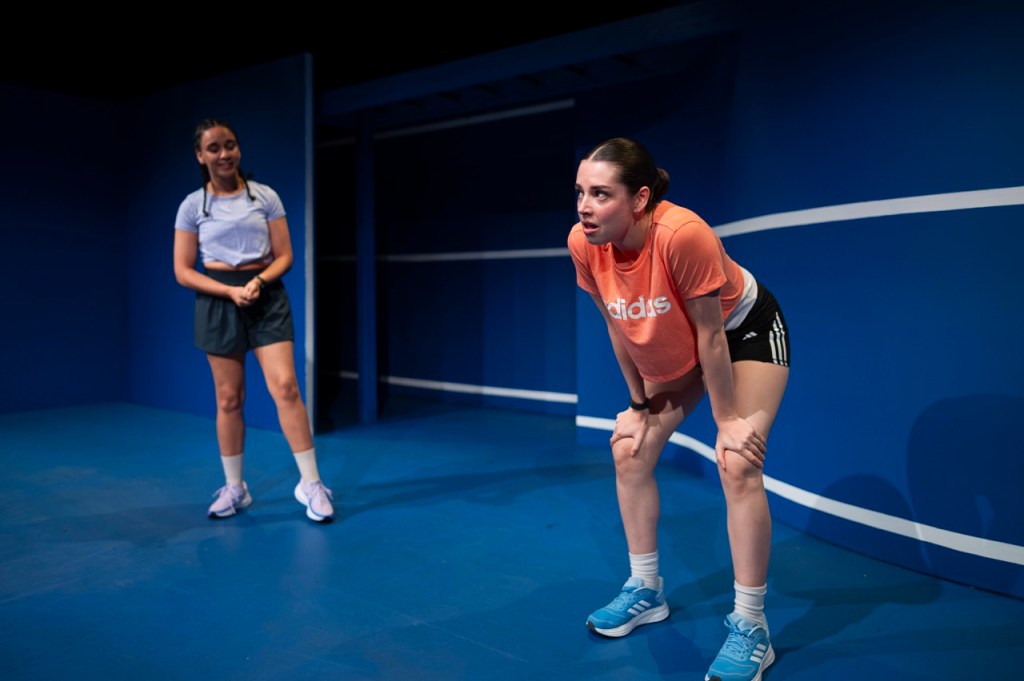
Rachel Crossan & Elodie Westhoff. Photo: Robert Miniter. Ironically though, for a play about running, it’s actually a bit of a slow burn with slightly frustrating pacing. A succession of short scenes — the scene changes are also visually striking, thankfully, because there are a lot of them — slowly builds Ann & Sophie’s friendship across about three quarters of the 100 minute running time. The play then jam packs a whole hour’s worth of ethical discussion into a swift 20 minutes at the end. It’s a real shame — this is genuinely interesting stuff to sink your teeth into, but we’re rushed to the finish line too soon.
The great thing about Fair Play is that it stuck in my mind as I left the theatre — I wanted to mull over these big thoughts more. And you know a play has sunk its claws into you when it actually changes your own behaviour — I left craving a McDonald’s McChicken… for the protein, obviously (you’ll understand once you’ve seen the show).
-
The Elocution of Benjamin Franklin (Griffin) ★★★★★
Written by steve j spears. Griffin Theatre Company. Belvoir Downstairs Theatre. 21 Feb – 29 Mar, 2026
This is Simon Burke’s show — we’re just lucky to be able to buy a ticket.
The Elocution of Benjamin Franklin is fifty years old this year, and Griffin Theatre’s anniversary production — directed by Declan Greene and staged at Belvoir’s intimate Downstairs Theatre — makes a compelling case that steve j. spears’ tragicomedy has only grown more urgent with age. In 1976, it scandalised audiences at the Nimrod (the forefather to both Griffin and Belvoir). Half a century on, it’s still wickedly sharp.
It arrived in good company. The mid-seventies was a remarkable moment for queer visibility — Rocky Horror had just hit cinemas, La Cage aux Folles was packing out theatres in Paris, and play & film of The Boys in the Band were in recent memory. Where those works leaned into camp and spectacle, spears went the other way entirely — quiet, domestic, devastating. Harvey Fierstein would later mine similar territory with Casa Valentina (2014), a Tony-nominated ensemble piece about heterosexual cross-dressers stealing a weekend of freedom in the Catskills — but spears got there first, and did it in one room, with one man.
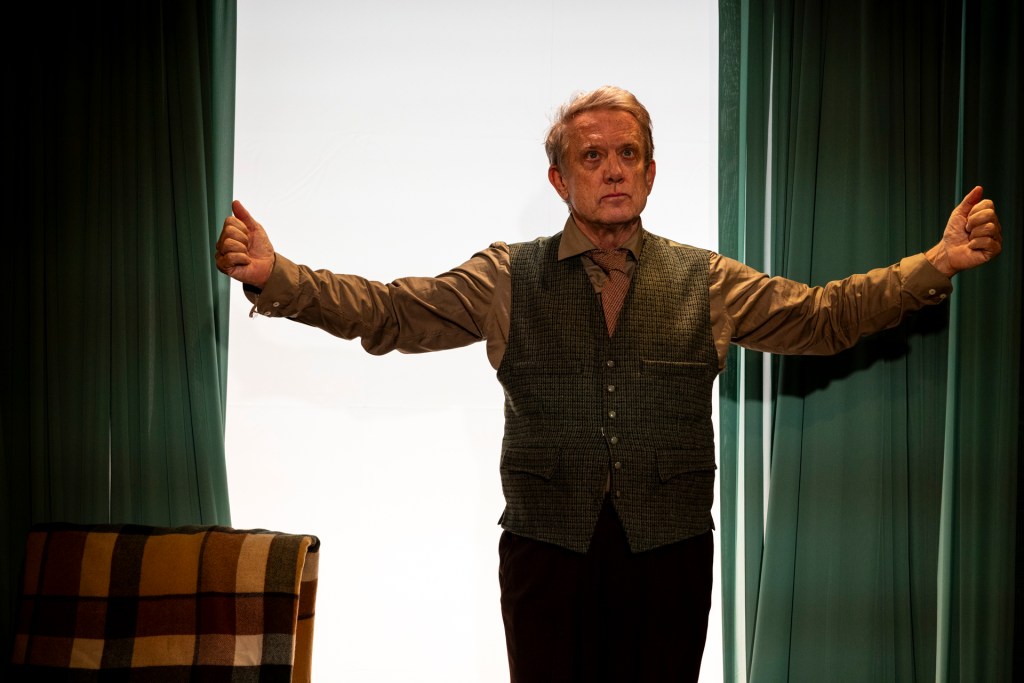
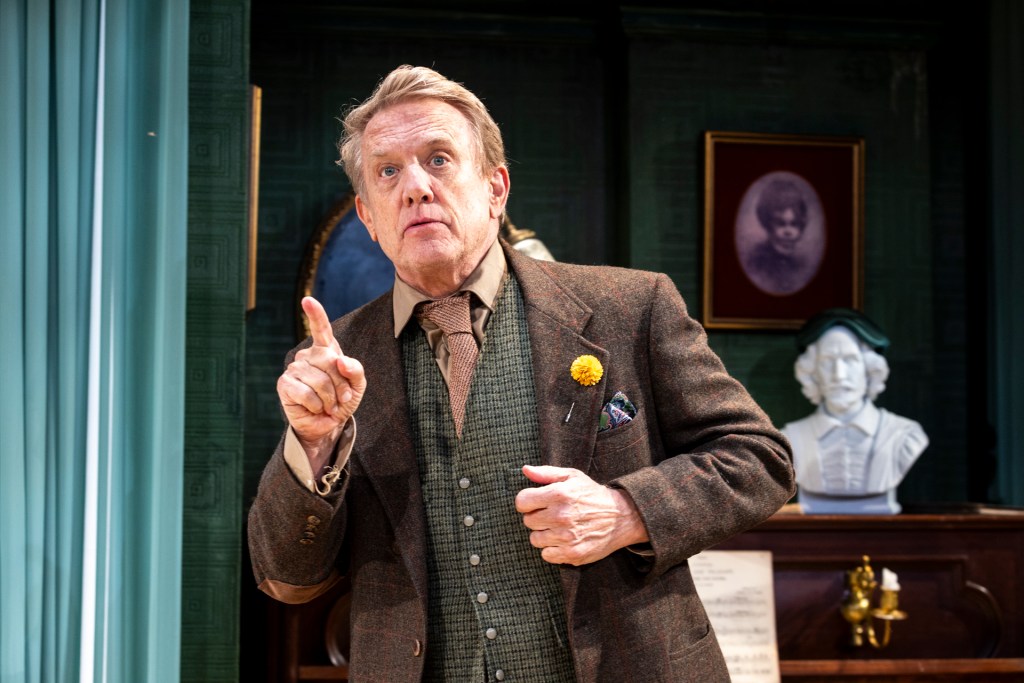
Simon Burke. Photo: Brett Boardman. Speech and drama teacher Robert O’Brien (Simon Burke) has a secret. Behind his fusty, professorial appearance is a gay man who loves to dress in women’s clothing and dreams of intimate moments with Mick Jagger — a side of himself he must keep well hidden from the conservative clients who visit his Double Bay home. This is the 1970s: being gay is illegal, and cross-dressing is even more dangerous. When Mrs Franklin brings her twelve-year-old son Benjamin for help with a stutter, Robert sees a natural performer. But as Robert takes a professional interest in Benjamin, Benjamin is taking quite a different kind of interest in the much older man.
This is a one-hander, and the synergy between Burke as a performer and the text is extraordinary. His years on Play School have set him up well — his affinity for voices is put to remarkable use as he populates the stage with an entire world of invisible characters: neighbours, students, a best friend, a psychiatrist. He moves from high camp to quiet devastation without a single false note, finding in O’Brien a man of warmth, sharp wit, and bittersweet dignity. It is easily the best single performance of the year so far, and a strong awards contender.
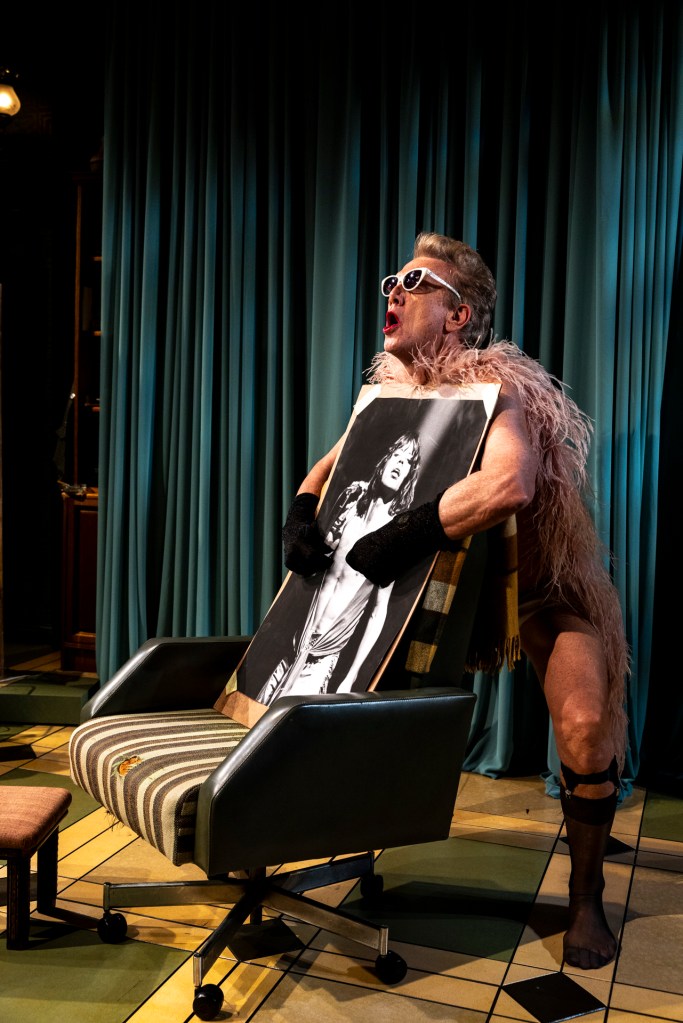
Simon Burke. Photo: Brett Boardman. From the opening — Burke frolicking naked around his flat (yes, this is my second gay play in two days featuring full frontal nudity; there’s something in the water) — it’s clear that dressing in a jacket and tie for his students is itself a form of drag, and that his truest self emerges in private, in a simple housecoat and head wrap.
It is in this duality, and the fear it creates, that the play builds its tension. Greene’s direction is laced throughout with an illicit sense of danger, masked by humour, that quietly tightens as the play progresses. For O’Brien the greatest peril is an open curtain or a knock at the door. He can never fully relax when the world is watching.
The production around him is equally rich. Isabel Hudson’s design layers nostalgia and unease with real intelligence. The sound design by David Bergman gives the space texture without ever drawing attention to itself. Brockman’s lighting is subtle until it isn’t. Greene trusts the material completely, adding moments of finesse — some nicely underplayed magic tricks — that are pure theatre.
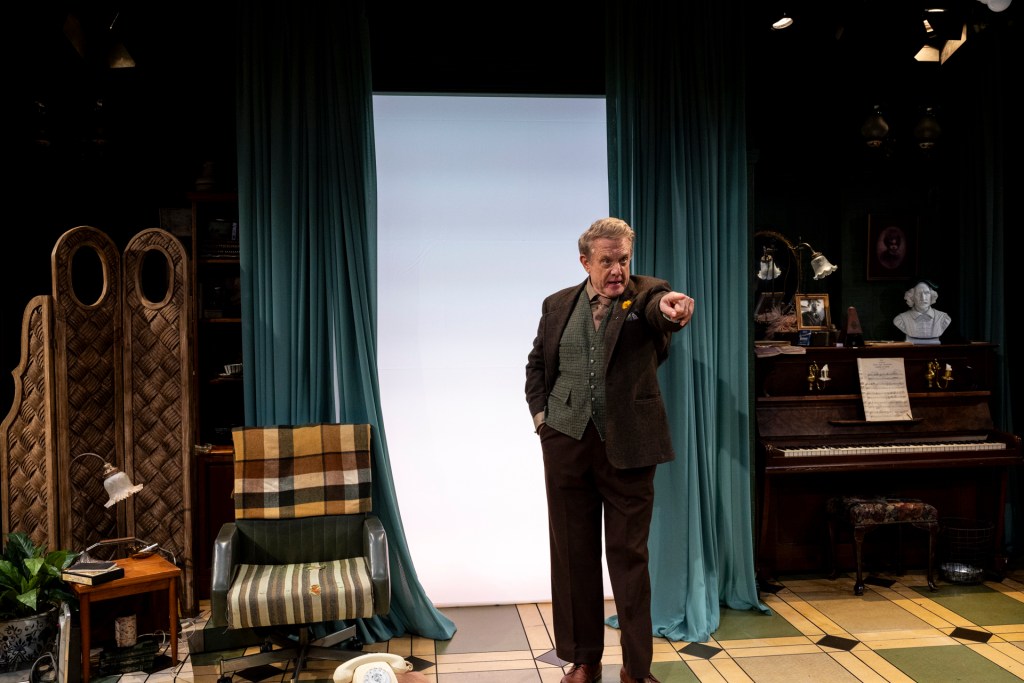
Simon Burke. Photo: Brett Boardman. Watching The Elocution of Benjamin Franklin alongside The Normal Heart and Afterglow — an inadvertent triptych spanning the 1970s, 80s, and 2010s currently on our stages — is a fascinating measure of how far gay rights have travelled, and how quickly that progress can be threatened. Today it is trans and gender-diverse people who bear the sharpest edge of that backlash — their visibility hard-won, their rights newly contested. O’Brien isn’t transgender, but in a world that policed gender expression with psychiatric institutions and criminal law, his hidden life speaks to that experience. It’s a sharp reminder of where we came from, and the damage it wrought.
This is a great play with a knockout performance at its core. Grab one of the very few remaining tickets while you can.
-
Afterglow (Eternity Playhouse) ★★★
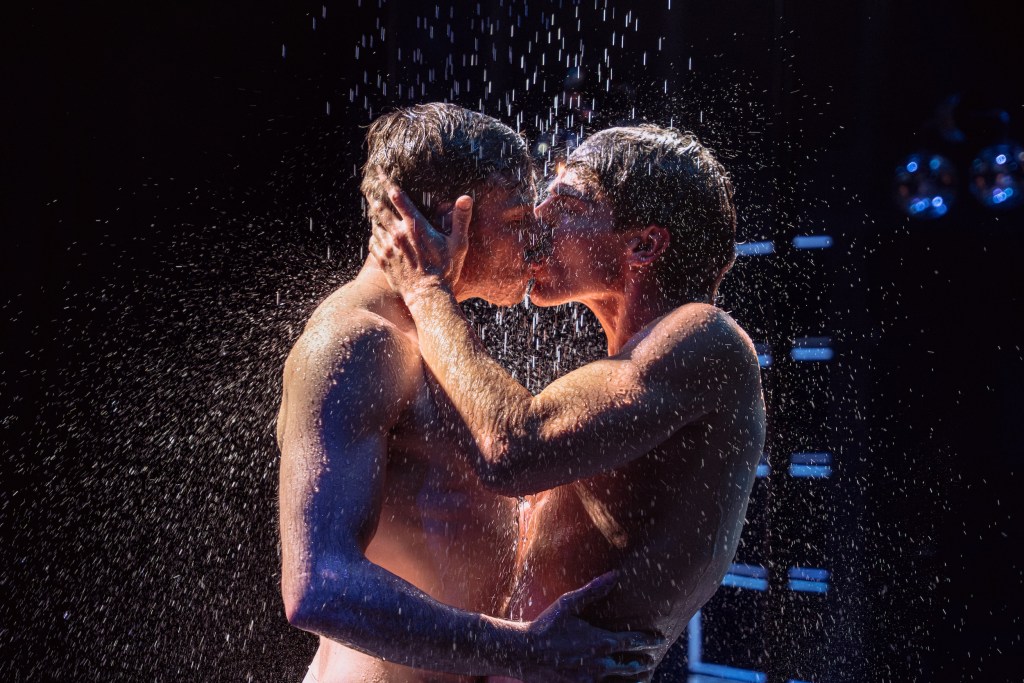
Written by S Asher Gelman. Midnight Theatricals. Eternity Playhouse. Feb 26 – Mar 22, 2026.
Much like its characters, Afterglow — S. Asher Gelman’s Off-Broadway and Off-West End gratuitously sexy threesome play — doesn’t know what it really wants. Does it want to be sexy escapism, or an exploration of complex relationships? In trying to do both, it manages to do one of those very well.
This is, at heart, a silly melodrama, with the most gratuitous use of full-frontal nudity I’ve seen in a long while (completely different in execution to Griffin’s Naturism, if you were wondering). But just because something has the subtlety of a pornographic telenovela doesn’t mean you can’t enjoy it.
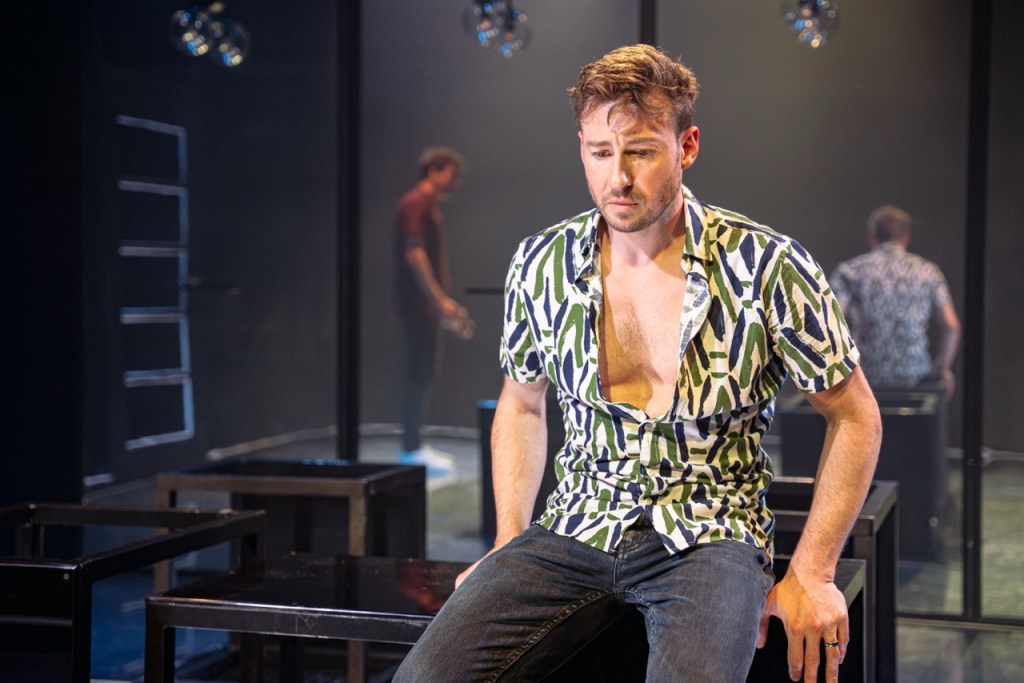
Matthew Mitcham. Photo: Cameron Grant Parenthesy. Theatre director Josh (Matthew Mitcham) and scientist Alex (Julian Curtis) are a thirty-something married couple in an open relationship, who invite the twenty-something massage therapist Darius (Matthew Predny) round for a night of complication-free sex. They hit it off, and pretty soon Josh and Darius are hooking up during the day with Alex’s approval — Josh is high-maintenance with a strong sex drive, and Alex is quietly relieved to have someone keeping him occupied. But what starts as adventurous fun grows more complicated as the emotional connection deepens, and things they thought were rock solid begin to seem simply rocky.
As far as plot complications go, anyone who has even walked past the Romance section of a bookshop can guess the twists and turns from the off. Writer/director/choreographer Gelman isn’t trying to add anything new to the conversation around modern love and its many arrangements. Fair enough — let’s not overcomplicate things.
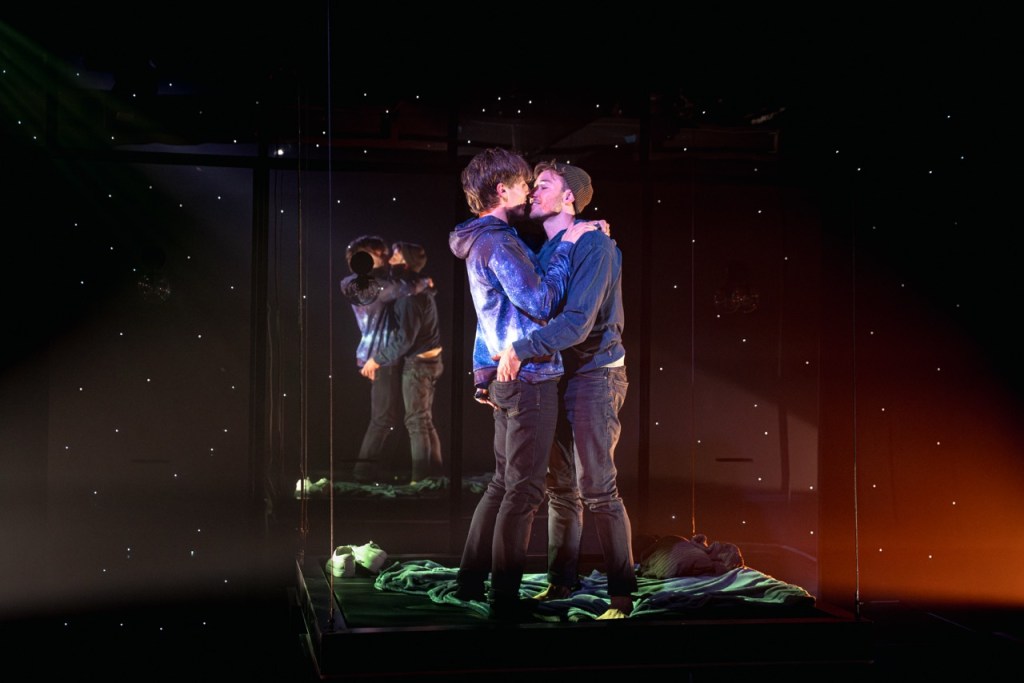
Matthew Predny & Matthew Mitcham. Photo: Cameron Grant Parenthesy. This show is obsessed with surfaces, especially when they’re buffed and shiny. It trades in projections of perfection — physical, sexual, financial — that reveal a hollowness underneath. The messy white gays who fill the stage are the stereotypical characters of slightly outdated queer fiction: rich, entitled, gym-hardened, and hollow.
Ann Beyersdorfer’s sharp-edged, neon-drenched set design blends nightclub and sex-club aesthetics, putting performative sensuality centre stage (and under a shower). This isn’t real sex — it’s the choreography of porn, all lighting and angles, six-packs and sweat. Someone clearly spent too many nights at New York’s Splash Bar in the 00s.
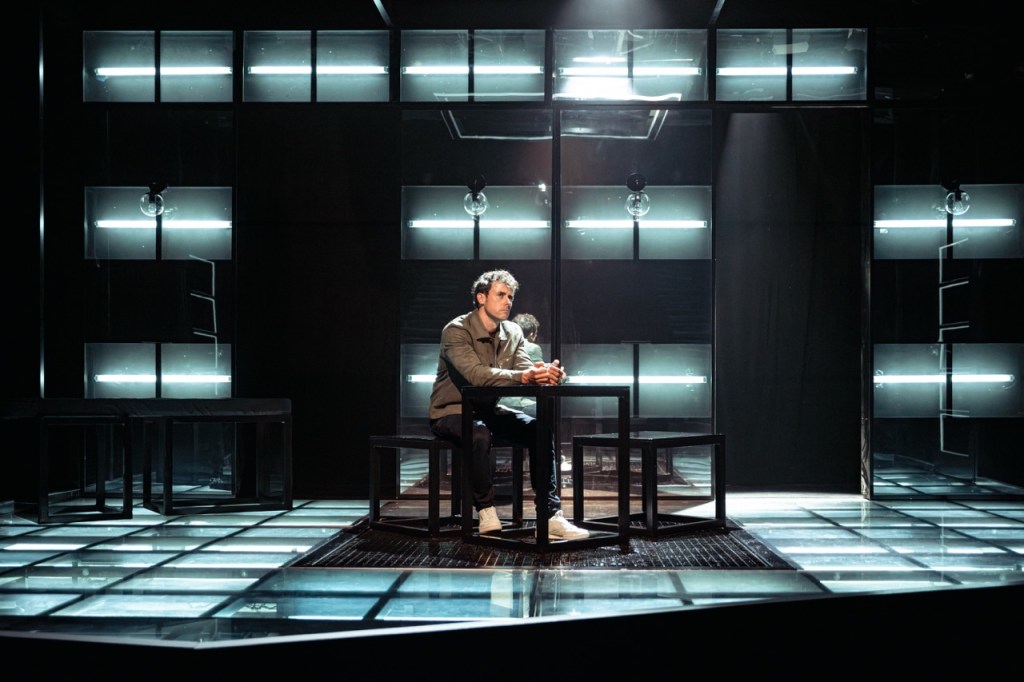
Julian Curtis. Photo: Cameron Grant Parenthesy. Afterglow asks us to treat its characters as sexual objects before layering in personality and detail. This is less HBO-style “sexposition” — using sex to make dull exposition palatable — and more straightforward sexploitation: using sex to put bums on seats. Once you move past the nudity and the long, over-choreographed scene transitions, you’re left with around 75 minutes of actual theatre: a thirty-something couple buckling under pressure, and a twenty-something man who struggles to make genuine connections in the big city.
Gelman’s script nods in the direction of their woes, but neither it nor the performances quite manage to navigate the shift from skin-fest frivolity to heartfelt drama. The carefully staged sex sometimes feels inorganic, and the set ill-suited to domestic moments — unless your home is decorated in pleather, plastic, and steel (no judgement here). The emotional plot beats feel equally awkward. A subplot about Josh and Alex pursuing surrogacy does a lot of heavy lifting, but you can hear the gears grinding beneath the dialogue. Much like its characters, Afterglow doesn’t quite know how to handle its own emotions.
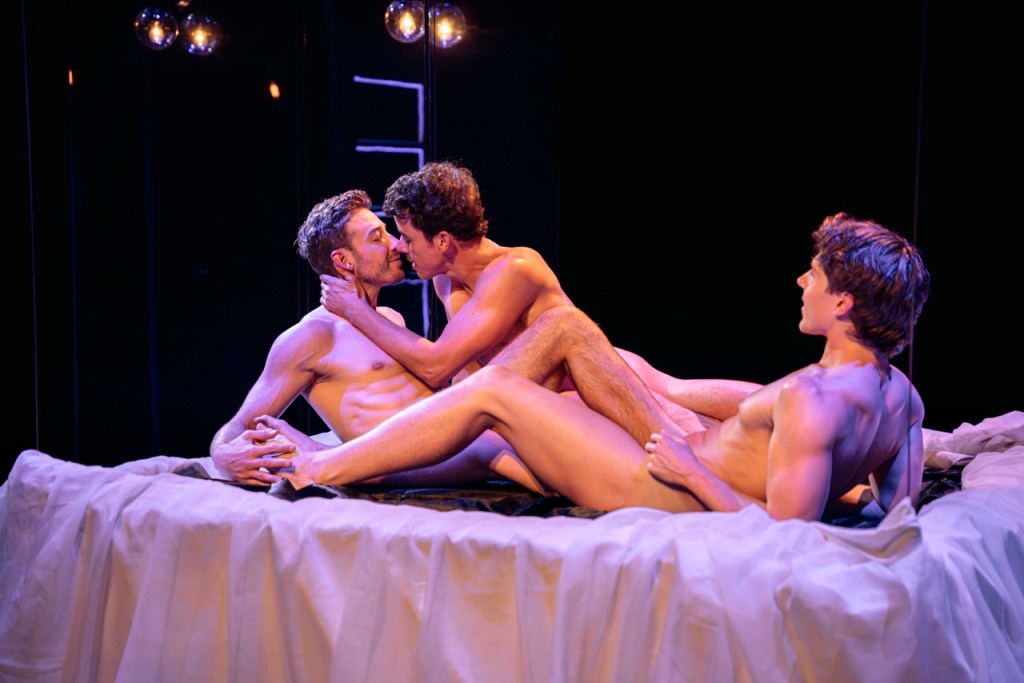
Matthew Mitcham, Julian Curtis & Matthew Predny. Photo: Cameron Grant Parenthesy. But this is a melodrama — so we’re not here to get under the skin of anything. It’s much easier, as singer Peaches once put it, to simply “fuck the pain away.” It feels churlish to harp on about a lack of nuance in a play whose tagline is “The climax is just the beginning.”
Afterglow is exactly what it says on the tin — there’s something almost admirable about that commitment and there’s definitely much to enjoy here. If you’re after serious gay theatre, The Normal Heart and The Elocution of Benjamin Franklin are playing nearby, and Qtopia has a strong range of indie queer alternatives. But if you want ridiculous, slutty fun with a generous side of overwrought schmaltz, this one’s for you.
-
A Mirror (Belvoir) ★★★★½
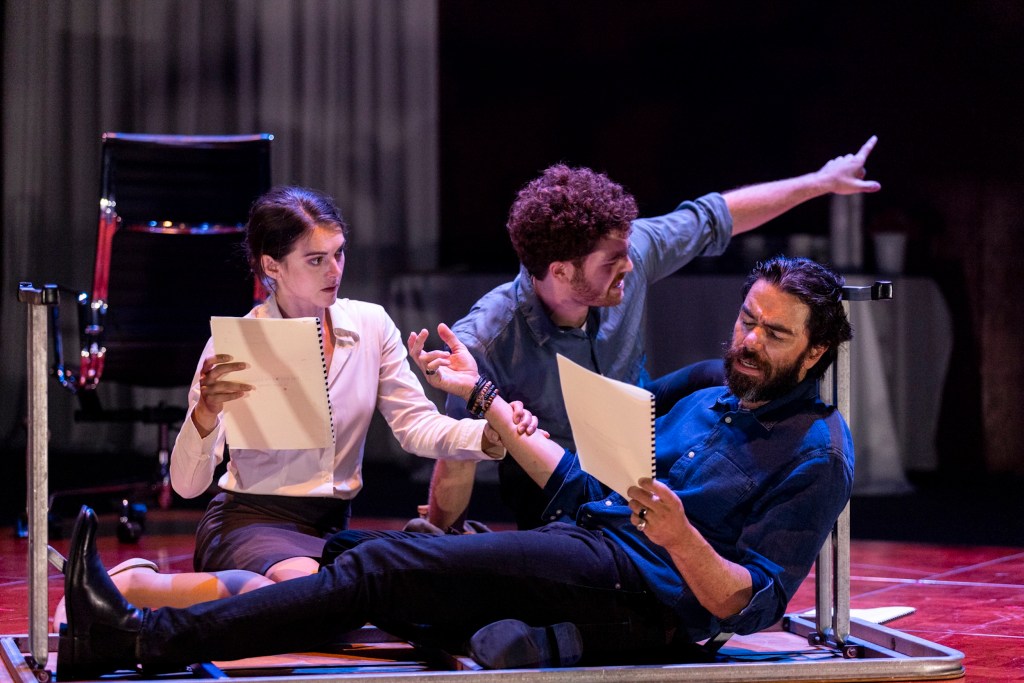
Written by Sam Holcroft. Belvoir. 21 Feb – 22 Mar 26.
Now this is a play with meat on its bones. Sam Holcroft’s A Mirror is a slippery beast, constantly wrong-footing the audience in a way that keeps your mind questioning just about everything.
You wind your way up the staircase covered in art that has been covered up by the Ministry of Culture to arrive at a wedding ceremony with a groom and best man waiting nervously, or so it seems. Within minutes of the ceremony beginning the ruse is dropped and the real reason for gathering is revealed. You’re going to see a banned play that the totalitarian regime doesn’t want you to see. In this play-within-a-play, a young playwright, Adem (Faisal Hamza) has been pulled into the frightening office of Mr Čelik of the Ministry of Culture (Yalin Ozucelik) to answer for a work he submitted for approval. But Adem is confused. His work isn’t subversive — it’s a word-for-word transcript of things real people have said. How can the truth be a crime?
Čelik, surprised by Adem’s naivety but impressed with the technical skill of his writing, decides to take him under his wing, much to the surprise of his ex-military assistant Mei (Rose Riley). Čelik introduces Adem to a renowned state-sanctioned playwright, Bax (Eden Falk), and they try to teach Adem how to really craft a play — one that will impress the censors and the regime.
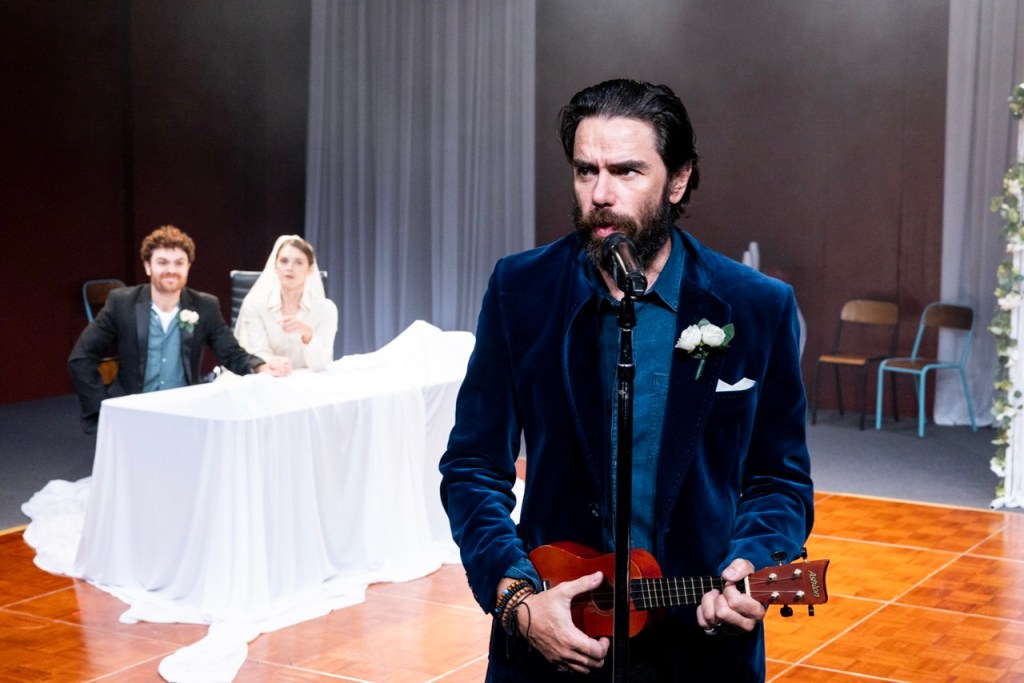
Faisal Hamza, Rose Riley & Eden Falk. Photo: Brett Boardman. All of what I’ve described takes place in the first act of A Mirror, and to give you more plot would be to compromise your eventual enjoyment when you see it. Needless to say, the twists, interruptions and revelations keep coming, and they will keep you probing your understanding of the play as it goes on. This is mentally active theatre — a puzzle box that keeps changing size and weight as you shake it.
Holcroft’s writing has a clarity of intent and a sharpness that cuts. Even though we don’t live in a police state like the characters, there was a wry chuckle when “social cohesion” is used as a justification for censorship. Holcroft takes the oft-repeated platitude “Art is the lie that reveals the truth” and pushes back — in a world of non-stop misinformation, maybe art needs to be truth itself.
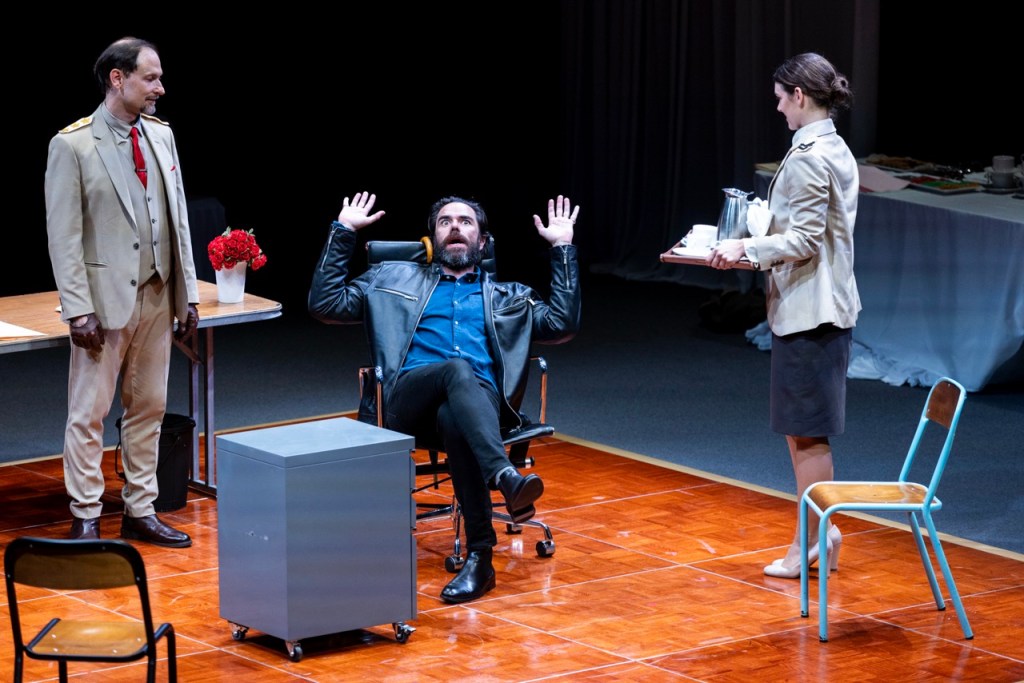
Yalin Ozucelik, Eden Falk &Rose Riley. Photo: Brett Boardman. To drive this point home, she has crafted a script that plays with theatrical form as it slowly peels back the layers. At one point, as the quartet of characters stage a reading, we are wrapped in a-play-within-a-play-within-a-fake-wedding-within-a-play. There are small clues scattered through the work that hint at its resolution, but they are never too overt. Like the best mysteries, when the moment comes for the big final reveal, the truth was always in plain sight — but is still a surprise.
The message is layered, depending on which angle you want to approach it from. This is either a satire of cultural gatekeeping which “encourages” artists to make palatable work “that will sell.” Or it’s a bracingly political deconstruction of authoritarian politics, offering us a way through the fog of lies. This is the sort of writing I live for.
It’s never confusing, thanks to the fantastic work of the cast — all playing roles-within-roles, the true extent of which is only revealed at the very end. Faisal Hamza continues to impress, bringing the overtly literal Adem to life and finding real comedy in his genuine honesty.
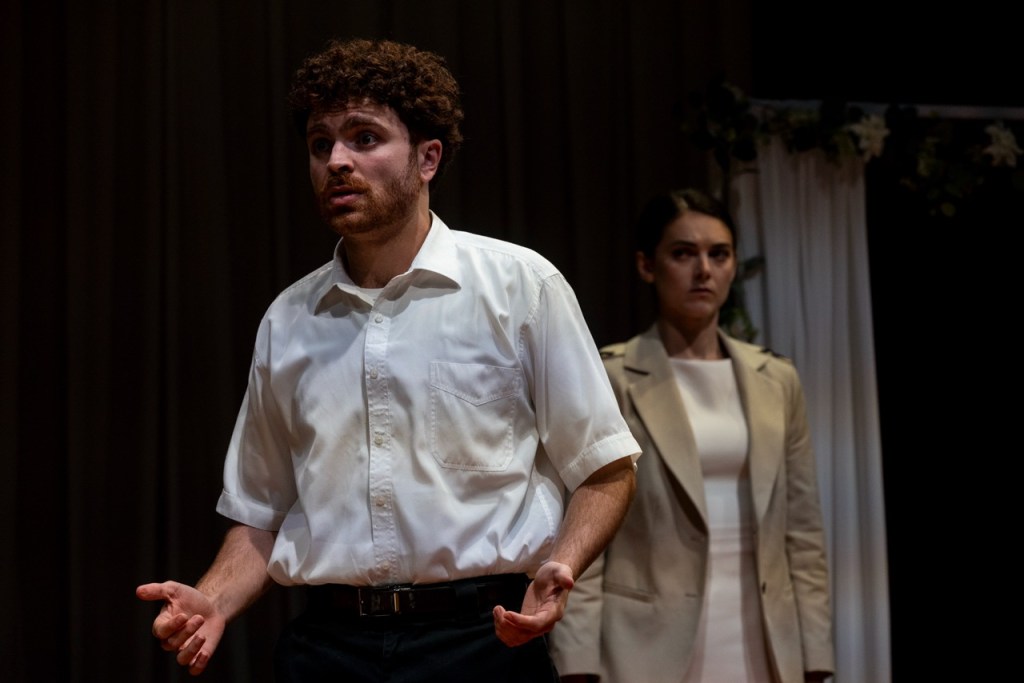
Faisal Hamza & Rose Riley. Photo: Brett Boardman. Rose Riley is constantly transformative as she slips between the awkwardness of being a soldier forced into the world of the arts, and a quick-witted activist. And Eden Falk swings from confident to tortured as a once-revolutionary playwright who has allowed himself to be dulled into submission.
The standout is Yalin Ozucelik’s friendly yet menacing Mr Čelik — a tightrope-walking performance that fills you with unease in small degrees. A high-level bureaucrat in the regime, he is the not-so-subtle force of censorship while also being filled with a genuine love of the arts. Is he a well-meaning collaborator trying to find small ways to improve people’s lives under oppression, or just the kind of self-deluding functionary that keeps any abusive regime running?
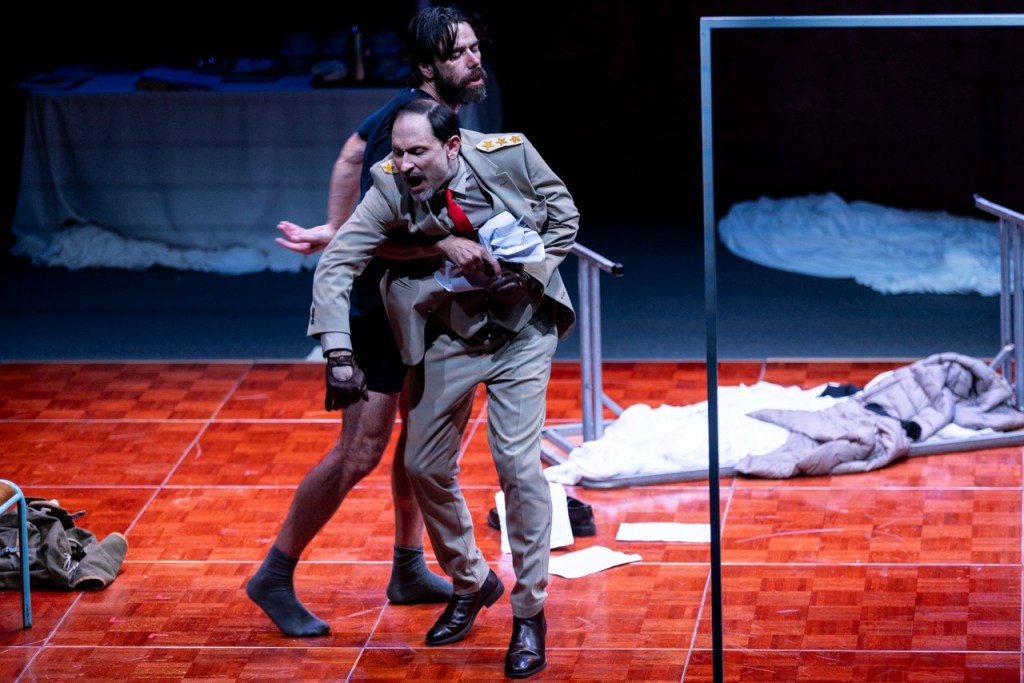
Yalin Ozucelik & Eden Falk. Photo: Brett Boardman. Clear-eyed direction from Margaret Thanos — who, along with designer Angelina Daniel, transforms the Belvoir corner stage into a semi-panopticon — means we feel like we’re both witnessing and enclosing the characters in a prison. Phoebe Pilcher’s lighting and Daniel Herten’s sound design guide us through the Inception-like layers of reality.
A Mirror is a classic piece of theatre-about-theatre-making mixed with some Dario Fo-style political agitation. This cerebral work will leave some audience members a bit cold, but it is well and truly right in my wheelhouse. I even started to read my own meta commentary into the play skewering the toothless, commercial production of Art happening down the road at the Roslyn Packer — but that’s probably just me.
-
Head Over Heels (Hayes) ★★★½
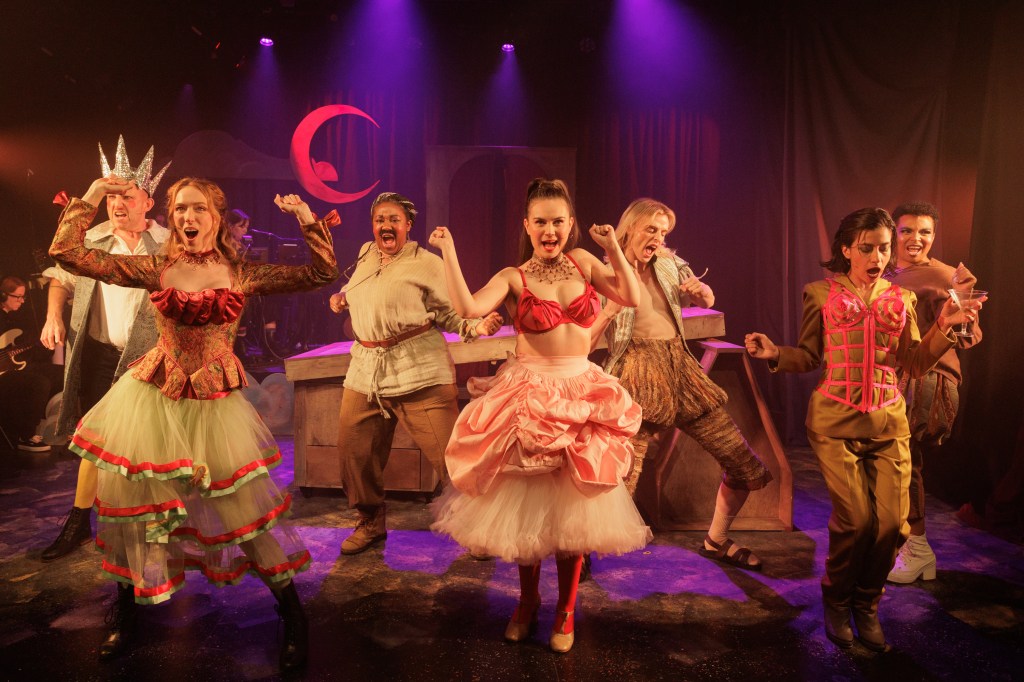
Songs by The Go-Go’s. Adapted by James Magruder. Based on The Arcadia by Sir Philip Sidney. Conceived & Original Book by Jeff Whitty. Presented by Well Done Creative in association with Hayes Theatre Co. 20 Feb – 22 Mar, 2026.
After two aborted attempts to bring Head Over Heels to the Hayes, it’s finally here. This romping queer, punk-pastoral musical is full of tongue-in-cheek wit (and the tongues are usually firmly planted in someone else’s cheek).
In the mythical kingdom of Arcadia, King Basilius (Thomas Campbell) receives a terrifying prophecy from Pythio (Gaz Dutlow). In a rage he sets out to defy the fates with his trusty servant Dametus (Nancy Dennis) and his family in tow — including his wife Queen Gynecia (J Ridler), his youngest daughter Philoclea (Jenni Little), his self-absorbed daughter Pamela (Shannen Alyce Quan — replaced by Lucy Lalor for the performance I saw), and Pamela’s handmaid Mopsa (Minerva Khodabande).
When noble young shepherd Musidorus (Adam Noviello) follows them out of his love for Philoclea, fate intervenes — disguising himself as an Amazonian warrior woman to get close to the king. But this gender-switching time bomb creates ripples among the whole camp. The prophecy is already coming true.
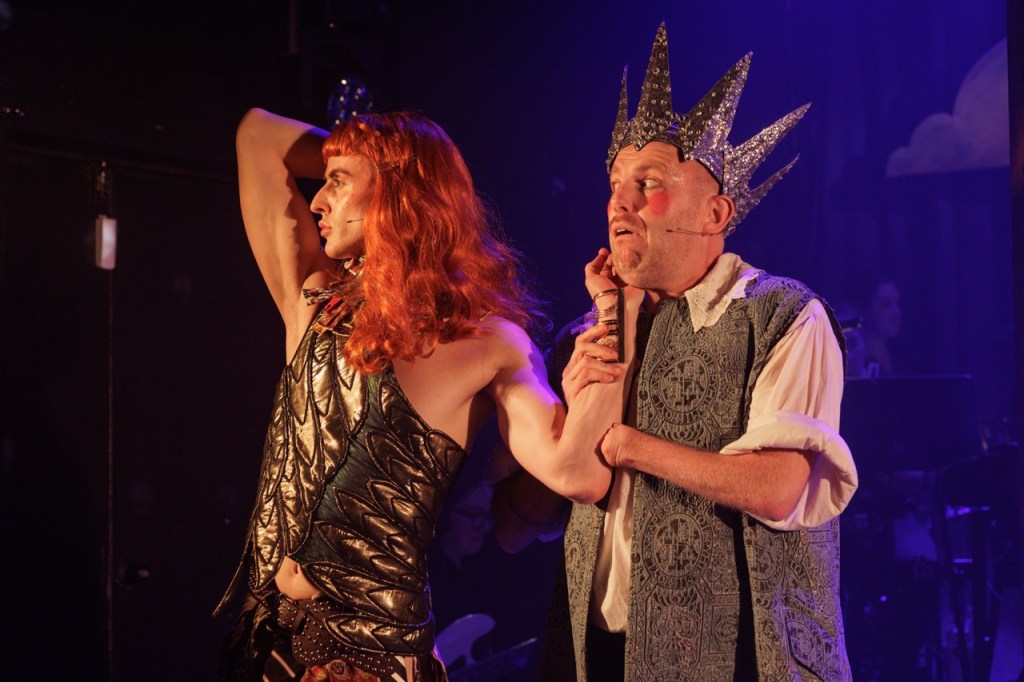
Adam Noviello & Thomas Campbell. Photo: Kate Williams. Head Over Heels feels like three shows in one: a camp, faux-Shakespearean comedy, a brash queer teen-romance, and a high-energy jukebox musical. If it reminds you of something, you’re not wrong. Head Over Heels came first. It walked so & Juliet and The Lovers could run.
The most interesting thing about the show musically is the collision of The Go-Go’s 80s punk-infused pop with a sixteenth-century plot and its heightened, archaic language. As the songs take us into the true thoughts and desires of the characters, they become instantly more relatable singing in 80s vernacular than when speaking to one another — which is an odd juxtaposition, but actually a lot of fun. It does however run into the age-old issue with jukebox musicals — the songs bring the plot to a standstill. Which is fine if you accept a jukebox musical for what it is: a covers concert with a pantomime plot thrown in the middle.
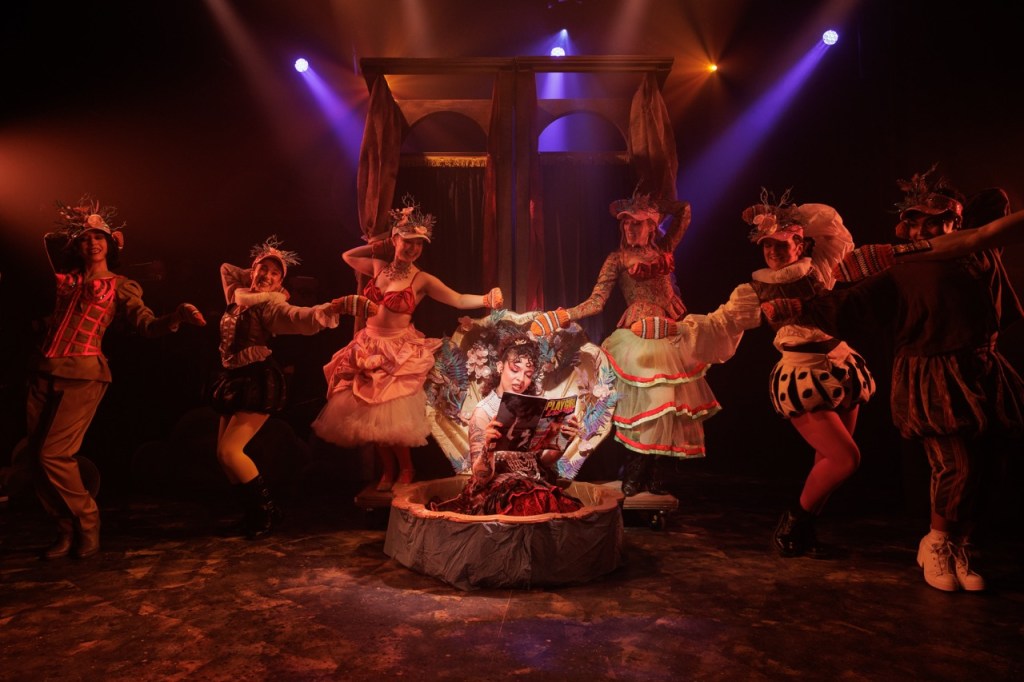
Minerva Khodabande and Company. Photo: Kate Williams. The cast are clearly having a ball, especially Nancy Dennis who unashamedly steals her scenes. Jenni Little gives a warm and convincing romantic-lead performance. J Ridler’s martini-swilling matriarch is always on the verge of singing “The Ladies Who Lunch”, and Gaz Dutlow practically purrs as the sassy prophet. With the ever-excellent Shannen Alyce Quan unwell, full credit to the brave Lucy Lalor who stepped in at the last minute and belted with the best of them.
Brendan de la Hay’s costumes are rich, and I’m not sure who was responsible for the choices but did I detect some sly digs at Disney in the looks? From the slain lions, clown fish and an Ariel-esque moment (pictured above)… I may have been reading too much into it, but I felt a theme developing.
This is ultimately a distracting, enjoyable romp — a queer fantasia where the storytelling is as fluid as gender and the message as uplifting as a sugary treat. If you’re in need of a post-The Normal Heart (playing at STC till March 14) pick-me-up, you could do a lot worse.
-
Gravy (KXT on Broadway) ★★★★
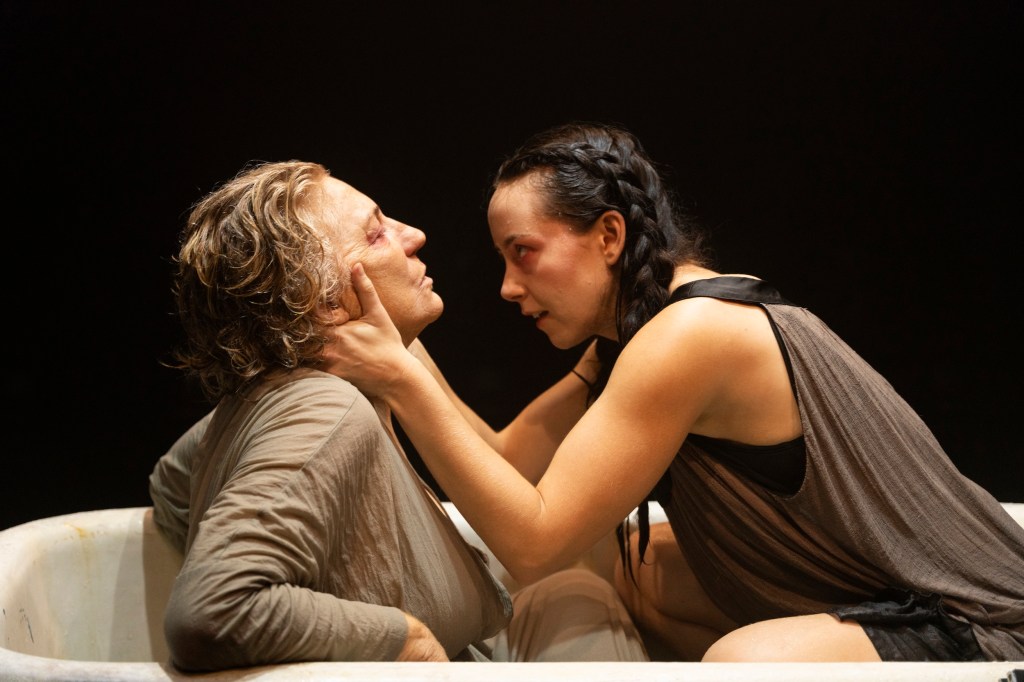
Written by Gemma Burwell. World Premiere. Presented by Merak. KXT on Broadway. 18-28 Feb, 2026.
Stunningly visceral and intriguingly surreal, Gravy is a distraught dissection of mother-daughter relationships and the oppressive force of the male gaze.
Young Trisha (Meg Hyeronimus) and Mummy (Deborah Jones) are in a bathtub. Trisha is washing her mother, intensely commenting on her body as she does so. Trisha herself is becoming more aware of her own physicality, dreaming of a boy who might one day touch her and take her away. But they are in a room with no doors or windows and can’t remember how long they’ve been there. All they know is that god is watching.
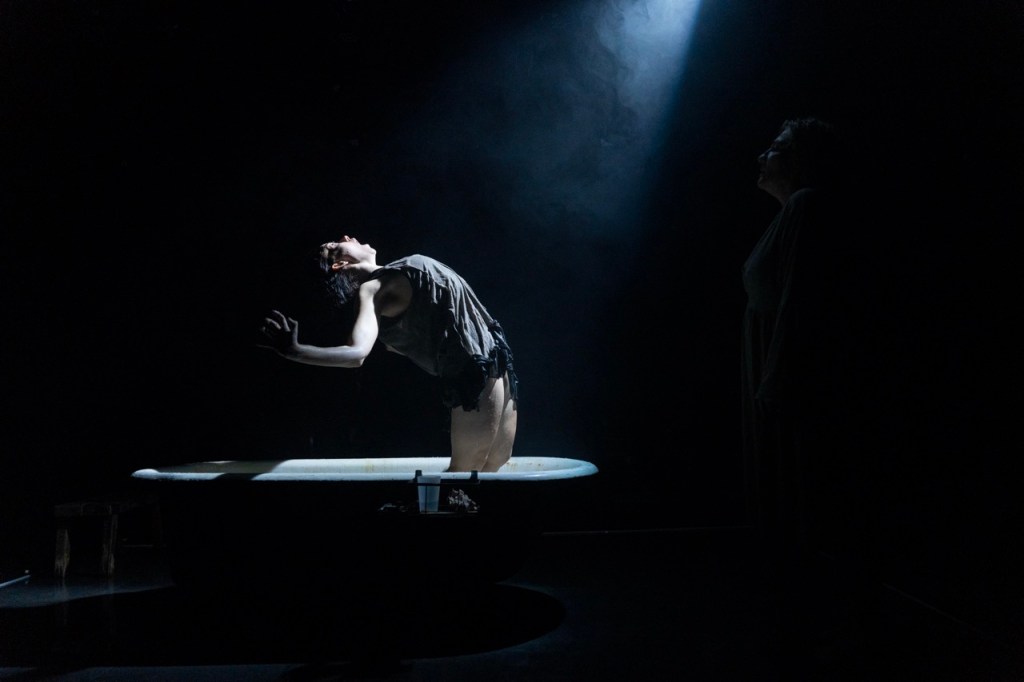
Meg Hyeronimus & Deborah Jones. Photo: Abraham de Souza. If you’re a fan of the work of playwrights like Sarah Kane, Martin Crimp or Edward Bond, then Gemma Burwell’s debut should excite you. Gravy is a dark, menacing abstraction sprinkled with moments of absurd humour, but always grounded in a truthful exploration of human themes.
In the programme notes, Burwell talks about Gravy as an exploration of the male gaze’s influence on women, even when no men are present — how women can revert to a performative femininity they’ve internalised. But that wasn’t my first instinct when watching it. I saw the inner workings of a young woman’s mind as she steps out of the shadow of her mother’s influence (a Jungian Demeter/Persephone dynamic, or an example of matrophobia — the fear of becoming one’s own mother). Layer in the unseen masculine influences — the potential boyfriend, the judgemental god — and you get a psychological cauldron of ideas forming a potent brew.
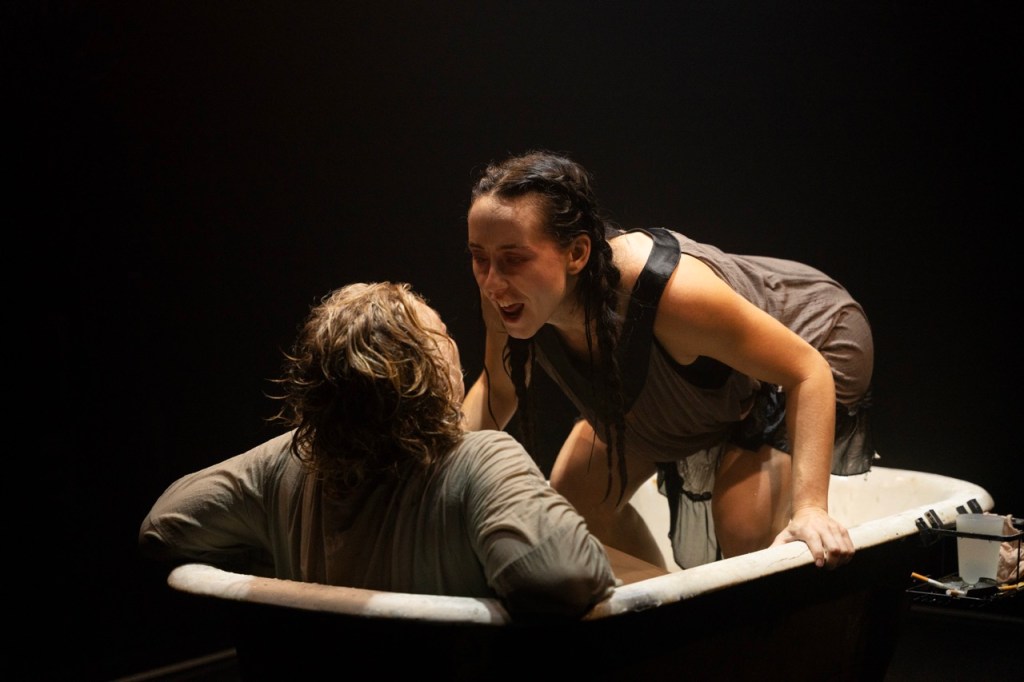
Deborah Jones & Meg Hyeronimus. Photo: Abraham de Souza. As if this mordant thematic mix wasn’t enticing enough, director Saša Ljubović brings an elegance and clarity of vision to the staging that is bracing. A single bathtub in a black space — evocative and menacing. Add in atmospheric trickery from the immersive sound design by Milo McLaughlin & Zsa Zsa Gyulay (look, I love sound design, I will always pay attention to it), cutting lighting by Frankie Clarke, and some deceptively simple design by James Smithers, and you’ve got a near-perfect “black box” execution.
And water! I’ve not seen this much water on an independent stage in years (since the last time I saw Afterglow — coming soon to Sydney). The water becomes a character in its own right, an unpredictable scene partner adding layers of sound and physical constraint. It is unsettling — a symbol of purity and of dank dangers. (On a practical note, don’t worry — there’s no “splash zone”. You should be safe in the front row.)
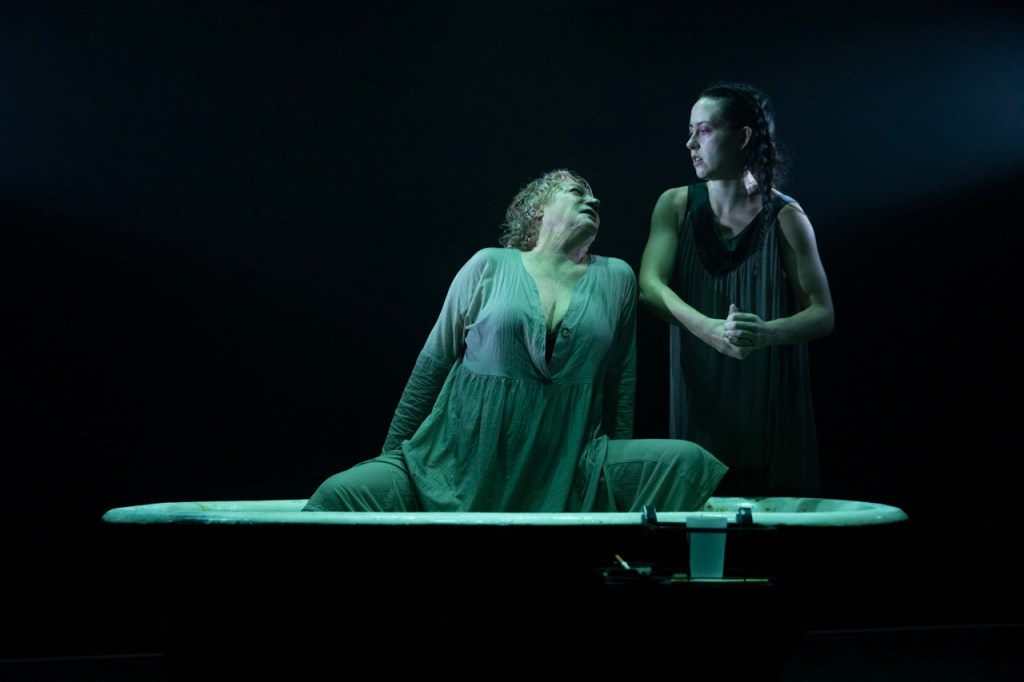
Deborah Jones & Meg Hyeronimus. Photo: Abraham de Souza. Floating above all of this are two performers giving otherworldly yet grounded performances of pain, rage, twisted affection and persuasion. Both Hyeronimus and Jones (that sounds like a crime procedural on BritBox — would totally watch) rise to the tenor of the show, straddling the sometimes circular dialogue and abstract rhythms to deliver a complex 60 minutes of drama.
Gravy will not be to everyone’s liking. But for lovers of complex work, this is a beauty. Much like Gia Ophelia before it, Gravy has a short run — as part of KXT’s more experimental summer programme — but the production values of a much larger show. This is gorgeous, disturbing, thought-provoking theatre which, I’ll be honest, gave the neat-freak in me the total icks, but thrilled the theatre nerd in me.
-
Tonsils + Tweezers (Old Fitz) ★★★★
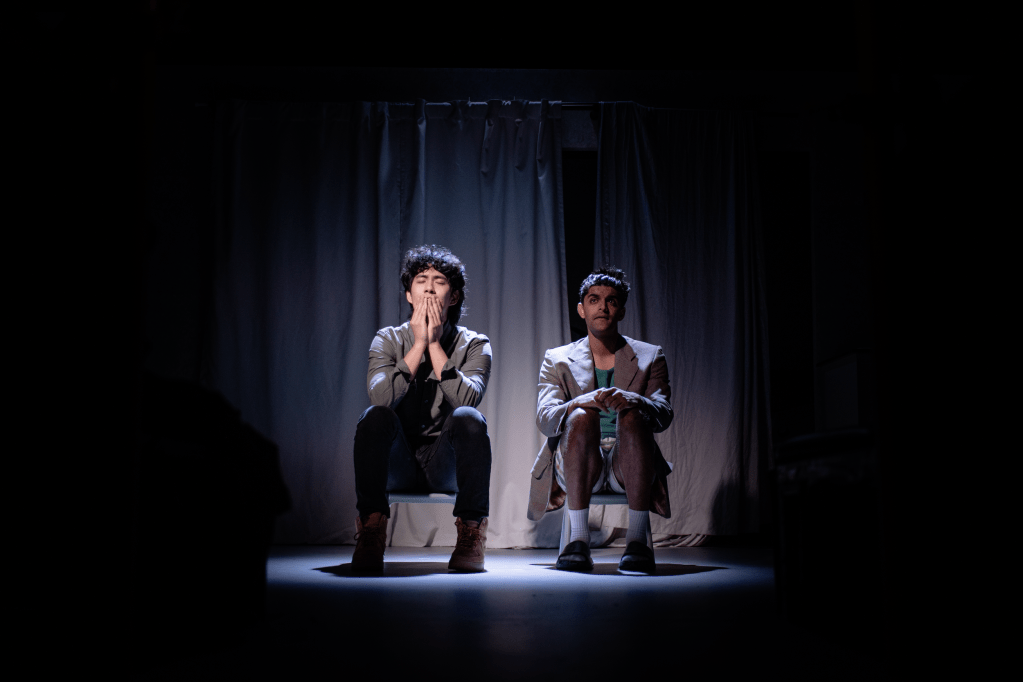
Written by Will O’Mahony. Sharehouse Production Company. Old Fitz Theatre. 17-27 Feb, 2026.
The new lo-fi production of Will O’Mahony’s Tonsils + Tweezers (part of the Old Fitz’s Late Night programme) practically fizzes with energy. From the second you walk into the theatre to the final bow, this little play is more kinetic than anything else I’ve seen this year so far… another Late Night winner.
Tonsils (Ariyan Sharma) is already playing guessing games with the audience. The show hasn’t technically started; the crowd is still drifting in from the bar, but the tunes are banging and Tonsils commands the stage like a circus ringmaster. Once the doors shut, we meet his best mate Lewis (Victor Y Z Xu), aka Tweezers. Then Tonsils drops an omniscient time bomb: in ten minutes, Tweezers is going to ask, “Tonsils, ever wanted to kill someone?”
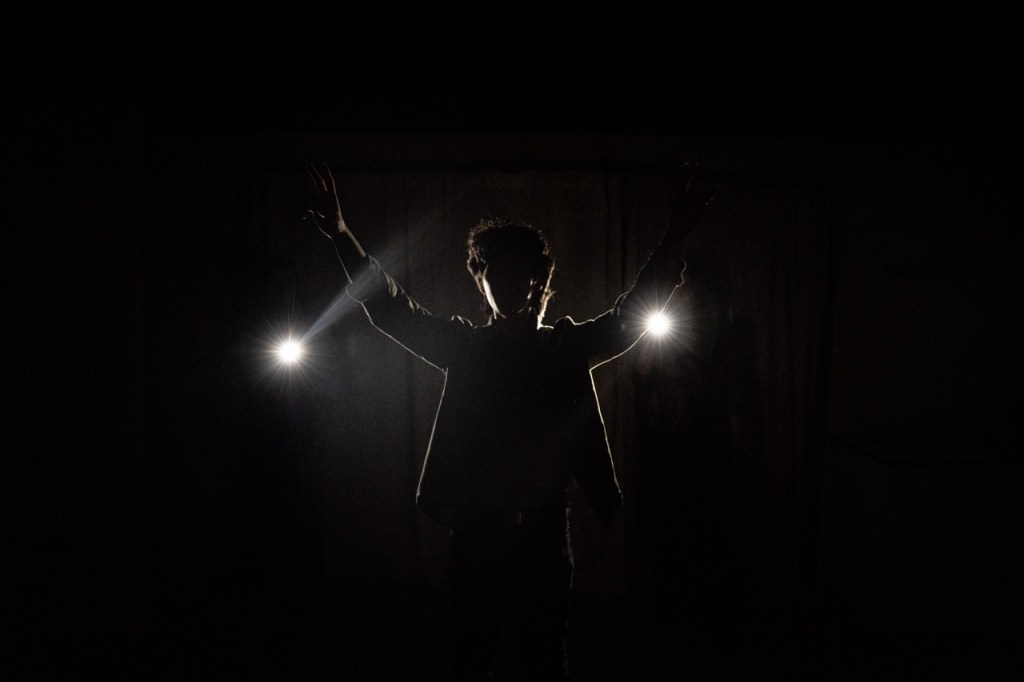
Victor Y Z Xu. Photo: Nicholas Warrand. What follows is a whip-smart, timey-wimey journey through teenage mistakes and twenty-something anger, laced with dark humour. O’Mahony’s self-aware script plants clues and warnings while winking at the audience, carefully doling out information and daring us to keep up. The pleasure lies in watching the pieces click into place.
The beauty of it all lies in the power of simple, clear storytelling. As part of the Fitz’s Late Night programme, Tonsils + Tweezers is performed on the set of the main show, Es & Flo. Yet this constraint doesn’t stop director Lucy Rossen from throwing everything she has at the material, deploying a cornucopia of papier-mâché props, puppets and lighting tricks – and, most importantly, drawing four performances that contain multitudes.
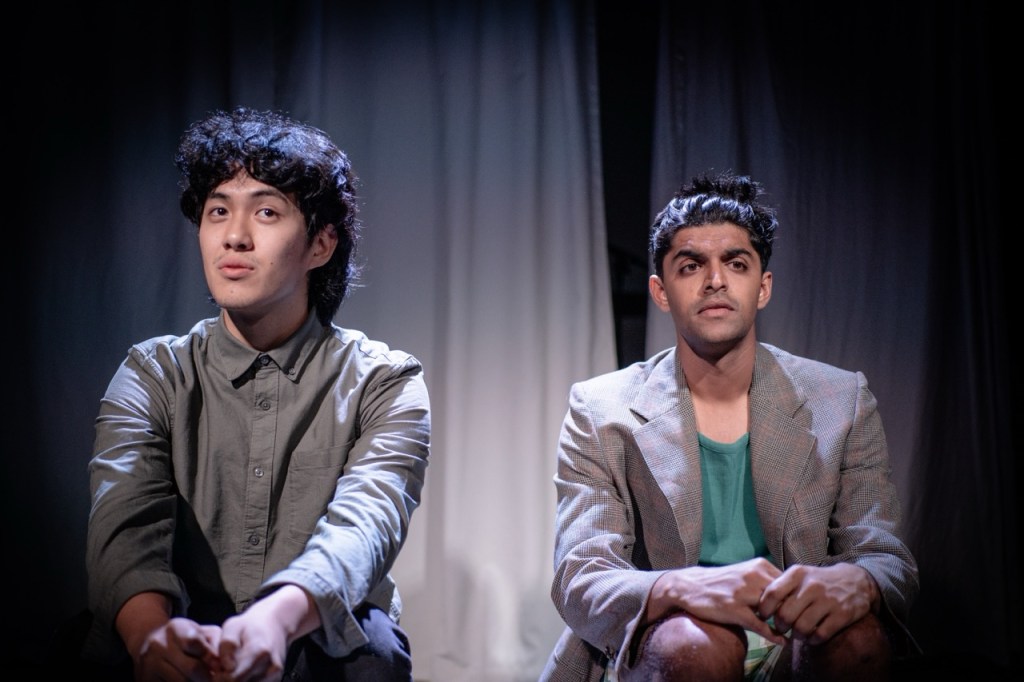
Victor Y Z Xu & Ariyan Sharma. Photo: Nicholas Warrand. The night belongs to the effervescent Sharma, who narrates and teases us through the story while also appearing bound by the somewhat metaphysical rules of the game. His Puck-like Tonsils never says as much as he knows, and it’s clear there is control and compassion beneath the chaos. Opposite him, Xu’s Tweezers is brooding and murky. Is he capable of violence? Is this a story of redemption or revenge? Xu keeps us guessing, hiding intent behind wounded eyes and a challenging smirk.
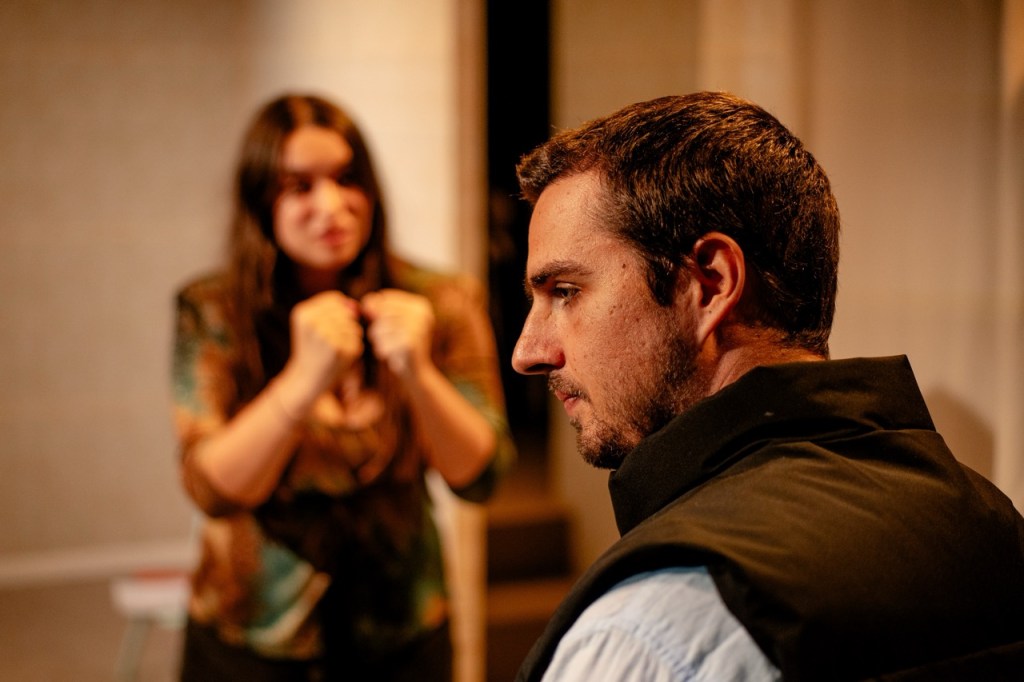
Caitlin Green & Toby Carey. Photo: Nicholas Warrand. They’re joined by Toby Carey as Max, a school bully who’s grown into a middle manager trying to learn the lines to Macbeth, and Caitlin Green as Beth, Max’s co-star and occasional ethereal storyteller. Despite being supporting roles, both Carey and Green deliver layered performances alive with subtext.
At the start of any show, there’s often a flicker of “okay, what have I let myself in for?” – especially with low-budget independent or fringe work. But despite this being the debut production of a company I’d never heard of, featuring actors largely unfamiliar to me (Carey was the only one I recognised, from the excellent All Boys at KXT), and a play I knew nothing about, I felt an immediate sense of assurance.
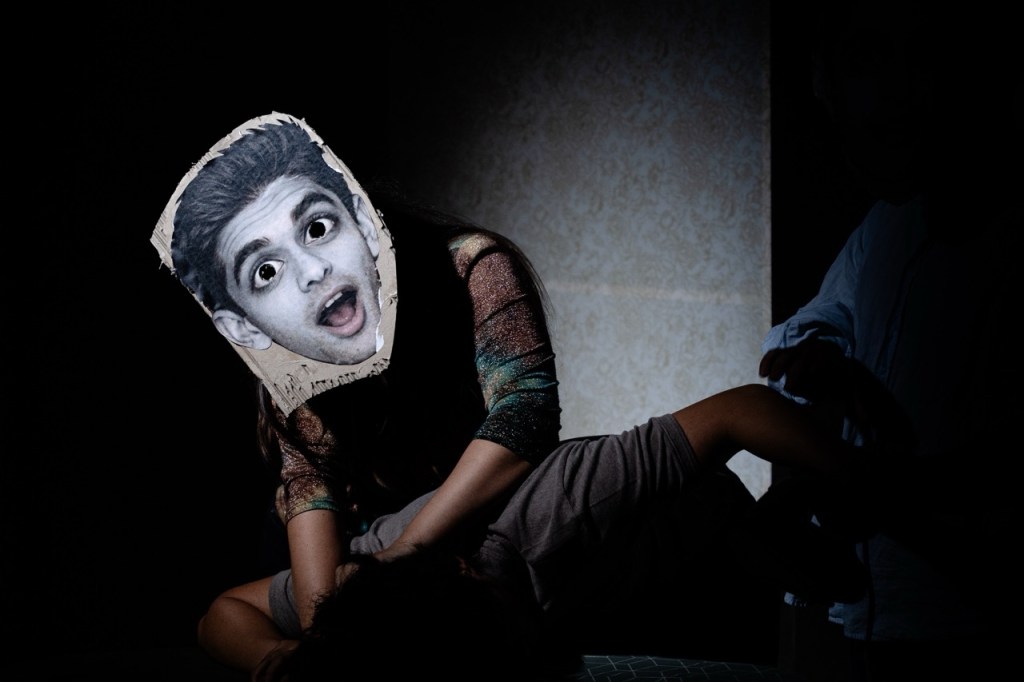
Caitlin Green. Photo: Nicholas Warrand. From the moment I sat down, I thought, “Oh, they’ve got this,” and settled into the mental and emotional space to relax and take in the wild ride. That takes skill. It’s the mark of assured direction and confident performers. Combine that with a “throw everything at the stage” approach to storytelling and you’ve got a scrappy winner.
Tonsils + Tweezers runs for just 65 minutes, but it’s packed with story, style and a dark joyfulness well worth seeking out.
-
Subscribe
Subscribed
Have a WordPress.com account? Log in now.

