-
Welcome to Cultural Binge

The rating system is simple:
★★★★★ – Terrific, world-standard. Don’t miss.
★★★★ – Great, definitely worth seeing.
★★★ – Good. Perfectly entertaining. Recommended. Individual mileage may vary.
★★ – Fine. Flawed and not really recommended, but you may find something to appreciate in it.
★ – Bad (& possibly offensive).
See more reviews over at The Queer Review.
Instagram: @culturalbinge
Substack: culturalbinge.substack.com
Email: chad at culturalbinge.com
-
Koreaboo (Griffin) ★★★

Written by Michelle Lim Davidson. Griffin Theatre Company. Belvoir Downstairs. 14 Jun – 20 Jul, 2025.
Griffin’s nomadic Grand Tour of Sydney venues continues with Koreaboo setting up shop in Belvoir’s downstairs theatre, usually the home of Belvoir’s 25a programme. It’s interesting to see the space used for a grander, if still very intimate, production.
Hannah (Michelle Lim Davidson) has flown to South Korea to see her birth mother (Heather Jeong). After their first reunion last year, Hannah wants to spend time with the mother she never knew and form a new bond but her mother, her Umma, feels less enthused. She works all day, every day, in the 24hr Mart she owns and runs, but Hannah starts to suspect that her reticence stems less from the awkward language barrier and more from their separate pasts. Thankfully, they find common ground in the world of K-Pop.

Heather Jeong & Michelle Lim Davidson. Photo: Brett Boardman. Koreaboo plays out like a two-handed sitcom. Expect silly laughs served with a side of hammy, or should that be “spam-my”, acting. It’s not my favourite kind of theatrical comedy, but others obviously enjoyed the clearly signposted punchlines much more than I did. Personally, the silliness and inorganic acting undermined the mother/daughter story, which felt all talk and no genuine heart. The text contained emotion, but I just didn’t care about these plastic caricatures.
Meanwhile, Davidson’s script impresses. Drawing from her own experience, it’s both broad and fun, while also packed with the specific details that make a play feel real and lived-in. Even when the plot mechanics felt obvious, it was fun to watch the story unfold and discover the gems in the dialogue. My only gripe comes from a moment of narration near the play’s end that felt unnecessary.

Michelle Lim Davidson & Heather Jeong. Photo: Brett Boardman. As you’d expect from a Griffin production, the technical aspects shine. Kate Baldwin’s lighting design adds moments of whimsy that bring extra life to Mel Page’s busy and deep design work. The costumes are a delight.
So chalk this one up to just not being my personal cup of tea — as is the case with many broad comedies. It may not be for me, but there’s certainly a lot to appreciate here. The show has racked up plenty of four-star reviews, so check it out for yourself and see.
-
Blackbird (KXT on Broadway) ★★★
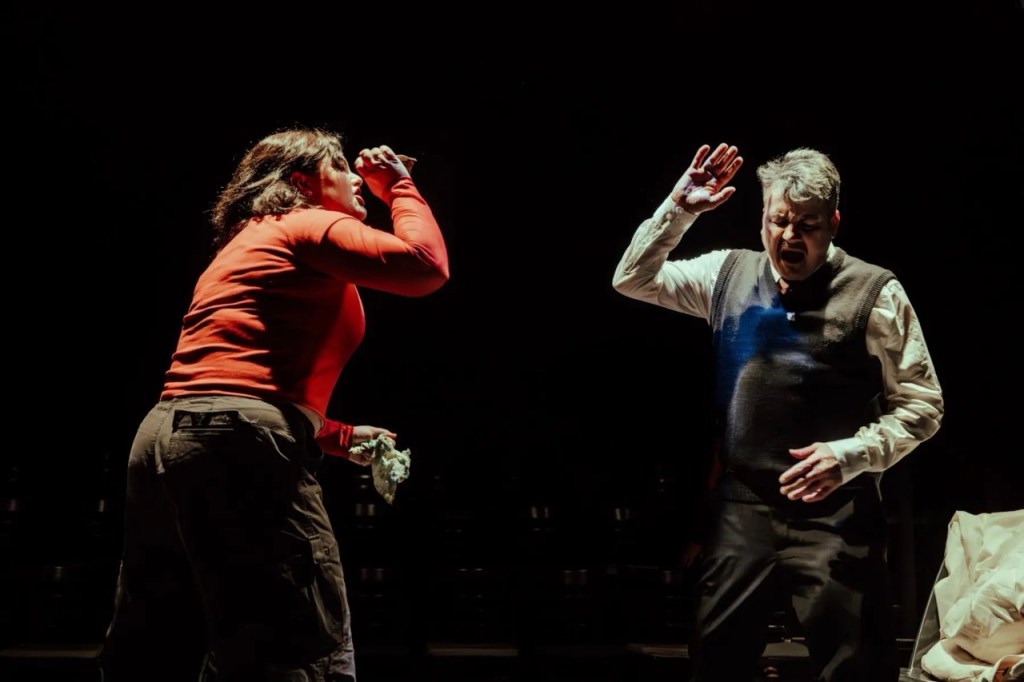
Written by David Harrower. HER Productions. KXT on Broadway. 25 Jun – 5 Jul, 2025.
David Harrower’s acclaimed, intense 2005 play, Blackbird, won’t be for everyone. It’s a complex tale of child sexual abuse that plunges into murky emotional waters. I understand why performers are drawn to it, but some audiences may find it difficult to watch.
Una (Charlotte De Wit) has ambushed Ray (Phil McGrath) at his workplace. They haven’t seen each other in 15 years. Ray has moved on, changed his name, and started a new life. Una, however, remains fixated on their shared past, obsessing over details he wants to leave behind. When she was only 12, Ray had sex with her. Now, after he served a prison sentence, she is forcing him to confront the past once again.
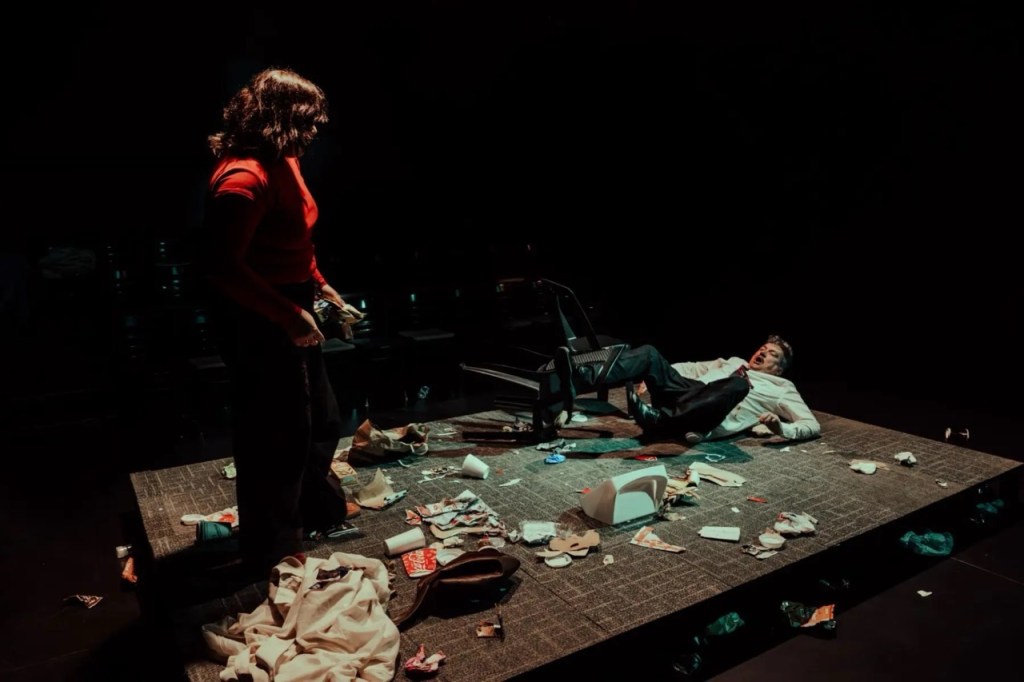
Charlotte De Wit & Phil McGrath. Photo: Ravyna Jassani. Harrower’s script is a knotty affair, exploring the grey areas of a situation many see as simply black and white. While Ray’s criminality is never in doubt, his motivations—and our assumptions—are questioned. Una, too, is a tangle of conflicting impulses, which steer the story through unexpected twists. It’s a smart, well-structured narrative, and it’s easy to see why it has been praised across Europe and America.
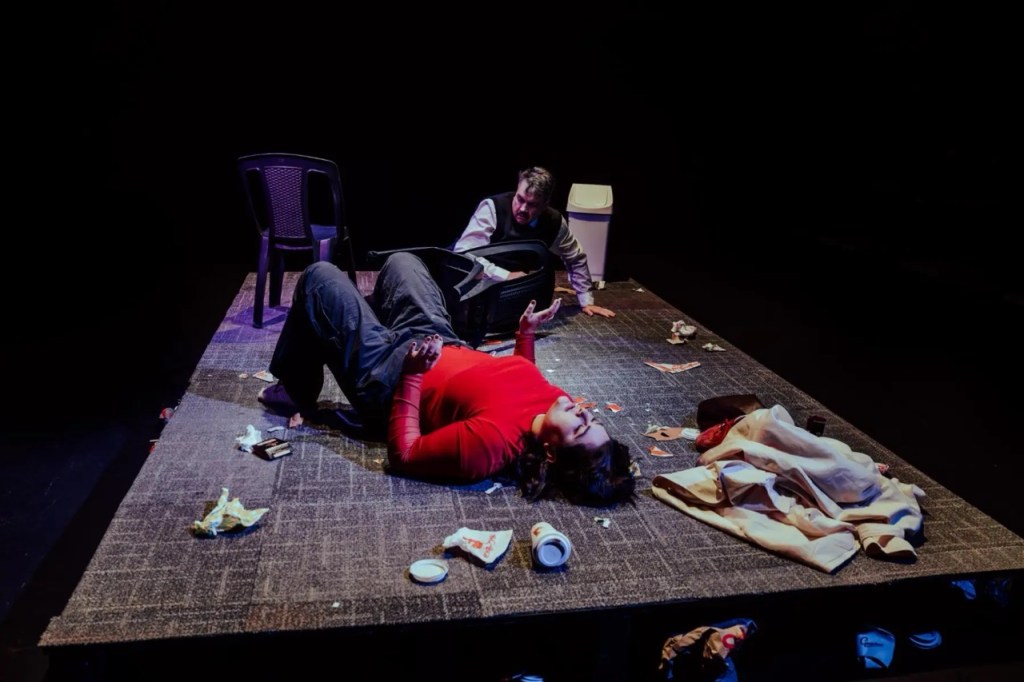
Charlotte De Wit & Phil McGrath. Photo: Ravyna Jassani. Although the play is relatively short (just 75 minutes) it can feel longer. This is partly due to the static staging, set in a bland, generic office common room, and partly because of the heavy subject matter. Despite the script’s dynamism, this production struggles to capture its nuance. The performances and direction lack the subtlety needed to fully reveal the humanity of these psychologically complex characters. Both are deeply scarred by their pasts, wrestling with confusing and conflicting desires. Some moments in the third act seem designed merely to shock and are telegraphed too far in advance.
Nonetheless, this is powerful material that dares to get messy and push the audience into uncomfortable territory. It’s a bold script that rewards engagement, even if this particular production doesn’t quite reach the heights of the text.
-
Primary Trust (Ensemble) ★★★½

Written by Eboni Booth. Ensemble Theatre. 19 Jun – 12 Jul, 2025.
Eboni Booth’s Pulitzer Prize-winning Primary Trust takes us inside the mind of a man gradually confronting the trauma life has handed him, and learning when to let go of the coping mechanisms that have become crutches.
Kenneth (Albert Mwangi) sits in his favourite tiki bar, sipping mai tais with his best friend Bert (Charles Allen). The staff at Wally’s give him odd looks sometimes, but he’s been going there every day for happy hour, sitting in the back, for years. Kenneth is upfront with the audience: Bert is imaginary. The staff only see him sitting at a table, talking and laughing to himself. One day, he starts a conversation with a new waitress, Corina (Angela Mahlatjie), and maybe, just maybe, he’s about to make his first friend IRL.

Charles Allen, Albert Mwangi, Angela Mahlatjie & Peter Kowitz. Photo: Prudence Upton. I usually roll my eyes at the mawkish sentimentality of American plays, but I’ll confess that Primary Trust got to me despite myself. As Kenneth begins to open up to the people around him — Corina and his new boss, played by Peter Kowitz — the shift from his assured private mental world (talking to the audience and bantering with Bert) to forming real connections is a rough journey.

Charles Allen & Albert Mwangi. Photo: Prudence Upton. Booth keeps things tight, avoiding lazy dramatics in favour of character work. Mwangi is almost too charming as Kenneth, who is prone to panic attacks and fits of rage. It’s only around the calm, assured presence of Bert that he ever finds peace. Their relationship is fascinatingly complex. Despite being a figment of Kenneth’s subconscious, Bert feels fully realised thanks to Charles Allen’s performance.
The real MVP of the show is Angela Mahlatjie, who plays not just Corina but a dozen other waitstaff and sundry characters. It’s comedic, yet fully satisfying — one of the most fun performances I’ve seen this year.

Albert Mwangi & Angela Mahlatjie. Photo: Prudence Upton. The most surprising thing about Primary Trust is how much dramatic tension it sustains in a play where, well, not much happens. In this world, small shifts in personality take on tectonic significance. There’s a comfortable security to the play’s construction. We begin with a monologue telling us that in fifteen years, all the places mentioned will be levelled for new apartments. The very presence and wisdom of Bert symbolise Kenneth’s healing subconscious. Despite the setbacks, you know Kenneth is going to be okay. Rather than robbing the play of tension, this sense of safety allows you to fully invest in Kenneth’s journey. This is a feel-good story of healing, told in retrospect.
Leaving the Ensemble, I felt a warm rush of melancholy and peace. I’d just spent a tight 90 minutes on a journey that left me a bit sad, a bit happy, and ready to face the world outside the theatre’s walls.
-
Instructions for Correct Assembly (Flight Path) ★★★½

Written by Thomas Eccleshare. Clock & Spiel Productions. Flight Path Theatre. 25 Jun – 5 Jul, 2025.
Parenting is hard. But what if you could build the perfect child from scratch and program it as you go? Instructions for Correct Assembly imagines a world of IKEA-style convenience, where artificial offspring are delivered flat-packed and ready to construct. Offering a fresh lens on the challenges of real-life parenting it makes you wonder, what if humans were as easy to reprogram as machines?

Jane Wallace & Nick Curnow. Photo: Patrick Phillips. Hari (Nick Curnow) is thrilled to share his latest impulse buy with his wife, Max (Jane Wallace). A chronic DIY enthusiast, he’s ordered a top of the line android S.O.N. named Jån (Ben Chapple), to build in the garage. But this isn’t just another gadget. Hari and Max have styled Jån to look uncannily like their deceased son, Nick. And soon they realise Jån, just like Nick, is far harder to program than expected.
The best science fiction holds up a mirror to our world, reflecting our humanity through the strange and unfamiliar, whether it’s Star Trek, Black Mirror, or Severance. Instructions for Correct Assembly turns that mirror on family life, exploring the tension and tenderness of close relationships and the desire to perfect what can’t be controlled.
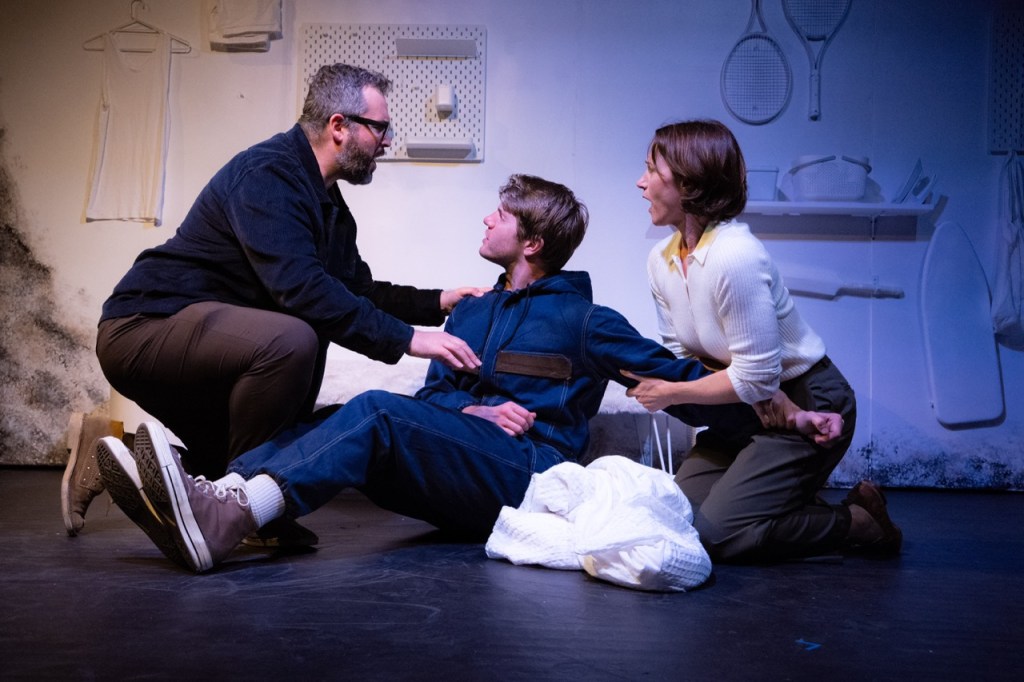
Nick Curnow, Ben Chapple & Jane Wallace. Photo: Patrick Phillips. As we discover through flashbacks, for this family things fell apart when Nick went to university and started using drugs. It was a cycle they could never break, but in Jån they see a way to fill the gap in their lives and somehow undo the errors of the past.
Eccleshare’s script, relocated from the UK to Australia, is delivered by a strong cast—most notably Ben Chapple, whose dual performance as Jån and Nick is compelling. By giving Jån a slightly more childlike tone (without going full robot), Chapple makes the distinction between the two characters clear, despite minimal changes in appearance.

Jane Wallace & Nick Curnow. Photo: Patrick Phillips. Curnow and Wallace carry much of the emotional weight as grieving parents striving for a second chance. Their mission—to correct past mistakes by raising a flawless replica of their son—adds depth and poignancy to a plot that sometimes feels overstated or stretched.
They’re supported by David Allsopp, Jacki Mison, and Kyra Belford-Thomas as well-meaning family friends (and subtle social rivals). Their high-achieving daughter, Amy (Belford-Thomas), becomes an unintentional source of pressure for Hari and Max.

Kyra Belford-Thomas, Jacki Mison, David Allsopp, Jane Wallace, Ben Chapple & Nick Curnow. Photo: Patrick Phillips. While the premise is clever and full of potential, the writing often feels unfocused with scenes that struggle to get to the heart of the matter. A run of very short, early scenes, broken up by lengthy blackouts & set changes, disrupts the pacing. Jokes are repeated and at times, I found myself wondering, “Would an android really say that?” do the degree that it started to pull me out of the emotional drama. Instructions for Correct Assembly takes a bit too long to find its rhythm, and then doesn’t quite know when to stop. The final few scenes blur the message rather than sharpen it.
Still, the heart of this production lies in three excellent central performances. Curnow, Wallace, and Chapple bring warmth and humanity to a story built on artificial parts. Their final scene together is quietly devastating.
-
Coriolanus (Bell Shakespeare) ★★★★

Written by William Shakespeare. Bell Shakespeare. Neilson Nutshell. 20 Jun – 19 Jul, 2025.
Bell Shakespeare strikes gold with their timely staging of Shakespeare’s Coriolanus, only the second time it has been produced in the company’s history.
Rome is in turmoil as famine grips the republic, and the upper-class patricians and working-class plebeians are turning on each other. Meanwhile, a neighbouring tribe, the Volscians, is rising up against Rome. Into the fray steps war general Caius Martius (Hazem Shammas). After turning back the Volscians, he is renamed Coriolanus, after the Volscian city of Corioli that he captures. The patricians urge him to run for consul, but to win the votes he must gain favour with the plebeians whom he openly despises. When two plebeian tribunes, Brutus (Marco Chiappi) and Sicinius (Matilda Ridgway), stir up the people against him and conspire to have him exiled, Coriolanus is enraged. Turning his fury on Rome, he joins forces with the very Volscians he once defeated to mount an attack on the city.

Peter Carroll, Brigid Zegeni, Hazem Shammas, Suzannah McDonald & Gareth Reeves. Photo: Brett Boardman. While Coriolanus may be a relative stranger to Australian stages, it’s received considerable attention in the UK, with recent major productions starring Tom Hiddleston and David Oyelowo — both critically acclaimed. So it makes sense that Bell Shakespeare has spiced up their season with this bloody political drama. The rise of overly emotional autocrats in the real world certainly doesn’t hurt either.
You know you’re in safe hands with Shakespeare’s text when the likes of Peter Carroll (as elder patrician Menenius), Brigid Zengeni (as Coriolanus’ mother Volumnia), and Marco Chiappi (as tribune Brutus) take the stage. With a cast this strong — including Anthony Taufa, Suzannah McDonald, Septimus Caton, Gareth Reeves and Jules Billington — Shammas has the space to make Coriolanus a deeply unlikeable protagonist we can’t wait to see fail.

Matilda Ridgeway & Marco Chiappi. Photo: Brett Boardman. There’s no love lost for the haughty patrician class who seek to push and manipulate the people, but things aren’t as cut and dried as good versus evil. Carroll’s Menenius delivers withering lines about the rabble-rousing tribunes, as both sides wield populism in a bid for control. This morally murky play offers no admirable heroes — even if you sympathise with the plebeians, you’ll still shake your head at their giddy overreach.
Peter Evans directs this traverse production as a constantly shifting balance of control. The simple set features a moving platform the cast slides up and down the space, adding dynamic movement and weight. Location names are projected onto the floor in animated text transitions, filling the room with motion even when the stage stands still.
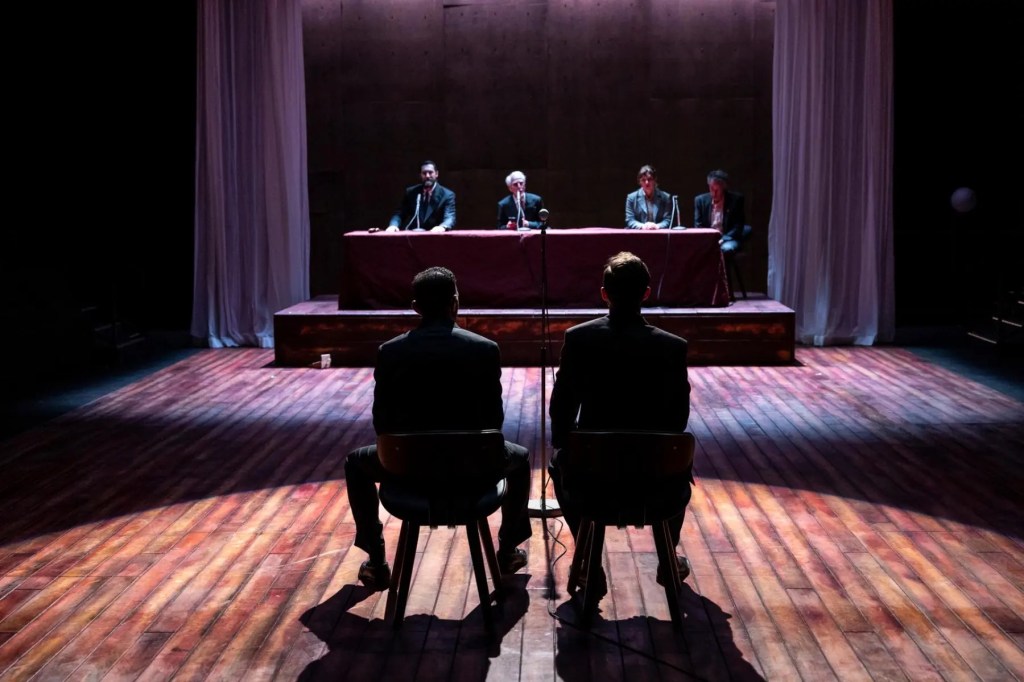
Septimus Caton, Hazem Shammas, Peter Carroll, Gareth Reeves, Matilda Ridgeway & Marco Chiappi. Photo: Brett Boardman. But don’t assume this is a Shakespearean tragedy full of doom and gloom. While, yes, there are plenty of deaths, Evans and the cast find moments of levity and comedy. Jules Billington opens the show with a brisk pre-show talk and Acknowledgement of Country that is both educational and inviting.
If I had to pick a fault, the only moment that didn’t quite ring true for me was [spoiler alert, BTW] Coriolanus’ eleventh-hour change of heart. I just didn’t buy that he cared enough about his wife and mother to be swayed from his prideful anger.
After a few years of relying on the big-hitting classics, it’s refreshing to see Bell Shakespeare bringing us one of the Bard’s lesser-staged works. While I could happily go a few years without seeing another Hamlet, Macbeth, or Romeo & Juliet, I definitely want more of these relative rarities.
-
Being Alive: The Music of Stephen Sondheim (Hayes) ★★★

Music & lyrics by Stephen Sondheim. Hayes Theatre Company. 25 Jun – 12 Jul, 2025.
Being Alive, the new Sondheim revue at the Hayes Theatre, pulls together a quixotic assortment of the great man’s tunes – from fan favourites to some more obscure entries – to explore the broad strokes of life.
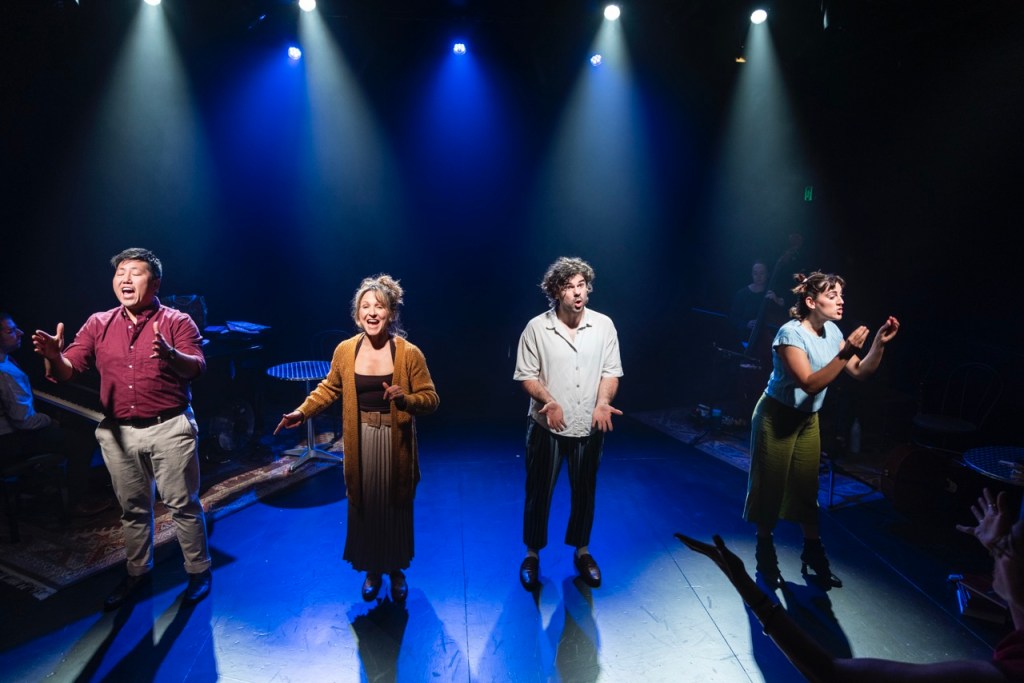
Raphael Wong, Blazey Best, Lincoln Elliot & Kala Gare. Photo: John McRae. Despite having overseen a number of revues of his own material, the majority of Sondheim’s songs are notoriously ill-suited to cabaret presentations – the lyrics are usually so tightly tied to specific plots and characters that they make little sense outside their original shows. As such, large chunks of Being Alive are aimed squarely at musical theatre fans who need no introduction to the plot mechanics of songs like “Color and Light” (Sunday in the Park with George), “The Ballad of Guiteau” (Assassins), “The Advantages of Floating in the Middle of the Ocean” or “Someone in a Tree” (Pacific Overtures).
Highlights of the night include a new boy-band-infused arrangement of “Losing My Mind / You Could Drive a Person Crazy” (Follies & Company) that will delight or infuriate with its sheer cheek, a melancholic blend of weepies “Send in the Clowns / Not While I’m Around” (A Little Night Music & Sweeney Todd), and a terrific rendition of “The Gun Song” (Assassins).
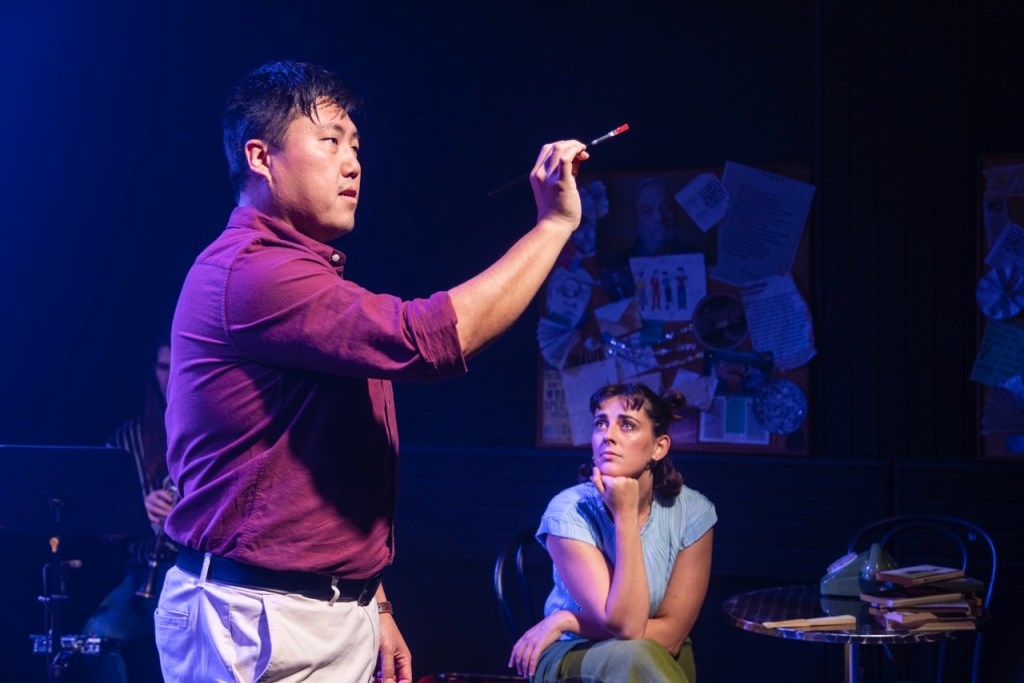
Raphael Wong & Kala Gare. Photo: John McRae. Raphael Wong’s sonorous baritone is an easy standout among this excellent cast of four (it’s great to hear him tackle more challenging music than his show-stealing turn in Sister Act: The Musical). Lincoln Elliott’s voice has the kind of crisp specificity required to handle Sondheim’s trickier lyrics. Blazey Best, no stranger to bringing the house to tears with Sondheim’s songs, hits the peaks with “Witch’s Lament” (Into the Woods). Kala Gare is slightly underserved in the shuffle, but shines with the titular “Being Alive” (Company).
Things get rockier whenever the music stops. Between songs, we’re given a string of oblique literary quotes about humanity—from Carl Jung to Ursula K. Le Guin. These syrupy, self-serious moments clash awkwardly with hammy attempts at comedy. It’s the show’s weakest element by far. The lack of a set or costume designer is obvious and keenly felt; the staging is clearly in need of some love and attention. Being Alive would have worked far better as a simple concert performance.

Blazey Best & Lincoln Elliot. Photo: John McRae. Thankfully the onstage talents and the power of Stephen Sondheim’s storytelling are first class. We will be forever grateful that Sondheim left behind a legacy of exquisite, insightful, challenging, and richly textured works for us to pore over. When even his notorious flops, like Merrily We Roll Along, can be reinvented into award-winning gold, and his more obscure shows contain musical gems, Sondheim’s place on the musical theatre pedestal is assured.
Now we just need a Hayes production of Passion… oh, and Road Show… and an Australian premiere of Here We Go… and the gender-flipped Company… and a revival of Assassins…
-
The Play That Goes Wrong (Sydney Opera House) ★★★½

Written by Henry Lewis, Jonathan Sayer & Henry Shields. Mischief Theatre. Drama Theatre, Sydney Opera House. 19 Jun – 3 Aug, 2025 then touring nationally.
Slapstick supergroup Mischief Theatre’s original hit is back in Aus. The Play That Goes Wrong has grown from fringe breakthrough to theatrical staple, and now, the 13-year-old comedy is proving that simple gags are timeless.
If you’ve never been to a production by the Cornley Polytechnic Drama Society, you’re in for a treat, as this accident-prone amateur theatre troupe gives more than their share of blood, sweat and tears—simply because the show must go on. As they attempt to stage a production of The Murder at Haversham Manor (a pseudo-Agatha-Christie murder mystery), well, things go wrong…
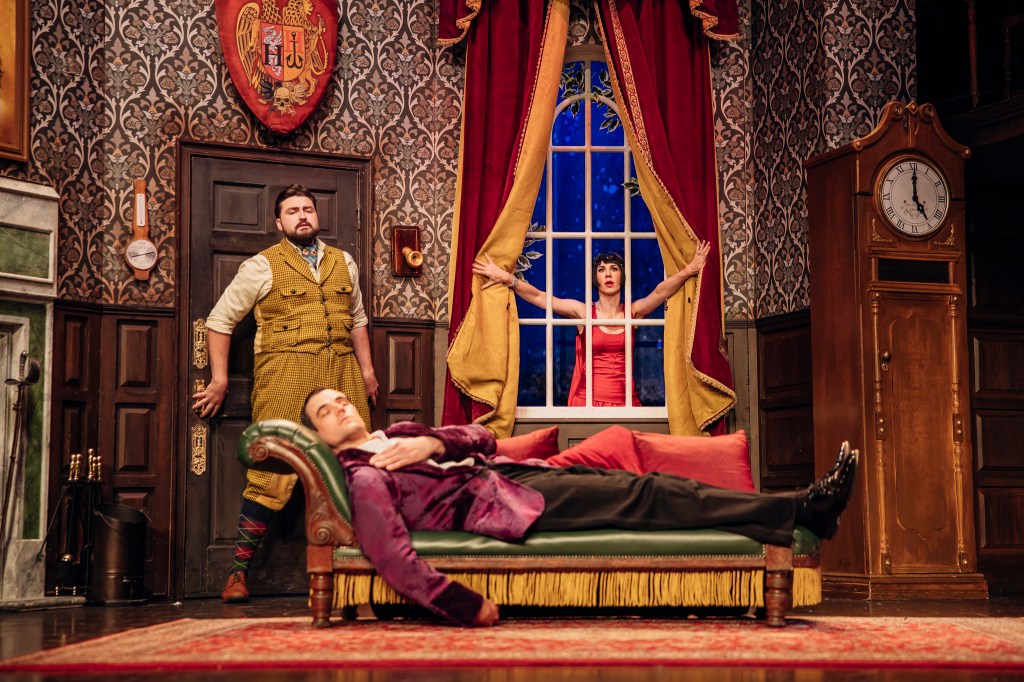
Joe Kosky, Brodie Masini & Stephanie Astrid John. Photo: Jordan Munns. I must confess, every time I sit down to watch an Agatha Christie play (be it the recent Robin Nevin-directed The Mousetrap and And Then There Were None, or the work of Sydney’s beloved Genesian Theatre), I think about The Play That Goes Wrong. It so perfectly skewers the tropes of the genre and the quirks of a small theatre company. If you’ve ever spent time in the world of community or amateur dramatics, you’ll know what I mean. This show-within-a-show is littered with familiar types—from the pompous over-actor, the constantly posing actress, the neophyte mugging for easy applause, the forgetful cast member sneakily reading his lines off his palm, to the one-man actor/director/producer trying to hold it all together while staying in character. Wobbly sets and glimpses of backstage crew included.
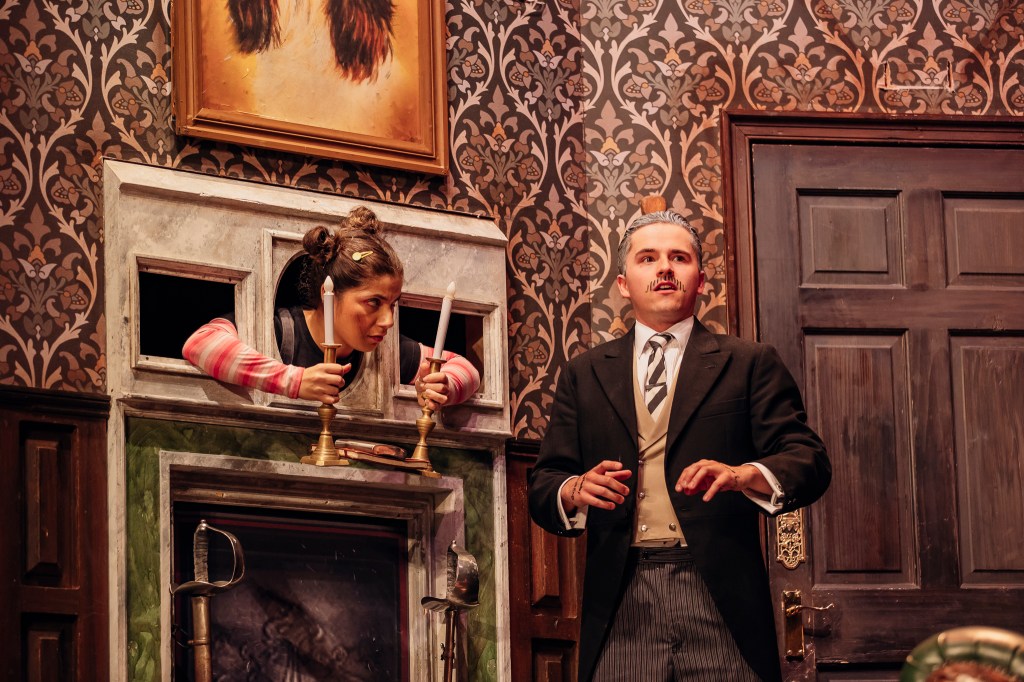
Olivia Charalambous & Tom Hayward. Photo: Jordan Munns. The Play That Goes Wrong lives in the shadow of Michael Frayn’s immortal backstage classic Noises Off, but it swaps that play’s intricate backstories and rivalries for oodles of ever-escalating physical comedy. Nigel Hook’s original set design is a wonder of hidden tricks, and original director Mark Bell made the madness look easy.
This local cast all have fantastic moments to shine amid the careful chaos. Jonathan Martin is a rock as the stressed/manic director/star/producer Chris, always trying to smile through gritted teeth. Joe Kosky’s Robert delivers one of the best physical comedy moments as he clings onto furniture for dear life. And Sebastiano Pitruzzello, in the crowd-pleasing role of the shy-but-loving-it Max, earns his rounds of applause.
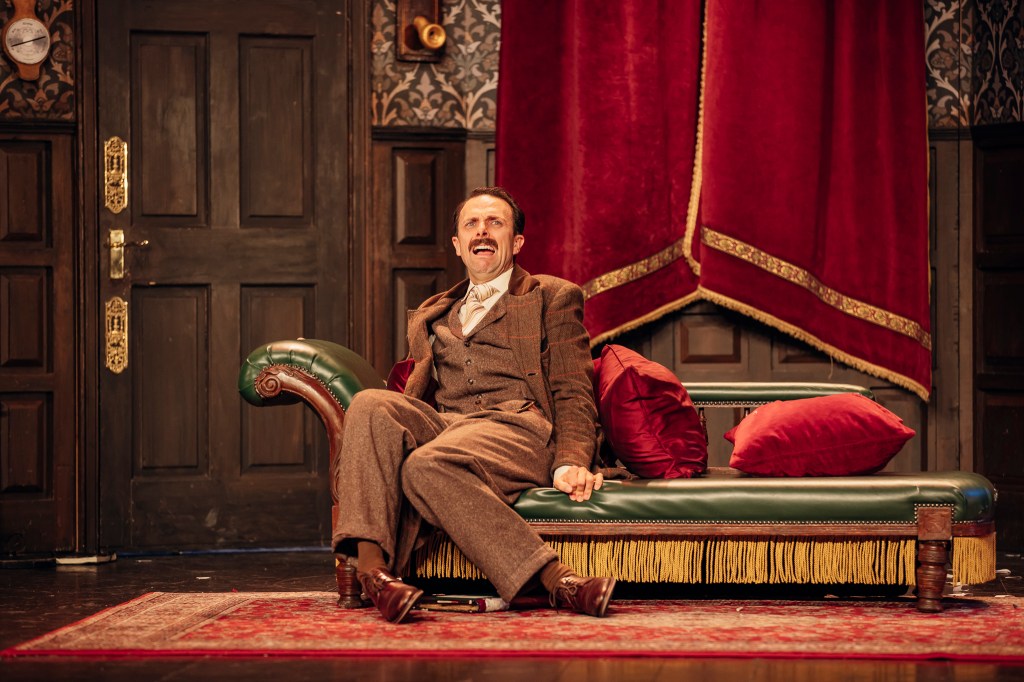
Jonathan Martin. Photo: Jordan Munns. The danger for all long-running shows is that they start to get a bit tired, and you run the risk that subsequent casts—playing a copy of a copy of the original performance—lose the apparent spontaneity that’s central to the humour. And I must confess, that does happen here. We’re now so far removed from the original creators and actors that the performances have lost that sliver of authentic heart. For me, the real success of Mischief Theatre was their ability to create realistic(-ish) enough characters, then pile a farcical amount of pressure on them and watch them react. Currently, there’s a lot of big acting happening, but less genuine reacting—which robs the comedy of some of its depth.
The Play That Goes Wrong has “good bones”, as they say, and is a guaranteed laugh (especially after a wine or two on a cold Sydney winter night). As I find myself hunkering down and comfort-watching favourite TV shows, it’s nice to do the same with theatre—to settle back with a show you already know will deliver a hilarious night out.
-
Cats (Theatre Royal) ★★★½
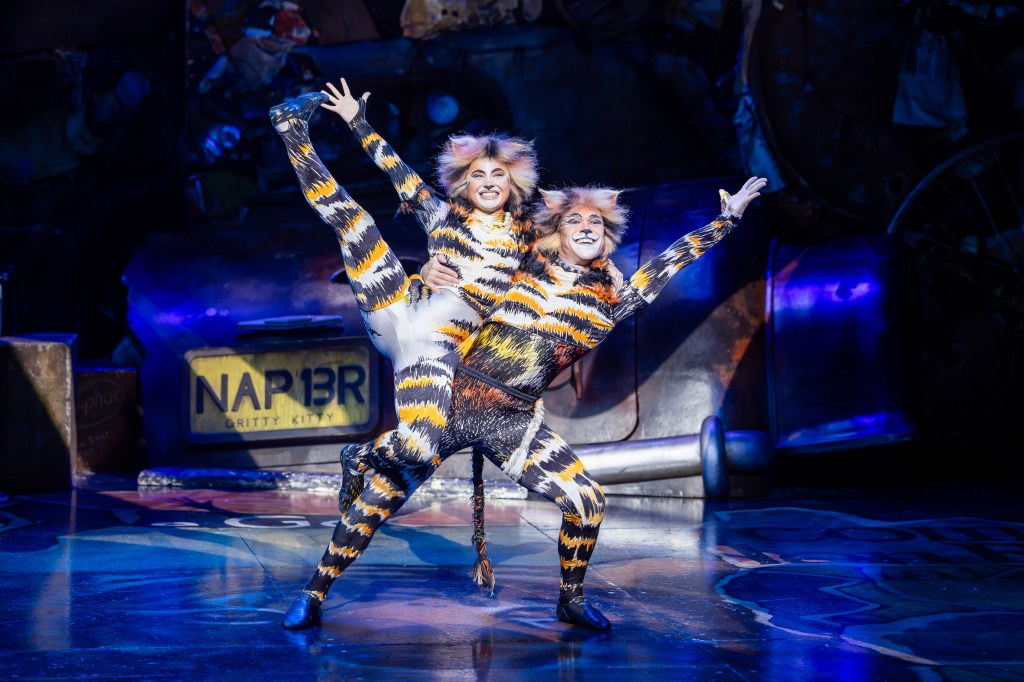
Music by Andrew Lloyd Webber. Based on ‘Old Possum’s Book of Practical Cats’ by T.S. Elliot. Additional lyrics by Trevor Nunn & Richard Stilgoe. Theatre Royal, Sydney. 17 Jun – 6 Sep, 2025.
Grab your leg warmers, Sydney, and escape the cold outside – Cats is back for its 40th Australian anniversary in its original Aussie home, the Theatre Royal. And for those of you in the theatrical nerdisphere – no, I don’t mean Cats: The Jellicle Ball, the New York ballroom scene reinvention that wowed audiences last year and is about to be restaged there. I mean Cats. Good ol’ middle-aged Cats.
This is where I usually write a plot summary. Hahahaha – moving on…
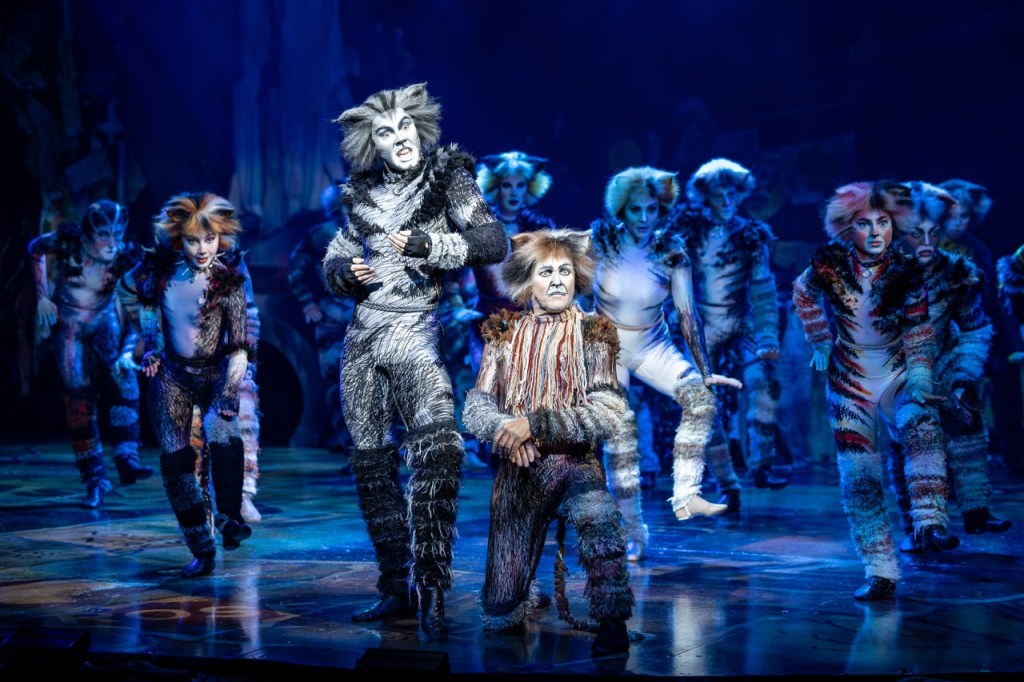
Jarrod Draper, Todd McKenney & ensemble. Photo: Daniel Boud. Cats is… well, Cats. It may be hard to picture it as the revolutionary musical theatre phenomenon it was back in the eighties, but it was huge. Like Hamilton huge. Looking back, that might seem inexplicable (or ineffable, maybe?), and it’s easy to lean into contemporary cynicism – but the fact remains: Cats changed the face of theatre. From the up-to-date-for-the-80s choreography, immersive set design, and skin-tight costumes to the iconic marketing campaign… Cats was to theatre what Jaws was to cinema – the birth of the blockbuster.
I remember seeing Cats back in 1985 when I was (checks calendar) -20 years old, and being totally mesmerised by it. It was my first proper, big theatre experience and, as a wide-eyed kid, I was completely hooked. My mind was blown by the idea that they allowed the audience on stage during the interval to talk to John Wood as Old Deuteronomy, who was gracious and charming with the kids around him. (I assume they’re still doing that – Mark Vincent stayed on stage on opening night, but I didn’t see any of the glitterati go up there.)
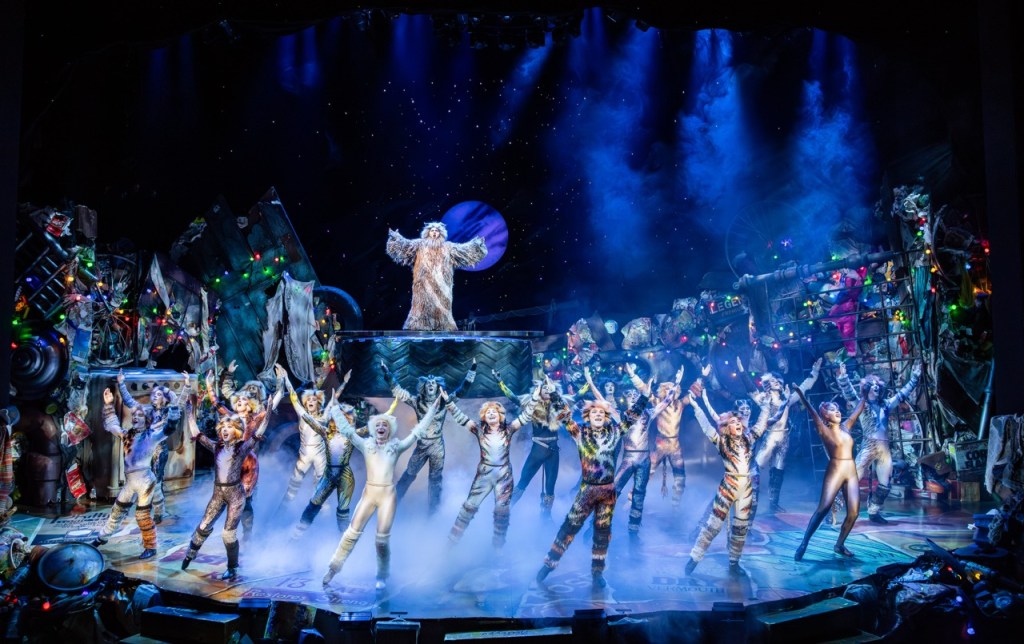
Cast of Cats. Photo: Daniel Boud. If you don’t know Cats (or only know it by reputation), there’s one thing you must understand before walking in: this is not a musical, at least not in the traditional sense. Personally, I see Cats as primarily a kids’ show. Secondly, it’s a dance show. Gillian Lynne’s choreography is iconic. It’s essentially plotless – but not in a “character-hang-out-vibe” way; more in a “we’re stuck in a perpetual first act as more and more characters are introduced” way. Which is totally fine. I’m a fan of Stephen Sondheim’s Assassins, and structurally it’s not that different – it just carries an air of literary respectability because it’s Sondheim.

Des Flanagan & ensemble. Photo: Daniel Boud. The storytelling is confined to each song – colourful vignettes of feline life – with some thin overarching strands: the Jellicle Ball (something akin to a suicide cult where the best singer gets to die with the promise of reincarnation – let’s not think too hard about that, though it would definitely make me tune into another season of The Voice), and the threat of Macavity, the Mystery Cat, a cat burglar who strikes fear into the hearts of the others for… reasons.
And these tunes are catchy AF. Let’s put the power ballad ‘Memory’ to one side for now, but you’ll find yourself humming ‘Skimbleshanks: The Railway Cat’ (Tom Davis almost steals the show with that one) or ‘Mr. Mistoffelees’ (Alex Alvares does steal the show with that one) all the way to the light rail. This may not be Lloyd Webber’s best score, but it shows him at his ear-worm-writing pinnacle. If later shows like Stephen Ward, Love Never Dies, or Bad Cinderella had a tenth of these melodies, we’d remember them much more fondly.
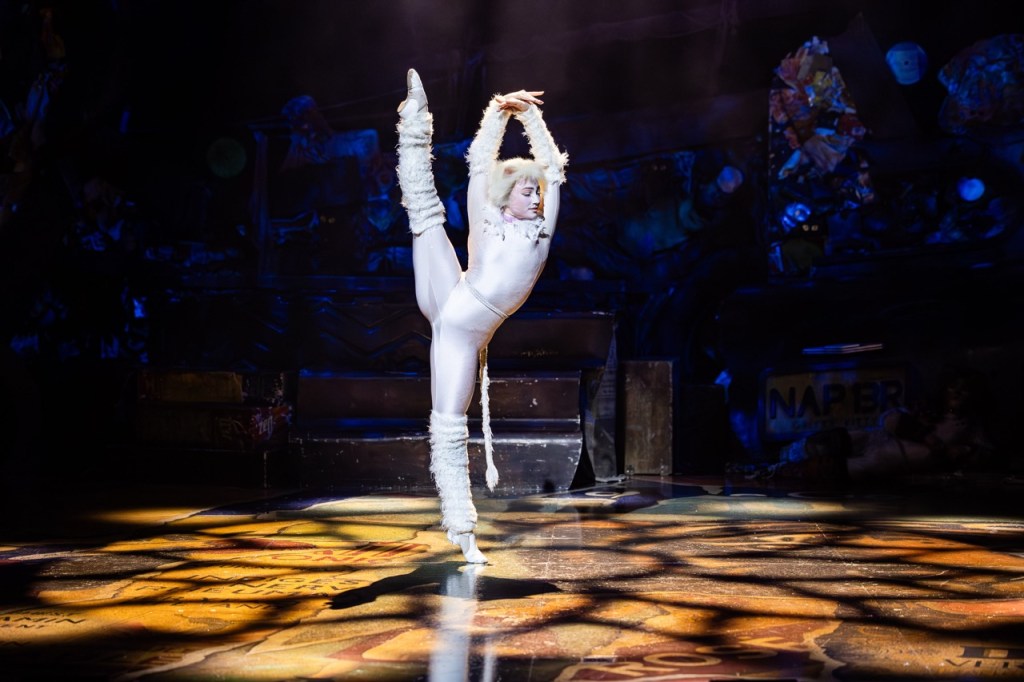
Claudia Hastings. Photo: Daniel Boud. Other standouts among the expansively talented ensemble include Mia Dabkowski-Chandler as Bombalurina and Olivia Carniato as Demeter, who bring “Macavity” to life; and Jarrod Draper as Munkustrap, who holds the whole thing together. Lucy Maunder, as always, delivers, and makes you wish there was more for her to do. In general, if you could bottle the sheer commit-to-the-bit energy of this whole cast, you could power Sydney for a year.
Due to the show’s episodic nature, it can be an uneven experience. For every standout number, there’s a less convincing one. This production’s biggest letdown comes in its most anticipated number – ‘Memory’. I won’t elaborate too much, but I’ve seen more emotional, characterful performances in late-night basements or on boozy ships. There’s a world of difference between belting a note and really interpreting & performing a song.
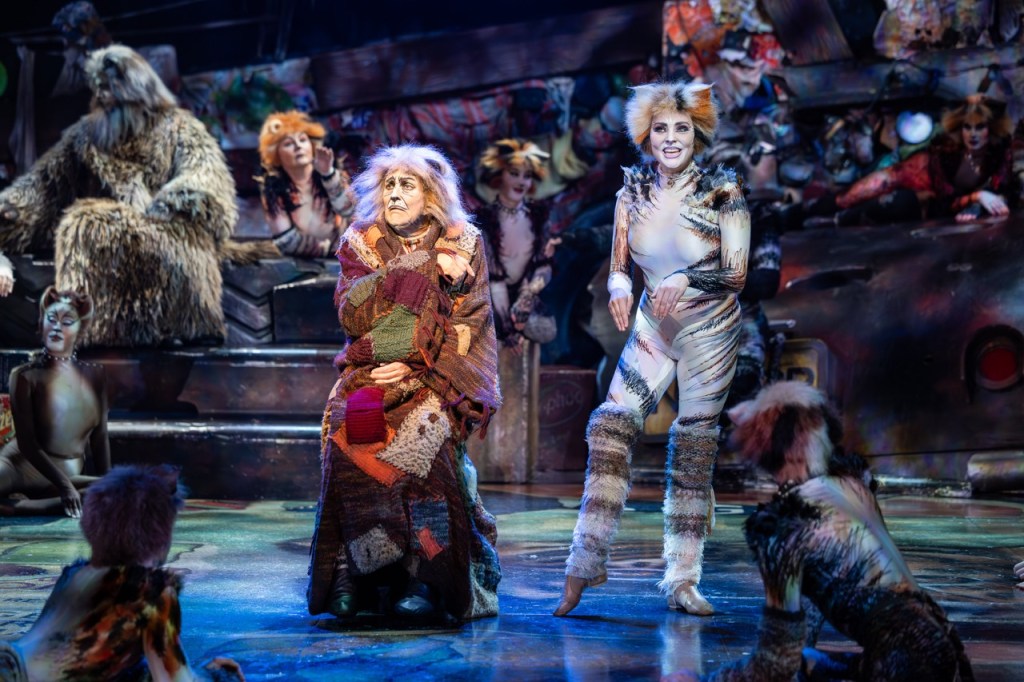
Todd McKenney, Lucy Maunder & ensemble. Photo: Daniel Boud. Cats is such a pop-cultural phenomenon that it’s almost review-proof. You don’t come to Cats to see a musical or a story – you come to see Cats. The furry leg warmers, the Jazzercise choreography, the anachronistic poems – all of it. Everything that seems a bit tacky today was astonishingly fresh in the 80s. And that success has left the show frozen in amber for the past 40 years. It’s crying out for new orchestrations (the synths were cute then, less so now), new choreography (maybe even using some of Andy Blankenbuehler’s from the film), and a whole new vision – which is happening. In New York. Not here. It’s 2024s Sunset Boulevard all over again…
For me, seeing Cats return was a welcome trip down memory lane and a chance to relive a turning point in musical theatre history. But then, I’m a nerd – this is the kind of thing I really love. It’s easy to scoff at Cats, but hard to deny its place in the MT pantheon. Do yourself a favour: take some kids along and enjoy the magic through their eyes. We could all do with being a bit less cynical – and a bit more Cats.
-
Illume (Bangarra) ★★★★★

Choreographed by Frances Rings & the Dancers of Bangarra Dance Theatre. Sydney Opera House, Dame Joan Sutherland Theatre. 4-14 Jun, 2025.
Bangarra’s new show is bringing the galactic to Gadigal with a dance of light. This is Illume.
Moving from their decades-long home at the Sydney Opera House Drama Theatre, Bangarra Dance Theatre have moved up in the world—specifically to the Dame Joan Sutherland Theatre—giving them more space to expand their ambition, and it shows.

Bangarra Dance Theatre’s Illume. Photo: Daniel Boud. Illume is a deeply spiritual, sci-fi-infused show blending an Indigenous futurism aesthetic with ancient movement and belief. It opens with darkness and the first flickers of distant stars in an immersive 3D space (a beautiful blend of lighting and projection by Damien Cooper and Craig Wilkinson). As the troupe of dancers begin to take the stage, the key theme of light is everywhere, with half-obscured ruins filling the skyline like astrological symbols to the beats of Brendon Boney’s soundtrack (can we get a soundtrack released please?).
Much of Illume floats in a liminal space—its 11 distinct chapters flow in and out of each other so seamlessly you barely register them. As the dancers sweep across the stage floor, they alter the staging piece by piece so elements seem to appear out of the ether. In doing so, dramatic and vivid vignettes emerge from the darkness.
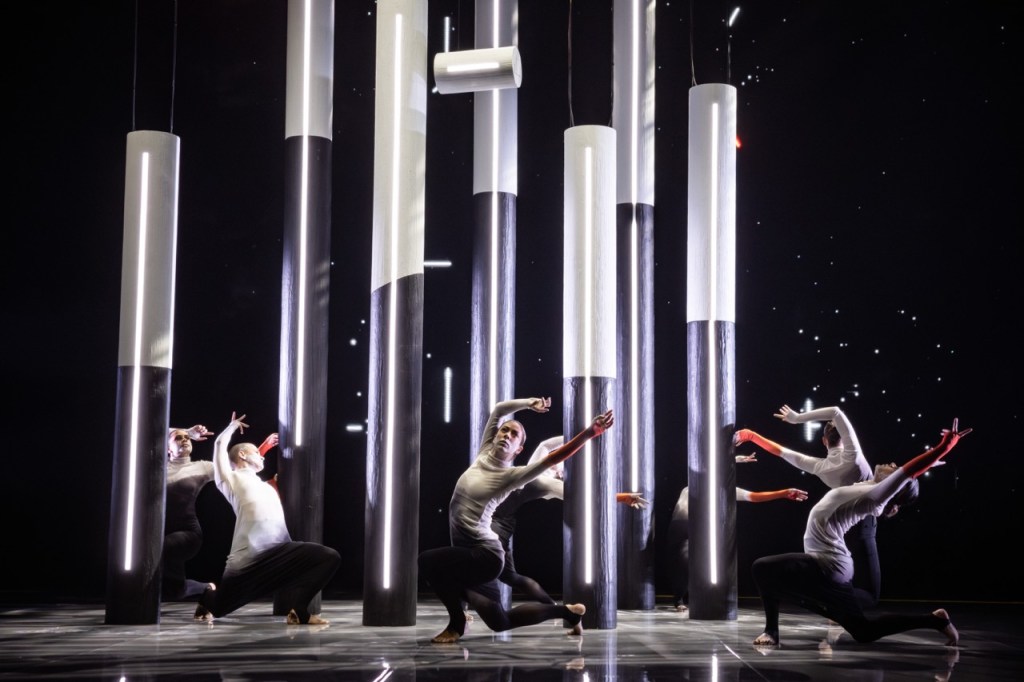
Bangarra Dance Theatre’s Illume. Photo: Daniel Boud. The centrepiece is the collaboration between choreographer Frances Rings and Goolarrgon Bard visual artist Darrell Sibosado, who have created a show that is as much multidisciplinary performance art as it is pure dance. Rings’ choreography, mixed with the forward-looking visuals, gives Illume a contemporary and commercial edge—one rooted in history but always looking towards the future.

Bangarra Dance Theatre’s Illume. Photo: Daniel Boud. Just when you think you have a grip on the show’s style, it morphs into something new. A giant mother-of-pearl shell descending from the ceiling becomes an alien behemoth to be worshipped. A sequence of rich red projections and a whipping fringe dress (costumes by Elizabeth Gadsbey) washes across the stage like a rush of blood to the head. Illume may delve into the abstract, but it does so with such verve and confidence you’ll happily go along for the ride.
The result is a show of remarkably stark imagery. These visuals will stick with me far longer than the projections of the Vivid Festival outside. With the energy of a stadium R&B gig and the creative drive of artists striving for the new, Illume sets Bangarra Dance Theatre on a path for the stars.
-
Eureka Day (Seymour) ★★★★
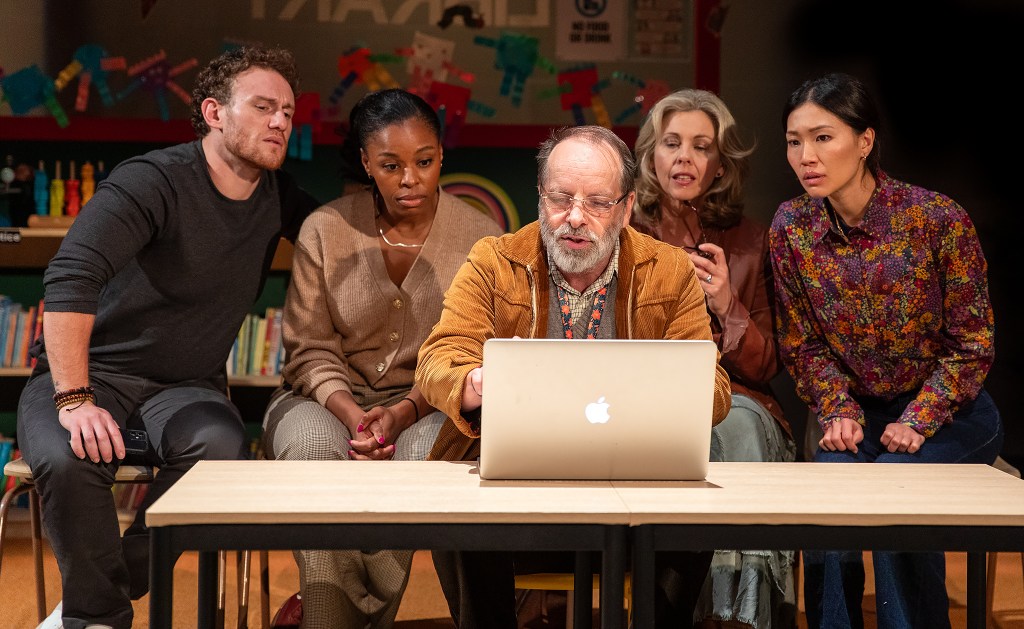
Written by Jonathan Spector. Presented by Seymour Centre and Outhouse Theatre Co. 29 May – 21 Jun, 2025.
Eureka Day is, on the surface, a funny look at the political Left’s delicate balancing act between broad inclusion and reconciling contradictory beliefs. Set in 2018 at a progressive private primary school where kids learn both spelling and social justice, this group of compassionate parents and educators finds themselves stuck in a moral quandary that feels all too familiar. But I must confess, I took away a deeper, simpler truth – parents of school kids are just the ****ing worst.
The parents on the “Eureka Day” school Executive Committee have gathered to welcome a new member, Carina (Branden Christine), and to debate making their admissions form even more inclusive. The committee is chaired by the accommodating Don (Jamie Oxenbould) and includes founding parent Suzanne (Katrina Retallick), stay-at-home dad Eli (Christian Charisiou), and May (Deborah An). Their discussion is a MAGA-head’s nightmare of liberal jargon and identity politics. But the usually open and accepting community takes a darker turn when a mumps outbreak hits the school. The Committee is soon flooded with angry parents on both sides of the vaccination debate, exposing deeper divisions that threaten the school’s future.
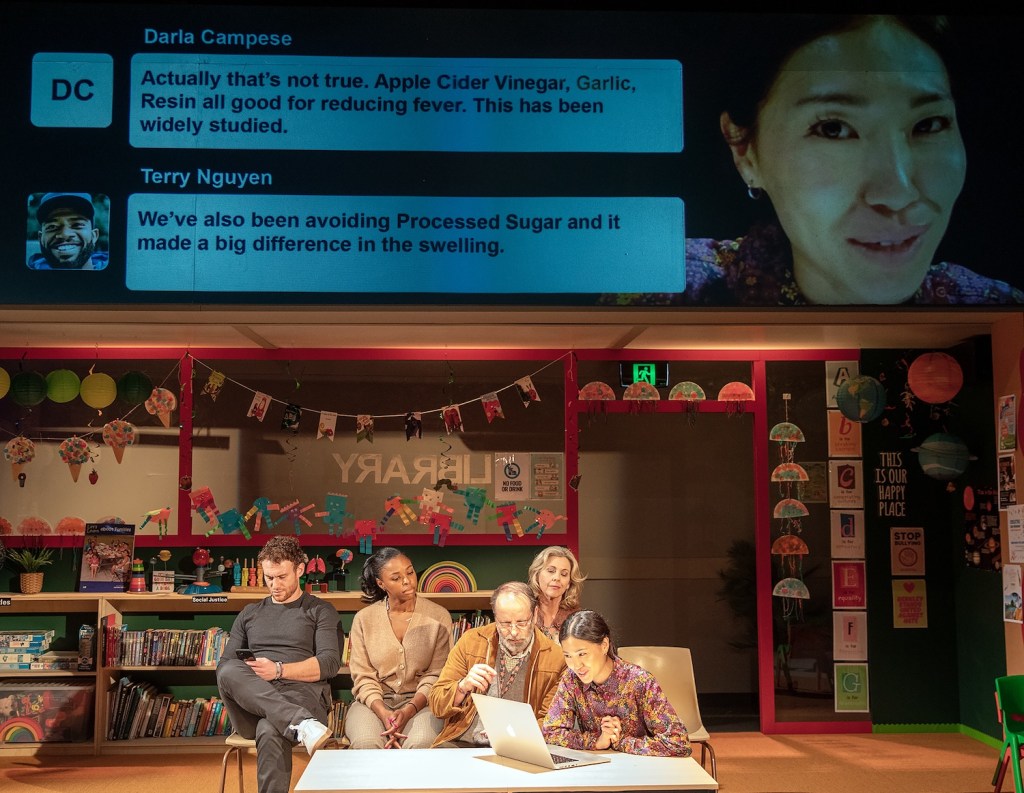
Christian Charisiou, Branden Christine, Jamie Oxenbould, Katrina Retallick & Deborah An. Photo: Richard Farland. The highlight of Eureka Day is an online forum where the Committee tries to listen to parents’ feedback after temporarily closing the school to quarantine. As Don speaks on video, the parents’ chat is projected above him. What starts as typical tech issues (one parent can’t figure out the live stream, etc.) quickly devolves into a sadly familiar online “flame war” (do we still call them that?) between parents. But theatrically, what seems like chaos reveals itself as a carefully timed ballet of dialogue and projection. The audience splits between the live discussion on stage and the scrolling text above, and the two streams of information dovetail into wonderful comedic moments—like when the live cast is upstaged by a thumbs-up emoji.
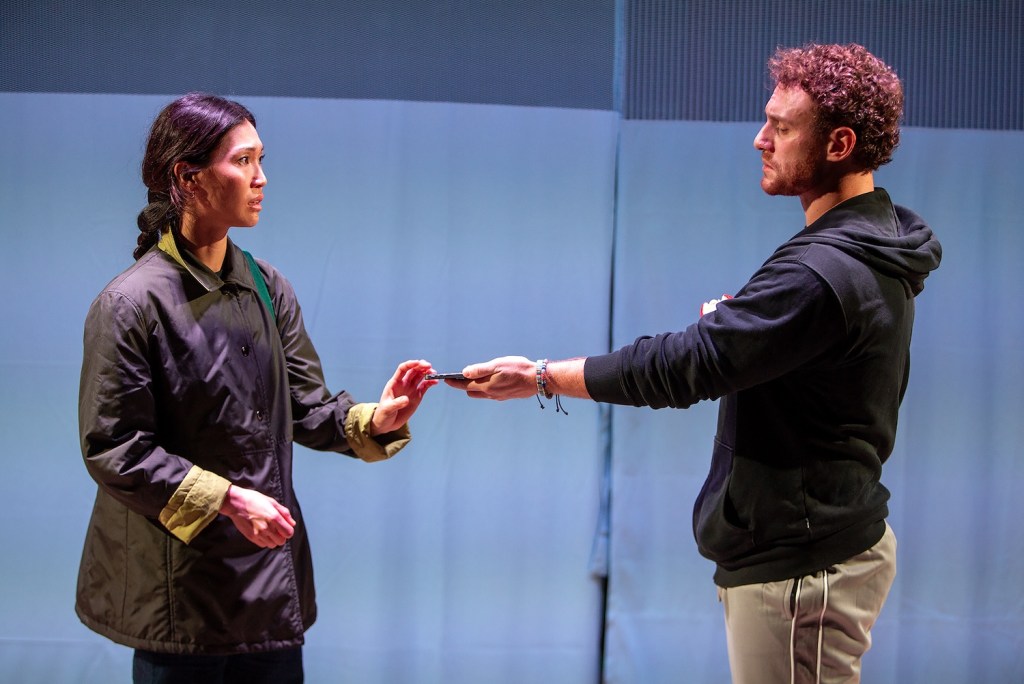
Deborah An & Christian Charisiou. Photo: Richard Farland. Among the Committee members, opinions on vaccines – and more broadly on liberal ideals clashing with emotional realities – vary widely. How can you foster consensus while including such divergent viewpoints? Suzanne refuses to introduce a vaccination mandate, advocating for families who feel attacked for distrusting medicine. May is cautious and hasn’t vaccinated her own daughter. Eli staggered his son’s vaccinations but believes having them was the responsible thing to do. Carina is shocked parents aren’t following the best science to protect their kids. It’s a spectrum from evidence-based reasoning and faith in institutions to woo-woo denialism and “alternative facts” (remember those?). At the centre, poor befuddled Don tries to create a safe space for all viewpoints to be heard and respected—but it’s a losing battle.
Set and first staged in 2018, the play offers a prescient pre-Covid look at how anti-scientific views and online disinformation have taken root in society. The fact it so clearly predicted what happened a few years later is disturbing. But this saves it from being just a “Covid play”; it’s about something more fundamental.
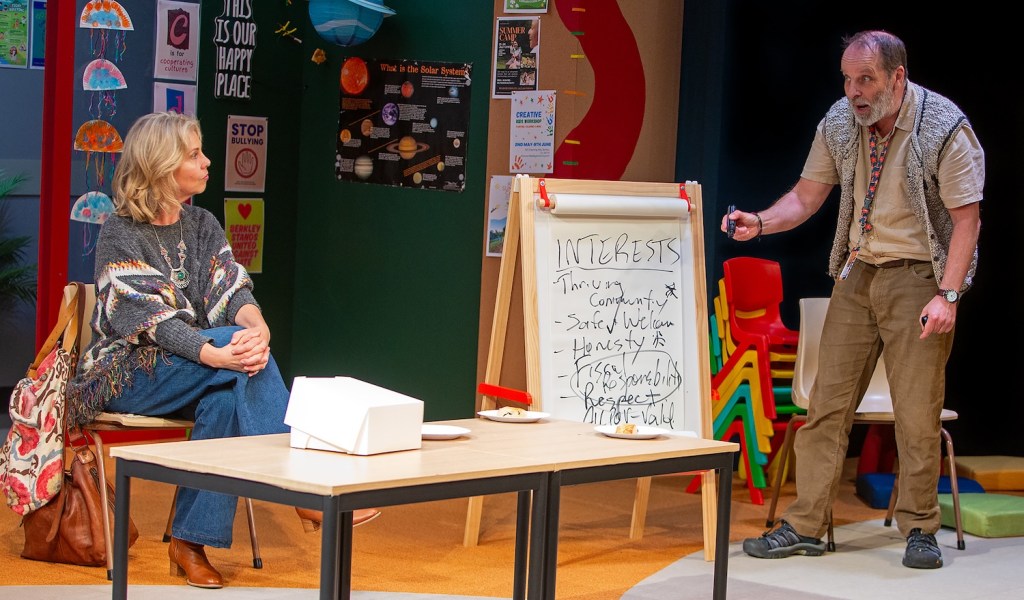
Katrina Retallick & Jamie Oxenbould. Photo: Richard Farland. Playwright Jonathan Spector wraps this moral and intellectual debate in the comedy and drama that play out at every school drop-off. The intense politicking and subtle jibes behind smiling teeth grow sharper as the emotional stakes rise. We’re invited to laugh at the well-meaning, stereotypical liberal parents we all recognise (debating the ethics of disposable plates while eating rustic artisan muffins). At times, the “spoonful of sugar” threatens to overpower the “medicine,” and you may laugh more than you think—but you’ll never stop being entertained.
The cast are terrific, with careful and subtle comic timing. Katrina Retallick makes it easy to laugh at the earnest and emotional Suzanne without undermining her core. Branden Christine’s Carina throws stunning side-eye as she fights for rational thought. But for me, Deborah An’s May holds the key to the play—caught in the middle, burdened with information and aware of the medical sciences’ history of hubris, she is simply lost trying to do the right thing.
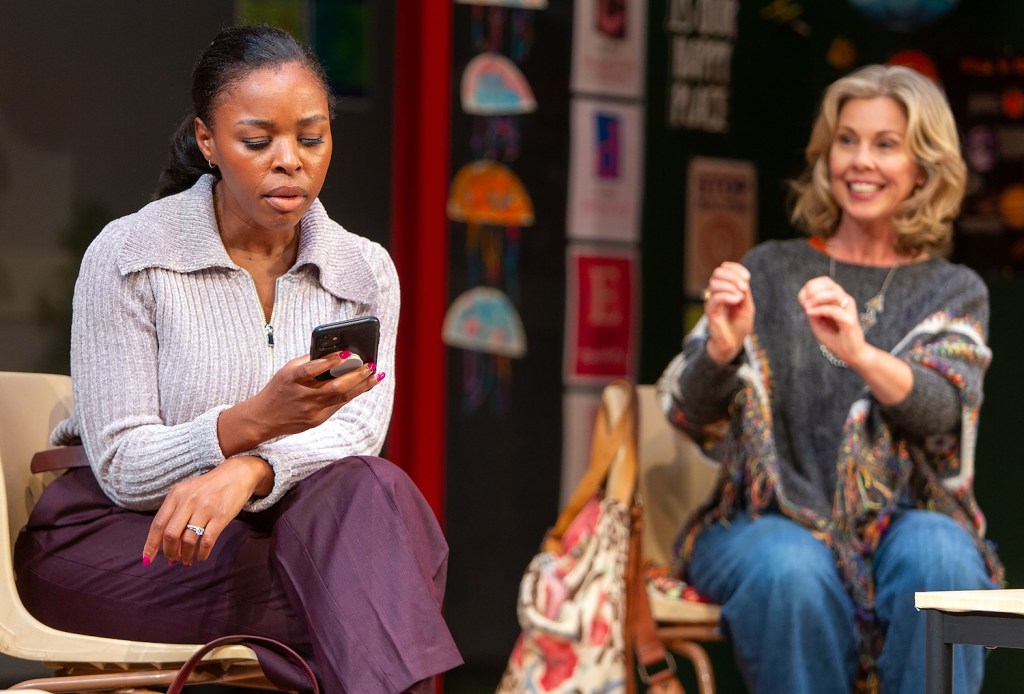
Branden Christine & Katrina Retallick. Photo: Richard Farland. Director Craig Baldwin’s light touch keeps things organic and genuine, allowing moments of farce to unfold naturally. Through both the fun and emotionally fraught scenes, the play remains grounded in a human truth: these are regular people, with good intentions, struggling to handle an intense and confusing situation—leading to big laughs and tears.
To the play’s credit, it doesn’t sit on the sidelines, leaving the final judgement to the audience. It makes its case clearly and compassionately, without the cynical bite of something like Bruce Norris’ Clybourne Park. But perhaps its biggest message isn’t about conspiracy theories, parental rights, or medical science at all. Eureka Day delivers a cold, hard fact: even in fiery, emotional ethical debates… money talks the loudest.
-
Subscribe
Subscribed
Have a WordPress.com account? Log in now.

