-
Welcome to Cultural Binge

The rating system is simple:
★★★★★ – Terrific, world-standard. Don’t miss.
★★★★ – Great, definitely worth seeing.
★★★ – Good. Perfectly entertaining. Recommended. Individual mileage may vary.
★★ – Fine. Flawed and not really recommended, but you may find something to appreciate in it.
★ – Bad (& possibly offensive).
See more reviews over at The Queer Review.
Instagram: @culturalbinge
Substack: culturalbinge.substack.com
Email: chad at culturalbinge.com
-
Mary Jane (Old Fitz) ★★★★
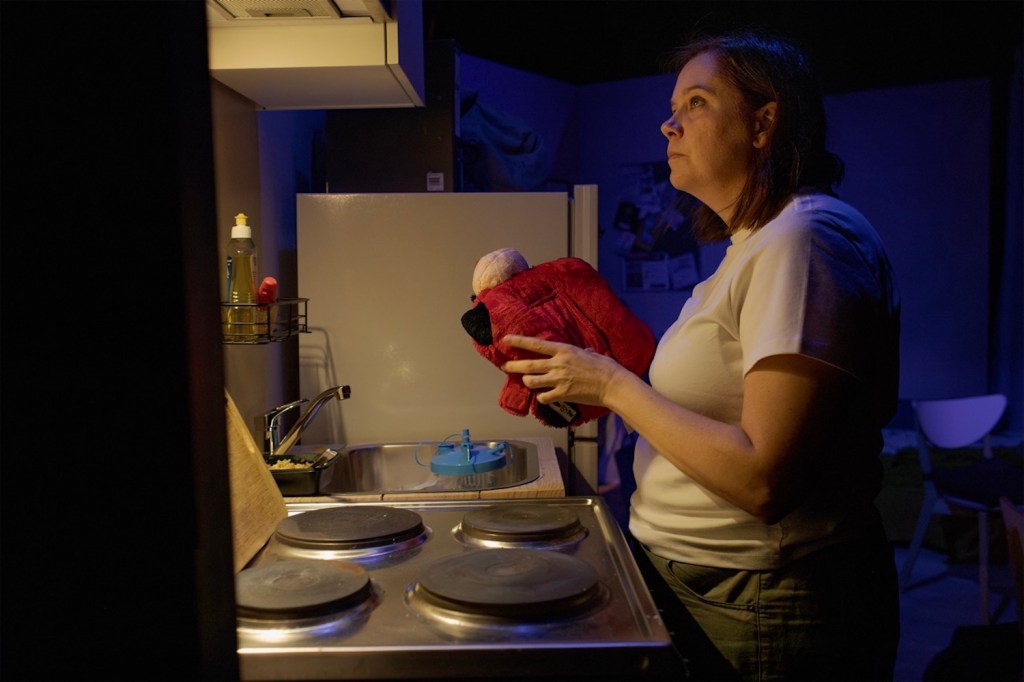
Written by Amy Herzog. Australian Premiere. Mi Todo Productions. The Old Fitz. 23 May – 15 Jun, 2025.
There is a quiet elegance to Amy Herzog’s Mary Jane that is gently and overwhelmingly affecting. This is pure theatre—a great text combined with sympathetic acting—storytelling at its best.
Single mum Mary Jane (Eloise Snape) lives with her toddler son Alex in their small apartment in Queens. Alex suffers from cerebral palsy and associated medical issues, requiring constant medical supervision and care. She remains upbeat but grounded as she navigates this life. Around her, a parade of nurses, therapists, friends and fellow parents circle, showing us new angles on this strong and resourceful woman.

Photo: Phil Erbacher. The plot is remarkably simple; this is a study in character—and I do mean character, as in internal fortitude and strength of moral purpose. Mary Jane is generous, frazzled, tired, friendly, compassionate and more, dealing with bureaucracies and life-and-death situations. She is Alex’s only advocate, holding it all together by the skin of her teeth.
Herzog has the confidence to let us sit with Mary Jane and slowly absorb the details. Alex, never seen and only heard via the gentle beeping of machines off-stage, is the centre of her world. She is helped by no-nonsense nurses and friends who do what they can, but ultimately the weight rests on her shoulders—an impossible burden for anyone to bear.

Photo: Phil Erbacher. Eloise Snape’s performance is subtle and powerful. In a play that draws gasps from the simplest of line readings, Snape measures out her emotions and deep-rooted frustrations in micro-moments. Director Rachel Chant never lets the performances telegraph more than they need to. The rest of the cast—Di Adams, Sophie Bloom, Isabel Burton and Janine Watson—play two roles each, filling out the world.
As Mary Jane bounces off the other characters, we explore thoughts on mortality, religion, endurance and love without ever feeling forced. As events happen off-stage or between scenes, we sit with Mary Jane through the aftermath as silent observers to her pain.

Photo: Phil Erbacher. It is refreshing and moving to see a piece of theatre that eschews gimmicks of any form. There is no twist in the writing, no moment of revelation. This is a slice of one woman’s life presented with grace and the composure to let the audience follow its lead. This play whispers when others want to shout.
Mary Jane is a gorgeous piece of theatre that gives us the honest gift of human connection.
-
Beetlejuice (Regent Theatre) ★★★★

Music & lyrics by Eddie Perfect. Book by Scott Brown and Anthony King. Based on the Geffen Company Picture with a story by Michael McDowell & Larry Wilson. Michael Cassel Group. Regent Theatre, Melbourne. 27 May – 31 Aug, 2025.
Beetlejuice: The Musical, The Musical, The Musical (to give it its full title) has a not-so-secret weapon on stage. Forget that stripey creep in the title—the name you’ll want to say three times is “Erin Clare,” “Erin Clare,” “Erin Clare!”
Lydia Deetz (Karis Oka) is mourning the loss of her mother. She’s become a full-on teen goth, much to the dismay of her father Charles (Tom Wren) and his life coach/secret girlfriend Delia (Erin Clare). When they move into a new house, Lydia finds herself hanging out with the ghosts of the previous owners, Adam and Barbara Maitland (Rob Johnson and Elise McCann), and a disgusting ghost with a nasty plan named Betelgeuse (Eddie Perfect), who may have a way for her to reunite with her dead mum.
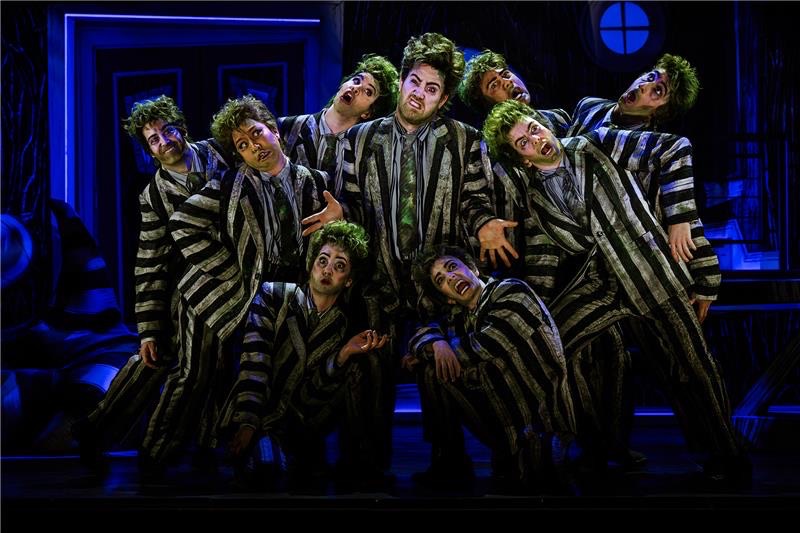
Eddie Perfect & ensemble. Photo: Michelle Grace Hunder. I’ll be upfront about the fact I’ve never seen the Tim Burton film Beetlejuice, so I’m judging the show purely on what happens on stage, without any knowledge of “in-jokes” or Easter Eggs that might exist.
Beetlejuice is the rarest of things—a film-to-musical adaptation where the book is better than the music! And the music isn’t exactly slouching either. Eddie Perfect’s score is fun, in a pretty standard rock-musical mould, with enough playfulness and invention to raise it above the pack of similarly IP-driven shows. “Say My Name” and “The Whole ‘Being Dead’ Thing” get a lot of mileage teasing out the story’s premise, while giving us plenty of laughs and big ensemble numbers.
It was the book by Scott Brown and Anthony King that really got my attention for the great gags it found along the way. It reminded me of & Juliet’s book, which was sharp in its own right and could have sustained the show as a play without the tunes. Similarly, here the script is filled with clever wordplay that puts other shows to shame.
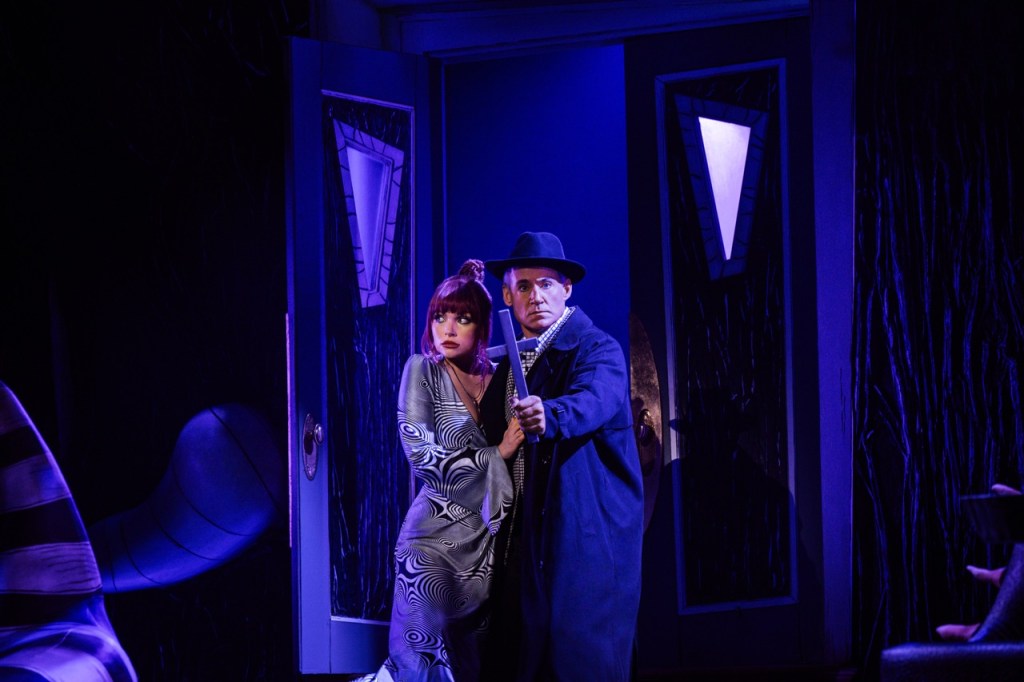
Erin Clare & Tom Wren. Photo: Michelle Grace Hunder. This is where Erin Clare gets to strut her not-insubstantial stuff, having the bulk of the show’s jokes all to herself as Delia, the show’s only purely comedic role. It must be daunting taking on a character originally played by comedy genius Catherine O’Hara, but thankfully the role of Delia has been reworked, giving her room to make it all her own. Repositioned now as Charles’ girlfriend, Delia is a colourful foil to Lydia’s dark, gothic presence. It’s a scene-stealing performance that threatens to run away with the show.

Karis Oka Photo: Michelle Grace Hunder. Karis Oka, meanwhile, plays things straight as Lydia. Vocally astonishing, Oka faces the challenge of making Lydia likeable. As a character, she is sullen and makes disastrously bad choices due to her grief. Oka’s performance perhaps lacks the shades of nuance required to make Lydia anything more than a plot engine, moving the story along.
The rest of the cast are all excellent (even if performers like Elise McCann feel underused). It’s great to see Rebecca Ordiz (who I last saw breaking hearts and getting laughs in The 25th Annual Putnam County Spelling Bee at Hayes) get a featured moment as a plucky but unlucky Girl Scout. On the day I saw the show, Eddie Perfect was out, and James Haxby took on the role with ease.

Eddie Perfect & Noni McCallum. Photo: Michelle Grace Hunder. Scenic design by David Korins and Peter Nigrini’s projections merge to provide some fun effects (it all gets a bit Vivid in there), and Alex Timber’s original direction finds ways to bring the cinematic imagination to the stage. Jeremy Chernick’s special effects and Michael Weber’s illusions are not groundbreaking by any means, but it is entertaining to see how things translate to the physical stage. Often the problem isn’t the effects—it’s simply that there is so much chaos on stage you can easily miss things happening right in front of you.
Beetlejuice: The Musical packs in a lot of laughs and action for a thoroughly entertaining show. It may not have the gross-out thrills the film is famous for, but it makes up for that with some surprisingly hilarious jokes, big effects, and belting comedy tunes. Get yourself on a plane down to Melbourne—this one is a hell of a lot of fun.
-
The Birds (Malthouse) ★★★
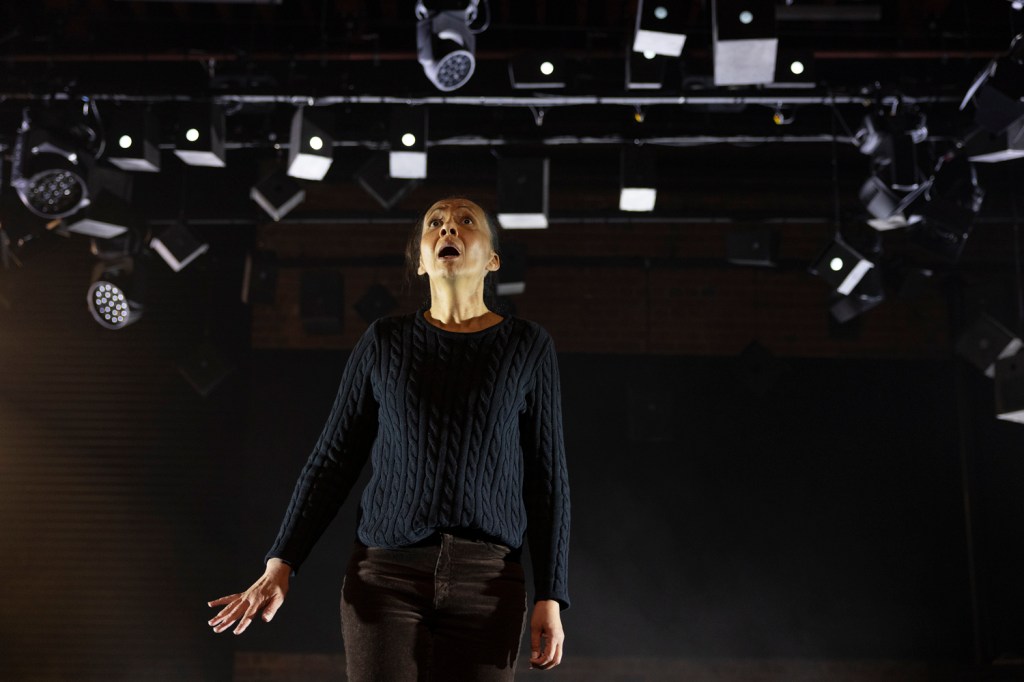
Based on the story by Daphne du Maurier. Adapted by Louise Fox. Malthouse, Melbourne. 16 May – 7 Jun, 2025.
Forget Alfred Hitchcock’s classic cinematic thriller. Forget Daphne du Maurier’s original story. Louise Fox has taken the frightening premise of an avian revolt against humanity and placed it in Australia with a sharply contemporary context to creep you out. Some intimate audio and a shape-shifting solo performance from Paula Arundell combine to create an interesting piece of theatre.
Tessa and her family (husband Nat and their two children) have made a classic Covid “sea change”, trading the city for the open spaces of farms and beaches. One night, she hears an incessant tapping at her bedroom window. Investigating, she opens the window as a bird swoops in to attack her. A scream from her daughter’s bedroom sends her bolting in and battling off dozens of birds. In the morning… she realises it wasn’t a freak occurrence.

Paula Arundell. Photo: Pia Johnson. Unsurprisingly, Paula Arundell is wonderful playing all the roles, including Tessa and her family, as well as neighbours and friends. It’s a beautifully precise array of performances showing her personal range. Vocally, she manages to convey age, gender, mood and more with impressive agility.
However, for a show aimed at providing an inventive and immersive experience, The Birds felt rather conventional on the technical side. Outgoing Artistic Director Matthew Lutton directs Malthouse’s production, which gives the audience headphones, making the sound design (and Arundell’s dialogue) feel very close. However, this is where the play fails to reach its promise. J. David Franzke’s sound design is crisp and effective but doesn’t make enough use of the intimate stereo environment to truly elevate the play. Had the sound design simply been pumped through some good surround-sound speakers in the theatre, it would have had the same effect.
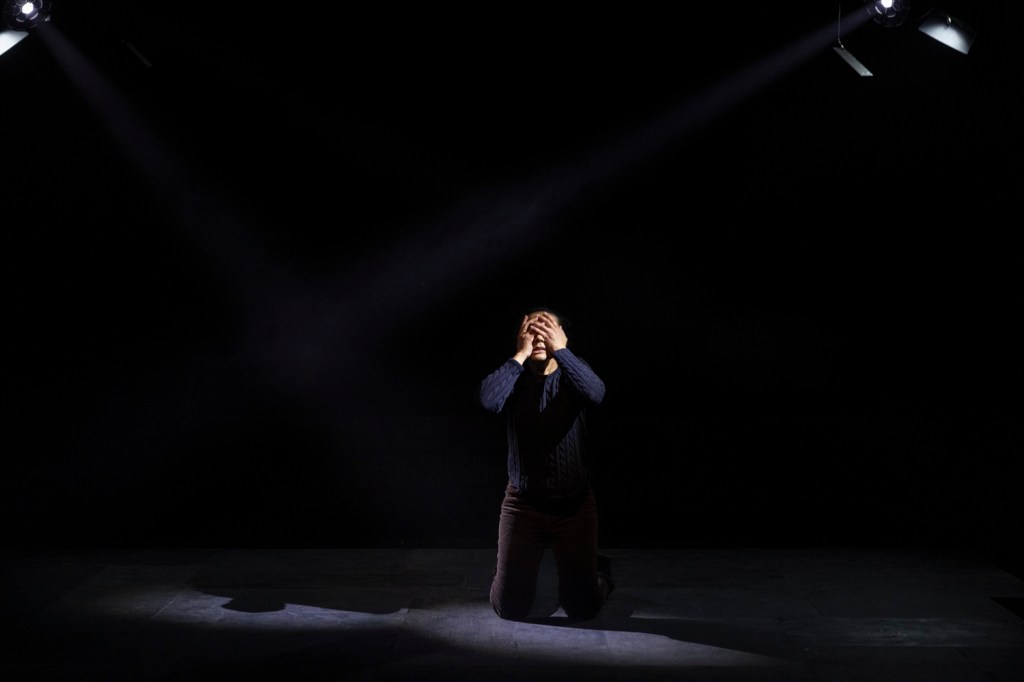
Paula Arundell. Photo: Pia Johnson. Niklas Pajanti’s ambient lighting features some interesting accents, but mostly works against the audio because the featureless lighting fails to engage the imagination of the non-existent birds. I found myself shutting my eyes to enjoy the production as an audio play, which worked wonders—placing the danger in my imagination made it more thrilling.
Kat Chan’s stage design puts Arundell on an elevated platform surrounded by props. Dozens of wooden birdhouses hang from the ceiling above her, physically reminding us of the threat we experience only through audio and lighting. Again, the abundance of space lessens the threat of attack (although the birdhouses are used to excellent effect, I just wish there was more to it).

Paula Arundell. Photo: Pia Johnson. One of the best things adaptor Louise Fox has done is take du Maurier’s post-war paranoia and place it in the world of modern conspiracy theorists and climate upheaval. While The Birds never explains the uncanny happenings, humanity’s guilt hangs over Nature’s suicidal assaults. Would anyone question the Earth’s right to defend itself against the abuses humanity has inflicted on it?
Tellingly, the play’s most disturbing moment comes not from the antagonistic birds themselves but from a morally upsetting choice Tessa must make. It is more terrifying than all the effects and relies solely on Arundell’s tortured delivery. It’s the one image that has stuck with me long after the play ended.
In retrospect, I feel the use of headphones isolated the audience in their own bubbles, muting communal gasps and reactions and lessening the theatrical experience. I still think there is much that can be done with this technique with more time and imagination to play with the form.
-
And Then There Were None (Theatre Royal) ★★★
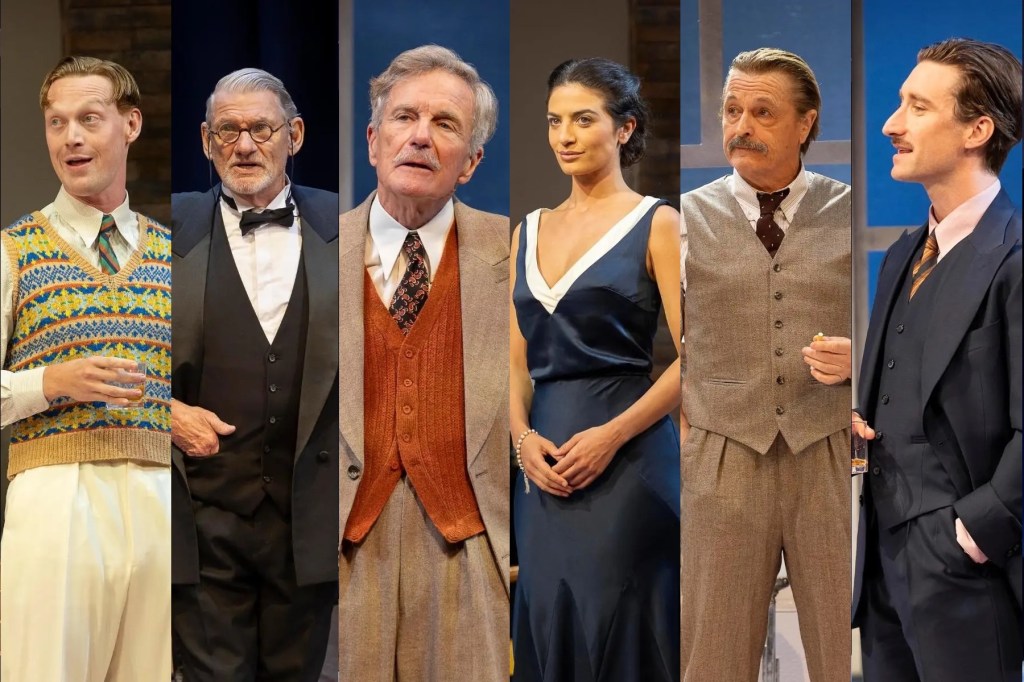
Written by Agatha Christie. Presented by John Frost for Crossroads Live. Theatre Royal, Sydney. 3 May 3 – 1 Jun, 2025.
Agatha Christie is justifiably considered one of the greats, if not the GOAT, of the murder mystery genre. And Then There Were None (not the original title) is one of her best and most groundbreaking novels, but her stage adaptation suffers from hackneyed characterisations and a slightly altered plot (no spoilers).
Ten strangers are invited to a secluded island mansion under false pretences. Once assembled, a pre-recorded voice accuses each of them of murder. But who is the mysterious Mr UN Owen who brought them all here? And who is killing them off, one by one?

Mia Morrissey & Jennifer Flowers. Photo: Jeff Busby. I’d been meaning to see And Then There Were None since it opened, but real life kept getting in the way. As the run progressed, I couldn’t help but notice the seating chart for the Theatre Royal had plenty of options available, even with the balcony closed off on weeknights. It started to look like And Then There Were None was referring to the paying audience. But a last-minute night off saw me grabbing a mid-priced ticket and sitting down for a bit of comfort crime.
The air of pantomime quickly wafted in from the painted seaview on stage, as a parade of ridiculously on-the-nose accents began speaking. One of them was actually meant to be fake, so Peter O’Brien gets a free pass. Some of the others, though, were a mix of rejects from Olivier! and extras from Downton Abbey. They weren’t all bad, not at all, but the range of accents was so artificially pointed, and seemingly mimicked from a binge-watch of The Crown, that it was hard to get past them. Once the play settled into its rhythms, and the cast began to be thinned out, the performers really got to sink their teeth into things.

Anthony Phelan, Eden Falk, Nicholas Hammond & Jack Bannister. Photo: Jeff Busby. I enjoyed the work of Anthony Phelan as the retired judge Sir Lawrence Wargrave and Jack Bannister as the irresponsible Anthony Marston (but that may be because his opening costume seemed like a bit of Doctor Who cosplay). Peter O’Brien seemed to be having the most fun on stage. Tom Stokes made for a suitably unlikable Phillip Lombard.
Structurally, the play is a sound mystery (although a 45-minute Act I feels particularly short; the story had barely started). As the psychological torture of the second act begins, the thrills kick in. With each subsequent killing driving the survivors’ paranoia higher, things veer ever closer to melodrama.

Mia Morrissey, Tom Stokes, Eden Falk, Grant Piro & Peter O’Brien. Photo: Jeff Busby. Part of this is undoubtedly due to the play itself which, like Nevin’s recent revival of Christie’s The Mousetrap, cannot escape its well-worn material that has been adapted time and time again. Having become the template for a whole sub-genre of genteel British murder, it is very easy for anyone in a Christie to stumble into cliché, which they inevitably do on occasion. But where The Mousetrap leaned into its “drawing room murder mystery” trappings, And Then There Were None tries to freshen things up, which simply reveals the creaking moving pieces underneath.
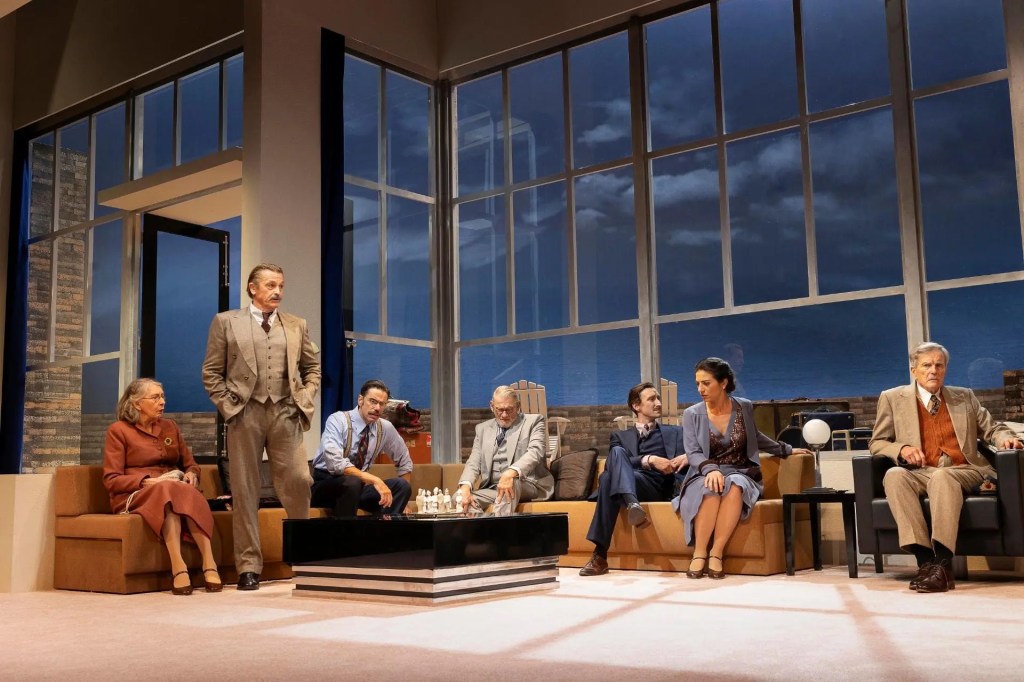
Jennifer Flowers, Peter O’Brien, Eden Falk, Anthony Phelan, Tom Stokes, Mia Morrissey & Nicholas Hammond. Photo: Jeff Busby. There is an unrelenting flatness to this production that starts to wear thin through the first act. Dale Ferguson’s open, modernist set felt fresh and clean, though possibly too sparse in places. The bright lighting didn’t differentiate moments or tones (I genuinely wondered if they’d missed a lighting cue or two – especially in the early scenes). Paul Charlier’s sound design earned the first, though not the last, laugh of the evening with its bold shock opening.
Christie’s stories are like a box of chocolates, all similar with different flavours. But instead of being a rich, dark treat with a surprise inside, this version of And Then There Were None is more like a lone white chocolate that’s all froth and no bite. I think I’ll rewatch the thrilling 2015 BBC adaptation instead.
-
Heaven (Qtopia) ★★★½

Written by Eugene O’Brien. Presented by Bitchen Wolf. Qtopia Loading Dock. 14-31 May, 2025.
Less of a two-hander and more two interwoven monologues, Eugene O’Brien’s award-winning Heaven is a later-in-life tale of self-discovery firmly rooted in character.
Middle-aged married couple Mairead (Lucy Miller) and Mal (Noel Hodda) are attending a wedding. Mairead wonders what her whole 50-plus years of life have been leading to. Is this it? A daughter she despises and a passionless marriage? Mal thinks about the roads untaken and his sensual curiosity about lithe, long-haired young men who look a bit like Jesus. Over the course of the weekend, they both take chances that open up their lives to new possibilities.
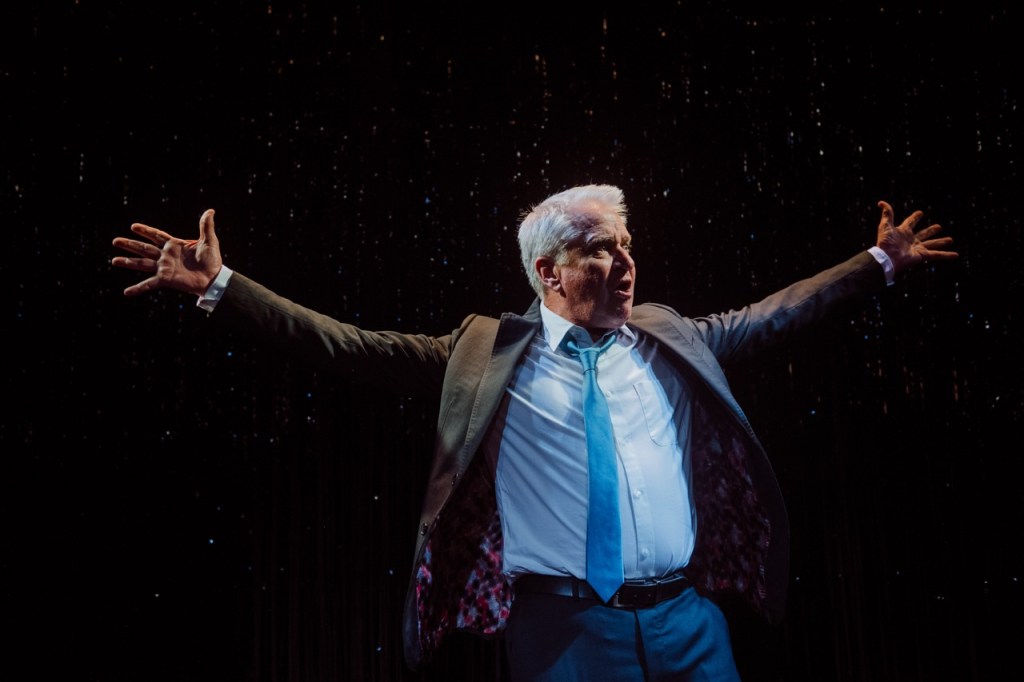
Noel Hodda. Photo: Alex Vaughan. Kate Gaul’s production keeps things simple and focused. This play is all about the charisma of the two performers, with nothing to distract you, and is the better for it. Miller is dynamic as the rough and fiery Mairead—the slightly larger role of the two. Balancing her is Hodda’s charming, bumbling Mal, who goes on a wilder adventure. As their two stories move in parallel, there is a clear love between them, but that love is not giving either of them what they need at this stage. Gaul keeps them both moving around the small space, filled with an internal energy that refuses to let either of them sit still for long.
O’Brien’s writing is rich and detailed, but at times the wall of text (with strong Irish accents) threatens to become overwhelming. With lesser performers, it would. While the two characters often inhabit the same stage space, they never interact with each other, instead speaking their internal thoughts directly to the audience. So be prepared for some direct contact as you watch the show.
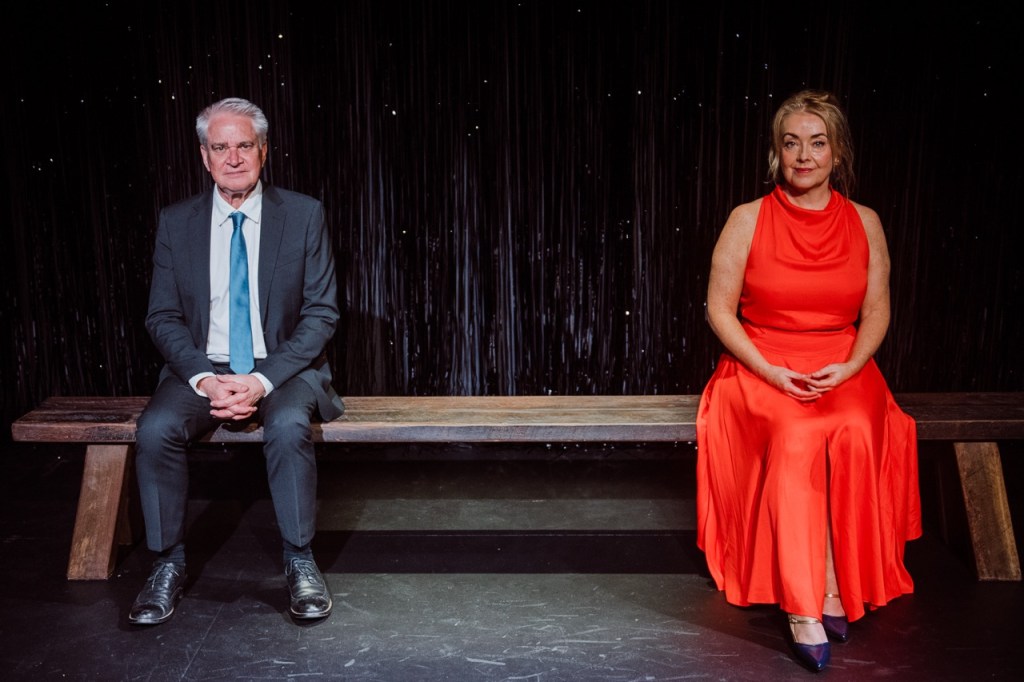
Noel Hodda & Lucy Miller. Photo: Alex Vaughan What makes Heaven work are the interesting little details. From Mairead’s dislike of her own daughter to Mal’s bittersweet longing, each feels nicely specific, saving the play from retreading tropes of ‘late bloomer coming out’ stories (although there is some of that to be found). The closing moments bring the whole show home, leaving us with a pleasant ambiguity.
Heaven is a dual character study where the details of plot are less relevant than the exploration of these two people admitting what they really want out of life. Non-judgemental in tone, the play lets them roam free without the need for definitive judgements at the end.
-
Women on the Verge of a Nervous Breakdown (Hayes) ★★★★

Music & lyrics by David Yazbek. Book by Jeffrey Lane (based on the film by Pedro Almodóvar). Presented by Pinwheel Productions in association with Hayes Theatre Co. 9 May – 8 Jun, 2025.
If chu only see one musical in Sydney this week, make sure chu choose Women on the Verge of a Nervous Breakdown. It’s the most demented, fun farce I’ve seen in a while where the only thing more absurd than the plot, is the accents.
We’re in Madrid, Spain, in 1987. The city is bubbling with political tensions and old school sexism. It’s here we fine actress Pepa (Amy Hack) losing her mind. Her lover and co-star Iván (Andrew Cutcliffe) has dumped her via answering machine (ahh, the 80s), leaving her heartbroken and more than a little strung out. She’s on a mission to find him, but things take a number of left turns when she instead runs into Iván’s ex-wife Lucia (Tisha Keleman) and their twenty-year-old son Carlos (Tomäs Cantor). On top of all that, her best friend Candela (Grace Driscoll) has just discovered that her passionate new lover may, in fact, be a wanted terrorist… What’s a woman in her early 40s to do?

Ensemble of Women on the Verge of a Nervous Breakdown. Photo: Daniel Boud. This is exactly the kind of show I love seeing at the Hayes: a fresh reinvention of a failed Broadway show. I saw the West End production of this around ten years ago, and it bored the pants off me, but this new version by director Alexander Berlage is anything but dull. Quite the contrary – you’ll leave far too over-stimulated.
As ever, Amy Hack is brilliantly engaging as Pepa. She starts the musical as an emotional and physical wreck and runs a marathon before the night is through – dodging the police, ex-wives, work colleagues, and a literal pillar of flame (no joke; God only knows how they’re getting away with having a not-insubstantial physical fire on stage). Pepa is rarely still, and when she is, she is either frozen in place in an awkward pose, unconscious… or both.
Hack is backed by a team of vocal and comedic heroes. Grace Driscoll’s simple-minded Candela – a model blessed with all the gifts physical beauty brings, including an underdeveloped ability to think for herself – is hilarious to watch in her confusion. Tomäs Cantor flits between a number of memorable minor roles before making his mark as Carlos, a young man being pushed and pulled by the women around him. Tisha Keleman’s Lucia gets some of the best lines in the show, and her vocals are powerhouse.

Melissa Russo & Andrew Cutcliffe. Photo: Daniel Boud. Being a Berlage jam, the technical details here do wonders on a Hayes budget. The maximalist set (by Hailley Hunt) is a multicoloured cacophony of items, all of which multitask as different locations depending on the scene, but all combine into an eclectic, cohesive vision of Pepa’s life and style. Not an inch of the Hayes’ limited space is wasted. Similarly, Sam Hernandez milks the 80s for iconic fashion images that brand each role instantly and ensure the cast are never lost in the jumble-sale background.
Chiara Assetta’s choreography amplifies this incredibly physical show, with the cast dancing and climbing over anything and everything. Phoebe Pilcher’s lighting brings specificity to scenes and a disco energy to the action sequences (did I mention there’s a car chase? Yes, there’s a car chase). Be sure to keep an eye on the surtitles above the stage that let you know where each scene is set.
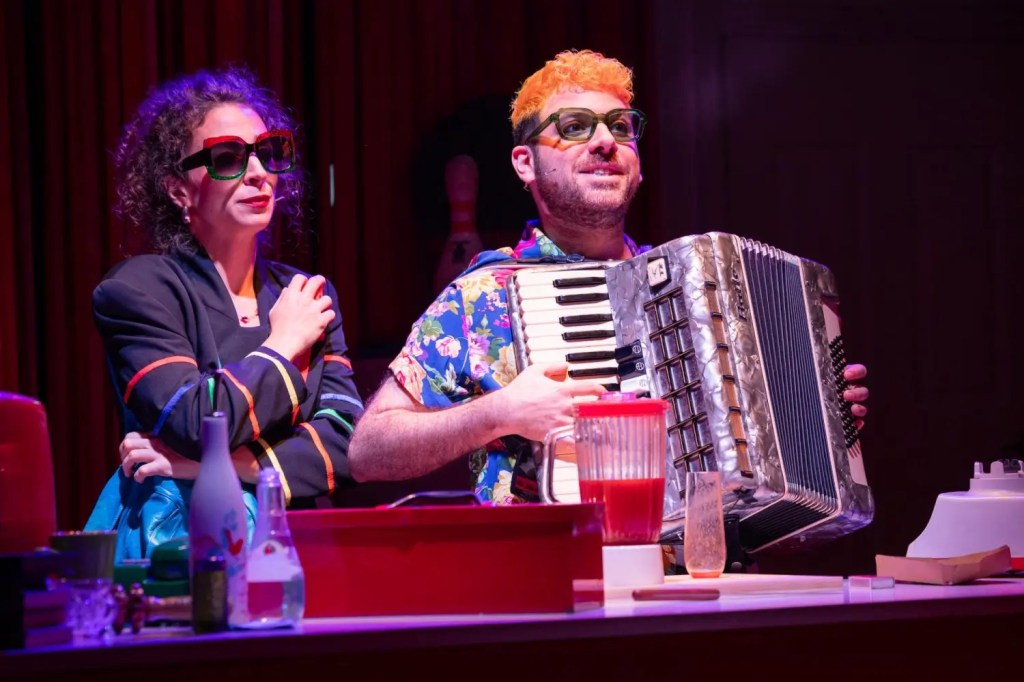
Amy Hack & Aaron Robuck. Photo: Daniel Boud. Of course, the show itself is flawed, without a doubt. It could do with a good trim – not because it’s long or dull, but because it’s padded out with unnecessary numbers that don’t add much to the texture of the piece. Yazbek’s score hits the skids with the ballads but roars to success with the comedy numbers – this sounds like nothing else I’ve heard on stage, capturing the energy of Almodóvar’s filmmaking. These manic tunes combine the fast patter and wordplay of a proto-Hamilton. It’s a shame the audio in the Hayes can be muddy at times, especially when the full band is playing, and the lyrics can be lost in the mix. In addition, Aaron Robuck’s Taxi Driver character is redundant, giving unnecessary exposition and slowing the action down.
Part of the great fun of Women on the Verge is how borderline inappropriate it gets (enough to annoy some of the more uptight/self-righteous reviewers). This is a farce, with an 80s European edge; if you think this is going to be some beige, sanitised, intellectual comedy, you’ll be left disappointed. The accents are absurd, the men are stupid and driven by their penises; the women are… well, the title tells you. The characterisation isn’t that deep.

Tisha Keleman & Sean Sinclair. Photo: Daniel Boud. And boy, is this show queer. No, let me rephrase that as it’s set in the 80s. Boy, is this show gay! Not explicitly in any way (all of the characters are very hyper-stylised in their gender-specific roles) but the high camp of the farce and the deep affinity for the lives of women being screwed around by their men feels very homo-adjacent. Oh, and the asses. Berlage makes full use of his peachy ensemble and their tight outfits.
Women on the Verge of a Nervous Breakdown is bawdy, silly and full of verve – I mean energy, but probably also the champagne. I’ve barely mentioned Nina Carcione’s virginal Marisa, Mel Russo’s lawyer (& feminist) Paulina, or Sean Sinclair’s numerous comedic appearances – all of which deserve praise. This show is packed full of goodies to enjoy (keep an eye out for Tomäs Cantor’s extra hits of physical humour in the background of scenes). Delightfully demented and overflowing with lyrics that will leave you yelping with surprise, this production has rehabilitated a show I long thought was a write-off. Now I need a Valium to help me calm down…
-
I & You (Belvoir 25a) ★★★½
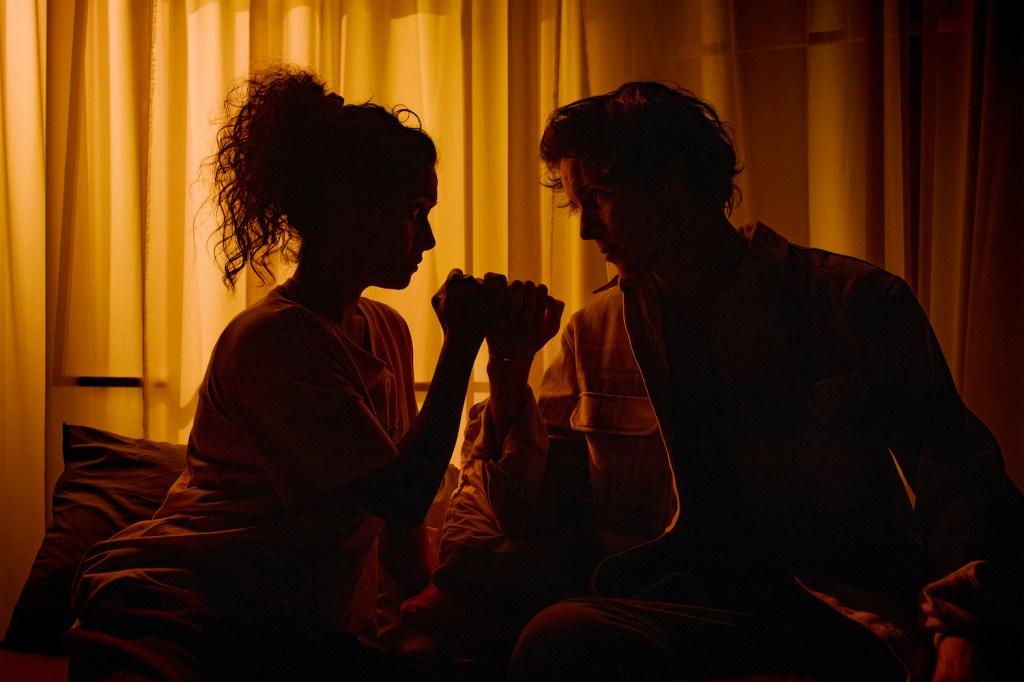
Written by Lauren Gunderson. Belvoir 25a. 6-18 May, 2025.
It’s the most YA of YA plots—so much so you could probably rename Lauren Gunderson’s 2014 teen romance I and You something like The Fault in Our Star Turtles (you’ll get it when you see the show). Despite occasionally feeling more like someone’s film pitch than a piece of theatre, I and You achieves its goals admirably. It’s adorable and sad. Sadorable, if you will.
Caroline (Alyssa Peters) is home sick—and has been for most of her life. She’s waiting for a kidney transplant, spending her time in her bedroom immersed in the back catalogue of Elvis and dancing around with her favourite toy, a blue turtle. She’s surprised when athletic schoolmate Anthony (Josh Hammond) turns up trying to rope her into a school project analysing a poem by Walt Whitman. And so “grumpy, sick girl” meets “handsome jock,” and the duo are forced to spend hours alone together to hit their assignment deadline.
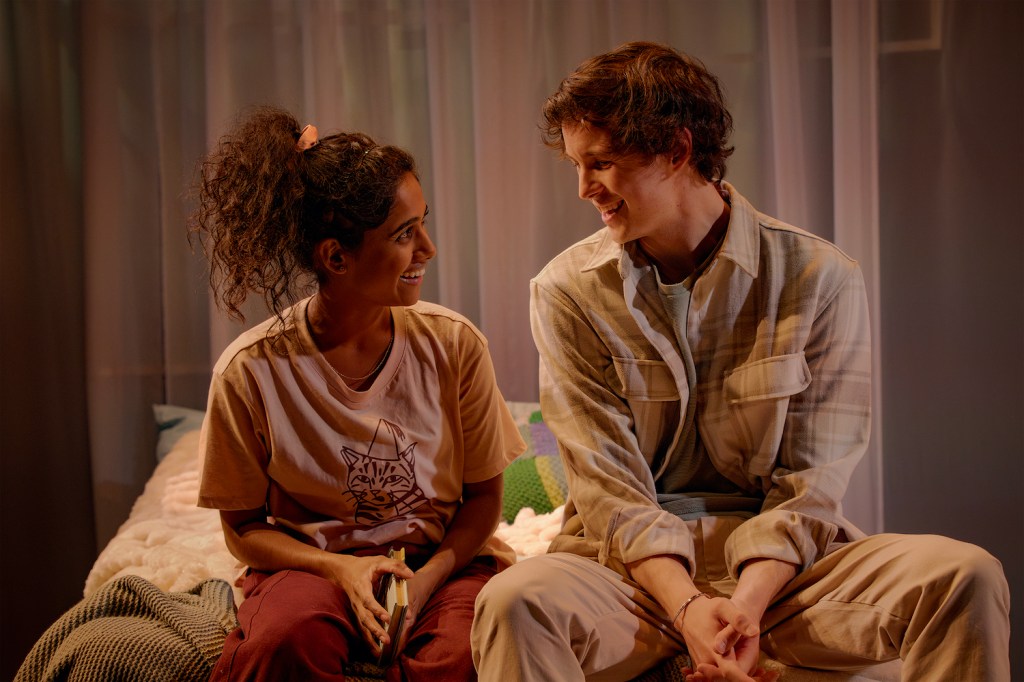
Alyssa Peters & Josh Hammond. Photo: Phil Erbacher. Surprise: she’s not that mean after all, and he has the soul of a poet and a taste for jazz. They meet-cute hard, talking about life, death, their dreams and secret passions. But there’s a twist… which I’m obviously not going to spoil.
This is schmaltz with a side of saccharine, and it’s not trying to pretend otherwise. Two attractive young people in a room for a play—you won’t be surprised at where it goes, only that it takes as long as it does to get there. I and You doesn’t have a message or a grand moral to deliver. Instead, it wraps you up in a pulpy romance plot that won’t make your brain do much more than go “awww.”
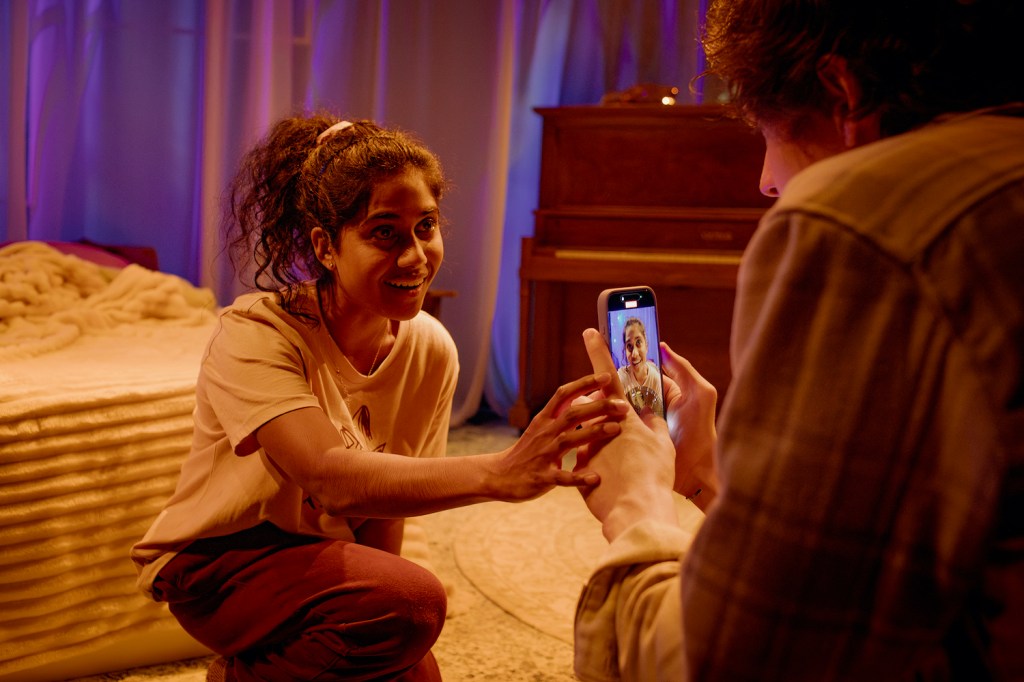
Alyssa Peters & Josh Hammond. Photo: Phil Erbacher. The dialogue is quippy teen banter—never too dense—and delivered by two actors with oodles of charm. Like the overly loquacious teens we’ve come to expect from every teen-focused TV show post-Dawson’s Creek, the conversation isn’t remotely realistic, but it has a cadence all its own that works in this artificial environment.
Of course, the kicker is that the one bit I most want to talk about is tied up in the play’s “twist”—which we can’t really discuss—but it will make you look back at the previous hour searching for hints. My complaint is that there aren’t many, which makes the late tonal shift feel more like a cheap trick than a meaningful reveal. I saw another play a few years ago that used the exact same twist (oddly, that one was a horror—I’m not telling you what it was), and it was layered into the story with much more art and subtlety.
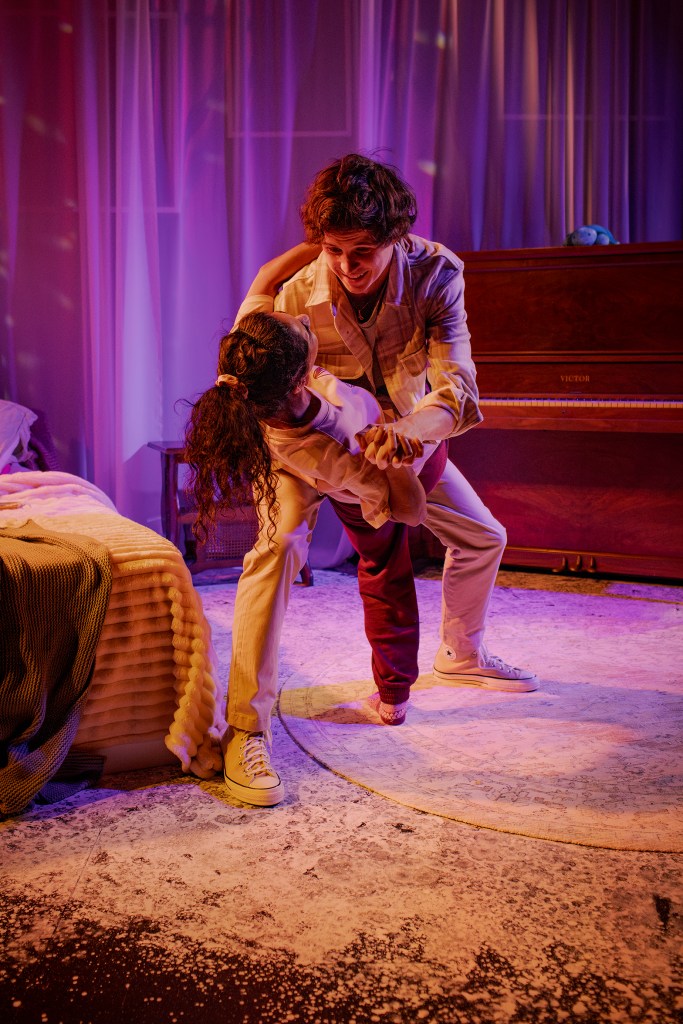
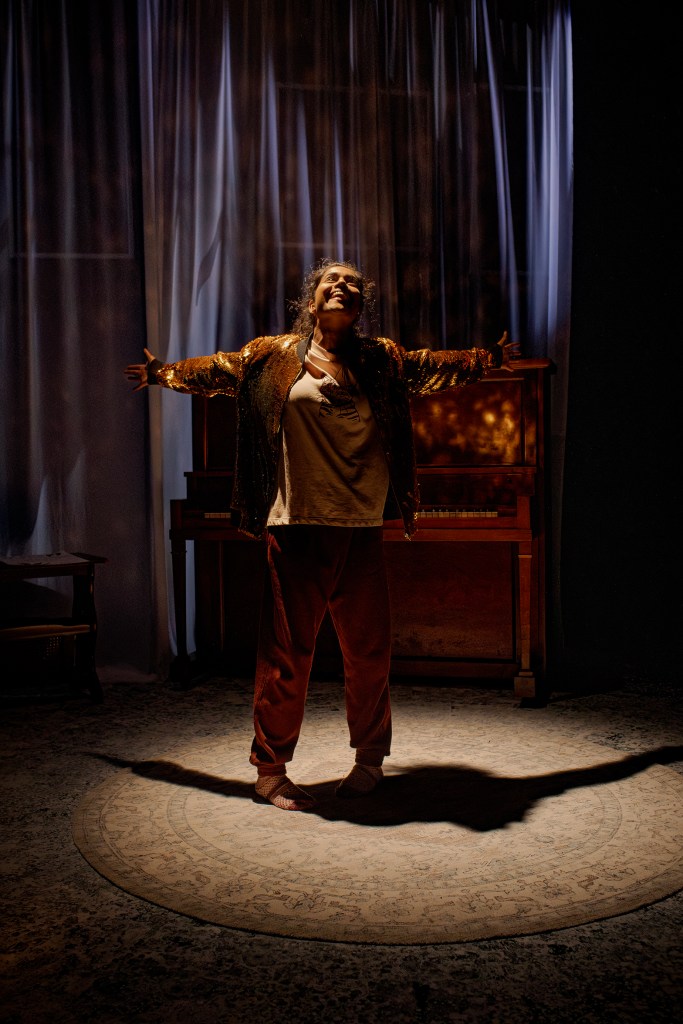
Alyssa Peters & Josh Hammond. Photo: Phil Erbacher. I and You continues the 25a trend of looking and sounding like it cost far more than the $2,500 budget would suggest. The set and lighting by Saint Clair & Mason Browne have a whimsical charm (I did wonder if the splatter effect on the ground was actually left over from Snakeface, to be honest). Claudia Barrie’s direction is focused and keeps things moving, though the play does occasionally feel like it’s spinning its wheels, waiting for the next conversational turn. The closing moments, including an expressionistic dance sequence, didn’t quite achieve the strong emotional climax they were aiming for.
Despite its lack of grander themes, I and You delivers a simple, brisk (only 75 minutes long) teen story. More importantly, it serves as a showcase for two very good performers—whose agents should be dragging every casting director to come and see them. Fans of YA media will enjoy it. Is this essential viewing? No. Is it a sweet reprieve from the world outside? Definitely.
-
Happy Days (Sydney Theatre Co) ★★★★
Written by Samuel Beckett. Sydney Theatre Company. 5 May – 15 Jun, 2025.
Usually, when a critic says a show is “static”, it’s a criticism—but not in the case of Samuel Beckett’s surreal Happy Days. Here, being “static” is the whole point.
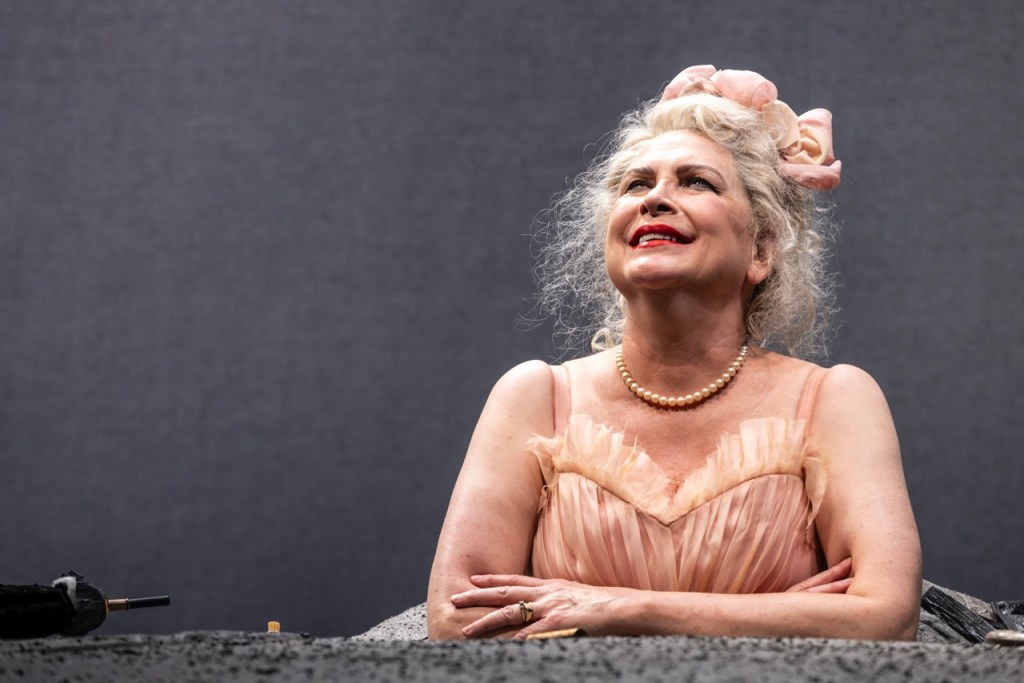
Winnie (Pamela Rabe) wakes up and is ready to tackle the day. In a stream of consciousness, she talks us through her orderly daily routine: brushing her teeth, combing her hair, and timing exactly when to sing her song. She is accompanied by her capacious black bag and a positive attitude. When confronted with the gradual decay of her possessions, or even the decline in her eyesight, she simply sighs and carries on—what else can she do? Her only human companion is her husband, Willie (Markus Hamilton), who potters around occasionally, muttering the odd word or two, like any old married couple. The only difference is… Winnie is encased in solid rock up to her waist.
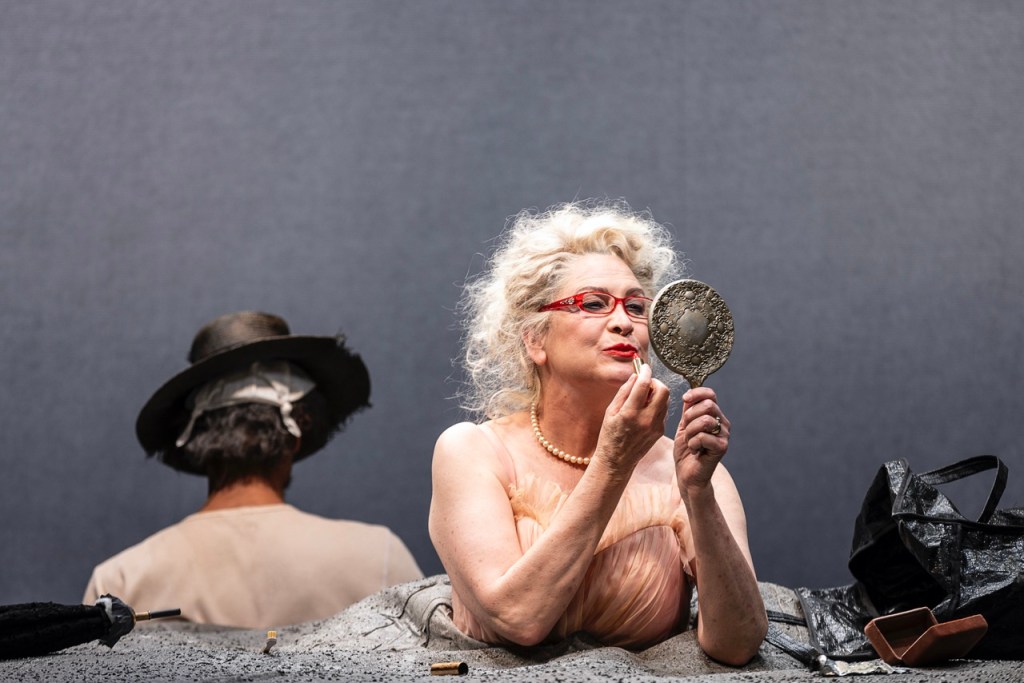
Markus Hamilton and Pamela Rabe. Photo: Brett Boardman. Beckett’s Winnie is a powerhouse of cheerful denial. It takes a performer of intense charisma to hold the audience’s attention for a solid 100 minutes with little more than her voice and facial expressions. But that doesn’t seem to limit the ways in which Winnie can be interpreted and performed. I’ve seen three main stage productions of Happy Days (Juliet Stevenson at London’s Young Vic, Judith Lucy at Melbourne Theatre Company, and now Pamela Rabe), and each has found nuances and elements to make entirely its own.
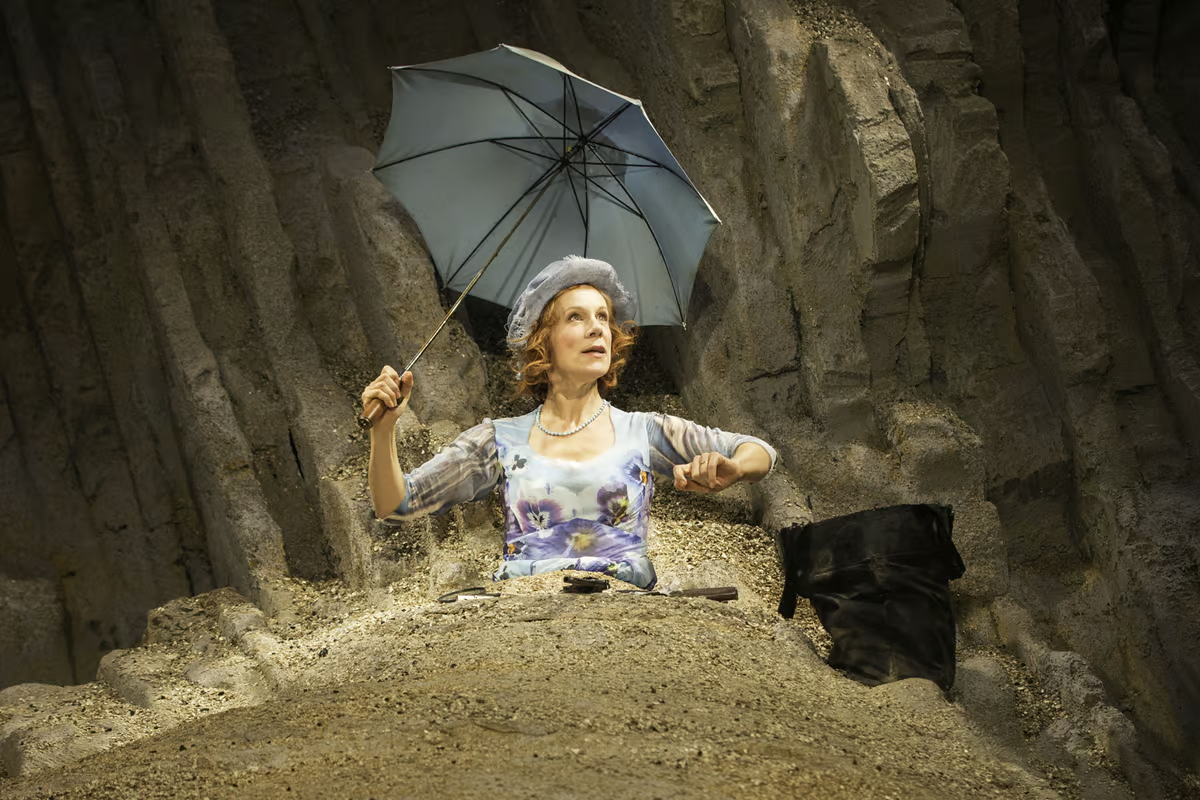
Juliet Stevenson (The Young Vic, 2015) Photo: Johan Persson. 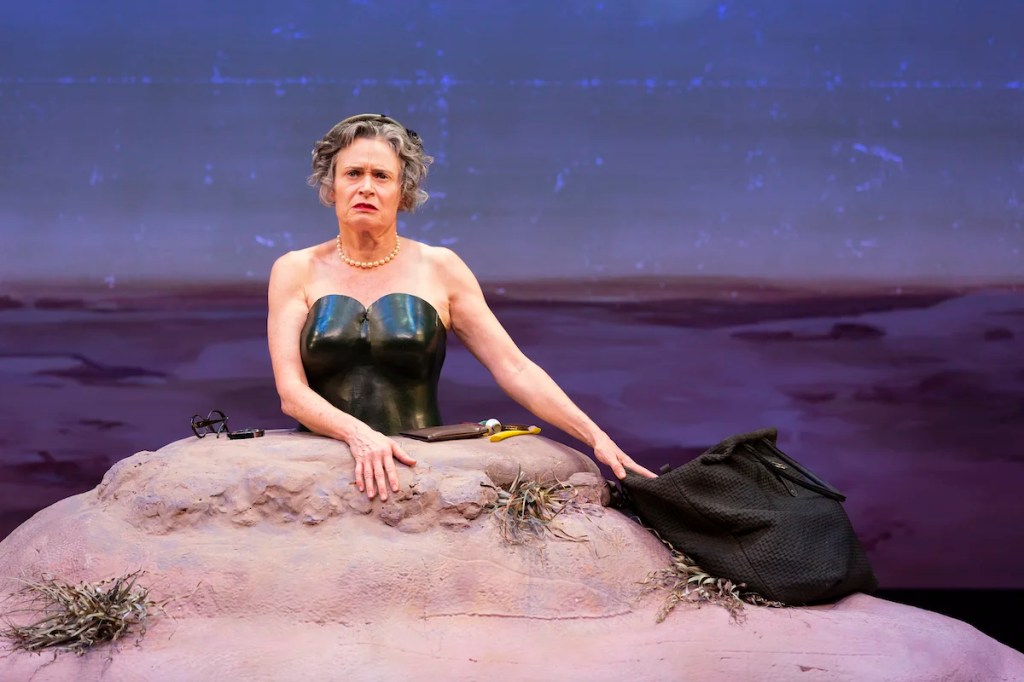
Judith Lucy (MTC, 2023) Photo: Pia Johnson. Pamela Rabe (who co-directs this production alongside Nick Schlieper, who also designed the show) commands this post-climate-apocalyptic mound of slag with sharp shifts in expression. Her Winnie is a combination of self-soothing routines and a bubbling stream of doubt and rage that slowly filters through to her public persona. She is always on edge, but always putting forward a good face and positive spin.
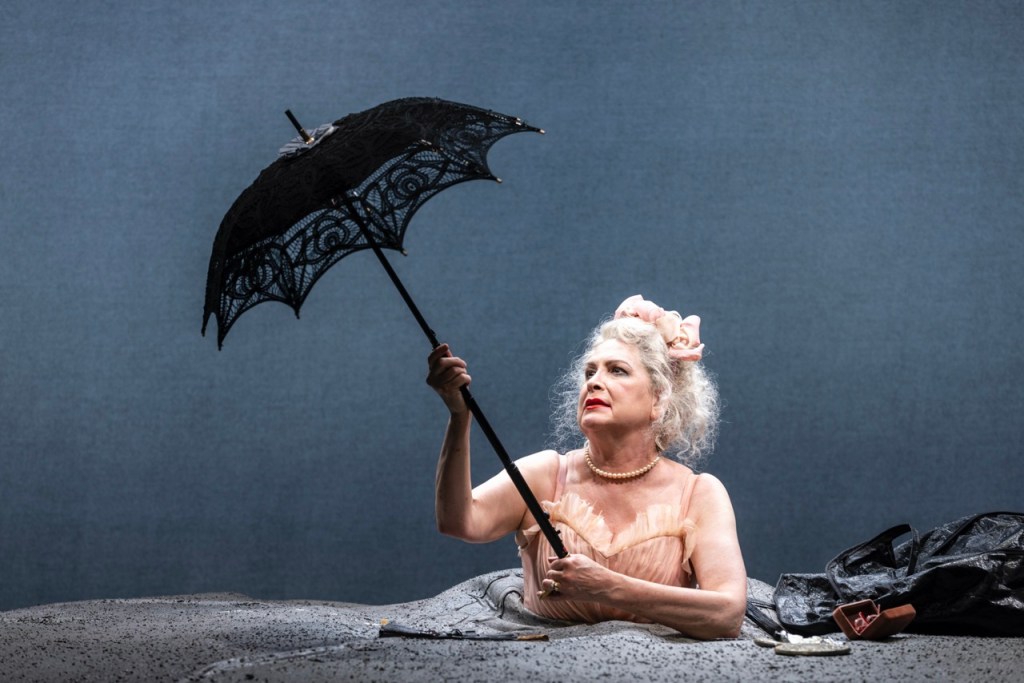
Pamela Rabe. Photo: Brett Boardman. And what do we make of Winnie’s denial in 2025, more than 60 years after the play was written? When I saw the 2023 MTC production, I felt the weight of the climate emergency bearing down, with Winnie—baking in the sun, surrounded by man-made detritus—refusing to act as the arid world swallowed her. That image still lingered in my mind. But this time, I felt more connected to Winnie’s sense of self and how it is bound up with her memories, which are fading along with everything else. Rabe’s Winnie feels anchored (literally) by her past experiences and the routines that have accrued their own meaning. She is primarily trapped in a psychological loop that is slowly killing her.
Yet there is an element of grace here. Faced with an impossible situation, Winnie does not rail against the world. Instead, she finds ways to stay in the moment and discovers small joys to sustain her. Hers is a stoic mindset in a drastic situation.
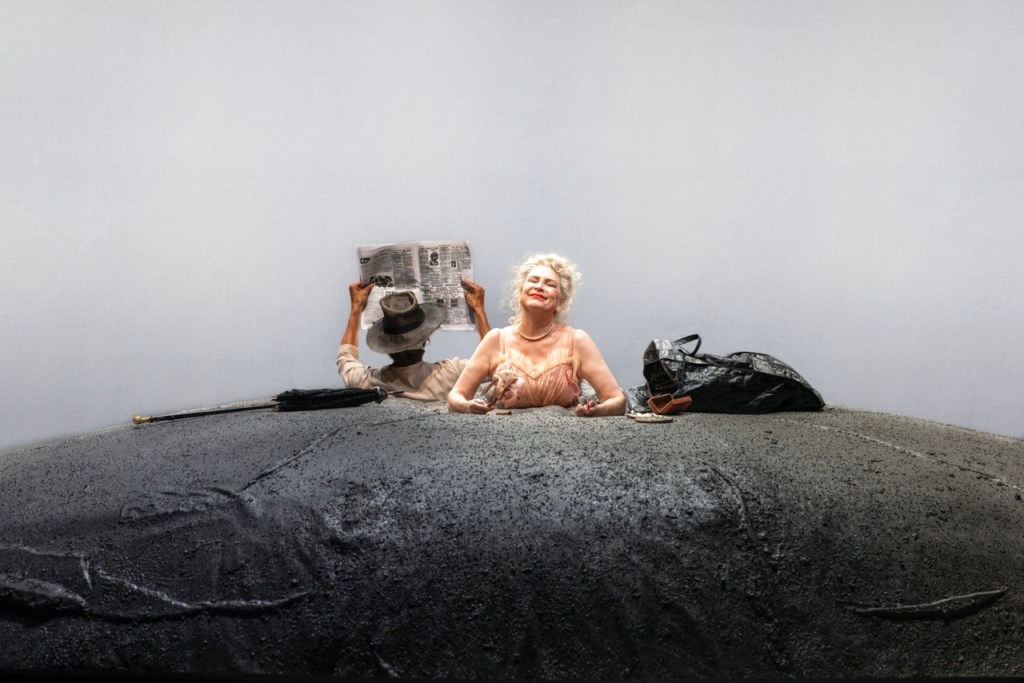
Markus Hamilton and Pamela Rabe. Photo: Brett Boardman. Schlieper’s design is stark. The stage is framed by a letterbox window, through which we see Winnie. Behind her, a single uninterrupted expanse of white. Her rock is a solid mound of bleak, tar-like, congealed lava. It has an organic quality that lends a hint of horror to its mass. The only colours come from Winnie’s faded possessions & clothing (costumes by Mel Page) and the occasional lighting cue. It’s a bold choice for such a sparse and static play, placing all attention on the central performer to bring life to the stage with only her upper body.
I’ve always had a soft spot for Happy Days, which I much prefer to Beckett’s more revered masterpiece, Waiting for Godot. There is no escaping the show’s surrealist nature, your tolerance for which will dictate how much you get from it, but with a performer like Rabe at its core, this production holds strong and its humanity reigns. Central to the character of Winnie is her constant movement, but ultimate inaction. It’s a purely human thing to do. Her bizarre behaviour holds a mirror to our own foolishness. Happy Days is a reminder to address the elephants in the room—before it’s too late.
-
The Wrong Gods (Belvoir) ★★★½

Written by S. Shakthidharan. World Premiere. Belvoir St Theatre co-production with Melbourne Theatre Company. 3 – 31 May, 2025.
For all the small-scale human specificity in S. Shakthidharan’s new play about the lives of Indian farmers on the banks of a river, it manages to speak to the state of the world in expansive ways. Its insights are powerful, but you might need to pay close attention to catch them in the details.

Nadie Kammallaweera & Radhika Mudaliyar. Photo: Brett Boardman. Young Isha (Radhika Mudaliyar) dreams of leaving her family farm and starting a new life in the city. However, after receiving an education, her mother Nirmala (Nadie Kammallaweera) needs her help tending the land following her father’s abandonment. When the ambitious and encouraging Lakshmi (Vaishnavi Suryaprakash) arrives offering a university education and new, high-yield, genetically modified crops, it all seems too good to be true.
Seven years later, the world has changed. Nirmala has grown bitter and angry at the erosion of her traditional life by encroaching city dwellers and their demands to develop the land and build a new dam. Their construction has already disrupted the cycles that fed and nurtured the local tribes for generations. When Isha returns with horrific news, Nirmala calls upon the old gods for guidance and vengeance.

Nadie Kammallaweera, Radhika Mudaliyar & Vaishnavi Suryaprakash. Photo: Brett Boardman. The smartest move The Wrong Gods makes is to bring back Counting & Cracking cast members Mudaliyar and Kammallaweera, whose on-stage chemistry reaps instant dividends. These two women are a joy to watch as they spar and dance around each other. They fall into a natural rhythm with Shakthidharan’s text, playing with its poetry. Suryaprakash (another Counting & Cracking alum) acts as a third gravitational force pulling them apart. Her Lakshmi is the alluring and reasonable pull of modernity and progress.
While it may lack the physical and temporal scope of Counting & Cracking, The Wrong Gods tackles far bigger themes. What is better: thousands of years of sustainable but limited lifestyles, or hundreds of years of wealth and comfort? Are the promises of progress merely short-term pleasures at the expense of our long-term health? Be sure to listen carefully as often, the key thoughts are buried in the middle of furious arguments or passionate tirades and can be easily missed.
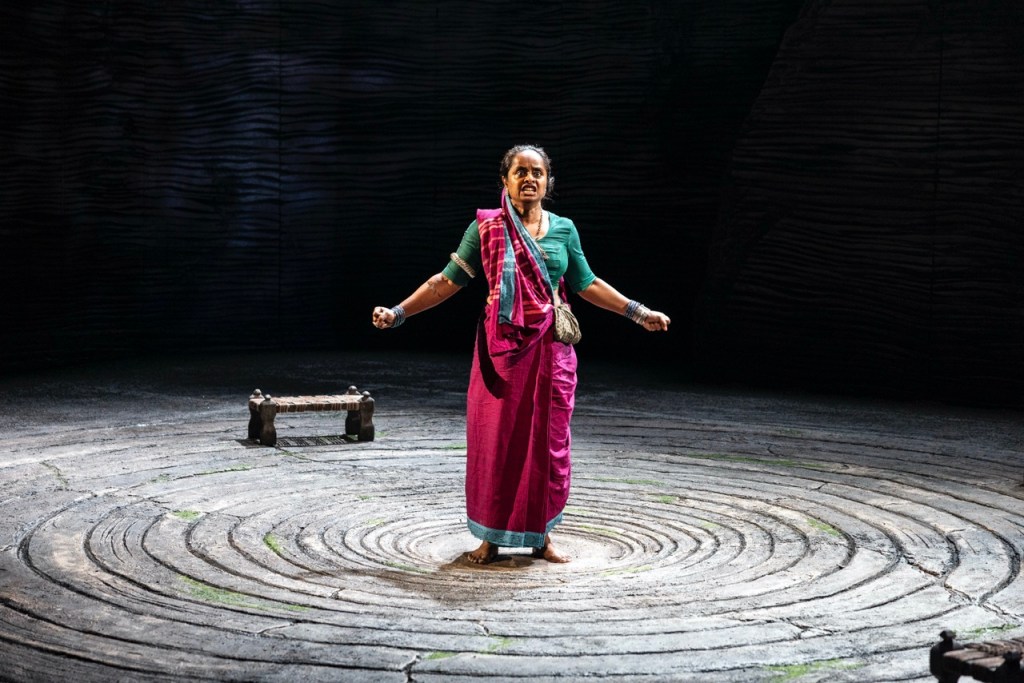
Nadie Kammallaweera. Photo: Brett Boardman. Set design by Keerthi Subramanyam is a feast of simplicity and elegance, wrapping the stage in the earthen textures of wood, accented with key pieces made from recycled materials. The tree-ringed floor grounds us in history and nature over a time span that far exceeds our mere human lives.
But there is an unusual flatness to The Wrong Gods’ pace as it races through its 90-minute running time towards the conclusion. Isha’s change of heart feels abrupt and shallow, as the conflict doesn’t quite take root. One or two pivotal moments could benefit from added emphasis to let them truly land with the audience.
As we currently reap the rewards—and curses—of our modern, comfortable lives, it’s too easy to turn a blind eye to the destruction and long-term impacts of our choices. The Wrong Gods begs us to look at the hard truths and face up to our reality: no gods will be coming to save us.
-
IRL (KXT on Broadway) ★★
Written by Lewis Treston. The Other Theatre in association with Bakehouse Theatre. KXT on Broadway. 25 Apr – 10 May, 2025.
Lewis Treston, the Brisbane playwright behind the camp-Austen Hubris & Humiliation and the manic-crime-comedy Hot Tub, arrives at KXT on Broadway with his take on pop cultural fan culture and Xennial internet dating – IRL.
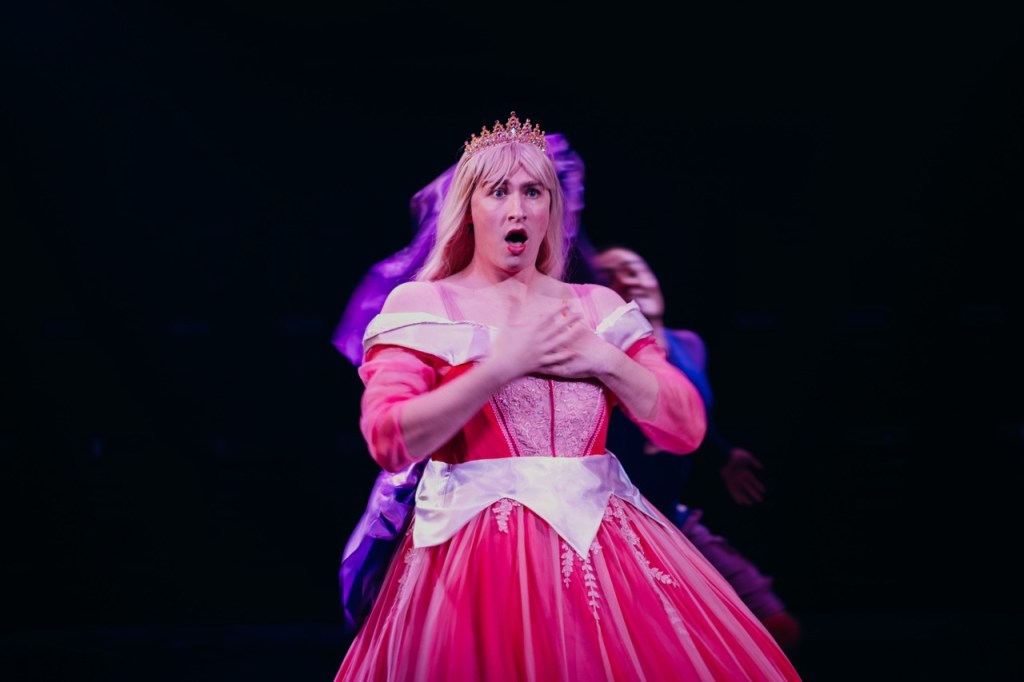
Alexei (Andrew Fraser) is a Tumblr teen, exploring his blossoming sexual expression online and living out his dream Disney Princess life in cosplay. He’s been talking to a nice guy online, Thaddeus (Leon Walshe), who is a little film nerd with lots of thoughts about big topics. They finally plan to meet at Brisbane’s Supernova Convention, a Comic-Con for fans of all sorts of pop culture media, from anime, to computer games, film, TV and comics books. But Alexei is nervous, he’s coming in Princess cosplay… What will Thaddeus think?

Andrew Fraser & Leon Walshe. Photo: Justin Cueno. So Alexei concocts a plan. Seeing as they’ve never met in person before, or shared photos online, he’ll see how Thaddeus reacts to his cosplay before revealing his identity. That way, if Thaddeus freaks out, Alexei can just walk away. But when Thaddeus falls for the anonymous Princess, things get complicated. How can Alexei get around the lie? And what’s going on with Alexei’s best friend, Taylor (Bridget Haberecht), an actress who is a guest at the con but seems to be very publicly going off the rails?
Treston is an entertainer, there’s rarely more than a token “big message” to his plays, and the same goes for IRL which waves in the direction of subtext but is more interested in trying to make you laugh than having anything meaningful to say. There’s a lot of plot, and a lot of characters, in the mix. Most of which turns out to be random noise in the long run, as Treston throws in improbable event after improbable event to get the characters where they have to be.

Leon Walshe, Andrew Fraser & Bridget Haberecht. Photo: Justin Cueno. It’s almost as if the play were being made up as it goes along. We’re often treated to long backstories of characters who have no real bearing on the story and subplots that exist simply to be weird (or to cover a costume change). It feels like one of those Marvel TV shows that got substantially rewritten and reworked in post-production resulting in characters appearing and disappearing with little context or consequence, and a mish-mash of tones.
And the confines of independent theatre budget and space are really evident. It’s clear this production doesn’t have the resources required to bring this story to the stage and the results are sloppy and confused. There’s a world of difference between wearing an off-the-rack dress and the skill and passion of genuine cosplayers. It’s hard to suspend your disbelief when the characters are talking about a hand-stitched bespoke outfit, but you’re seeing a pair of baggy K-Mart trackies. The set decoration looks like it was raided from a Salvos without a clear visual plan. Without the production values to elevate the fantasy elements of the script, the heightened characters or the action, we’re left with a compromised, confusing, mess. It doesn’t help that Alexei changes into the costume of DC’s The Flash (and no one needs to be reminded of that movie &/or drama).

Andrew Fraser & Leon Walshe. Photo: Justin Cueno. This lack of production elements could be forgiven if the play’s script and/or the performances were outstanding as a counter-weight, but things fall flat there as well. Treston’s script throws out vague ideas about identity, insecurity and the commercialisation of our communal myth-making, but can’t follow them through with any exploration and insight. Instead we get pointless hallucinations, a musical number and a superhero battle that has no grounding in emotion or character. It’s just stuff happening on top of stuff, without the Hollywood budget to at least distract us with spectacle.
Which leaves the cast floundering, often literally just pacing up and down the KXT traverse stage, shouting out dialogue and delivering false emotions in place of real characters. Alexei and Thaddeus’ love story is charmless and unearned. Alexei is particularly unlikable in the overtly selfish way he treats both Thaddeus and Taylor. Taylor’s entire storyline is bewildering and pointless – treating her mental health as a punchline. When she does go full “Dark Phoenix” it felt more like X-Men: The Last Stand than the Chris Claremont classic comic book (for those not well-versed in this stuff, that’s definitely a bad thing). Don’t even bother questioning the internal logic behind it all – there is none.
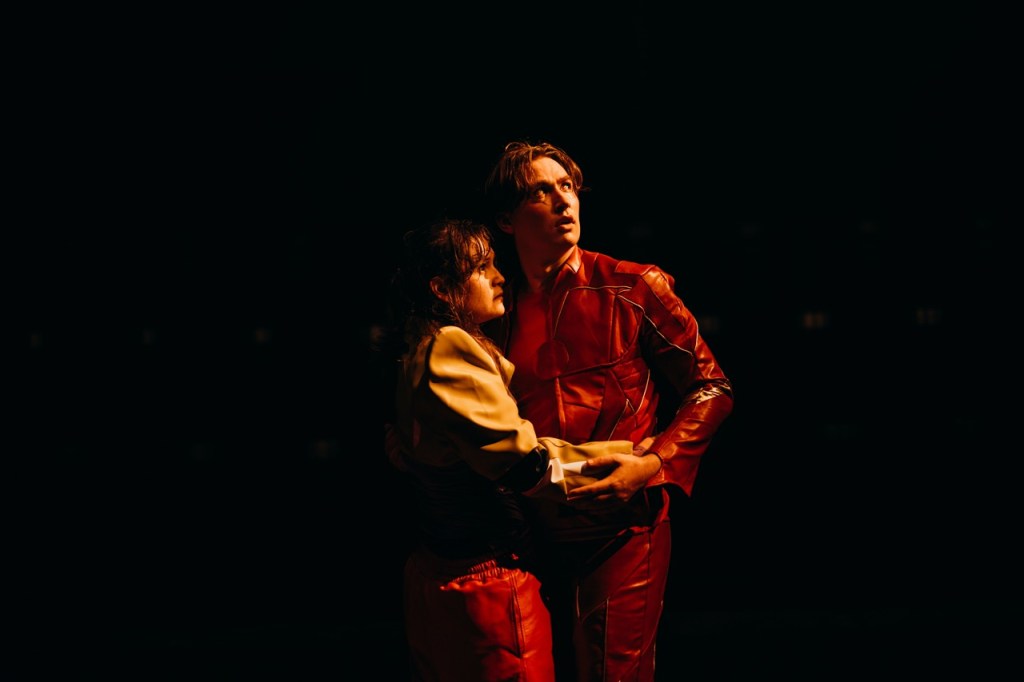
Bridget Haberecht & Andrew Fraser. Photo: Justin Cueno. As the show began I whispered to my friend that as a longtime pop culture nerd myself (who was on Tumblr a lot in the early noughties and has attended a number of Comic-Cons) I was either going to hate IRL or be completely on board with it, and sadly it’s the former. While I don’t feel like the play is mocking fan culture, it is definitely not steeped in it enough to translate it to the stage. The scope of the script clearly outstretched the resources and imaginations of the creatives. Those hoping for a fun night like last year’s Harry-Potter-slash-fiction themed [Your Name] (which also starred Andrew Fraser) will need to look elsewhere.
-
Subscribe
Subscribed
Have a WordPress.com account? Log in now.

