-
Welcome to Cultural Binge

The rating system is simple:
★★★★★ – Terrific, world-standard. Don’t miss.
★★★★ – Great, definitely worth seeing.
★★★ – Good. Perfectly entertaining. Recommended. Individual mileage may vary.
★★ – Fine. Flawed and not really recommended, but you may find something to appreciate in it.
★ – Bad (& possibly offensive).
See more reviews over at The Queer Review.
Instagram: @culturalbinge
Substack: culturalbinge.substack.com
Email: chad at culturalbinge.com
-
Abigail Williams (HERStory Arts Festival) ★★★★

Written by Rebecca McNamee. Sydney Theatre Co, Wharf 2 Theatre. 23-26 Apr, 2025.
This kick-ass, 50-minute prequel-of-sorts to The Crucible gives Arthur Miller’s dissembling teen leader a compelling backstory—and even more compelling staging. It provides context but does not excuse her deadly actions.
In Rebecca McNamee’s play, orphan Abigail Williams (Ebony Tucker) tells her own story, from life with her hateful uncle to going to work for the Proctors, helping to wean their newborn while new mother Elizabeth “Goodie” Proctor suffers from apparent post-natal depression. While there, 17-year-old Abigail finds herself attracted to the stoic, thirty-something farmer John Proctor, and the two begin a sexual relationship marked by an uneven power dynamic. When he eventually rejects Abigail, the teenager is confused and furious.

Photo: Robert Miniter. Ebony Tucker is outstanding as Abigail in this brilliantly staged one-woman, one-act play. On the nearly bare Wharf 2 Theatre stage, she begins shrouded in darkness, a single noose hanging from the ceiling under a spotlight. As the story progresses, Tucker removes layer upon layer of her restrictive costume, using the pieces as props and set-dressing to lay out a pictorial roadmap of her life. She is never less than thoroughly engaging as she monologues her frustrations, her desires, and her anger.
Directed by writer McNamee, there’s a clear elegance to Abigail Williams that seduces you. The simplicity of the staging (designed by Angelina Daniel) is so pointed in its clarity, and often filled with dark humour, that it makes for a remarkable economy of storytelling. The sound design by Keelan Ellis and Madeleine Picard provides an immersive soundtrack (the sound system in this space is brilliant and used to full cinema-like effect). Similarly, the lighting by Chris Milburn and Chaii-Ki Chapman transforms the inky black space into a lively environment filled with secrets.

Photo: Robert Miniter. McNamee’s writing is beautiful—both in its use of language and in the theatrical moments she’s created. A mid-play sidebar, discussing a contemporary situation of sexual power imbalance much like that between Williams and Proctor, anchors the story in real people and real consequences.
The Crucible, that HSC syllabus classic and revered part of the American theatrical canon, is getting quite the exploration these days. While here in Sydney we’ve got this intimate and immaculate Abigail Williams, on Broadway right now the play John Proctor is the Villain is getting rave reviews. Which begs the question: why is there this desire to re-examine these characters?

Photo: Robert Miniter. Do we need to redress the history presented in The Crucible? While based on real people, all the personal relationships are fictional (the real Abigail Williams was a 12-year-old, and there’s no suggestion of sexual relationships). Miller’s 17-year-old version of Williams is simply drawn to drive the plot; her ultimate thoughts and motivations are never revealed, while Proctor is the flawed lead. But there’s no suggestion that Proctor’s sexual relationship with Williams is anything other than deeply wrong—both for the adultery and the way Proctor clearly took advantage of the teenage girl. John Proctor may be the protagonist of The Crucible, but he is not—and never has been—a “hero”. We admire his final actions for their self-sacrifice and nobility, knowing that his own past has cost him dearly, but we do not give him a free pass.
Abigail Williams herself, meanwhile… While we might forgive the historical 12-year-old for getting caught up in hysteria and being manipulated by the adults around her, by ageing her up to 17, Miller gives her much more agency—and thus much more culpability. After watching this backstory, do I feel more enlightened or sympathetic to her plight? Or do I think less of Proctor? Not particularly. Everything presented here I got from Miller’s play. Just as Proctor is not presented as a hero, Williams has never been presented as a villain. Both are better written than that.
But as much as I don’t connect with its central premise, that doesn’t detract from the fact this is damn good theatre. Terrific script, terrific staging, and a powerful performance kept me completely ‘lean-in’ engaged in the story. Abigail Williams is well worth exploring.
-
Posh (Old Fitz) ★★★★½
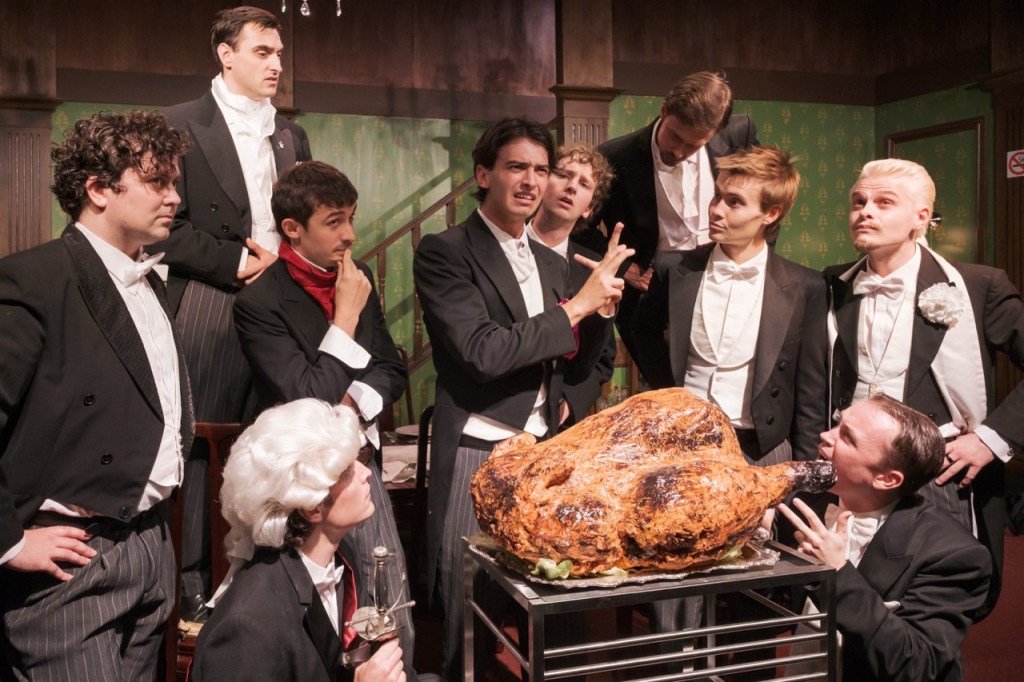
Written by Laura Wade. Australian Premiere. Queen Hades Productions. Old Fitz Theatre. 19 Apr – 17 May, 2025.
Laura Wade’s incendiary class-war drama, Posh, is fifteen years old and only just getting its Australian premiere (what? seriously?). Somehow, it’s gained extra resonance over the years as the divide between the rich and the middle class has grown wider. No longer just a look at the likes of Oxford’s infamous Bullingdon Club and a generation of young Conservatives who would go on to rule Britain, it now carries shades of contemporary right-wing backlash and the paranoia of the embattled uber-rich.
Ten Oxford students gather for the first dinner of the secretive “Riot Club” to be held in some time. When one of their number drunkenly revealed the existence of the club to a non-member—and whose antics became fodder for the press—the age-old institution went to ground. But now, months after the offence, they are finally reconvening, and hopes are high. Can the current Riot Club live up to the debaucherous heights of its alumni?

Roman Dalo, Max Cattana, Anthony Yangoyan & AJ Evans. Photo: Robert Catto. Guy (Roman Dalo) wants to make a name for himself and become the next President of the Club, but he’s up against his friend, Dimitri (Anthony Yangoyan). Toby (Dylan O’Connor) must make penance for outing the Club. Outgoing president James (Ryan Hodson) is trying to walk the line between fun and responsibility, while others consider the Club part of their family heritage. But as the night wears on and more wine is consumed, the privilege and presumption of these young men—and the spirit of old Lord Ryott (Charles Mayer), in whose name the Club was created—push them too far.
You see, the strata of class never really went away; they just went into hiding.

Anthony Yangoyan, Roman Dalo, Tristan Black & Jack Richardson. Photo: Robert Catto Wade has painted each member of the Club with a different shade of wealth. The simplistic George (Tristan Black) lives in a Downton-esque fantasy where his family and the farmers who work alongside them are all friends (but he’s always the one who buys the drinks). Gay Hugo (Jack Richardson) is studious and camp, not built for life outside the hallowed halls of aristocracy. Gluttonous Harry (AJ Evans) is a foolish child playing at being a big man. But they all speak a common language of grievance and entitlement.
Sick of opening their stately homes to the National Trust for summer tours and Christmas market stalls (to pay for the leaky roofs), frustrated by the erosion of their unearned wealth, and furious at the presumption that they are expected to behave just like everyone else (i.e. the lower classes), this black-tie manosphere whips itself into a frenzy—led by the frighteningly insightful Alastair Ryle (Christian Byers).

Front: Mike Booth & Christian Byers. Photo: Robert Catto Alastair longs for the unrestrained glory days of wealth, before the beige egalitarianism of New Labour swept in. When the group begins to break out into internal squabbles, he pulls everyone back in line by casting the blame outward—onto the common people—like a budding autocrat riling up the masses. It is only Alastair who sees through the gilded veneer of the Riot Club and recognises its flailing “lost boys” for what they are.
This large ensemble (14 actors squeezed onto the Old Fitz stage) are in good form. The production is held together by Christian Byers as Alastair, who never overplays his hand and slowly rises from the ranks to become the most engaging character in the room—a perfectly mannered performance.

Christian Byers, AJ Evans & Dylan O’Connor. Photo: Robert Catto. Around him, there is a slight imbalance, with some actors (naming no names) feeling like they’ve stepped out of a sketch-comedy routine (it’s the accents, it’s always the accents), while others remain grounded. But overall, it evens out, thanks to Margaret Thanos’ direction. The stage is crowded, but characters are never lost (though sitting in the front row might be an act of bravery, considering the chaos happening right in front of you). Soham Apte’s set makes the confined space feel larger—who knew you could fit a staircase-to-nowhere into the Old Fitz?
The real star for me is Laura Wade’s writing. While it is admittedly a bit of an “eat-the-rich” polemic, it still holds up after 15 years. First staged in 2010, in the wake of the 2008 financial crisis (seriously, Australia—no one calls it the “GFC”, it’s not a fucking fast-food outlet), and later turned into a film (The Riot Club, 2014), it even predated the scandals of Boris Johnson. As Alastair says in the play: “‘Can’t have one rule for them and another rule for you’—why not? Seriously, why the fuck not? We’re the fucking Riot Club. And we’ve hardly started, mate!” That line pretty much sums up the 2020/21 “Partygate” scandal.

Cast of Posh. Photo: Robert Catto. Do the rich really, secretly, hate and fear the rest of us? Looking at the machinations of the 1%—building bunkers to survive climate change and refusing to limit their own consumption—it seems plausible. While the 90s and 00s brought a democratisation of many spheres of life, it’s clear that businesses are now reorienting themselves to cater to the wealthy (fashion brands cutting off cheaper diffusion lines, airlines investing more and more in first and business class, etc.).
The beauty of Wade’s script lies in how she saw this bitterness rising even as David Cameron was pushing the image of a “new, compassionate” Conservatism, and Boris Johnson hid his public disdain behind the facade of “the bumbling toff.” She captures the mindset of a generation of young, rich men looking at previous generations and feeling screwed over by the system—which doesn’t sound a million miles away from the current plight of Gen Z men, feeling abandoned and lashing out.

Cast of Posh. Photo: Robert Catto. And that’s where I was pleasantly surprised by how well Posh has stood the test of time. For me, it’s less a story of class and more a portrait of young men whose futures are less grand than those of their forebears—how they isolate themselves from society into their own bubbles and stew, with disastrous consequences.
Posh at the Old Fitz is great writing brought to life on stage. It may be a bit cramped in there, but it’s worth it—and I wouldn’t be averse to seeing it play in a larger space sometime.
-
New York Mini-Reviews 2025 p5: Wrap Up

Epilogue
Did I do anything else other than theatre? Of course I did! Admittedly mainly because there were still plenty of hours to fill in a day and there aren’t matinees on Tuesdays, Fridays and Mondays but still…
Like everyone else, I hit the galleries and museums. Apart from stopping by the usual ones like the Guggenheim, MoMA and The Met, I checked out some smaller ones I’d never been to before. Sadly my favourite museum, The Frick Collection, hadn’t reopened yet (that renovation is astonishing).
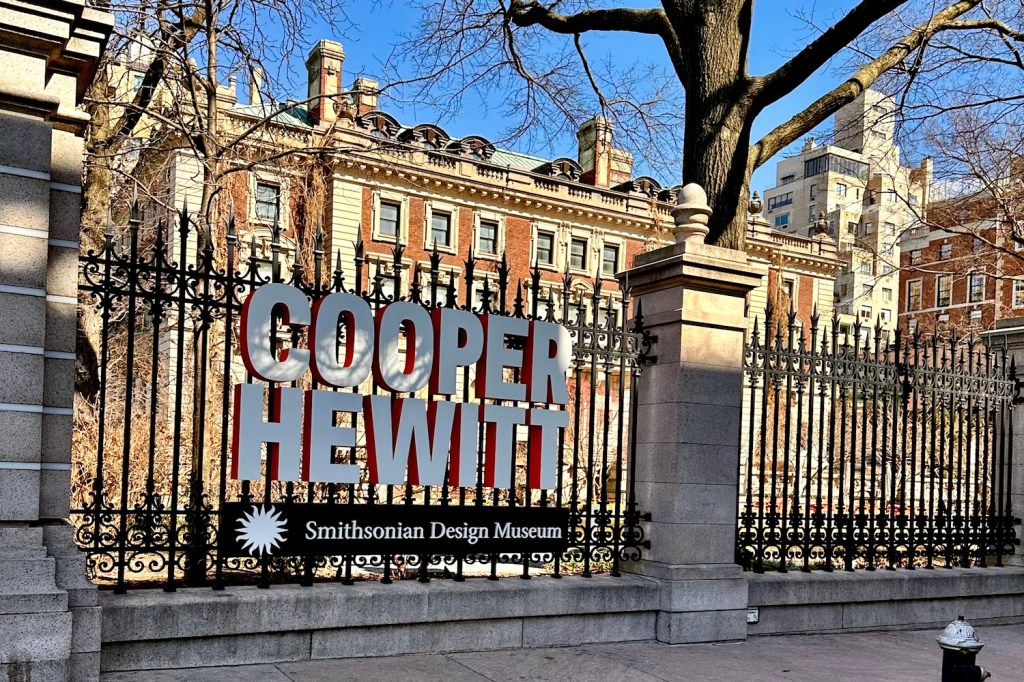
I especially liked The Cooper Hewitt Smithsonian Design Museum which was small but had some stunning pieces. There was a multi-disciplinary installation about ‘Home’ at the time that was fascinating.
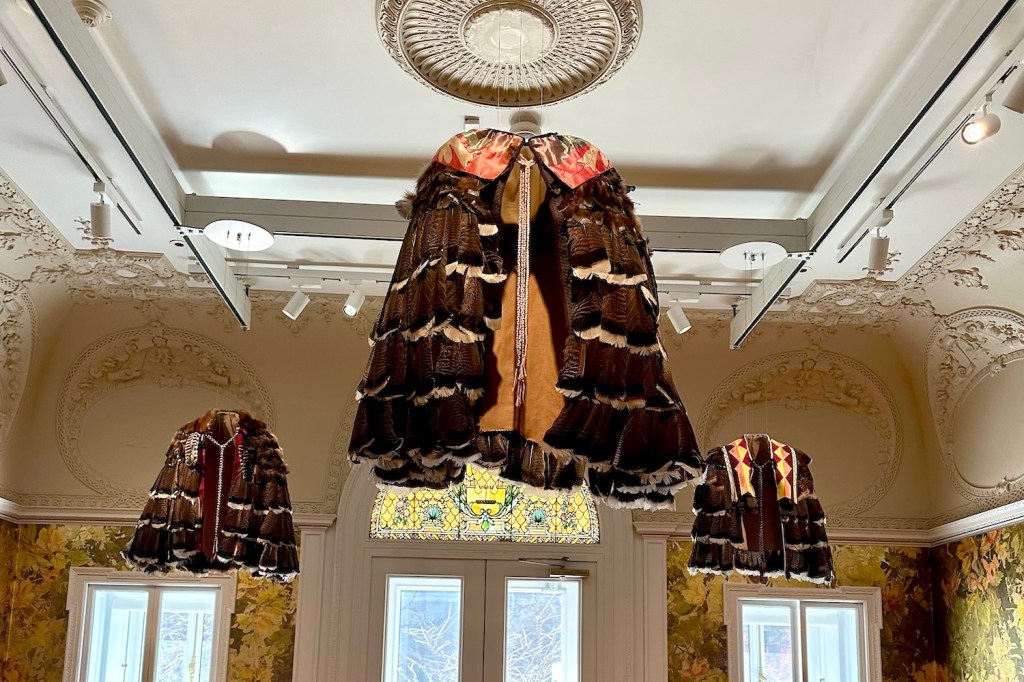
The Cooper Hewitt Smithsonian Design Museum I also visited the Neue Galerie for the first time, and finally saw Gustav Klimt’s stunning ‘The Woman in Gold’ with my own eyes. It’s more impressive in person and much larger than imagined. Plus they had an exhibition of the Neue Sachlichkeit (The New Objectivity) in Weimar Germany which looked at the art movements around the time of the rise of Nazism which, you know, timely…
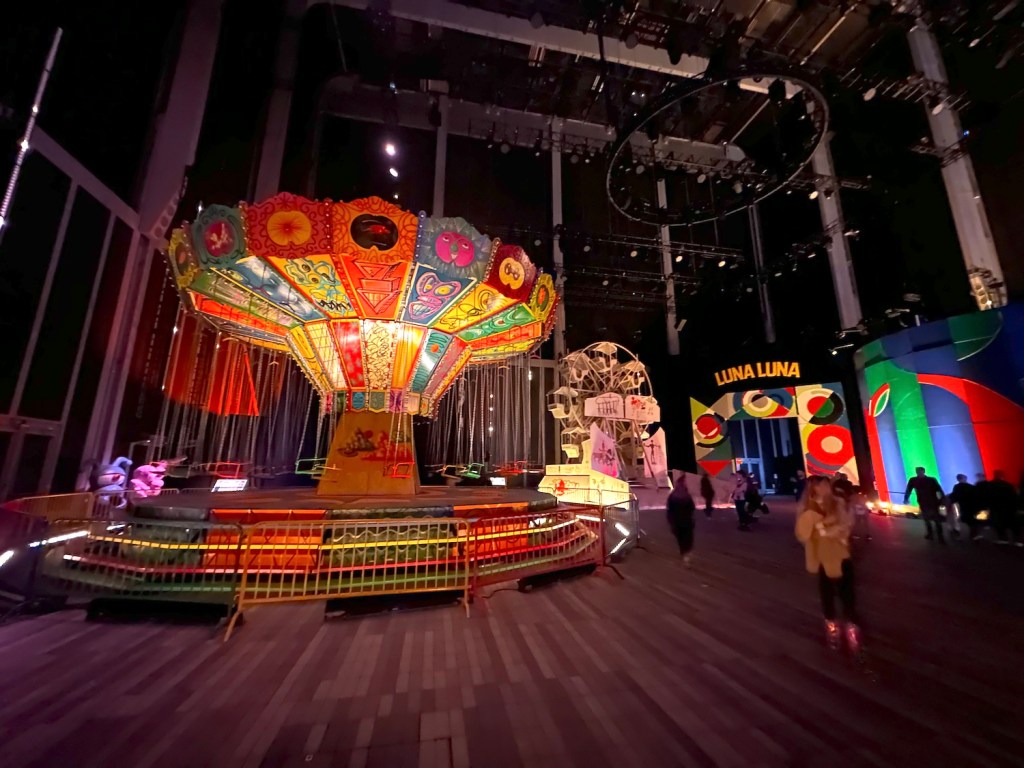
Luna Luna at The Shed One of the best things was visiting the mind-blowing Luna Luna exhibition at The Shed (hey, Sydney Festival – bring this to Sydney!). A forgotten art fairground with works by the likes of Salvador Dali, Keith Haring, Jean-Michel Basquiat, David Hockney, Roy Lichtenstein and many more. They have a fascinating podcast which is worth listening to to get the whole story.
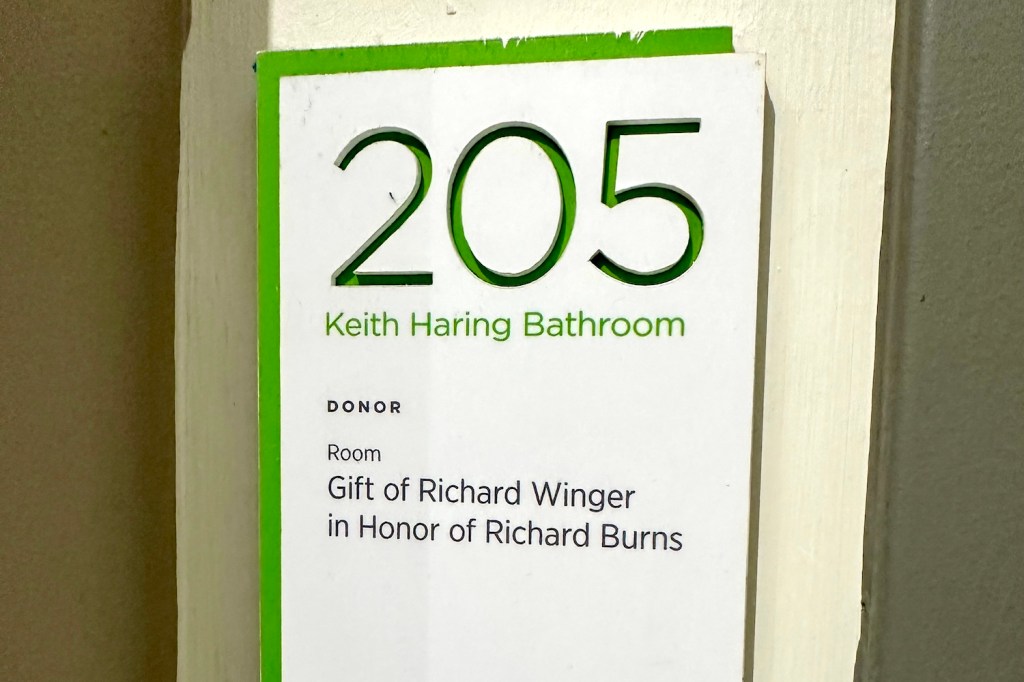
I stopped by the Stonewall National Monument Visitor Center (a bit small and sterile TBH, full of corporate sponsors that may not age well) and finally saw Keith Haring’s ‘Once Upon a Time Mural’ in the bathroom at The Lesbian, Gay, Bisexual & Transgender Community Center (it’s NSFW so no photos here).

I caught a fashion exhibition at the Fashion Institute of Technology, lots of dresses from Alexander McQueen, Tom Ford, Mary Katrantzou etc alongside historical pieces and collectors items (like a feathered table owned by photographer Bill Cunningham) and I flirted with the idea of getting new glasses from my stapple Cubitts (but couldn’t decide on the colour – also the exchange rate was diabolically bad).

New glasses? I wanted them all. Made the obligatory stop at The Strand bookstore…
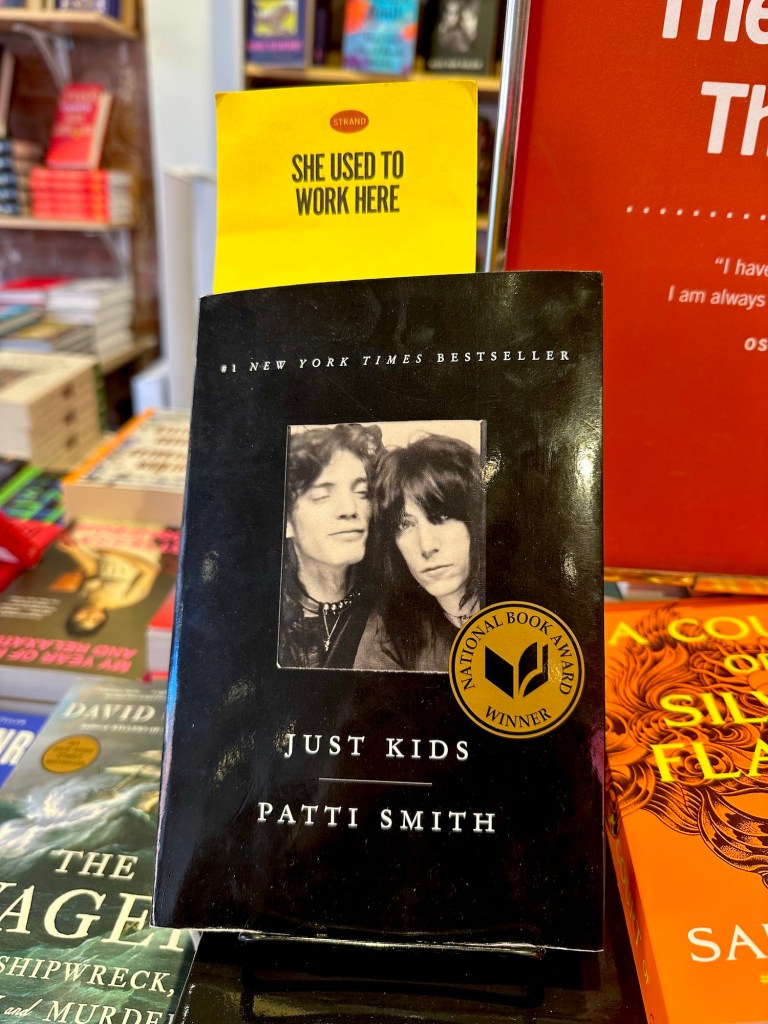
Good humble brag from The Strand. And I ate a lot of croissants. New York is also in the middle of croissant wars between amazing bakeries (it’s like Lune vs APB magnified). And giant doughnuts. So many giant, ridiculous doughnuts.

Bow before the gilded croissant at Librae in the East Village I drank a lot of coffee from St Kilda Coffee on W44th (saw Philipa Soo there one day) and generally enjoyed the sunny but cold weather. I stayed at The Pod Times Square which was a) vaguely affordable and b) perfectly positioned in the theatre district and right by the Times Sq/42nd Subway so I could catch the subway to/from JFK instead of paying for a very expensive taxi/Uber.
I don’t know when I’ll go back next, we’ll see how all the politics and exchange rates shake out but it might be a while.
-
New York Mini-Reviews 2025 p4: Broadway Plays

Oh Mary! (Betty’s Version) ★★★★★ / The Picture of Dorian Gray (Sarah’s Version) ★★★★★ / Glengarry Glen Ross ★★★★½
I usually focus on seeing Broadway musicals over plays, mainly for the spectacle, but also because Broadway plays seem to offer less bang for the many bucks you spend. A lot of celebrity casting leads to astronomical prices for mediocre plays that people lap up to see their favourite film stars on stage. But these three (two of which I’ve seen before) were the highlights of my trip.

Oh Mary! (for the second time) ★★★★★
Written by Cole Escola. Lyceum Theatre.
Oh Mary was one of the highlights of my last trip to New York, and I was drawn back to it to see if the show could work without creator Cole Escola in the lead. This time, Betty Gilpin stepped into the role of Mary Lincoln, flipping what had been a drag character into a cis-gendered role.
I think Betty Gilpin is a great actress with a unique, intense comedic energy (see her performance in the one-season 2023 TV show Mrs. Davis, where she plays a nun on a mission to find the Holy Grail and destroy an AI—it’s bonkers). I knew she’d be able to fill Escola’s shoes and bring a similar-but-different energy to the role.
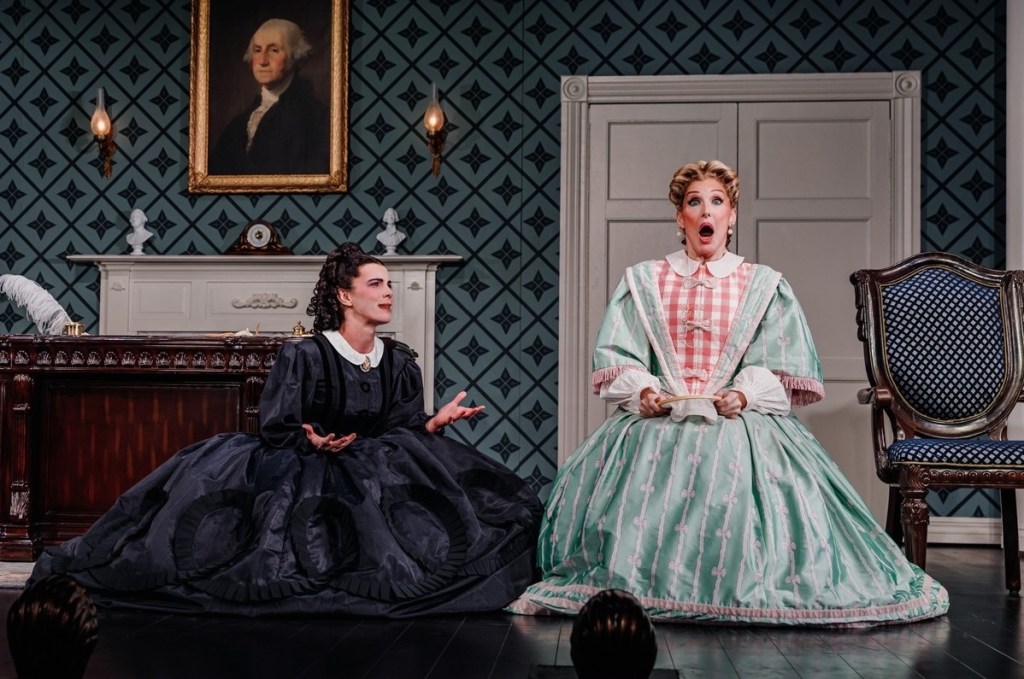
One of the advantages for me was that Gilpin wasn’t the same draw as Escola was and tickets were more easily accessible at a sane price. Where as I paid handsomely for a restricted view seat (admittedly up-close in row G of the Orchestra/Stalls last time), this time I paid less and sat in the Mezzanine with a clear view.
Gilpin was AMAZING as Mary. It was one of the best takeovers of a role I’ve ever seen. Usually, when you see another performer replace the originating lead you’re always conscious of the way their copying their predecessor, especially when that person is also the writer. Gilpin managed to embody all the elements Escola did as Mary, but made them feel organically her own, as if she had originated the part. She was more intense than Escola, but equally as funny. With drag there is always a level of metatextual commentary on gender, in this case on womanhood, but with a cisgendered woman in the lead you could focus on the woman herself, if that makes sense.

As a test run for how Oh Mary could continue in other cities, it proved that with the right casting, anyone—and I mean anyone—could be Mary Lincoln. After Gilpin the role was taken over by Titus Burgess before Cole Escola and the original cast all returned for a final run (I hope they filmed it!).

The Picture of Dorian Gray (Sarah’s Version – for the second time, fourth time overall) ★★★★★
Based on the novel by Oscar Wilde. Adapted by Kip Williams. Music Box Theatre.
FYI – this isn’t a review of the show, mainly because I assume most of you reading have seen it, but if you’d like a full, fresh review of the production head to The Queer Review where editor James Kleinmann watched it with fresh eyes.
Here’s the funny thing about me: When I know a show is really good—like, mind-blowingly, heart-wrenchingly good—I get a real kick out of watching other people experience it for the first time. I took almost sadistic pleasure in seeing/hearing audiences cry while watching The Inheritance. Similarly, when I was in London last year, I loved watching the West End crowd’s jaws drop as The Picture of Dorian Gray unfolded. So, when the show transferred to Broadway, crossing over with my holiday by two days, I knew I wanted to see it again. I bought a ticket to the very first Broadway preview and crossed my fingers.
I got a real kick out of walking into a Broadway house and hearing so many Australian voices in the foyer and bar—all production crew who were finishing up before running out of sight. The show had a lot more merch than I’d seen in London as well—this was our STC hitting the big time. In the auditorium, we were greeted with complimentary copies of Kip Williams’ adaptation script and a thank-you card. Overhearing the chatter around me, it was obvious that everyone here was a fan of Succession. There were some classic “this was big in London, but we’ll see” vibes from some of the “ladies who botox” beside me.

Then the show began. It started with an odd gasp as the audience started to experience Williams’ cine-theatre for themselves, seeing Sarah Snook interact with her pre-recorded self—and that first moment Lord Henry touches Dorian’s shoulder sent a ripple of excitement through the room. You can feel when a show has either won or lost the audience, and this was the moment you felt the room lean in. From there, it was a bullet-train to the finale, full of laughter and surprises.
A minor technical glitch (the screen froze for a few seconds during one of the more active scenes) actually worked to the show’s advantage, proving to the audience that this was live and there were real stakes involved. You could feel the room hold its breath in anticipation, waiting to see how Snook would handle it. And she powered through, the technology worked itself out (I imagine the crew were frantic behind the scenes), and the show didn’t skip a beat.
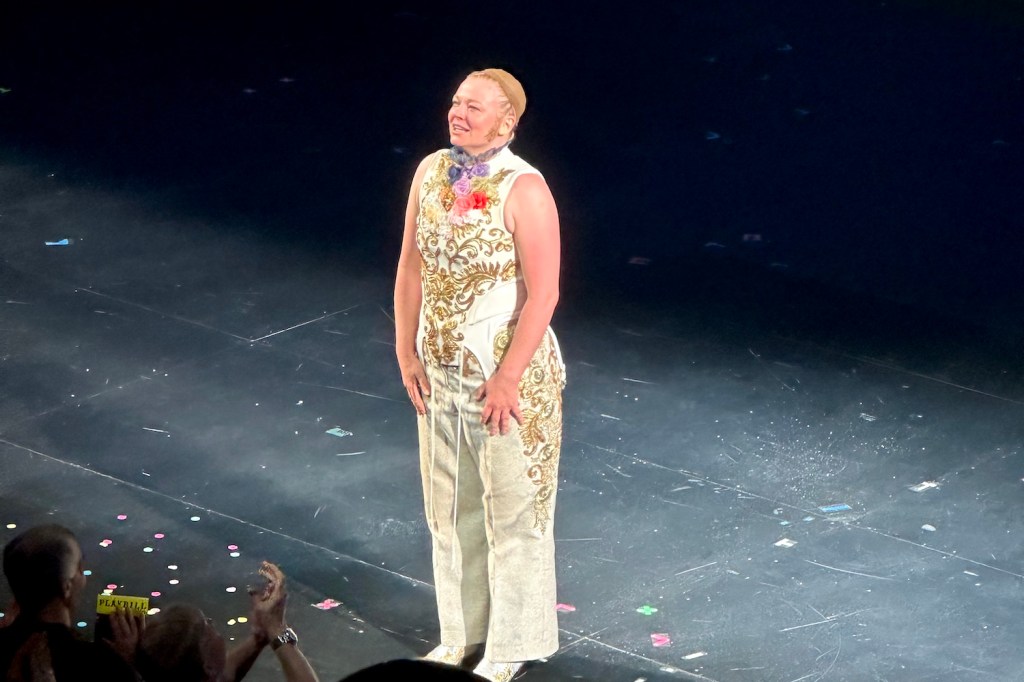
The standing ovation at the end was instant and rapturous—none of the usual polite clapping and “I’m only standing up so I can walk out faster”. The women beside me looked at each other, slack-jawed: “Oh my god! I’m texting the group now, they have to see this!” There was a chorus of “I knew she was good, but that’s insane” and “What do you mean she doesn’t have an understudy?” as the audience filed either to the merch stand or out onto the street.
There’s just a great feeling knowing that the best show on Broadway came from our own STC. Australian excellence for the win!

Glengarry Glen Ross ★★★★½
Written by David Mamet. Palace Theatre.
So here’s a funny story—bear with me.
I wasn’t going to see Glengarry Glen Ross. It was having its first preview on my last night in New York, and I’d already booked a ticket to another show that was also having its first preview that night—Boop: The Musical. But during my week in New York, I hadn’t had a chance to catch up with a friend of mine but he was suddenly free on that one night.

The plan was for me to sell my good $160 Boop ticket (on resale app Theatr) and we’d buy two cheaper tickets for Boop to see it together. So I listed the ticket, and we went out for dinner. An hour later, the ticket wasn’t selling. But the worst-case scenario was that he’d buy a cheap ticket, and we’d meet up during the interval and after the show. Then, I kind of forgot about it.
Thirty minutes before curtain, someone snapped up my ticket, but when we looked, we couldn’t see ANY other seats for the performance, let alone two together. So… panic! He’s an avid theatre-goer and had seen most of the up-and-running shows already, but on another resale website, there were tickets for the first preview of Glengarry Glen Ross still available for astronomical prices ($500–$1100—just stupid prices). But he figured that as we got closer to showtime, the prices would drop—there were stories that $600+ tickets for Denzel Washington’s Othello could be snapped up for $100 if you were prepared to wait till the last second. So we walked up to the theatre and kept an eye on the tickets… and waited… and waited… and no luck, they never dropped.

We ended up walking in to the box office as the bell was ringing and asked if there was ANYTHING available, to which the box office manager smiled and said, “You’ll be happy.” He sold us two tickets for a reasonable-for-Broadway $150 (less than my original Boop ticket). We ended up in the premium seats, dead center, 8 rows back—tickets that usually sell for $500+.
So, from the best seats in the house, I settled in to see this star-studded (Kieran Culkin, Bob Odenkirk, Bill Burr, and Michael McKean) overblown production of David Mamet’s toxic masculinity drama. And you know what? It was brilliant!
I thought this relatively small play (set in a Chinese restaurant and a small office) would get completely swallowed up by the enormous Palace Theatre, which is usually home to large musicals. The intricately detailed set of Act One’s restaurant felt overblown and a bit ridiculous compared to versions I’ve seen before. But once the actors started speaking, and comedian Bill Burr hit his rhythm—it’s a fantastic Broadway debut for him—it all just clicked.

Director Patrick Marber is one of the best in the business, and he’s made this production different from the classic reading of the play, thanks to the casting of Culkin, who undercuts the usual manipulative alpha-male vibes of Richard Roma with his disarming, impish charm. McKean delivers some beautiful comedic readings as the older salesman George Arronow. But it’s Odenkirk’s skilled but desperate Shelley Levene that really made this show for me. He channeled the “faded superstar trying to get his second wind” desperation to its heartbreaking conclusion. None of these are good men, so it’s a wonder we care for any of them as much as we do.
All in all, this was a terrific last-minute surprise and a great final show before I hopped on my Qantas flight home.
-
New York Mini-Reviews 2025 p3: Broadway Musicals

Sunset Boulevard (Nicole’s Version) ★★★★★ / Redwood ★★★ / Buena Vista Social Club: The Musical ★★★½ / Gypsy (Audra’s Version) ★★★½
Enough of “slumming it downtown with the poor” and seeing Off-Broadway shows (jokes—most of them were in the theatre district anyway). I was hankering for some big Broadway pizzazz, and I got it.

Sunset Boulevard (Nicole’s Version – for the third time) ★★★★★
Music by Andrew Lloyd Webber. Book and Lyrics by Don Black & Christopher Hampton. St James Theatre.
Yes, I’m addicted to this production. It’s perfection. This time, after seeing it twice from the mezzanine, I got a seat as close to the stage as I could in the side-orchestra. I was surrounded by theatre kids who were all there for the third or fourth time too. As the twenty-something girl in front of me said, “You get it, I know you totally get it.”
I’d actually hoped to see the show when Mandy Gonzalez was on instead of Nicole Scherzinger, because I wanted to see how it landed with an alternate, but I just wasn’t in town on the right day. So this time, I got an up-close look at all the blood and camera work. Poor Tom Francis had to do his outdoor oner in the rain, which was a new wrinkle.
And I still haven’t grown tired of it. I could see it again and again and again. It’s the best thing Jamie Lloyd has ever done, and one of the best theatre productions I’ve ever seen. If it doesn’t hoover up Tony Awards I’ll be angry.
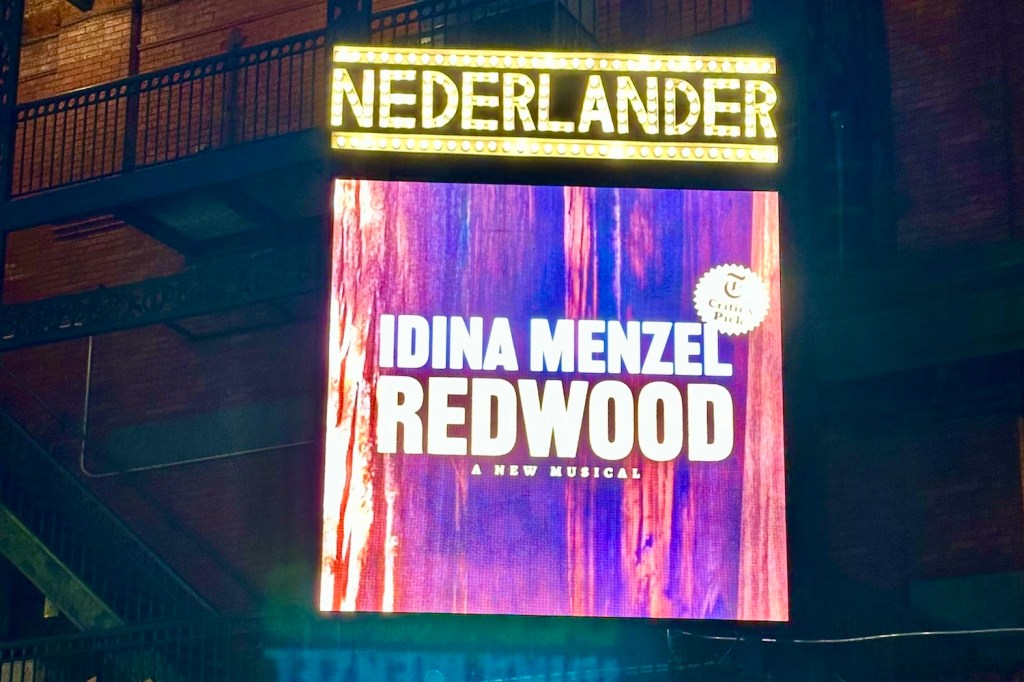
Redwood ★★★
Book & Lyrics by Tina Landau. Music & Lyrics by Kate Diaz. Nederlander Theatre.
The third part of my inadvertent Jonathan Larson/Rent marathon (after The Jonathan Larson Project and seeing Adam Pascal in Drag: The Musical), I got to see Idina Menzel in the new, original musical Redwood.
It’s so refreshing to see a completely original show on Broadway. Not a remake, not a revival, not a jukebox, not based on some existing IP—an actual goddamn original show. I just wish it was… better.

Redwood has taken a bit of a kicking from critics (and received an inexplicable rave from Jesse Green in The New York Times—though frankly, I’ve lost faith in his reviews recently after he dismissed both The Picture of Dorian Gray and Operation Mincemeat. I think he just dislikes popular imports from London). And it’s clear Redwood is not your typical blockbuster Broadway fare.
In fact, it probably shouldn’t be on Broadway at all. It’s a rather melancholic, fairly static show about a middle-aged woman who climbs a tree to process her grief. Normally, this would belong in a smaller theatre—but in order to truly visualise the majesty of centuries-old redwoods, it requires the space and budget of a Broadway-sized production.
If I had to pinpoint what the show is lacking, I’d say it’s as simple as “more money”. The staging is both stunning and expansive, but the reliance on projections over a physical set makes it feel a bit cheap. The projection work is gorgeous and immersive, and the show’s gigantic central tree trunk is impressive—but it needs more: more set, more props, more components to fill out the empty space.

Redwood stage before the screens turn on. The result is a show that sometimes feels very two-dimensional. That’s not helped by the fact that, once Menzel climbs the tree, she’s physically stuck on a small platform—so there’s not much movement or visual variety. The “vertical dance” sequence is less impressive than the creative team seem to think it is.
As for the show itself, I liked it. A meditation on grief and healing through nature, it has some beautiful moments. The cast are also fantastic—especially Khaila Wilcoxon, who almost steals the show. But is it something I’ll be rushing to rewatch, or to listen to on cast recording, or hoping for a transfer? Probably not.

Buena Vista Social Club: The Musical ★★★½
Book by Marco Ramirez. Featuring music recorded by the ensemble musician group Buena Vista Social Club. Schoenfeld Theatre.
If you were alive in the ’90s, it was impossible to escape the album and the film Buena Vista Social Club. It was an explosion of Cuban music that drove what was then called “World Music”, and became a mega-hit documentary by Wim Wenders. Now the music and history of that album have been turned into a Broadway musical, framed around the recording sessions with some added fictional elements.

The storyline is very simple. A young record producer is trying to reunite the original Buena Vista Social Club members to capture the “old music” while everyone is still alive. But one holdout—singer Omara Portuondo (Natalie Venetia Belcon)—doesn’t want to revisit the past, as it dredges up memories of her youth and a tragedy under Castro. In flashback, we see the young Omara performing with her sister, but as Castro’s regime takes over, one sister flees to America while the other stays.
This wasn’t high on my “too see” list, but a chat with a friend-of-a-friend who is a Broadway producer recommended it. This show is a bright, warm hug on a cold New York day. The music is as rich and layered as ever, and the live performance is rapturous—it’s hard not to smile when you’re enveloped in those rhythms. As none of the lyrics are in English and there are no surtitles, it makes sense to keep the story clean and easy to follow.
The result is a show that’s pure joy without any guilt. This isn’t just fluff (unlike a few other shows on Broadway right now); this has history, legacy, and a whole lot of heart.

Gypsy (Audra’s Version) ★★★½
Music by Jule Styne. Lyrics by Stephen Sondheim. Book by Arthur Laurents. Majestic Theatre.
This was the big one—the real reason for the trip. I’ve seen three major productions of Gypsy over the years, each led by a superstar (2003: Bernadette Peters, 2007: Patti LuPone, 2015: Imelda Staunton), but the draw of seeing Audra McDonald in the role, with a majority African-American cast, directed by George C. Wolfe, was too strong to resist.
Here’s a bombshell—I don’t like Gypsy.
It’s fine, but it’s not particularly moving. It is, however, one of the great roles for musical theatre leading ladies, so it always attracts top talent I want to see. It’s the Hamlet of musicals.
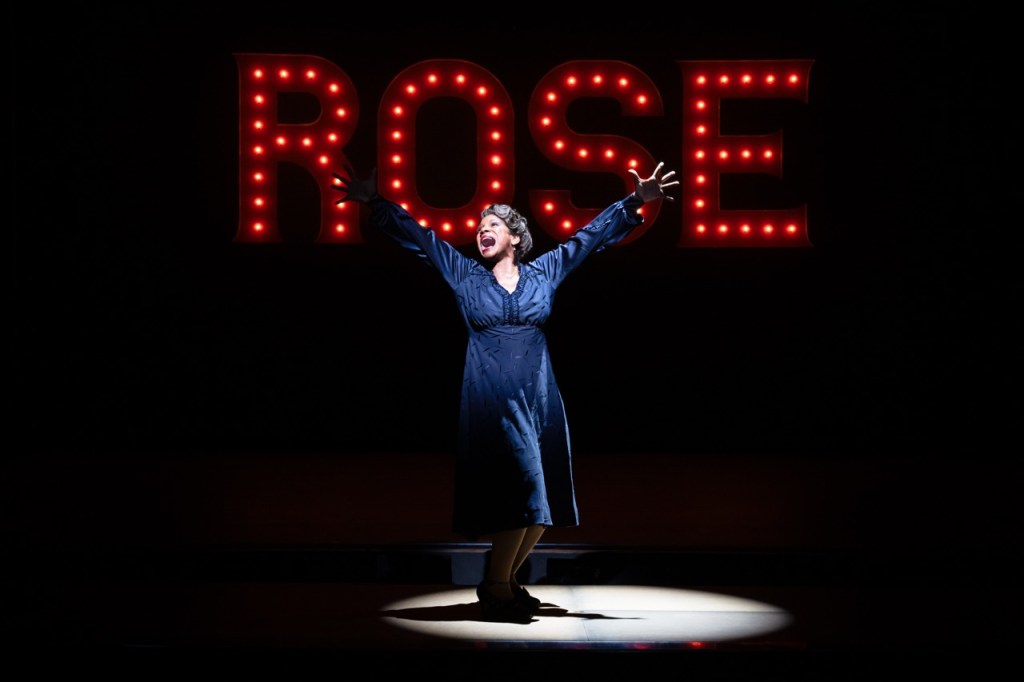
I booked Gypsy as the middle show in a ridiculous three-show day (sandwiched between The Jonothan Larson Project and Drag: The Musical – hey, my tastes are broad). I had an early matinee downtown, giving me just thirty minutes to get from the East Village to Times Square. I deliberately booked an aisle seat so I could sneak in quietly if I was late, and figured the first few numbers are fairly average anyway—Act Two is where all the good stuff is.
But I made it in time, and away we went.
And… the production is fine. Which is kind of disappointing, to be honest. Audra McDonald acts the hell out of Mama Rose, but her vocals don’t sit comfortably with the score. The new staging works well but isn’t remarkable.
All in all, a bit of a letdown.
-
New York Mini-Reviews 2025 p2: Off-Broadway Musicals

The Jonathan Larson Project ★★★★ / Drag: The Musical ★★★
Just like the Off-Broadway Plays, these musicals are all of the standard we can easily see here at home, but both felt tied to New York for their own reasons.
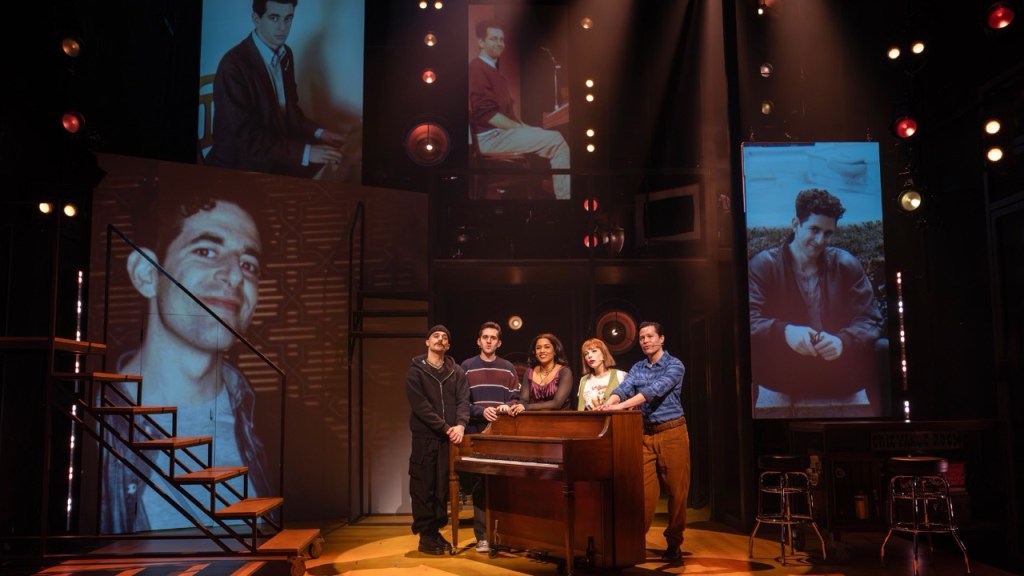
The Jonathan Larson Project ★★★★
Music & Lyric by Jonathan Larson. Show conceived by Jennifer Ashley Tepper. Orpheum Theatre.
Less of a musical and more of a song-cycle, this collection of unheard, unproduced songs from the archive of Jonathan Larson has been floating around as a cabaret and a live recording for a few years. And, for a brief time, it got a fully staged production at the Orpheum.
This staging deserved a longer run than it eventually got, but in a crowded Broadway season it seemed to just get lost in the mix. Its rather random nature, with disparate tunes and no narrative thread to bind it together, made it a show for musical theatre fans and not the general audience.
The cast were all exceptional. I was familiar with Andy Mientus and Adam Chanler-Berat already but it was the two female cast members, Taylor Iman Jones and Lauren Marcus who really blew me away.
I can definitely see this landing at the Hayes sometime soon.
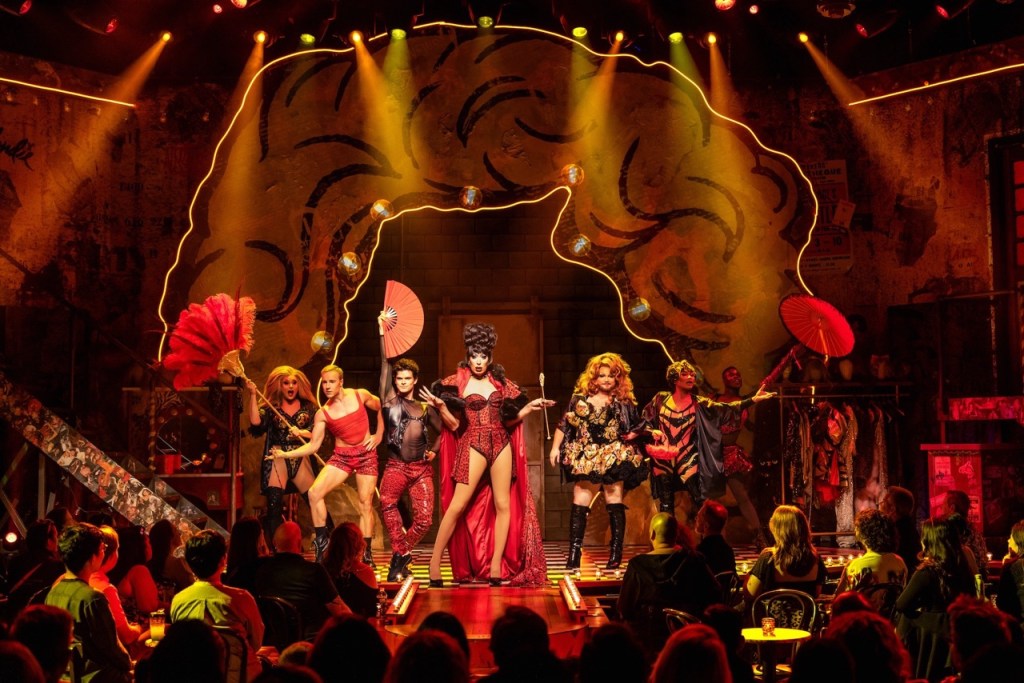
Drag: The Musical ★★★
Book, Music & Lyrics by Tomas Costanza, Justin Andrew Honard & Ashley Gordon. New World Stages.
My decision to finally see Drag: The Musical was based on timings. They were one of the only shows doing a Sunday evening performance. I’d heard some mixed reports about the show, and I’d long grown weary of the RuPaul’s Drag Race variety of drag, so I wasn’t going to go out of my way to see this. But some spare time, and the fact that Broadway legend Adam Pascal (continuing the Jonathan Larson/Rent theme – more on that to come) was the show’s “token straight man” got me planting myself down with a stiff alcoholic drink.
And I had a great time. For all the Drag Race alumni on the stage, it didn’t resort to riffing off the show. Cleverly written for Alaska Thunderf*ck (she walks on, throws out an insult, and sings a few songs with a very limited vocal range – and it’s brilliant) and Nick Adams (he walks on, sings, dances and poses like the Broadway pro he is and is equally wonderful), it knows what it’s trying to do and does it well.
Despite the punk/grunge aesthetics of the set, this show is pure pop and aimed at Drag Race’s core audience – straight women. The plot is frothy, the “meaningful message” is simplistic but heartfelt and the resolution obvious from a mile away, but I definitely enjoyed myself.
-
New York Mini-Reviews 2025 p1: Off-Broadway Plays
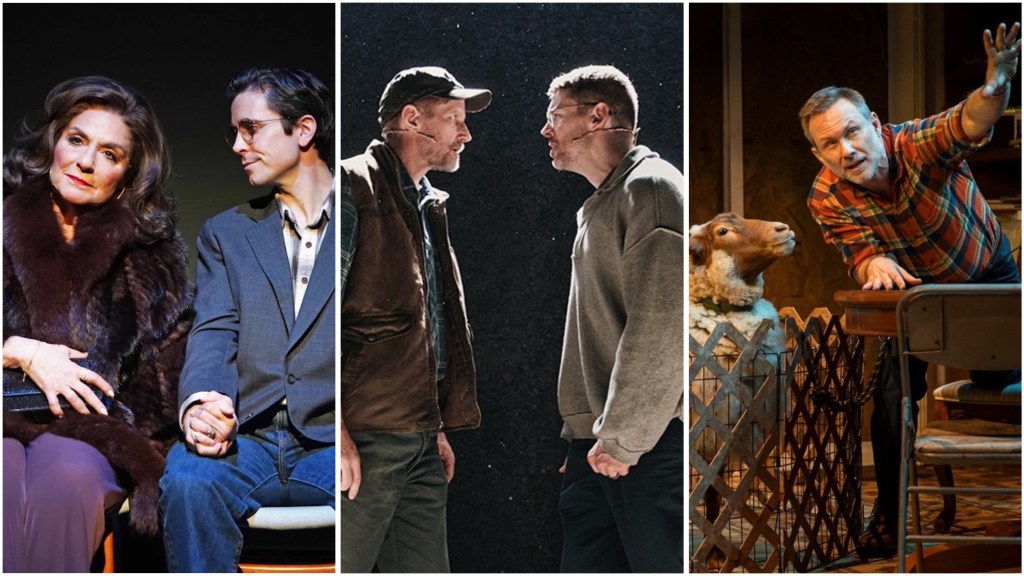
Conversations with Mother ★★½ / Grangeville ★★★★ / Curse of the Starving Class ★★½
Returning to New York for the second time in six months (a quirk of my work schedule more than anything else) meant that many of the shows I’d already seen were still up and running. That gave me a chance to head Off-Broadway more than I usually would, and to see more plays than musicals. The results were definitely hit and miss.
The level of Off-Broadway work felt very familiar to what we have at home, and after a few plays I started to find myself itching for the scale of Broadway shows. I initially had tickets to a fourth Off-Broadway play, which I sold (on the Theatr app – a great little resale app) in favour of seeing a Broadway show that was getting very mixed reviews.
Of the three Off-Broadway plays I saw, there was a real mix of quality and a range of very famous names. It certainly was interesting…

Conversations with Mother ★★½
Written by Matthew Lombardo. Theatre 555
I’ll be honest, the reason I saw this play was timing. Very few shows have Thursday matinees, and it was either this or seeing The Great Gatsby again with new leads. While I definitely enjoyed Gatsby the first time, I thought I should embrace something new instead – plus this starred Tony Award-winner Matt Doyle (he won for playing Jamie in the gender-switched Company) and Caroline Aaron.
It’s the story of a gay man and his relationship with his mother over several decades, taking him from childhood to old age in a series of scenes. While it was certainly sweet and occasionally funny (not as funny as it thought it was), it didn’t really do much to justify its own existence on stage. This felt like the kind of show you’d take your mother – or your grandmother – to. A safe, low-budget play that could be staged at a community theatre, rather than the level of writing you’d expect Off-Broadway; more like Off-off-Broadway. The saving grace was Caroline Aaron’s clear sitcom timing and Matt Doyle’s innate charm.

Grangeville ★★★★
Written by Samuel D. Hunter. Signature Theatre.
Samuel D. Hunter is one of the current crop of acclaimed playwrights, with big hits like The Whale (which became the Oscar-winning film) and A Case for the Existence of God (produced by Outhouse Theatre Co at the Seymour Centre last year). Grangeville, his new play, starred Brian J. Smith (best known for his TV work in Sense8, Stargate: Universe and Treadstone, and his Tony-nominated role in The Glass Menagerie in 2014) and Paul Sparks (also best known for TV – Boardwalk Empire, House of Cards et al) as two estranged brothers trying to reconnect after the death of their mother.
Over the years, the younger brother Arnold (Smith) has moved to Europe with his boyfriend and pursued an art career without ever looking back, while Jerry (Sparks) stayed at home, caring for their mother as she grew ill.
It’s a tight, tough little two-hander that keeps the brothers apart. Though they’re physically on stage together, they communicate through phone calls and video chats for most of the play. It’s an interesting choice, though I’m not sure it does the show many favours. But both performances were excellent, and the script was funny and moving.
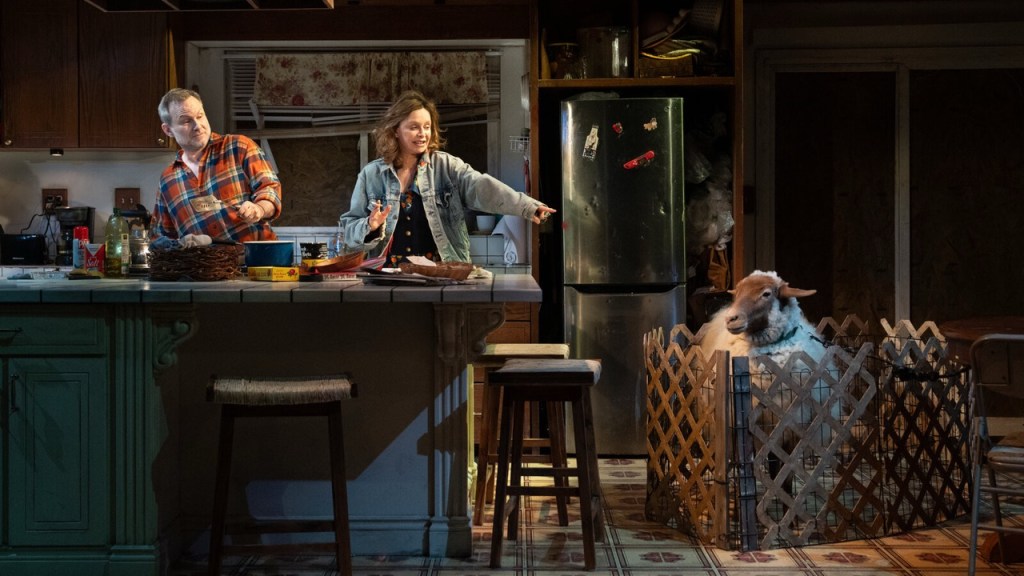
Curse of the Starving Class ★★½
Written by Sam Shepard. The New Group
The decision to see Curse of the Starving Class was threefold: it’s a Sam Shepard play I hadn’t seen before; it starred Christian Slater and Calista Flockhart; and, as a mini-bonus, it also featured Cooper Hoffman – son of the late, great Philip Seymour Hoffman.
Sadly, it wasn’t a very good production. A combination of well-meaning but questionable casting decisions and static staging meant it felt much longer than its 2hr 45min run time. Shepard’s writing remains razor-sharp, and this is one of his most autobiographical works, so there was a lot to take in – but ultimately, it fell flat.
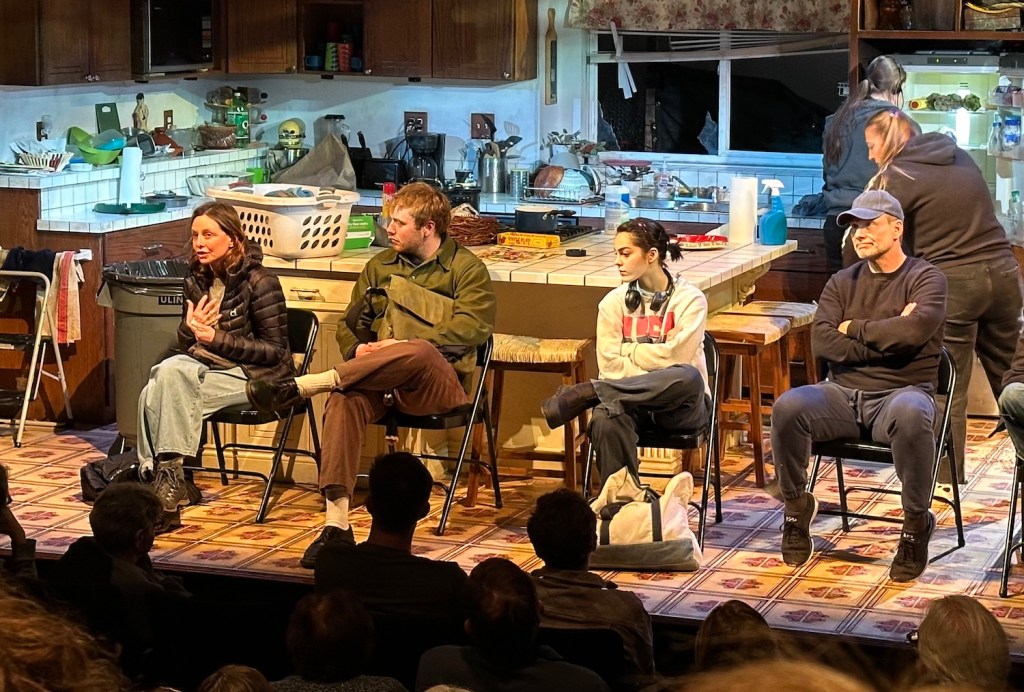
I stuck around after the performance for a cast Q&A, which only reinforced how much personal magnetism both Slater and Flockhart possess. Even though they were clearly exhausted, they still put on a good show for the audience.
-
Snakeface (Belvoir 25a) ★★★½

Written by Aliyah Knight. Fruitbox Theatre. Belvoir 25a. 8-27 Apr, 2025.
Poetic and visceral, there’s an energy to writer/performer Aliyah Knight’s work Snakeface that bodes well for their future. This is a voice I want to hear more from.
Snakeface is a monologue that jumps backwards and forwards between events in the life of Maddie (Knight). It’s a rolling commentary on life, friends, sexual partners and fantasies as both a teenager and a young Black 20-something. But some of those moments are dark, and Maddie doesn’t always want to – or know how to – face them.
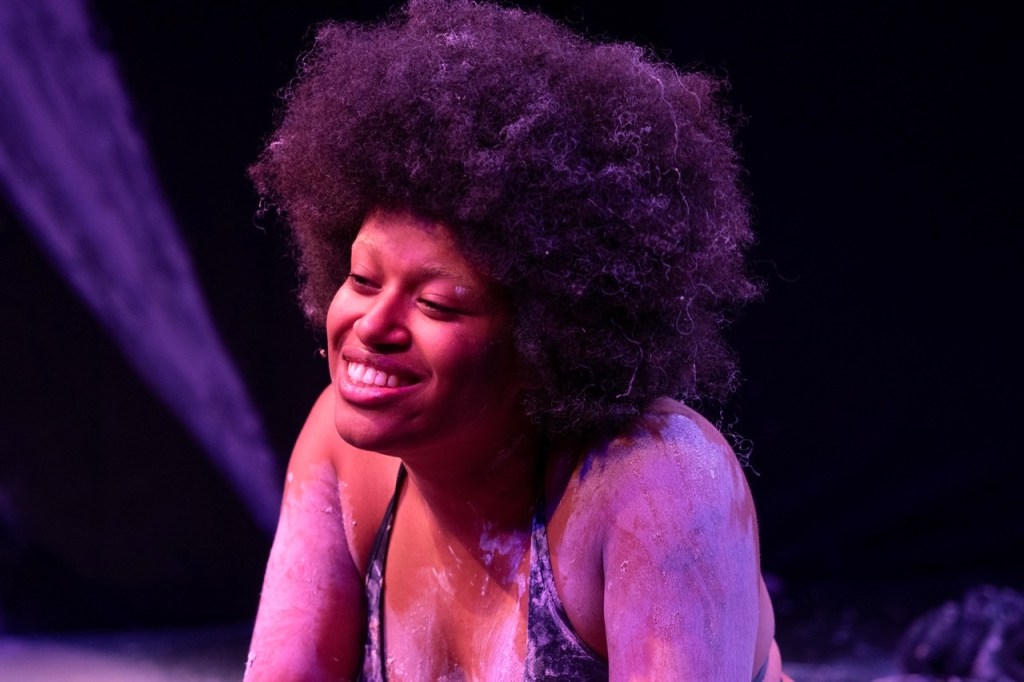
Aliyah Knight. Photo: Abraham de Souza. Knight is fantastic as Maddie: full of warm, childlike enthusiasm, with flashes of violent intent. Taking its inspiration from the legend of Medusa, Snakeface hints at violence unseen. Knight’s performance gives us all the graphic details through her physicality. Their hands are rarely static – either tugging at pieces of costume, playing with jewellery, or tearing into a large block of clay that dominates the stage.
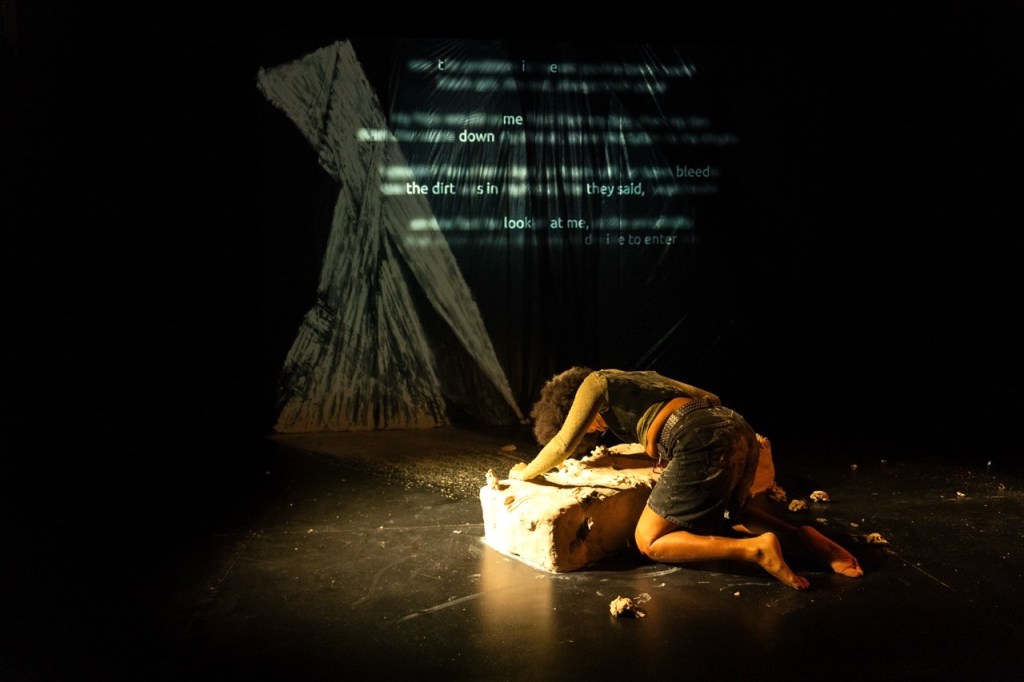
Aliyah Knight. Photo: Abraham de Souza. At times, this is less a play and more a piece of spoken word poetry, as Maddie slips into a rhythmic metre that hits the ears like a heartbeat. It’s an evocative way to show her transformation into something more animalistic than she first appears. We are introduced to a heavily redacted written version of Maddie’s story as text projected onto the wall. The words and letters we see spell out anger and pain, though it’s clear we’re not reading the full piece. It’s only at the show’s climax that we get to read the full poem.
There were moments, as the language grew more poetic – and at times obtuse – delivered with measured tempo, that I began to lose track of the story. The delivery became more prominent than the words themselves, and I was lulled into a trancelike state for a minute. This, combined with the time jumps and the multitude of characters to keep track of – who are the ex-lovers, who are the best friends, who are the ex-lovers who are now best friends, etc. – does make it hard to track the details of the story. But ultimately Snakeface boils down to a single moment and its aftermath, which is crystal clear.
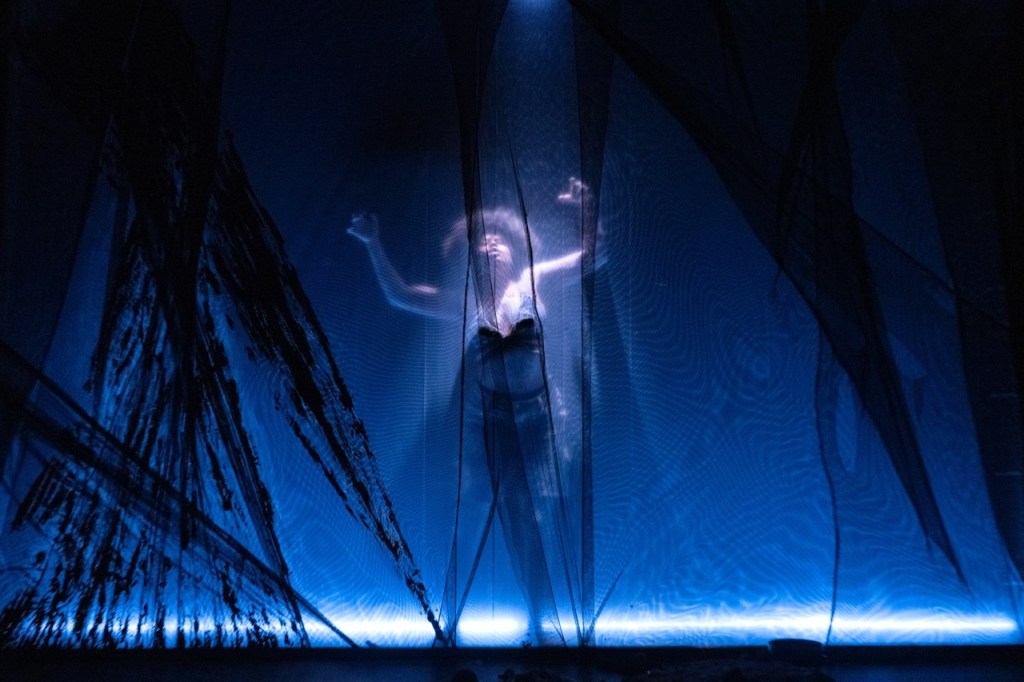
Aliyah Knight. Photo: Abraham de Souza. What is undoubtedly successful is the brilliant staging. In the black room of 25a’s space, your eye is instantly drawn to the large earthen block of pale clay in the centre. It sits in the room like a sacrificial altar. Above, netting like spider webs frames the stage. 25a has become a cave – a lair – for this Medusa to work through her pain. It is stunningly simple work from Keerthi Subramanyam (set & props), Rachel Lee (lighting), Wanyika Mshila (costumes), Marco Cher-Gibard (sound), and Wendy Yu (projections). For the first time in a while, this 25a show actually feels like it is genuinely made for the $2500 budget (unlike other recent shows that definitely seemed to be… well… let’s just say I wanna see some receipts), but that budgetary restriction has brought out their best.
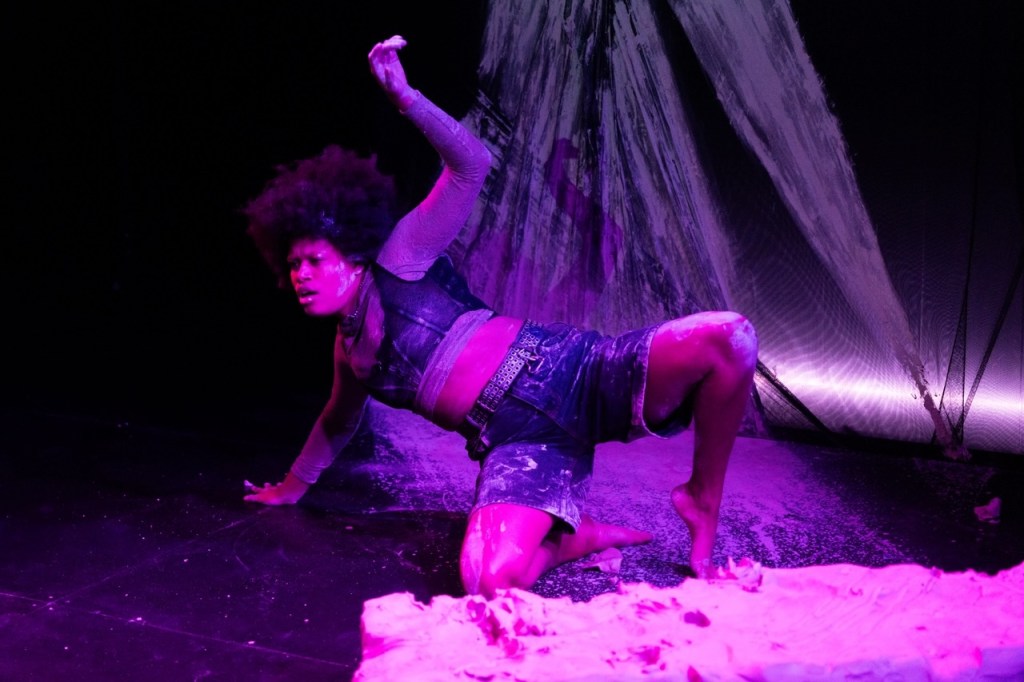
Aliyah Knight. Photo: Abraham de Souza. Aliyah Knight and director Bernadette Fam have created an excellent intersectional work that drills into the specificity of a Black/queer experience. Snakeface is a story of survival, in many forms, that avoids the pitfalls and boring clichés of “trauma porn” drama and finds something more engaging, more fascinating, and ultimately more hopeful. I think some extra refining to the storytelling will ensure it really lands its punches.
-
These Youths Be Protesting (KXT on Broadway) ★★★

Written by Izabella Louk. World Premiere. KXT on Broadway. 4-19 April, 2025.
Energetic and entertaining, These Youths Be Protesting shouts loudly about big topics but doesn’t really say a great deal.
A high school club set up to encourage recycling by wannabe School Captain Lemon (Karrine Kanaan) and her best friend/obedient sidekick Georgie (Rachel Thomas) becomes the unwitting focal point of environmental activism thanks to the arrival of the determined Mandi (Mây Trần). Carrying along popular slacker Jimbo (Hamish Alexander), the teens find themselves face-to-face with local politicians, the media, the internet, and an impending new local mine as they try to make their voices heard and fight for their future.

Rachel Thomas, Karrine Kanaan & Hamish Alexander. Photo: Karla Elbourne. The climate crisis is the existential issue of our time, yet it seems everyone just wants to ignore it (*stares at the current government). For all the corporate and political lip service to “sustainable futures,” we are no closer to a solution despite knowing what needs to be done. And it’s the younger generations who’ll bear the brunt of the problems we’re failing to address.
In tackling this weighty topic, These Youths Be Protesting suffers from an unbearable lightness of being, using these issues as a backdrop for a teen friendship comedy. It’s less Ferris Bueller’s Day Off, as the marketing suggests, and more The Breakfast Club, with a group of unlikely students becoming a close-knit team, bound together by varying degrees of concern for the environment.
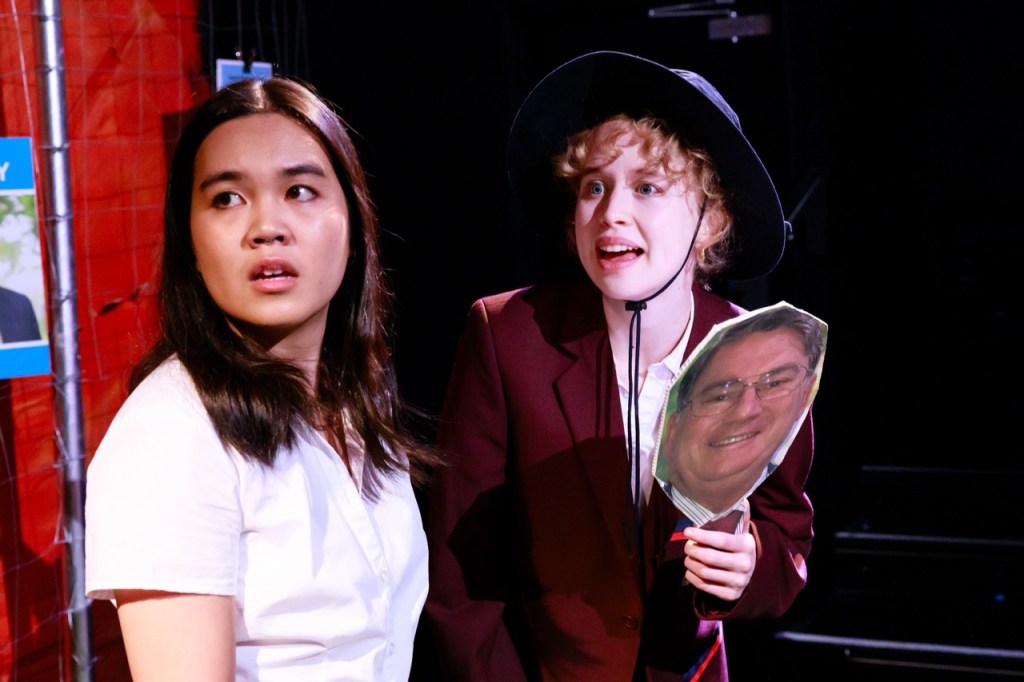
Mây Trần & Rachel Thomas. Photo: Karla Elbourne. It’s in these awkward bonds of friendship and budding adulthood that the show finds its footing, playing with the sometimes confusing nature of teenage relationships and gradual self-discovery. In this, the cast excel with fun and genuine performances rooted in youthful insecurities and dreams.
Writer/director Izabella Louk has a firm grasp of narrative and character. Despite some repetitive beats and a bit of clunky scripting near the very end, the show is undoubtedly pleasant and entertaining, in no small part due to the cast’s energy. You can almost hear their panting as they race through the corridors of KXT on Broadway to make their next entrance on the other side of the stage.
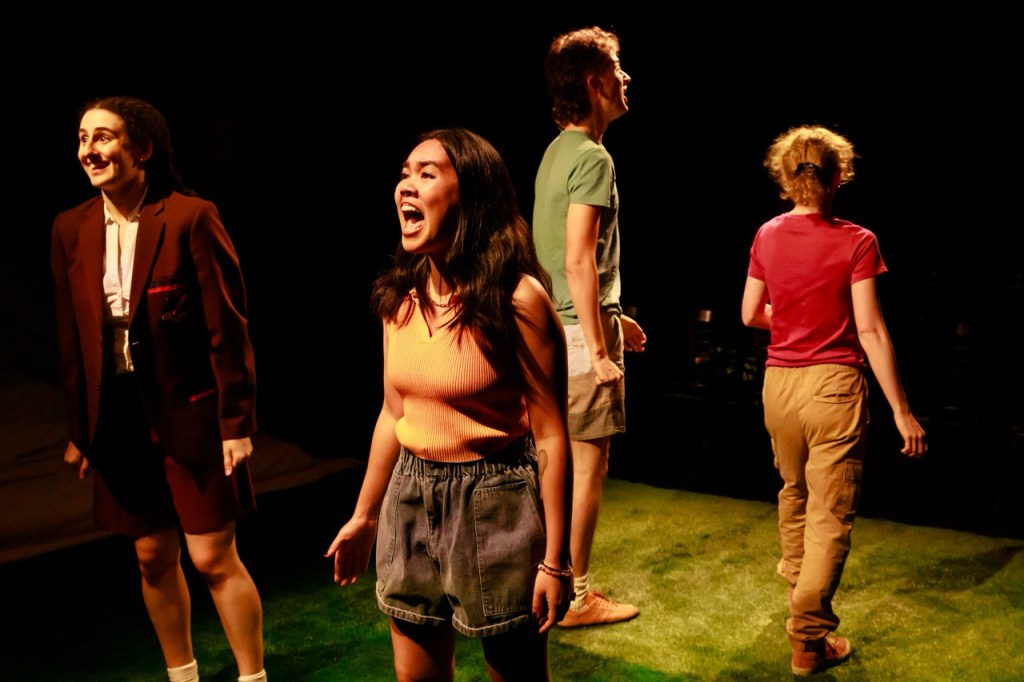
Karrine Kanaan, Mây Trần, Hamish Alexander & Rachel Thomas. Photo: Karla Elbourne. But while the play touches on a variety of closely related topics (protest vs working within the system, token environmentalism, mental health etc), it never really goes deep, resulting in moments that preach a very basic message to the choir rather than issuing a rallying cry. This isn’t a guidebook for better action or a critique of the world; it’s a simple snapshot of teenage life that, for all its comic moments, doubles down on nihilism.
Coming in at under 90 minutes (three cheers for shorter one-act plays!), These Youths Be Protesting has the laughs, performances, and vivacity to keep you engaged. Ironically, for a play about mining, it just doesn’t go very deep.
-
Dear Elena Sergeevna (Old Fitz) ★★★★
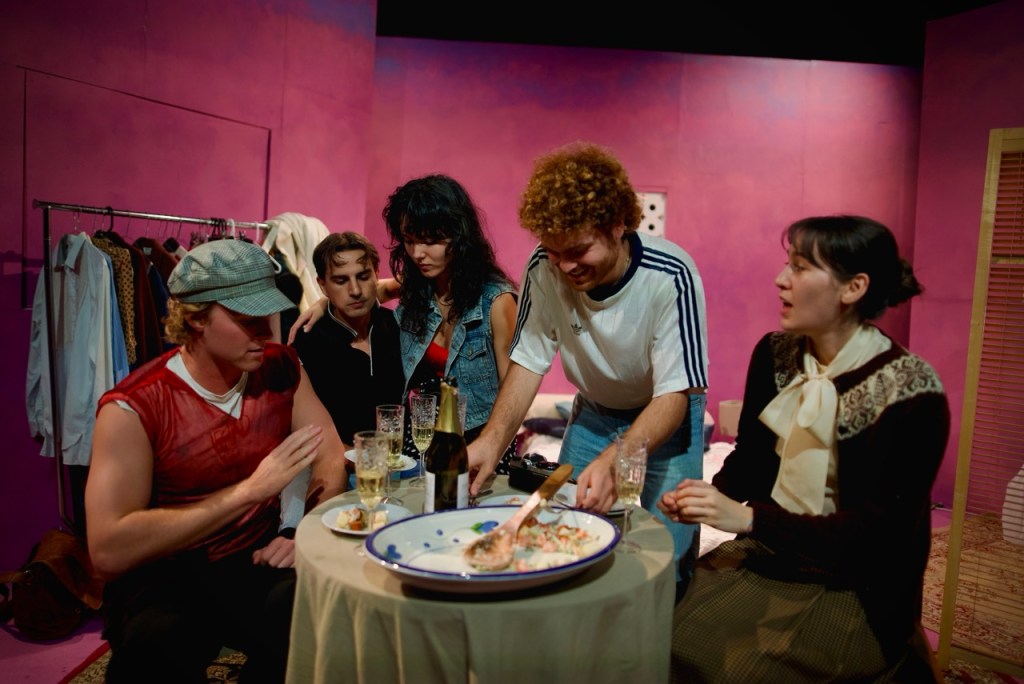
Written by Lyudmila Razumovskaya. Old Fitz Theatre. 1-11 Apr, 2025.
Dear Elena Sergeevna puts the focus on the actors to bring this 80s Russian moral drama to the small stage. It’s thrilling.
Mathematics teacher Elena Sergeevna (Teodora Matović) is alone in her home on her birthday when four of her students unexpectedly arrive bearing extravagant gifts. They’ve just sat their final maths exam, which will determine whether they get into university, and there is an air of unease about their presence in Sergeevna’s home. Over wine and some hastily assembled food, the truth comes out.
They need Elena Sergeevna’s help to break into the school and replace their failing exam papers with new ones before they are marked in the morning. But Elena is a moral, sturdy Russian woman who believes in order, while these young, avaricious youths are more than willing to bend any rule to get ahead in life.
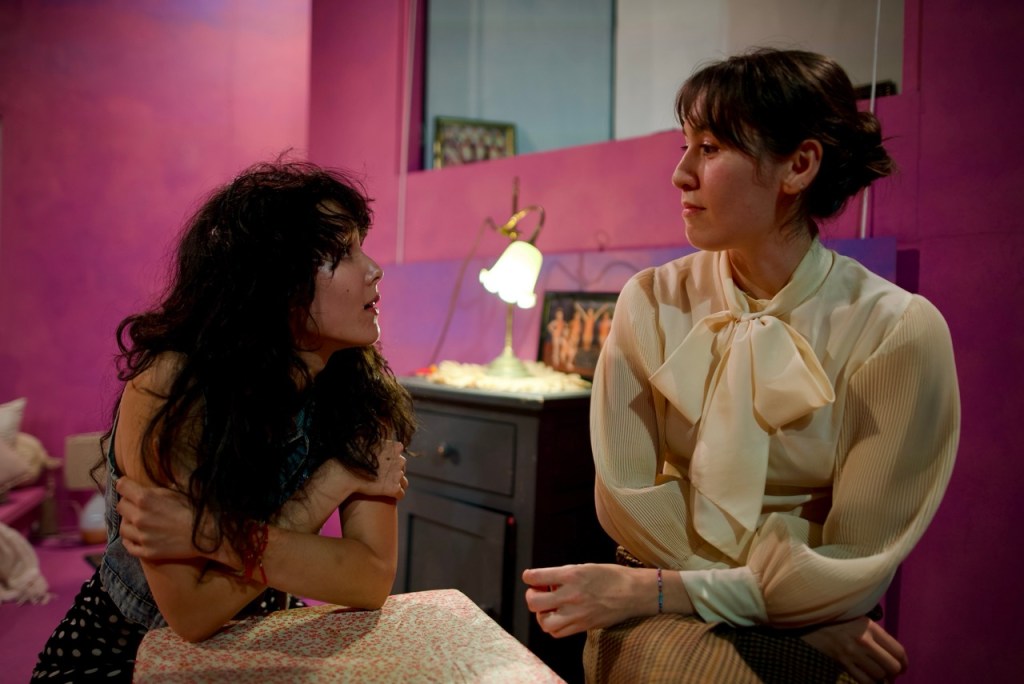
Madeline Li & Teodora Matović. Photo: Noah David Perry. Dear Elena Sergeevna has the creeping unease of a domestic break-in thriller, combined with a clear, biting message about the dehumanising combination of desperation and greed. Razumovskaya cleverly establishes two immovable forces: the upright Elena and the frighteningly amoral ringleader, Volodya (Faisal Hamza), a bright young man who wants nothing more than to exert his power and win the intellectual and moral victory. While Elena is a woman who has lived through rough times and will not bend, Volodya is like an ever-shifting con artist, constantly looking for the advantage and waiting to strike.
Volodya uses his fellow students as pawns to manipulate Elena. Vityok (Harry Gilchrist), the group’s fool, has few prospects and wants nothing more than to live in the country. Pasha (Toby Carey) wants to study literature, but a failing grade will ruin his chances. Lyalya (Madeline Li) is a modern woman, fully aware of how gross materialism is changing Russia, and determined to do what she must to get ahead.
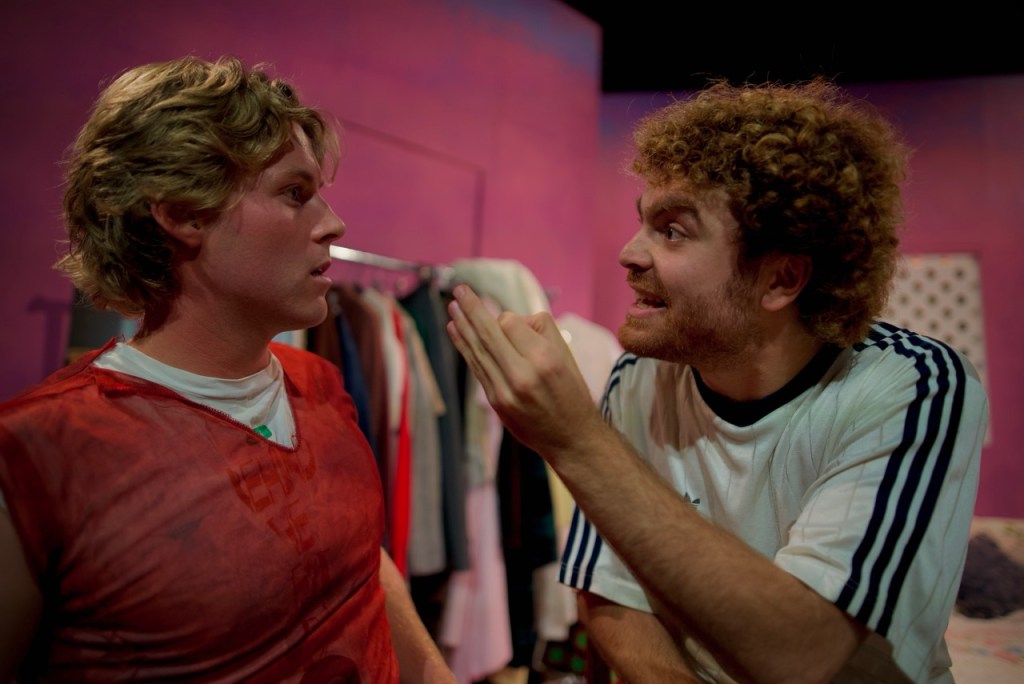
Harry Gilchrist & Faisal Hamza. Photo: Noah David Perry. What makes Dear Elena Sergeevna so effective is that the nihilism and greed of the capitalistic 80s and Perestroika Soviet Union, embodied by the students, is a shocking mirror of today. Volodya’s attempts to dominate others come straight out of the pathetic, “alpha”-obsessed manosphere playbook (he even refers to Pasha as a “cuck”). Lyalya’s scheme to auction off her virginity isn’t that different from launching an OnlyFans.
Razumovskaya’s disgust at the modern world is clear, with Sergeevna critiquing the way the world has lost its moral and ethical centre. There is even a whiff of anti-intellectualism in her tone, as the more academically minded students are the most disturbing, while the relatively simplistic Vityok finds a late moment of (partial) redemption.
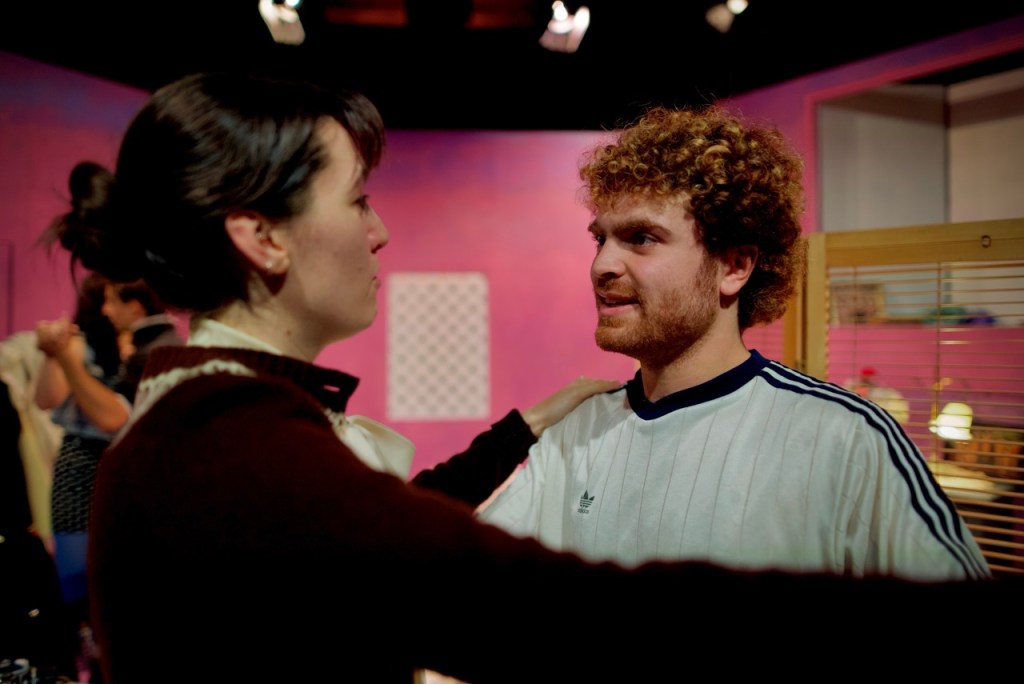
Teodora Matović & Faisal Hamza. Photo: Noah David Perry. Faisal Hamza is dynamic as Volodya. His playful, anarchic energy has a Joker-like quality that is undeniably magnetic. Up against Matović’s brilliantly stern Elena, they form two strong poles that hold the play together.
Director Clare Voda tackles the action with a light touch, which can sometimes detract from the material. There is a naturalistic realism to the performances that, while compelling and grounded, results in muddied cross-talk which becomes confusing for the audience. Scenes often feel unstaged and random (admittedly, as a late-night show at the Old Fitz, they are using the set of Amber, which brings restrictions). At times, the onstage chaos feels like genuine chaos.
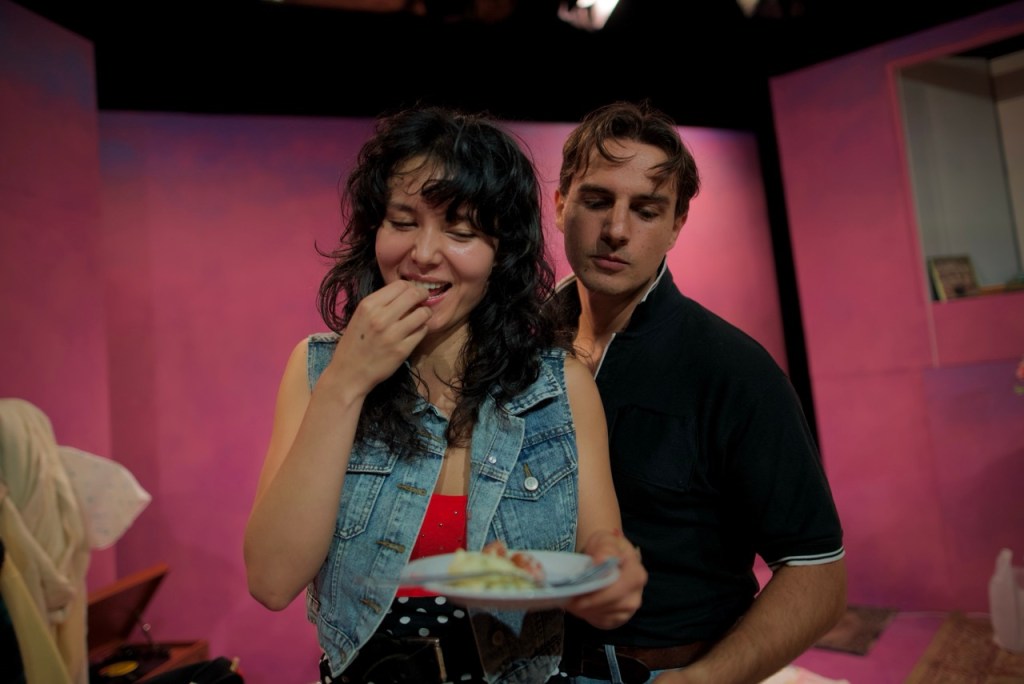
Madeline Li & Toby Carey. Photo: Noah David Perry. While the production elements are definitely lacking, there is something energising about this script and these performances (just like Amber, two of the cast come from All Boys at KXT on Broadway – that show seems to have been a breeding ground for great new talent). It had me so engaged I could forgive all the obvious faults.
Dear Elena Sergeevna might be messy and a heavy watch for a late-night show, but it delivers authentic drama, an intellectually interesting script, and boldly honest performances without needing the bells and whistles. Great writing, combined with great acting – this is what I want from independent theatre.
-
Subscribe
Subscribed
Have a WordPress.com account? Log in now.

