-
Welcome to Cultural Binge

The rating system is simple:
★★★★★ – Terrific, world-standard. Don’t miss.
★★★★ – Great, definitely worth seeing.
★★★ – Good. Perfectly entertaining. Recommended. Individual mileage may vary.
★★ – Fine. Flawed and not really recommended, but you may find something to appreciate in it.
★ – Bad (& possibly offensive).
See more reviews over at The Queer Review.
Instagram: @culturalbinge
Substack: culturalbinge.substack.com
Email: chad at culturalbinge.com
-
Peter & the Starcatcher (Capitol Theatre) ★★★★
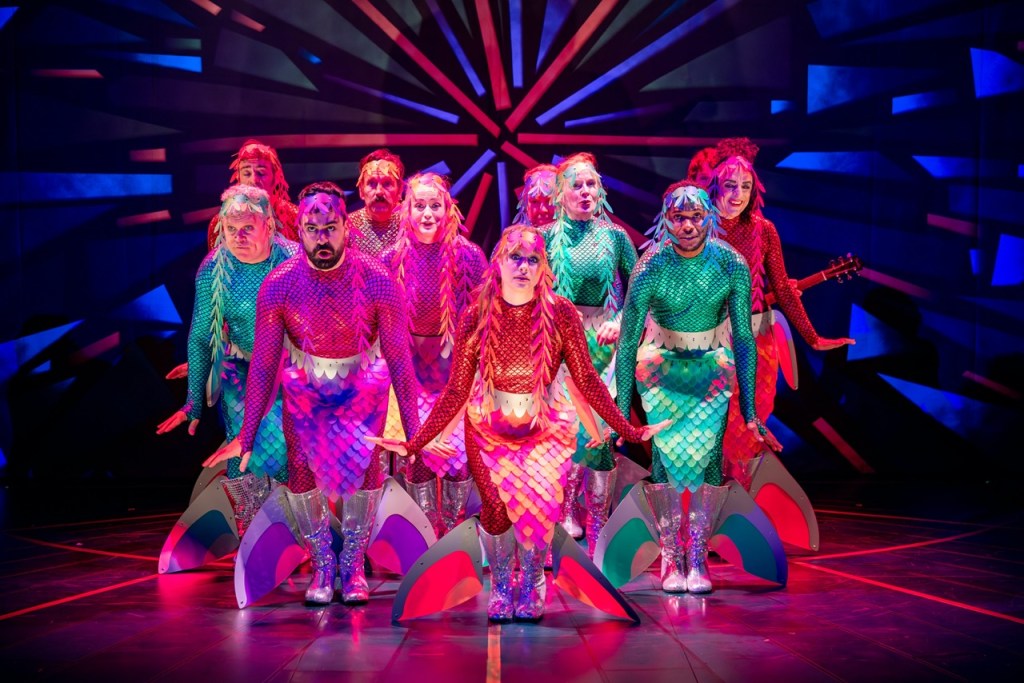
Written by Rick Elice. Based on the novel by Dave Barry & Ridley Pearson. Music and lyrics by Wayne Barker. Capitol Theatre until 9 February.
Magical staging and joyous performances combine for a sparklingly silly show. If, like me, you’re a sucker for fairy lights and the odd fart joke, you’ll love this Peter Pan prequel. Just don’t think about it too hard.
Thirteen-year-old Molly Aster (Olivia Deeble) is determined to prove she’s grown up by helping her father, Lord Aster (Alison Whyte), on a mission and showing she can be a fully fledged Starcatcher. While Lord Aster carries an important trunk full of Starstuff on the ship The Wasp, he puts Molly and her nanny Mrs Bumbrake (Lucy Goleby) on the slower but safer Never Land. There, Molly finds three orphans, including a Boy with no name (Otis Dhanji). But when The Wasp is attacked by pirates, led by the fierce (in a camp way) pirate Black Stache (Colin Lane), it becomes a race to catch the Never Land, which leads both ships to an unknown island full of hungry locals… and a big crocodile.

Peter & the Starcatcher. Photo: Daniel Boud. Director/designer David Morton has opted for a “more-is-more” approach to what is essentially a panto that could be performed in a school library with minimal props and a lot of gusto. The script is full of narration designed to tell rather than show, with wordplay that trips off the tongue. It’s all aimed at kids, with some jokes hidden for the grown-ups. In the hands of Morton and the Dead Puppet Society, however, the story has literally grown in the telling, full of awe-inspiring puppetry that puts that other show to shame.

Peter & the Starcatcher. Photo: Daniel Boud. The level of silliness is high, and all the better for it. There’s a sprinkle of sentimentality, but the real selling point here is the multicoloured world they’ve created. Some sharp commentary about British colonialism and gender roles will keep the grown-ups amused between the bum jokes and broad racial stereotyping aimed at the kids. The word “focaccia” has never been so well deployed as by Ryan González’s Fighting Prawn.
And the cast are having a ball on stage. Especially Colin Lane and Pete Helliar, who threaten to descend into giggles at any moment (or at least are pretending to corpse… I was a little suspicious). It all works because, as loose and chaotic as the show appears, it snaps back into tight formation when it needs to. The pieces of set glide around the stage with ease, and the choreography of some simple lighting tricks is wondrous to watch—very simple stage magic deployed with finesse. Something that that other show would do well to study.

Peter & the Starcatcher. Photo: Daniel Boud. Olivia Deeble is feisty and acrobatic as the young Molly, suitably endearing and annoying. Otis Dhanji is inquisitive and brash as the young Boy (no prizes for guessing who he becomes—his name is in the title). Colin Lane’s Black Stache owes a debt to Robert De Niro’s Captain Shakespeare from the film Stardust. I can forgive the rather two-dimensional racial stereotypes and borderline queer jokes because this is a simplistic family story, and the core message is positive.
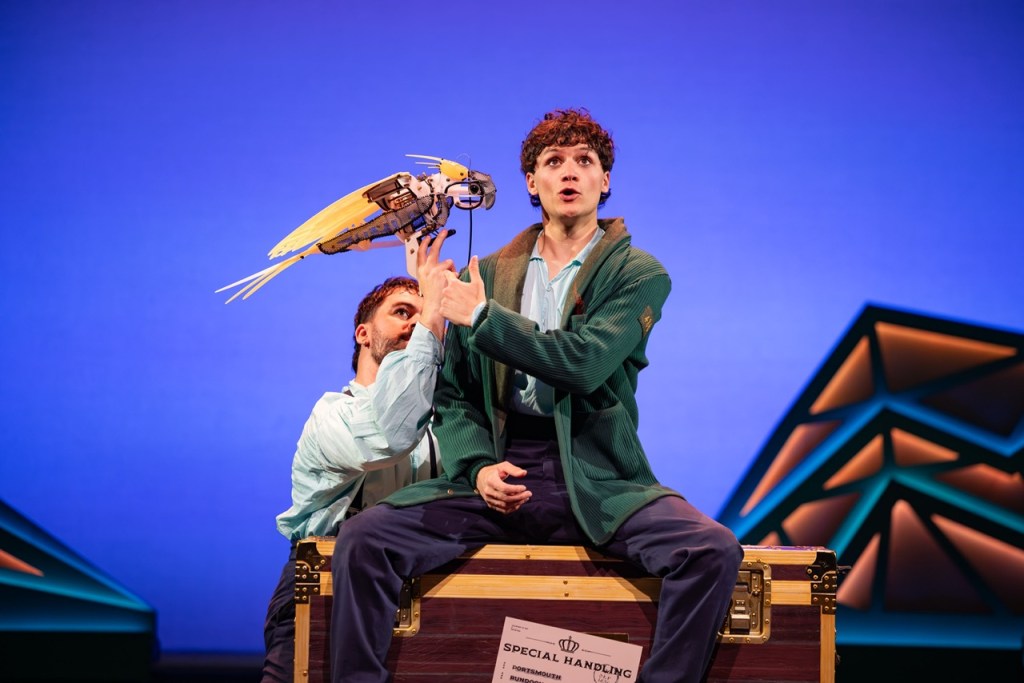
Peter & the Starcatcher. Photo: Daniel Boud. Prequels are generally pointless, and I don’t think audiences were crying out to discover how a magical boy who doesn’t age ended up on an island, but the corporate mining of IP never ends. Were you curious how Peter Pan got his name? Of course, you weren’t, but you’ll find out. How was Tinkerbell created? Never crossed your mind? Don’t worry, we’ll tell you. How did that crocodile get so big? We’ve got you covered. To their credit, Barry and Pearson’s tale doesn’t diminish the beauty of the original by explaining away the magic too much, and Elice’s adaptation puts Molly front and centre rather than Peter, which helps ground the story. While it hits all the familiar beats you expect from a tale in Neverland (crocodiles, pirates, mermaids), each is given a new spin.

Peter & the Starcatcher. Photo: Daniel Boud. So, it’s a shame that, on opening night, things were threatened by muddy, unclear sound. Group numbers were reduced to a well-choreographed wall of noise, and much of the witty script was difficult to catch. These moments were saved by the dazzling costumes and terrific cast.
If you’re looking for fun, laughs, and some spectacle, then Peter and the Starcatcher is just the charm bomb you’ll want. If you’re worried that it’s a “kids’ show,” you’ll be fine—there’s enough for the grown-ups to make it an enjoyable trip. And for the theatre nerds, there’s great puppetry and stagecraft on display.
PS – Walking home, I had a real hankering to rewatch Mischief Theatre’s Peter Pan Goes Wrong.
-
Aria (Ensemble) ★★★★
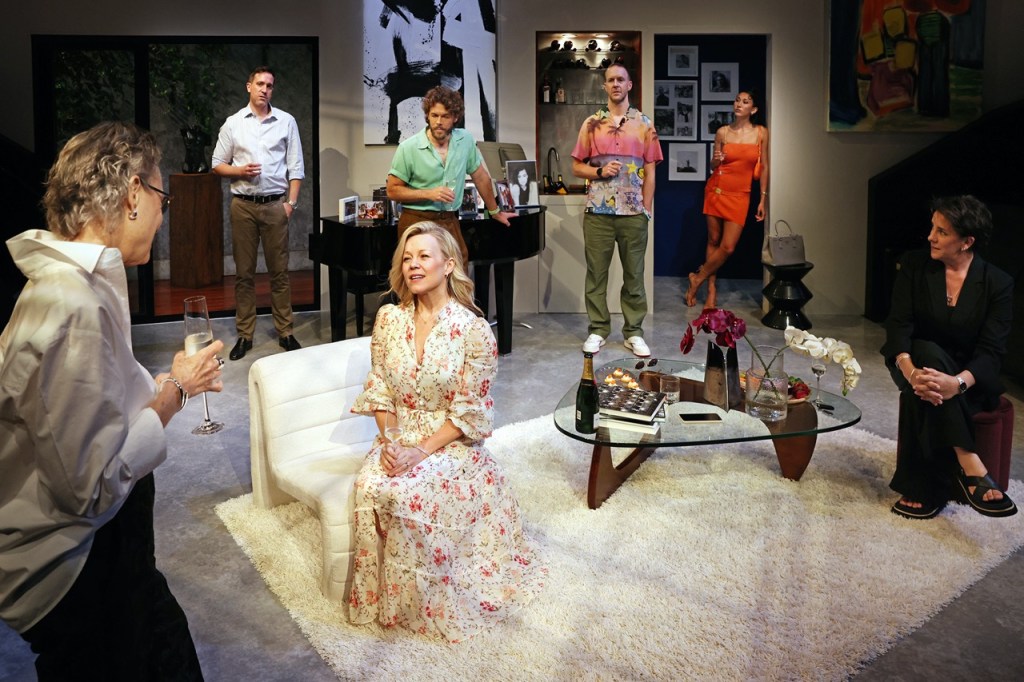
Written by David Williamson. World Premiere. Ensemble Theatre. 24 Jan – 15 Mar, 2025.
Sydney’s delusional, monied elites are in for a pasting in David Williamson’s sharp-tongued Aria. If you’ve spent any time with the privileged offspring who populate the city’s more prestigious private schools, or with the pampered show-ponies of the Eastern Suburbs, you’ll recognise people identical to this cast of characters. Aria seems like a broad comedy, but it could just as easily be a wildlife documentary.
Monique (Tracy Mann) is ready for her big day. Her three sons are coming over for dinner to celebrate their joint birthday. Her oldest twins, Liam (Jack Starkey-Gill) and Daniel (Sam O’Sullivan), and her youngest, Charlie (Rowan Davie), born three years later on the same day. She adores them all, even if they’re not quite living up to their potential, despite her best efforts. Monique knows who’s to blame: their awful wives. But she is determined to enjoy the day, give a heartwarming speech, and sing her most difficult aria yet!
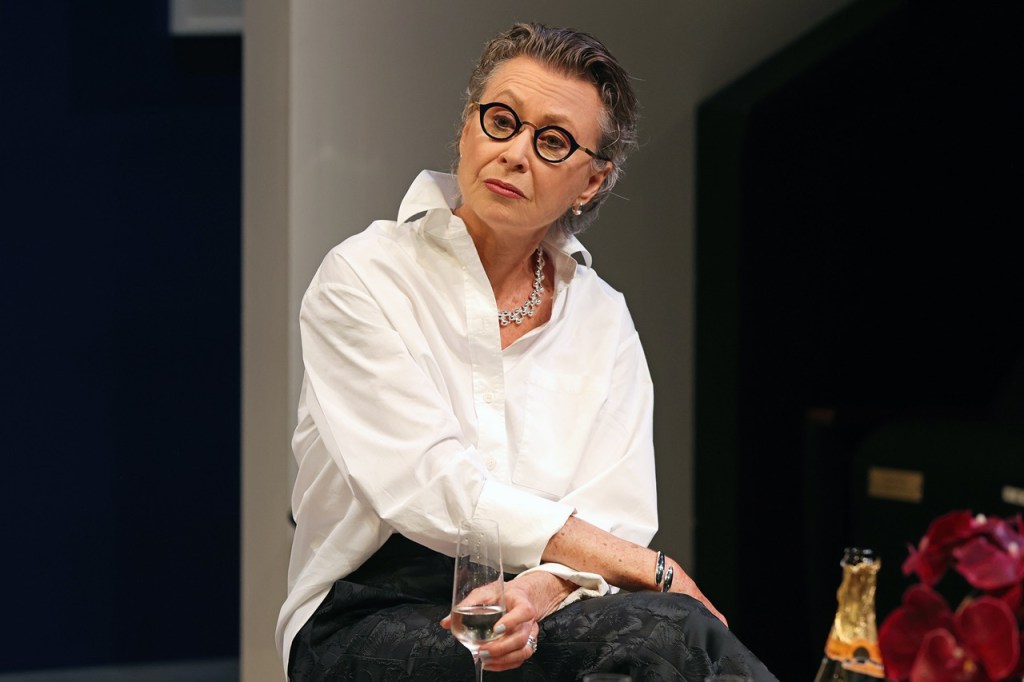
Tracy Mann. Photo: Prudence Upton. Tracy Mann is absolutely fabulous as the champagne-swilling, controlling family matriarch, Monique. Her insidious commentary and malicious maternal remarks are executed with comedic flair. In a virtuosic performance, Mann tackles a mountain of text (her birthday speech runs for four uninterrupted pages – do yourself a favour and grab a copy of the playtext at the theatre), as well as performing a full Mozart aria. Monique’s delusions aren’t limited to her musical ability; her vision of her children is equally skewed.
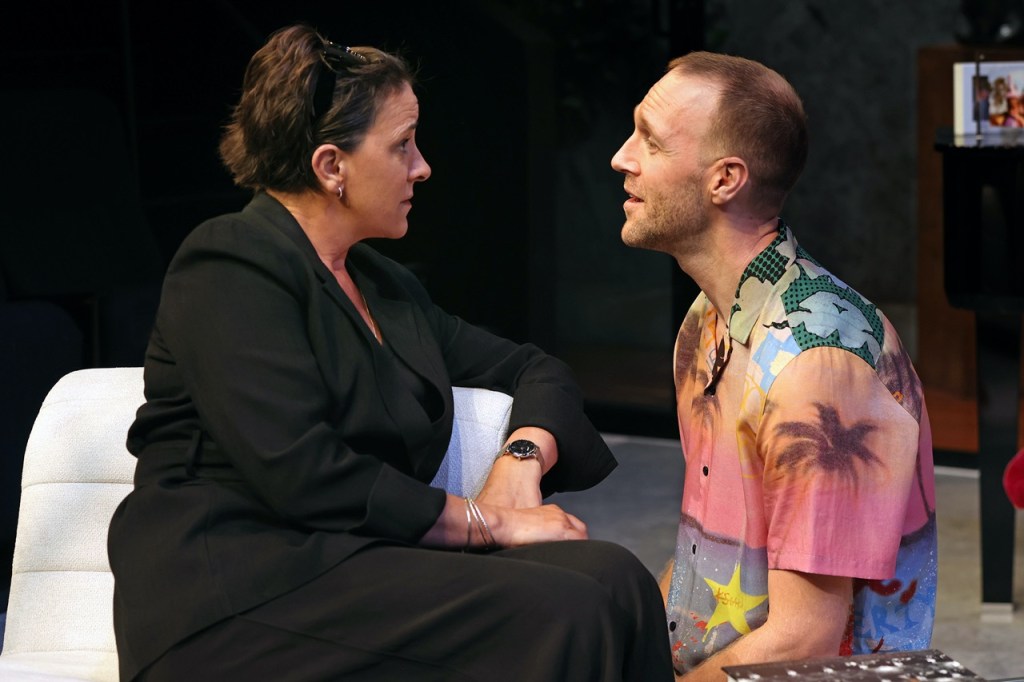
Danielle King & Sam O’Sullivan. Photo: Prudence Upton. Around her spin three couples so quintessentially Sydney that it almost hurts. There’s the eldest twin, Liam, a junior minister in the state government, convinced he nearly has the numbers to make a pitch for the leadership, and his wife, Chrissy (Suzannah McDonald – a scene-stealer), all blonde, motherly perfection, falling apart at the seams. Then there’s the second twin, Daniel, born 10 minutes after Liam, who plays second fiddle to his lawyer wife, Judy (Danielle King), whom Monique despises for her middle-class upbringing. Finally, there’s Charlie, who’s already lost one wife and has married the younger Midge (Tamara Lee Bailey), a bombshell beautician with a no-nonsense tongue. Between the brothers’ sibling resentments and the wives’ frustration at being belittled by Monique, each character is a cauldron of emotions, waiting for Monique to turn up the heat and give it one final stir.

Suzannah McDonald. Photo: Prudence Upton. The cast, all excellent, bring characters so clearly defined and realised that it’s easy to simply relax into the silliness and revel in the slow-moving train wreck unfolding before you. While the opening moments of the play felt artificial, things quickly found their rhythm, building to the cathartic eruption of family grievances finally aired. While not as vicious as August: Osage County, it is definitely more charmingly comedic.
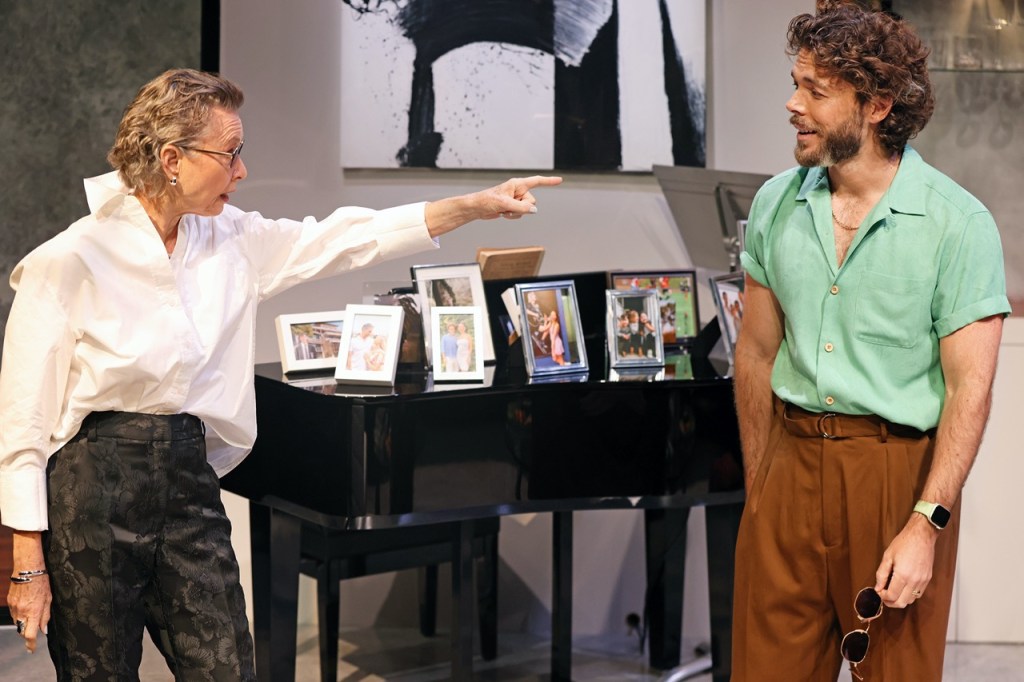
Tracy Mann & Rowan Davie. Photo: Prudence Upton. Kudos to David Williamson for holding it all together. After feeling slightly underwhelmed by last year’s The Great Divide, Aria hits the high notes. The story is clear without being obvious, the characters real(ish) without being predictable, and the jokes bubble up from character rather than feeling overtly contrived. It is a well-balanced script, delivered by a writer who knows their craft.
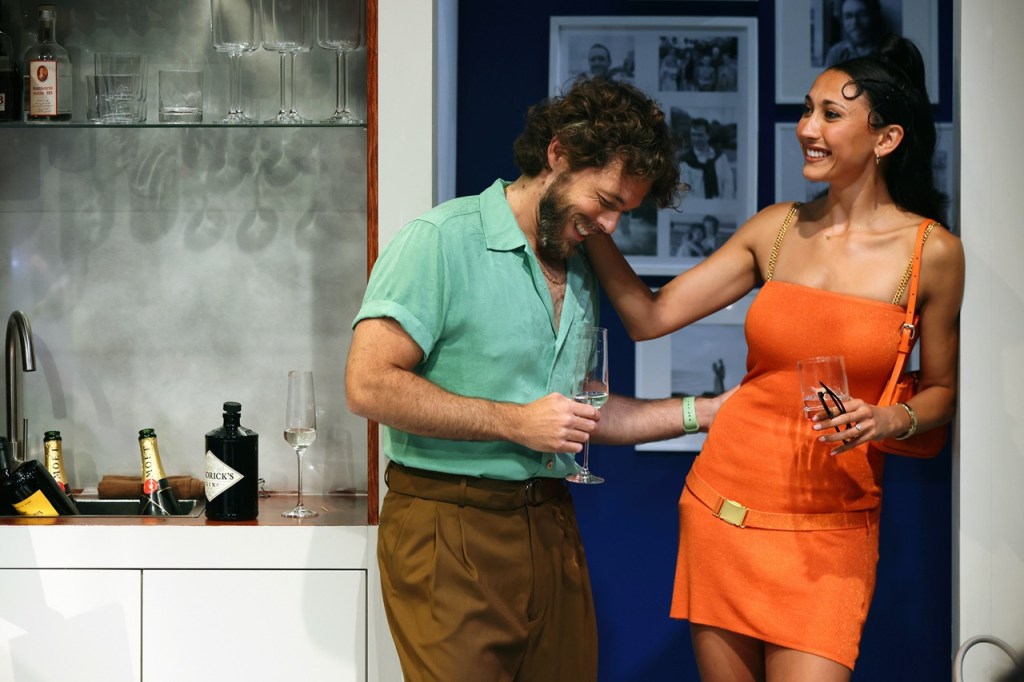
Rowan Davie & Tamara Lee Bailey. Photo: Prudence Upton. My enjoyment was undoubtably heightened by the fact I’d recently had a conversation that was almost identical to one in the script. Well, it’s true! You don’t want to be sat at Aria (the restaurant) and not have a window seat – what’s the point? #MidgeWasRight
Aria is, first and foremost, simply fun. Littered with timely observations and lightly dusted with societal commentary, it is primarily a piece of entertainment – and it hits the mark. It’s the diva at its centre who deserves all the applause – brava Tracy Mann, brava!
-
Dark with Excessive Bright (Sydney Festival) ★★★★

Omega Ensemble. ACO on the Pier. Sydney Festival. 18 Jan, 2025.
Program:
Philip Glass – Etudes for solo piano (selections) (1991-2012)
Bryce Dessner – Aheym (2009)
Missy Mazzoli – Dark with Excessive Bright (2018)
Samuel Adams – Lighthouse (2024)
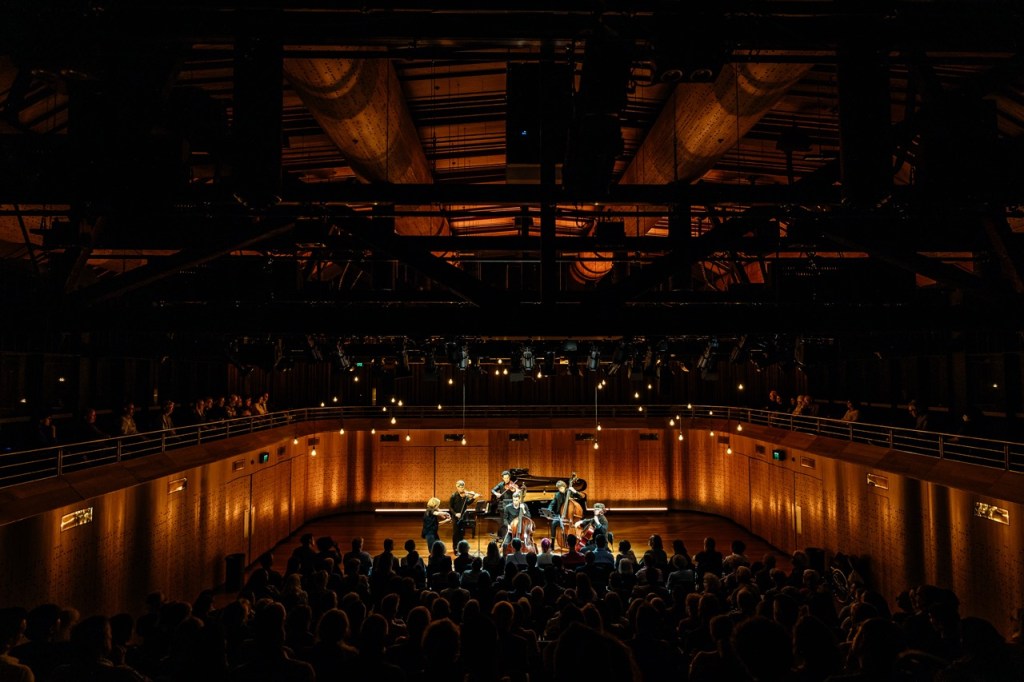
Dark With Excessive Bright. Photo: Victor Frankowsk Taking a break from my usual theatrical fare at the Sydney Festival, I slipped into the ACO on the Pier for Omega Ensemble’s programme Dark With Excessive Bright, named after Missy Mazzoli’s contemporary composition. This was performed alongside three other recent works. Bare in mind, I’m approaching these pieces as an enthusiastic audience member rather than a knowledgeable connoisseur of contemporary classical music.
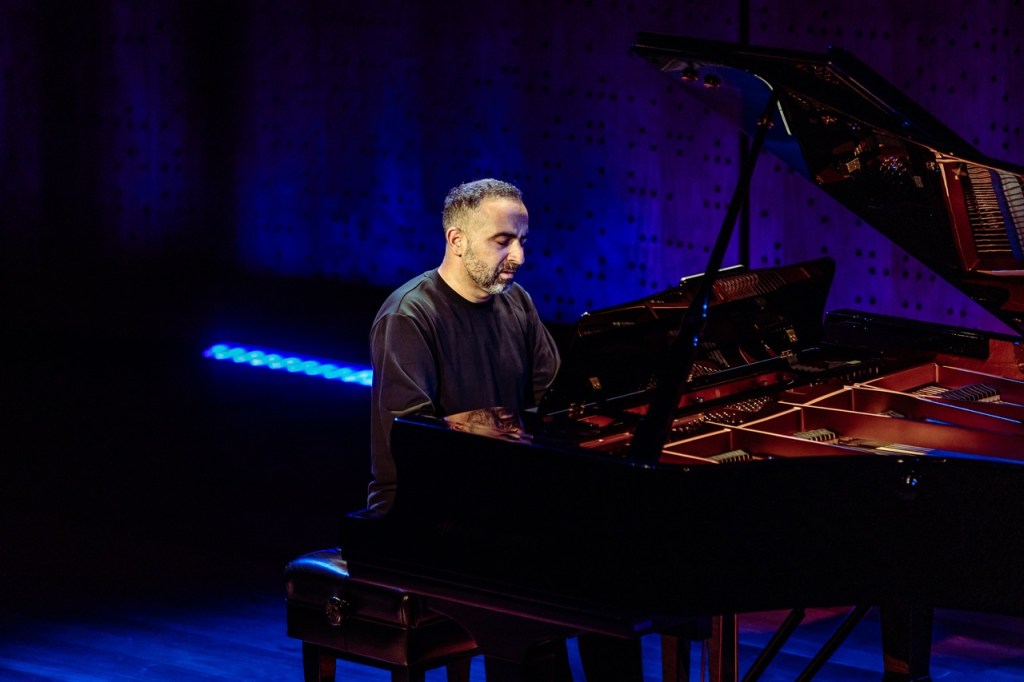
Dark With Excessive Bright. Photo: Victor Frankowsk The concert opened with three of Philip Glass’s Etudes for solo piano, performed by Vatche Jambazian, who demonstrated a range of exacting tones. As an opener, it set the tone for the entire performance while subtly underplaying its hand. Mixing lyrical moments with darker, disquieting phrases, the piano pieces gave way to the second work: Bryce Dessner’s quartet Aheym. From the start, Aheym launched with full force and maintained its unsettled rhythm throughout, never letting up.
The third piece, the titular Dark With Excessive Bright, is a Grammy-nominated, sweeping double bass concerto (led by Jaan Pallandi), which expanded into an almost cinematic scope. Pallandi’s virtuosity on the double bass was a stunning spectacle, particularly for a neophyte like myself. Of the four works, this was by far my favourite.
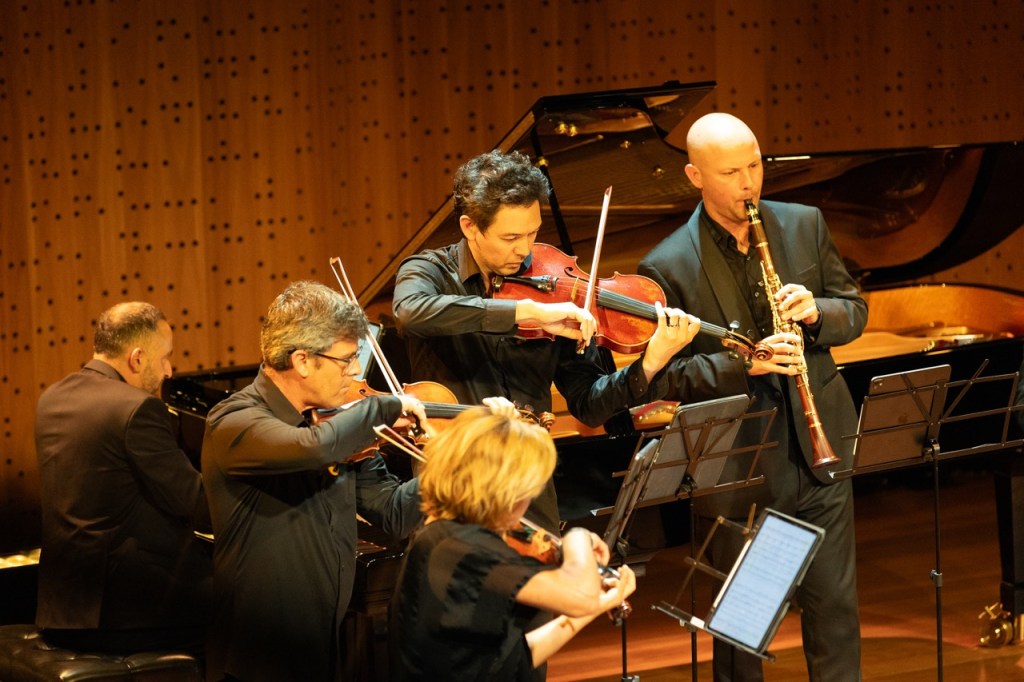
Dark With Excessive Bright. Photo: Victor Frankowsk The performance concluded with Samuel Adams’ recent composition Lighthouse, an original commission by Omega Ensemble from 2024. Neil Thompson took the lead on viola, with the piece’s rhythmic themes playing with light and shade.
All in all, it was a gorgeous afternoon of meditative music – the perfect reprieve from the summer humidity outside and yet another reason to immerse yourself in Sydney’s diverse classical music scene.
-
Mardi Gras Film Festival 2025 Reviews & Interviews

Again this year I’m reviewing films at Queer Screen’s Mardi Gras Film Festival for The Queer Review. As many of the films have already been reviewed at different festivals around the world, I’ve created this page to collate the relevant ones together to make it easier for you to browse and see what you want to buy a ticket to. There are some interviews as well.

I’m Your Venus INTERVIEWS
Exclusive Interview: I’m Your Venus filmmaker Kimberly Reed
Exclusive Interview: Luke Gilford & Charlie Plummer on dreamy queer rodeo movie National Anthem

★★★★★ REVIEWS
I’m Your Venus ★★★★★ (reviewed by James Kleinmann)
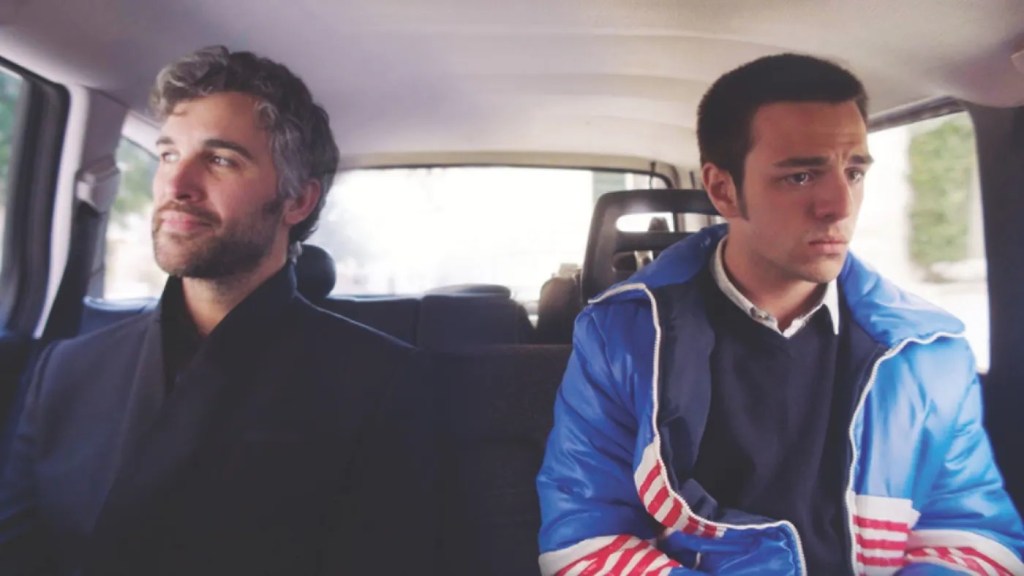
Duino ★★★★ REVIEWS
Baldiga – Unlocked Heart (Baldiga – Entsichertes Herz) ★★★★½
Any Other Way – The Jackie Shane Story ★★★★
Crossing ★★★★ (reviewed by James Kleinmann)
In Ashes (Se Gennem Aske) ★★★★
Liza – A Truly Terrific Absolutely True Story ★★★★ (reviewed by James Kleinmann)
Ponyboi ★★★★ (reviewed by James Kleinmann)
Sebastian ★★★★ (reviewed by James Kleinmann)
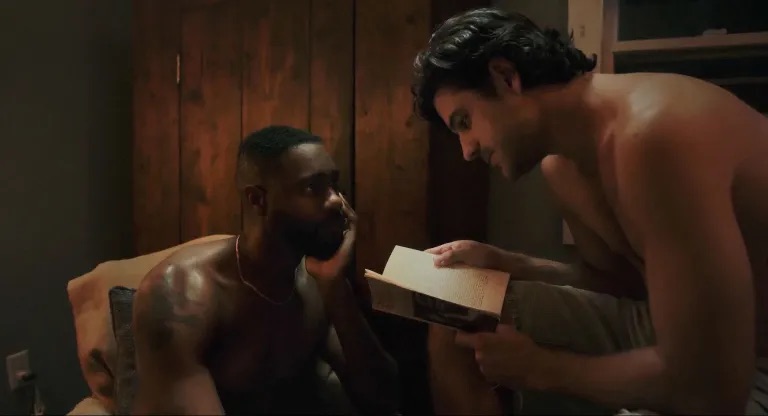
High Tide ★★★ REVIEWS
Desire Lines ★★★1/2 (reviewed by James Kleinmann)
Layla ★★★1/2 (reviewed by James Kleinmann)
The Last Taboo (Das letzte Tabu) ★★★
-
Jacky (Belvoir) ★★★★★
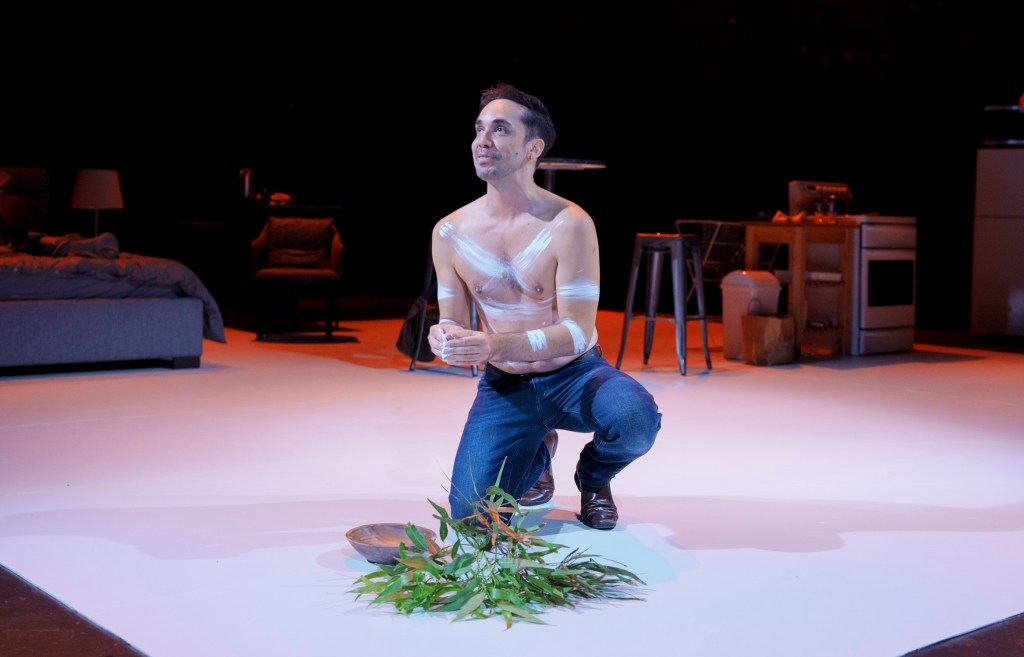
Written by Declan Furber Gillick. Belvoir. 16 Jan – 2 Feb, 2025.
Well, the starting gun for the 2025 Sydney theatre season has definitely sounded with Jacky at Belvoir. Funny, brutal, and nuanced—this is everything you want in a contemporary Australian play.
Jacky (Guy Simon) has reinvented himself as the model modern Aboriginal man in Melbourne. Well-dressed, well-groomed, and successful, he’s a million miles away from his family life “up north”. He’s about to step onto the property ladder, as soon as he can swap his high-paying casual work for a full-time job to satisfy the bank. But sex work pays well, and he’s good at it, so it’s hard to give up. When his friend Linda (Mandy McElhinney) uses her position at a recruitment agency to line up a full-time role as part of a cultural outreach to Indigenous communities, it looks like a win-win for them both—he gets his mortgage, she gets a poster child. But things begin to unravel when Jacky’s unmotivated brother Keith (Danny Howard) comes down to stay, and Jacky’s new regular client, Glenn (Greg Stone), starts asking for more questionable role-play.

Greg Stone & Guy Simon. Photo: Stephen Wilson Barker. There is so much going on in this incredibly well-balanced script that it’s easy to overlook how well-oiled the production is. Themes merge seamlessly into one another so that a single scene feels like a whole play’s worth of inquiry. What are the boundaries of racially charged sexual role-play? What’s worse: kink-shaming or historical racism? Do the rules of cultural appropriation apply within the Aboriginal community? Can good intentions justify bad actions?
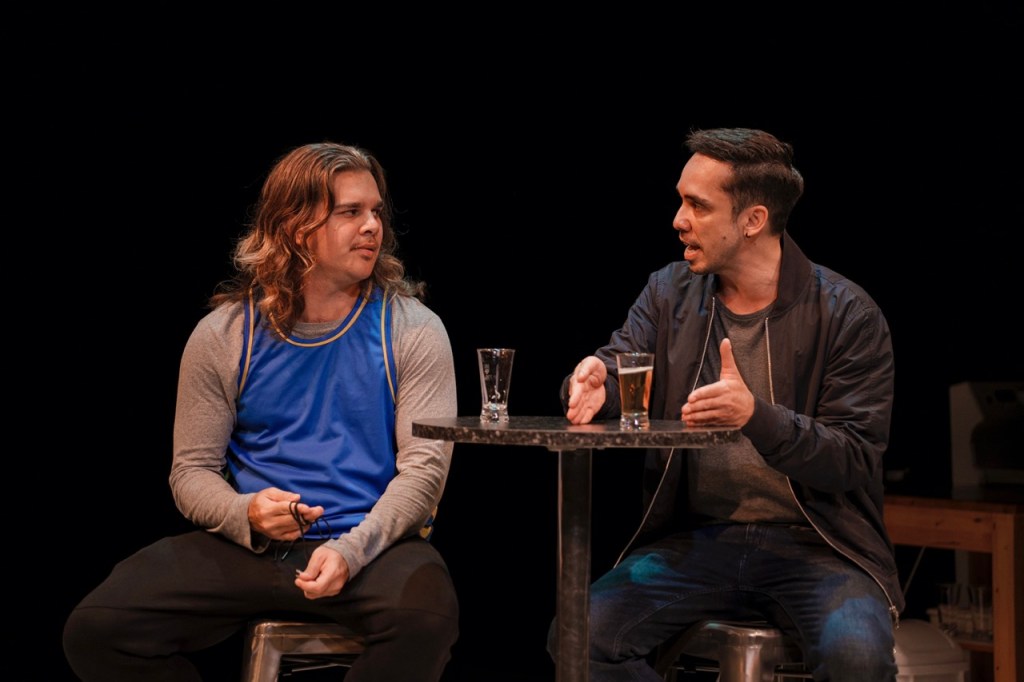
Danny Howard & Guy Simon. Photo: Stephen Wilson Barker. Declan Furber Gillick has a sharp eye for character, and this quartet are each uniquely human, defying easy stereotyping. He pushes them all to the point where their facades crack and deep truths spill out. Keith may be used for comedy (Danny Howard channels youthful, bro charm and stupidity with glee), but he’s also an important moral voice. Linda is a positive force helping people, but her ignorance, combined with Jacky’s own weaknesses, leads to disastrous results.
And then there’s Glenn, the middle-aged man exploring his long-repressed sexuality. In the sugar-rush of his sexual awakening, he barges past red lines, unaware. Greg Stone delivers one of the most powerful and upsetting performances I’ve seen in a long time. I can’t imagine what it’s like to perform this night after night, fully aware of how it’s received by the (very vocal) audience. Given how well each character inhabits morally grey areas, his slow creep towards a glaring red line feels especially powerful.
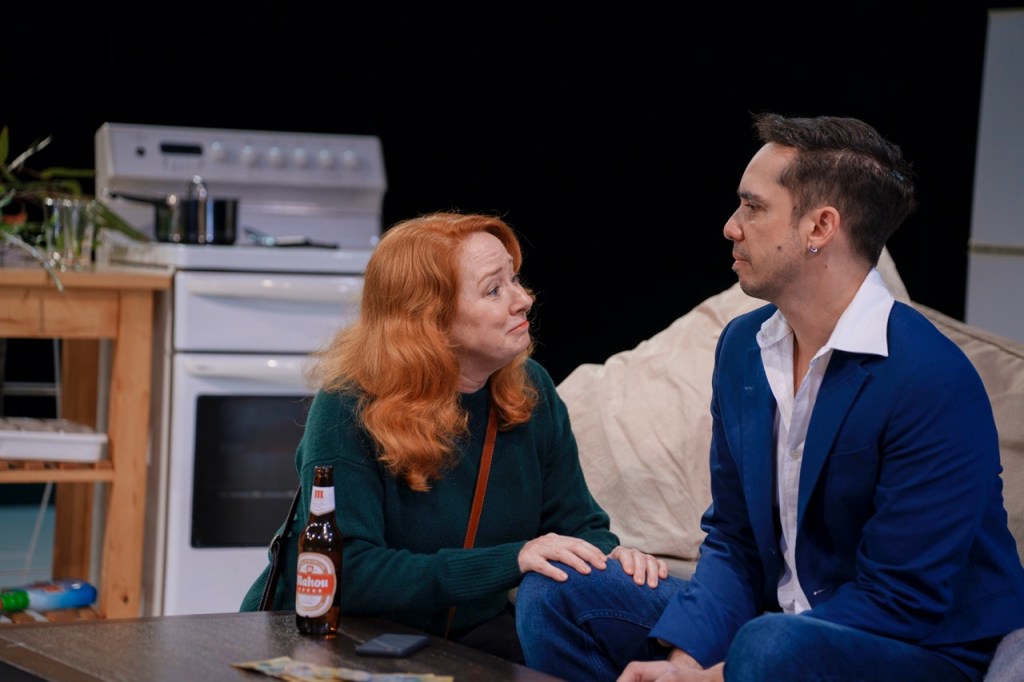
Mandy McElhinney & Guy Simon. Photo: Stephen Wilson Barker. Perhaps strangely, there is an element of the well-worn “second-generation immigrant” story in Jacky’s plight, as he works to fit into mainstream Australian society and be like everyone else. His attempts to merge his two cultures into a single identity are successful until put under stress. He loves his brother Keith, but his frustration with Keith’s lazy attitude stems from his own internalised self-loathing.
Time has done wonders for Jacky. The original run was very good, but with the extra space, the show has relaxed into its moments more. Sorry, Melbourne, but it’s a bit better here in Sydney. Jacky is a psychologically complex man, and Guy Simon has clearly settled into the role even more. New cast members Howard and McElhinney, while not a million miles from the original interpretations, have shifted the balance just enough to work in the show’s favour.

Danny Howard. Photo: Stephen Wilson Barker. If I had a critique, it would be the show’s final line of dialogue, which, apart from being damn funny, closes the door on one of the play’s biggest questions (yes, it’s frustrating not being able to really discuss it, but spoilers etc.—just go and see it for yourself, then meet me in the pub to dissect). In wrapping things up, it gives a definitive answer after a play of careful ambiguities. Some will no doubt be very happy to finally find some solid ground to stand on, but I rather enjoyed floating in the sea of moral questions.
In my original 2023 review, I wondered, “When is saying ‘sorry’ just not enough?” That question feels stronger than ever now. In Glenn and Linda, we have two very different types of white people. Glenn is offensive but constantly apologetic; Linda is an ally but doesn’t understand the nuance and impact of what she’s asking. It’s questionable which one has a more negative impact on Jacky’s life.
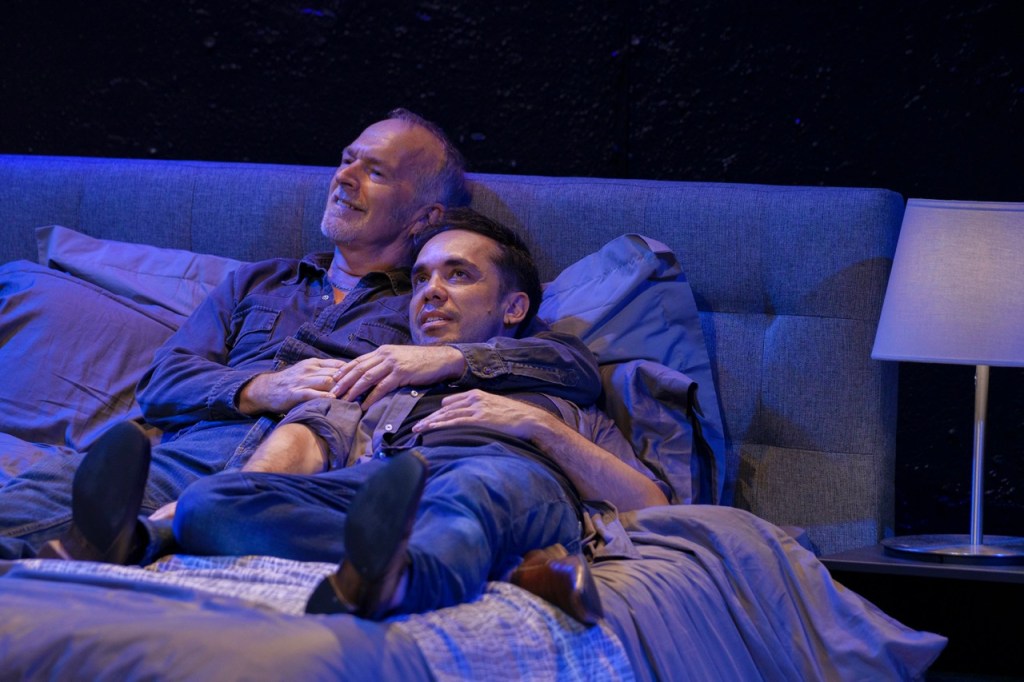
Greg Stone & Guy Simon. Photo: Stephen Wilson Barker. The issues Jacky raises—and the brilliance of their delivery—are fresh and prescient. It’s the kind of play that could only come from an Aboriginal writer, and could only be delivered by a writer of great skill. Incisive, intelligent, and emotionally complex—this is exactly the kind of play I love to see and the kind of inter-state transfer we need more of. Just bloody great Australian writing.
PS—Dear awards voting people: don’t forget this play come the end of the year!
-
Pride & Prejudice (Old Fitz) ★★½
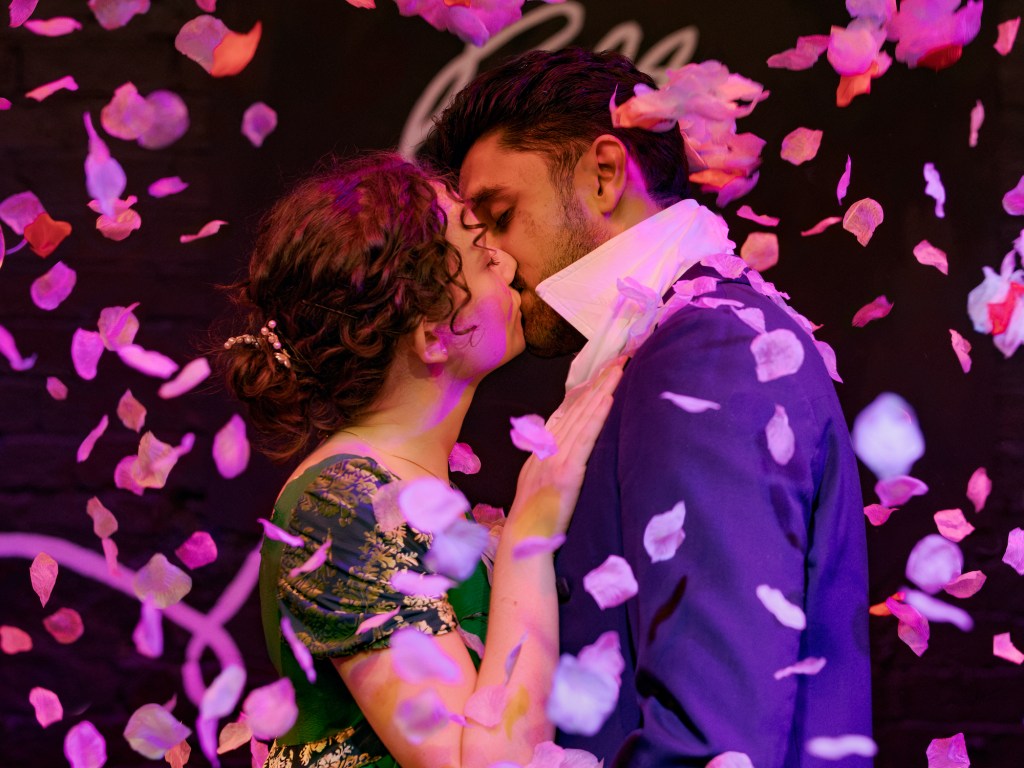
Adapted by Kate Hamill. Based on the novel by Jane Austen. Australian Premiere. The Old Fitz Theatre. 14 Jan – 8 Feb, 2025.
This lo-fi adaptation of Jane Austen’s classic witty romance Pride & Prejudice has all the hallmarks of a fringe darling, and it very nearly manages to pull it off… nearly.
Kate Hamill’s reworking of Austen stays faithful to the plot while amplifying the laughs. There have been some trims, and a few characters have been cut (bye-bye, Kitty Bennett). Yes, it’s a bit odd to be presented with an Austen romance as an out-and-out comedy, but an irreverent take can often reveal more about the text. Purists will no doubt shriek (more on the shrieking later), but Hamill works hard for the laughs, even if it means drafting in pop culture references and modern, euphemistic readings of perfectly chaste words. Does it cheapen the source material? A bit, but Austen’s a big girl; her legacy will remain intact.

Pride & Prejudice. Photo: Phil Erbacher. The cast of eight moves through a dizzying array of characters, frequently playing two at the same time. In this story of defying gender roles, the casting relies heavily on drag for easy laughs. AJ Evans hits the comedy beats hard as the scheming, overwrought Mrs Bennett. Steve Corner plays both Mr Bennett and Charlotte Lucas, Dylan O’Connor juggles triple duty as Mr Wickham, Mr Collins, and Miss Bingley, but it’s Victoria Abbott who plays both Mr Bingley and Mary Bennett, often in the same scene, who takes home the MVP crown. The cast is rounded out by Mym Kwa as Lydia Bennett and Lady Catherine, Lucy Lock as both Jane Bennett and Anne de Bourgh, Abbey Morgan as Elizabeth Bennett, and Idam Sondhi as Darcy.

Pride & Prejudice. Photo: Phil Erbacher. For all of Austen’s own wit that’s been supplemented with extra gags, Pride & Prejudice ends up unfocused and, well, unfunny. The gentle comedy of manners clashes with the shrieking drag, and characters are inconsistent in their traits (e.g., Bingley acts like a literal dog… sometimes, but not others). Too often, multiple characters are screaming simultaneously, drowning out any other action on the stage. Some pitch their performances at high camp while others are trying to stay grounded. There are a few iconoclastic jokes (like Mary Bennett playing a Radiohead song on the piano), but not enough for them to become part of the show’s style. Instead, they pull you out of the moment. And then there are the dance numbers… I’m not really sure why they’re there.
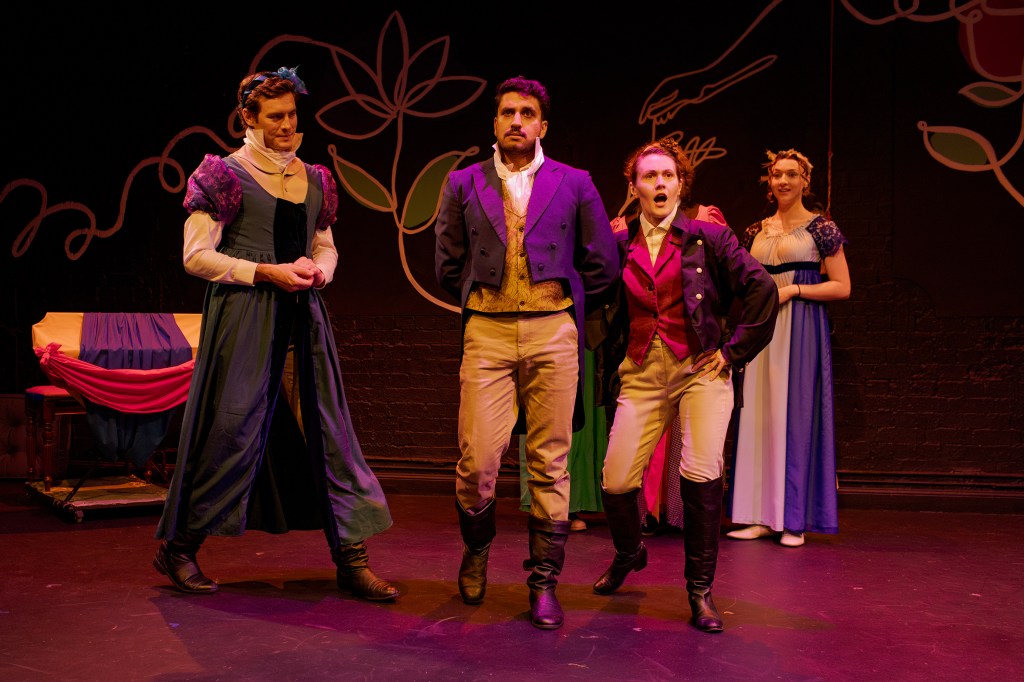
Pride & Prejudice. Photo: Phil Erbacher. Good comedy is all about timing and execution, and these are the two things that seem to weigh Pride & Prejudice down. There is a dullness and lack of focus to the action that buries punchlines, while other moments linger with no discernible purpose. Some performances are waiting for a laugh, others mumbling their lines making them incomprehensible. As for the romances? Well, as far as chemistry goes, these love matches were inert.
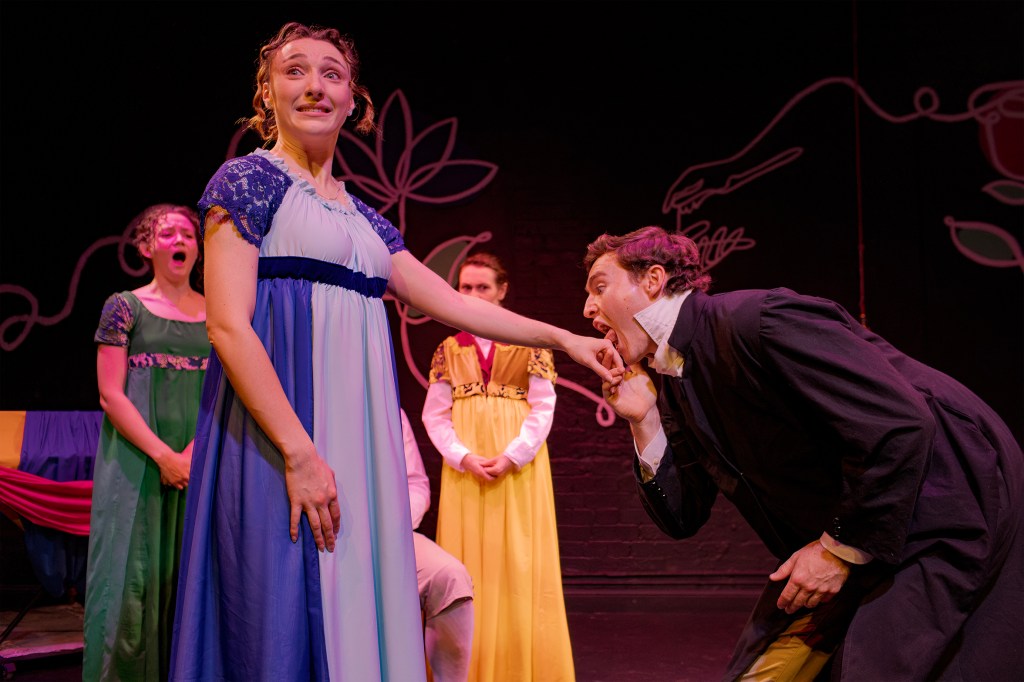
Pride & Prejudice. Photo: Phil Erbacher. And yet… I didn’t find myself hating it like I have some other recent shows. While, on the whole, I didn’t find the show particularly funny, every performer did something that was ‘kind of’ funny enough for me to forgive the moments when things got muddy. There is something pleasantly likeable about this ensemble: they’re fine actors, but they’re just not a comedy troupe.
With more disciplined comedy direction and a sharper delivery (and a shorter running time), this Pride & Prejudice could be the kind of scrappy hit you tell all your friends about. At the moment, it’s just not quite getting there for me but others may be more on its wavelength – comedy is very subjective after all.
If you want more comedy Austen, I recommend Budget ’95 Pride & Prejudice on Youtube instead.
-
The Chronicles (Sydney Festival) ★★★★½

Choreographed by Stephanie Lake. World Premiere. Sydney Festival. Roslyn Packer Theatre. 16-19 Jan, 2025.
Stephanie Lake takes us from womb to tomb in the thrilling dance piece, The Chronicles. Clashing imagery of the organic meets the cold inorganic, and conformity collides with individualism before erupting in a maelstrom of hay. For someone like me, who is more steeped in theatre than dance, The Chronicles presented me with imagery I’ve not seen before in a dance performance. I was enthralled.
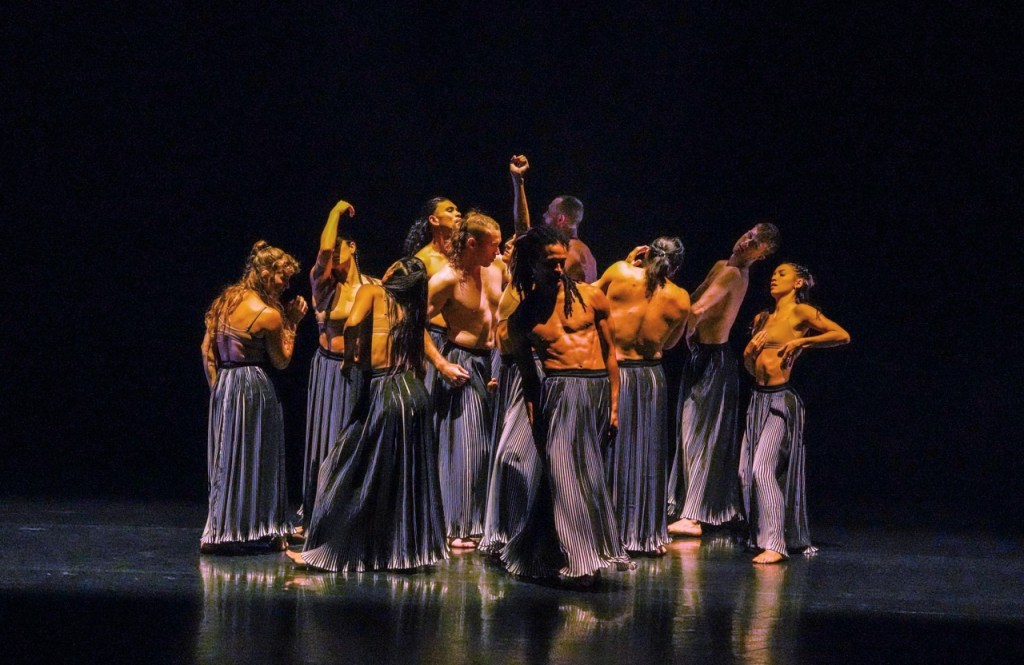
The Chronicles. Photo: Neil Bennett. The Chronicles is overflowing with ideas. Each stage of life adopts its own visual and kinetic language, filling the Roslyn Packer stage with moments of beauty, grace, rage, and invention. Over the span of one hour, we move through 7 or 8 distinct phases. Just when you think things are settling, the playbook is rewritten.
It makes for an exciting viewing experience, as you both appreciate the work in front of you and sit in anticipation to see what happens next. Lake saves her most visually arresting concept until the end, transforming company member Jack Ziesing into a writhing, constantly shedding mass of fibres. It’s both joyous and awe inspiring.
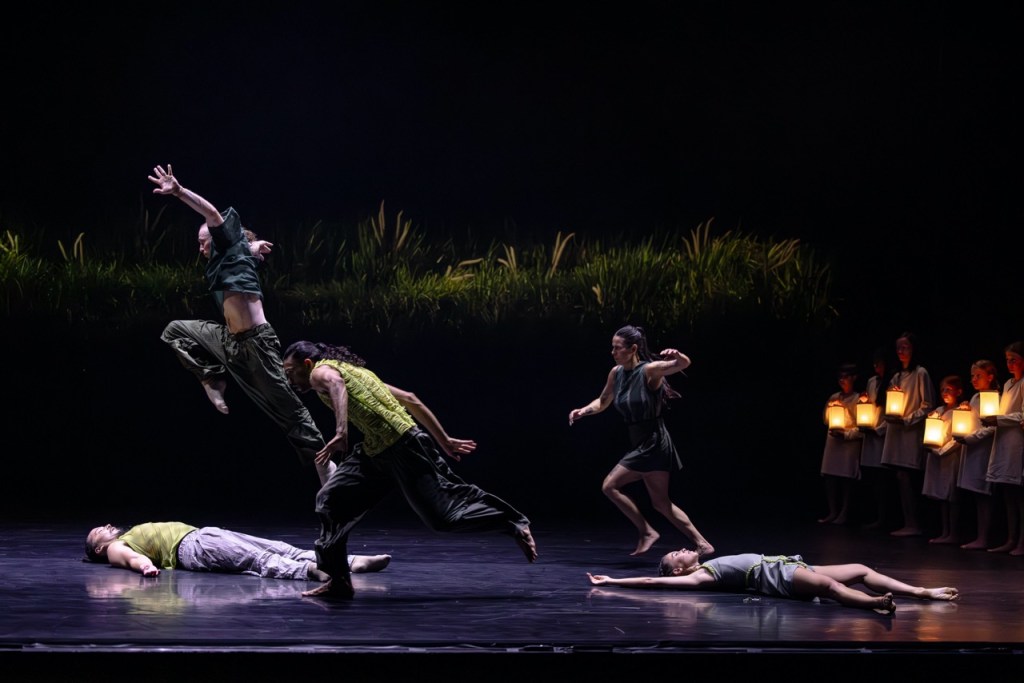
The Chronicles. Photo: Jacquie Manning. I also appreciated how each member of the company received small showcasing moments throughout the piece. Each dancer clearly has their own forte, which is used to bring subtle tweaks and elevations to sections. From one member’s extreme flexibility to another’s physical strength and height, the choreography is tailored to the artist.
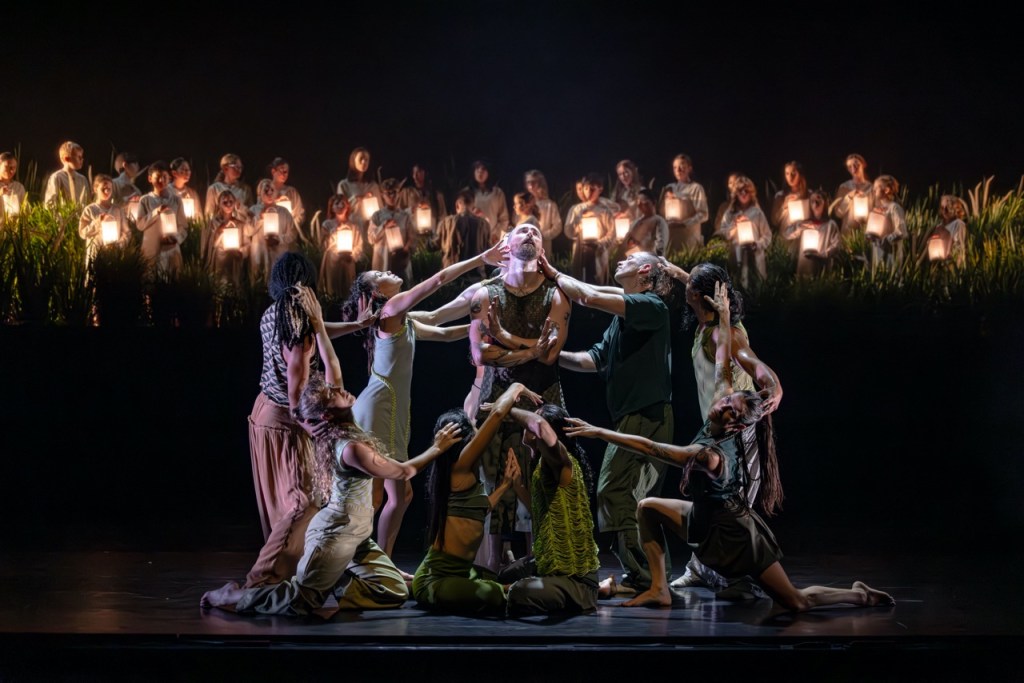
The Chronicles. Photo: Jacquie Manning. The music by Robin Fox constantly flips the tone, from a propulsive beat to the ethereal choral music of the Sydney Children’s Choir, from an eerily organic series of clicks and hums to disconcerting snippets of reversed music, and the elegiac cry of a solo rendition of Alphaville’s ‘Forever Young’ (by soloist Oliver Mann).
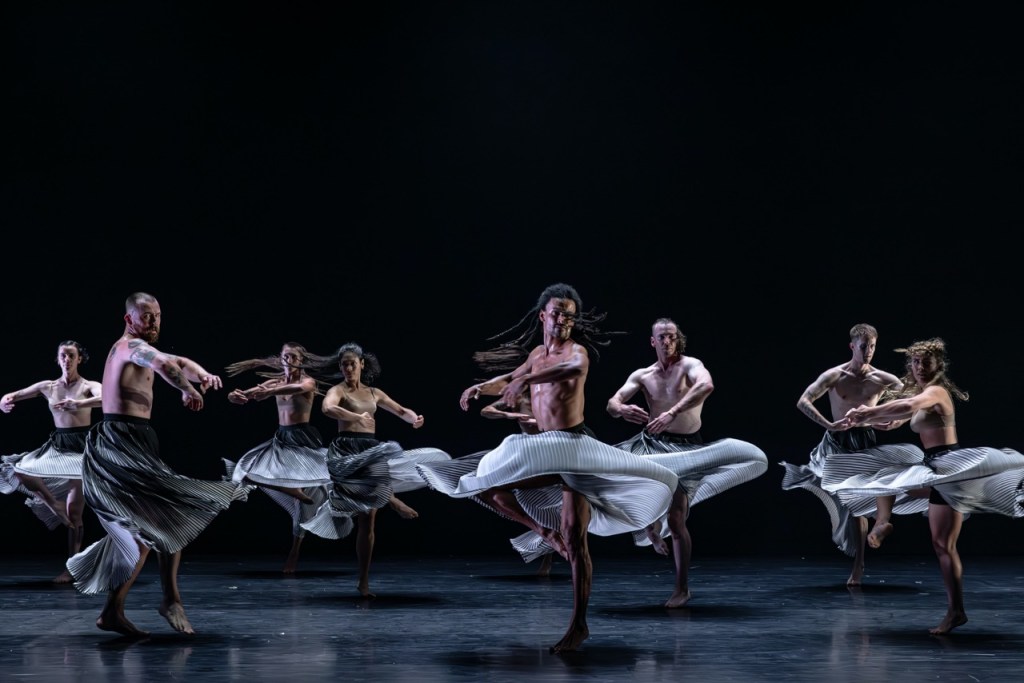
The Chronicles. Photo: Jacquie Manning. Harriet Oxley’s costumes start off in muted natural tones with geometric prints before moving through a phase of more sexualised, revealing pieces, and then into stark blacks. Meanwhile, Bosco Shaw’s dynamic lighting design forms an integral part of the storytelling—the light is often confining and controlling, sometimes warm and elating. Set designer Charles Davis gives us a series of reveals, beginning sparse but gradually unveiling the natural world as both an oasis and a chaotic force.
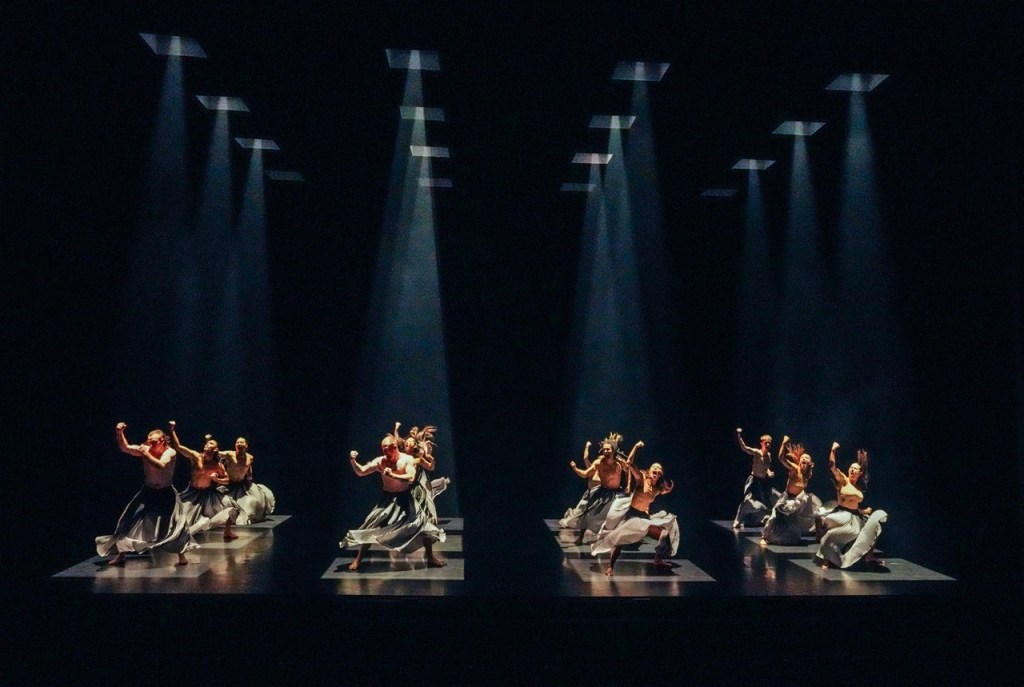
The Chronicles. Photo: Neil Bennett. I can honestly say that in The Chronicles, Stephanie Lake has shown me visions I’ve never seen before on stage, and that’s a gift. The playfulness and power of her choreography fill the 60 minutes of the show with material that never fails to impress.
-
Converted (ATYP) ★★½

Music & Lyrics by Vic Zerbst and Oliver John Cameron. Book by Vic Zerbst. World Premiere. Sydney Festival. ATYP Rebel Theatre. 3-25 Jan, 2025.
Camp and colourful, the new queer musical Converted has a lot of heart, which goes some way to make up for its lack of depth. While it’s nice to fold asexuality and non-binary genders into the familiar inclusive coming-of-age tropes, that alone isn’t quite enough to build a show around.
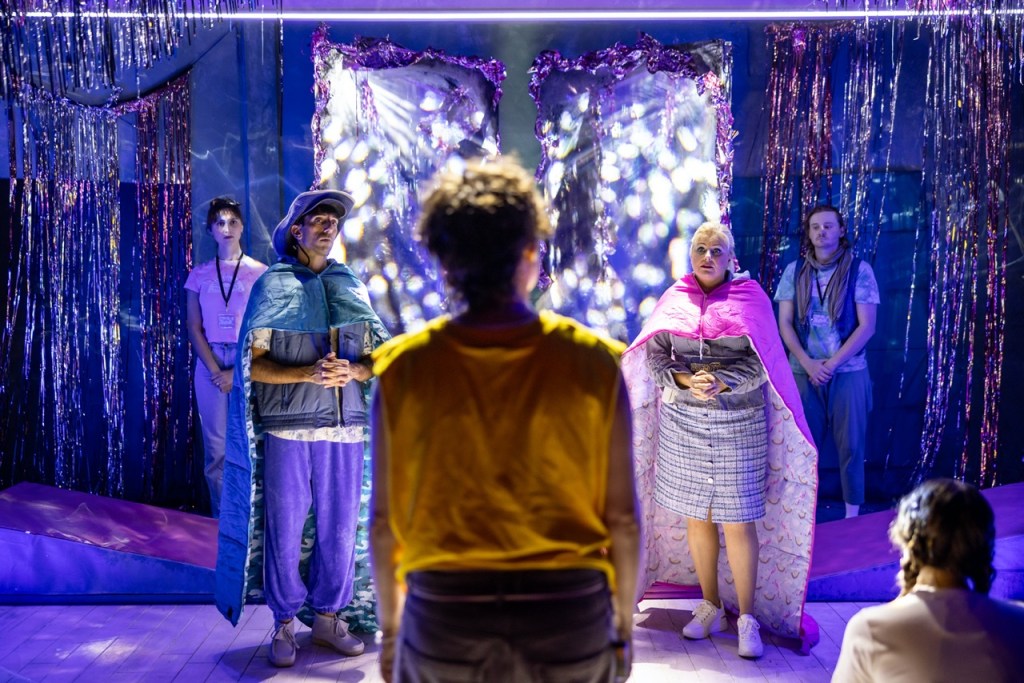
Converted. Photo: Daniel Boud. Teenager Maya (Megan Robinson) feels misunderstood and alone, often spending her lunchtimes with her favourite teacher, Glenda (Cassie Hamilton), whom she may have a crush on. When Glenda recommends Maya spend time at ‘Fix Yourself’, a camp for low self-esteem teens, she eagerly agrees hoping to make herself more popular.. Once she gets there, she meets the rebellious and charismatic butch Bone (Teo Vergara), with whom she instantly feels a connection. However, the camp leaders are unsubtly pushing her toward Horace (Teo Persechino)—trying to get the two teens together in a “normal” (i.e., heterosexual) pairing. As the toxic leaders Mr and Mrs Doctor (Nat Jobe and Helen Dallimore—both chewing the scenery) push the kids to look in the mirror and focus on the things people don’t like in order to change and become lovable, it starts to become clear that ‘Fix Yourself’ isn’t just a wellness camp for high schoolers; it’s a conversion therapy camp for queer teens. But will these gay, lesbian, non-binary, and asexual kids reject the attempts to “fix” them and learn to love themselves for who they really are? Obviously. Will the camp leaders be secretly gay themselves? Probably. Will it all end in a big dance number? Definitely.
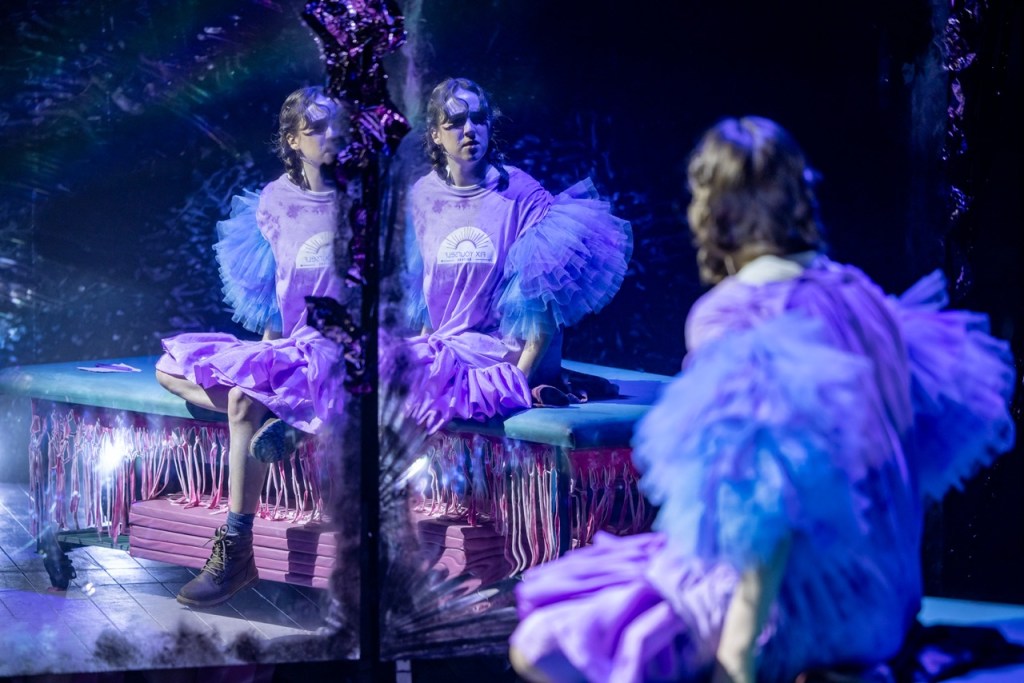
Megan Robinson. Photo: Daniel Boud. Take the 1999 queer teen comedy But I’m A Cheerleader or that episode of Will & Grace where Jack sneaks into a conversion therapy camp to rescue his grandson, put them in a 2025 context, and you’ve got the basics of Converted.
As a satire, it’s all pretty toothless. The comedy is played so broadly it’s almost a pantomime, and the characters are little more than elevator pitches in search of some layers. The lack of subtext or anything approximating an honest emotion robs the story of its punch and makes the emotional beats feel unearned. I only care about these kids in the abstract.
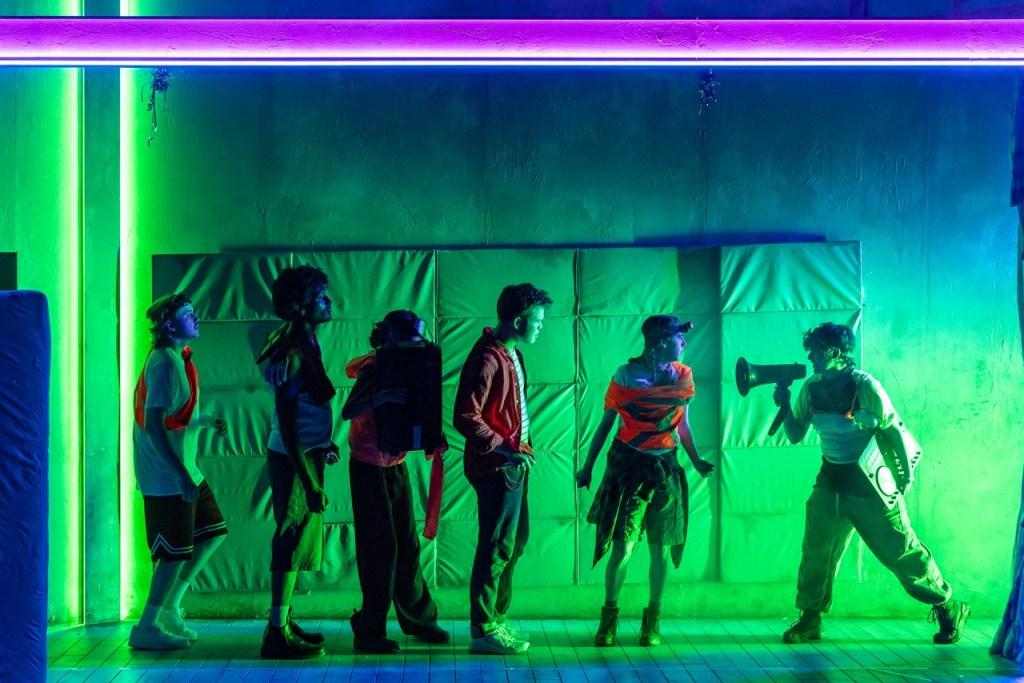
Converted. Photo: Daniel Boud. The show constantly pulls its punches when it comes to gay conversion therapy – a psychologically dangerous practice that is disturbingly still legal in parts of Australia. Why is a “conversion therapy musical” tiptoeing around the basic premise of the show? Is Converted afraid of offending the type of religious homophobes who definitely will not be sitting in the audience? For a show that is didactically one-note in its message of self-acceptance, it feels like a very weird omission.
While I didn’t expect the plot to take any wild swings (SPOILER— a happy ending is guaranteed for everyone; even the “baddies” get a hug), there is very little here that takes the slightest diversion on the way to the pre-prescribed feel-good finale. And at 2.5 hours, we really need something fresh to make it all worthwhile.
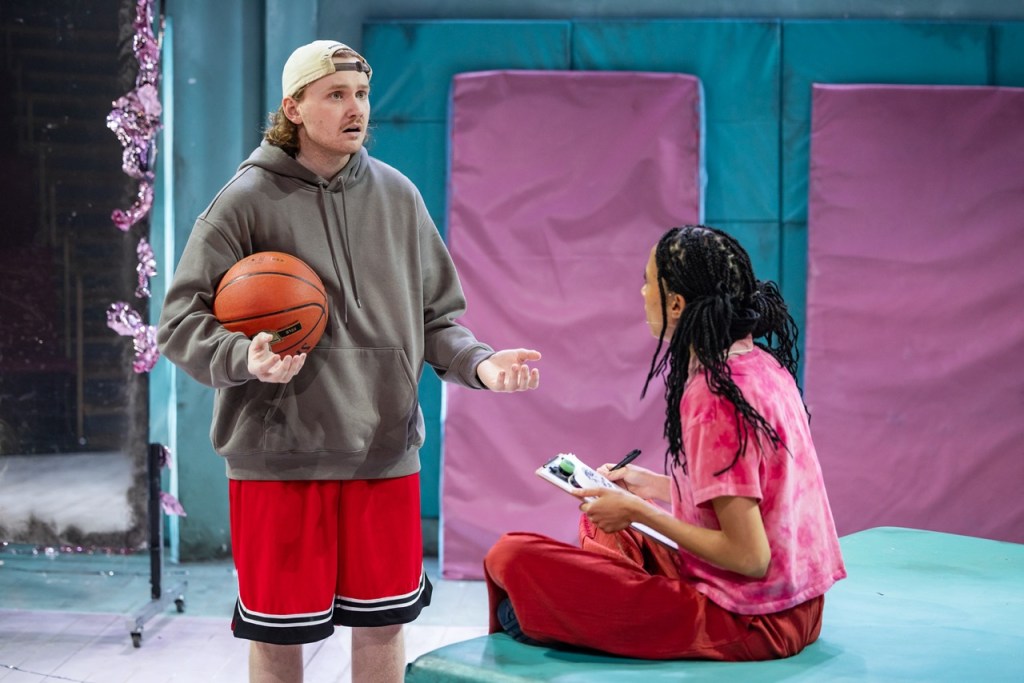
MVPs Ashley Garner & Melody Kiptoo. Photo: Daniel Boud. Which isn’t to say there aren’t some lovely moments; they just all happen to relate to the side characters. Sammy (Melody Kiptoo), a shy girl who doesn’t know where her “compass of attraction” is pointing, gives us the most grounded and affecting storyline of the night. Give me a whole show reoriented around her, please! Poor Kyle (Ashley Garner), a straight boy who has been dropped off at the wrong camp, provides genuine laughs. Garner also plays the second role of Silent Greg, one of the camp leaders and Glenda’s fiancé, with equal amounts of fun—consistently giving the best performance(s) of the whole show. Strangely, the person I felt most for in the end is poor Glenda, who really got steamrolled on the way to the big, joyous ending.
Director Hayden Tonazzi throws in some moments of directorial flair, and while some of the comedy beats are overplayed, he knows how to deliver a set piece. Lighting by Brockman takes the meme of “bisexual lighting” to new limits with a colour scheme of pinks, blues, and purples, with some sharp neon accents. The set and costumes by Savanna Wegman will either delight or horrify, depending on your personal views about tie-dye. The lo-fi joy of watching an inflatable piece of set slowly emerge was one of the night’s high points (the deadpan assistance of Scarlet Lindsay, the onstage swing & dance captain, nailed it).
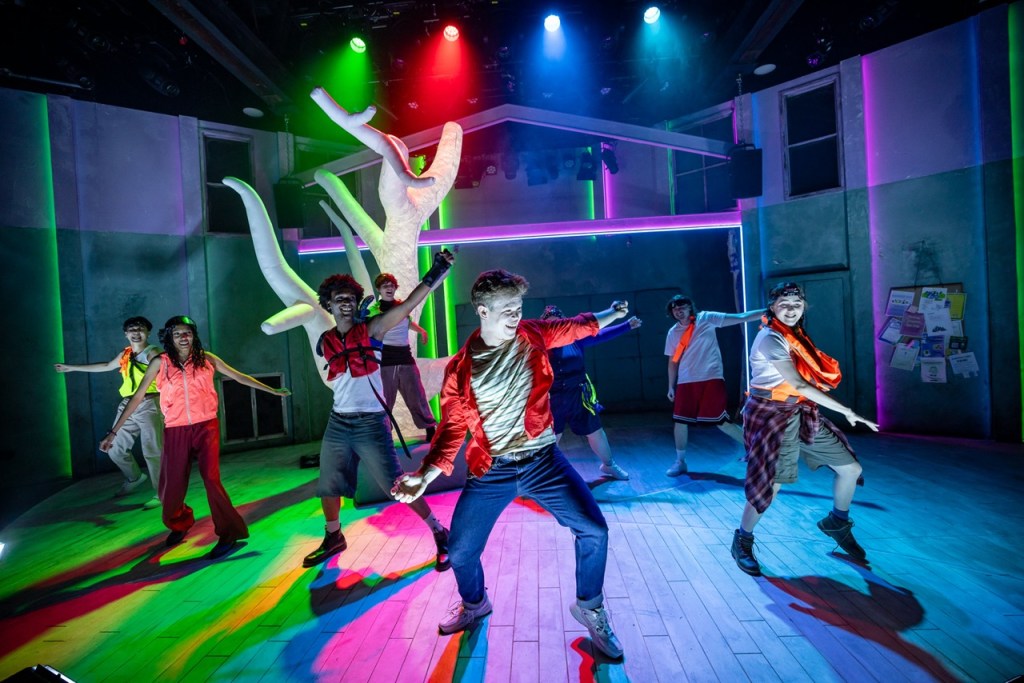
Converted. Photo: Daniel Boud. The rest of the cast are strong but are dealing with weak, inconsistent material. The songs are overwritten and forgettable (and there are too many fillers; the whole show needs a proper trim). There are jokes aplenty, but the hit rate is frustratingly low. It has little to say about the bigger issues it touches upon, and does nothing to challenge or enlighten the audience—the show seems to be content repeating well-meaning platitudes of self-acceptance.
Converted needs more time to discover what it really is and what it really wants to say. For all the good intentions and goodwill the show generates, it doesn’t necessarily make for good theatre. There’s definitely things to love here, but Converted ends up just preaching to the choir.
-
Ghost Quartet (Hayes) ★★★½

Music, lyrics and text by Dave Malloy. Hayes Theatre. 8 Jan – 1 Feb, 2025.
Dave Malloy’s bold concept piece Ghost Quartet is more of an experimental song cycle than a “musical,” but there is something intoxicating in this blend of spectral narratives, whiskey, photography, and imprecise familial relationships. It may not make a lick of sense, but it overflows with atmosphere.
We start on side one, track one (like a vinyl double album), as Rose enters a shop to get her broken camera fixed, only to be served a glass of whiskey and invited to tell her story. Over the next 90 minutes, the cast of four perform their songs, which slowly—if partially—piece together into a fractured narrative involving a photographer, a train driver, a murderous sister, an astronomer, a bear, Thelonious Monk, and a retelling of Edgar Allan Poe’s The Fall of the House of Usher. I already mentioned that this doesn’t make sense, right?
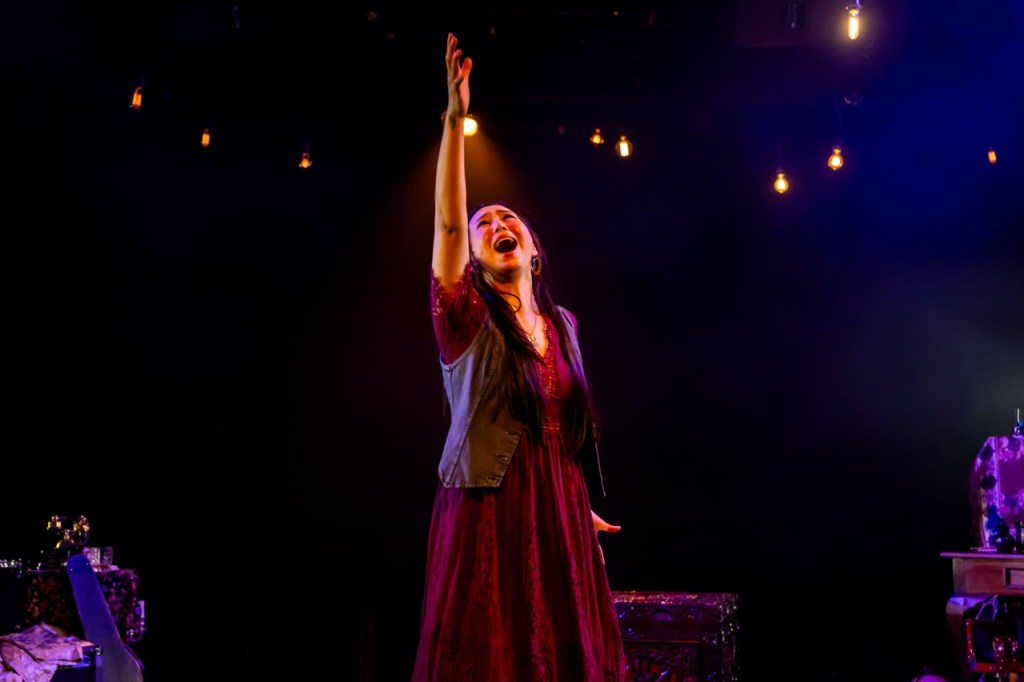
Hany Lee. Photo: Angel Legas / 3 Fates Media But that’s fine, because Ghost Quartet sits in that boozy, liminal space between dreams and reality, drunkenness and sobriety, life and death.
“I don’t know if this is me at all, or just some ghost of me that I dreamed up just to sing myself to sleep.”
If you’ve seen Malloy’s previous musical Natasha, Pierre & the Great Comet of 1812, you’ll be familiar with his rich, complex songwriting. Ghost Quartet is that, unbound by linear storytelling.
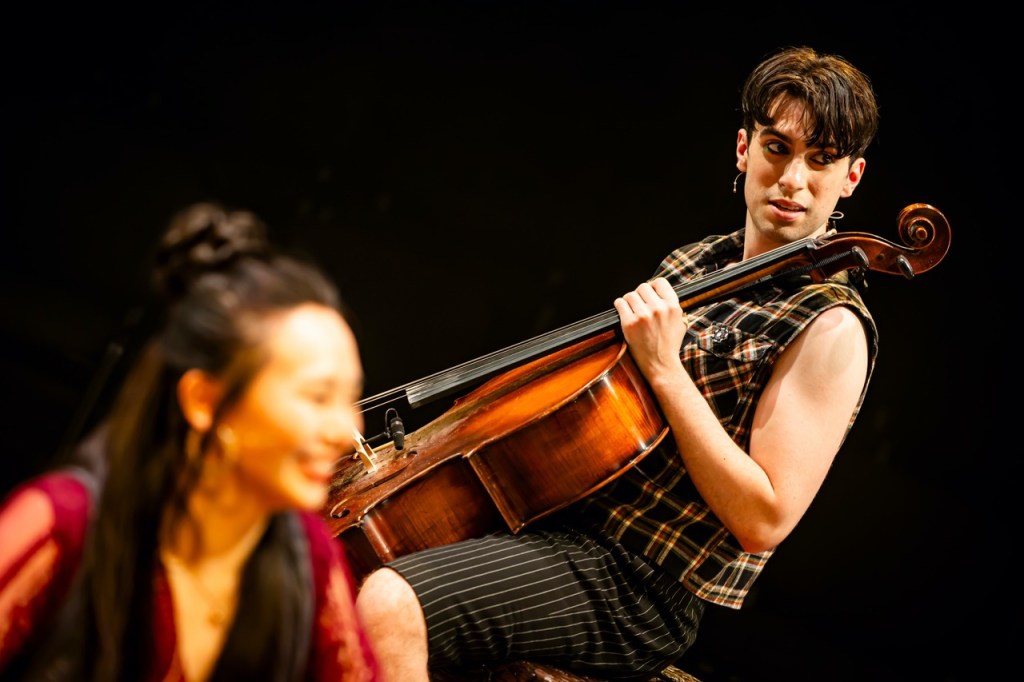
Hany Lee & Cameron Bajraktarevic-Hayward. Photo: Angel Legas / 3 Fates Media This particular production has been floating around Melbourne for a few years now and has become a well-oiled machine. As you enter the theatre, you quickly realise this isn’t just a show—it’s more of a hangout session. Staged in traverse (more shows at the Hayes should be presented this way), the audience is very much part of the scenery.
The cast of four (Cameron Bajraktarevic-Hayward, David Butler, Hany Lee, and Willow Sizer) each have distinctive voices that blend beautifully. The quartet plays a variety of instruments as they go, and while the banter feels a bit too rehearsed at times, the quality of the performance and their own charisma draw you in.
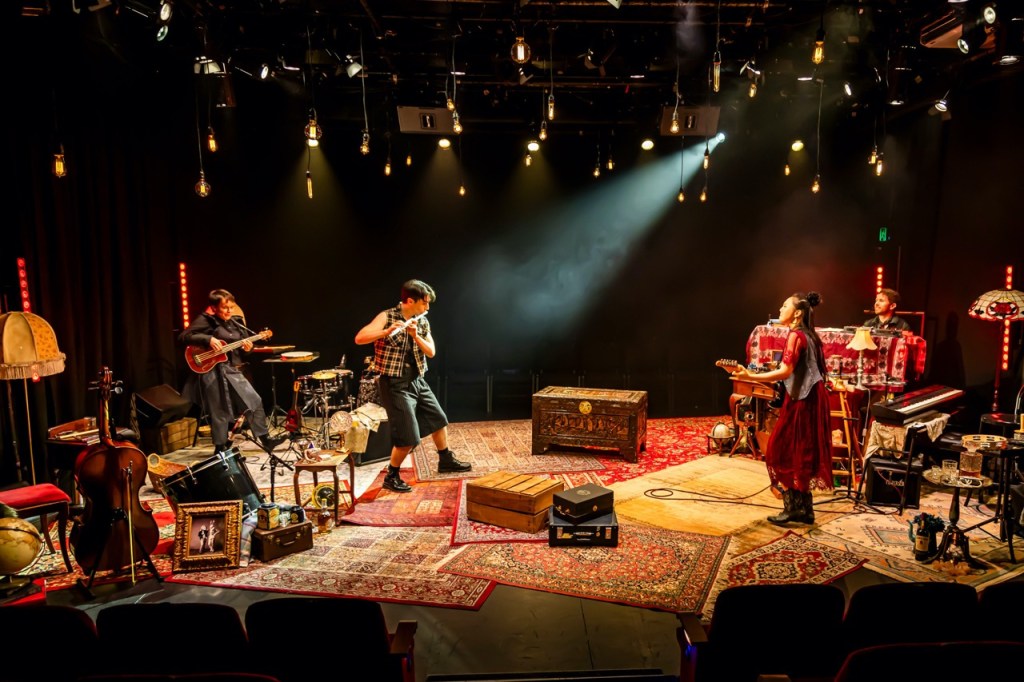
Cast of Ghost Quartet. Photo: Angel Legas / 3 Fates Media Jodi Hope’s set design is littered with paraphernalia related to the songs, set upon a bed of rugs, creating a gothic atmosphere. Sidney Younger’s lighting design is crucial, not only to the mood but also to the storytelling. An extended portion of the show is performed in total darkness, forcing you to focus solely on the music—it’s an excellent touch.
This is the second production of Ghost Quartet I’ve seen, and while I’m no closer to understanding it, the hypnotic effect it has on me has been repeated. Do not come to Ghost Quartet expecting a conventional piece of musical theatre. Instead, let this living-room-gig-cum-séance wash over you and just go for the ride. It’s worth it.
-
The Lord of the Rings: A Musical Tale (State Theatre) ★★

Book & lyrics by Shaun McKenna and Matthew Warchus. Music by A.R. Rahman, Värttinä and Christopher Nightingale. Australian Premiere. State Theatre, Sydney. Jan 7 – Feb 1, 2025.
Lord Elrond, bearer of the Elven-ring Vilya and master of Rivendell, looks at the group before him: four hobbits, a wizard, an elf, a dwarf, and two human men.
“Nine companions… so be it,” he says, reaching down to pick up his… trombone? Wait, what? “You shall be the Fellowship of the Ring.”
This is The Lord of the Rings: A Musical Tale, a new reworking of the 00s West End kinda-flop. This three-and-a-half-hour show condenses the epic book trilogy into a single musical. We’ve got all your favourite moments from the films… err, I mean books: the jolly little hobbits, haughty elves, silly wizards, scary wizards, the Balrog, Shelob, and a singing Gollum. It’s a lot, even for someone who’s been to a lot of comic-cons.

The Company of Lord of the Rings: A Musical Tale. Photo: Daniel Boud. As a fan of The Lord of the Rings in almost all its forms — J.R.R. Tolkien’s books, the Peter Jackson trilogy, the Rings of Power TV show, and even the original version of this musical — writing this really stings because I wanted to believe this show would be better.
I had every reason to trust that it might be. Reviews from critics and friends who had seen the new staging in England came out raving. One friend saw it four times. And one of the things I love most about theatre is its malleable, transformative nature. In the right hands, even a failure can become a hit. There is a long history of small theatres reinventing large shows to miraculous effect. That’s what I hoped had happened here — that by stripping back the complex and flabby original, this team had found a core that would resonate with the audience.
“Fool of a Took,” as Gandalf might say. I was wrong.

The Lord of the Rings: A Musical Tale is devoid of the kind of magic, literal and figurative, the story demands. Tacky, nonsensical, and self-serious — this is the kind of show that people who hate musical theatre are thinking of when they say they hate musical theatre.
Rather than fixing the problems of the original production, this staging falls straight back into the same pitfalls. It’s a bog-standard, film-to-musical adaptation with an added serving of cheap cosplay. Instead of building a narrative that would a) work within the confines of a stage show and b) tell the heart of Tolkien’s story through a new lens, we are given a montage of set pieces from the book (via the films), regardless of how ridiculous or impractical they look on stage. If you don’t already know the story, you’ll have no hope of following it here. I’m sure this staging was charming in the Berkshire countryside (it was a semi-outdoors experience) but beneath a proscenium arch, it just looks cheap.
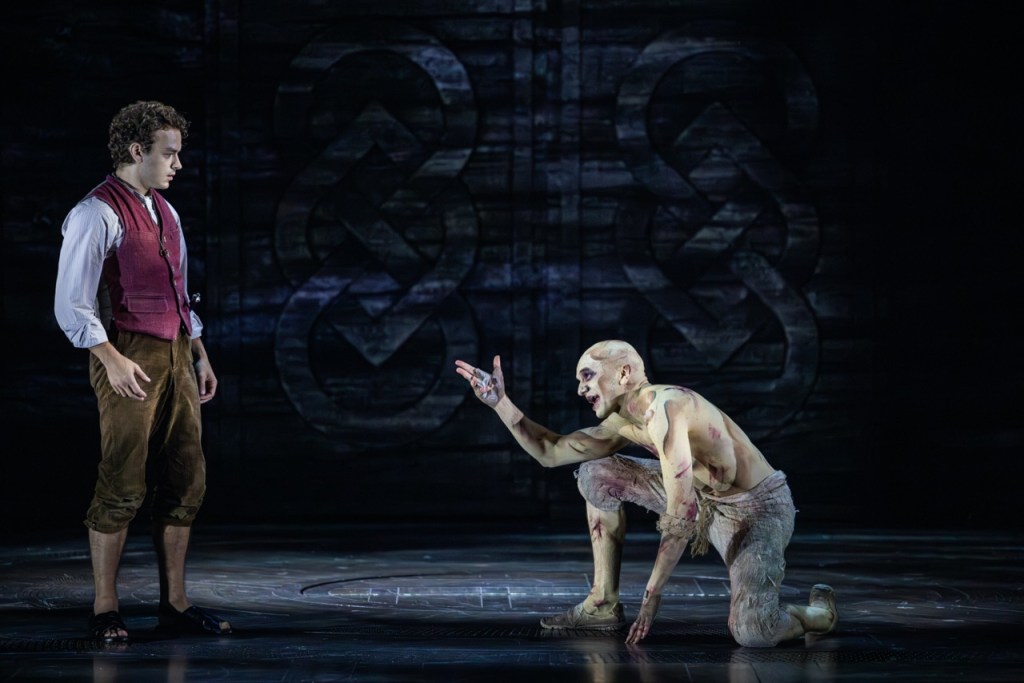
Rarmian Newton and Laurence Boxhall. Photo: Daniel Boud. The show stumbles at the first hurdle: Bilbo putting on the titular ring and disappearing. As poor Laurence Coy, playing Bilbo, tried to dismount a riser behind an anemic puff of smoke, you knew things weren’t going to improve. If you’re hoping for Harry Potter and the Cursed Child levels of stage magic and effects, then I’m sorry to disappoint you. The fearsome Balrog? A billowing sheet with glowing cartoon eyes. The giant pantomime spider for Shelob is marginally better, mainly thanks to the darkness. The wizards spend most of their time waving their staffs at the back of the stage trying to look like they’re doing something — I can only applaud their commitment. Welcome to the floor show at Warner Brothers Movie World.
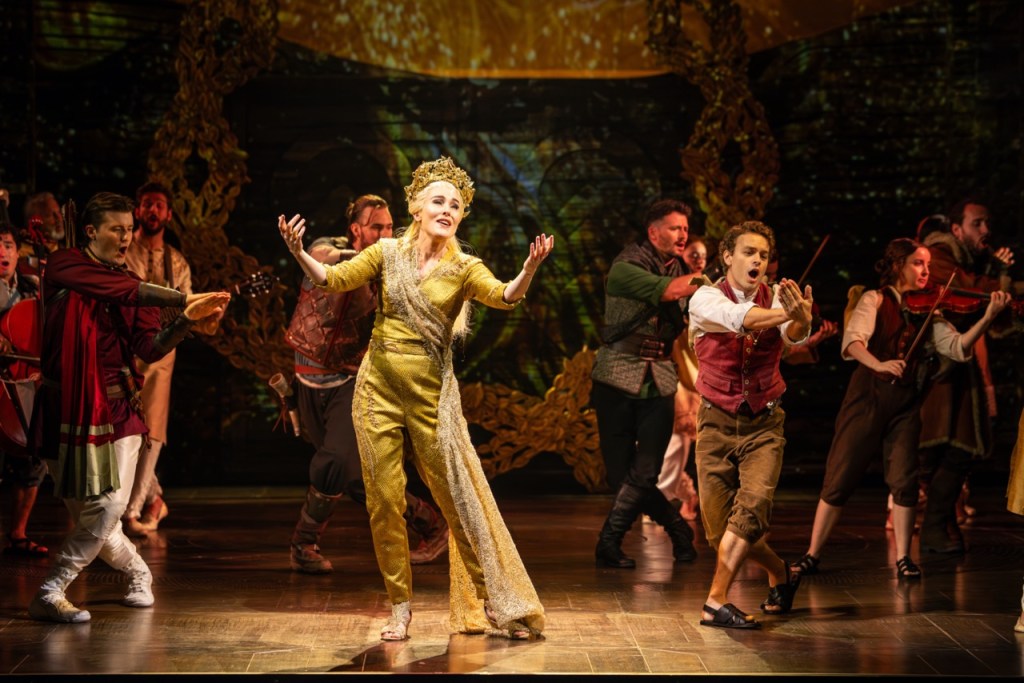
Jemma Rix and company. Photo: Daniel Boud. The two things The Lord of the Rings: A Musical Tale has in abundance are camp and cringe — neither in a good way. The rivalry between the elves and dwarves comes across like a sassy run-in between preening Potts Point Botox-boys and their crunchier Inner West counterparts. The poor elves, especially, are left resorting to a lot of bored looks and insipid hand-waving to indicate their “otherness” and magic.
My cringe levels at moments of Lord of the Rings equaled those watching this sequence of Rogers: The Musical. Meanwhile, the wizards and humans use their best Shakespearean voices to imbue the flamboyant dialogue with a vague sense of gravitas. The epic battle? A mess of incoherent movement that did nothing but add to the excessive running time. As we approached the third hour, I was rooting for Sauron to win. His eye could not have been more withering than my own.
To be clear, the problems lie with the show itself and the lack of imagination in the staging. This is, for all intents and purposes, merely a poor cousin of the original overblown misfire but the cast is giving it their all. They’re better than the West End ensemble, if I’m honest, and these aren’t easy roles to sell on stage. With the performers pulling double duty as musicians (hence Elrond’s odd trombone moment), there is no time to rest.
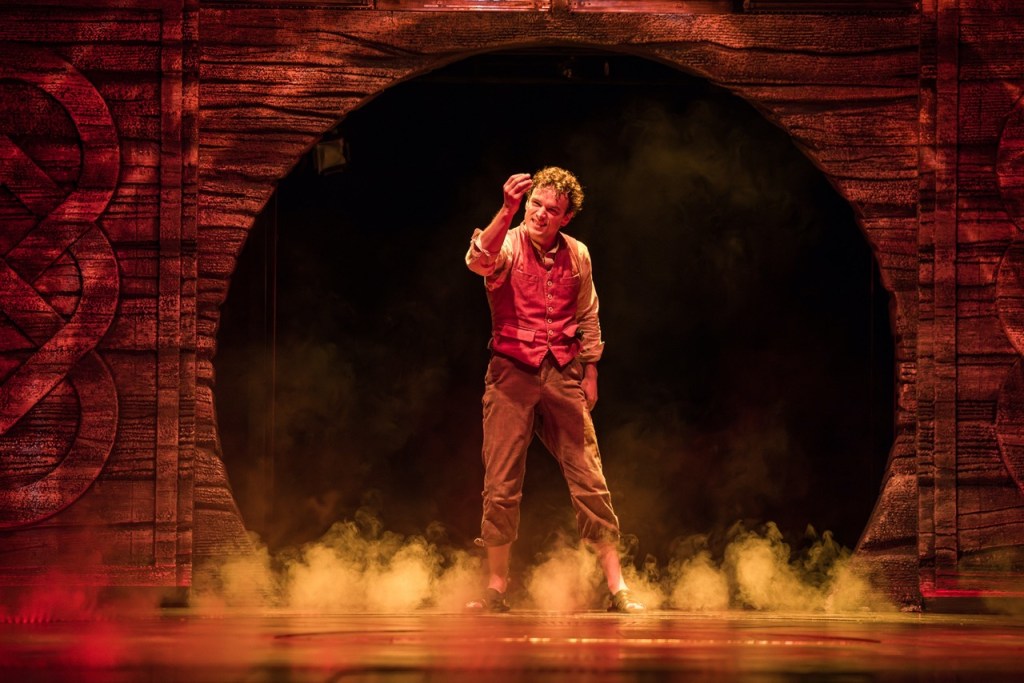
Rarmian Newton. Photo: Daniel Boud. Rarmian Newton is fantastic as Frodo, charming until the ring starts to corrupt him. He’s a warm and appealing lead, holding the show together alongside Wern Mak’s Samwise Gamgee. The show is at its best when these two are at the centre. Their quest is the heart and soul of the story (the small people who do big, important things simply because it’s the right thing to do), and it often gets lost in the noise of subplots. Jeremi Campese and Hannah Buckley equally deliver the comedy and childish energy as Merry and Pippin (although in another odd musical instrument moment, it was weird watching Merry flee the Nazgûl with a cello on his back).
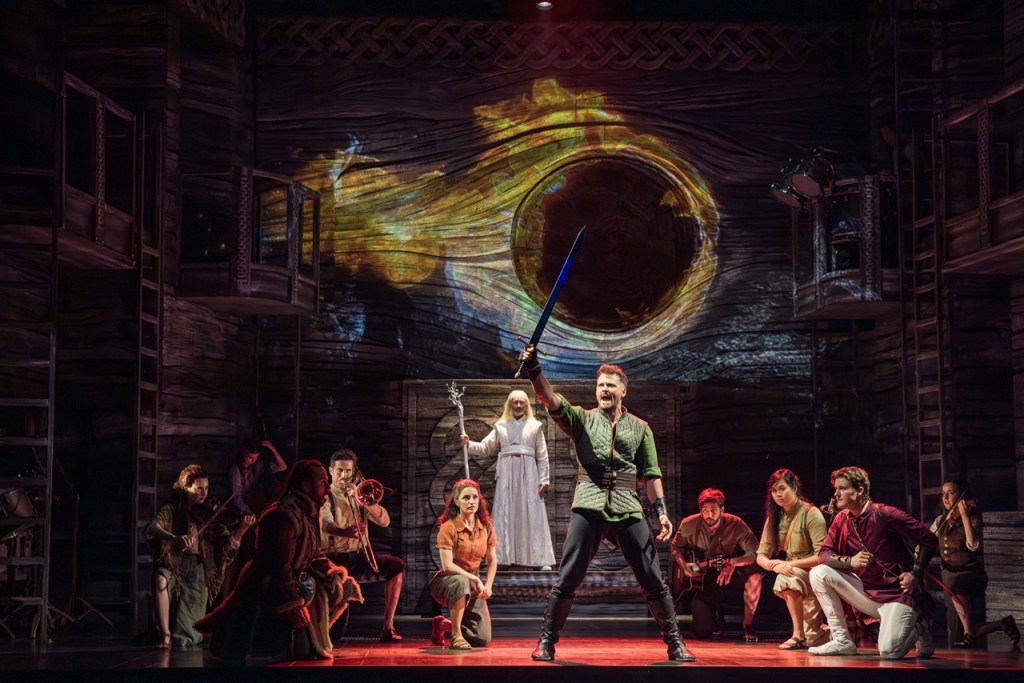
Rob Mallett and company. Photo: Daniel Boud. Rob Mallett manages to bring a level of dignity to the role of Strider that the West End production failed to deliver. Jemma Rix dazzles as Galadriel, even if she is mostly confined to the back of the stage belting out ethereal tunes. As much as I hate the design choices of this show, the one bright spot was the elegant Star of Eärendil that frames Galadriel. Stefanie Caccamo is wasted as the redundant Arwen. Laurence Boxhall is excellent as Gollum — well, as excellent as you can be trying to sing with a Gollum voice.
Then there’s the never-ending endings, the leather-hooded orcs in cargo pants, and the Ents! I could go on, but you get the point. Maybe this is an expectation game? Did I want more than was reasonable to expect from the show? Maybe this is all just good family fun, and I’m being a grinch, or an orc, about a silly, entertaining musical? Is there good stuff in here? Sure. The cast is wonderful, and some of the tunes are earworms. But everything else can be thrown into the fires of Mount Doom. Someone call me a giant eagle — I’m done.
I stumbled on this reel of footage from the original production of Lord of the Rings.
-
Subscribe
Subscribed
Have a WordPress.com account? Log in now.

