-
Welcome to Cultural Binge

The rating system is simple:
★★★★★ – Terrific, world-standard. Don’t miss.
★★★★ – Great, definitely worth seeing.
★★★ – Good. Perfectly entertaining. Recommended. Individual mileage may vary.
★★ – Fine. Flawed and not really recommended, but you may find something to appreciate in it.
★ – Bad (& possibly offensive).
See more reviews over at The Queer Review.
Instagram: @culturalbinge
Substack: culturalbinge.substack.com
Email: chad at culturalbinge.com
-
Ruins أطلال (Belvoir 25a) ★★★★
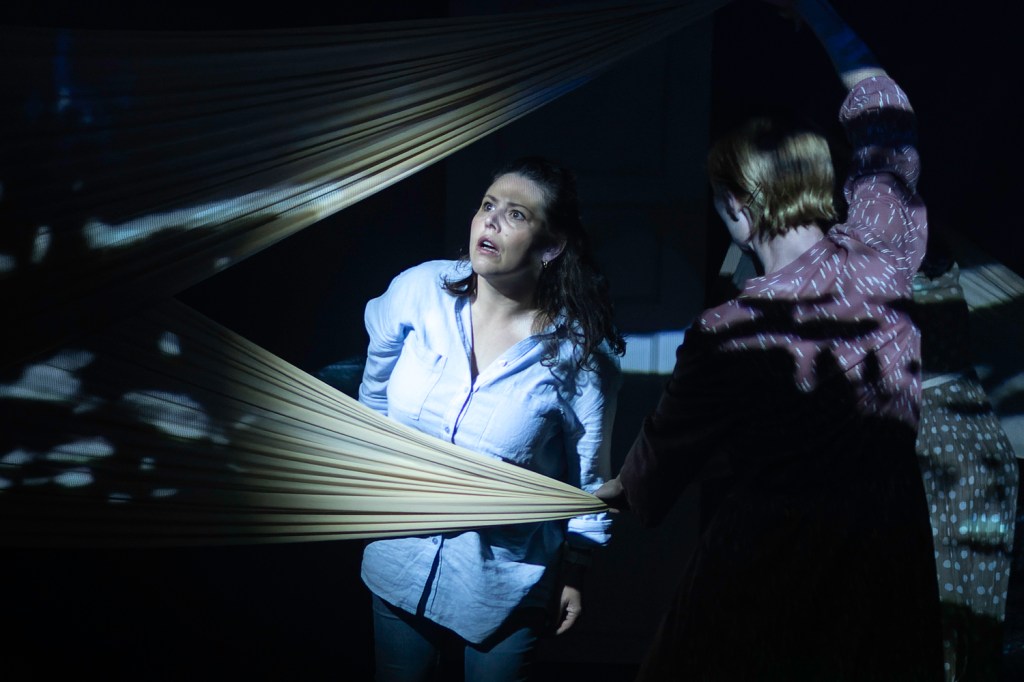
Created and Directed by Emily Ayoub and Madeline Baghurst. Belvoir 25a. 1-20 Oct 2024.
It’s quite rare that I watch a piece of independent theatre and leave pondering its beauty, but Ruins is exactly that. Beautiful.
Amelia Alyssa (Emily Ayoub) leaves her family in Australia behind as she heads to Lebanon, the land of her ancestry. There, among the ancient Baalbek ruins of the Bekaa Valley, she is haunted by thoughts of her father (Tony Poli) who had recently passed away and was supposed to go on this journey with her. As she stays at the Palymyra Hotel, her mind is filled with memories of Jean Cocteau films (who was one of the famous guests at the hotel) and the stories her father once told her.
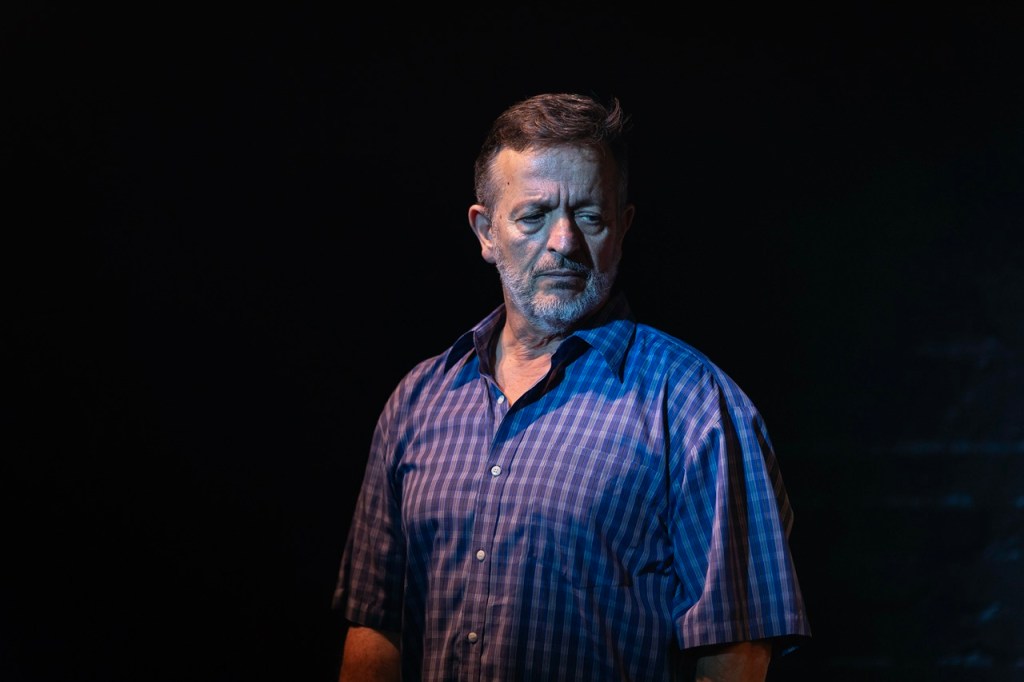
Tony Poli. Photo: Geoff Magee. Ayoub and co-creator Madeline Baghurst have created a dreamlike story of a woman lost in her grief and ancestral memory. Overcoming with emotions and new, jarring experiences Amelia sees reflections of her father all around her. Directed with clarity and compassion, Ruins travels to lofty places with the simplest of theatrical techniques and excellent storytelling skills.
The production aspects of Ruins are gracefully presented, remarkably so considering the limited $2500 25a budget. A door and a desk transform into an airport security screening, a taxi, a hotel room and more with each elegant move. After seeing the full-scale multimedia extravaganza of Frankenstein this week, it’s refreshing to see a simple white door effectively used as a projection screen with more emotional heft than the big budget version.
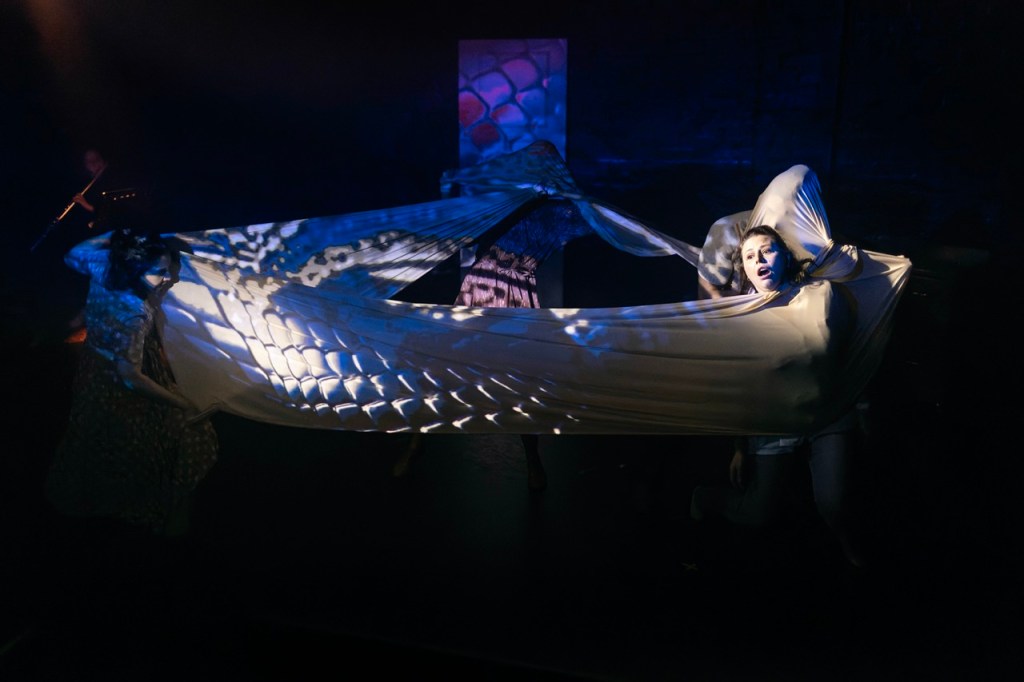
Emily Ayoub. Photo: Geoff Magee. The ensemble (Piumi Wijsundara, Madeline Bahurst and Adam Al Kuhel) morph between characters and scenarios with a disorienting smoothness. The gentle live score by composer Johnny Yang sets the tone and carries the audience through the piece, and videographer Laura Turner’s images ground us in the sense of place, before transporting us into a world of memories and nightmares.
This whole show is seamless, a flowing stream of moments that brings itself to a neat and satisfying resolution in under 45 minutes. By not outstaying its welcome or throwing needless complications into the plot, Ruins manages to be a perfectly concise distillation of its story. This kind of storytelling takes disciple and clarity behind the scenes, skills sorely lacking in many productions.
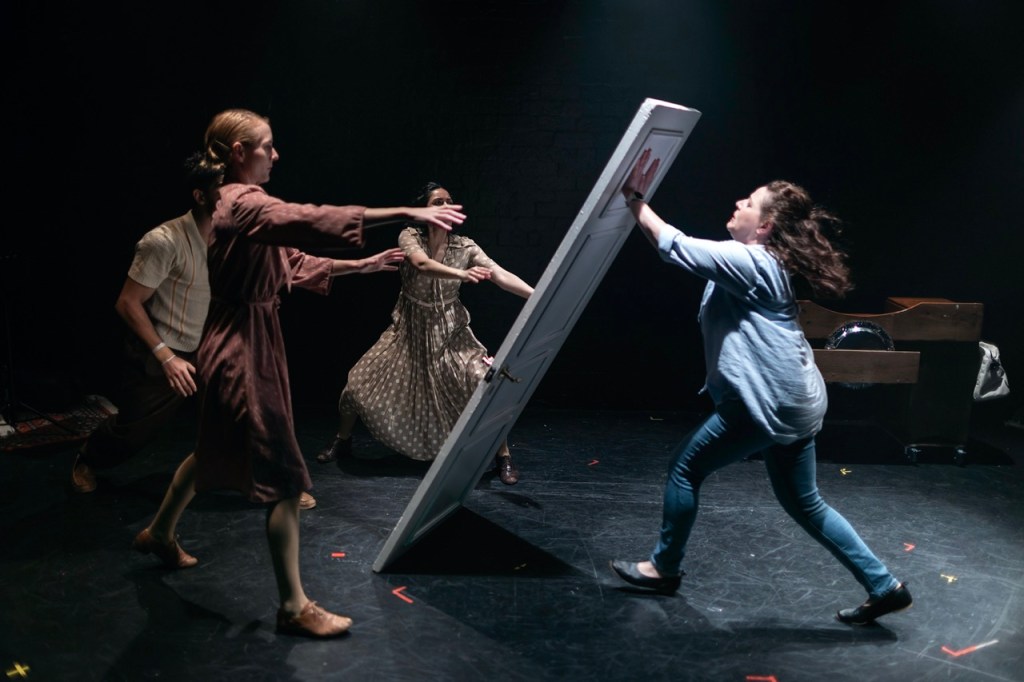
Emily Ayoub and ensemble. Photo: Geoff Magee. Could Ruins be expanded into a fuller work? Definitely, but the fact the creatives have let this version become its own, complete vision without forcing it to be longer makes for a refreshing piece of theatre. Perhaps the future is simple to double-bill it with another work? Either way, the Ruins we have now is worth experiencing all on its own.
-
Well-Behaved Women (Belvoir) ★★★½

Music & Lyrics by Carmel Dean. Additional lyrics by Miriam Laube. Belvoir. 28 Sep – 3 Nov, 2024.
Aussie songwriter Carmel Dean’s song-cycle Well-Behaved Women brings the bangers to Belvoir. Dean pokes fun at the patriarchy and heaps praise on some key stories of female rebels, iconoclasts, champions and quiet achievers throughout time.
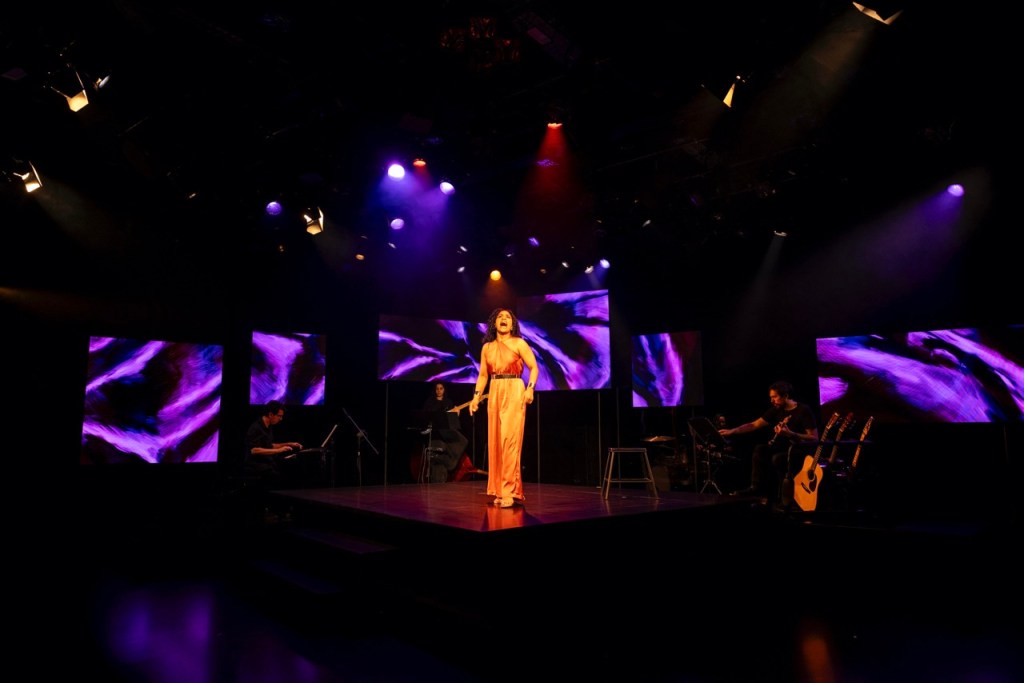
Elenoa Rokobaro. Photo: Brett Boardman. The cast of four, Stefanie Caccamo, Zahra Newman, Elenoa Rokobaro and Ursula Yovich take turns playing women from the biblical Eve to Grace Tame, via Cleopatra, Harriet Tubman, Frida Kahlo and more. On the night I went, Ursula Yovich was subbed out for Sarah Murr “the hardest working woman in musicals”™ – who proves yet again she can belt like Boudicca at the drop of a hat. Dear casting agents and producers – just give her a lead role already!
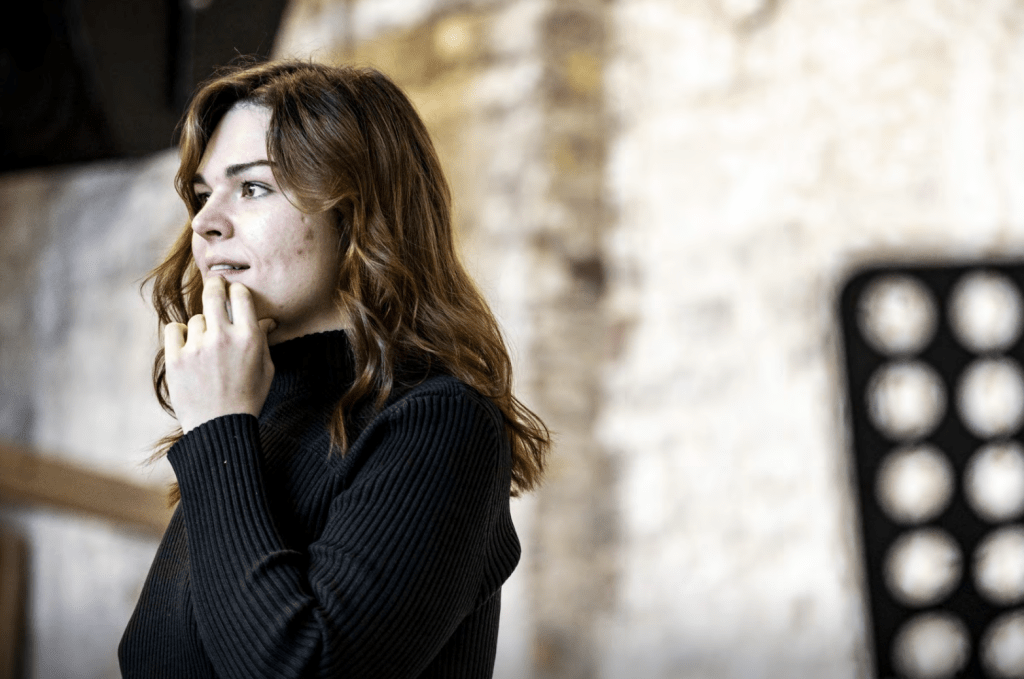
Sarah Murr in rehearsals. Photo: Brett Boardman. While Dean has composed tunes for the well-known women of history, there are some interesting smaller tales that enliven the evening, like Janet Armstrong, wife of astronaut Neil Armstrong, singing about holding down the fort at home while her husband is off in space, or Australian swimmers Fanny Durack and Mina Wylie defying local authorities to swim, and win medals, in the Olympics in Stockholm.
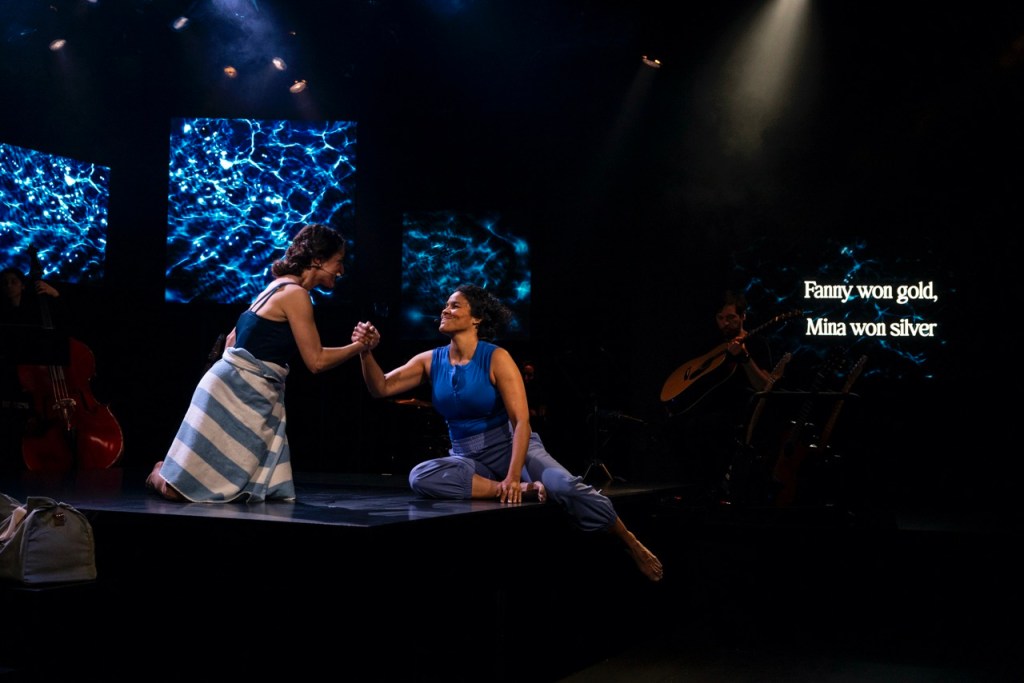
Stefanie Caccamo & Zahra Newman. Photo: Brett Boardman. Dean keeps things varied by playing with genres. There is some traditional musical theatre, rock, R&B, country and more, though often the evening settles into a similar mid-tempo for serious numbers. It’s when the tunes hit the comedy that things really click. As Virgina Wollfe (Caccamo) sings about a fictional Shakespeare’s Sister it’s playfulness elevates (even if the tune itself seems a bit too reminiscent of Sondheim’s “The Story of Lucy & Jessie”). Caccamo again nails her number as Mary Magdalene complaining about being the only woman at the Last Supper. Newman works the room singing as Julia Gillard pointing out the hypocrisy of press coverage.
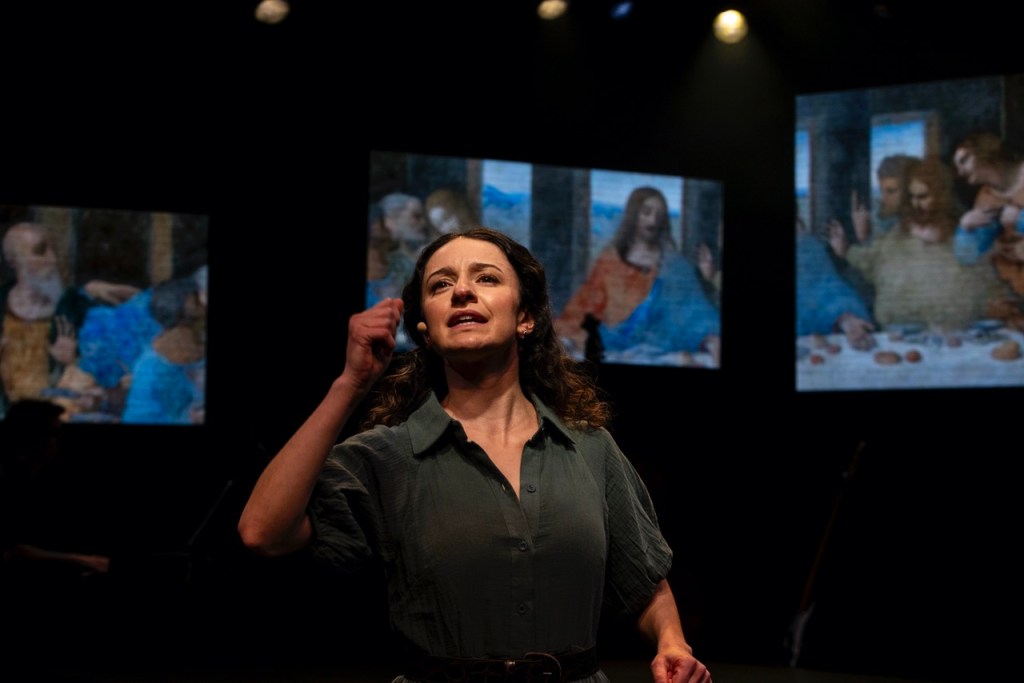
Stefanie Caccamo. Photo: Brett Boardman. Director Blazey Best, bringing this production over from a short run at Hayes in 2021, gives it a shiny-floored gala-style presentation (all sparkles and reflections) under the design direction of Grace Deacon. Video screens deliver key quotes and information as required. It’s a simple and elegant vision.
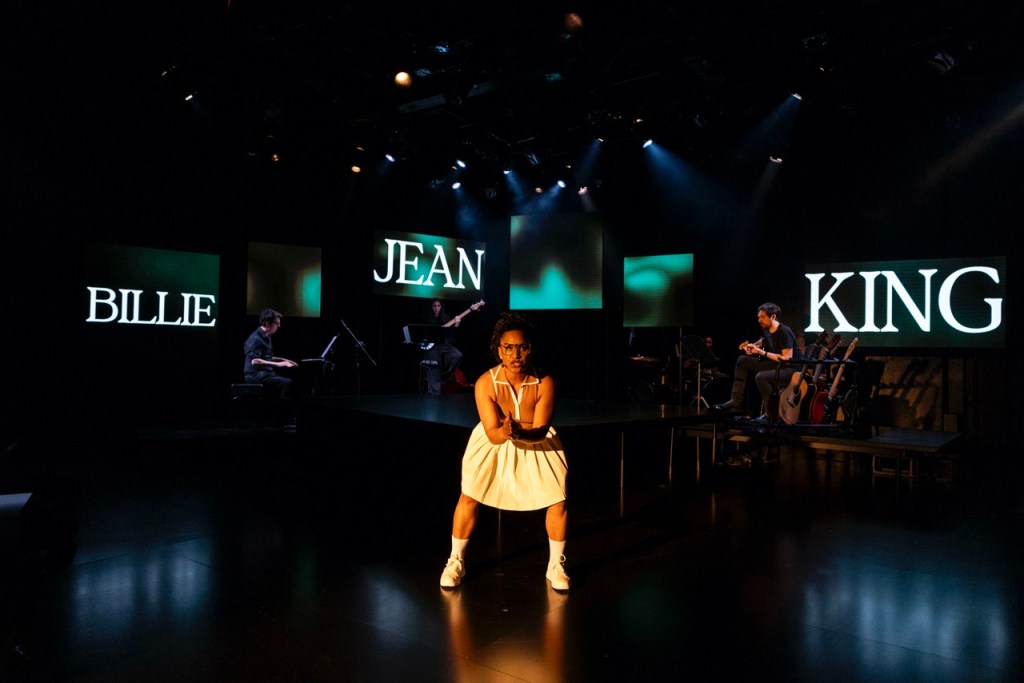
Elenoa Rokobaro. Photo: Brett Boardman. But this is a song cycle, and as such struggles to have any momentum as it moves from song to song. Wisely, the creative team has dropped some numbers to keep the show at a short, sharp 70 minutes. By the time we hit the group anthem “We Rise”, we’ve been entertained and educated without ever being bored. This is just a quick primer on just a few notable women through history, a great showcase for four fantastic performers, and for the songwriting talents of Carmel Dean herself.
-
Frankenstein (Theatre Royal) ★★★★

Based on the novel by Mary Shelley. Adapted by Nelle Lee. Theatre Royal, Sydney. 28 Sep – 13 Oct, 2024.
The Theatre Royal continues to be the home of frothy gothic thrillers as Shake & Stir’s Frankenstein finally makes its way to Sydney. This is wide-screen theatre with an almost computer game sensibility to storytelling… and it’s a lot of fun.
Victor Frankenstein (Darcy Brown) is a brilliant young scientist obsessed with the “spark of life”, the animating force that separates living tissue from dead. He leaves his father, younger brother and fiance in Geneva, Switzerland to go to university in Germany and there starts experimenting with dead tissue, and eventually, creates a new man from cadavers. When the Creature (Jeremy Wray) comes to life and flees, Frankenstein must deal with the consequences of playing god.
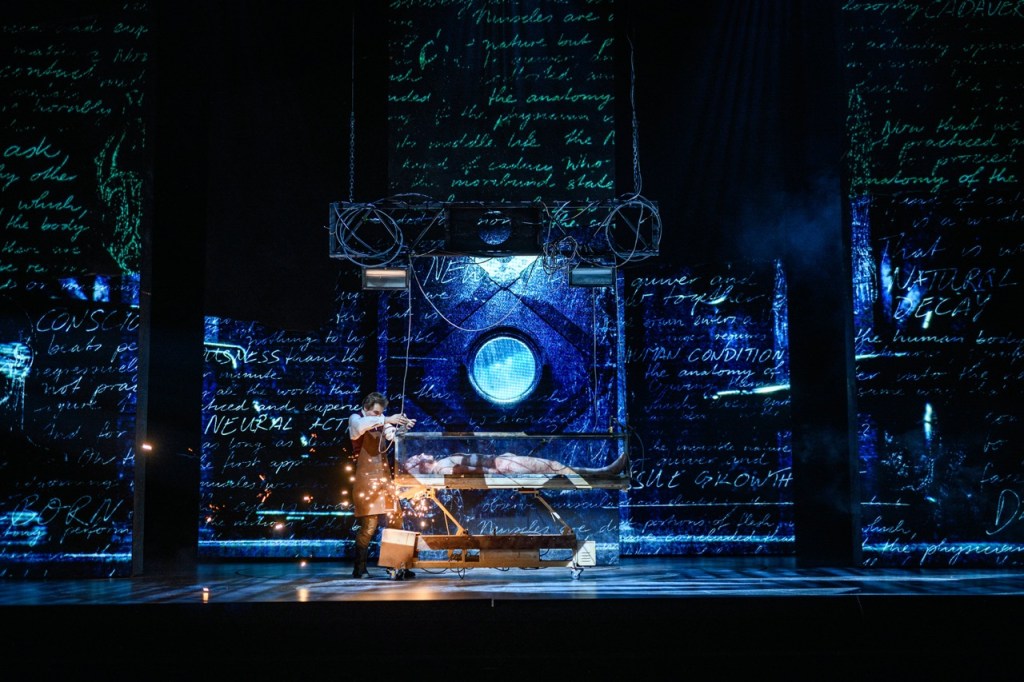
Darcy Brown & Jeremy Wray. Photo: Joel Devereux. Befitting the tale of scientific hubris and technological advancement, Frankenstein’s stars aren’t actually any of the actors. No, it’s monolithic screens that dominate the stage (and instantly made me think of Kip Williams’ Gothic Cine Theatre trilogy – to which this show owes a debt). Director Nick Scubij and designer Josh McIntosh have created a piece full of fantastic moments. The opening aboard Robert Walton’s ship in the arctic is stunningly presented, as is the sight of a cabin burning in the woods.
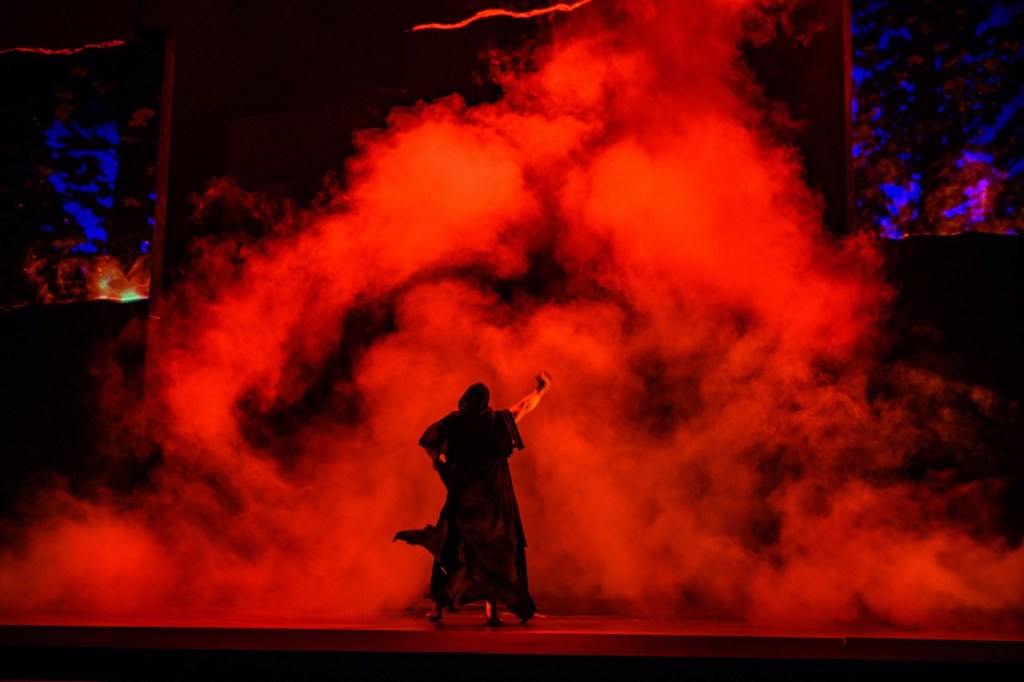
Jeremy Wray. Photo: Joel Devereux. Vibrant animation by video designers Craig Wilkinson and Jake Lodder transport us from stately homes in Geneva, to creepy attics, icy expanses and lush woods. The transitions are beautiful and video work mostly manages to enhance rather than distract. Combined with Trent Suidgeest’s lighting, Guy Webster’s sound design and music, and the hardest working stage revolve since Les Miserables, Frankenstein is a moody, immersive experience using all the tricks in the book to impress you.
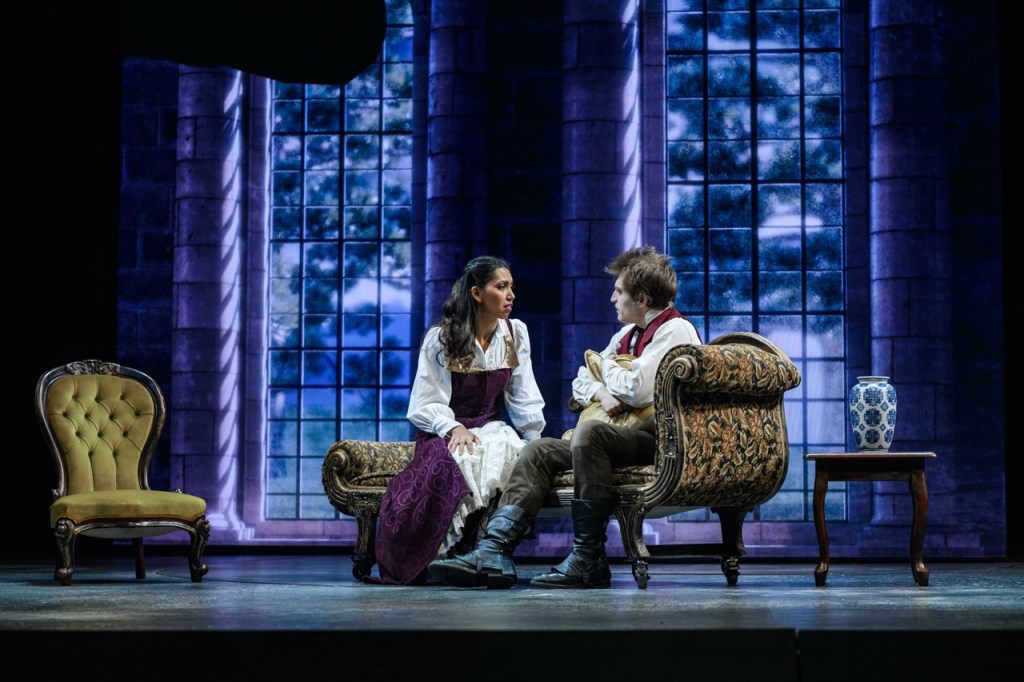
Chloé Zuel & Darcy Brown. Photo: Joel Devereux. That’s not to say the performances are weak, they definitely are not. Darcy Brown uses his comedic skills to breathe new life into the role of Victor Frankenstein, who isn’t just an obsessed scientist, but instead a bumbling, frantic geek on the verge of a nervous breakdown. Chloé Zuel gives strength to Elizabeth, Frankenstein’s very long suffering love interest. Nick James is the calm in the story as Frankenstein’s friend Henry. Jeremy Wray has the toughest job of all, making us care for the miraculously autodidactic Creature Frankenstein creates, while still being a menacing presence. Along with Anna Lise Phillips and Tony Cogin who play a number of roles, they keep the spectacle around them grounded.
Nelle Lee’s adaptation put the spotlight primarily on Frankenstein himself. Stepping away from the stereotypical maniac genius of Hammer Horror films and painting him more as a neurotic nerd who finds himself out of his depth and struggling to take responsibility for what he has done. It’s a more sympathetic portrayal than you usually find (more so that the gruff arrogance of Danny Boyle’s star-studded version of Frankenstein for the National Theatre).

Darcy Brown & Jeremy Wray. Photo: Joel Devereux. If I was going to get picky, then yes, the accents are all wrong, and the gender politics are pretty sketchy at best (they do try to rectify this as much as possible by giving the female characters more agency, but you can’t get around the blatant “fridging” of a key character). The overreliance on the screens and the revolving stage does get a little obvious as the show progresses and, as I’ve mentioned, the show plays out like a computer game in “story mode”, you’re here for the plot not for any deeper character work.
Frankenstein is big, bright, blockbuster theatre, and it does exactly what it sets out to do – entertain us with thrilling visuals and a classic horror story. It’s a fun, occasionally silly, often spectacular show that puts its money on stage for everyone to see and I had a blast with it.
-
Seventeen (Seymour Centre) ★★★
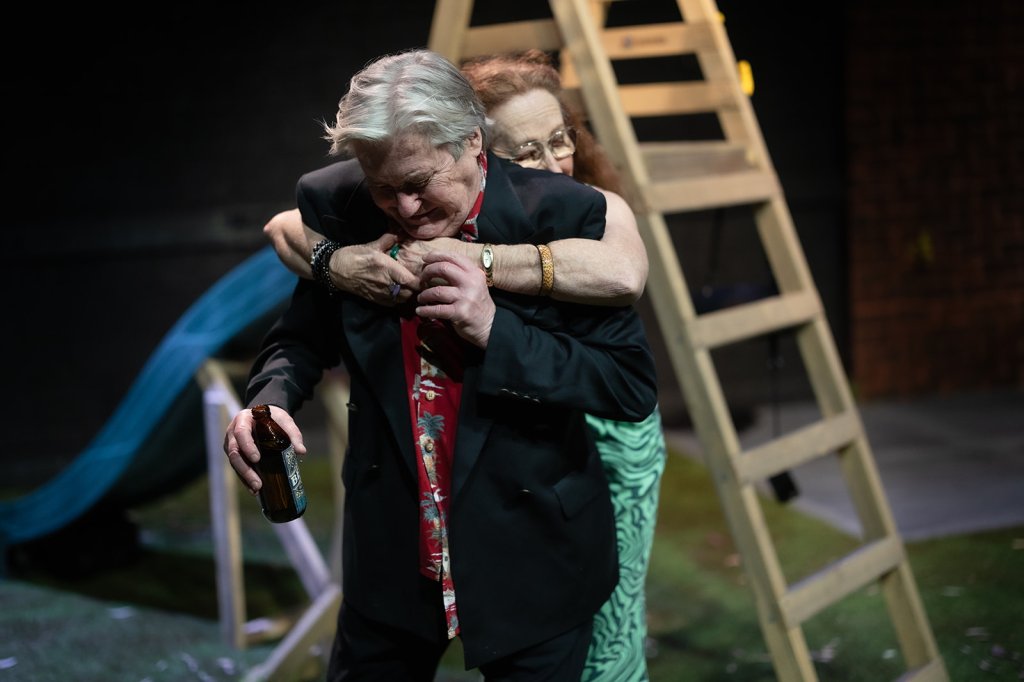
Written by Matthew Whittet. Seymour Centre. 27 Sep – 19 Oct, 2024.
Matthew Whittet’s Seventeen gets its first Sydney revival since its debut at Griffin in 2015 (hot on the heels of a different revival production at Melbourne Theatre Company earlier this year) with a team of performers refusing to act their age.
It’s the last day of school and a group of friends, and two uninvited guests, party in the park, waiting for the new day to dawn. But these teenagers can’t handle their pilfered alcohol or their emotions, and soon all their hopes, fears and secrets are laid bare.

Peter Kowitz, Katrina Foster & Di Adams. Photo: Carlita Sari. The central conceit of Seventeen is that the six teenagers are played by much older adults. This is a play about perspective, and the dissonance of having performers in their 60-70s playing much younger, haunts the simple story. Time is both cruel and calming, making the moments that feel sharp in puberty seem mellow in reflection.
It’s this duality that makes Seventeen something special. While the characters are full of nervous energy, fueled by their anticipation of the future, the audience also reads a layer of melancholy and regret from the older performers. Some of the teenager’s concerns are charmingly trivial compared to what is to come, while others strike at a deeper sense of loss. It begs the question, if you could go back to when you were 17, would you do anything differently?

Peter Kowitz & Noel Hodda. Photo: Carlita Sari. The introduction of Tom (Noel Hodda) carrying a letter that he wrote to his “future self” a mere six years prior is a time capsule in itself. We change so much in a few years that the gap between an 11 year old and a 17 year old feels larger than that between 17 and 70. It’s also a reminder of how little life these characters have lived despite the seismic event happening to them as they leave school.
Most of the cast manage to evoke this youthfulness to the point you stop thinking about their actual ages and it’s fun watching seemingly mature adults channel the exuberance and arrogance of adolescence. Of the ensemble the two stand outs are Di Adams as the attractive and popular Sue, a mix of casual confidence and surging emotions; and Katrina Foster as Edwina, Sue’s sharp and bookish best friend who struggles to reconcile her head and her heart.

Katrina Foster & Di Adams. Photo: Carlita Sari. Not all of the story revelations get the necessary runway to land convincingly and some of the costuming choices scream middle-age rather than teen. When the full cast are onstage the action can be unfocused, but is on much firmer ground as the group breaks off into various pairs and the real conversations start to happen. Even at a zippy 80min duration it feels like there’s room to tighten.
For all the high school drama and the somewhat elegiac tone, Seventeen offers a warm and comforting lesson. As the sun rises on a new day, and the six characters head off to lead their new, different lives, we know that on some level they will grow to become older, wiser adults. After all, we’ve seen a version of their future selves already.
-
Gilgamesh (Carriageworks) ★★★½

Composed by Jack Symonds. Libretto by Louis Garrick. World Premiere. Carriageworks. 26 Sep – 5 Oct, 2024.
Composer Jack Symonds’ new work Gilgamesh has premiered at Carriageworks under the stewardship of longtime collaborator, and outgoing Sydney Theatre Company Artistic Director, Kip Williams. It’s big, bold and complicated. And my reaction to it was similarly big… and complicated.
Part of the joy of opera is the scale and spectacle, and Gilgamesh dishes both up with finesse. The cavernous space of Carriageworks’ Bay 17 has been opened up, giving us a wide canvas on which to play. And the white floor is especially canvas-like, as Elizabeth Gadsby’s set sprawls horizontally over the expanse.

‘Gilgamesh’ Presented by Opera Australia, Sydney Chamber Opera & Carriageworks. Photo Credit: Daniel Boud. We open on the vista of a felled tree, sectioned into pieces but lying in place. Greeting audiences as they enter, is a blood-soaked Gilgamesh (Jeremy Kleeman) sitting on the stump nursing his chainsaw, wearing little more than his coronet. As far as opening images go it’s instantly arresting and fascinating. It sets the stage for an evening of glitter and gore; blood, metal and bone.

‘Gilgamesh’ Presented by Opera Australia, Sydney Chamber Opera & Carriageworks. Photo Credit: Daniel Boud. In the midst of this, David Fleischer’s costumes strike a pose. Ishtar (Jane Sheldon) is a vision in blue. The evolution of Shamhat (Jessica O’Donoghue) from dark coat and collar to shimmering ruby one-piece cements the aesthetic. When Gilgamesh returns in full regalia, he travels in a shower of metallic confetti, fanned into the air by his courtiers. In comparison, Enkidu (Mitchell Riley) is a creature of clay and dust. Combined with Amelia Lever-Davidson’s dramatic, rock-stadium lighting, and sound design by Bob Scott and Benjamin Carey, this is a sumptuous experience from beginning to end.

‘Gilgamesh’ Presented by Opera Australia, Sydney Chamber Opera & Carriageworks. Photo Credit: Daniel Boud. Kip Williams creates an array of vivid images that have stuck with me long after the opera ended. The endlessly evolving spiral of Uta-Napishti’s dessert home, the violence of the dismembered tree, the sight of Humbaba’s (Daniel Szeisong Todd) bedazzled wrestler appearance, the cowboy/scorpions, and Gilgamesh & Enkidu bathing themselves in their slain foe’s blood. Gilgamesh is suitably epic.
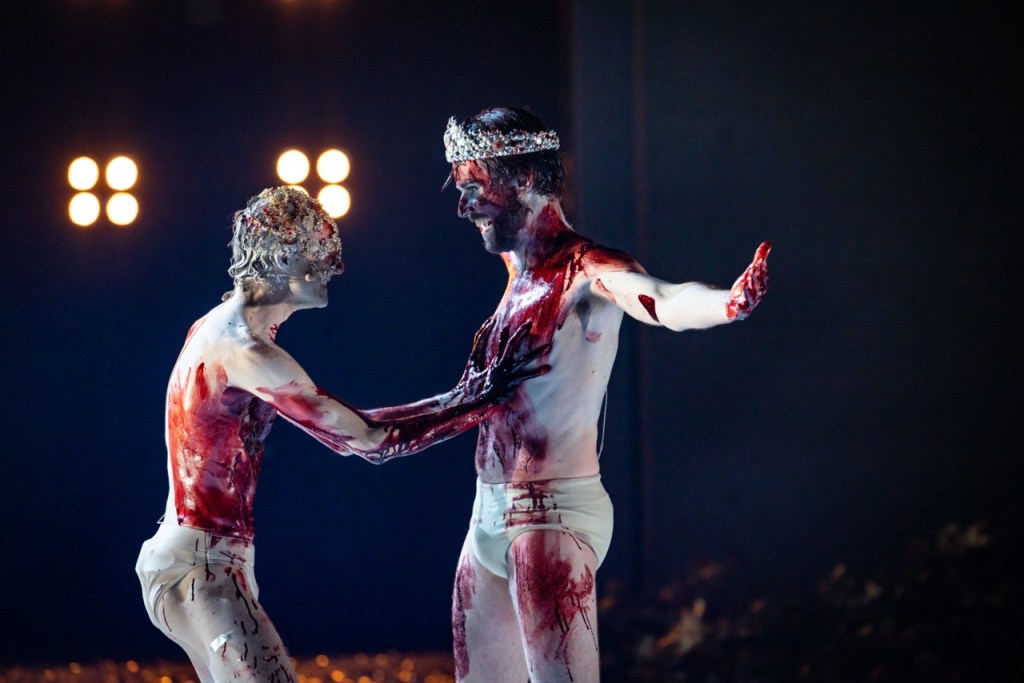
‘Gilgamesh’ Presented by Opera Australia, Sydney Chamber Opera & Carriageworks. Photo Credit: Daniel Boud. Where I struggled was the center-piece score and libretto. As an interested but emerging lover of opera, this was challenging. For me Jack Symond’s dissonant compositions elevated the supernatural and violent scenes, but the sharp modernist tone cut against the softer moments. The storytelling felt as if it were rearing up to confront the audience, rather than invite us in. But as I said, I’m no aficionado of opera. Those with more grounding in the art may (and seem to) find much more to adore.

‘Gilgamesh’ Presented by Opera Australia, Sydney Chamber Opera & Carriageworks. Photo Credit: Daniel Boud. Kleeman’s Gilgamesh is a refreshingly non-binary presence, fully embodying their own persona. Passionately loving the undefeated Enkidu, as much as loving the rage & violence of victory. Their spiritual awakening is slow and esoteric but powerfully realised. Riley’s Enkidu is guttural and animalistic, a fantastic physical performance than is as much dance as it is movement.
Gilgamesh is a feast of visual imagination, utterly stunning to behold. As a piece of art and performance it is undoubtedly challenging but viscerally impactful.
-
Sunset Boulevard (Silvie’s Version) (Sydney Opera House) ★★★★½

Music by Andrew Lloyd Webber. Book and Lyrics by Don Black & Christopher Hampton. Sydney Opera House. 28 Aug – 1 Nov, 2024.
I wanted to rewatch Opera Australia’s Sunset Boulevard again for two reasons. 1) It’s one of my favourite Andrew Lloyd Webber scores. I still have the hulking 2-CD set of the original cast recording. And 2) I wanted to see Silvie Paladino in the role of Norma Desmond. So I trundled down to the Opera House on a balmy autumnal Sydney night for another hit of old Hollywood.

Tim Draxl. Photo: Daniel Boud. For a full review of the show, check out my first review. This second trip, with different seats, made me really appreciate Morgan Large’s set. Yes, it creaks a bit as it moves into position, but the sheer size and grandeur of it all really gives you a sense of place and scale. When the set blends with George Reeve’s projections, and Mark Henderson’s lighting it takes on new dimensions. It’s really wonderful. I also really enjoyed noticing how subtly the characters moved into position and were revealed to the audience. Director Paul Warrick Griffin, and choreographer Ashley Wallen, do a great job at distracting and dazzling us while moving the pieces into place.

Ensemble of Sunset Boulevard. Photo: Daniel Boud. Soaking in this score, played by the stunning orchestra, is just a joy. And when the full ensemble sings, you feel it. After watching some obviously amplified shows, it was wonderful to be fully enveloped by the voices. I’m sure they are amplified as well, but the sound mixing and the quality of sound in the Joan Sutherland Theatre felt organic and warm.
On the night in question an understudy (I believe it was Mary McCorry) was on in place of Ashleigh Rubenach in the role of Betty. She was excellent. A terrifically precise voice and real charm on stage.

Ensemble of Sunset Boulevard. Photo: Daniel Boud. And of course, the role of Norma Desmond was played by Silvie Paladino. I’ve never seen Paladino live before, and my god… her voice. “With One Look” has never sounded better and the audience (about 80% full if you were wondering) was rapturous in their applause. Paladino’s performance hits the same beats as Sarah Brightman, but there is a more naturalistic tone. Her Norma feels less performative and more emotional. She knows when to camp it up and serve full Gloria Swanson. If you insist, then yes, I do believe she’s better in the role than Brightman is. If you’ve been nervous based on some of Brightman’s reviews then check the performance schedule and book for Paladino. You will not be disappointed.

Nicole Scherzinger in the West End / Broadway production. Photo: Marc Brenner The good thing is that this production is totally worth a second viewing on its own (especially if you’re a musical theatre nerd, and I assume you are if you’re taking the time to read this). I’ve already booked to see the stark, modern Jamie Lloyd directed version on Broadway starring Nicole Scherzinger in a couple of weeks, so it’ll be great to compare these two very, very different takes.
-
Titanique (The Grand Electric) ★★★★

Music & Lyrics by various artists. Book by Tye Blue, Maria Mindelle & Constantine Rousouli. Based on the film Titanic by James Cameron. The Grand Electric. 12 Sep – 3 Nov, 2024.
Read my review of Titanique over on The Queer Review.
-
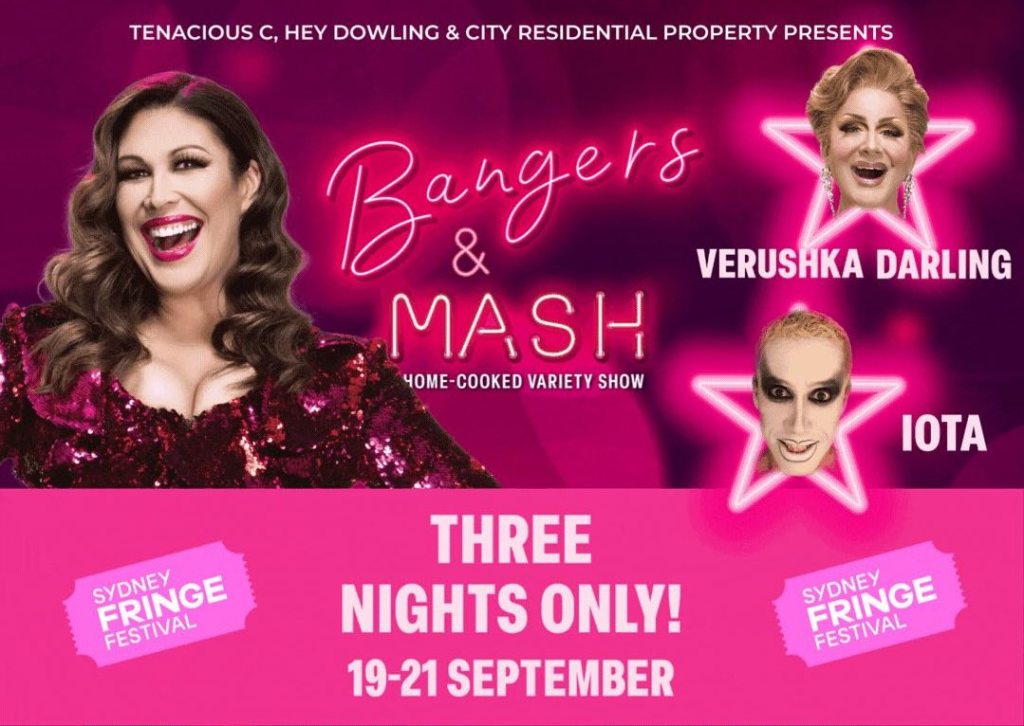
Bangers & Mash (Sydney Fringe) ★★★★
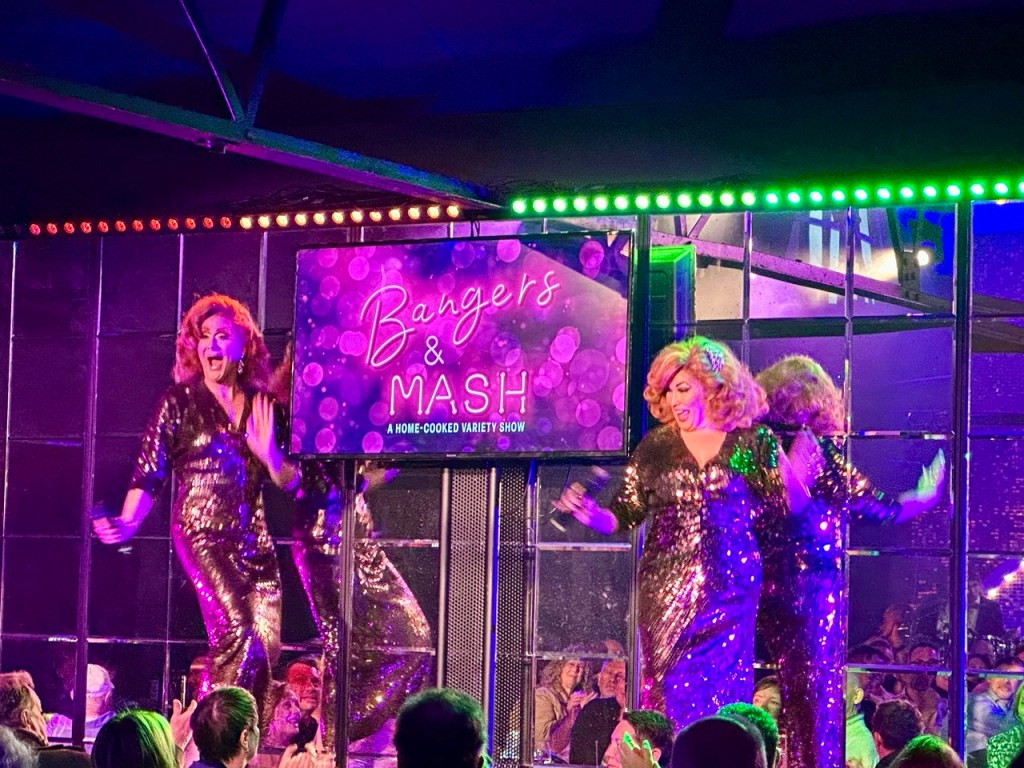
Hosted by Catherine Alcorn featuring Verushka Darling and iOTA. The Emerald Room. 19-21 Sep, 2024.
What’s long, phallic & salty, yet somehow still a “comfort food”? Bangers & Mash. And the variety show at The Emerald Room is living up to its name by mashing up tunes in a blend of cabaret, performance art, drag, comedy and therapy… unaccredited, please-don’t-sue therapy.

Catherine Alcorn. Bad Photography: Me. Musical diva Catherine Alcorn is centre stage, working the Emerald Room and being a terror to all the men named David and Jack in the audience (if you were there you know what I mean). With her big voice she’s mashing-up tunes from Dolly Parton & Miley Cyrus to Nirvana and singing the hell out of Beyonce’s ‘Love on Top’ – every ****ing key-change (it’s worth the price of admission alone)!

iOTA. Photo: Me. Joining her for this spicy evening of madness is Sydney drag legend, Verushka Darling , doling out sex advice and art history as she goes. And iOTA brings the devilish rock to the room. It’s an eclectic mix of talents that orbit each other and exert a pull of creative friction between them, backed by the terrific four-piece band of Oliver Stanton, Ned Koncar, Amanda Jenkins and Jack Powell. When they hit the stage together, sparks fly.
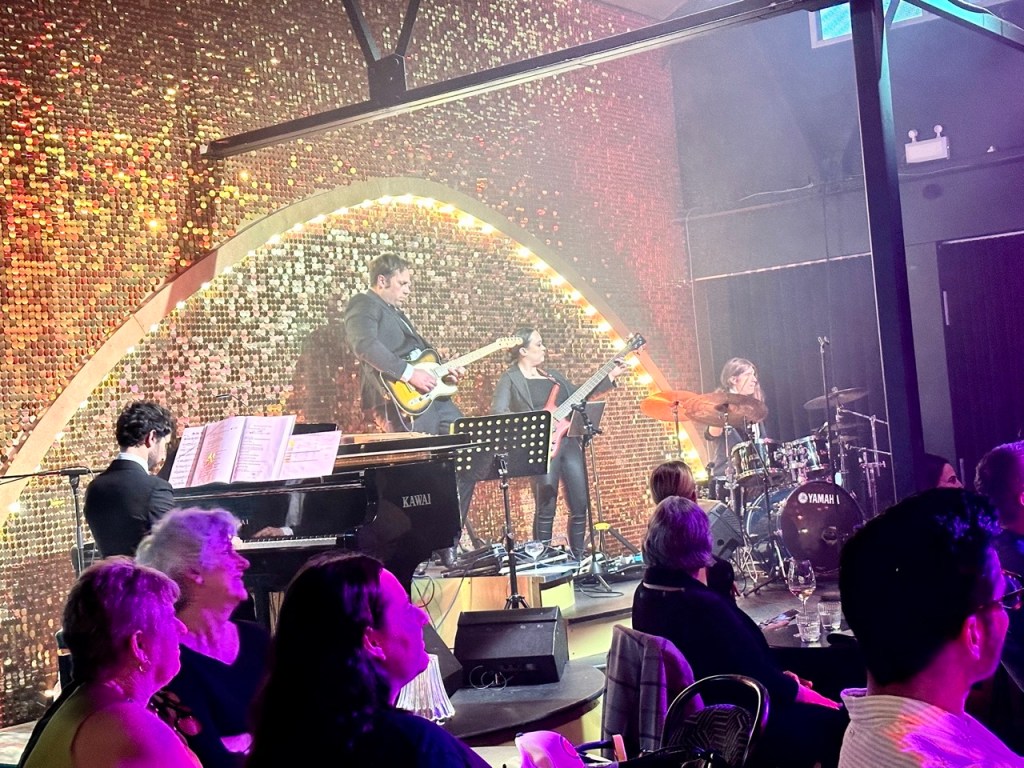
Oliver Stanton, Ned Koncar, Amanda Jenkins and Jack Powell. Photo: Me Sydney’s had no shortage of cabaret this year from some brilliant musical theatre (like Sunday Service), to the circus infused Smashed but Bangers & Mash is working the variety show format to keep things varied. It’s got an experimental edge that gives it an extra electric thrill. And on a side note, if any producers are thinking of bringing the current West End / Broadway production of Cabaret to Australia, iOTA would be the perfect Emcee.

Verushka Darling, Catherine Alcorn & iOTA. Photo: Me. Bangers & Mash is a bag of mixed sweets that keeps you on your toes between the familiar tunes that get the whole room singing along and the totally unexpected laughs. Catherine Alcorn is serving sass on a side plate to the main course of music & laughter. The fact you can have a proper meal and a great cocktail at The Emerald Room is just icing on the cake.
But be quick, you’ve only got till Saturday to catch it!
-
Railed (Sydney Fringe) ★★★½
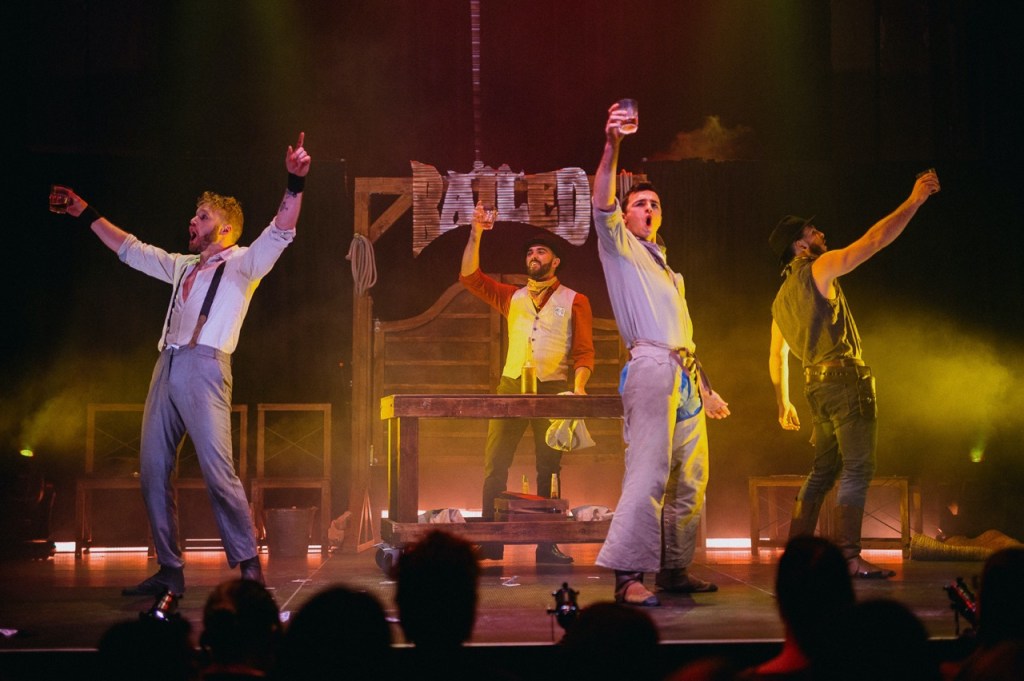
Head First Acrobats. Sydney Fringe. Spiegeltent Festival Garden The Vault. 17-29 Sep, 2024.
Head First Acrobats switch things up for the latter half of Sydney Fringe with Railed, their Western-themed acrobatic/circus/comedy show that goes full bush… ranger. If sexy muscle unicorns and denim are your fetish, you’re in for an eyeful.
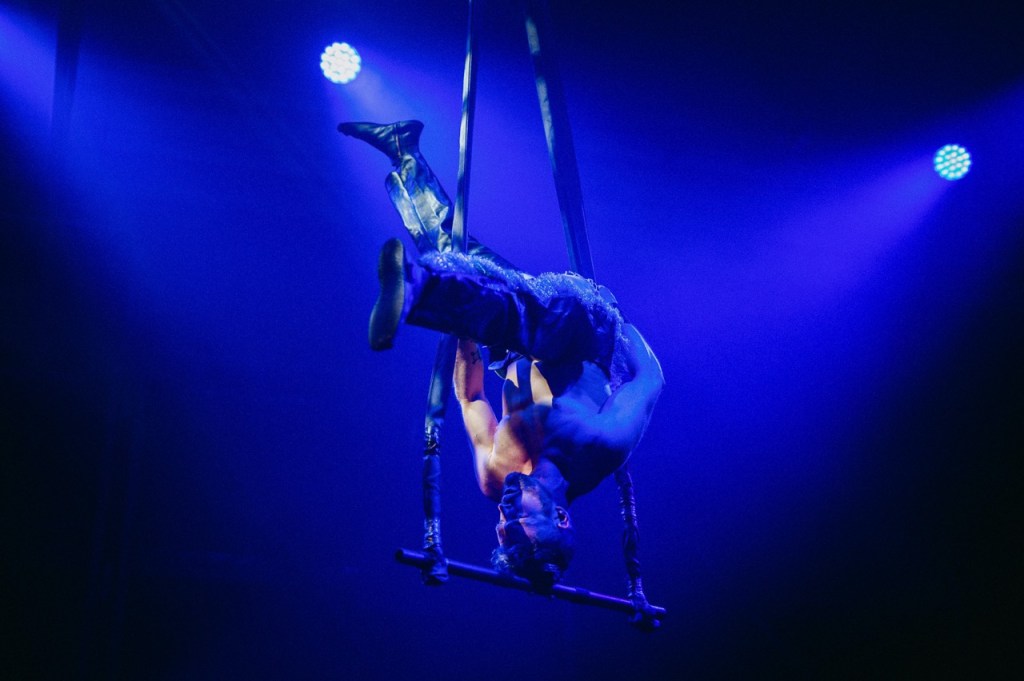
Head First Acrobats. Photo: Matthew Gedling. At first I wonder if this was merely going to be Godz replacing the togas with plaid, but here the boys are showing a whole new bag of tricks… okay, maybe not ALL new tricks, one or two acts have been carried across with a change of outfit, but they’re amplified with a few more comic touches.
Railed is less risqué than the marketing suggests, but these acrobats do get gussied up in the shortest jorts I’ve ever seen that leave little to the imagination. The result is a show that’s a bit less blatant gay-bait and a bit more, drunken, brawlin’ lads mixed with a bit of horseplay. Well, actually, lots of well hung horseplay.

Head First Acrobats. Photo: Matthew Gedling. This quartet of country boys (Juggling – Richard Sullivan, Head Trapeze – Thomas Gorham, Knives – AJ Saltalamacchia, Straps – Stan Ricketson) are as impressive as ever, with feats of balance, strength and acrobatics teamed with endless gags and magic tricks. Of course the acts are all well and good, but it’s the flair, the prestige that really sells them and the boozy, country criminal shtick makes for great fun.
At times it feels like Railed is genuinely very close to going off the rails and the chaotic energy threatens to go from thrilling to uncomfortable. The abundance of glass bottles flying through the air gives everyone in the front row pause. The addition of knife throwing (with a very funny misdirect) keeps things on edge.

Head First Acrobats. Photo: Matthew Gedling. If Godz was just too high on the queer & sexy scale for you then Railed will be your thing. A bit less raunch, and a lot more ranch. But the charisma and good vibes are all here in abundance.
-
Golden Blood 黄金血液 (Sydney Theatre Co) ★★★★
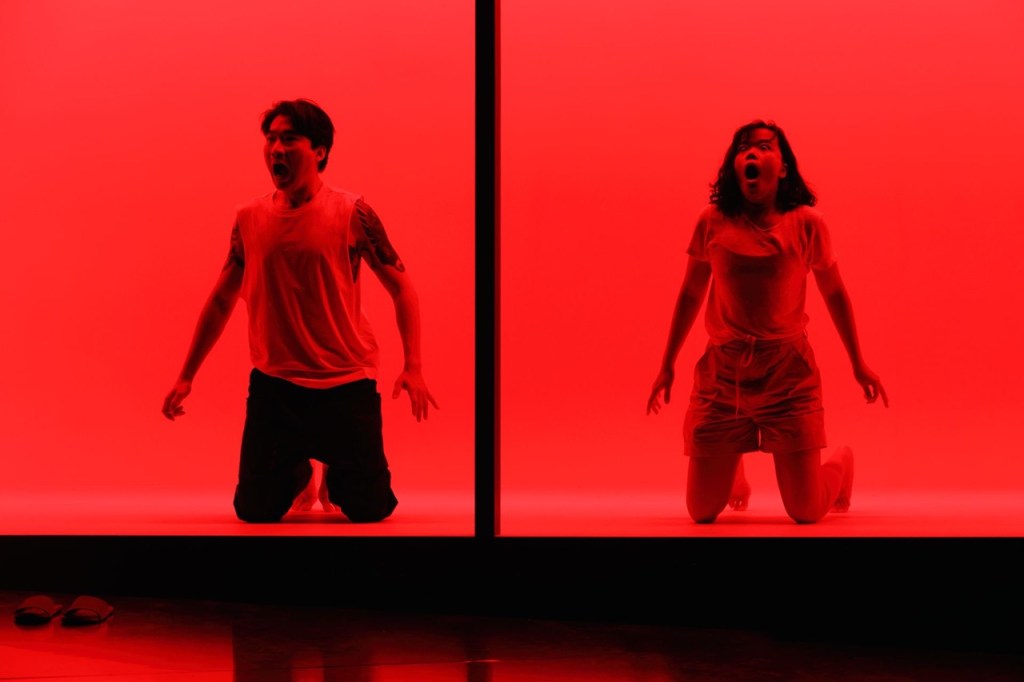
Written by Merlynn Tong. Sydney Theatre Company. 13 Sep – 13 Oct, 2024.
Merlynn Tong’s Golden Blood is back after its 2022 debut at Griffin Theatre Company. Same cast and a subtly enlarged set sees this story of two orphaned siblings growing up in Singapore expand without losing its verve.
14-year old Girl (Merlynn Tong) has to make a big decision. After the death of her mother she has to pick an adult guardian. Should she go with her boring Uncle, or her 21-year old brother, Boy (Charles Wu)? Boy convinces her that he is her best choice, promising “I will always look after you”. Surrounded by his gangland brothers, an entrepreneurial spirit and sheer desperation the two eke out a new life of highs and lows.

Charles Wu & Merlynn Tong. Photo: Prudence Upton. This may be Tong’s playwriting debut but Golden Blood is a terrifically sharp 90 minute two-hander that balances the drama with fresh laughs, especially for those with Singaporean connections. Presented in a heavily accented “Singlish”, her language captures both the idiosyncratic cadence of the region but also the youth of the speakers.
And that’s the show’s real triumph, in convincingly conveying the flawed choices of two children forced to be adults. Boy thinks he’s a man, full of cocky bravado but the audience sees through it in an instant. It’s clear that Girl should not choose Boy as her guardian, but their emotional connection is hard to break.

Charles Wu & Merlynn Tong. Photo: Prudence Upton. Merlynn Tong’s Girl is innocent and precocious. Her love of her toy koala, and desire to go to veterinary school to learn to look after marsupials is instantly charming. Girl and Boy may have no money and be constantly scraping by, but you feel like Girl has a potential way out.
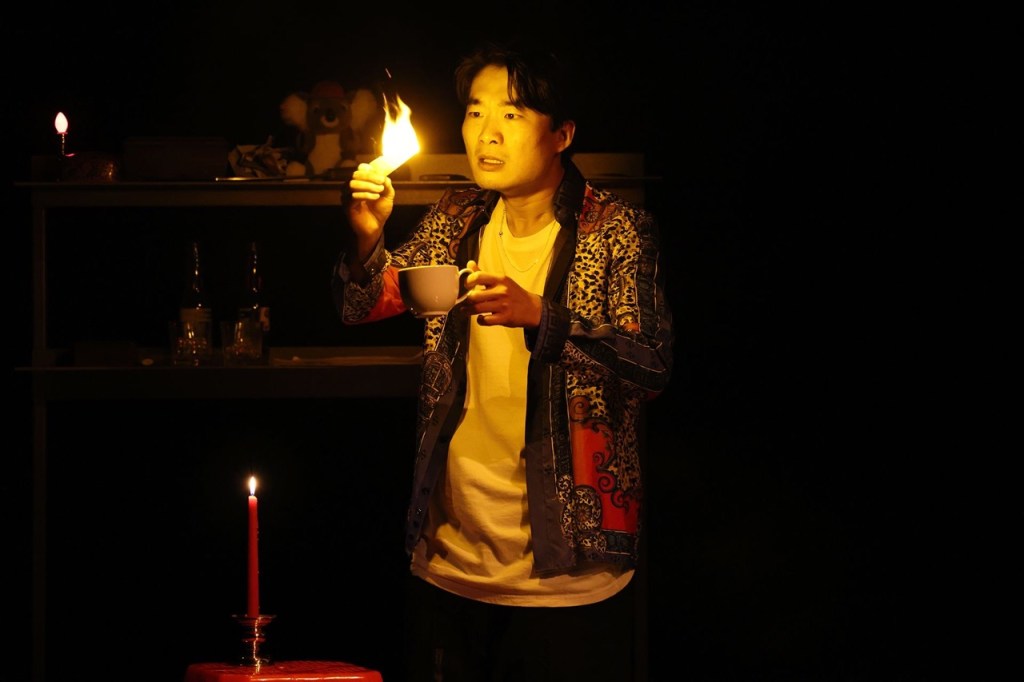
Charles Wu. Photo: Prudence Upton. Charles Wu’s Boy is old enough to know how messed up their mother was before her death, and as the story progresses, and we learn more details, it’s easy to see how he became the man he did. Both Girl and Boy are children of an abusive, mentally ill parent and the scars show.
Michael Hankin’s original set has been given a glow-up to fit the space but retains the iconic Griffin corner-stage shape. Fausto Brusamolino’s lighting channels the frenetic energy of the duo and their fracturing lives.
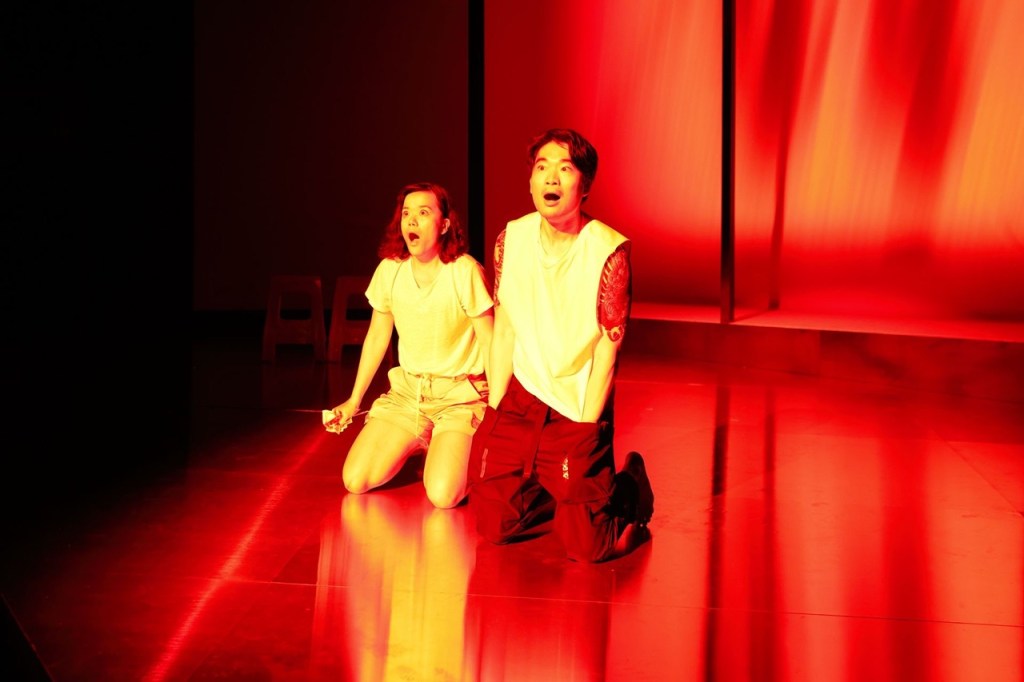
Charles Wu & Merlynn Tong. Photo: Prudence Upton. Golden Blood may not have much to say in terms of a larger meta-narrative, but its fascinating characters and Tong’s terrific pacing make it an ever unraveling puzzle that is both wickedly fun and heartbreaking. This is an incisive piece of writing and it’s a great move by Sydney Theatre Company to pick it up and present it to a wider audience. It showcases just how much we need the work Griffin does (I can’t wait for its reopening) and how the ecosystem of Sydney theatres can work together.
-
Subscribe
Subscribed
Have a WordPress.com account? Log in now.

