-
Welcome to Cultural Binge

The rating system is simple:
★★★★★ – Terrific, world-standard. Don’t miss.
★★★★ – Great, definitely worth seeing.
★★★ – Good. Perfectly entertaining. Recommended. Individual mileage may vary.
★★ – Fine. Flawed and not really recommended, but you may find something to appreciate in it.
★ – Bad (& possibly offensive).
See more reviews over at The Queer Review.
Instagram: @culturalbinge
Substack: culturalbinge.substack.com
Email: chad at culturalbinge.com
-
All Boys (KXT on Broadway) ★★★★
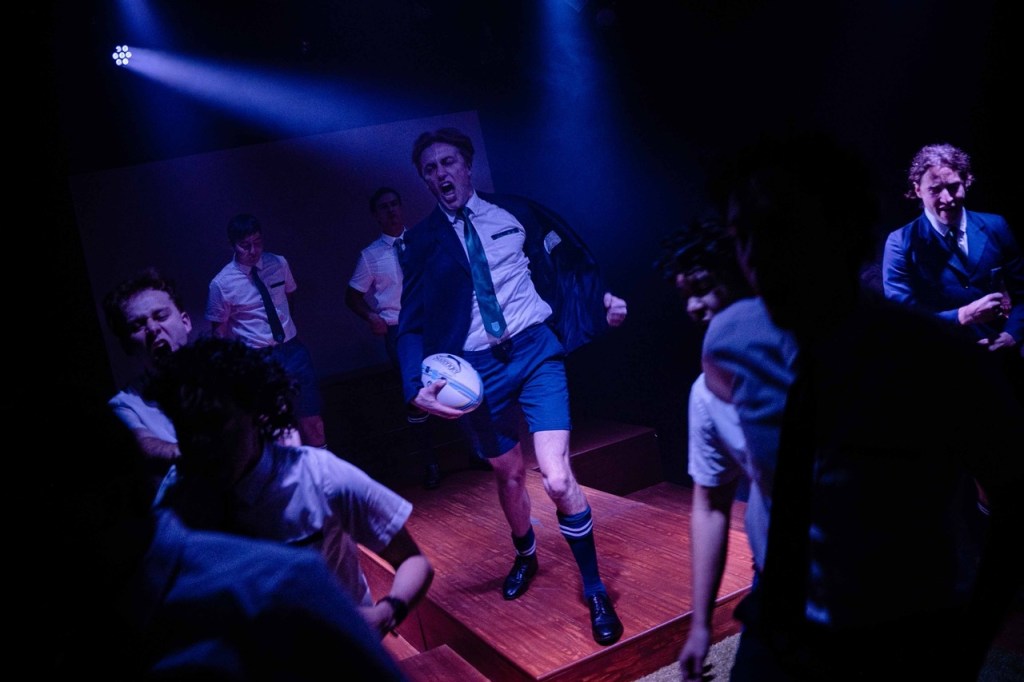
Written by Xavier Hazard. KXT on Broadway. 6-21 Sept, 2024.
Read the review on The Queer Review.
-
The Queen’s Nanny (Ensemble Theatre) ★★★★

Written by Melanie Tait. World Premiere. Ensemble Theatre. 6 Sep – 12 Oct, 2024.
There is a clarity and assuredness to The Queen’s Nanny, Melanie Tait’s new play at Ensemble Theatre, that makes for a thoroughly engaging watch. This is comfort food, as many stories about the British Royal family are, that fits neatly into the world of The Crown, The Queen, The King’s Speech and The Audience (and presumably other British stories starting with ‘The’).
Marion Crawford (Elizabeth Blackmore) sits by her window and watches the cars go by, waiting for the woman she raised to stop for tea. Despite sacrificing her own career and family ambitions to educate an eventual monarch, Queen Elizabeth II, Crawford (or “Crawfie” as she was known) was expelled from royal society. Her sin? Writing a benign memoir of her time as the nanny to the children of the then Duke and Duchess of York. It would make her a best selling author and the first “royal commentator”, but would never replace the loss of the relationship that defined her.
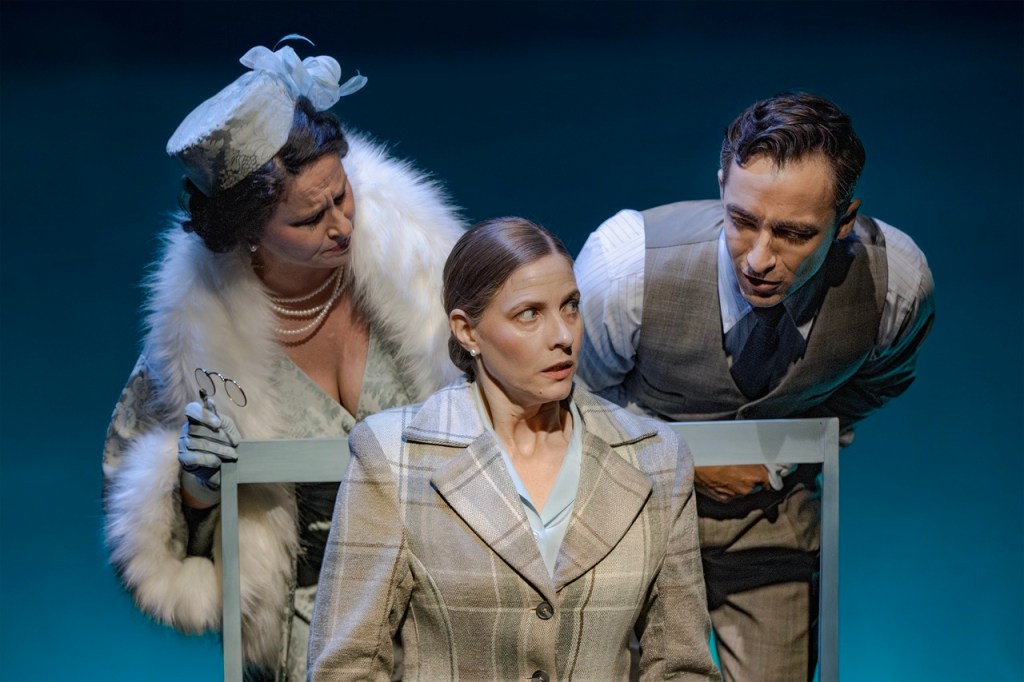
Emma Palmer, Elizabeth Blackmore & Matthew Backer. Photo: Phil Erbacher. The more I think about The Queen’s Nanny, the more it makes me smile. Playwright Tait has fine tuned the script into an engine of stoic heartbreak, filled with tiny moments of grace. Under the direction of Priscilla Jackman, recurring motif’s trip lightly through the auditorium. While the presentation is at times deliberately arch, there is an unforced and unfussy confidence to the production.
From the moment you enter the theatre and look down onto the sparsely dressed set (Michael Hankin has transformed the theatre into a clean dream-like space) you know this isn’t your standard drawing-room drama. Music and sound by James Peter Brown fill the space, as does the evocative lighting by Morgan Moroney. For a show that could sound stuffy on paper, the staging is refreshing and contemporary.

Matthew Backer & Elizabeth Blackmore. Photo: Phil Erbacher. Elizabeth Blackmore’s Crawfie is an exercise in restraint. The big emotions surge behind her eyes, held back by her professional demeanour. A spirited free thinker in the midst of a rigid structure of hierarchy, her compassion and love of the children given to her care overrides her personal life. She believes, in caring for the young Lilibet (who would unexpectedly be thrust up the line of succession by the abdication of her Uncle Edward) that she was doing something “important”. As the older Crawfie watches the royal motorcade drive past her home, she is both proud of the woman Elizabeth became, and saddened by the loss of their intimacy.

Emma Palmer & Elizabeth Blackmore. Photo: Phil Erbacher. Emma Palmer gets to be both camp-posh and cut-throat as Elizabeth, Duchess of York and the Queen Mother. She takes her from entitled “fun mom” through wars and coronations to the “betrayal” of Crawfie with finesse as the foppish mannerisms give way to a backbone of steel.
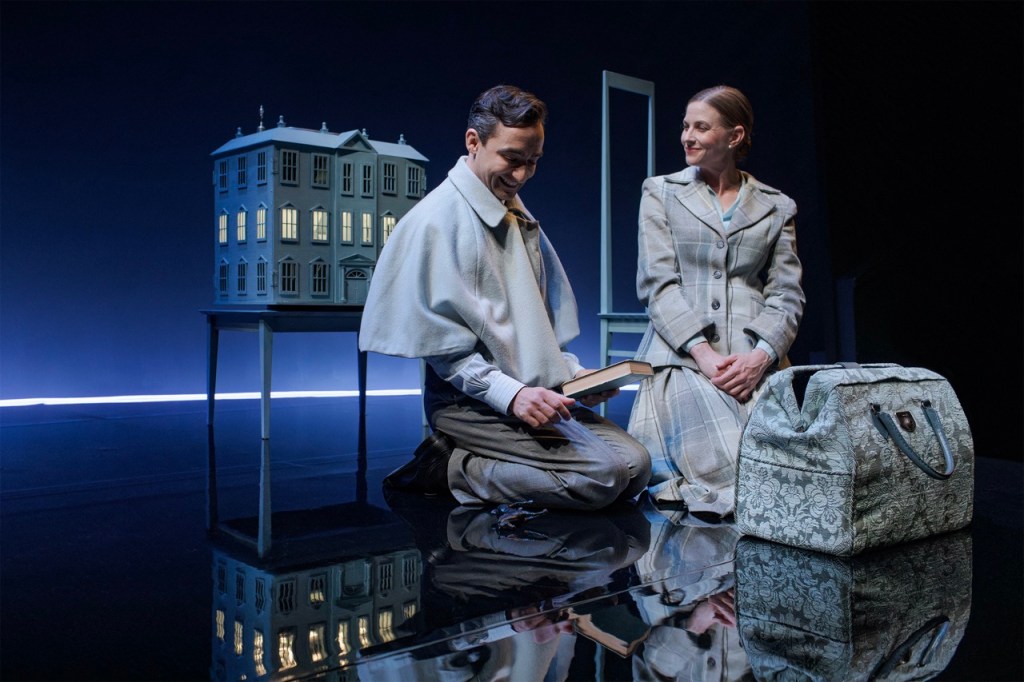
Matthew Backer & Elizabeth Blackmore. Photo: Phil Erbacher. But it’s Matthew Backer who almost steals the show as… well everyone else. Backer seamlessly slides between roles as narrator, butler, Duke, publisher and even the young Lilibet with such authenticity he manages to never lose the emotional tone. It’s quite remarkable that we are still deeply invested in the core relationship between Crawfie and Lilibet, even though the child is played by a grown man. Backer is less putting on a character, than letting his own inner-girl out – there is a conviction powering each role. The gentleman behind me let out an unforced “oh, he’s good” after the second character switch, and I couldn’t agree more.
After laying the groundwork of the relationships and world, the play skips lightly over some of the drama in the third act which left me wanting more. As Crawfie refuses to elaborate on her own feelings at being cast aside by the royals, Tait chooses not to speculate. It’s an admirable choice for the sake of accuracy, but threatens to pull the rug from under the emotional work that had been done in the lead up. We are left facing a wall of British reserve, a stiff upper lip, and our imaginations need to fill the gaps.

Matthew Backer & Elizabeth Blackmore. Photo: Phil Erbacher. There is an impulse to put our own thoughts about royalty and republic onto The Queen’s Nanny. Tait herself says as much in her writer’s note. But this play is less interested in commenting on the anti-democratic aberration that is hereditary monarchy than looking at a unique heartbreak. Marion Crawford’s story is not a happy one, but Melanie Tait has threaded the needle between sensationalist drama and cosy character study with the skill of a master seamstress.
-
Definitely NOT A Hungry Game: A Parody Musical (Sydney Fringe) ★★★

Co-created by Robbie Alexander & Freya Moore. Sydney Fringe. Turner Theatre, 3-8 Sep, 2024.
For a dose of film-related frivolity, Dramafreak Productions are deconstructing and generally taking the piss out of the book trilogy that became a film quadrilogy that spawned a prequel but is for legal reasons definitely not Suzanne Collins’ Hunger Games series. It’s crass, stupid and frequently hilarious.

Freya Moore and ensemble. Katniss (Freya Moore) is an attention seeking teen with “main character syndrome” that makes her less than popular with the residents of District 12. Her boyfriend, Gail (Jordan Batten) is an Australian hot bogan no-one understands. And there’s some guy named Peeta (Liam Faulkner-Dimond) that’s around. When Katniss’s sister is chosen for “the reaping” and must compete in the deadly ****** Games, Katniss steals the limelight by volunteering in her place. Together with that P boy, she must travel to the Capitol and fight for her life while singing songs and trying to be likable.
This isn’t the first Hunger Games parody show and it probably won’t be the last, the YA series has had an enduring afterlife the Divergent series must envy. Creators & stars Robbie Alexander (who plays Effie Trinket in drag) and Freya Moore litter the story with jokes that range from sophomoric to quite subtle. The more you know the films and books (and general pop culture) the better. While it’s not all successful or totally coherent, there is a hell of a lot of fun to be had and more than enough gems to make it worth the price of admission.
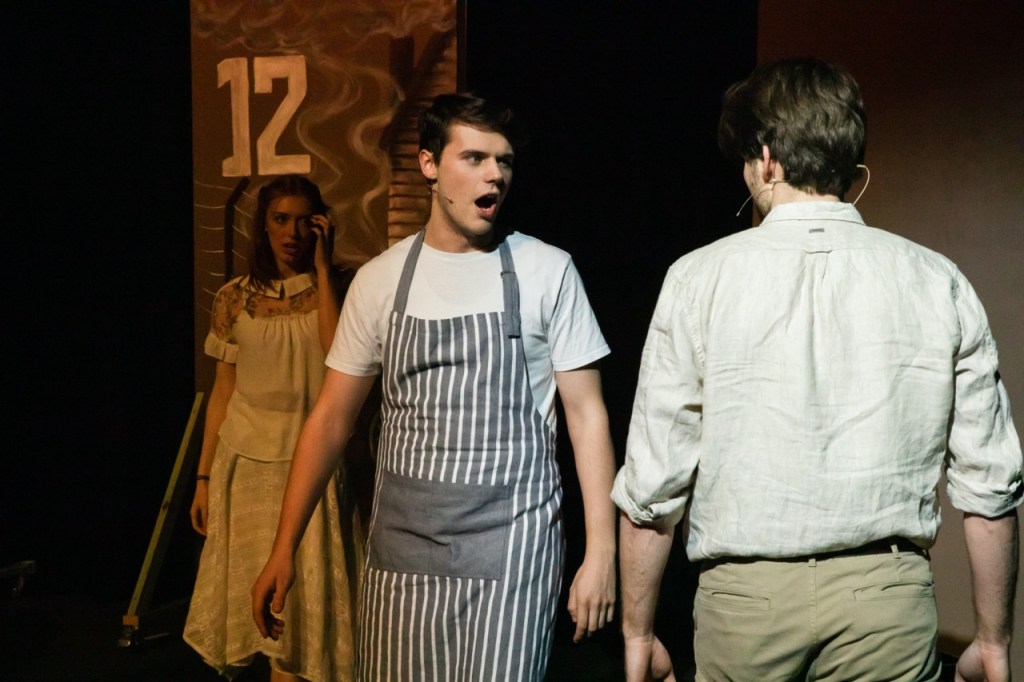
Liam Faulkner-Dimond Alexander is terrific as Effie, nailing both the heightened performance level and the small asides, giving the show a firm footing (not easy in those heels). Alex Gonazlez gets to chew the scenery and get the biggest laughs as Katniss’s drunken mother and Phea Pennington stands out as the dim-witted Glimmer. But it is Faulkner-Dimond who gets to shine as the frequently interrupted and ignored Peeta. His ecstatic Tracker Jacker fever dream performance is one of the show’s true highlights, as is the show’s finale which veers off from the source material.
At over two hours long, the show is baggy with some jokes overplayed repeatedly and some scenes only exist to hit touchstones in the book/film but with judicious trims it could really zip along. The original songs work, none are earworms but they’re solid musical theatre numbers that keep the show moving. The humour is at times questionable, some of the queer jokes definitely need revisiting, but on the whole it’s a fun show.
-
Hillsong Boy (Sydney Fringe) ★★★½

Created by Scott Parker & Felicity Nicol. Sydney Fringe. PACT Centre for Emerging Artists. 3-14 Sept, 2024.
Scott Parker is in pain. After devoting nineteen years to Hillsong, Sydney’s internationally famous megachurch, he’s on the outside and processing his religious trauma in the autobiographical show Hillsong Boy, returning for Sydney Fringe.
I’ve been where Parker is at. As an ex-Evangelical, I’m very familiar with the inner workings of this world. Those who’ve not been inside them, may struggle to understand how all-encompassing they are. Scott details his life, and non-stop itinerary, as a committed member. Essentially working a full time job singing on stage (aka a “worship leader”) at multiple events per week, plus being a youth leader attending meetings and practices, he was busy every day of the week. He reveled in his tight knit community of friends and the moral purity of purpose of following Christ but all the while he was “struggling with homosexuality”, and trying to reconcile the church’s behaviour to gay people with his own life.
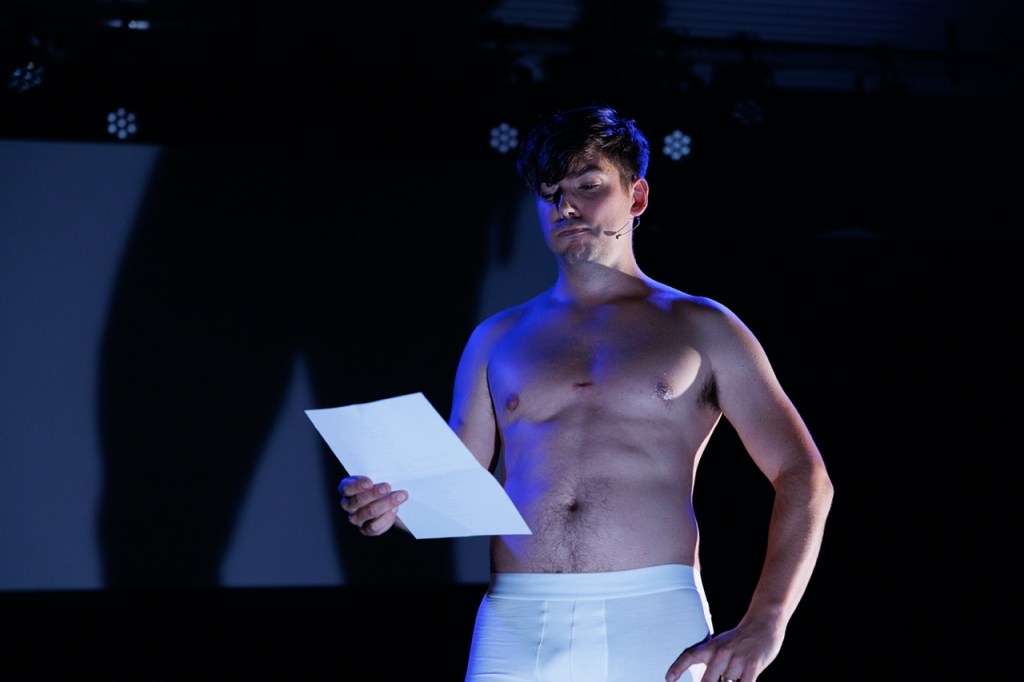
Hillsong Boy isn’t really about Hillsong and its very public reckonings which form the backdrop of the story (if you want that there is no shortage of documentaries, books and news articles to dive into. Also the Stan TV show Prosper deals with the inner workings of a fictionalised version and is very good), it’s about Scott’s attempts to find his own sense of harmony.
Over 60 minutes, Hillsong Boy jumps through genres to tell its story. Starting as a recreation of a service, then an interview that goes off the rails, a private confessional text exchange and a direct talk/sermon to the audience. It’s not always successful and falls back on “telling” rather than “showing” us this world, but one thing is clear, Scott Parker is still healing from the experience all these years later.
The show gets a fair bit of its humour, sometimes unintentionally, from playing it completely straight, giving us the everyday behaviour of the faithful and snippets of church-speak outside of the context of the belief system. In the cold light of day it looks and sounds ridiculous. From the Jesus-ballads, speaking in “tongues” and the super-positive double-speak that masks any real emotions, if you’ve been through this system you may find it re-traumatising.
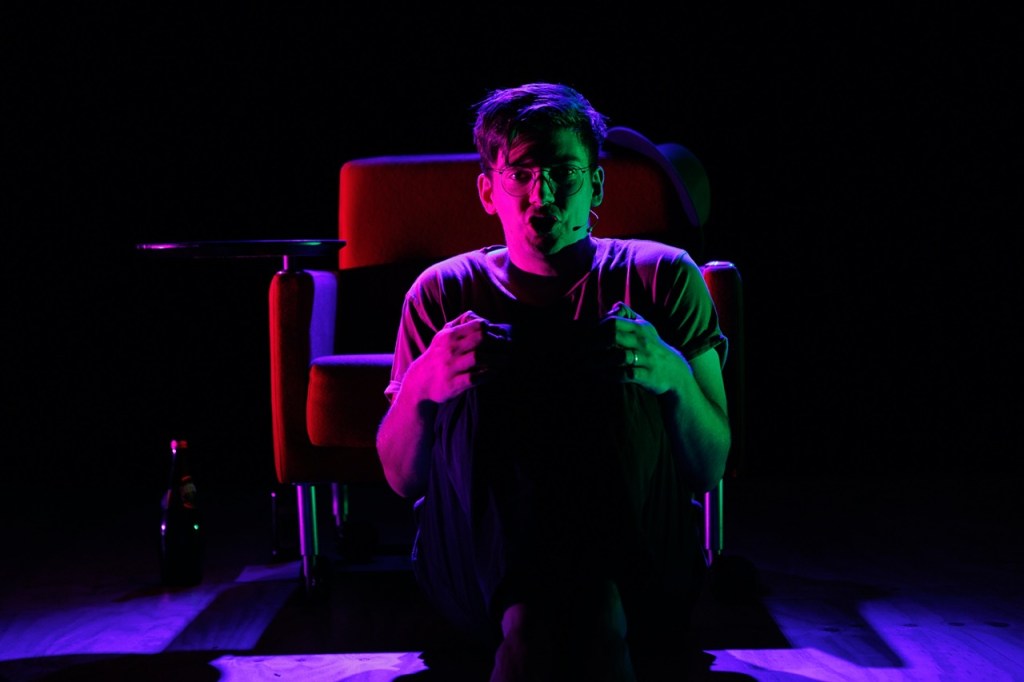
Bouncing between the personal betrayal and abandonment he felt leaving it behind, and the bigger problems of Brian Houston and the megachurch, Hillsong Boy finds itself trying to say too much. But the thing that interested me the most was the absence of anger from Parker’s narrative. There is some emotion missing from this retelling.
On some level, Parker is still a “Hillsong boy”. There is a recognisably modern Pentecostal style of behaviour, a preacher-ly faux-sincerity, that Parker slips in and out of as he speaks/preaches to the audience. The impulse to make this show a new form of “ministry” can be hard for a Hillsong survivor to resist.
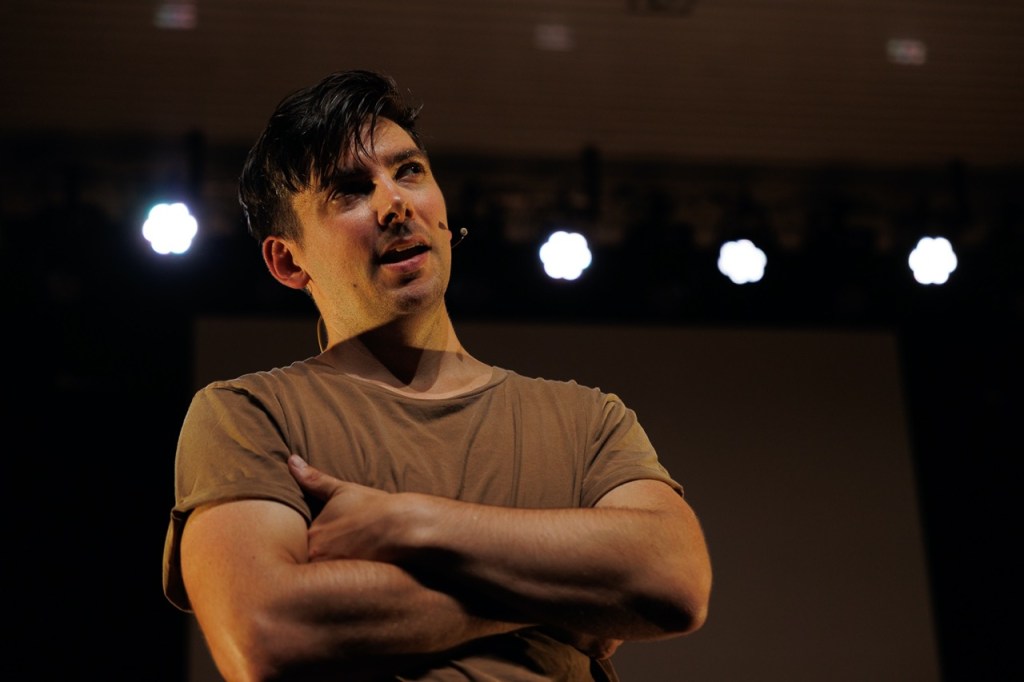
Hillsong Boy felt like the start of a journey away from toxic faith. Religious deconstruction is a long and messy process that only complicates the usual “coming out” narrative, and Hillsong Boy is just scratching the surface.
If you’re interested in going deeper on of these issues, I recommend Anthony Venn Brown’s autobiography, “A Life of Unlearning”, which details some of the very earliest years of Hillsong.
-
UnWrapped: AUTO-TUNE (Sydney Opera House) ★★★★★
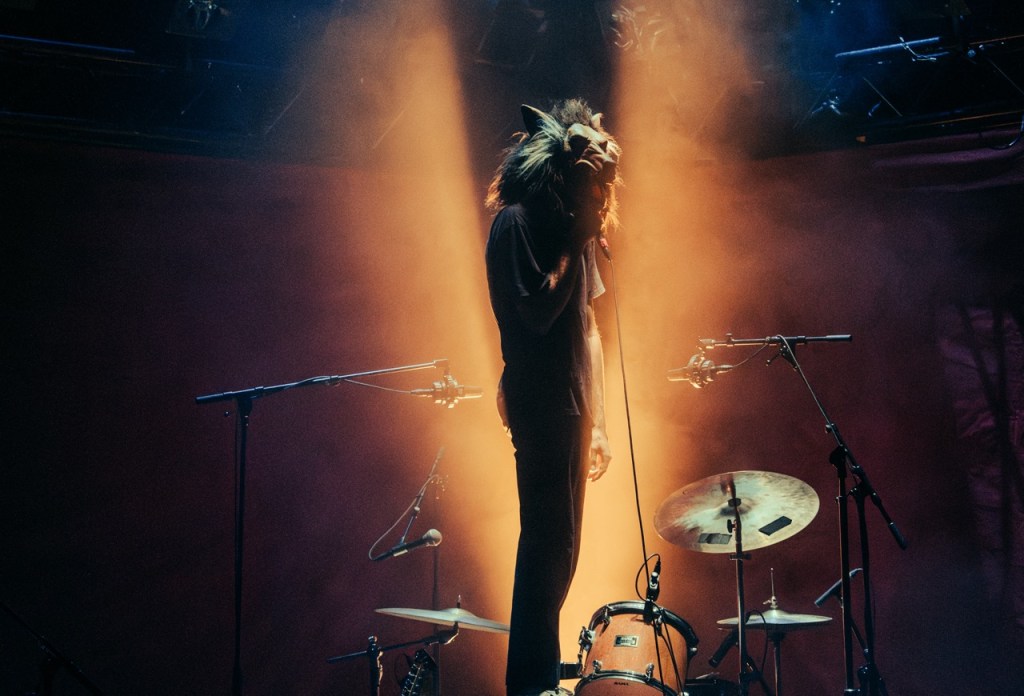
Written by Mark Rogers. Sydney Opera House. 4-7 Sept, 2024.
Re:group performance collective deliver their most emotionally engaging show to date with AUTO-TUNE, part of Sydney Opera House’s far too short UnWrapped season. Their ever-playful use of technology gets taken for a new spin, and maybe it’s the focus on music, or maybe it’s the first person narrative, but this one comes with an unexpectedly strong emotional kick. Now let me ask you the question… do you believe in life after love?
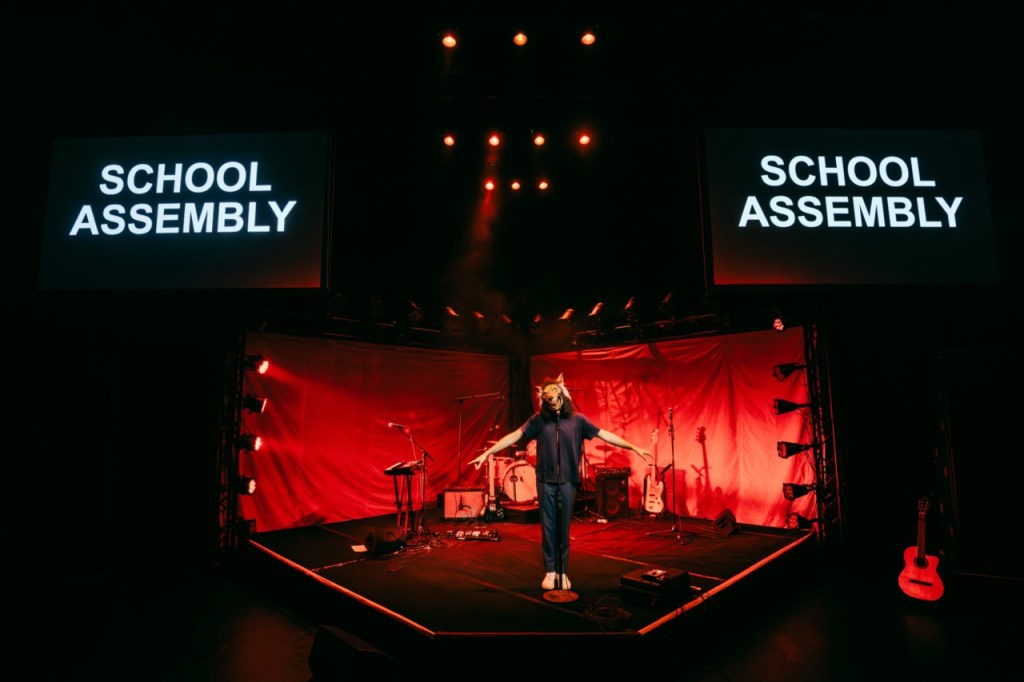
Mark Rogers. Photo: Ravyna Jassani. You know how auto-tune corrects your singing instantly? What if there was a way to do that with your whole life? Smoothing out every little wobble and making your life pitch perfect all the time. Well, teenager Michael is just a kid in Wagga Wagga who’s in a band with his mates and has a superpower. When he makes a mistake, a portal appears and lets him jump back in time to fix it. Useful for when he plays the wrong note or embarrasses himself. But what happens if, one day, the portal disappears and he’s faced with the worst decision of his life?
AUTO-TUNE is a musical, or an opera if you will complete with surtitles. Mark Rogers plays Michael, in a show without a fourth wall. It’s part pub rock gig, part awkward school assembly, part performance art.
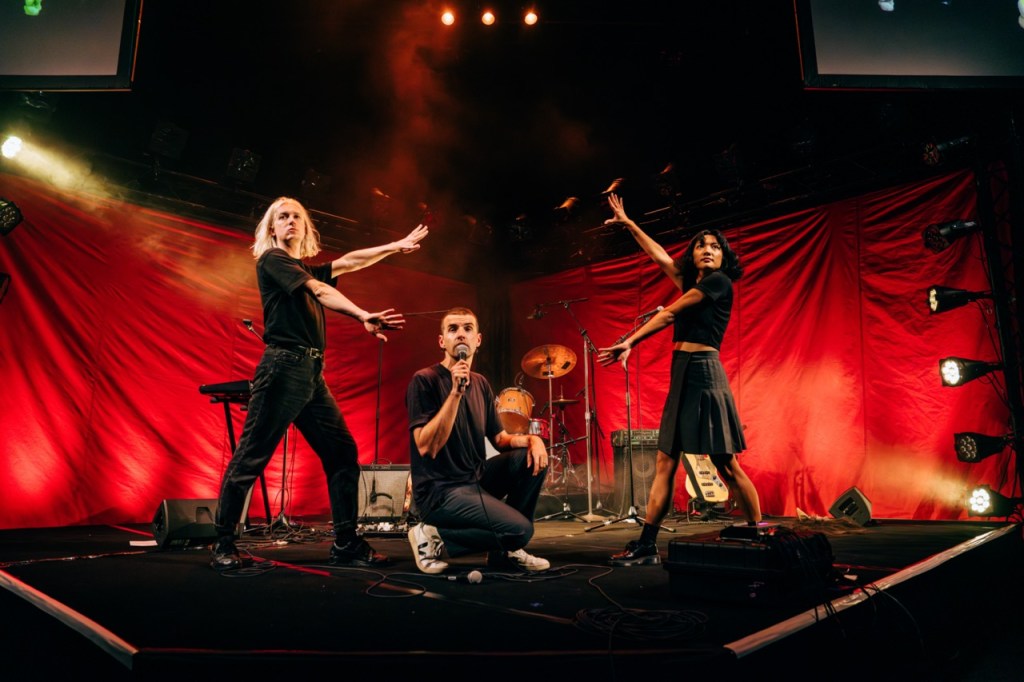
Liam ‘Snowy’ Halliwell, Mark Rogers & Ashley Bundang. Photo: Ravyna Jassani. Liam ‘Snowy’ Halliwell plays Michael’s best mate, and Ashley Bundang is their keyboardist and mutual object of teenage affection. Set in the mid-noughties, a time of bands like Limp Bizkit, Slipknot and other magnets for male teen angst. It’s an era of music I’m far too familiar with (R.I.P. Channel [V] – the best job I ever had) and while the music is rooted in this rap/rock hybrid core, it jumps across multiple musical genres without losing its garage band energy.
The genius is how these tracks, and their accompanying lyric videos, convey the story. These are better musical-theatre songs than you find in most musicals. Each one combines character, advances plot and keeps you entertained all the way through. It’s the most DIY, indie musical I’ve seen.
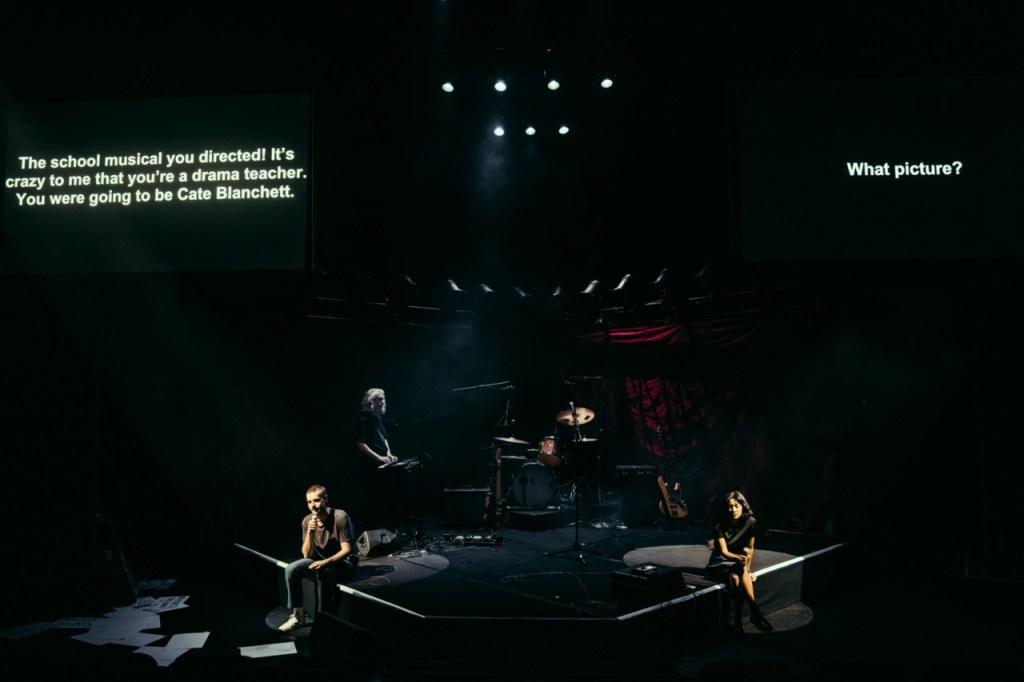
Mark Rogers, Liam ‘Snowy’ Halliwell & Ashley Bundang. Photo: Ravyna Jassani. Of course all the genre-bending and technology means nothing if the story isn’t there, and AUTO-TUNE gets pretty shockingly deep. Michael’s mistakes escalate to a future-destroying level and he’s forced to face up to the consequences of his actions.
There is a sly sense of humour to the entire production that smirks but never sneers, and a juvenile shit-stirring vibe that keeps you guessing. There’s something in the lo-fi rock’n’roll set up that had me on edge the whole time, unsure which direction the narrative would go in. How dark would it get? The answer is, pretty fucking dark but always intriguing. It’s like watching Donnie Darko: The Musical. A brilliant third act rug pull drew gasps from the crowd and proved that re:group aren’t just masters of multimedia tech, they know how to really engage an audience with old school theatrical tools as well.
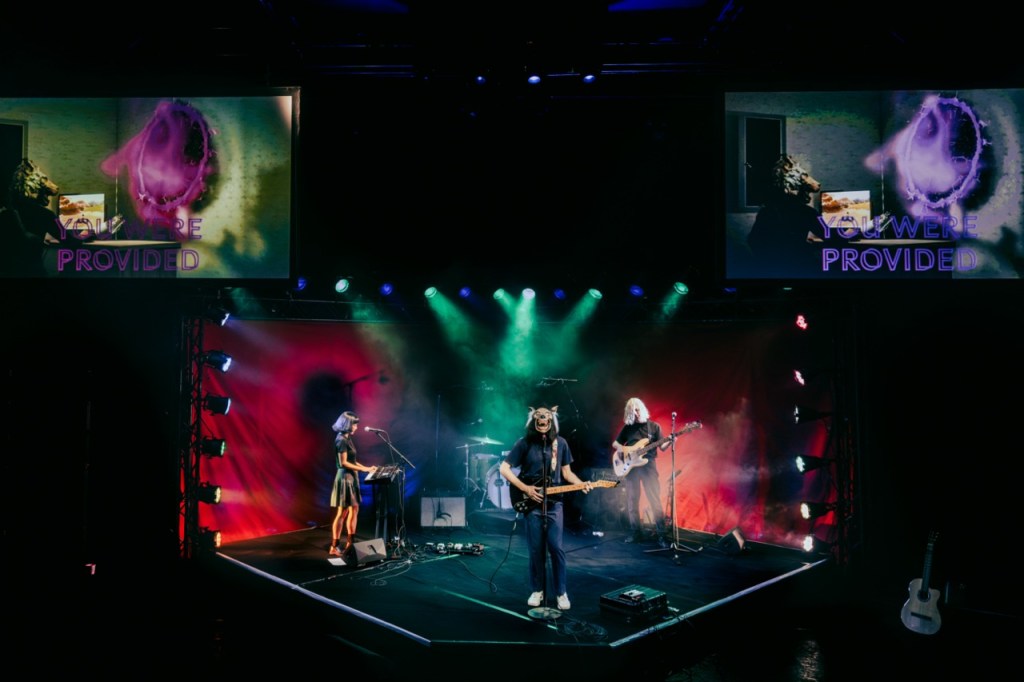
Ashley Bundang, Mark Rogers & Liam ‘Snowy’ Halliwell. Photo: Ravyna Jassani. If you’re familiar with re:group’s earlier shows like UFO, POV or Coil, you’ll understand the general vibes at play here. They excel at deconstructing genre, narrative and theatrical convention, and reassembling things in a new order. With AUTO-TUNE we have a reinvented form of musical theatre, gig-theatre. It’s brilliant. I can’t get enough of their work. Re:group are easily the most creative and exciting theatre-makers I’ve seen in years.
-
Sunset Boulevard (Sarah’s Version) (Sydney Opera House) ★★★★
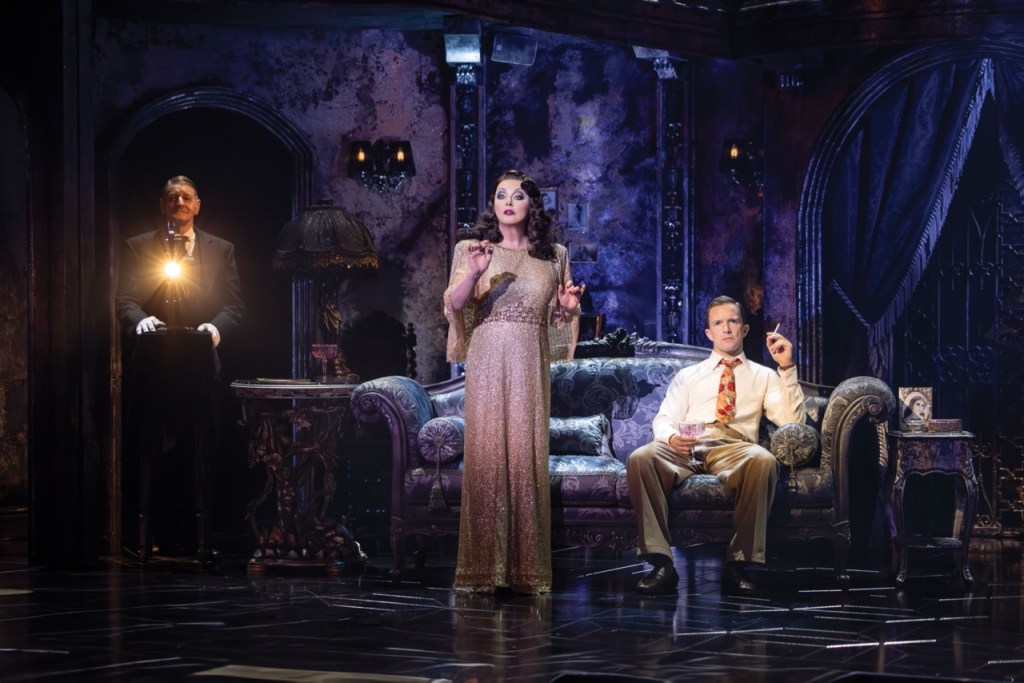
Music by Andrew Lloyd Webber. Book and Lyrics by Don Black & Christopher Hampton. Sydney Opera House. 28 Aug – 1 Nov, 2024.
Sunset Boulevard is big, it’s the other musicals that got small. There is an old world opulence and decadence to everything about this show, from the ornate set, the sumptuous costumes and the soaring score. Sunset Boulevard makes the other big shows in town (*cough*SisterAct) look like high school productions.
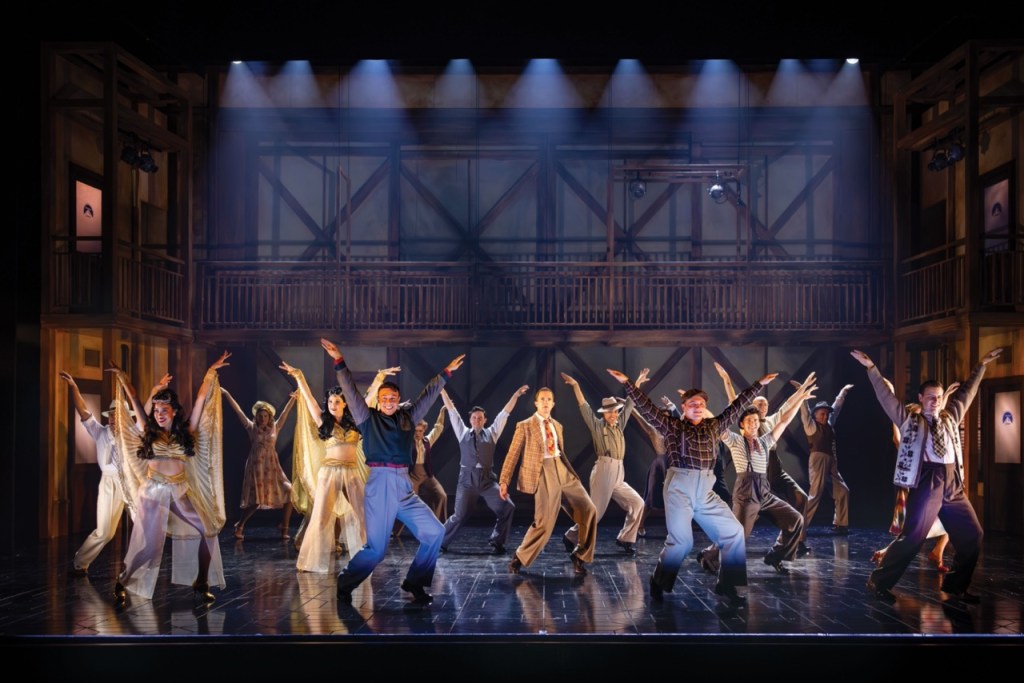
Company of Sunset Boulevard. Photo: Daniel Boud. Screen-writer Joe Gillis (Tim Draxl), hiding from debt collectors, stumbles into the grounds of a faded Hollywood mansion. He’s shocked to discover former silent film era superstar Norma Desmond (Sarah Brightman, or Silvie Paladino if you prefer) lurking inside with her devoted butler Max (Robert Grubb). Desmond enlists the handsome writer’s help in working on a script she has written for her own return to the screen. Gillis moves into the mansion and settles into the life of a kept man, but when he meets an idealistic budding writer, Betty Schaefer (Ashleigh Rubenach) who manages to get underneath his cynical skin, he’s caught between a life of soulless luxury or youthful passionate creativity.

Sarah Brightman and company of Sunset Boulevard. Photo: Daniel Boud. As I watched Sunset Boulevard I was half waiting for the moment I felt the disappointment many Melbourne critics felt. By the interval I realised it wasn’t coming. Yes, there is something desperately silly and ridiculous about the show but I was genuinely being swept up by the creaky old grandeur of a 30+ year old mega-musical. Over a glass of interval champagne, against the backdrop of the Harbour Bridge, watching Sydney’s finest dazzle in a sea of sequins, tight suits and tighter faces… It all suddenly made sense.
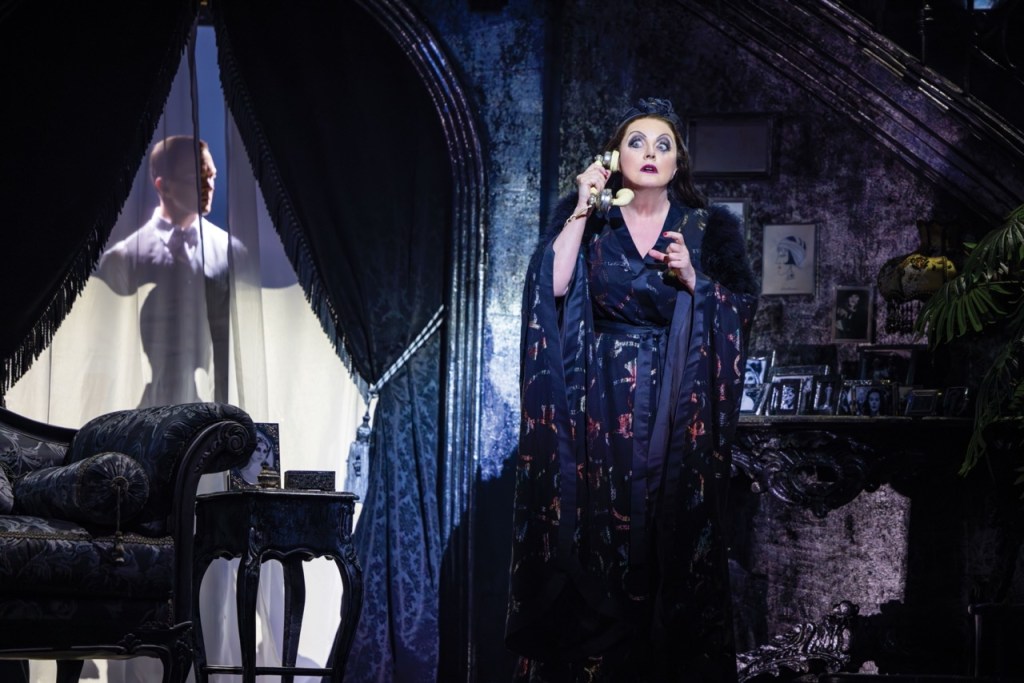
Tim Draxl & Sarah Brightman. Photo: Daniel Boud. This is camp. True camp.
Not the gaudy, knowing “low camp” of something like RuPaul’s Drag Race (or the upcoming Titanique which I’m very excited about), but this is “high camp”. This is the camp of genuine love, unwitting eccentricity and whole-hearted folly. This is Grey Gardens (the documentary, not the musical). A Sontag/Isherwood-worthy piece of camp theatre. It’s taking itself very seriously but in doing so produces something more exhuberant. Sunset Boulevard is not making fun of its content, it is making fun with its content and playing on multiple levels.
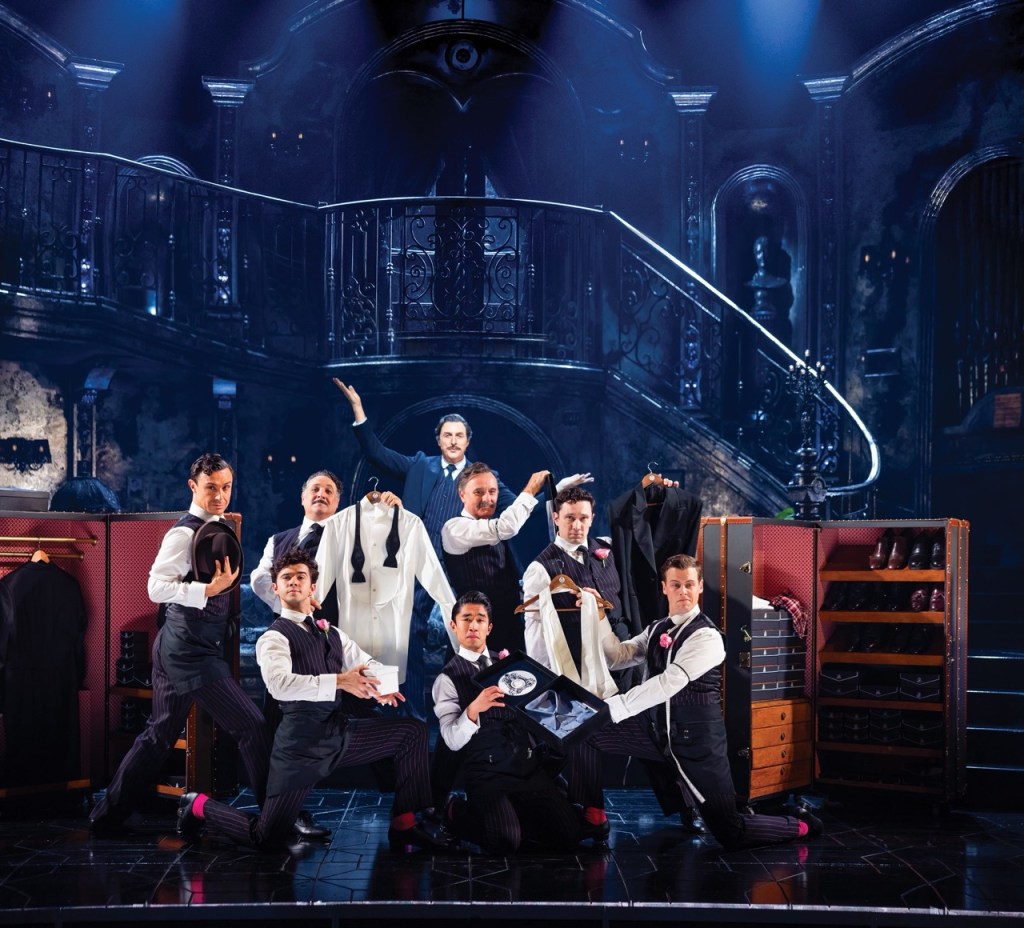
Company of Sunset Boulevard. Photo: Daniel Boud. As a critique of creative industries, it’s pretty clear. Success can ruin you more than failure. While those at the bottom dream of their triumph “this time next year”, the iconic Desmond is a broken shell, hollowed out by a heartless industry that has discarded her once her star started to fade. Gillis is just trying to survive in the battle between art & commerce, where commerce always wins. Desmond and Gillis cling to each other as codependent life rafts.
The meta-narrative around this production is even greater. Casting Sarah Brightman makes total sense on paper. From her long and deep connection to Lloyd Webber’s career, her status as a theatrical superstar staging a return (don’t call it a comeback), and the fact the set includes an organ on a grand staircase. When Desmond snaps at Max to stop playing the organ, a knowing snicker moves through the stalls. All the discussions of hallowed film studios like Fox (long since absorbed by Disney) and Paramount (in the process of being sold once again) remind us that the whole film industry would suffer the same fate as Norma herself, with the great studios often being put out to pasture.
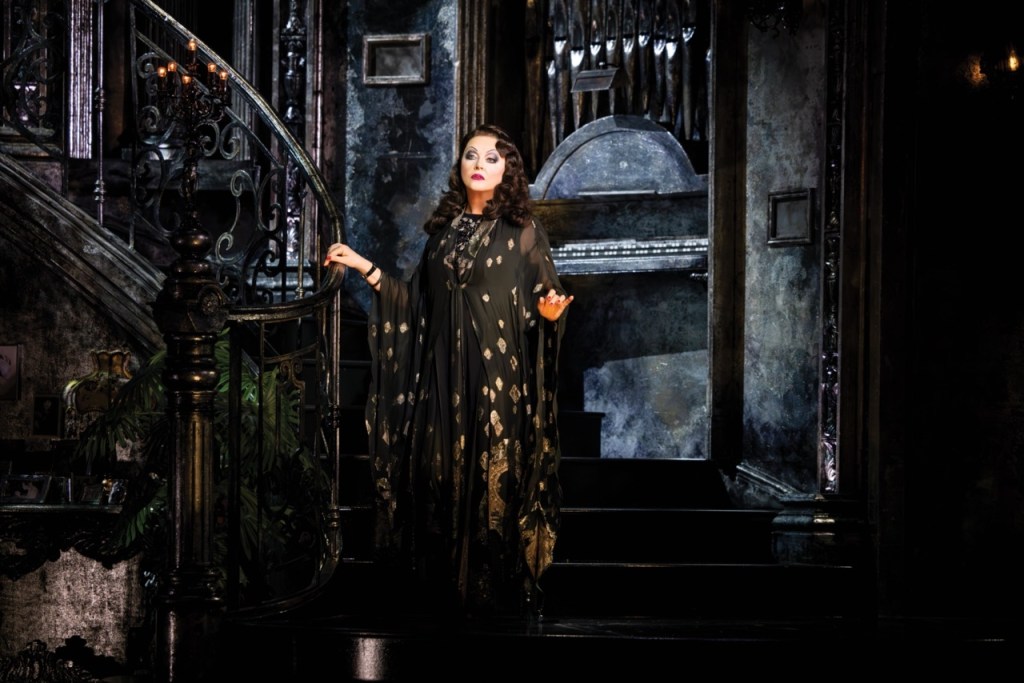
Sarah Brightman. Photo: Daniel Boud. Brightman’s performance channels the over-the-top melodrama of the silent era that would inspire drag queens for generations to come. With Brightman it completes the loop and comes back where it was meant to be. However it lacks the nuance required to make us invest in Norma’s plight. In terms of the music, she is ultimately miscast. Her operatic vocals fight with the musical theatre score, lacking the necessary sharpness and speed of delivery. At times it sounds as if she’s not singing any consonants. Brightman devotee’s will find a lot to love, but I was left wanting more.

Washed up screenwriters do not look like this. Tim Draxl. Photo: Daniel Boud. Tim Draxl is not just a triple threat, he’s a veritable six-pack of talent as Joe Gillis, the actual leading part of the show. Draxl’s incredulous reactions are key to making the show work, as the rough-edged Gillis is thrown into a world of obscene wealth.
There is only one knowing acknowledgement of the production’s camp aesthetic in the whole show and Draxl sells it expertly. He sings the titular anthem shirt open, instagram-thirsty body on display. The moment is the show relaxing, smiling at the crowd and saying “okay, fine, you can have this one” before returning to the dark, gothic glamour. It’s completely wrong for the role of a washed up, struggling Hollywood writer, but totally right for this queer-coded cornucopia of excess. The fact that it happens during a notoriously difficult song (full of fast lyrics, minimal space for breathes and a big belting final note) that lays out his entire motivation while summing up the whole show, is simply genius. It’s camp.
And spare a thought for poor Ashleigh Rubenach who is excellent in the show’s most underwritten character, the idealistic writer Betty Schaefer. It’s the thankless role of “the girl” in an old musical. Exactly the kind of part she got to skewer as Nancy in Groundhog Day which Rubenach did so well in Melbourne. Betty is quite literally a brief diversion, just a detour (off Sunset Boulevard), on the journey of some man.
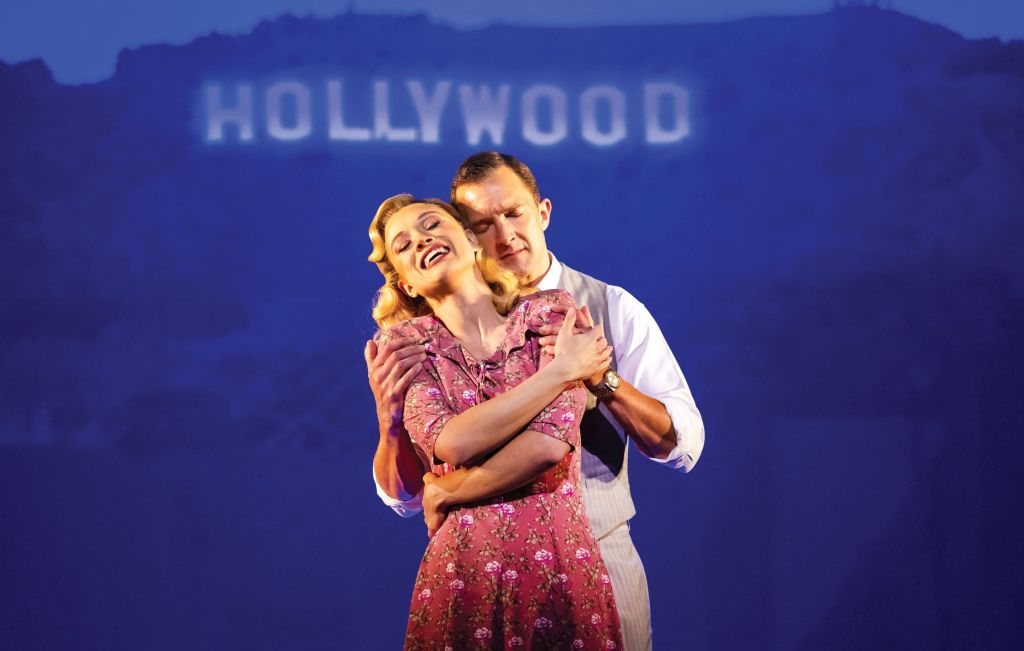
Ashleigh Rubenach & Tim Draxl. Photo: Daniel Boud. Director Paul Warick Griffin has produced a tight show with attention to details. There are choreographic flourishes in the scene changes that keep things flowing and never let you forget that this is the heightened world of a musical. Ashley Wallen’s choreography gets to shine in “The Ladies Paying” but his impact is felt in all the movements of the cast. Mark Henderson’s lighting works with Morgan Large’s intricate set to pull new emotions and vistas for each scene. When the full cast and orchestra belt out “This Time Next Year”, the Opera House reverberates. It’s the kind of all-encompassing moment you want from a musical.
The other spectre hanging over this production is the Olivier Award winning reinvention of Sunset Boulevard that has wowed British audiences, made popstar Nicole Scherzinger into a bona fide theatre powerhouse and is about to hit Broadway. Where our local production is operatic and indulgent, director Jamie Lloyd has stripped his production back to its core. I’m hoping to see it next month, so I’ll report back then but London friends and critics adored its simplicity. Finger’s crossed we get it here. If we can have two productions of Phantom of the Opera in quick succession in 2022, why not Sunset Boulevard?

Company of Sunset Boulevard. Photo: Daniel Boud. Sunset Boulevard is one of the first cast recordings I ever bought with my own money back in the early 90s. The clunky double CD set is sitting in a box in the cupboard right now. It is one of my favourite Lloyd Webber scores, just behind Phantom of the Opera and Jesus Christ Superstar. So I’m basically the core demographic for this show, and I loved it.
PS: I’ll be back to see this production again just to see Silvie Paladino play Norma.
-
Godz (Sydney Fringe) ★★★★

Head First Acrobats. Sydney Fringe. Spiegeltent Festival Garden The Vault. 30 Aug – 15 Sep, 2024
Greece is the word! Head First Acrobats bring their 2074-years-in-the-making-more-or-less show Godz to Sydney Fringe to make you believe in the supernatural. Or at the very least the super “au-naturel”.
Cal Harris, Thomas Gorham, Liam Dummer and Jordan Twartz play a succession of Greek gods here to amaze us mere mortals with gravity-defying stunts, Herculean feats of physical strength, whips, ropes and breaking. It’s an eclectic skillset geared towards one thing – a lot of fun.
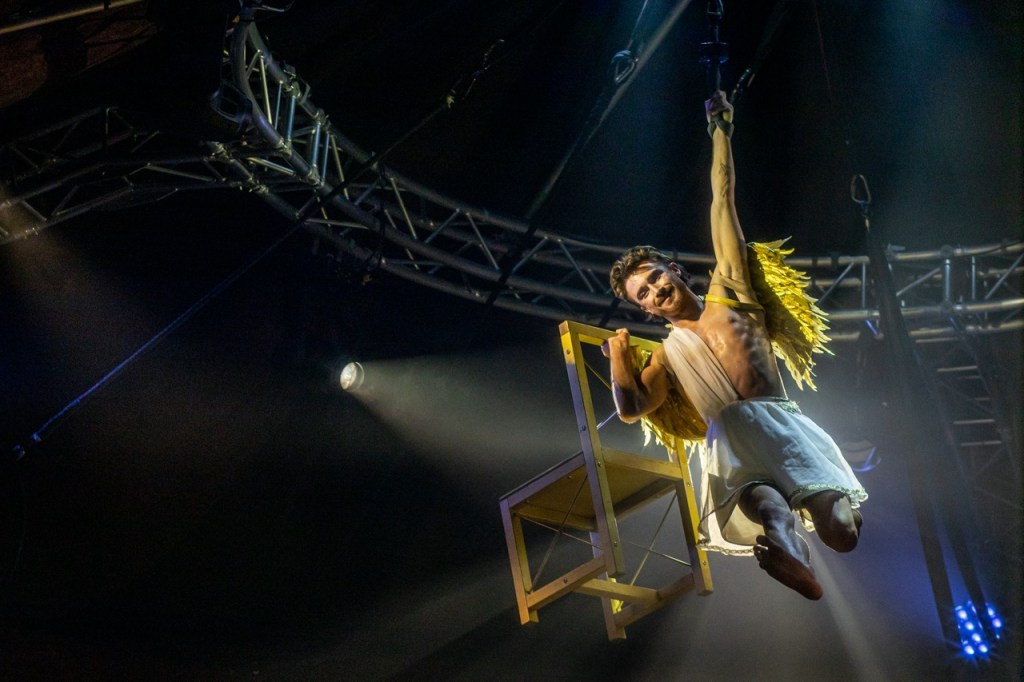
Liam Dummer. Photo: Beck Stone. Familiar circus and acrobatic tricks are given a fresh twist and lashings of cheek as the lads flirt, flip and flash their way across the stage. Make no mistake, this show is both carnal and camp. What more do you expect from Dionysis and Cupid?
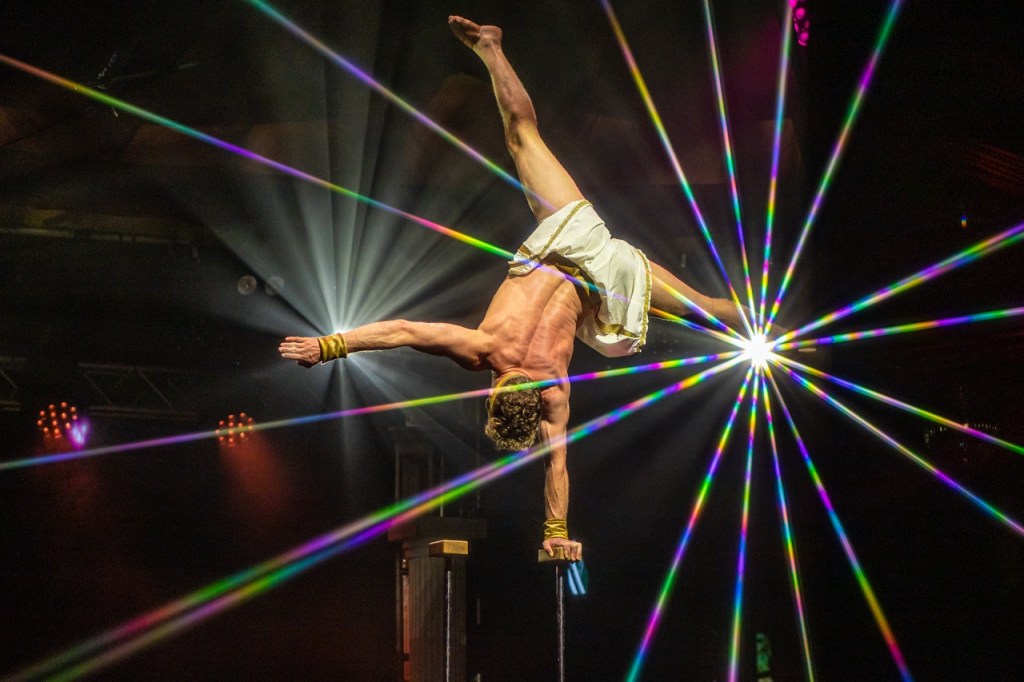
Thomas Gorham. Photo: Beck Stone. Godz is a comedy show through and through. While the circus tricks are thrilling and impressive, it’s the showmanship and humour that makes this show what it is. From slapstick to a bit of mime and some absurdist moments, the variety of comedic tricks is almost as varied as the acrobatic feats. Each cast member has a wink in their eye promising chaos at any moment. Like members of a boyband, they each have their own look and get their moment to shine.
There is playful nudity in abundance, carefully choreographed but, well, let’s just say I can confirm that at least two of the cast aren’t Jewish. It’s sexy in a laid back, larrikin kind of way. The addition of Gorham’s breakdancing skills (balancing on his head, on a trapeze was a particularly impressive feat) shakes things up a bit from your standard acrobatic fare.
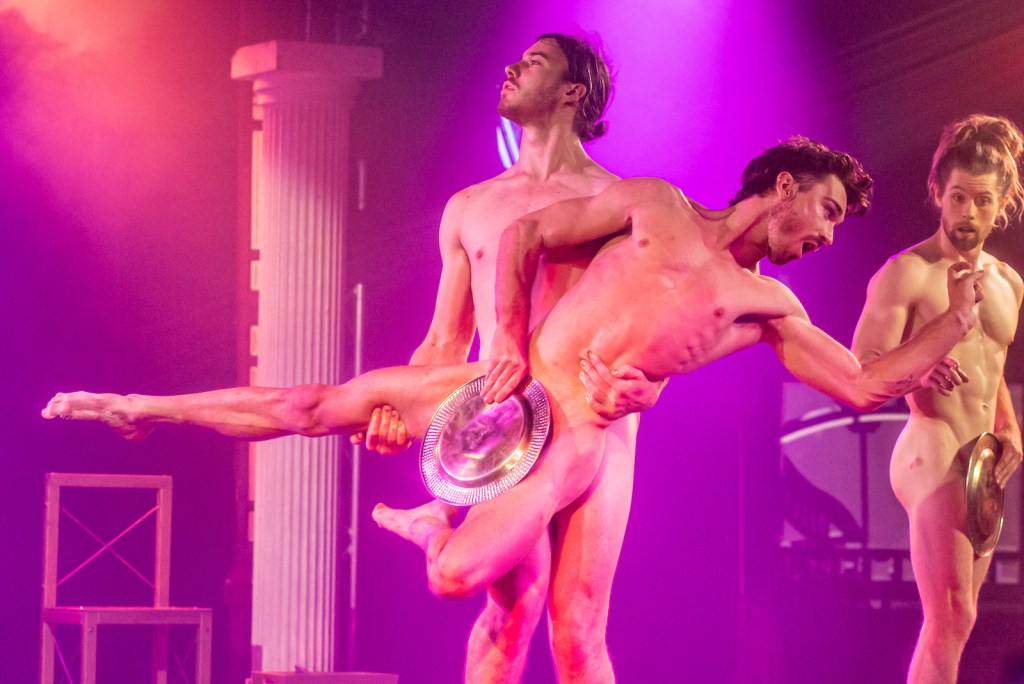
Jordan Twartz, Liam Dummer and Cal Harris. Photo: Beck Stone. Godz is a hell of a lot of flesh-filled entertainment and a real crowd pleaser. While their skills are terrific, it’s the cheeky charm and joyful abandon in their eyes that gets the crowd roaring. And apologies to Sister Act, but these nuns are more fun.
-
UnWrapped: Class Act (Sydney Opera House) ★★★½

Lead Artist: Mish Gregor. Sydney Opera House. 28-31 Aug, 2024.
Sydney Opera House’s UnWrapped season is underway, giving independent creators the chance to produce groundbreaking, unique works in its hallowed halls (well theatre spaces), and first up is Mish Grigor’s Class Act. Using the tale of My Fair Lady to attack the insidious class divide in Australia, and particularly the arts industry, Grigor channels her rage into a funny and sometimes uncomfortable 60 minute long show.
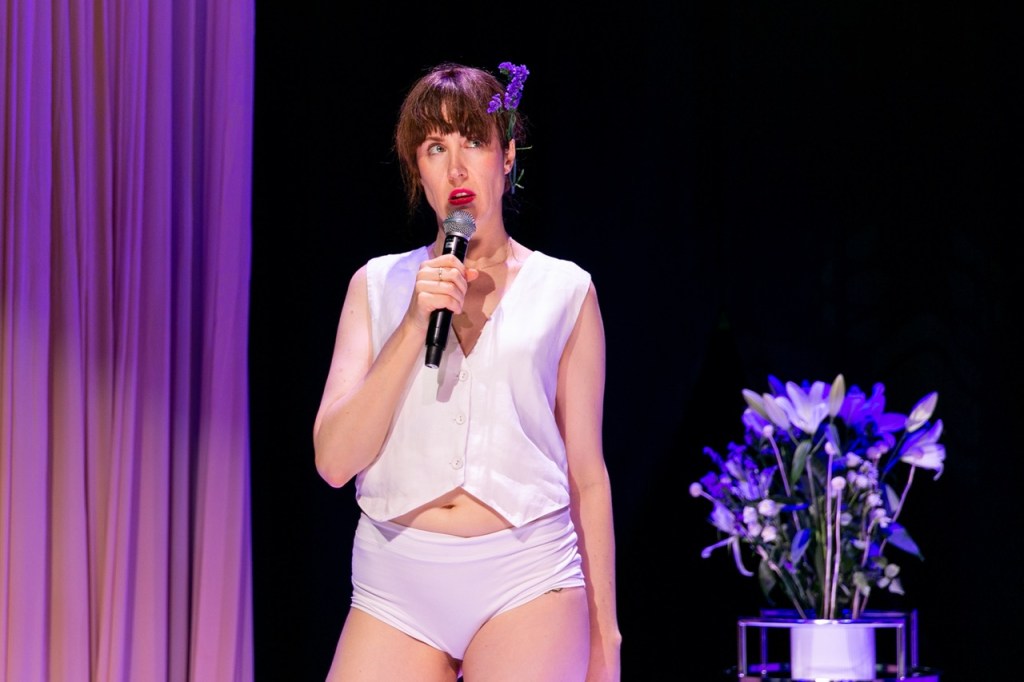
Photo: Yael Stempler. If you think Australia doesn’t have a class divide then you’ve been buying into our own national propaganda. Sydney-siders are quick to break into tribal lines based on income or geography. It’s Westies and Bogans vs the Eastern Suburbs and Northern Beaches. Home-owners vs renters. Loewe vs Lowes. We don’t use the same language as Britain’s entrenched divisions, but they exist here in subtler ways.
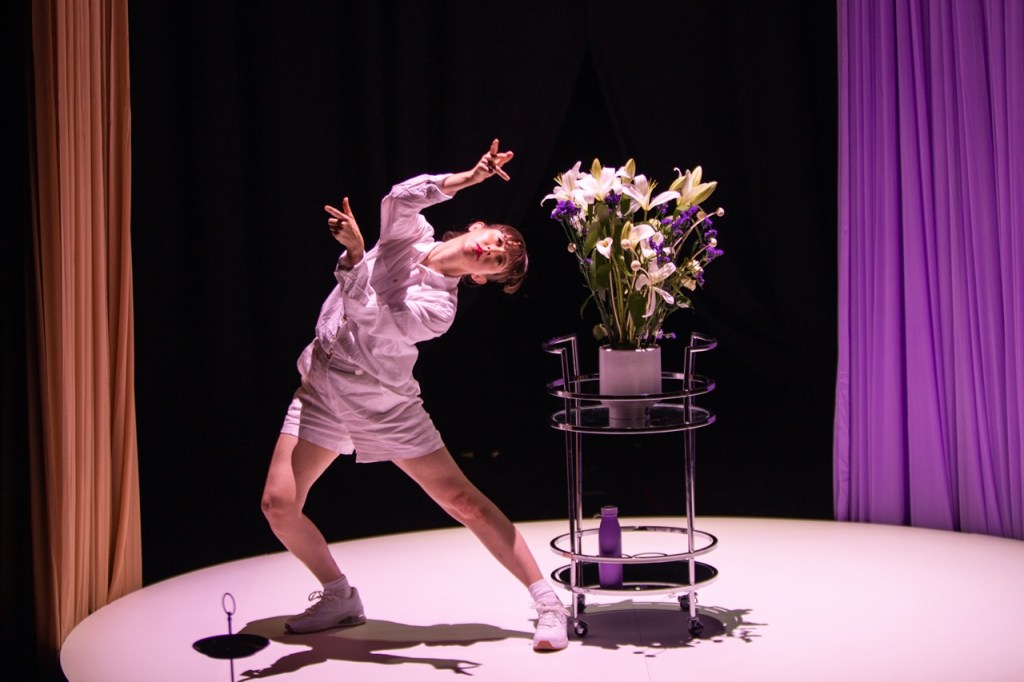
Photo: Yael Stempler. Under the direction of Zoey Dawson, Grigor and dancer Alice Dixon ease you into the story with visual gags and witty asides, slowly drawing the parallels to modern Australia that grow deeper as the show goes on. As Grigor and Dixon twist the narrative, and break any pretence of a fourth wall, it becomes clear that we are not here to passively observe. We, the comfortable theatre goers, are under the microscope.
As Grigor transposes her own story into that of My Fair Lady, she makes us squirm in our seats. Wisecracks about poverty and privilege are pointed back at us. The codes of our bourgeois existence, our Ottolenghi salads, holiday homes and, well, shoes, make us the butt of the jokes. Grigor breaks the unspoken code of the theatre. She is not “one of us” (middle-class), she is “one of them” (the poor). While, like Eliza Doolittle, she can speak the language, wear the clothes and enter the ballroom like all the other posh women, she might end up skipping the hors d’oeuvres and just “eat the rich” instead.

Photo: Yael Stempler. There is an element of Gen Z “trauma-bragging” but somehow the show strikes an uncanny balance between entertaining and damning us all. At a time when it seems only the rich can afford to go into the arts, this performance piece makes sure we know how damn lucky we are to afford the luxury of a show (at the Opera House no less), especially for those who paid for the deluxe High Table seating at the very front.
Class Act is refreshing and confronting. With smart directorial choices and two performances that sit right on the edge of many peoples comfort zone, it’s the kind of show that constantly challenges and surprises.
-
The Curious Incident of the Dog in the Night-Time (Belvoir) ★★★★★

Adapted by Simon Stephens. Based on the book by Mark Haddon. Belvoir St Theatre. Aug 17 – Sep 22, 2024.
This new production of Simon Stephens’ international hit play, The Curious Incident of the Dog in the Night-Time, sees Belvoir doing what Belvoir does best. They have a knack for taking something big and complex and using every ounce of ingenuity to tell it on an inventively small scale. Stripped back of the theatrical wizardry of the acclaimed original London production, this version finds new ways to surprise and delight while keeping its focus on the family at its core.
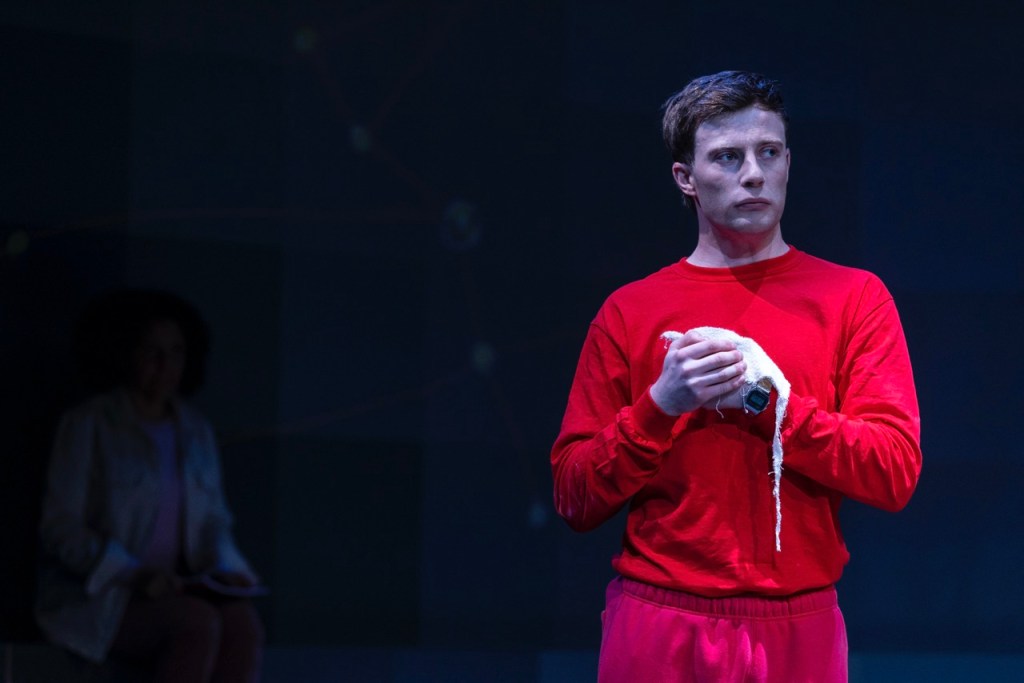
Daniel R. Nixon. Photo: Brett Boardman. Fifteen year old Christopher (Daniel R. Nixon) has found a corpse. Someone has killed Wellington, the dog belonging to Mrs Shears (Ariadne Sgouros) across the road. The neurodivergent Christopher is determined to find the killer in his community, despite his father (Brandon Mcclelland) ordering him to give it up. He may find out more than he bargains for.
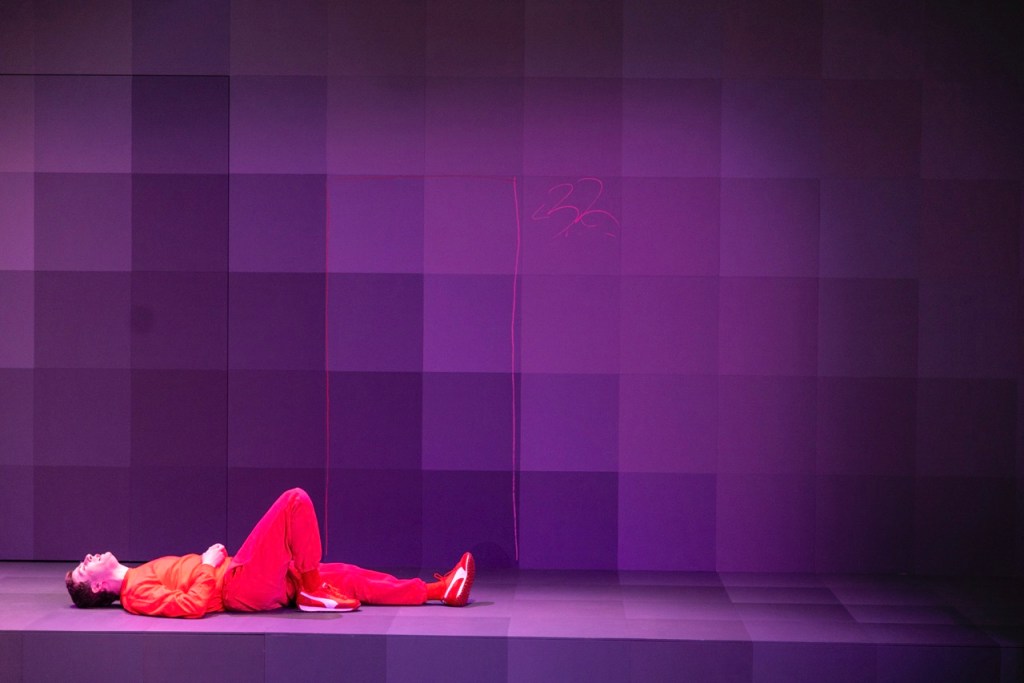
Daniel R. Nixon. Photo: Brett Boardman. There is a magic to Stephens’ construction of this play that transcends the page and the stage. Taking the novel’s first person narration and turning it into a play-within-a-play, Stephens gives us a way into Christopher’s unusual mind. It makes the story a fully theatrical experience, letting the actors slip into each new role with a minor adjustment of their costume, or break the fourth wall.
Director Hannah Goodwin, with Designer Zoë Atkinson, have created a staging that visually excites in its simplicity. With only two chairs and a small table, the actors use chalk to delineate spaces and objects. The outline of the titular dog becomes the centrepiece of an ever evolving artwork involving rooms, stars, London’s Underground and more. Kelsey Lee’s lighting is vital in evoking the right tone and focus, as is Alyx Dennison’s sound and music.

Brandon McClelland, Daniel R. Nixon and Brigid Zengeni. Photo: Brett Boardman. One key aspect of the staging that is new is the warning system. A split-flap display is built into the set, serving as a time-stamp and giving other information. Or, as demonstrated in a pre-show introduction, serving as an advance warning of upcoming loud noises or flashing lights giving sensitive audience members a chance to protect their senses. It’s a lovely touch, worked into the fabric of the show, to make the experience more inviting for sensitive audiences.
Goodwin has cast neurodivergent actor Daniel R Nixon in the lead role to stunning and charming effect. While his presentation of Christopher isn’t vastly different from others I’ve seen from neurotypical actors in the past, there is an assumed verisimilitude that helps ease the audience into the performance. Around him are a spectacular ensemble made up of some familiar faces from Belvoir (upstairs and downstairs), STC and other shows.

Ariadne Sgouros, Nicholas Brown and Roy Joseph. Photo: Brett Boardman. Nicholas Brown, Tracy Mann, Brandon McClelland, Matilda Ridgway, Ariadne Sgouros, Roy Joseph and Brigid Zengeni all play multiple roles with a joyous wink in their eye. Zengeni and McClelland form the backbone, playing Christopher’s school counsellor and father respectively but it’s Sgouros (again, brilliant in both Shitty and Never Closer at Belvoir, and Midnight Murder at Hamlington Hall at Ensemble) and Mann (bringing that The Master & Margarita energy back to the Belvoir stage) who elevated the show for me.
Oh, and a shout out to Laura Farrell’s accent work with the cast – flawless!
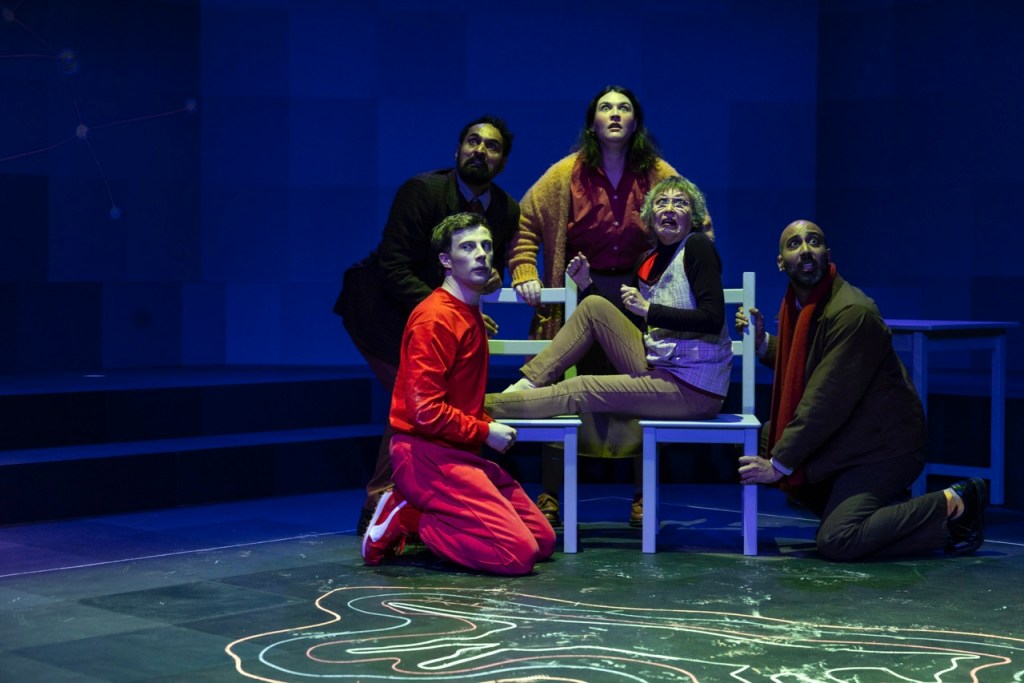
Nicholas Brown, Daniel R. Nixon, Ariadne Sgouros, Tracy Mann and Roy Joseph. Photo: Brett Boardman. I’ve always been a fan of this play in its more well known, big West End form but this Belvoir production shows how strong the writing really is. Without the tricks of a big high tech production to distract you, the audience can focus on the characters and the stage-craft. This is the kind of show we come to Belvoir for.
-
Queer Screen Film Festival 2024
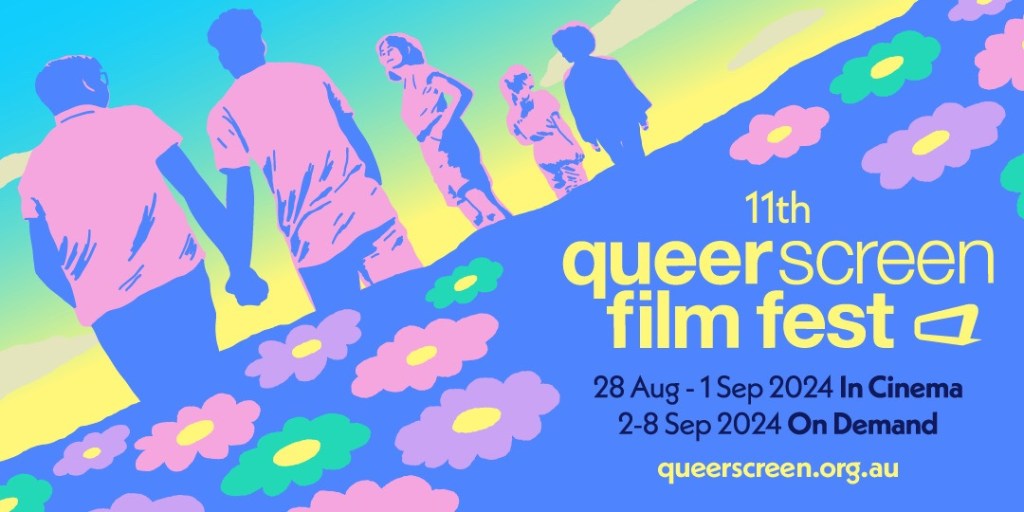
This year I’m reviewing films at the Queer Screen Film Festival 2024 (in cinemas 28 August – 1 September) for The Queer Review, so I’ve created a page to collate all the coverage.
I’ve sorted the reviews into star order so you can clearly see which films The Queer Review recommends.
This page will be continually updated as more content lands.
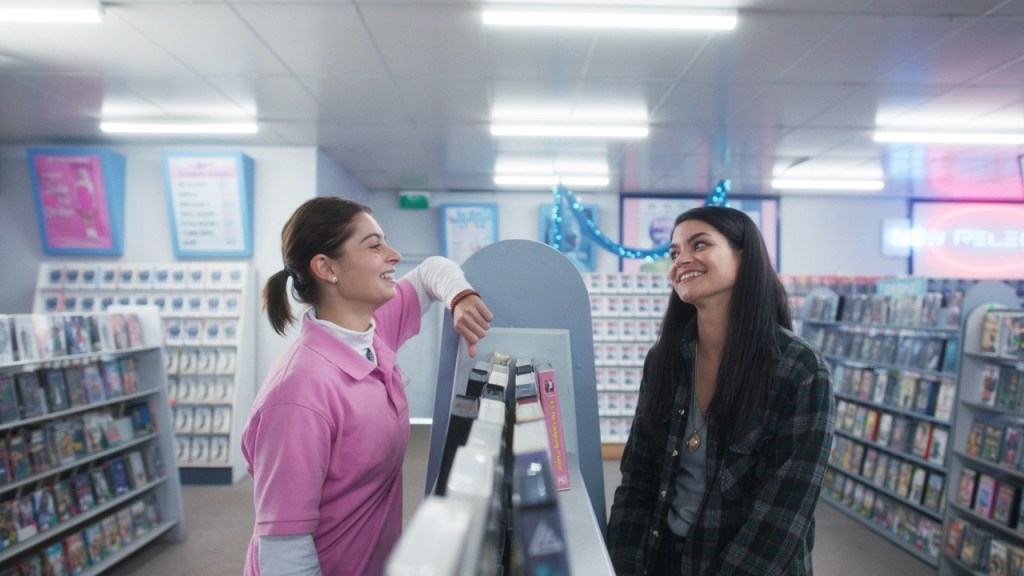
Videoland REVIEWS
Fragments of a Life Loved ★★★★½
Big Boys ★★★★ (reviewed by Glenn Gaylord)
The Astronaut Lovers (Los Amantes astronautas) ★★★1/2

Strange Creatures
-
Subscribe
Subscribed
Have a WordPress.com account? Log in now.

