-
Welcome to Cultural Binge

The rating system is simple:
★★★★★ – Terrific, world-standard. Don’t miss.
★★★★ – Great, definitely worth seeing.
★★★ – Good. Perfectly entertaining. Recommended. Individual mileage may vary.
★★ – Fine. Flawed and not really recommended, but you may find something to appreciate in it.
★ – Bad (& possibly offensive).
See more reviews over at The Queer Review.
Instagram: @culturalbinge
Substack: culturalbinge.substack.com
Email: chad at culturalbinge.com
-
Sister Act (Capitol Theatre) ★★★

Music by Alan Menken. Lyrics by Glenn Slater. Book by Cheri and Bill Steinkellner (with additional book material by Douglas Carter Beane). Based on the Touchstone Pictures Motion Picture “Sister Act” written by Joseph Howard. Capitol Theatre Sydney till 26 Oct, 2024.
Much like the choir at Our Lady of Perpetual Sorrow, when Sister Act kicks off its musical numbers, written by Disney legend Alan Menken, it is hard to resist. I must confess, with a cast of vocal powerhouses, these tunes sound immaculate.
When aspiring nightclub singer Dolores Van Cartier (Casey Donovan) witnesses her club-owning boyfriend murder a police informant, she goes on the run. Policeman, and old high school chum, Lieutenant Eddie Souther (Raphael Wong) puts her in hiding till she can testify. The best place he can think of is the rundown old convent, Our Lady of Perpetual Sorrow run by a cranky Mother Superior (Genevieve Lemon). While Dolores struggles to blend in, she finds her place helping the hapless choir, taking them from a tone-deaf cacophony and turning them into a local sensation by blending disco and R&B with their hymns. While the newfound crowds filling the once empty pews breathe new life into the congregation, the attention puts the spotlight on Dolores who is supposed to be in hiding. When her murderous ex discovers her, it puts the whole convent at risk.

Sister Act. Photo: Daniel Boud There are two real stars to this show. Firstly the terrific tunes by Menken and Slater that blend 70s pop hits (they get so close to replicating some big tunes you wonder what the copyright lawyers must say) and gospel. Menken, the man behind the Disney-renaissance of the 90s, knows how to write a musical theatre score that has plenty of room for hummable tunes, emotional heft and ridiculous comedy. Let’s be clear, there are no tunes from the Sister Act films in this show, so if you’re hoping for a funky rendition of “I Will Follow Him” or a soulful “His Eye Is On The Sparrow” you’ll be disappointed. This is a blessedly all-original musical.
Secondly, this show would be nothing without Genevieve Lemon, who not only belts with the best of them, but has all the best dialogue, a well tracked character arc and knows how to pitch her performance at the right level. There’s a lot of over-acting in colourful costumes happening on the stage around her, but Lemon brings the whole thing into harmony.

Sister Act. Photo: Daniel Boud As I mentioned, when it comes to the singing this show is a revelation. Casey Donovan hits the notes like a woman possessed, including some emotional heal-turns mid song. Rhonda Burchmore hoofs it up for every ounce of comedy as Sister Mary Lazarus (her hat-tip to Raygun at the bows was probably the show’s best bit of “choreography”) and Sophie Montague serves heart and surprising vocal heft as the young Sister Mary Robert. Equally all the men in the cast nail the tunes, with less stage time and even less material to work with. The trio work of TJ (James Bell), Pablo (Jordan Angelides) and Joey (Tom Struik) elevates their roles beyond some rather outrageously cartoonish performances.

Sister Act. Photo: Daniel Boud But when the music stops and the talking starts, your faith in the show starts to waiver. The book is diabolically mediocre, and often borderline offensive (jokes about not being able to understand Pablo’s spanish, or mistaking Dolores for a drag queen, feel cheap and tone deaf. If you’re a theatre-lover of faith, particularly Catholicism, you will wince at what passes for theological commentary). Most of the performances give in to the temptation to play to the rafters like a gaudy pantomime, making it hard to actually care for the characters.
The staging (this is a re-creation of the 2022 West End revival that is still playing) is simplistic and over-reliant on flashing lights. The original direction by Bill Buckhurst is pedestrian at best, the “action scenes” are laughably bad and pointlessly long.

Sister Act. Photo: Daniel Boud Thankfully, the tunes keep the energy high, and will have you humming all the way home. That, along with one genuinely impressive costuming gag and some obvious but amusing jokes, will keep you entertained. Sister Act won’t convert the hard hearted musical-hater out there, but if you like big numbers under coloured lights and want something to exorcise the winter blues, then this will be for you. Is it good? Well, as Mother Superior would say, “I have no words”.
-
Murder For Two (Riverside Parramatta) ★★★★★

Music & book by Joe Kinosian, lyrics & book by Kellen Blair. Riverside Parramatta. 9-10 Aug, 2024.
After knocking us dead last year at Hayes, Murder For Two gets a short, sharp run at Riverside Parramatta. Maverick Newman and Gabbi Bolt are back with a bigger set, and a million characters to bring to life.
In the home of Great American Novelist Arthur Whitney, a surprise party is waiting to kick off. Dahlia Whitney (Maverick Newman) is trying to get her party full of people into their hiding places before Arthur arrives. The group consists of Barrette Lewis (Maverick Newman), prima ballerina, Dr. Griff (Maverick Newman), the local psychiatrist, Whitney’s niece Stef (Maverick Newman) and old neighbours Murray and Barb Flandon (played by Maverick Newman & Maverick Newman) and more. When Whitney is shot as he enters the party, police officer / wannabe Detective Marcus Moscowicz (Gabbi Bolt) sees his chance to prove he’s up to the task.

Gabbi Bolt & Maverick Newman. What else can I say? I love this show. It’s young, scrappy and hungry and it’s not giving away its shot… sorry, I saw Hamilton this week too. Maverick Newman’s character work is as sharp as ever, playing a dozen different roles at the same time, and getting a laugh with each and every movement. A perfect physical comedy performance. No, I take that back, it’s a dozen perfect physical comedy performances all at once.
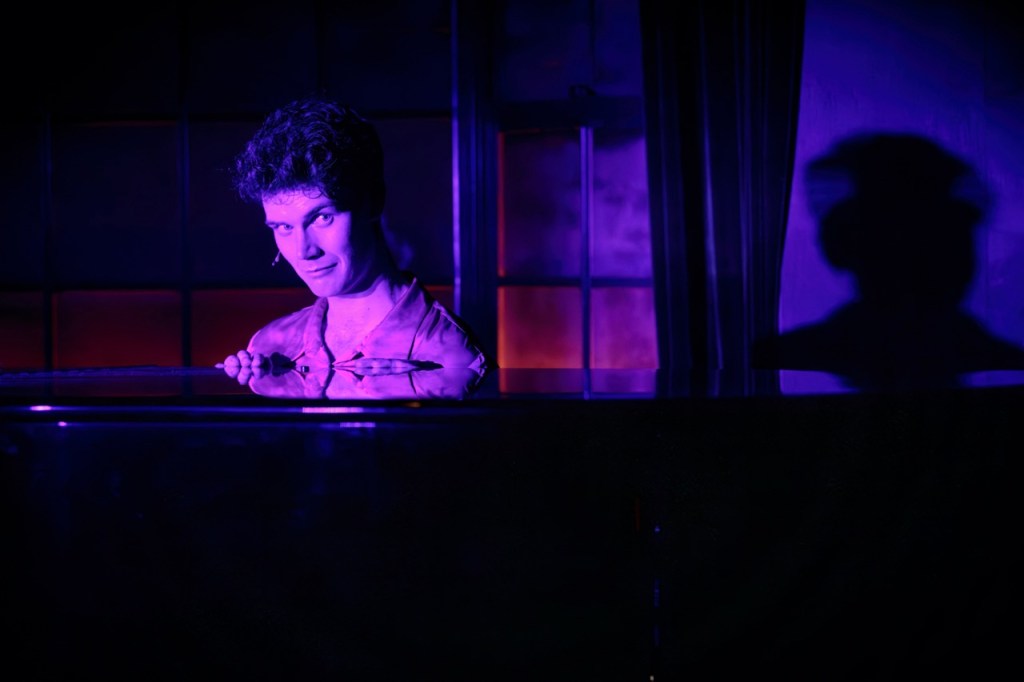
Maverick Newman. Gabbi Bolt is no slouch either. Delivering the bulk of the exposition and forming the core of the story, this is no mere “straight man” role. Bolt’s comedy is less physical but the timing and delivery are just as precise. I need to keep an eye out for her stand-up dates.
Joe Kinosian & Kellen Blair’s show is a cornucopia of silliness filled with slow burn gags as well as ridiculous one-liners. The songs are all great musical theatre comedy numbers that set the performers up for success. At just over 90 minutes, the show never overstays its welcome. In fact, the jokes come so thick and so fast you’ll barely notice the time fly.

Gabbi Bolt. Last time I reviewed the show I slightly glossed over the work of director Richard Carroll, which was an oversight. Murder For Two works at such a breakneck pace, I didn’t pause to think about how precise the timing is, or how every pause is filled with micro-moments of humour. It comes from a deep knowledge of musical theatre and quick-witted comedy. The fourth wall breaks feel organic, and the choreography by Shannon Burns, manages to get Maverick Newman into a variety of new positions without feeling like he’s moving from mark to mark. The Chicago-inspired lunacy of the flashback was especially funny having just rewatched the classic.
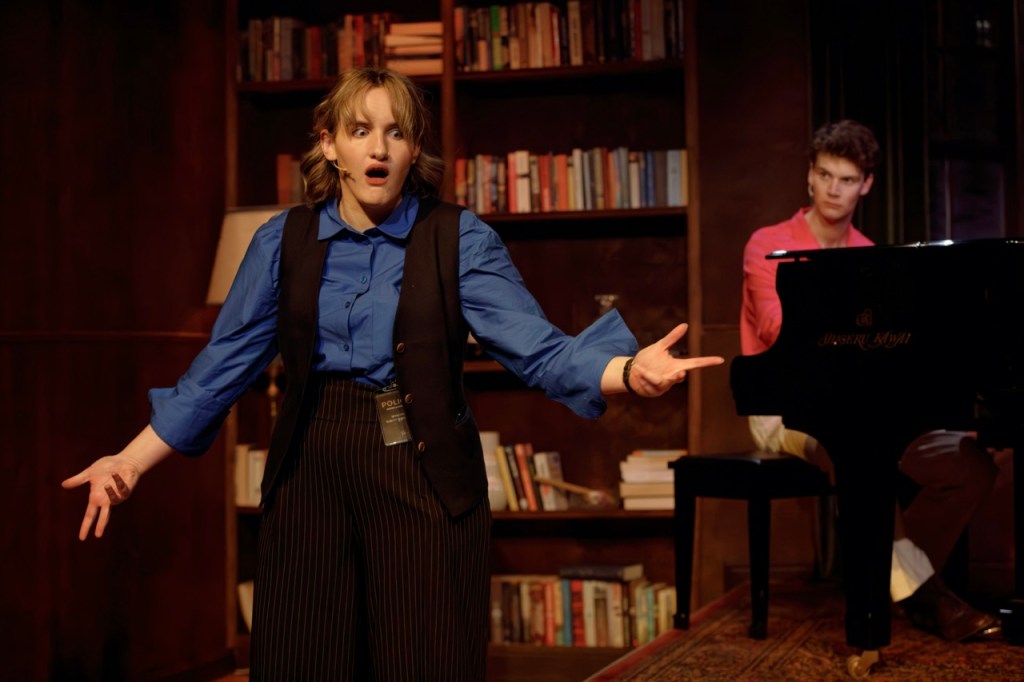
Gabbi Bolt & Maverick Newman. On a side note, it was interesting to see this play out in the much larger Riverside Parramatta space, which dwarfs the Hayes’ intimacy. I was worried the room would be a bit cold for this farce, but thankfully the laughter filled the room very quickly and didn’t stop. This run at Riverside Parramatta is far too short, but I’m just grateful the show has returned, giving more people a chance to see it.
-
Arlington (Seymour Centre) ★★★★
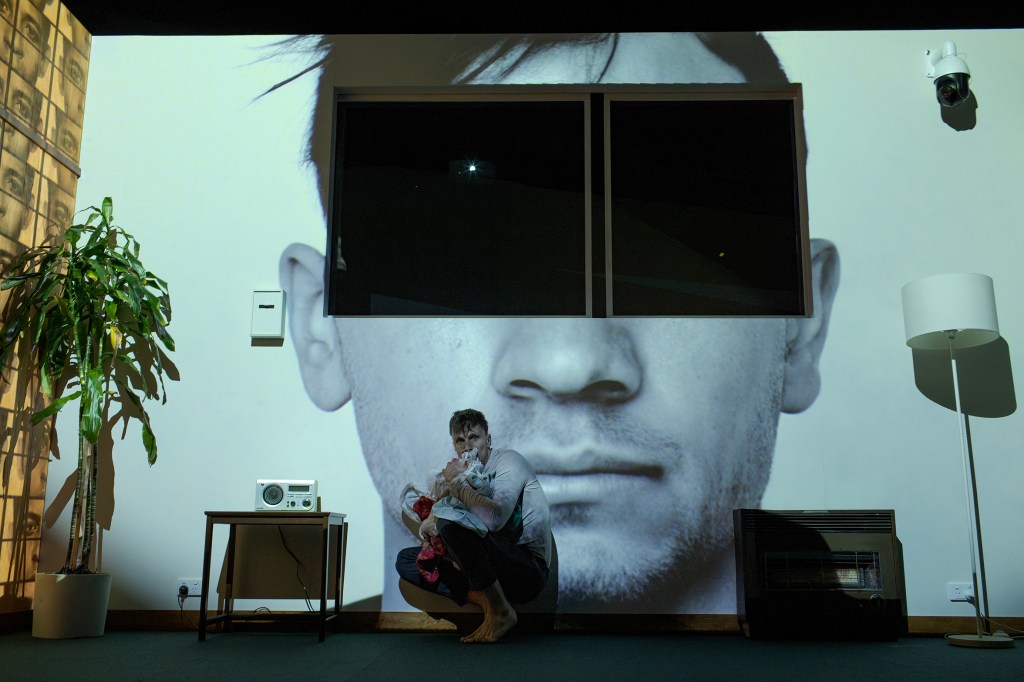
Written by Enda Walsh. Australian Premiere. Seymour Centre. 2-24 Aug, 2024.
Arlington is the sort of play that gets under your skin. Channelling the nightmares of Caryl Churchill through the class-war angst of 2016, Enda Walsh taps into the existential anguish that hums beneath modern life. This play will be divisive – multiple people walked out of the opening night performance. That rarely happens.
The marketing may tout this as being from “the Tony Award-winning writer of Once” but get that tender and sweet musical out of your head – this is the polar opposite. Some of the obvious touchpoints would be George Orwell’s 1984, and the TV series Black Mirror, but there’s clearly a lot of Kafka in the mix as well. Arlington will hint at backstories and meanings, but defiantly withholds details just to play with your mind. I instantly thought of 60’s British TV shows like the mind-bending The Prisoner. There is a gleeful sadism both in the story, and in the writing.
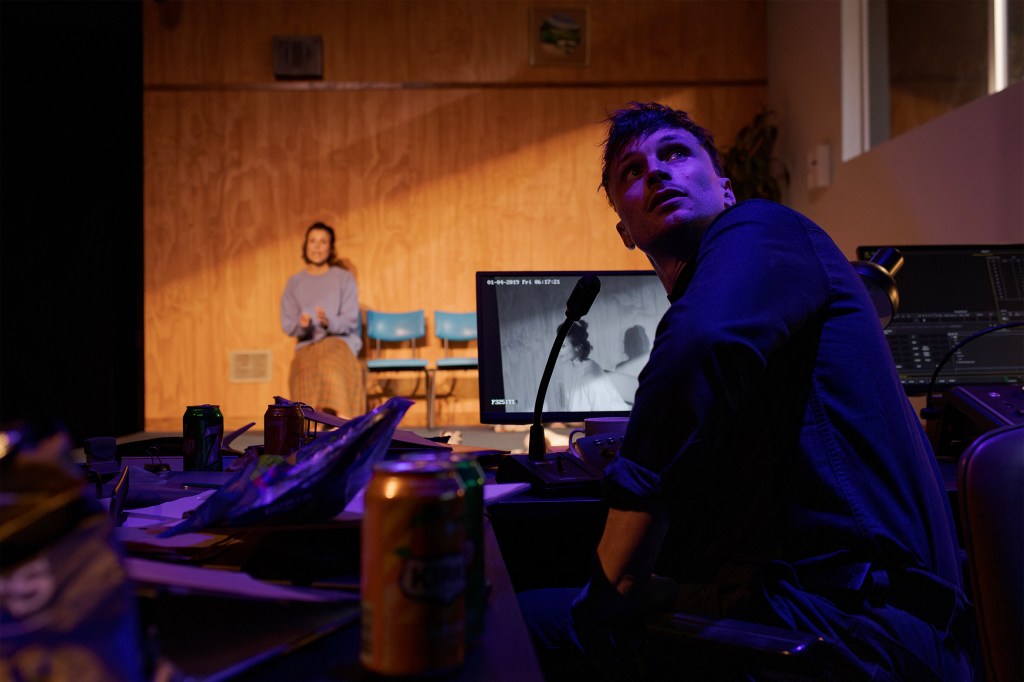
Phaedra Nicolaidis & Jack Angwin. Photo: Philip Erbacher. Told in three scenes, which are not in chronological order, we begin with Isla (Phaedra Nicolaidis) in a waiting room. She is being remotely observed by a young man (Jack Angwin) who seems flustered. Via intercom he instructs her to begin, and Isla tells a story as he records. Isla is torn between her engaging tale, and the thing she saw out the window earlier when the curtains had mysteriously fallen off – people outside, in identical tower blocks and identical waiting rooms…
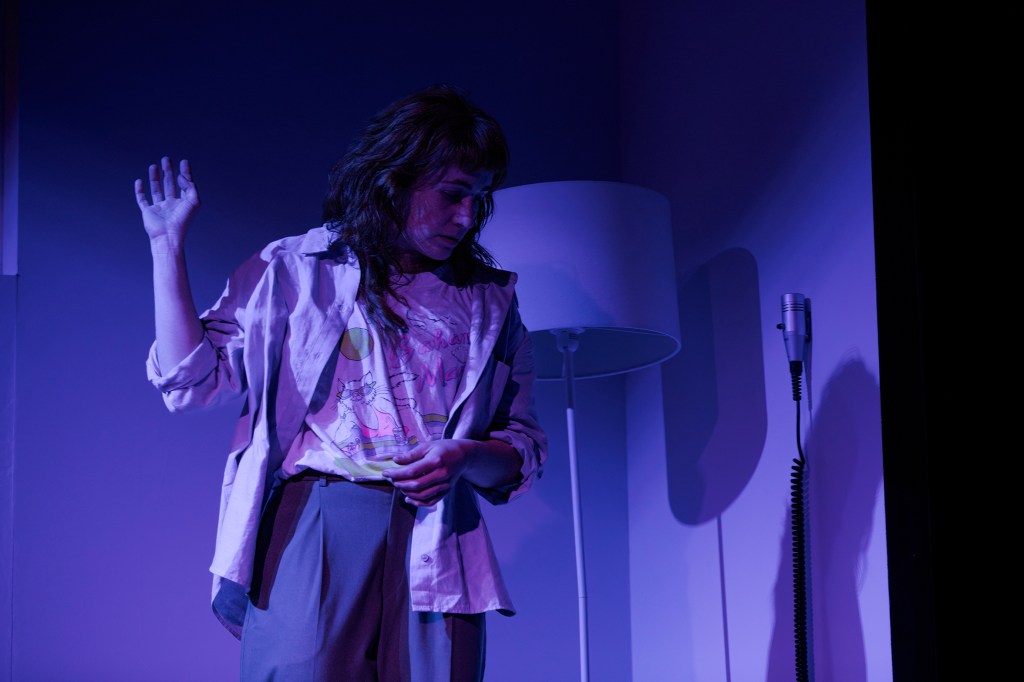
Emma Harrison. Photo: Philip Erbacher. In scene two, the most controversial of the three scenes, a woman (Emma Harrison – also the show’s choreographer) sits in a similar waiting room. As she waits, and waits, her movements become an erratic and unstable dance, a decaying repetition of cycles. This 25 minute scene, told entirely through dance, becomes the catalyst for the rest of the play.
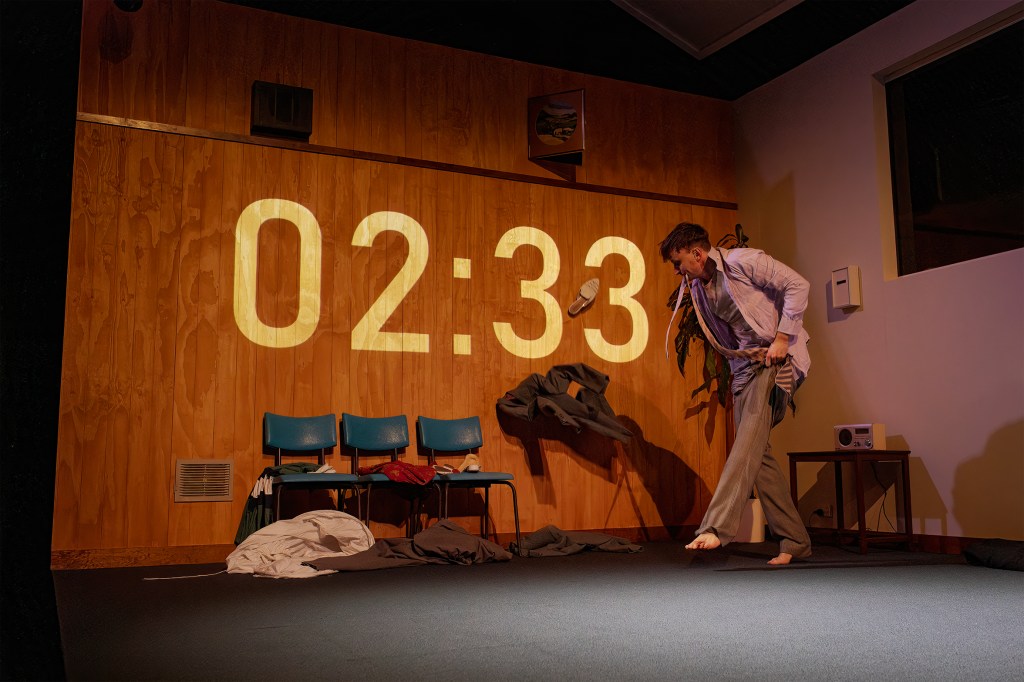
Jack Angwin. Photo: Philip Erbacher. The final scene sees the young man return, this time he himself is in a waiting room under surveillance from another woman (Georgina Symes) intent on interrogating him while he waits for his chance to earn some food and sleep.
Arlington is a dark play, and those looking for glimmers of hope or neat resolutions will do well to look elsewhere. Walsh takes the tensions of the wealth divide and institutional power and pushes them into a different, dystopian place. His lack of exposition lets this play out like a good horror story – it’s mainly happening in your own imagination where you can’t escape.
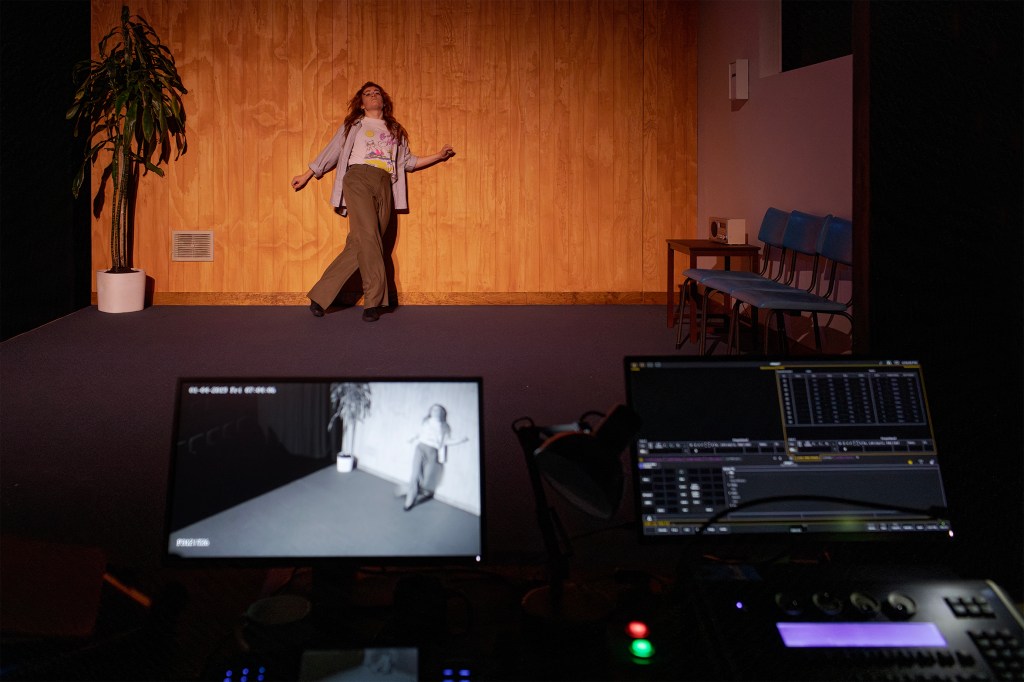
Emma Harrison. Photo: Philip Erbacher. Watching Arlington was at first intriguing, then frustrating, then annoying, then intriguing once more and finally satisfying in a way I didn’t expect. The dance scene pushed the limits of my attention span, but its resolution and impact are felt more keenly after going on its journey. Could it have been told more quickly, in a more conventional manner? Sure, but this bold choice is what makes Arlington unique and ties back into Walsh’s own work, feeling like an outgrowth of his other musical, 2015’s claustrophobic Lazarus (a show that infuriated me so much I went back to watch it a second time to make sure of how I felt).
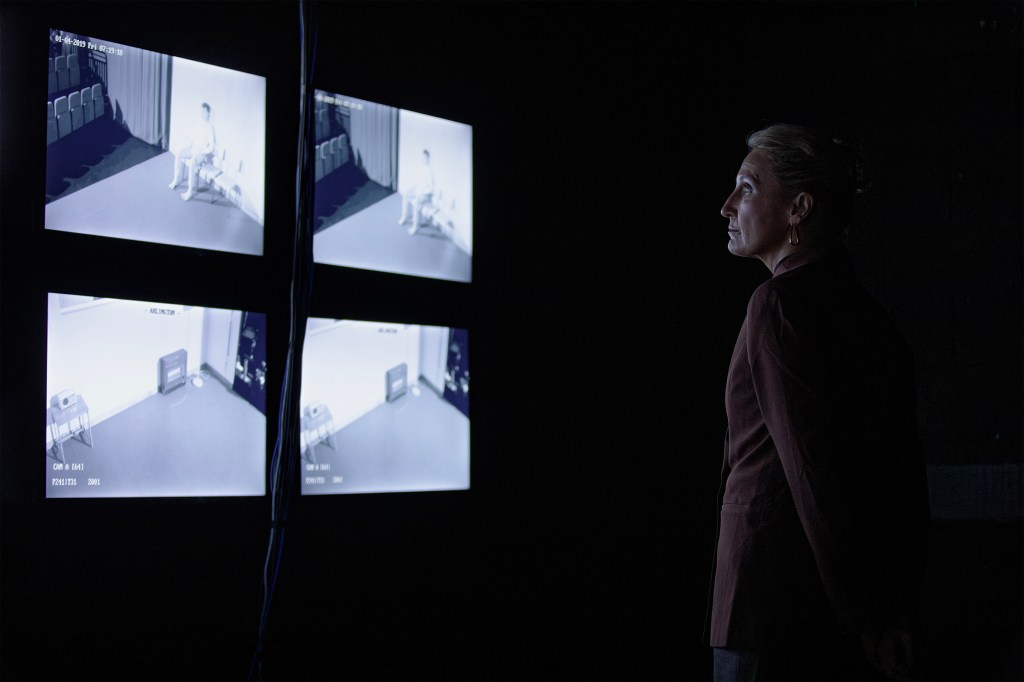
Georgina Symes. Photo: Philip Erbacher. Despite being written in 2016, it feels sharply contemporary with its themes of isolation, mental health and how the need for entertainment can drive society to dark places. I was always baffled in 2020 (and selfishly grateful) that in the height of the Covid pandemic, making reality TV was deemed an “essential service” that continued during lock-down, which eerily echoes the world of Arlington. Except in Walsh’s conception the idea of “bread and circuses” is turned back on the poor & middle classes as a punishment, forcing them to entertain others for basics like food and shelter.
The performances are all excellent. Nicolaidis’ pixie-esque charm skirts the line between she’s-broken-and-crazy and she’s-innocent-and-pure. Angwin goes through the largest story arc as a young man who makes a single, life changing decision. While Symes brings a harsh authoritarian chill to the closing scene.
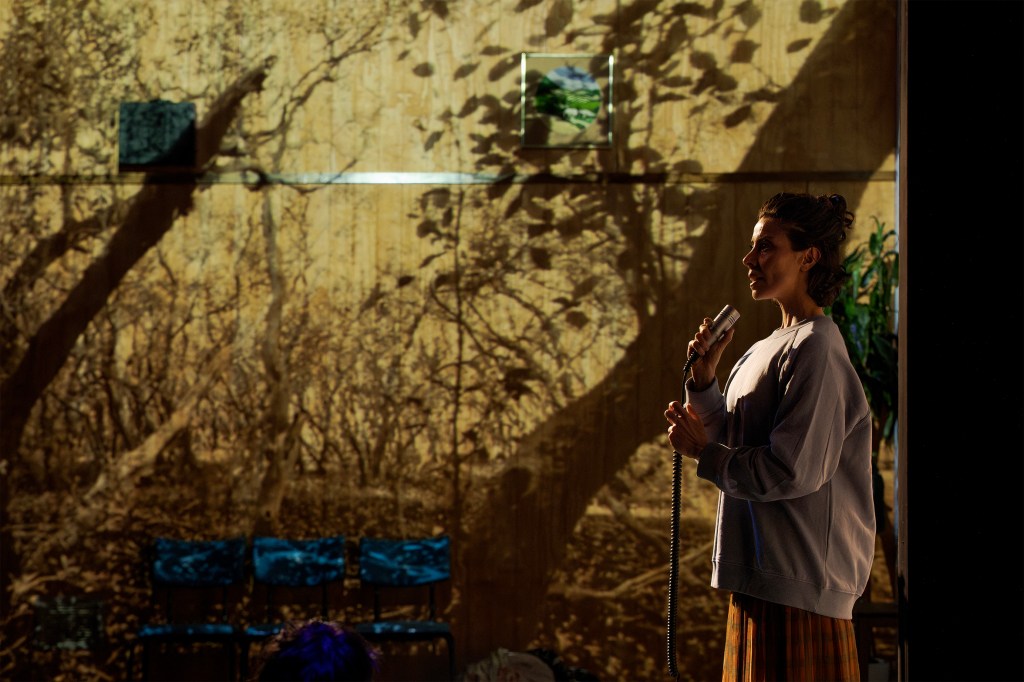
Phaedra Nicolaidis. Photo: Philip Erbacher. But it’s the production elements that really excel here, especially the lighting and video by designer Aron Murray, and the music and sound design by Steve Toulmin. Toulmin’s sound especially has a major impact as a tool of interrogation, wearing the characters down and jumping us through their fractured mental states.
Arlington will definitely not be for everyone. It’s a challenging piece, both in its form and subject. Walsh seems intent on making us question society’s structures and how they are evolving, without giving us any easy answers or release. The result is unsettling and rewarding.
-
The Arrogance (KXT on Broadway) ★★★½

Written by Olivia Clement. World Premiere. KXT on Broadway. 26 Jul – 10 Aug, 2024.
Olivia Clement’s The Arrogance is a gentle, and handsomely staged, look at the contradictions of abusive parents and the way adults deal with childhood trauma. With a focus on complex characters rather than plot, it may not travel far, but it has great depth.
A heavily pregnant Amber (Whitney Richard) has moved out of New York to Iowa, for her dream job. She’s a long way from her native Australia. Her new neighbour Erin (Linden Wilkinson), a widow living on her own, takes an instant interest in the newcomer and helps her get settled. But Amber is having a hard time sleeping, and has recurring dreams of her father (Alan Glover), dwelling on both his good and bad sides. In her dreams she gets to say all the things she wished she’d said to him in the past…

Whitney Richards & Alan Glover. Photo: Georgia Brogan. To start with, the evocative set by Soham Apte (the photos don’t do justice to the black on black theme), along with the gorgeous score by composer Baran Yildiz instantly set this above much independent theatre fare. This show has a look and feel (aided by Aisling Bermingham’s sound design and Sophie Parker’s lighting) that elevates the excellent text.

Whitney Richards & Linden Wilkinson. Photo: Georgia Brogan. Against this backdrop, the actors deliver strong, empathic characters who feel authentic and unique. The play moves through some very emotional material and the performances are held in tight control thanks to Lucinda Gleeson’s direction. This strong focus on character is where The Arrogance excels. These are deep characters with rich backstories.
The Arrogance is, in essence, a “hang out” play. The plot mechanics are minimal. Amber’s pregnancy puts a ticking clock on proceedings, and instigates a lot of parental soul searching, but doesn’t drive the drama in any particular direction. Plot threads of Amber’s increasingly unusual behaviour, or Erin’s past don’t really thread together in any way other than to lead us to the point of “damaged people helping each other in need”.
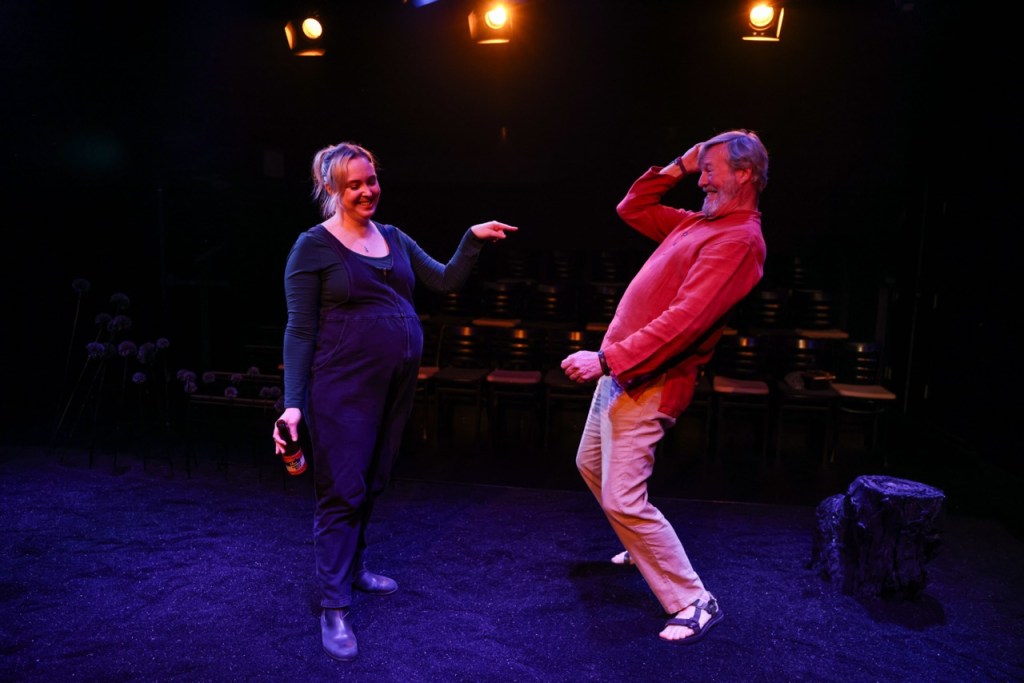
Whitney Richards & Alan Glover. Photo: Georgia Brogan. Alan Glover does great work as the memory of Amber’s father who is both warm and caring while also threatening and dismissive. It’s a fine line he walks well. I was instantly drawn to Linden Wilkinson’s Erin who is both giving and withholding in her solitude. Her yearning and sadness bled through every line of dialogue, no matter how simple. A lovely performance.
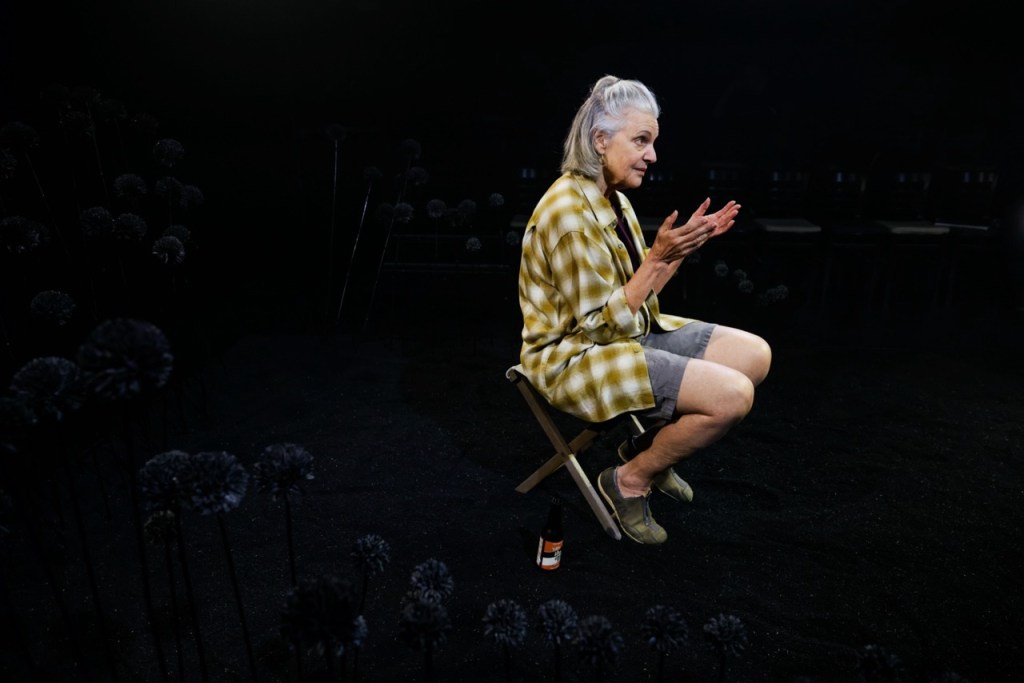
Linden Wilkinson. Photo: Georgia Brogan. For all the emotion on stage, the final scene of confrontation felt a bit forced to me, in sharp contrast to the rest of the play which played out quite naturalistically. It wasn’t quite justified in the narrative.
The Arrogance combines excellent performances with beautiful characters, supported by wonderful production elements. The result is a piece of theatre that evokes a strong mood that lingers after you’ve left the theatre.
-
The Woman In Black (Theatre Royal) ★★★½

Adapted by Stephen Mallatratt. Based on the novel by Susan Hill. Theatre Royal Sydney. Till 17 Aug 2024.
Cheap thrills and jump scares might not be the most sophisticated of theatrical outings, but there’s no denying the fun to be had from watching a ghost story in a packed theatre, and The Woman in Black delivers the frights as advertised.
I won’t venture into the mechanics of the plot for fear of spoilers, but you can read the wiki or watch the film, if you really want to know. Suffice to say, a young lawyer is sent to the estate of a deceased old lady whose house may very well be haunted by a woman, wearing black.
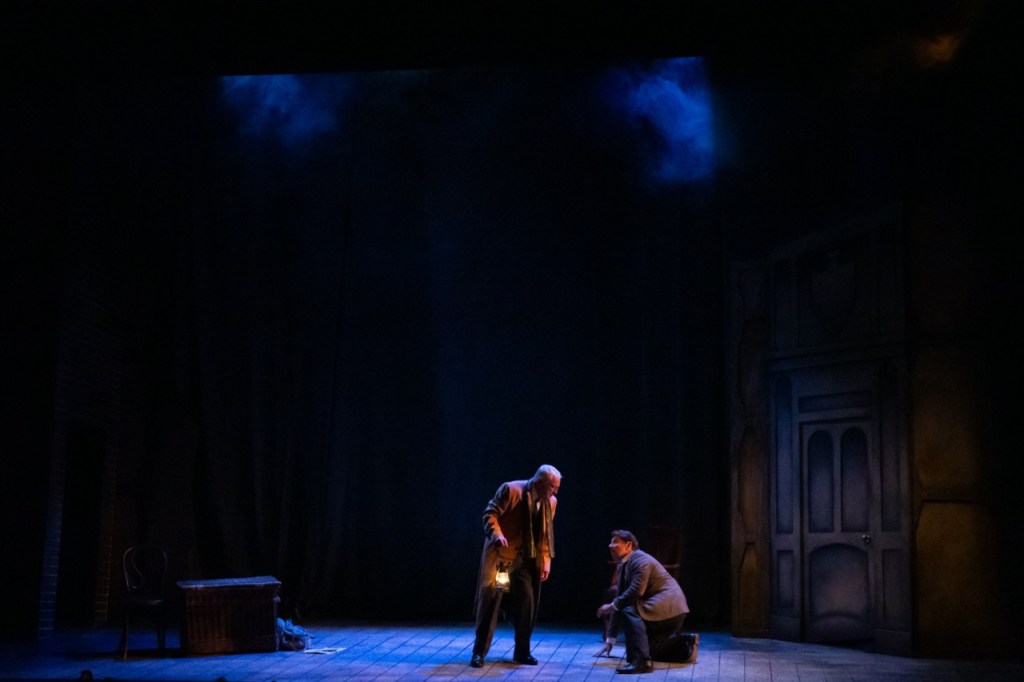
John Waters & Daniel MacPherson. Photo: Justin Nicholas But this isn’t a straight presentation of a creepy story, the premise, and ultimately the hook of the play is that our narrator, Arthur Kipps (played in his older years by John Waters) wants to tell the story of an horrific incident he experienced in his youth as a way to exorcise the memories. He has enlisted the help of a young actor (Daniel MacPherson) for tips on public speaking, whose enthusiasm for the story-within-the-story brings it to life.
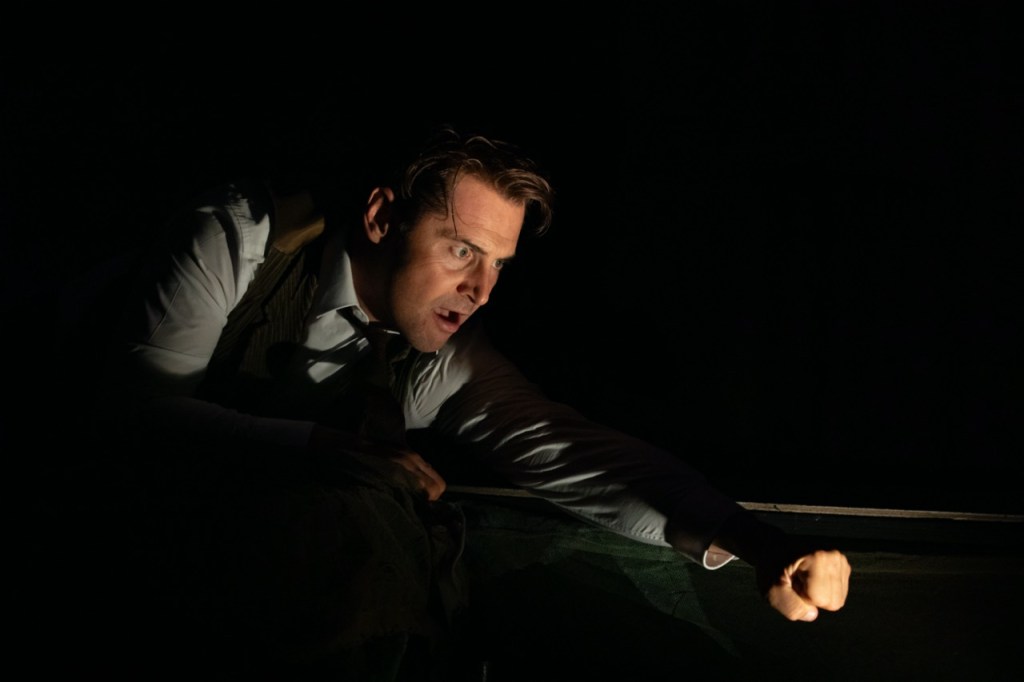
Daniel MacPherson. Photo: Justin Nicholas Mallatratt’s adaptation lures the audience in with a celebration of pure theatrics. We are invited to imagine props, scene changes and character and once the show has our imaginations engaged, it uses them to scare the bejesus out of us. The two leads slip between multiple roles (MacPherson plays the young Kipps in the retelling, while Waters plays, well, just about everyone else). We jump from reality into memory with a sharp change of the lighting. It’s a smart and theatrically literate presentation that uses the trickery of the stage, more than any modern technology, to give us the willies… and it’s better for it.
Director Robin Herford amplifies moments of comedy to perfectly accent the tension. Like watching any good horror film with an audience the first reaction is to scream, quickly followed by raucous laughter. Herford and Mallatratt deploy moments of silliness into the mix to disarm us, and once disarmed we are vulnerable.

John Waters & Daniel MacPherson. Photo: Justin Nicholas MacPherson’s Actor has a youthful excitability and warm enthusiasm about him that makes him instantly likeable. His gentle nature with the elderly and nervous Kipps is vital in gaining the audience’s sympathy. When he becomes the younger Kipps, there is a British stoicism to his behaviour – yes, he has encountered a ghost, but he won’t let that stop him from doing his paperwork!
But this is John Waters’ night. Playing a variety of roles, he is constantly called upon to change his performance on a dime, and does so wonderfully. Despite often being shoved to the side of the stage with little to do other than narrate, his sonorous voice and empathic style draw you in.

John Waters. Photo: Justin Nicholas I’ve a soft spot for The Woman in Black. It knows what it is and doesn’t stray from the basic premise. This is a ghost story, designed to give you chills in the telling just like The Turn of the Screw. There are no great morals (in fact it rests on some rather nasty old tropes), no lessons to be learned, this is entertainment, pure and simple. Its historically long run in London, 30+ years, may have more to do with the size of the tiny Fortune Theatre and discounted tickets, than the actual play itself, but it is nonetheless a perfectly fun, popcorn piece of theatre.
-
Interview: West End & Broadway Super-producer Sonia Friedman (2017)

West End and Broadway theatre producer Sonia Friedman has just taken Australian musical Fangirls to London, opening to rave reviews. Her pressence in the credits speaks volumes for the show’s ambition. It seems that a West End run is definitely on the cards, and who knows from there.
In 2017, I was lucky enough to sit down with Friedman for an hour to talk theatre (and dogs) for DOG Magazine. At the time, Sonia Friedman Productions was about to open Harry Potter & The Cursed Child on Broadway, and Friedman cryptically teased me about the fact she had the script for a new Tom Stoppard play (the then unannounced Leopoldstadt).
Over the years I would see Friedman a number of times. She was always busy, always keeping an eye on her shows. I once saw her sit on a step at the back of London’s Noël Coward Theatre during a performance of the 6.5 hour long play The Inheritance (which she produced) because she wouldn’t take a seat in case someone came late to the box office looking for a ticket. She was a fascinating subject. Seeing as the magazine issue is no longer in print, and the interview was never published online, I’ve received permission from Julian Victoria, editor of DOG, to republish the text and images here.

Sonia Friedman. Photo: Federico Michettoni. “Did you know you can clone dogs now?” Sonia Friedman says as she sits on the sofa in her Covent Garden office with her Bichon Frises, Teddy and Buddy, on either side. “I know of somebody who’s cloned his dog in America. He’s a multi-millionaire and loved his dog so much he cloned him.”
It says a lot about the circles this theatre producer moves in, that the world of cloning beloved pets is not out of the question. From beginnings that are almost too clichéd to call humble, to her current position at the head of the West End and Broadway, Sonia Friedman is the heart, mind and soul behind a decade of theatre’s biggest hits.
“I’m not a director, I’m not a writer, I’m not an actor, I’m not a composer; if I was I’d be doing it. I know what I’m good at. It’s a 50/50 split between creative instincts and business skills.”
This blend of art and commerce has made her the most powerful person in British theatre and beyond. If you’ve been to the theatre in the last decade, you’ve likely come into contact with some of her work: sold out runs of Dreamgirls, The Book of Mormon, Benedict Cumberbatch’s Hamlet, David Tennant and Catherine Tate’s Much Ado About Nothing, Sheridan Smith’s Legally Blonde, and critical darlings Chimerica, King Charles III and Jerusalem, along with major productions starring the likes of Keira Knightley, Samuel L. Jackson, Jim Broadbent, Kristin Scott Thomas and Hugh Jackman. And that’s all before we reach the behemoth that is Harry Potter and the Cursed Child – the two-part theatrical continuation of the book and film franchise that has been booked solid in London since it was announced two years ago, and is about to descend on Broadway audiences.

David Tennant and Catherine Tate. Photo: Johan Persson. Instead of cynically throwing a celebrity into a well-known classic, Friedman has made a name for herself for championing new writing and carefully picking revivals that really have something to say.
“Absolutely every show I do is me. It’s my taste. I get very defensive if people assume I’m just there to write cheques,” she says. “The producer has all the business responsibility as well as the ultimate creative responsibility. As the producer, I usually come up with or respond to an idea then find the director and, if it’s a new play, I commission or option the writer. My job is to create the infrastructure for the creative team to do their best possible work. The trite phrase is you do ‘everything from page to stage’, overseeing every single aspect of the production.”
Friedman’s office is a calm oasis in the middle of the Sonia Friedman Productions floor, painted a cool dark blue, with dark furnishings. A glass door to the left opens out onto a room filled with her staff, and the door to the right leads to meeting spaces and a conference room. Scattered around her desk are the familiar clues of dog occupation – beds, bowls and toys. As the staff move around, doors are opened for Teddy and Buddy as if by second nature.
“Anybody who knows me knows I come with the dogs! With every show I’ve ever worked on they’re there at the meet and greet, in the stalls, backstage, at the stage door – they are part of the company. They allow me to be me and do my job and tackle my challenges. They genuinely help me to relax. I’m better as a boss, as a person, as a strategist, with a dog over there in the corner. They help me put things in order in my head so I’m able to think about the things that worry me in a much calmer way. I’ll sit down and work out what to do while Teddy’s on my lap, then I can go again.”

A wall in Sonia Friedman’s office circa 2017. Photo: Federico Michettoni. Friedman grew up in an artistic household. The daughter of two professional musicians (her father left when she was born), she was surrounded by creative siblings including brother Ricky, also a professional musician, and sister Maria, a noted performer and director. She has another sister, Sarah, and a younger half brother, Ben. Growing up, the family had a dog, Nicky.
“Nicky came into the family when I was about two and a half years old. He was absolutely everything to me. When I was young, I believed that he was actually a prince; that when I left the room he became a prince and when I came back he became a dog again. I absolutely believed that he was put there to look after me, a prince disguised as a dog! As children we made up plays and stories all the time, and on my own, that was my story. My private world with my dog. As I’m talking about him now I’m tearing up because I loved him so much. Anyone who owns a pet will understand that. Pet owners, we’re like this gang. When you lose a pet, it’s a death in the family and we get that. People who don’t have them don’t understand.”
As an adult her allergies led her to adopt Bichon Frises – first Teddy, then Buddy. “I knew it had to be a little dog I could easily travel around with and one which was as hypoallergenic as possible.” It’s no surprise that for Friedman, the theatre and her dogs are so closely linked.
“I named her Teddy because I got her when I was doing a play called Faith Healer in New York. It was a huge hit and there was a vaudevillian character in it that I loved named Teddy. So I named the dog Teddy even though she’s a girl. Also, she looks like a teddy bear! The other is named Buddy for a much more personal reason. My partner is quite a lot younger than me and there’s a song in Stephen Sondheim’s Follies that my sister Maria sings sometimes called, ‘In Buddy’s Eyes’. It’s a beautiful song about being ageless. “Teddy and Buddy genuinely got me through some dark times both personally and professionally. Teddy got me up in the morning; Teddy needed to go for a walk, Teddy needed feeding. She would come up to me and lick me on the nose and wag her tail. How ever sad I was she would sit there, this little ball of fluff, wagging her tail so crazily I thought she would fall over, and would make me smile.”
Instead of planting herself in a luxury apartment in the centre of London’s theatreland, a converted pub in Stepney Green (“proper East London”) is where Sonia calls home. “I’m anonymous there. It gives me more perspective on the world. You also find places that you feel safe with dogs and you gravitate there and stay there. My social life is built around where I can take the dogs. In East London it’s definitely Victoria Park. We went last Sunday and there was a dog show going on and we entered Teddy and Buddy. At one point my niece said, “Shall I tell them you’re the producer of Harry Potter? If you won it would be great publicity.” I said “Yes!” and then a minute later, “No! They’re going to win in their own right!” They didn’t win and I was very upset,” she laughs.

Sonia Friedman. Photo: Federico Michettoni. Theatre is at its most powerful when it reflects society’s bubbling subconscious back to itself, and Friedman’s current crop of plays like Ink and The Ferryman have a lot to say about the state of the world today. She took Headlong Theatre’s long-running adaptation of George Orwell’s 1984 to America this year. Debuting in 2014 in the UK and receiving multiple return seasons in London and internationally, Friedman knew 2017 was the right time to take the show to Broadway. The story of fascism and ‘fake news’ was reportedly so prescient it had audience members fainting in the aisles.
“Taking 1984 to Broadway right now was absolutely a deliberate choice. We were responding to a war cry when the book went back to the top of the best-seller lists. Theatre is always an opportunity to respond to ‘now’. Each show running is responding in its own way. Some are about total escape, like with Dreamgirls it’s about shutting the doors for two hours and just exhilarating in the human voice. The Ferryman is overtly political, exploring cyclical violence and terrorism breeding through generations.”
Despite years of austerity and cuts to arts funding, London’s theatre scene continues to perform strongly. The unique blend of commercial theatre on the West End and government subsidised theatres like the National give London an edge over Broadway – something Friedman credits to pioneers like the late Peter Hall.
“We have a lot more theatres than Broadway. We are having this conversation two days after Peter Hall passed away, and thanks to him our theatre scene is alive and healthy. He led the way for subsidised theatre as we know it, but subsidised theatre is under threat right now, especially regionally. I’m a creature of the subsidised theatre; it’s where I come from. It’s responsible for creating and nurturing all of our creative talent that feed into television and film. Look at the screenwriting and directing credits – so many started in theatre and specifically subsidised theatre. Theatre is in our culture, it’s in the DNA of this country. As a culture and as a nation we will always need stories. We’re a country of extraordinary storytellers.”
For a person as busy as she is, time is a premium. A self-confessed workaholic, Friedman seldom gets to relax and read anything that’s not directly related to her job.
“Sitting down and opening a book by the fire? No, that doesn’t happen for me.” And she rarely gets to the cinema unless she has some connection to the film. “I went to ‘Dunkirk’ because of Mark Rylance, and Tom Glynn-Carney from The Ferryman is in it. It was a work of genius.”
Going to the theatre for pure pleasure is a tough task, too. “To put things into context, I’m at the theatre five nights a week and in the office 14 hours a day so it’s hard for me to get cultural nourishment from anything other than what I’m doing. It’s rare, but it’s a joy when it happens. Most of the time when I go to the theatre I’m watching the mechanics of how it’s done. For me, a show works when I completely forget all that. The Girl from the North Country [the Bob Dylan musical] at The Old Vic is a great example; within minutes I was just in heaven, in awe and swept up in it. I completely forgot about everything and was just another person in the audience.”
But for Friedman the real escape is to leave London and take her dogs to the Hampshire countryside. “We have a beautiful cottage in 400 acres of woodland. Just before we get there, Teddy and Buddy start barking in the car because they know. I don’t get out there anywhere near enough – maybe once every three or four weeks. The wifi signal is awful so you get to shut down from the world.”
With the run-away success of the Harry Potter plays it’s impossible not to wonder what could be Sonia Friedman’s next challenge, but she says: “I don’t think about things as being challenges. Harry Potter and the Cursed Child was never intended to be this big. That wasn’t what I set out to do. I just wanted to create a great piece of theatre with incredible storytelling at its heart. All I can say is, you never know what’s coming to you. Sometimes the best pieces of theatre come as a result of a suddenly empty space in the West End. Every now and then I’ll get a call saying, “We’ve got an eight week slot free, got any ideas?” and I love that.”

The Nether. Photo: Johan Persson. One notable example was Jennifer Haley’s dark, morally ambiguous cyber-thriller The Nether. The Black Mirror-esque tale of virtual reality was staged at London’s acclaimed incubator of new writing, the Royal Court Theatre. Friedman transferred it to the Duke of York’s Theatre in the West End to reach a bigger audience.
“I bloody love The Nether. I had no intention of doing anything with it when I went. My friend [Es Devlin] was the designer and she begged me to go and see it. I got to the last performance of its three week run and was just blown away. I said we have to do it, we have to take it to the West End. I actually think I should bring it back. It closed just as it was really getting going, just when it had some momentum, but it had to come off as the theatre was already booked for another show.”
This is where the talk of cloning dogs comes into our conversation. So how did things work out for her multi-millionaire acquaintance? “I don’t know, I should call and find out! I got Buddy so I could train her under Teddy; that way I could have another one the same. Obviously Buddy turned out nothing like Teddy. She couldn’t be more different,” laughs Friedman with a note of joyful resignation.
“Totally different personality. Everything different. But still perfect.” She muses, “I have never ever been unhappy when I’ve been with my dogs. They are my constant. I’m an example of a person who benefits in every way from having a pet. They are genuinely the reason I can do what I do. I love them unconditionally. At Christmas, most theatre companies or producers send out a very corporate looking Christmas card listing all their shows for the year. Ours is never that, it’s my dogs on the front. If I stepped back and thought I’d become one of those people who sends out a doggy Christmas card I’d think it’s a bit embarrassing. But it’s not for me, because they make me smile. It’s about not taking the job of a theatre producer too seriously.”
-
Present Laughter (NT Live) ★★★★★

Written by Noël Coward. Originally produced by The Old Vic, London in 2019. Broadcasting internationally via NT Live.
I reviewed this production of Present Laughter back in 2019 for The Queer Review and am republishing here in advance of the NT Live rebroadcasts starting on August 2, 2024. The original review follows.

Photo: Manuel Harlan. Andrew Scott is bringing that Hot-Priest-Energy from Fleabag into this slick and satisfying revival of Noël Coward’s Present Laughter, that gender-flips a key role, making this a polysexual farce that feels more in keeping with Coward’s real life.
Scott brings a childish bravado (and a great pair of guns, he’s been hitting the gym) to the pampered actor Gary Essendine. Indira Varma (Game of Thrones) plays his not-quite-ex-wife, Liz, helping everyone navigate Gary’s moods and diary with the help of Monica (Sophie Thompson) his droll secretary. When Gary’s business partner Morris has an affair with the debonair Joe (who happens to be married to Gary’s producer Helen), things turn farcical.

Photo: Manuel Harlan. By gender flipping the original object of attraction Joanna into Joe, director Matthew Warchus has unlocked the queerness inherant in Coward’s play. Turning Helen into an apparent lesbian and playing up the sexual infatuation of Roland (an over-zealous fan played to perfection by Luke Thallon – most recently seen in The Inheritance) smooths out the rough edges, and turns up the heat on this bedroom farce.
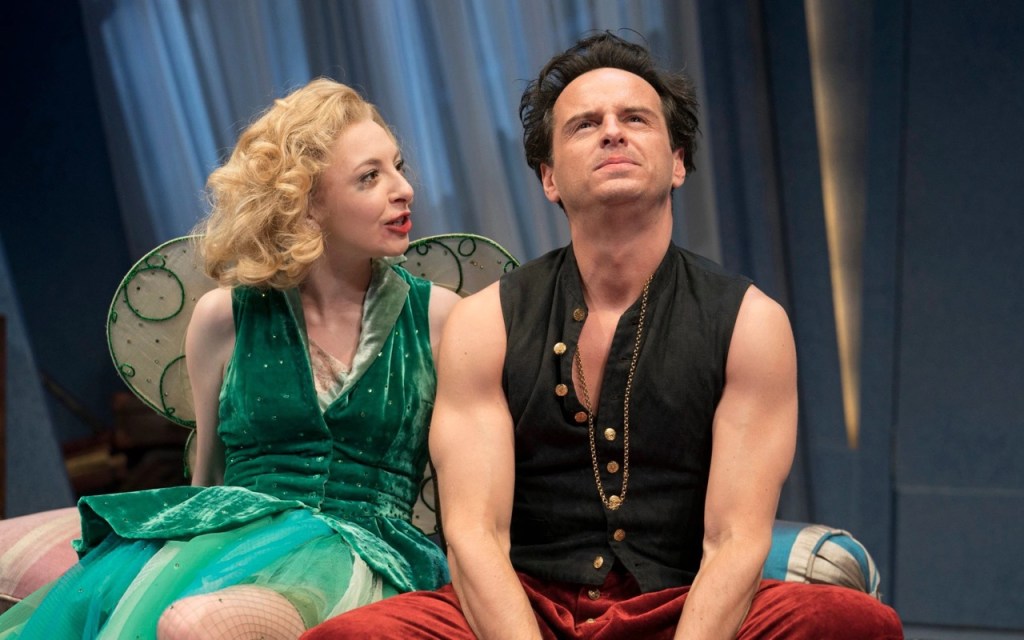
Photo: Manuel Harlan. And it’s hilariously funny. It’s been years since I’ve heard The Old Vic erupt in so much laughter. The script takes endless shots at actors and those who spend time with them. The cast also does a brilliant job of bringing layers of character to the fore. Scott’s Essendine is both vapid and genuinely overworked and stressed. His flippant nature covers up a richer person.
Everything is amplified by Rob Howell’s oversized, art-deco set that gives a seemingly endless number of doors for people to be shoved into and slammed. The cast lounge and luxuriate in (and later frantically run around) the expansive salon, it’s both stunning and deeply impractical like Essedine himself.

Photo: Manuel Harlan. It comes as no surprise that Andrew Scott excels here. Nine years ago he starred in Coward’s Design for Living at The Old Vic to rave reviews and since then his star has continued to rise with Sherlock, Pride (also directed by Warchus), Spectre and most recently Fleabag. This feels like a star at his peak. Essedine’s epic rants have all the emotional range and energy of watching a great actor tackle one of the classic Shakespearian monologues.
It’s a rare thing these days to watch a production without a bad note but here each performer seems so thoroughly on point and engaged there is no weak link. They say laughter is the best medicine, and Present Laughter is a fine tonic to the toxic state of the world outside.
-
The Past is a Wild Party (Qtopia) ★★★★

Written by Noëlle Janaczewska. Qtopia, The Loading Dock. 20-27 Jul, 2024.
Queer lit collides with queer life in Noëlle Janaczewska’s one-person show, The Past is a Wild Party, that has just wrapped its run at Sydney’s Qtopia.
As ‘The Writer’ researches their “chosen family” tree, they reflects on the literature and women that have shaped their queer life. From Sappho to Virgina Wolfe to Amy Levy to Radclyffe Hall, via lesbian pulp fiction and more, interwoven with tales of love and sex, this story is part travelogue, part memoir and part Goodreads listicle.

Jules Billington. Photo: Alex Vaughan. Performer Jules Billington breathes life and humour into the text. Unafraid to lock eyes with the intimate audience, there is a sharp glimmer of mischief to their performance. From tales of disappointment at the lack of practical “how to be a lesbian” tips in queer novels, to revelling in the coded language, Billington’s enthusiasm fills this simple story with a sense of adventure and play.

Jules Billington. Photo: Alex Vaughan. Director Kate Gaul has assembled all the right ingredients for this to really sing. Apart from casting a magnetic performer in Billington, the master stroke is bringing in lighting guru Benjamin Brockman who uses endless tricks to make the series of lightbulbs that make up the set into characters in their own right. There is a simplicity and elegance to the staging that elevates the performance. The final piece of this ensemble is the music by Madeleine Picard that gently guides the audience through moments.
Janaczewska’s script avoids turning into a lecture through a loving use of language. Tiny diversions into discussions of “second person queer” points of view (sidebar: “Second Person Queer” would be a great alternative title for the show), and a clarification of “they” as “third person plural” will delight the literary nerds in the audience (for whom this show is surely catnip). The anecdotes have the warm specificity of memory. They may not be completely accurate but the sense they leave behind is real.
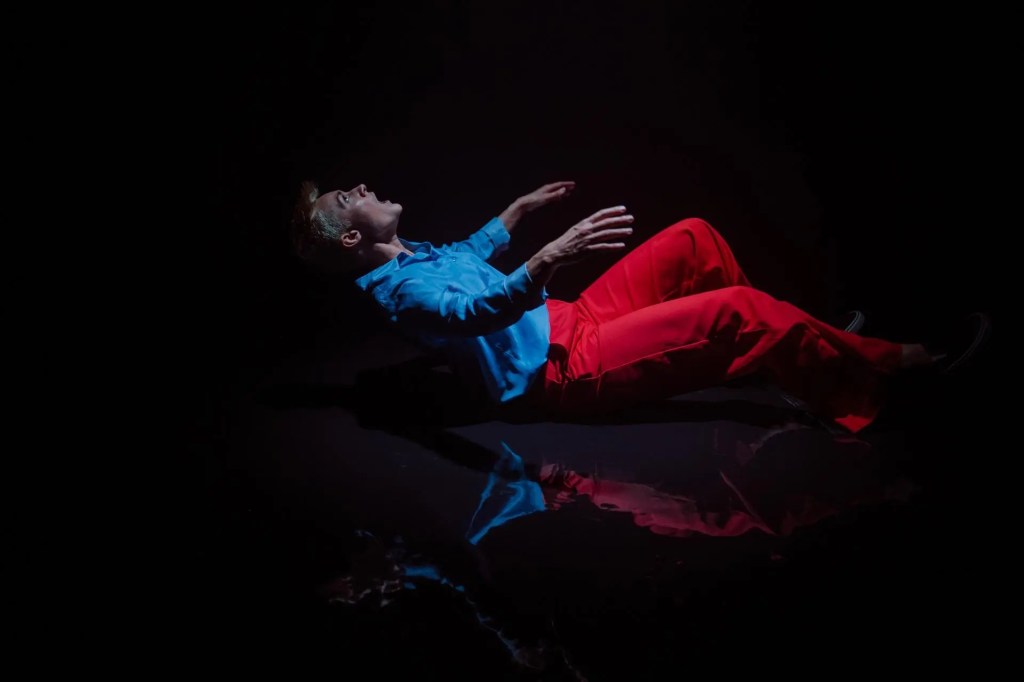
Jules Billington. Photo: Alex Vaughan. In the rush of real life, and other shows, I’ve sadly slept on the output of The Loading Dock at Qtopia, but I’m glad to have finally rectified that error. It’s the perfect, intimate space for this type of confessional work. I hope future shows are just as great as this.
-
Hamlet (Opera Australia) ★★★★

Composed by Brett Dean. Libretto by Matthew Jocelyn after William Shakespeare. Sydney Opera House. Joan Sutherland Theatre. 20 Jul – 9 Aug, 2024.
With an Australian composer, Brett Dean, and director, Neil Armfield, Hamlet was originally commissioned by Britain’s famed Glyndebourne Festival before touring to The Met in New York, and beyond. That’s quite the pedigree behind this show, even before you mention the S-word (that’s Shakespeare).

Photo supplied by Opera Australia. Taking a liberal approach to Shakespeare’s text, this opera plays with your senses to put the audience in the headspace of the Danish prince which can be a disorienting experience. The show opens with a fractured echo of the play’s Act 3 soliloquy “To be, or not to be” before throwing us into the dining hall at Elsinore. It sets the tone for an adaptation that is part deconstruction of the original, which is happy to crib from Shakespeare’s other works to make a point.
Dean’s score is decidedly modern in its outlook, echoing the essence of a film score at points, and playing with tonality and sound design to fill the theatre. The orchestra’s percussionists, positioned in the balconies, transport the audience into the realm of the supernatural. This is by no means an atonal piece, but those wanting soaring operatic melodies may be left wanting.

Photo supplied by Opera Australia. British tenor, Allan Clayton, plays Hamlet (as he has in previous productions) with a surly flare. Lorina Gore has her work cut out for her as Ophelia with a particularly technical part to sing. In a wonderful move, Dean has written Rosencrantz and Guildenstern (Russell Harcourt and Christopher Lowrey) as counter-tenors who constantly echo each other and those around them; it’s a wonderful comedic touch.
Ralph Myers’s set shifts as easily as Hamlet’s mental state, giving scenes a dream-like quality, and Alice Babidge’s costumes clearly mark each character. Armfield’s direction is as assured as always. Placing the ensemble cast around the aisles of the audience for the start of Act 2 is a master stroke. This is an opera that doesn’t stay on the stage, but gets inside your head.
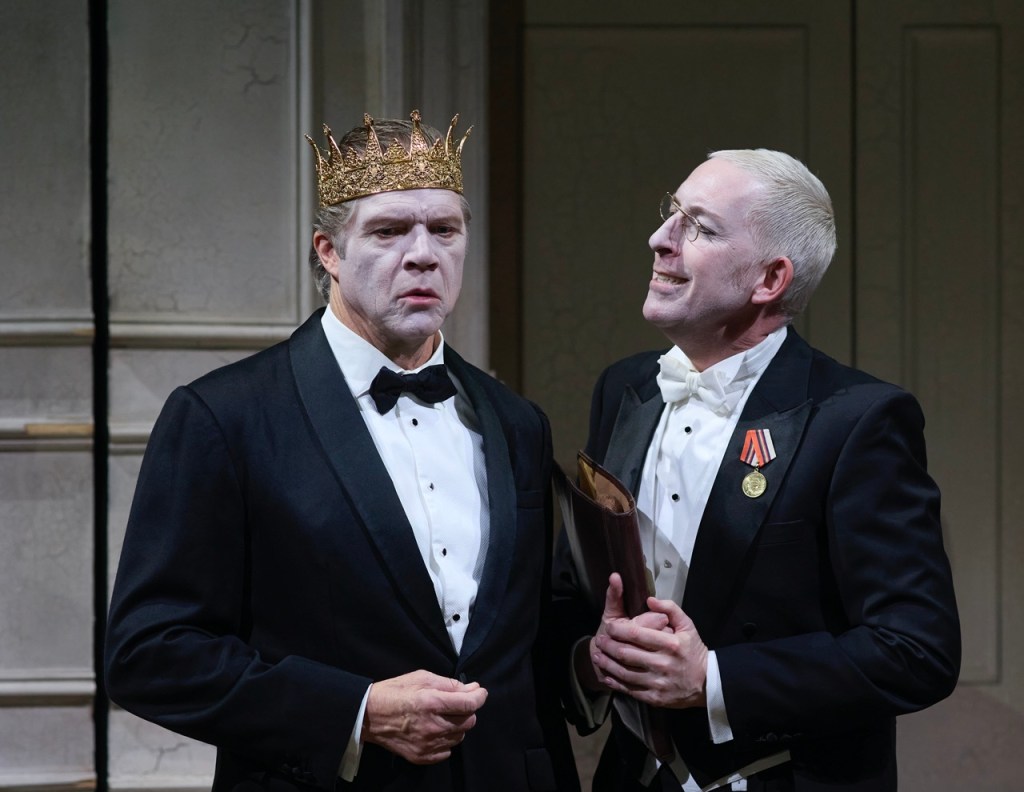
Photo supplied by Opera Australia. Hamlet takes the elements that are obviously classic and manages to present them with a modern vision through the medium of opera. It’s the kind of iconoclastic blend that Australian creatives do best. While I think this is aimed more at those with a solid operatic knowledge (and understanding of Shakespeare’s plot) it’s nice to see another fresh piece spice up the Opera Australia repertoire.
-
In The Heights (Sydney Opera House) ★★★½

Music & Lyrics by Lin-Manuel Miranda. Book by Quiara Alegría Hudes. Sydney Opera House, Drama Theatre. 20 Jul – 25 Aug, 2024.
There are few modern musicals with the heart and the energy of In The Heights. Seventeen years after its Off-Broadway debut, and just 3 years after the film adaptation brightened up the pandemic, this former Hayes Theatre production is back for a third run, this time in the Opera House’s Drama Theatre. It’s safe to say, people love this musical, and I’m one of them.

Ryan Gonzalez. Photo: Daniel Boud. Usnavi (Ryan Gonzalez) runs a corner bodega in Washington Heights in New York with his nephew Sonny (Steve Costi). It’s an intersection for the whole neighbourhood. Across the road Daniela (Janet Dacal) runs a salon catering to the primarily South American-born clientele, and businessman Mr Rosario (Alexander Palacio) operates a car service. But times are tough. Rosario is struggling to put his daughter, Nina (Olivia Dacal) through college, Daniela is being forced to move due to high rents and Usnavi is in debt, but his biggest problem is his inability to talk to Vanessa (Olivia Vásquez). When, in the midst of a heatwave, someone in the neighbourhood wins the lottery, everyone’s life is going to change.

Olivia Dacal & Barry Conrad. Photo: Daniel Boud. In The Heights hits that sweet spot of being both refreshingly original while also filled with the comfortable trappings of musical theatre. It’s a story of love and community, but it touches on the bigger, more contemporary issues of gentrification and the push-and-pull second generation immigrants feel. It’s not as “worthy” as Miranda’s mega-hit Hamilton, but it is more fun.
This production, directed by Luke Joslin, is scrappy and energetic, like the subject matter. The vocals are stunning (if you can get past the odd breathy pop of a microphone) and when the full ensemble combine for numbers like “96,000” and “Blackout” you can’t help but smile and soak in the terrific orchestrations by Alex Lacamoire and Bill Sherman under the direction of Victoria Falconer.
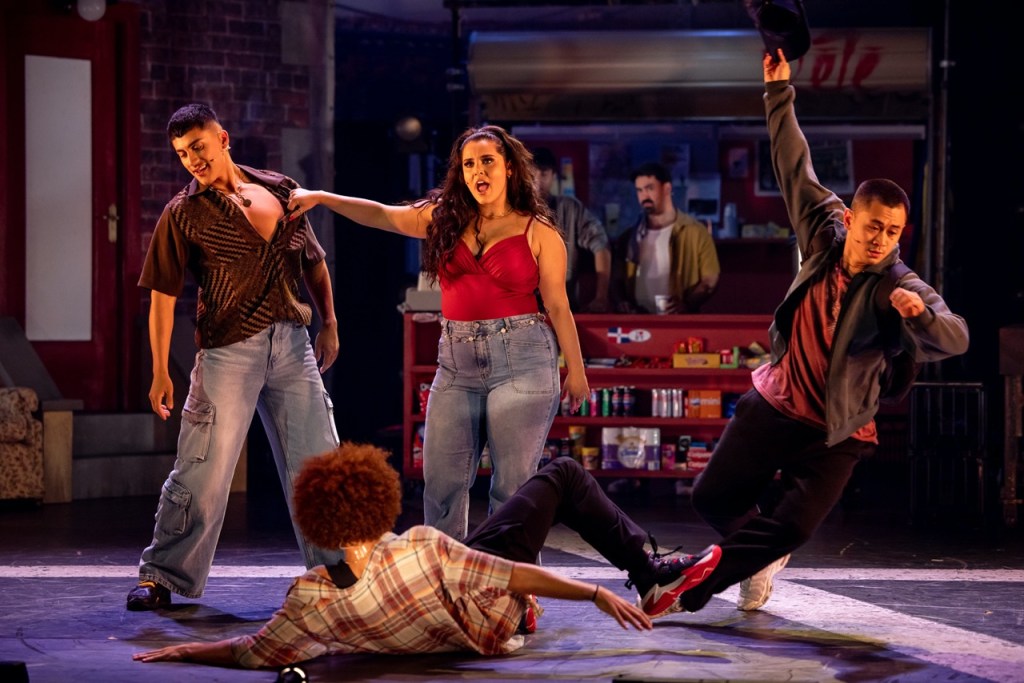
Olivia Vásquez & ensemble. Photo: Daniel Boud. There’s a lot of charisma on stage with Gonzalez infusing Usnavi with an awkward charm. Vásquez’s Vanessa is a great foil for him, driven and very much her own woman. Benny (Barry Conrad) is full of handsome, youthful bravado and Lena Cruz’s instantly adorable Abuela Claudia captures the audience within minutes.
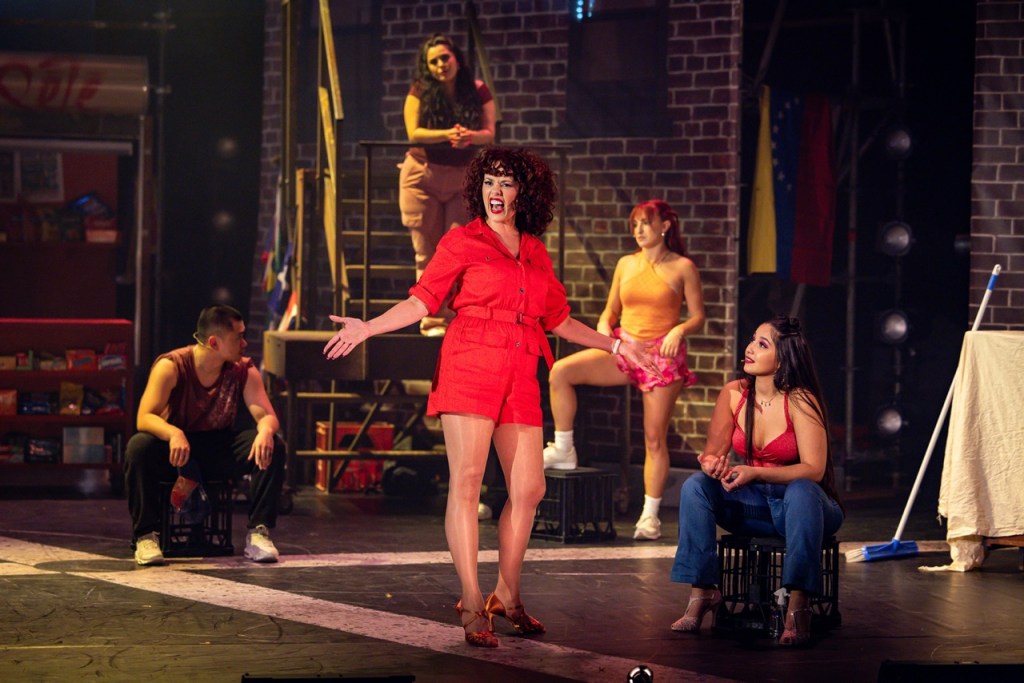
Janet Dacal & Tamara Foglia Castañeda with ensemble. Photo: Daniel Boud. For me, the real stars of the show are Janet Dacal and Tamara Foglia Castañeda as the salon duo Daniela and Carla. Their comedy and verve stamp every moment. Of all the performers they best balance the fine art of serving up an authentic character and also playing to the room for laughs. I wanted more stage time for them both.
There is a rather frustrating uneven-ness to the whole show which is easy to handwave in the small, independent space of the Hayes, but starts to look rough under the glare of the Opera House lights (I didn’t see the show when it was in the much larger Concert Hall in 2019, so I’m not sure how it fared there). The make-shift set looks paper thin, the choreography looks imprecise & cramped, and some costumes pop while others frustratingly blend into the backdrop. Some of the lead performers can’t back up their flawless vocals with the same level of acting, struggling to sell Miranda’s fleet-footed lyrics and seem to be happy to just hit their notes and move to their next mark.

Barry Conrad and ensemble. Photo: Daniel Boud. But the beauty of In The Heights is that it is overflowing with heart, and that warmth papers over all the cracks. This is a good night out, blending romantic comedy with big tunes, and there just isn’t a better venue to “look at the fireworks” than the Opera House.
-
Subscribe
Subscribed
Have a WordPress.com account? Log in now.

