-
Welcome to Cultural Binge

The rating system is simple:
★★★★★ – Terrific, world-standard. Don’t miss.
★★★★ – Great, definitely worth seeing.
★★★ – Good. Perfectly entertaining. Recommended. Individual mileage may vary.
★★ – Fine. Flawed and not really recommended, but you may find something to appreciate in it.
★ – Bad (& possibly offensive).
See more reviews over at The Queer Review.
Instagram: @culturalbinge
Substack: culturalbinge.substack.com
Email: chad at culturalbinge.com
-
King James (Old Fitz) ★★½
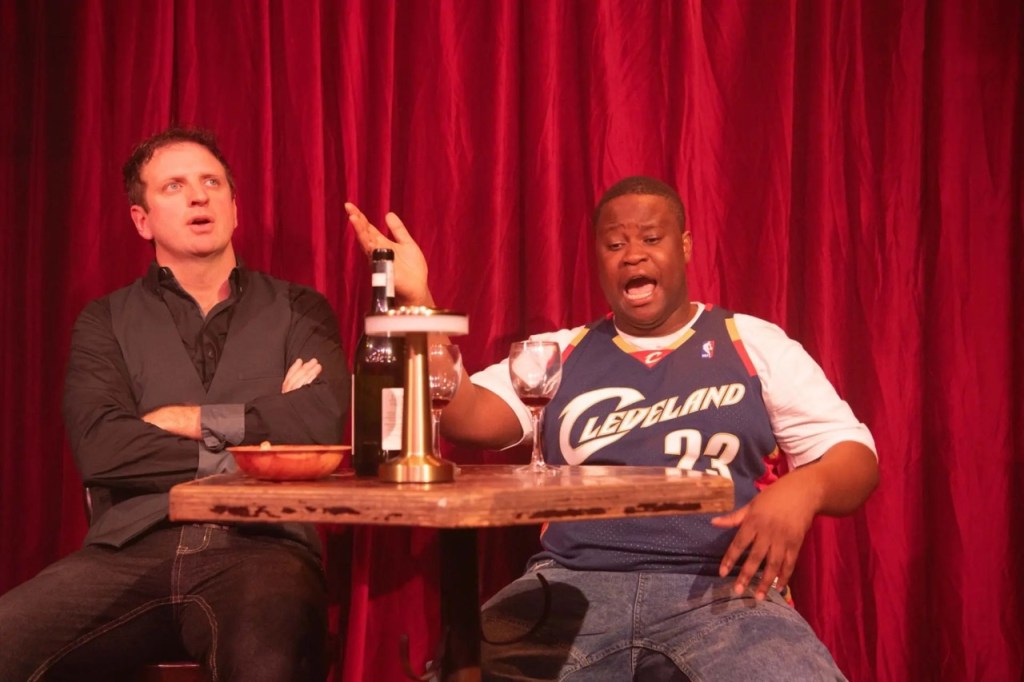
Written by Rajiv Joseph. Australian Premiere. Old Fitz Theatre. Jun 6-29, 2024.
King James at Old Fitz Theatre shocked me on multiple levels. I was shocked to discover it was only written in 2022 – if felt much more dated. I was shocked it was getting strong reviews – I literally don’t understand how I could have watched the same show as other reviewers. And no, it’s not because it was about sports.
I debated whether to review or not. I was not invited or given tickets, I paid my own money, so I had no obligation to provide coverage. And I do this to help promote and boost good shows at a time when companies are struggling. But seeing as the show is near the end of its run, and it has already had a number of very glowing write ups, I don’t feel like I’m kicking a show when it’s down.
Aaron Glenane and Tinashe Mangwana. Photo: Daniel Asher Smith. Two guys meet in a bar. It may sound like the set-up to a joke, but it’s not. They are both fans of their local basketball team, the Cleveland Cavaliers and the rising star player LeBron James. Matt (Aaron Glenane) has to offload his Season Tickets because he needs the cash. Shawn (Tinashe Mangwana) wants to buy them, but can’t afford Matt’s asking price. The thing is, Matt doesn’t want to sell them to some fly-by-night fan who’s only started supporting the Cavaliers now that LeBron has made them a hit. He wants them to go to a “real fan”… and Shawn fits the bill. This “meet cute” becomes the start of a decades long friendship.
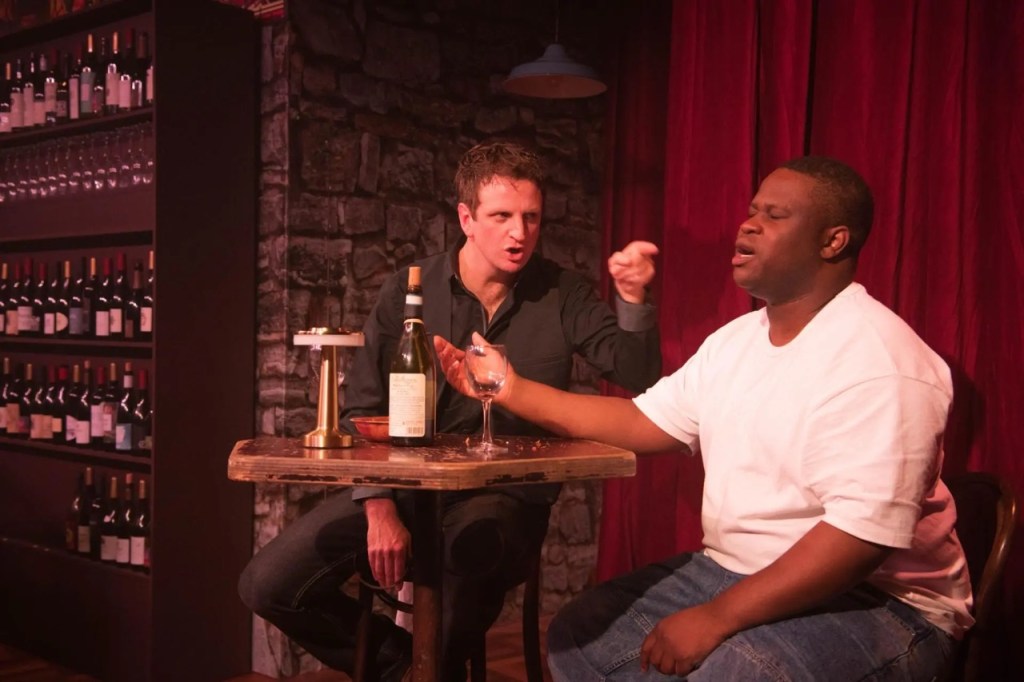
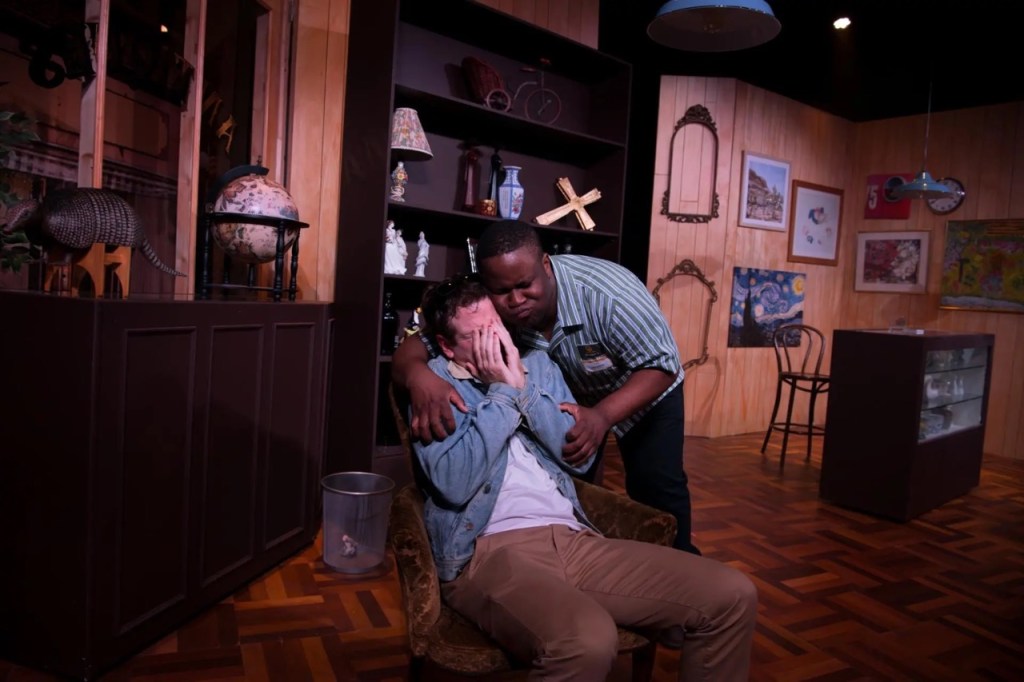
Aaron Glenane and Tinashe Mangwana. Photo: Daniel Asher Smith. To sum up a lot of my issues with this production I’ll just say that everything rang as false to me. From elements of the script (Matt doesn’t know about text messaging in 2004?), to the set (an excruciatingly long set change killed what little momentum the show was getting), to the lack of chemistry between the leads. Everything felt as thin and artificial as the stone-face wallpaper and “stained glass” mural above the bar.
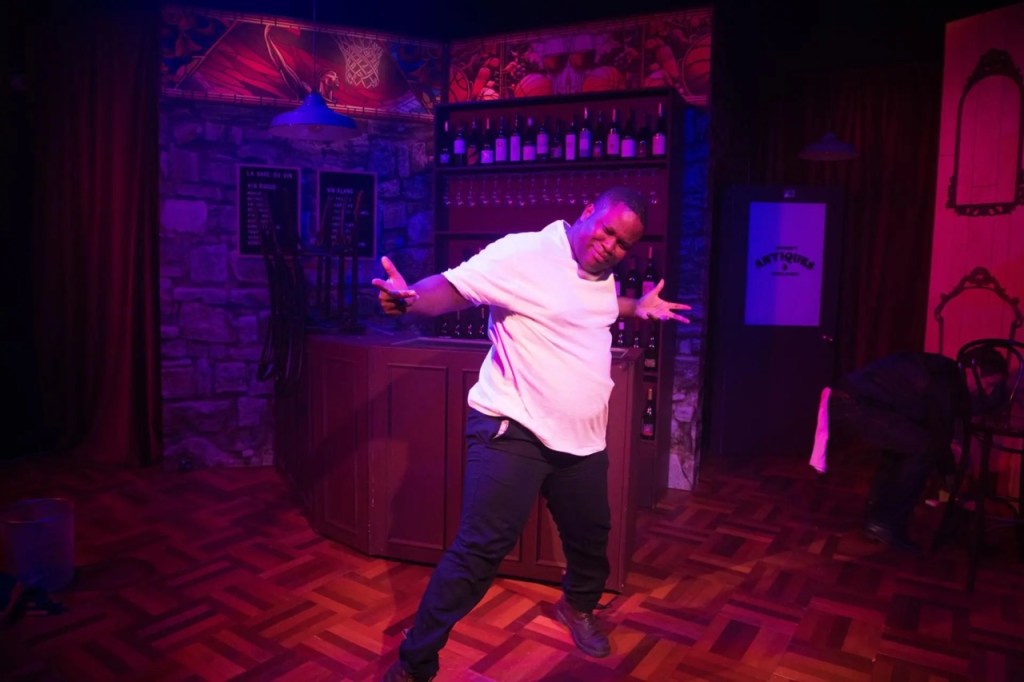
Tinashe Mangwana. Photo: Daniel Asher Smith. Now let me just say, this was not a perfect environment for a performance. A leak meant that a large section of the seating in the theatre was blocked off, and there were only a dozen people in attendance. Not the warmest of rooms for the two actors to face and that would affect any performer.
But I just didn’t believe in the core friendship, and if that doesn’t work the play falls apart. When the script pivots to issues of race, the conversation was so awkward and unrealistic my eyes rolled. The script kept “telling” us things that directions and performances simply didn’t “show”.
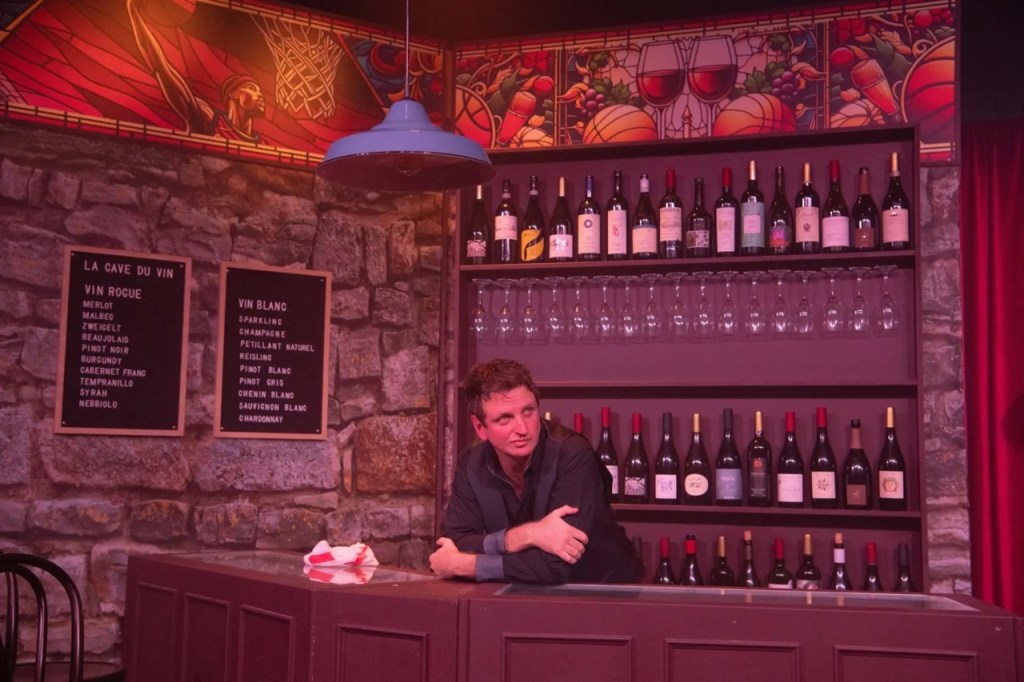
Aaron Glenane. Photo: Daniel Asher Smith. At its heart this is a play about male friendship. We know there are big problems with real world isolation and men’s mental health. At a time when many people struggle to say the word “masculinity” without putting the word “toxic” in front of it, we need more stories modelling healthy patterns of male behaviour and friendships. Especially for straight men. We need plays like King James. Which is why I think I was especially disappointed by this one. It floats around a topic worthy of our attention, then runs away to lay the blame on race relations.
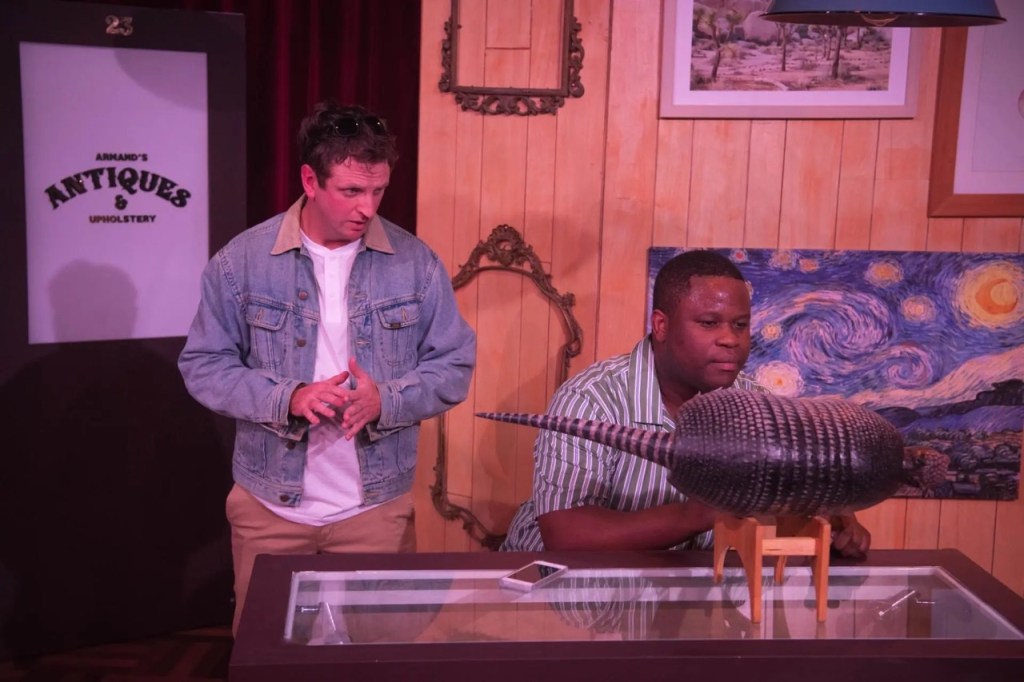
Aaron Glenane and Tinashe Mangwana. Photo: Daniel Asher Smith. One repeated line comes from Matt saying “This is the problem with America”… to which I just thought, “Who cares?” Without anything of substance to say about male friendship or modern masculinity, and only a token exploration of interracial friendships, King James just doesn’t have anything to say to Australia in 2024, at least, nothing that isn’t being better expressed in other plays.
So maybe I just saw a bad performance, while others saw it with all the buzz of Opening Night. But hey, that’s the fearful beauty of live theatre – every night is different.
-
American Signs (Sydney Theatre Co) ★★★★

Written by Anchuli Felicia King. World Premiere. Sydney Theatre Co. 15 Jun – 14 Jul, 2024.
No one likes management consultants. Even management consultants don’t like management consultants. It takes a performer of immense empathy to make us care for them and thankfully Catherine Văn-Davies is dynamic in this one-person show.

Catherine Văn-Davies. Photo: Prudence Upton. It’s all about statistics, and the stats on the lead character are this. Twenty-something, third-generation Vietnamese-American, Stanford graduate, horse enthusiast, starting her career at a top tier consultancy firm. One day she is chosen by her far-too-handsome (and far-too-married) superior, Max, to fly with him to Ohio to study a lighting manufacturer and look for cost cutting measures. She admires the way his manner is charming and friendly but his language is always non-committal, and the way his polo shirts fit very tightly… Moral quandaries are irrelevant, it all comes back to the data.
Playwright King dissects the semantic sedative that is corporate-speak and the hundred ways they have to say “lay offs”. The unnamed consultant is ambitious but clear sighted when it comes to the meaninglessness “values” her employers talk about. They’re nonsense, and she knows it, but she chooses to believe. Just as King ripped into the world of marketing in her play White Pearl, here she takes on the shadier world of management where numbers and profitability are more important than people.
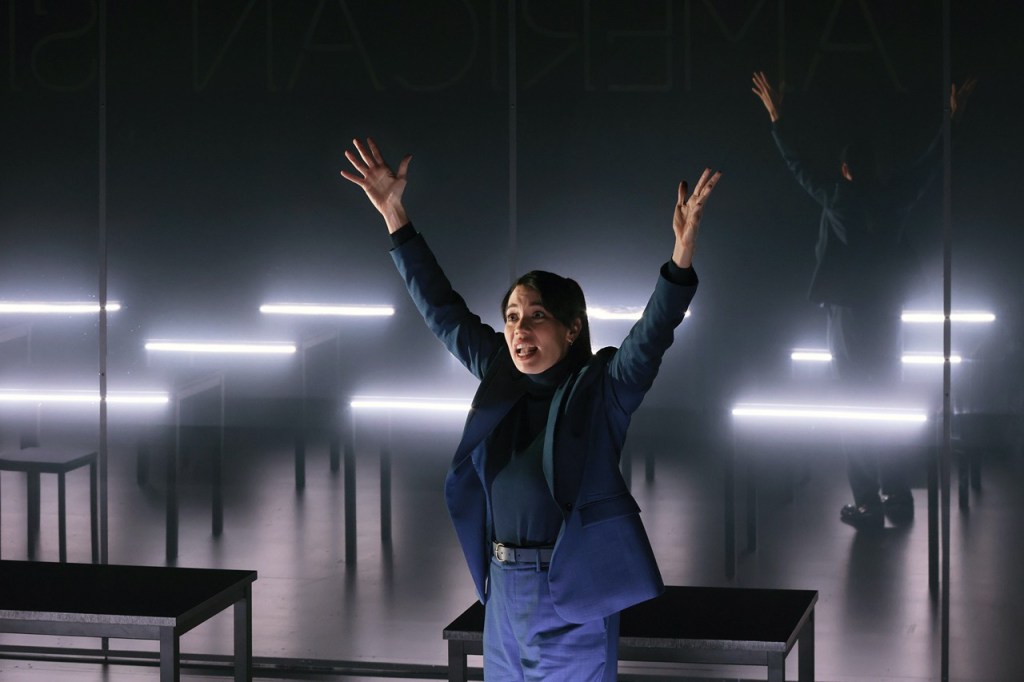
Catherine Văn-Davies. Photo: Prudence Upton. The moral trick of consultancy is the lack of direct responsibility. They are handsomely paid to advise, not the act. As the character states, they don’t do policy, just crunch the numbers. They give upper management the distance and excuses they need to avoid the blame for their actions. But when The Consultant hears of a disaster caused by her recommendations, her professional distance starts to break down.
While the subject matter is nothing particularly new, it’s very well presented. Designer James Lew and Lighting Designer Benjamin Brockman have created a set of sharp lines and neon that easily takes us from an office, to a factory, to a shop, a chapel and a hotel room without distraction. The rear wall of mirrors keeps us, the audience, in the picture at all times, and a single laptop flashes phrases of jargon like chapter headings. Into this cold, inorganic space, Văn-Davies is at once part of the furniture, then an agent of disruption.

Catherine Văn-Davies. Photo: Prudence Upton. Director Kenneth Moraleda doesn’t give The Consultant pause. She is on stage from the moment the audience enters, and sits patiently as we leave – with no curtain call. She is forced to keep her mask up, ignoring the passersby. Much like her story, there is no real end, only a dawning realisation that the machinery of capitalism moves on with or without you. It numbs us all to the horrors we create and support.
King uses race to demonstrate that for all the talk of cold hard data, even corporate greed is not colour-blind. The Consultant is chosen for the role because of her boss’s racial fetish. The head of the lighting factory being “right-sized” is an African-American woman. Her bosses are white.

Catherine Văn-Davies. Photo: Prudence Upton. Much like White Pearl, I felt American Signs was playing with big ideas around race and modernity, but I couldn’t quite get a solid grasp on what it actually wanted to say – I could intuit meanings, but they weren’t necessarily being presented to me. This melange of capitalism, race, horses and neon is gripping, but I feel like I’m personally still not 100% on King’s wavelength as a writer.
Catherine Văn-Davies is that wonderful mix of approachably lovable but also dramatically intense. She flips from tone to tone like a gymnast, coalescing the big themes into a personal story of one young woman’s life. She’s twenty-something, making romantic mistakes and losing her idealism. The really tragic part is how she ultimately shapes herself into another soulless cog in the machine for the cold, hard cash. Capitalism at its most insidious.
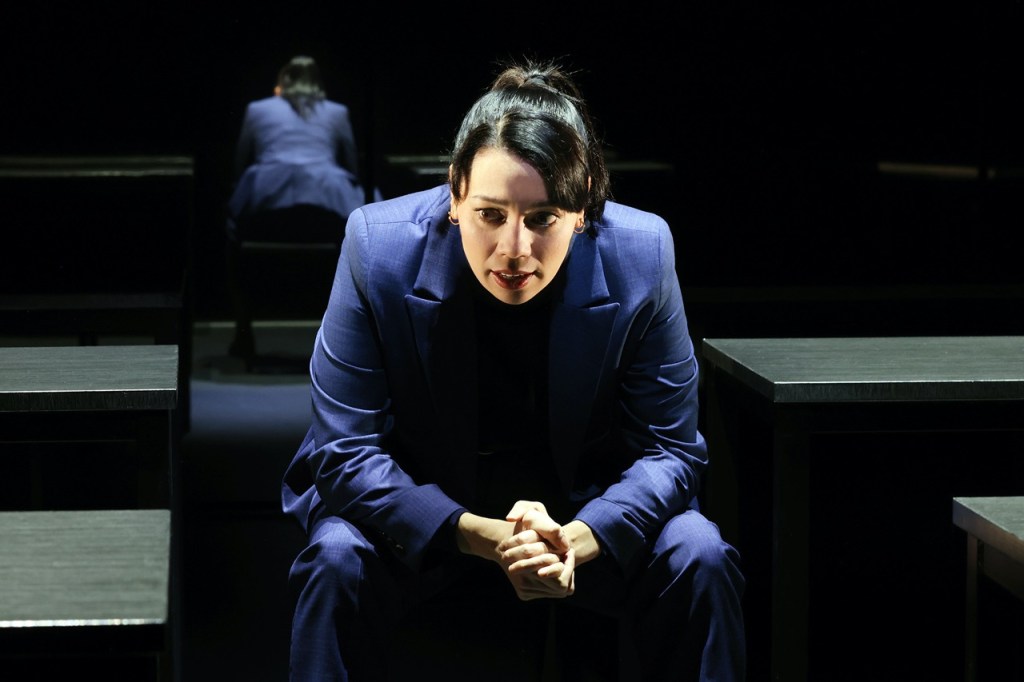
Catherine Văn-Davies. Photo: Prudence Upton. At a swift 70 minutes duration, American Signs is great for these cold winter nights (you’ll still have time to grab dinner after, or just get home to bed early). The combination of Anchuli Felicia King’s words and Catherine Văn-Davies’ presence, along with the seamless production team, make this a perfect little black-box theatre show, and a welcome christening for the Sydney Theatre Company’s smaller Wharf 2 space.
-
Master Class (Ensemble) ★★★½

Written by Terrence McNally. Ensemble Theatre. 14 Jun – 20 Jul, 2024.
Famed soprano Maria Callas is played, mostly, for laughs in Terrence McNally’s Tony Award winning 1995 play, giving Lucia Mastrantone the chance to work the room and terrorise her fellow performers.
Opera superstar Maria Callas (Mastrantone) is teaching a master class, and everyone’s invited. This is not a theatre anymore, but a classroom and we, the audience, are here to observe and learn. Between making demands of the staff and chit-chatting with Manny, the accompanist (Maria Alfonsine), Callas turns her hyper-critical eye on three aspiring students.
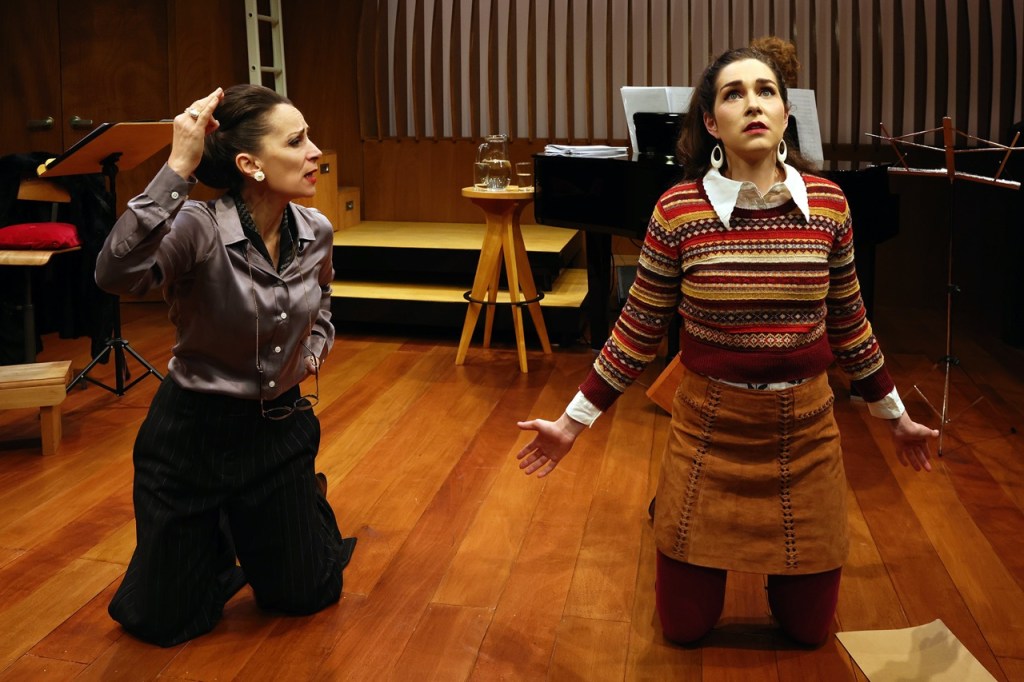
Lucia Mastrantone and Bridget Patterson. Photo: Prudence Upton. Don’t worry if you aren’t a fan of Callas or know her story, McNally lays out the important pieces in long monologues and dream sequences as Callas either lectures or gets lost in her own thoughts. These fantasy moments help break up the single location and allow us to get past the bluster and see more of the woman underneath. Her insecurities, her desire to be loved & appreciated and her grit are all laid bare.
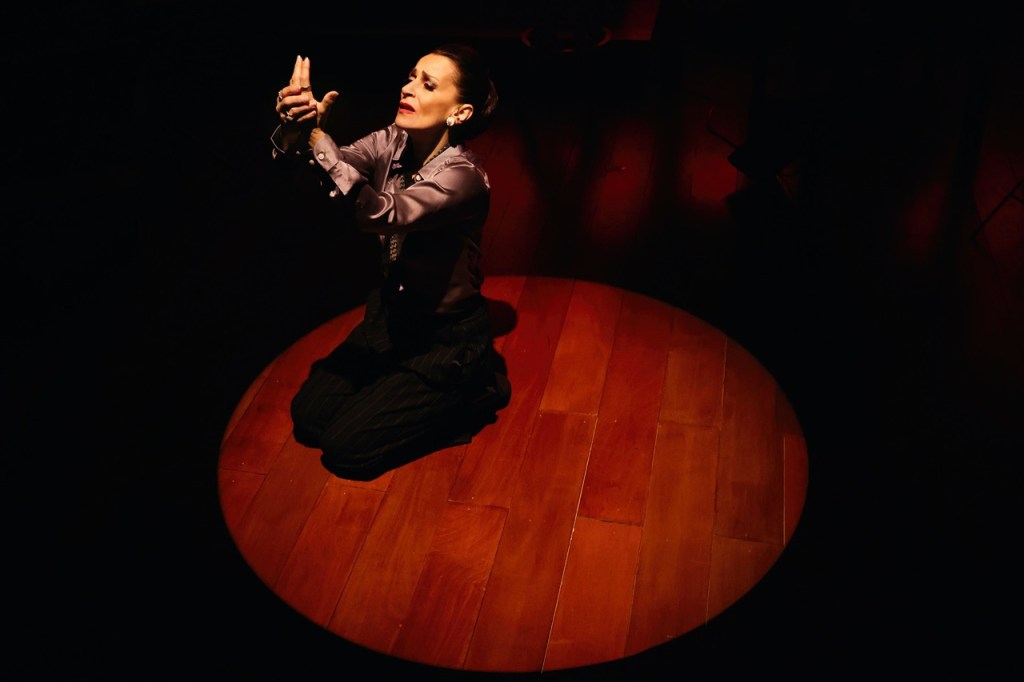
Lucia Mastrantone. Photo: Prudence Upton. There’s an undeniably cathartic joy to watching horrible people be horrible to other people and much of the play is devoted to navigating Callas’ tricky attempts at delivering constructive criticism. Beneath the smile is a grimace, behind the eyes is disgust and she can not help but let the venom flow. The script enjoys taking swipes at other famous sopranos, especially our own Dame Joan Sutherland, which gets wry acknowledgement from the audience. All too often though this production settles for the easy laugh without the necessary emotional weight and character. Callas is a caricature of a passive-aggressive diva instead of a complex woman reconciling with her life.
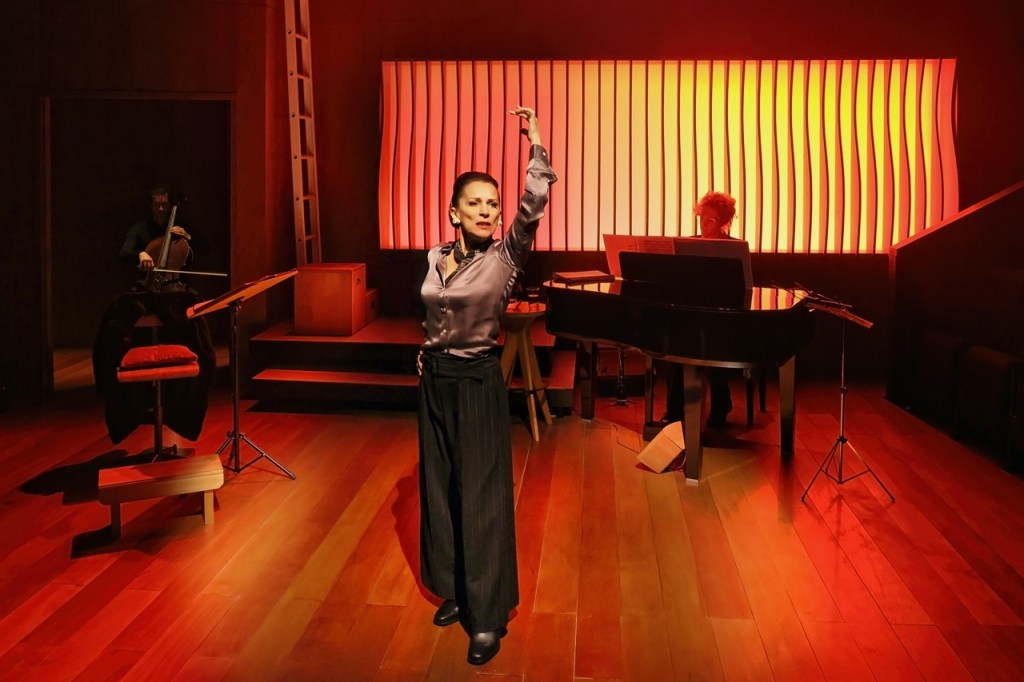
Lucia Mastrantone. Photo: Prudence Upton. The first act sees Callas torment three students, the blasé Sophie De Palma (Bridget Patterson), the skittish Sharon Graham (Elisa Colla) and the overconfident tenor Anthony Candolino (Matthew Reardon). It’s always a dicey proposition to ask performers who excel at one creative form to stand on stage and act as well. Sure they can sing/dance etc, but can they actually act at a standard to match their co-stars? There is a reason the script for Master Class steers away from making Callas sing live on stage – finding a lead performer who can hold the stage for two hours AND sing like a world class soprano is a tough casting call. Not all the cast achieve this double act, with some stunning professional voices being undercut by hammy acting, with one clear exception.
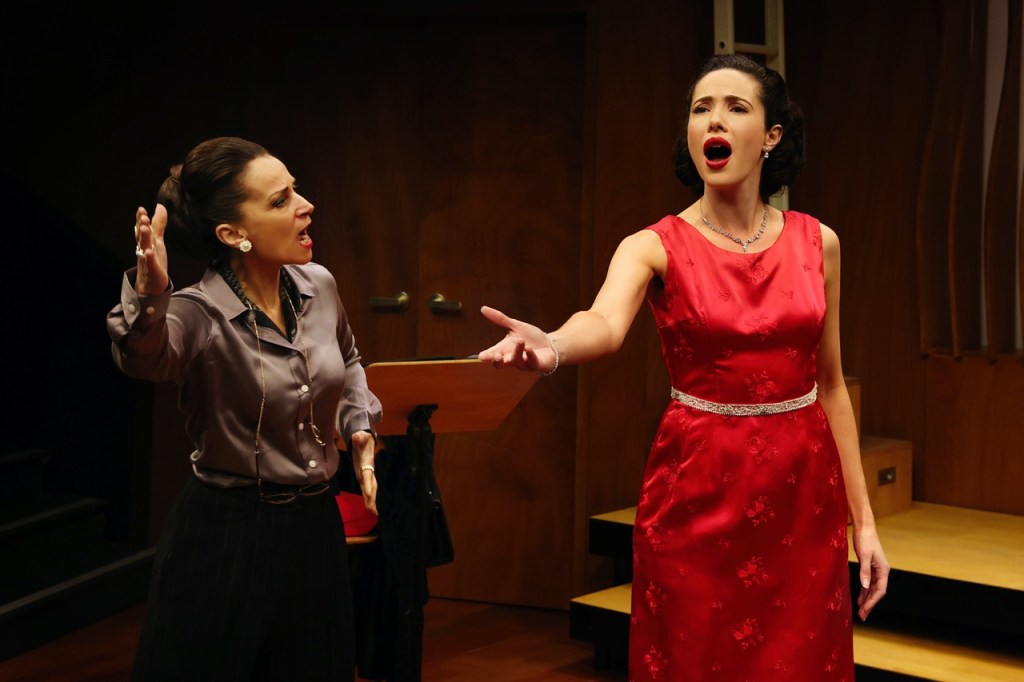
Lucia Mastrantone and Elisa Colla. Photo: Prudence Upton. Musical theatre actress Elisa Colla is the real star of this show. With her crystal cut vocals and perfect comedy timing, she pitches the shy but plucky soprano Sharon at the right level. After some earlier moments that felt like they were running on autopilot, she takes the wheel. You can see her listen and react to her costars making the laughs organic and fresh. Her authentic subtlety makes the second act truly sing.
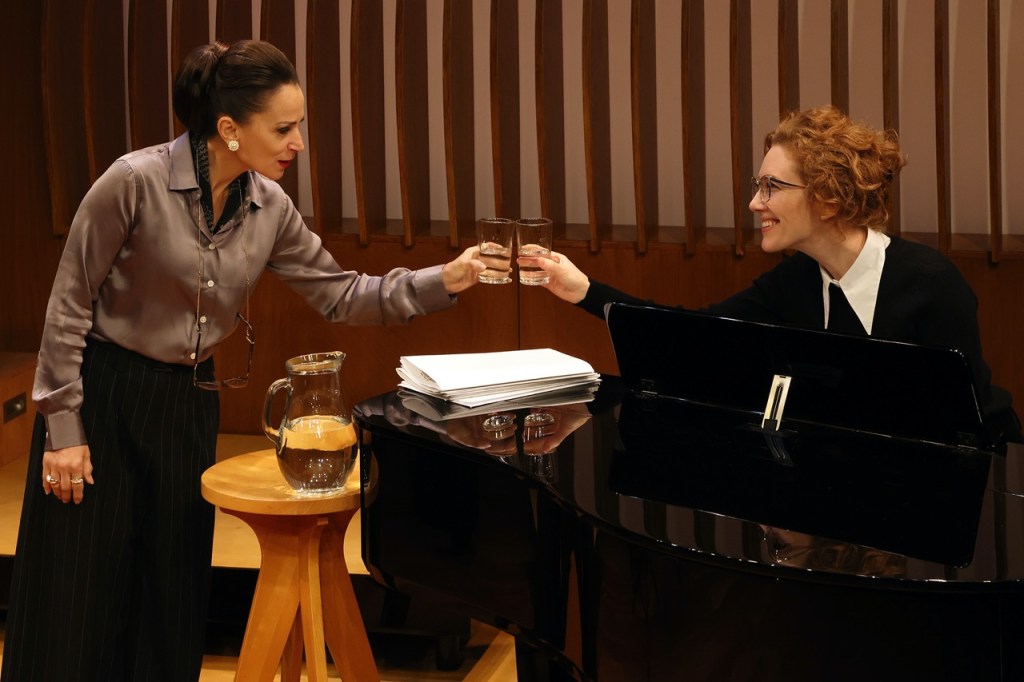
Maria Alfonsine and Lucia Mastrantone. Photo: Prudence Upton. I’m not the first to say that Master Class, well, isn’t actually a very good play. It’s over long, heavy handed and not particularly funny. But it has always been an excellent showcase for a lead actress. Here Mastrantone gets to hold the stage and demonstrate just how magnetic she is, and she succeeds with ease, on top of this Colla’s supporting role is the icing on the cake.
-
Ride The Cyclone (Hayes) ★★★★
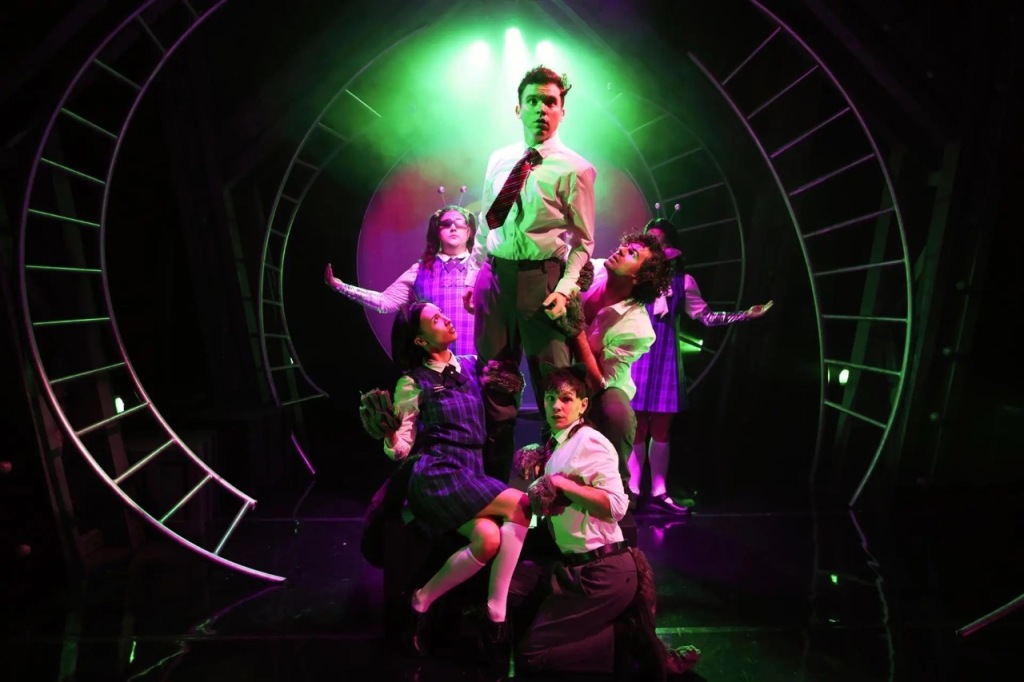
Book, Music & Lyrics by Jacob Richmond & Brooke Maxwell. Hayes Theatre. 23 May – 22 Jun, 2024.
Less a musical, and more a song-cycle with a basic plot, Ride The Cyclone sees the team at the Hayes pull out all the stops and boy does it pay off. When you’re having this much fun, who cares if the plot treads water.
When five (or is it six?) members of St. Cassian High School chamber choir die on a roller coaster named “The Cyclone” they find themselves in an odd limbo where a mechanical fortune-telling attraction, The Amazing Karnak (voiced by Pamela Rabe), has the power to send one of them back to the land of the living… but which one?
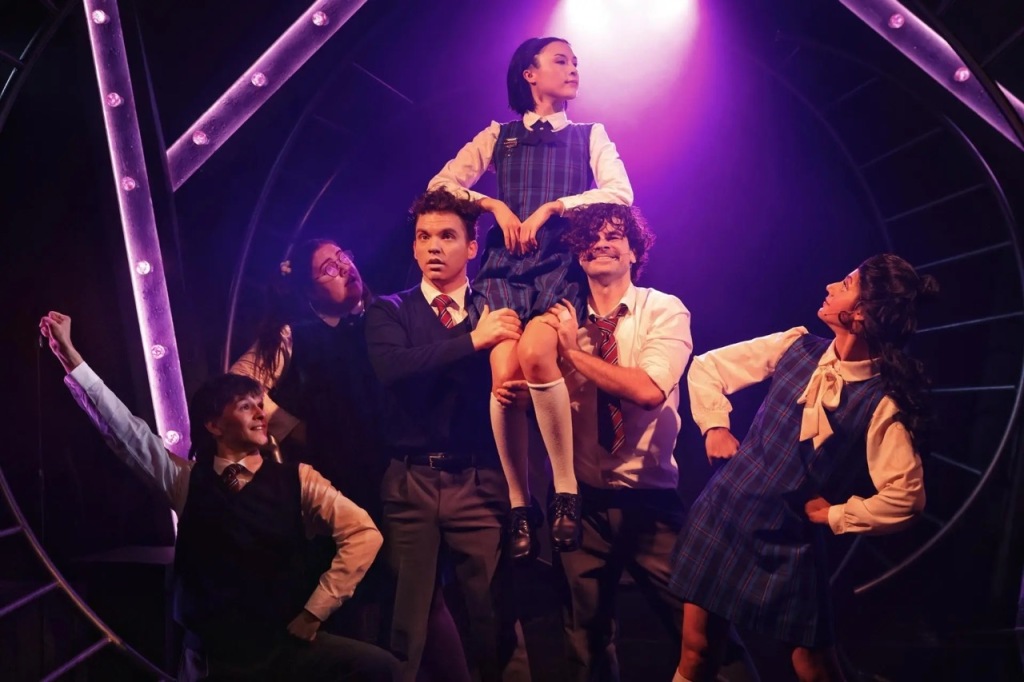
Cast of Ride The Cyclone. Photo: Prudence Upton. Will it choose Ocean (Karis Oka) the overbearing, overconfident, overachiever? Constance (Mel O’Brien) Ocean’s compliant “best friend”? Noel (Bailey Dunnage) the gay teen with dreams of being a classic film starlet? Mischa (Lincoln Elliott), the Ukrainian kid with a love of gangsta rap? Ricky (Justin Gray) the near mute with sci-fi dreams? Or the creepy kid none of them recognise, Jane Doe (Ava Madon)?
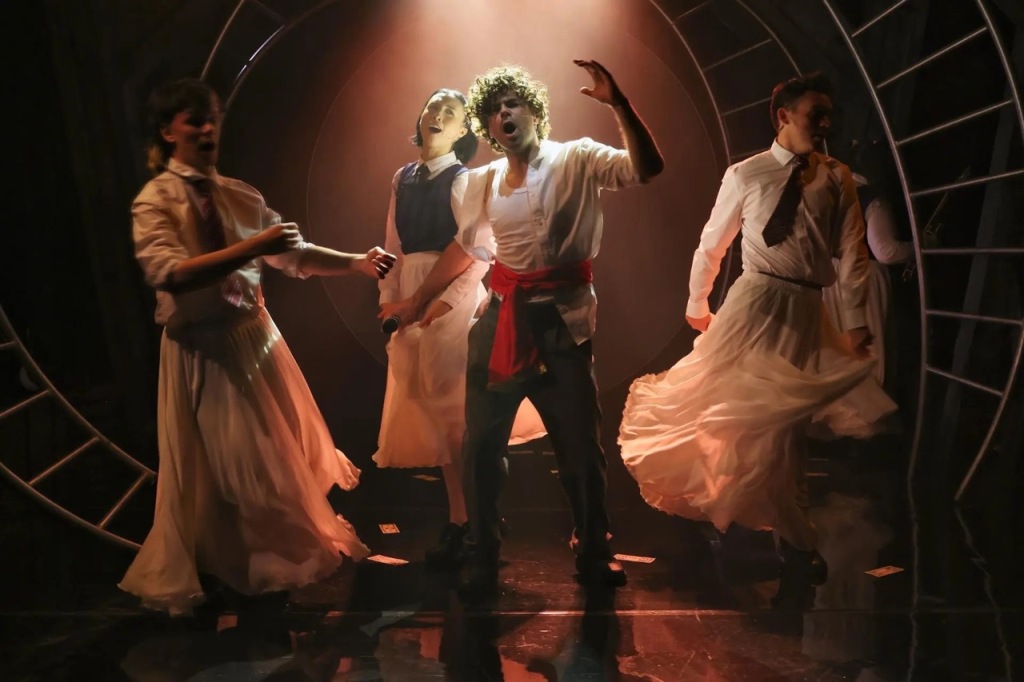
Cast of Ride The Cyclone. Photo: Prudence Upton. And so we begin… or more to the point, sit very still as each of the kids sings a song revealing their true inner selves in what is basically a singing competition (kinda like Six). Richmond and Maxwell’s songs vary in quality as they mimic different genres (kinda like Six). Ocean’s opening number “What the World Needs” is an instant hit, an uptempo noughties pop hit about her own superiority, as is the shows triumphant closer “It’s Not a Game / It’s Just a Ride” and post-show “Be Safe, Be Good”. Noel’s teenage ode to French cinema sirens is good for a laugh, as is Jane Doe’s morbid ballad. Less successful are Mischa’s Snoop Dog/Eminem-inspired rap “Talia” and Ricky’s “Space Age Bachelor Man” which are less ‘loving pastiche’ and descend into clear mockery of their subjects.
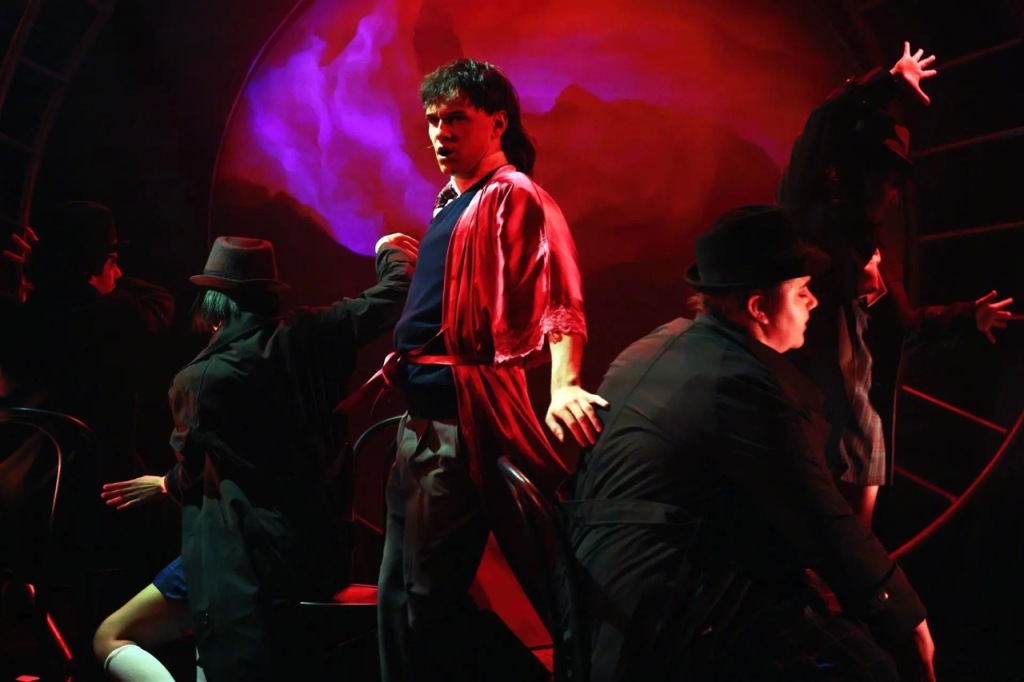
Bailey Dunnage. Photo: Prudence Upton. The strongest role is Pamela Rabe’s pre-recorded voice of The Amazing Karnak, who gets all the best jokes. It’s the success of the script that holds the show together and stops it from, well, spinning out of control or simply becoming a song-cycle/showcase for the songwriters.
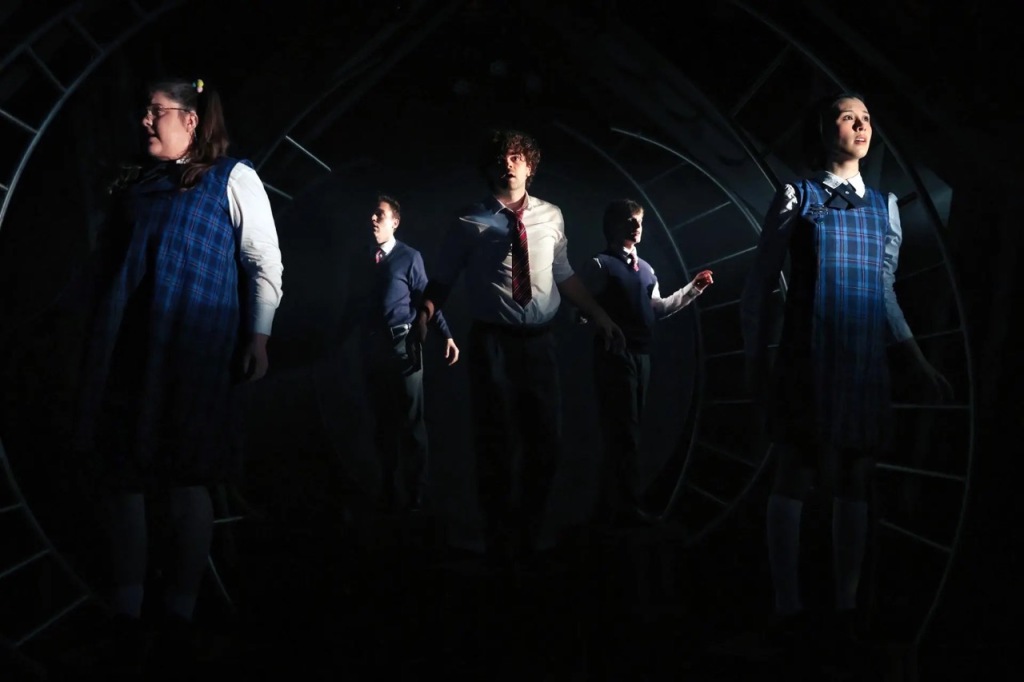
Cast of Ride The Cyclone. Photo: Prudence Upton. The cast are all fantastic. This ensemble is incredibly tight and under Richard Carroll’s direction keeps things moving despite the thin premise. But the true star of the show is Benjamin Brockman’s immersive set (easily the best ever seen in the Hayes Theatre) and Ryan McDonald’s kaleidoscopic lighting that manages to evoke a whole metaphysical, action packed, amusement park into the tiny space. Seriously, without them both this show would not be anywhere near as successful.
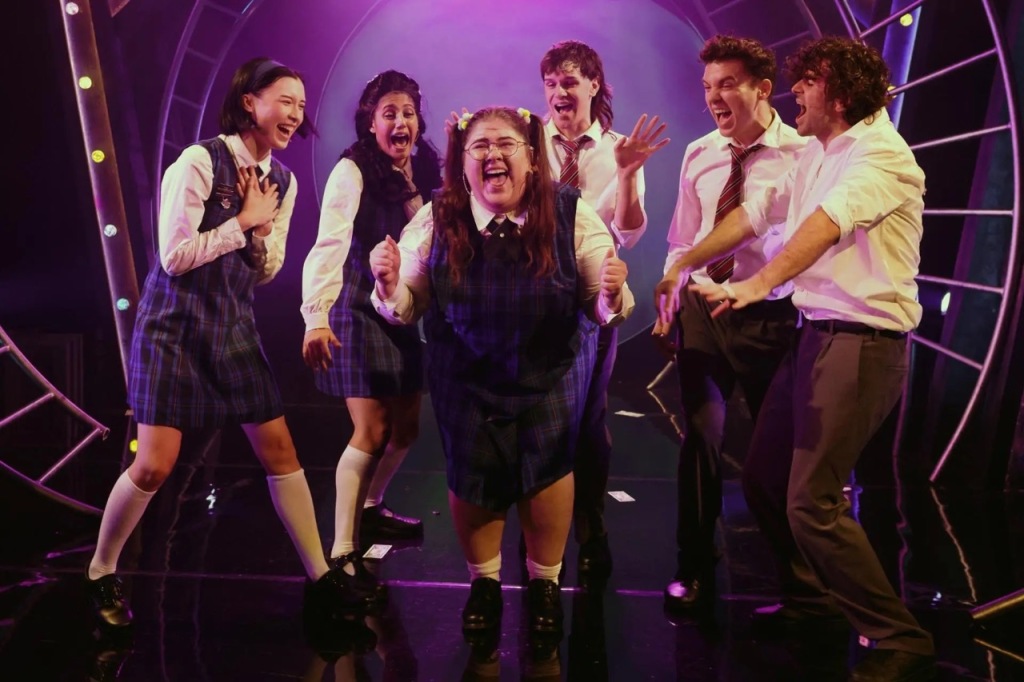
Cast of Ride The Cyclone. Photo: Prudence Upton. Ride The Cyclone is a hell of a lot of fun and deserves its cult status. The tunes may be a little dated now (it’s very 2008 – and to be clear, this show predates Six by almost a decade) but they’re upbeat and catchy enough to become cabaret night staples. Get a ticket if you can, it’s already sold out but there is a wait list for returns.
-
Watershed: The Death of Dr Duncan (Sydney Opera House) ★★★★

Composed by Joseph Twist. Libretto by Alana Valentine & Christos Tsiolkas. Joan Sutherland Theatre, Sydney Opera House. 14-16 Jun, 2024.
Following its acclaimed debut at the Adelaide Festival in 2022, the new Australian oratorio Watershed: The Death of Dr Duncan debuts at the Sydney Opera House retelling the story of the drowning of Dr George Ian Ogilvie Duncan. This homophobic murder, at the hands of police, would galvanise South Australia into leading the way on the decriminalisation of homosexuality.
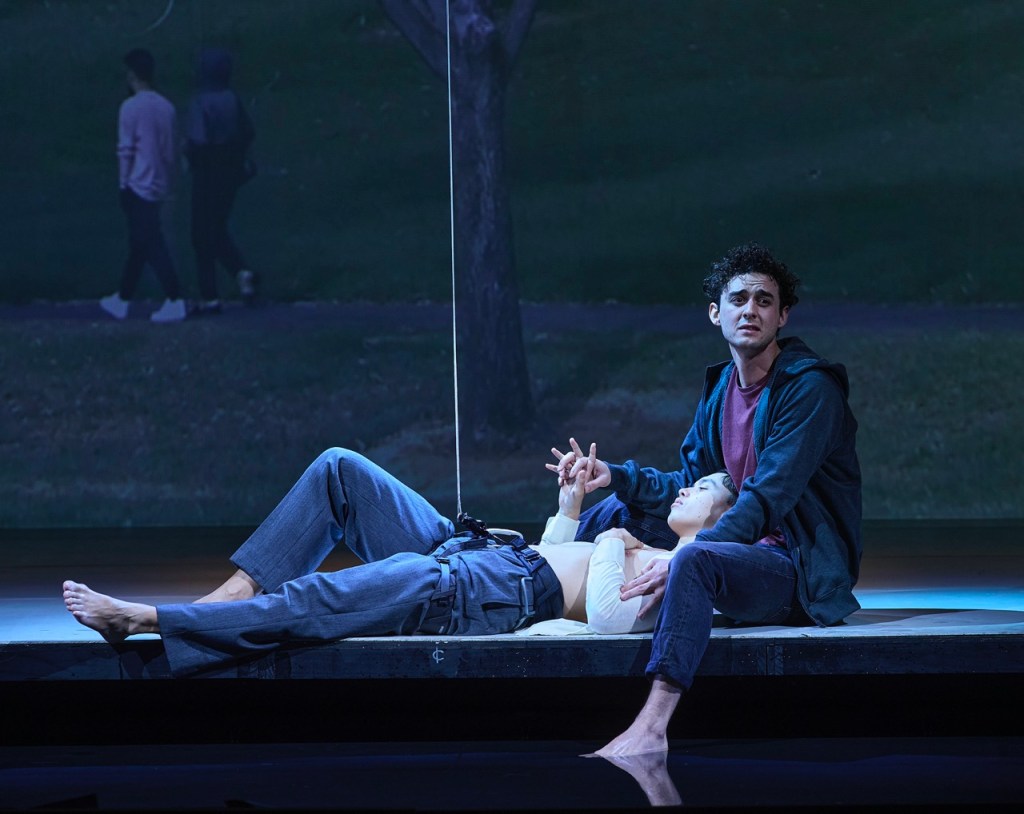
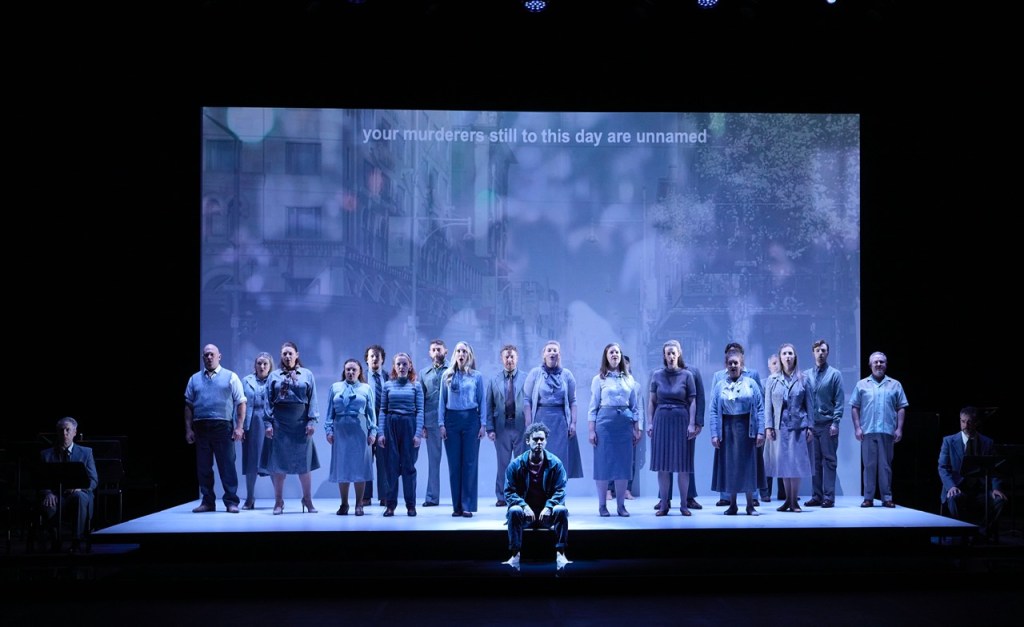
Commissioned and directed by Neil Armfield, for his final season as Festival Director, to commemorate the 50th anniversary of the murder, Watershed sees a core cast of four bring the story to life. Tenor Mark Oates and Bass Pelham Andrews return to sing the majority of the roles, from cops, lawyers, politicians and Duncan himself. They are joined by Tomáš Kantor as Lost Boy (a narrator of sorts) and Macon Escobal Riley as the dancer who embodies the drowning Duncan. The Opera Australia Chorus play a variety of smaller roles and serve as the Greek Chorus to the tragedy.
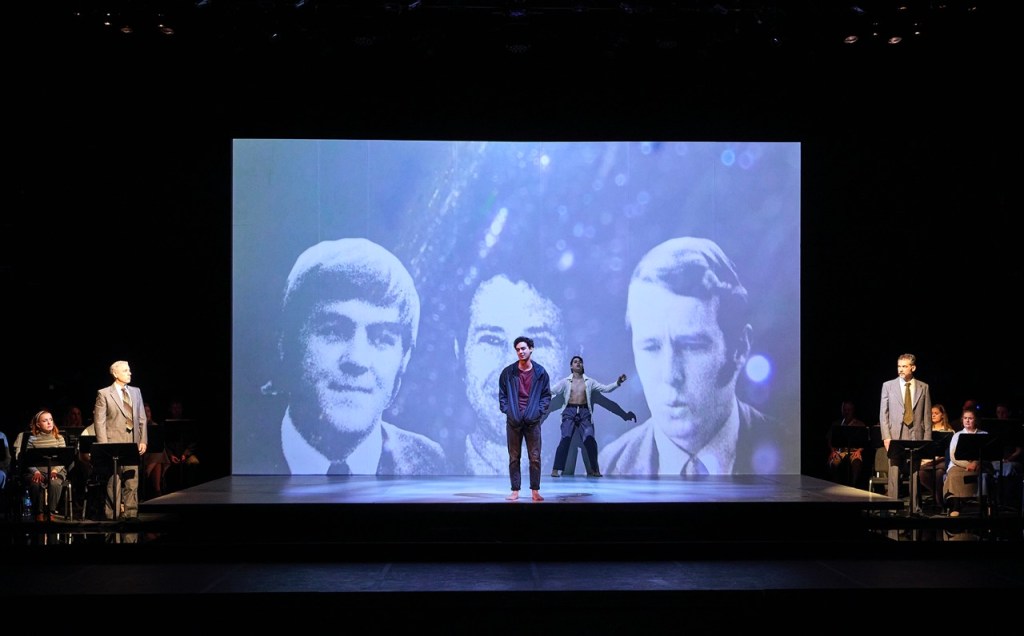
Starting with Duncan’s murder, the show spends most of its time exploring the legal and political movements that would swell afterward. An institutional cover up would protect those responsible (while officers were eventually accused, a prosecution was never pursued), but the outcry would lead to South Australia decriminalising homosexuality. However the show is quick to point out how that is little consolation for the many who had already been killed by homophobes.
There is a mournful, and contemplative poetry to Ailsa Paterson’s set – a platform surrounded by water, with a large projection screen behind. This is complemented by the design team of Sean Bacon (video), Jane Rossetto (sound) and Nigel Levings (lighting). A similar restraint is found in Armfield’s direction. Lewis Major’s choreography adds movement and beauty to the tale, a vital ingredient in making the show a success.

The real star is the music. Composer Joseph Twist’s orchestration plays with choral works as well as elements of musical theatre, ensuring that there is always an air of movement and diversity to the otherwise fairly static production. The libretto by Alana Valentine & Christos Tsiolkas is often blunt (the opening song, set during a sexual encounter in a public toilet is not coy in any way… it’s not everyday you see the word “cum” in a surtitle), but is also charmingly colloquial (at one point love is referred to as “a cheesy melt”). At first it makes your brain backflip over the high/low cultural divide, but once you’re in its grip you settle into the rhythms.
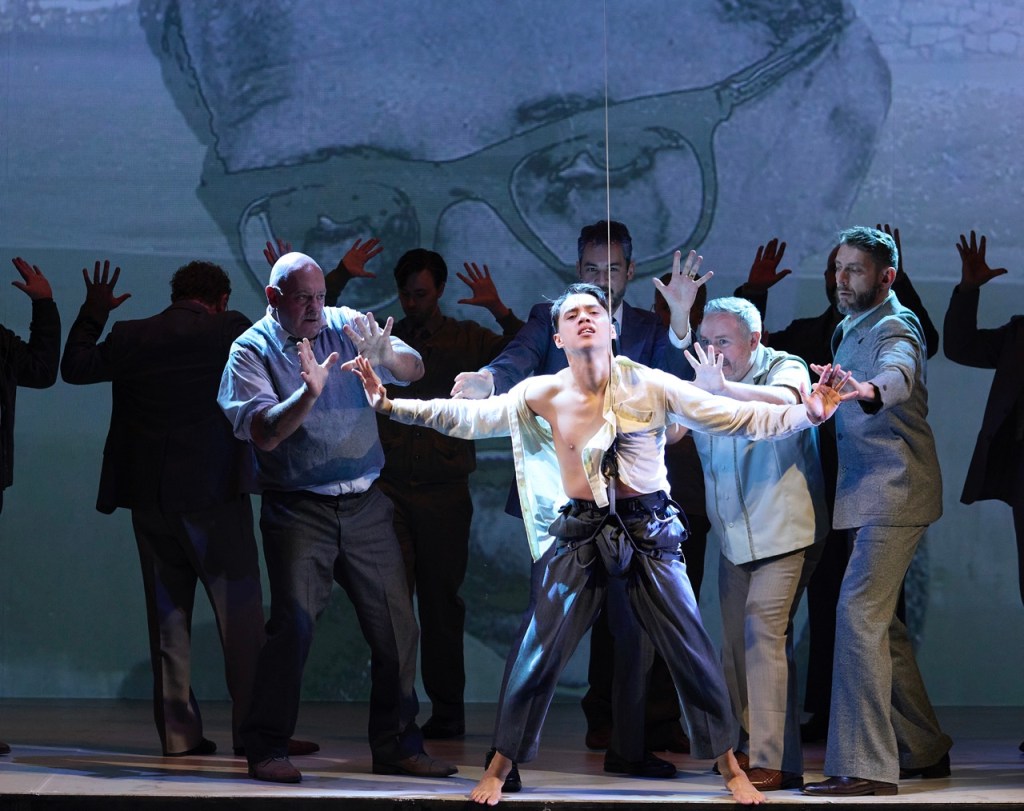
Kantor’s wide-eyed empathy radiates across the theatre, a conduit for the stories’ grief and rage. The powerful imagery of Riley first descending from the ceiling as he drowns, is repeated in reverse at the end – seeing him rise to the heavens is breathtaking to watch.
If you’re a student of queer Australian history, this is an enlightening look at our own story. For lovers of choral work, it’s a fresh Australian piece. With so few performances I’d urge you to rush out and see it.
-
Chicago (Capitol Theatre) ★★★½

Music by John Kander. Lyrics by Fred Ebb. Book by Fred Ebb and Bob Fosse. Capitol Theatre. 9 Jun – 28 Jul, 2024.
Kicks, splits, tits and Lipschitz – Kander & Ebb’s Chicago has Fosse’d its way back into town. This almost-30-year-old production of an almost-50-year-old show was last seen in Sydney in 2019. And as great as the ol’ girl is… has she run out of steam?
The short answer is ‘no’. Chicago is a classic for a reason – the combination of three musical theatre geniuses in Kander, Ebb and Fosse have created a show that is unironically bullet-proof. Walter Bobbie and Ann Reinking’s production (first staged in 1996) is sleek and sexy, keeping the focus on the smallest of movements. It makes the big space of the Capitol Theatre feel intimate. And these tunes are so ingrained in the musical theatre canon, the show plays like a Greatest Hits concert.
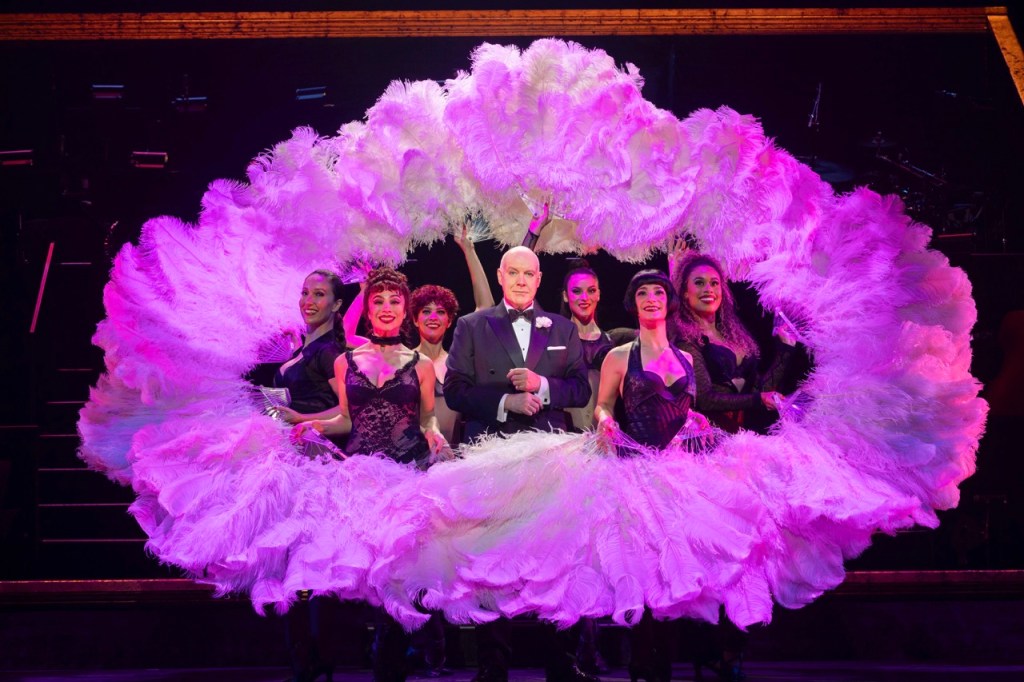
Anthony Warlow and female ensemble. Photo: Jeff Busby This new tour sees Zoë Ventoura and Lucy Maunder step into the roles of the jaded Velma Kelly and the avaricious Roxie Hart. Both nail their parts as the hard working professionals they are. The Fosse-inspired choreography is handled beautifully, but their vocals felt timid at times lacking show-stopping power. Anthony Warlow is effortlessly excellent as Billy Flynn (did you expect anything less?) and Peter Rowsthorn wins the heart of the audience as the ignored Amos Hart. Asabi Goodman is so powerful as Mama Morton you wonder whether they even bother to mic her.
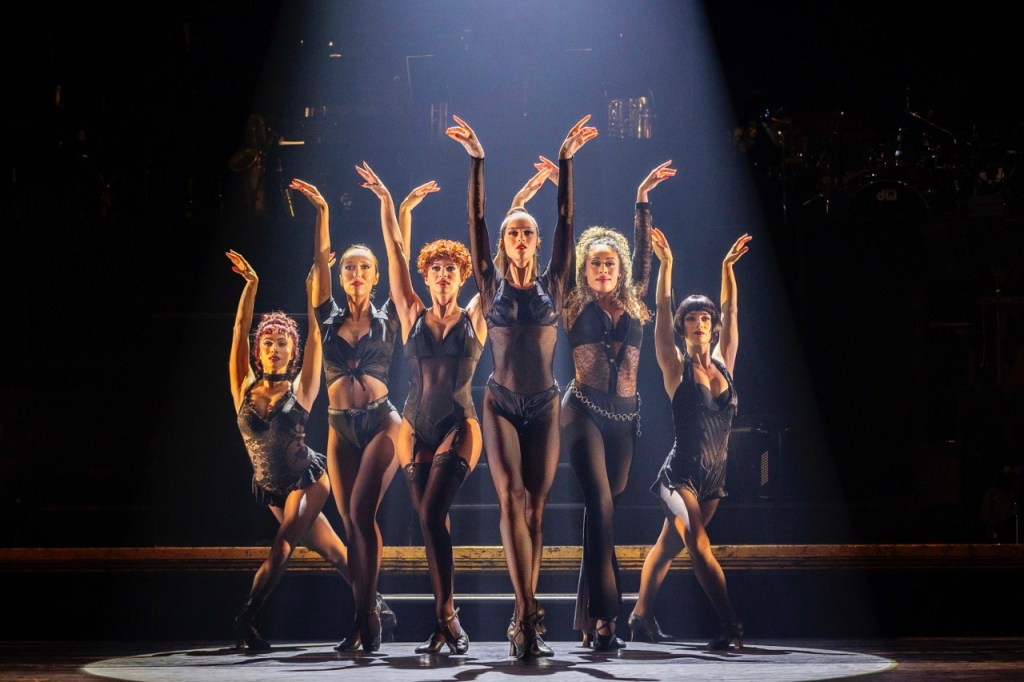
Female ensemble. Photo: Jeff Busby. But for all the attention that is paid to the leads, the real stars are the sexiest ensemble to populate a show. This crew of triple threats with abs to spare and curves to die for (if you need winter gymspiration – here it is) are the true drawcard, serving comedy, choreography and stunning vocals in skin-tight mesh and leather. To steal a line from The Producers, “Even though we’re sitting down, we’re giving you a standing ovation.”

Lucy Maunder and male ensemble. Photo: Jeff Busby. Overseas, Chicago has run non-stop for decades (it’s currently the longest running show on Broadway), cycling through celebrity stunt cast after celebrity stunt cast to the point it has become something of a punchline. But I can’t help think about how two things can be true at the same time. This production of Chicago is both a glorious classic I love and simultaneously dated and tired. It’s like listening to Fleetwood Mac’s ‘Rumours’. You can appreciate the genius while thinking it’s old fashioned.
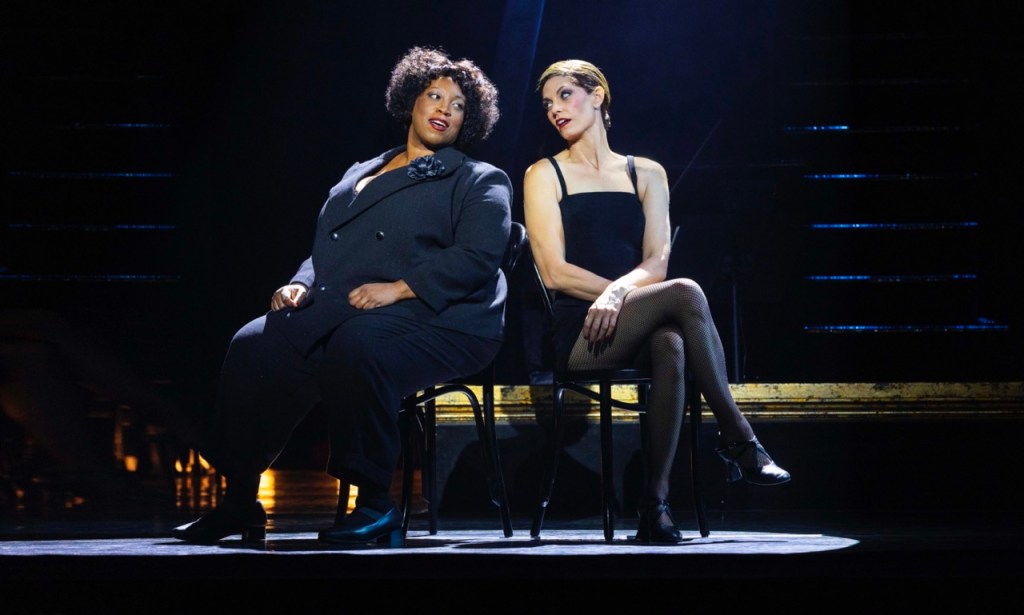
Asabi Goodman and Zoë Ventoura. Photo: Jeff Busby. If you’ve never seen Chicago then go and soak it all in. If you saw it in 2019 and are wondering whether to see it again, well, that’s going to be up to you. But for new audiences, accustomed to the technology and wizardry of modern theatrical blockbusters, it may seem a little quaint. Hopefully, one day soon, a new director will be allowed to reinvent the show for the next generation to come.
-
Stolen (Sydney Theatre Co) ★★★★½

Written by Jane Harrison. Sydney Theatre Company. 6 Jun – 6 Jul, 2024.
Jane Harrison’s 1998 play Stolen feels as cutting and vibrant as ever under the direction of Ian Michael. In 2024, it serves as a bitter reminder of Australia’s great sin, and an indictment of modern day Australia who denied indigenous Australians a voice in Parliament just recently..
Five children, Jimmy, Ruby, Shirley, Sandy, and Anne, taken from their families in a coordinated government scheme, tell their stories. Filled with tragedy, joy and pain, the cruelty inflicted on the Stolen Generation is laid bare.
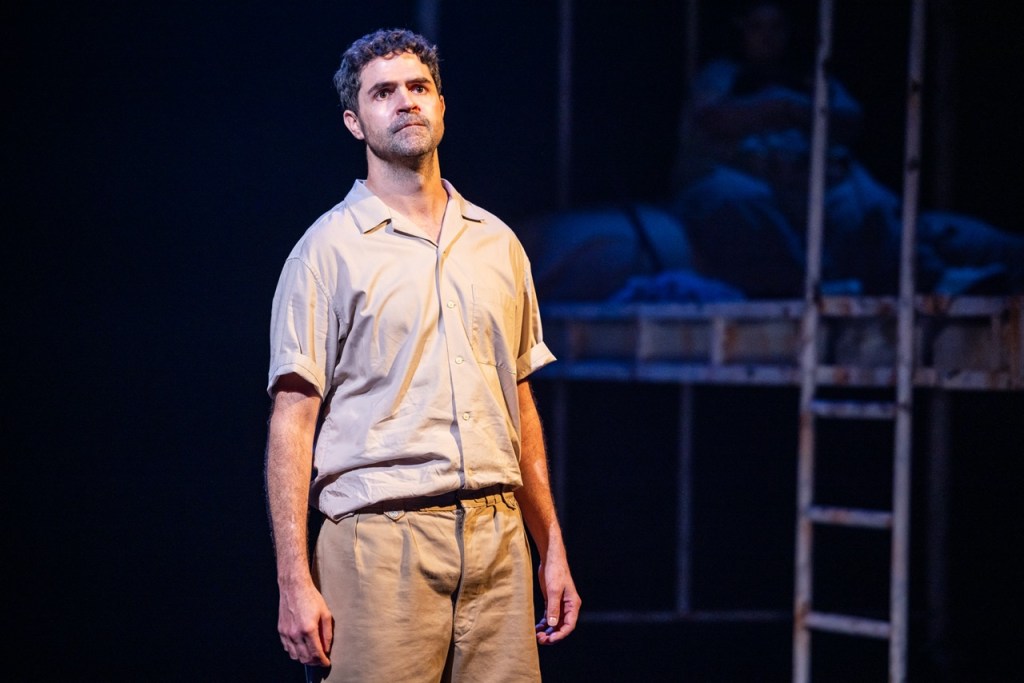
Mathew Cooper. Photo: Daniel Boud. The first thing you notice about Stolen is its sense of scale and space. The Wharf 1 Theatre stands almost bare, but that space is dominated by a gigantic metal bed frame, suitcases and an oversized filing cabinet. Renée Mulder’s set design is poetic in its simplicity. The five children at the core of this story are small and innocent in a world they can’t yet grapple with. James Brown’s score turns up the emotion when needed, sitting in balance with the rest of the elements. Trent Suidgeest’s lighting uses shadows to menace the children. It is a sparse but effective presentation.
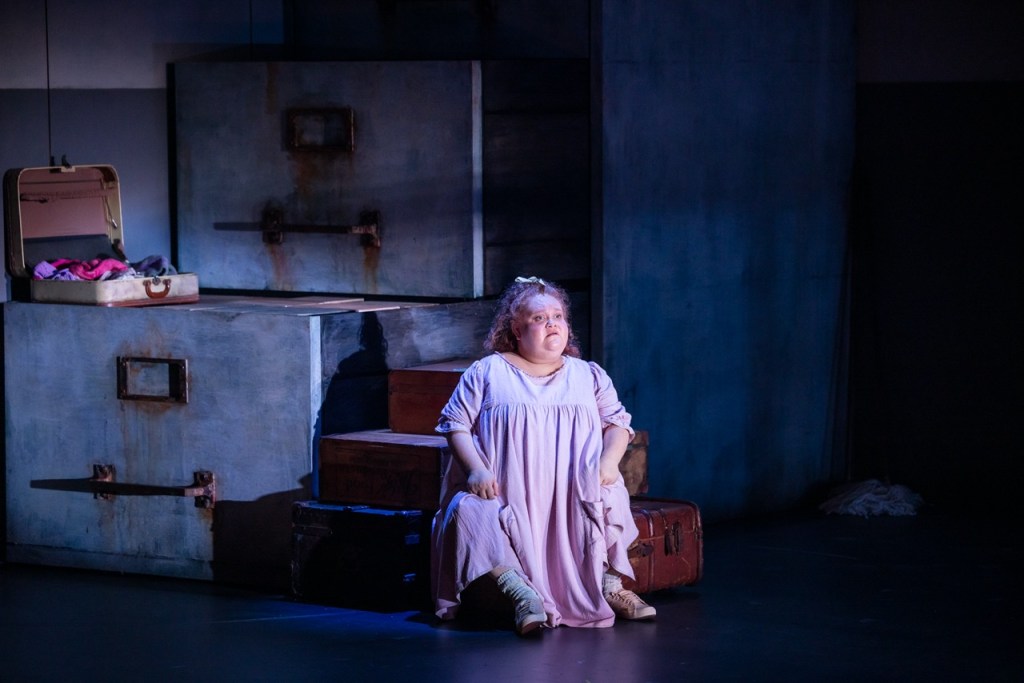
Megan Wilding. Photo: Daniel Boud. Ian Michael’s production balances the awkwardness of adults playing children with finesse thanks to the great performances by the cast. It’s refreshing to see Megan Wilding be given a meaty role that utilises both her comedic and dramatic chops. Stephanie Somerville’s Anne, a light skinned girl, finds herself rejected by both societies. Kartanya Maynard’s Ruby is subjected to the worst of humanity. Mathew Cooper’s Sandy has the resilience to survive and grow through it all.
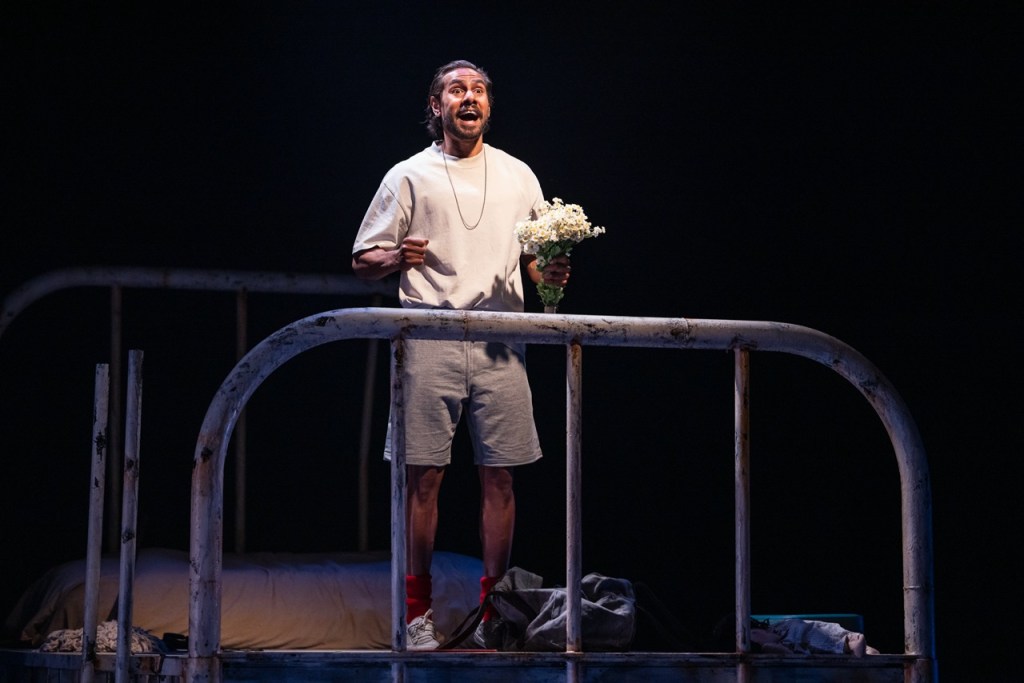
Jarron Andy. Photo: Daniel Boud. In the end, it is Jarron Andy’s Jimmy who emerges as the show’s stand out. A vivacious child determined to reconnect with his mother, his journey is all too familiar and devastating.
Harrison’s text has a timelessness to it that refuses to let us push these events into the past. Heartbreaking scenes of a mother writing letters to her son, which are never delivered, are more devastating for their lack of mawkish sentimentality. Even when the characters are happy, the wounds are close to the surface. The closing moments balance scenes of joy and distress (this isn’t a misery-fest by any means, but you won’t walk out cheerful & chatty).

Megan Wilding, Mathew Cooper & Stephanie Somerville. Photo: Daniel Boud. Deeply affecting, it is simply impossible to watch Stolen without a sense of sadness and rage brewing within you. While the tragedies are leavened with humour and some beautiful staging, the serious reality can not be missed.
-
Interview: Watershed’s Historical Consultant Tim Reeves & Co-Librettist Alana Valentine.

Watershed: The Death of Dr Duncan, directed by Neil Armfield, receives its Sydney premiere this week at the Sydney Opera House, bringing the story of the homophobic murder of a South Australian man that lead to a significant change in Australian law to operatic life.
Tim Reeves, the show’s Historical Consultant, and playwright Alan Valentine, the show’s co-librettist, took some time out to help set the scene and answer some questions about the Adelaide Festival hit.

Mark Oates and Mason Kelly. Adelaide Festival 2022. Photo by Andrew Beveridge Q: To start, Tim, can you give us some of the history of Dr George Duncan and the events that inspired the opera. What was Australia like in the early 70s, especially in relation to its views on homosexuality?
TIM: Male homosexuality was still a major social taboo in Australia, and sexual acts between men were criminalised in every state and territory with the possibility of jail time. In South Australia, having sex even in the privacy of one’s own home was illegal. Many homosexual men met at beats, covert public spaces where there was always the risk of being bashed. Dr Duncan was killed at the River Torrens beat in Adelaide on 10 May 1972 after being thrown in by a group of men and drowned. Soon after a first private member’s bill was introduced into state parliament to decriminalise male homosexual acts, but it was watered down. In 1975 South Australia became the first Australian jurisdiction to embrace full decriminalisation.
Q: His murder became the catalysing incident for the LGBT movement in South Australia, leading to it becoming the first state in Australia to decriminalise homosexuality but, to me, it feels like it’s a piece of our queer history we don’t discuss enough. Has it been overlooked? Or do I just have an East Coast bias?
TIM: I am concerned that especially young queer Australian people are not aware that a horrible murder of a gay man over 50 years ago in South Australia was the trigger for dramatic legal and social changes, that eventually spread to other states and territories (Tasmania was the last to enact decriminalisation, in 1997). The many freedoms that the LGBTIQA+ community enjoys today is on the back of that shameful event. We should never forget Dr Duncan, a quiet and unassuming law academic whose violent and senseless death ultimately ricocheted around the nation.
Q: We’re in a time when LGBTQ rights are being challenged and conservative politicians are targeting trans Australians. Are we sliding back to those dark times of the early 70s?
TIM: There are many countries in the world – including in Africa and Europe, but especially America – where hard-fought LGBTIQA+ rights are being wound back. It’s so bad in America that some states are removing queer books from libraries. We are nowhere near that here in Australia. Yet while we have achieved marriage equality and other advances we should never be complacent. We must stand proud and resolute.

Watershed Company. Adelaide Festival 2022. Photo by Andrew Beveridge Q: Alana, when did you get involved in co-writing the libretto? How was it working with Christos Tsiolkas? How did that collaboration work on a practical level – did you write together or bounce ideas/versions between you?
ALANA: I was asked to write the libretto by Neil Armfield. His vision was always that I would write it with Christos Tsiolkas. On a practical level we met many times and talked about what our values, perspectives, memories and aesthetic priorities were. Christos had never co-written a libretto before whereas I had written Barbara and the Camp Dogs with Ursula Yovich so I had some hard won wisdom about creating a successful collaborative process. Christos is a bold, imaginative thinker and a passionate artist so it was a great joy to work with him and we are both very proud of the libretto we have created.
Q: How is writing a libretto different to writing a traditional play? What were the challenges with the form?
ALANA: It really is totally different writing a libretto, different to writing a traditional play because the musical form makes different emotional demands and story arcs. In both writing the book for a musical and writing a libretto for opera you realise that the story beats have to be bold and intense because there is a different time scale in relation to character and plot. Being a librettist is even very different to being a songwriter because a librettist’s songs need to move the story forward and contribute to the whole piece of the drama. A librettist is a really a songwriter combined with a dramatist.

Watershed Company. Adelaide Festival 2022. Photo by Andrew Beveridge Q: Watershed was first staged in Adelaide in 2022 (marking the 50th anniversary of the murder). How do you feel looking back at its creation with a bit of distance?
ALANA: We are very proud of how much the Adelaide gay, lesbian and queer community got behind us to tell this story. Christos and I went to a wonderful event put on by the Rainbow Hub of COTA, which is the South Australian Council on the Ageing. Many of the attendees had been part of the very hard activist fight to urge SA toward the global change of decriminalising homosexuality. They told us the most amazing stories and were fully supportive of our creative endeavours. We also went to a commemorative event that is held annually to remember Duncan by the young adults who run the University of Adelaide Pride Club on campus. Because the University is right on the banks of the Torrens River, into which Duncan was thrown and drowned, it was a particularly poignant event and Christos and I were both overwhelmed by the huge commitment to honouring Duncan’s memory that they undertake every year.
In 2022 the commemoration was a special event because it was fifty years since his death so Christos and I spoke at the event and then, with all the gathered crowd, young and old, queer and others who remembered those terrible events of 1972, we walked along the river to the Don Dunstan Playhouse and watched the premiere of the work. I can’t tell you how thrilled Christos and I were to have the support of both generations – those who lived through it and fought the good fight and those young adults who continue to fight, speak up and honour the hard won battles of the past. It really was a highlight of my working life to be involved with the focus and commitment of all these people – this huge community – who all made this change happen.
Q: Has there been any tinkering on show since its debut?
ALANA: No, audiences will see the work exactly as it was performed in Adelaide.
Q: This is your second piece to play in Sydney this year, after Send For Nellie in the Sydney Festival (and touring). Have you had a chance to slow down at all? What’s coming next for you?
ALANA: Apart from Send For Nellie I directed and wrote a work for Brandenburg Orchestra called Notre Dame which premiered in Melbourne and then played in Sydney. I also co-wrote Baleen Moondjan with Stephen Page which launched the Adelaide Festival in 2024. In June I published Wed By the Wayside with Pantera Press, a creative non-fiction memoir based on my stage play Wayside Bride and I am the writer on erth’s arc, a visual and physical theatre show for children with the most amazing puppets (all endangered animals) which is about to embark on a 40 venue tour around Australia. So I am really enjoying 2024 and just trying to make a living as a queer freelance artist in this country! Please come to see one of my shows in 2025.
Thank you both for your time and insight.
Watershed: The Death of Dr Duncan plays at the Sydney Opera House from June 14-16, 2024.

Mason Kelly and Ainsley Melham. Adelaide Festival 2022. Photo by Andrew Beveridge -
Romeo & Juliet Suite (Sydney Opera House) ★★★★

Choreographed by Benjamin Millepied. Performed by L.A. Dance Project. Joan Sutherland Theatre, Sydney Opera House. 5-9 Jun, 2024.
“Specificity” is the first word that comes to mind after watching Benjamin Millepied’s Romeo & Juliet Suite. Specificity in the movement, intention, camera-work and even the way it uses the Sydney Opera House itself. While it may not be technically a “site specific” work, it uses the various spaces in and around the Joan Sutherland Theatre to remarkable effect.
The rock star, French choreographer blends the languages of ballet and video into an engaging cocktail filled with neon-washed vignettes and romantic escapes that break free from the boundaries of the stage in multiple directions. A giant video screen sits behind the main stage, at times showing us an aerial view of the ensemble in motion, but more often, feeding us the point-of-view of a roving steady-cam that moves in and around the dancers as they perform. When the action moves into the auditorium, through the foyer and out onto the Opera House steps… it becomes our primary vantage point.

David Adrian Freeland, Jr and Mario Gonzalez. Photo: Daniel Boud. I do not envy any dancer performing on the concrete forecourt for any period of time, especially not on a winter’s night, but the sight of the two lovers sharing a private dance against the backdrop of the Opera House sails is too romantic and intoxicating an image to ignore.
The use of the camera doesn’t stop there. Millepied converts the rear of the stage into a dark and sexy disco, partially obscured from the audiences view. The camera follows Romeo in pursuit of Tibault down the backstage stairwell for an intense, close-quarters fight. And the camera rides with Juliet as the stage descends into the theatre’s pit, turning what is usually a basement for storage and set-changes, into Juliet’s deathly mausoleum.

Photo: Daniel Boud. Remarkably, Millepied knows when to use the video screen to enhance emotions and when to turn it off and focus on the stage. There are things the camera excels at like giving us close ups of love-filled eyes, or playing with our knowledge of cinematic language to act as a storytelling short-hand. As Lorrin Brubaker’s Tibault (giving me very strong Saltburn vibes) glares at the camera under a wash of red light, we know he has murder in mind. The camera also forces perspective, giving the stage extra depth, and showing us angles the seated audience would never normally be privy to.

Photo: Daniel Boud. Romeo & Juliet Suite is performed by different couples in different pairings depending on which performance you attend. Opening Night saw the male/male pairing of Romeo (David Adrian Freeland, Jr) and Juliet (Mario Gonzalez). Future performances will feature a female/female pairing, and male/female pairing.
Millepied is no stranger to the world of cinema (having worked on films like Black Swan, Dune and directed his own feature, Carmen, starring Paul Mescal), and at times the carefully choreographed video work feels like a we’re watching a luxury fragrance campaign as much as a dance piece. It’s this intimate knowledge of both forms that makes Romeo & Juliet Suite so seamless. Even Sergei Prokofiev’s iconic score feels cinematic from repeated use in films.

Photo: Daniel Boud. I realise I’ve focused on the technical aspects of the show above that of the actual dance and dancers on stage. The choreography highlights the tribal nature of the Capulets and Montagues, with Shu Kinouchi’s Mercutio shining with his exuberant leaps. Mario Gonzalez’s Juliet is given more lyrical moves that quickly sell the characters innocence. Group numbers are tight and precise, at times feeling like a more contemporary music video for their energy.

Photo: Daniel Boud. Romeo & Juliet Suite will infuriate some. As we left the theatre I heard grumbles from people who thought the camera was intrusive, but after seeing shows like Kip Williams’ The Picture of Dorian Gray (and Ivo Van Hove’s disastrous Opening Night), the presence of a single camera operator wasn’t distracting in the least.
It’s exhilarating to see the Sydney Opera House be used so completely by a ballet without boundaries and with the rotating casts it warrants multiple viewings. Benjamin Millepied’s Romeo & Juliet Suite is no mere gimmick, it’s a fantastic synthesis of storytelling disciplines.
-
dog (KXT on Broadway) ★★★

Written by shayne. KXT on Broadway. May 24 – Jun 8, 2024
Laneikka Denne, who wrote Belvoir 25a’s Feminazi last year that I loved, takes centre stage with a fearless, raw performance as Sister in playwright shayne’s mental health drama, dog, a two hander about siblings dealing with the ramifications of living with, and living with someone with, Contamination Obsessive Compulsive Disorder.

Laneikka Denne. Photo: Clare Hawley Sister is struggling to function in the world due to her OCD. Having moved in with their brother (Jack Patten), the siblings struggle to navigate their lives around each other. Brother can’t understand Sister’s condition, thoughtlessly pushing them into states of distress without realising it. One day he tries to do something nice by buying Sister a puppy. At first things are good, but Sister’s OCD soon starts to impact the innocent pet as well.
The content warnings for dog are comprehensive. Playwright shayne was on hand in the foyer to talk the audience through them as they entered and it’s clear to see why they are taking them so seriously. This is a confronting show. Denne plays Sister’s distress forcefully, without a shred of vanity, in extended, wordless sequences of OCD sanitising objects and their own body, that show the extremes of their mental condition. This goes far beyond the “wipe everything down” early days of Covid-19. It’s not a show for the squeamish.

Jack Patten. Photo: Clare Hawley With no backstory or explanation, the audience is left to sit in the moment with Sister and Brother. Has Sister always suffered from OCD? We think not judging by Brother’s reactions. What set it off? We are given no clues.
Brother and Sister have a suitably rough but affectionate dynamic, pushing each other without the need for social graces. As Brother drinks too much and obsesses about his ex, Sister tries to present a sense of normality, despite the multiple bottles of antiseptic that litter every flat surface.

Jack Patten and Laneikka Denne. Photo: Clare Hawley The static locale is given dynamism thanks to Frankie Clarke’s lighting and Aisling Bermingham’s excellent sound design. The space breathes with life. Ruby Jenkins’ set design provides a raw and real backdrop and director Kim Hardwick melds all this together to produce a chilling, rural gothic tale.
With little dialogue, and little plot driving the story, dog is not a comfortable watch. The audience sits with the characters in their pain and watches that pain harm innocent others with no narrative arc giving us hope for a resolution.

Jack Patten and Laneikka Denne. Photo: Clare Hawley In showing us the realism of Contamination OCD, dog refuses to let us look away and the result is confronting. The show never quite elevates the situation into a compelling narrative to carry the audience through, but then maybe that’s the point… there is no reprieve from such a mental condition.
-
Subscribe
Subscribed
Have a WordPress.com account? Log in now.

